
1. Introduction
Intensifying global climate change and increasingly frequent extreme weather events are reshaping the operating environment of industries with heavy environmental burdens. The textile industry is characterized by high energy use, pollutant emissions, and exposure to climate risk, making it highly sensitive to both environmental impacts and climate vulnerability. The United Nations Environment Programme (2023) estimates that the textile value chain accounts for approximately 2%–8% of global greenhouse gas emissions. Textile production also entails substantial water pollution, chemical use, and microplastic emissions. At the same time, upstream natural-fiber production is vulnerable to extreme heat, drought, and flooding, while midstream dyeing and finishing depend heavily on stable water supplies. Physical climate risks may also propagate upstream and downstream along supply chains and affect firms’ operations and environmental decisions (Pankratz & Schiller, 2024; Zhong et al., 2026). The textile industry is therefore both an important source of climate impacts and a major bearer of climate risk. These pressures have motivated a growing body of research on the drivers of green and sustainable transformation in the textile value chain (Ma et al., 2026; Li et al., 2026b).
In this context, firms’ ability to develop persistent green innovation (PGI) capabilities is especially important. Green technological innovation not only helps reduce energy consumption and pollutant emissions but also improves resource efficiency and the capacity of production systems to withstand climate shocks. Compared with sporadic innovation in a single year, persistent innovation better reflects the continuity of a firm’s long-term research and development investment, knowledge accumulation, and innovation capabilities (Triguero & Córcoles, 2013). In the textile sector specifically, prior research shows that green patent persistence is shaped jointly by organizational, technological, and environmental factors (Yan et al., 2026). PGI nevertheless requires substantial investment, long development cycles, and uncertain returns, placing greater demands on sustained strategic attention and resource support. Climate risk is long term and uncertain, so managers with limited attention may underestimate its strategic importance when clear risk signals are absent (Ocasio, 1997). Persistent green research and development, supporting environmental equipment, and cleaner production upgrades also require long-term resource commitments and may be constrained by firms’ ability to obtain resources (Pfeffer & Salancik, 1978). Examining only whether green innovation occurs is therefore insufficient to determine whether firms can establish stable green technological accumulation under climate governance pressures. This distinction is especially salient in the textile sector, where firms under performance pressure may resort to symbolic environmental management rather than substantive improvement (Zhang et al., 2026).
China’s climate-resilient city (CRC) pilot program provides a distinctive policy setting in which to examine this question. The 2016 Urban Climate Change Adaptation Action Plan established the overall framework, and construction began in the first 28 pilot areas in 2017. Unlike mitigation policies such as carbon taxes and emissions trading, which operate mainly by changing emissions costs, the CRC program seeks to strengthen cities’ capacity to address climate risks. It improves the urban climate governance environment through climate risk assessment, monitoring and early warning, information sharing, and adaptation infrastructure. Prior research shows that firms adjust their adaptation behavior in response to the salience of physical climate risks and that greater climate exposure strengthens their perceptions of climate change impacts (Li, 2025). The CRC program therefore does not rely primarily on emissions pricing. Instead, it may influence firms’ long-term innovation decisions by increasing the salience of climate risks and improving the conditions for green investment. The program provides a suitable quasi-natural experiment for identifying whether a non-price adaptation policy can induce firms to pursue PGI with mitigation benefits and offers a micro-level setting in which to study adaptation-mitigation synergies (IPCC, 2022).
A substantial body of evidence has emerged on environmental policy and corporate green innovation, but two limitations remain. First, this literature focuses mainly on mitigation instruments such as carbon taxes, emissions trading, and emissions standards. Its central logic is that higher emissions costs or tighter compliance constraints create incentives for innovation (Porter & van der Linde, 1995; Calel & Dechezleprêtre, 2016; Aghion et al., 2016). However, policy instruments differ markedly in their mechanisms, so findings for pricing or command-and-control policies cannot be directly extrapolated to climate adaptation policies centered on risk identification and adaptive capacity. Second, existing evaluations of the CRC pilot program examine city-level outcomes, including urban climate resilience and green development (Wang & Chen, 2024; Ji et al., 2026). This study complements these city-level analyses by examining firm responses and potential transmission mechanisms. Meanwhile, studies of corporate green innovation focus more often on innovation quantities or contemporaneous performance, as well as on the configurational determinants of green innovation (Li et al., 2026a), and devote relatively little attention to whether environmental policy can create persistent innovation incentives across periods.
This study therefore asks whether a climate adaptation policy characterized by risk identification, monitoring and early warning, and adaptive capacity building can move firms from episodic green innovation toward persistent green technological accumulation. Unlike traditional mitigation instruments that rely primarily on price and compliance-cost channels, the CRC program may affect persistent corporate green innovation through two non-price mechanisms. It may heighten the salience of climate risk, reallocate managerial attention, and increase the strategic priority of climate issues. It may also improve the conditions for green investment and strengthen firms’ capacity for environmental investment through policy support, resource guidance, and adaptation infrastructure. An adaptation-oriented policy may consequently induce PGI with mitigation benefits and generate adaptation-mitigation synergies (IPCC, 2022).
Building on this research focus, we treat the 2017 launch of the CRC pilot program as a quasi-natural experiment and use data on textile-related firms listed on the Shanghai and Shenzhen A-share markets from 2013 to 2023 in a difference-in-differences model to examine how adaptation-oriented climate governance affects persistent corporate green innovation. We measure PGI using a continuous index constructed from firms’ green patent application counts across years. The results show that CRC development significantly promotes persistent corporate green innovation, a finding supported by the event study and a series of robustness tests. Mechanism analysis further shows significant post-policy increases in managerial attention to climate issues and environmental capital investment, consistent with the theoretical predictions of the risk-perception and resource-investment channels. Subsample regressions yield positive and statistically significant policy coefficients for the groups with greater public attention, greater analyst attention, and more advanced digital transformation. Further analysis shows that CRC development significantly increases the quantity of green innovation but has no statistically significant effect on green innovation quality as measured by patent citations.
This study makes the following potential contributions. First, it brings a comprehensive adaptation-oriented climate policy into research on corporate green innovation. It extends a literature centered on mitigation instruments such as carbon taxes, emissions trading, and emissions standards to a non-price policy characterized by risk identification, information sharing, and adaptive capacity building, thereby providing firm-level evidence on the mitigation co-benefits of climate adaptation policy. Second, it reveals the non-price transmission logic through which adaptation-oriented climate governance affects corporate green innovation by examining managerial attention to climate issues and environmental investment. These dimensions correspond to heightened risk perception and improved resource conditions and provide micro-level evidence on how adaptation policy enters firms’ long-term innovation decisions. Third, this study shifts the focus of corporate green innovation research from single-period output to persistence across periods and further examines the differential effects of climate governance on the quantity and quality of green innovation, thereby extending research on the microeconomic innovation effects of climate policy.
The remainder of the work is organized as follows. Section 2 presents the institutional background and theoretical analysis. Section 3 describes the research design. Section 4 reports the baseline results and robustness tests. Section 5 examines mechanisms and heterogeneity. Section 6 presents the extended analysis. Section 7 discusses the findings and provides the conclusion.
2. Institutional Background and Theoretical Analysis
2.1. Institutional Background
The institutional origins of China’s CRC program lie in the integration of global climate adaptation governance with China’s new urbanization strategy. As extreme weather becomes increasingly frequent, cities, where economic and social activity is highly concentrated, face mounting climate risks. International adaptation governance has consequently converged toward a resilient-city paradigm, exemplified by the United Nations Office for Disaster Risk Reduction’s Making Cities Resilient 2030 initiative and the Rockefeller Foundation’s 100 Resilient Cities program. China issued the National Climate Change Adaptation Strategy in 2013, incorporating adaptation considerations into urban infrastructure for the first time. The 2016 Urban Climate Change Adaptation Action Plan provided further detail and set a target of establishing 30 pilot cities, marking a shift from top-level design to practical experimentation. The 2017 Notice on the Pilot Program for Climate-Resilient City Development formally designated 28 pilot areas, including Hohhot, to develop governance models that could be replicated and scaled through differentiated experimentation. All 28 pilot areas prepared implementation plans specifying local adaptation goals, tasks, and safeguards. By 2020, they had developed preliminary replicable experience in risk assessment, planning, engineering, and governance mechanisms. The 2023 Notice on Deepening the Pilot Program for Climate-Resilient City Development launched a new phase and called for implementation in all prefecture-level and larger cities by 2035. In 2024, 39 cities and districts, including Beijing’s Mentougou District, were selected as deepened pilots.
Under the Urban Climate Change Adaptation Action Plan, China’s CRC program centers on systemic climate resilience and covers seven key areas consisting of urban planning; infrastructure design and construction standards; buildings; ecosystems; water systems; integrated risk management; and scientific and technological support. It emphasizes coordination among government, firms, communities, and the public across the full cycle of urban planning, construction, operation, and management, with particular attention to climate-sensitive industries. Whether multi-actor participation produces substantive governance outcomes, however, depends on whether consensus is translated into joint decisions and coordinated action. Otherwise, collaboration may remain symbolic (Zhou & Richardson-Barlow, 2026). The program’s theoretical foundation is climate resilience, defined as an urban system’s capacity to resist, absorb, and dynamically recover from climate disturbances. In practice, the first pilot cities were highly heterogeneous in geographic location, climate conditions, stage of development, and administrative capacity. They therefore cover a broad range of real-world implementation settings and provide a useful quasi-natural experiment for evaluating the effects of climate governance.
2.2. Theoretical Analysis
Existing theories of how environmental policy stimulates corporate green innovation are grounded mainly in price constraints and compliance costs. Mitigation instruments such as carbon taxes, emissions trading, and emissions standards generally raise the cost of pollution or alter firms’ relative price structures, prompting firms to respond to regulatory pressure through technological innovation (Porter & van der Linde, 1995). CRC development differs because it is a non-pricing adaptation policy. Its goal is not to change firms’ emissions costs directly, but to strengthen the capacity of cities and micro-level actors to identify, address, and recover from climate risks through vulnerability assessment, monitoring and early warning, information sharing, and adaptation infrastructure. Its effects therefore operate more through firms’ risk perceptions and resource conditions and may induce green technological innovation with mitigation benefits. Adaptation and mitigation are not separate. With appropriate policy design, they can generate synergies (IPCC, 2022).
This mechanism has a strong practical basis in the textile industry. The industry uses substantial energy and water and has high pollution intensity, while also facing direct exposure to extreme weather and supply-chain risks. Although green technological innovation can reduce resource use and environmental impacts, it generally requires substantial initial investment, long research and development cycles, and entails high uncertainty. Firms therefore have relatively weak endogenous incentives to pursue it persistently in the absence of effective policy incentives. CRC development can mitigate disruptions to supply-chain stability and production continuity by improving cities’ capacity for disaster prevention, adaptation, and recovery. It can also make climate risks more salient and improve supporting conditions, increasing the feasibility of long-term corporate green investment. Prior research shows that physical climate risks can propagate substantially along supply chains and prompt firms to adjust their adaptation strategies (Pankratz & Schiller, 2024; Li, 2025). CRC development is therefore expected to strengthen firms’ incentives to engage in PGI. We propose the following hypothesis:
Hypothesis 1. CRC development significantly promotes PGI among textile firms.
Heightened risk perception is an important non-price channel through which adaptation policy affects persistent corporate green innovation. The attention-based view treats managerial attention as a scarce resource. A firm’s strategic actions depend on the issues and solutions to which decision makers allocate their limited attention (Ocasio, 1997). Climate risks are long term and uncertain and often involve infrequent but severe losses. In the absence of clear external signals, managers may place them behind short-term operating objectives. Firms may therefore fail to incorporate green technology investment into their long-term strategies even when they face objectively high climate exposure.
CRC development can alter this allocation of attention. Policy arrangements such as vulnerability assessments, climate risk maps, disaster monitoring and early warning, and adaptation plans transform abstract, long-term climate risks into more concrete, perceptible, and urgent operating information, thereby increasing the salience of climate issues in managerial decision making. Stronger perceptions of physical climate exposure also increase the likelihood that firms will adopt adaptive strategic actions (Li, 2025). When managers devote sustained attention to climate change and its potential effects on supply chains, production, and market demand, they are more likely to incorporate energy conservation, emissions reduction, cleaner production, and green technology research and development into long-term strategy instead of treating them as short-term compliance responses. Firm-level evidence also shows that managerial attention to climate issues significantly affects corporate environmental and sustainability behavior and is closely associated with green technological innovation and environmental investment (He et al., 2025).
By increasing the salience and urgency of climate risks, CRC development prompts managers to reallocate limited attention and embed climate risk management in long-term operational and research and development decisions, thereby strengthening firms’ strategic motivation for PGI. We propose the following hypothesis:
Hypothesis 2. CRC development promotes PGI among textile firms by increasing managerial attention to climate issues.
Improved resource conditions constitute another important non-price channel through which adaptation policy promotes persistent corporate green innovation. Resource dependence theory holds that firms’ strategic choices depend not only on internal preferences but also on their ability to obtain critical resources (Pfeffer & Salancik, 1978). PGI requires long-term commitments of research and development funds, environmental equipment, cleaner production technologies, and environmental governance facilities. Compared with one-time innovation investments, it places greater demands on firms’ capacity to secure resources continuously. For textile firms, upgrading conventional production equipment, modifying dyeing and finishing processes, and controlling pollution are capital intensive. Resource shortages may therefore prevent firms from maintaining stable innovation investment even when they recognize the importance of green transformation.
CRC development can improve the resource conditions for corporate green innovation. Policy implementation is often accompanied by the reallocation of resources related to climate governance, green development, and technological upgrading, which can strengthen firms’ environmental governance and green investment capabilities. Adaptation infrastructure involving urban drainage and flood control, water resource management, and public environmental governance can also improve the external conditions for green production and reduce some environmental governance and resource recycling costs. Firms can consequently allocate more resources to green technology research and development and related environmental equipment, providing a material foundation for PGI. Prior research finds that corporate climate risk governance can promote environmental innovation and that environmental investment is an important channel linking climate governance to environmental innovation (Hamim & Mollah, 2025).
More importantly, environmental investment is not limited to current environmental governance expenditure. It also accumulates capital that supports long-term green technological capabilities. Environmental equipment, energy-saving upgrades, and cleaner production facilities can complement firms’ research and development activities and reduce the subsequent costs of developing and applying green technologies, making PGI more feasible. By improving resource conditions and promoting environmental investment, CRC development can therefore transform episodic policy responses into persistent green technological accumulation. We propose the following hypothesis:
Hypothesis 3. CRC development promotes PGI among textile firms by increasing corporate environmental investment.
Figure 1 presents the theoretical framework.
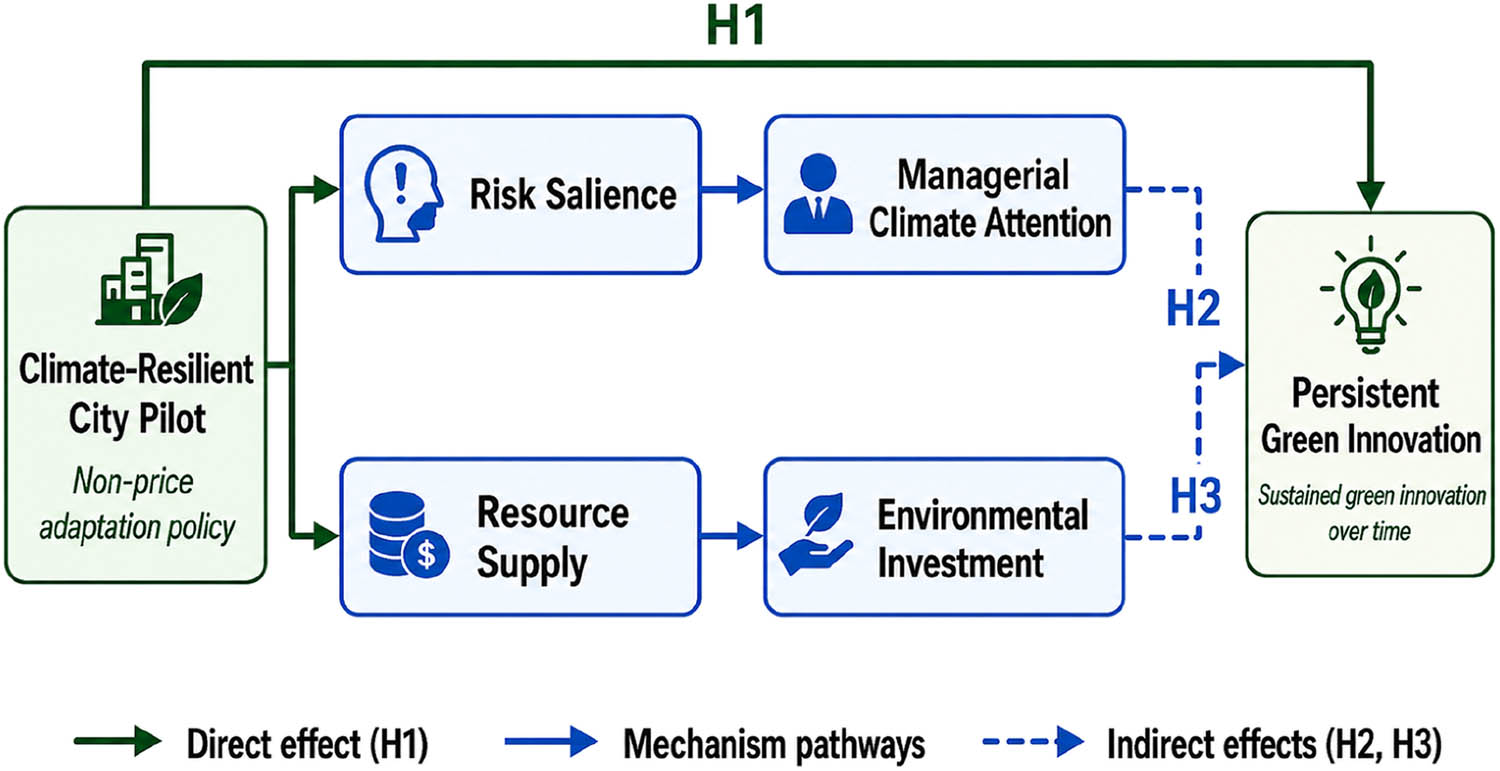
Figure 1
Research framework.
3. Research Design
3.1. Data Sources
Our sample consists of textile-related firms listed on China’s Shanghai and Shenzhen A-share markets from 2013 to 2023. It includes firms in pilot and non-pilot cities and treats the first CRC pilots in 2017 as a common policy shock. Firms located in pilot cities form the treatment group, and firms in other cities form the control group. Following the China Securities Regulatory Commission’s 2012 Guidelines for the Industry Classification of Listed Companies, we include firms that meet our sample criteria in textiles (C17); textile apparel and accessories (C18); leather, fur, feathers, related products, and footwear (C19); chemical raw materials and chemical products manufacturing (C26); and chemical fiber manufacturing (C28). Green patent data come from the China National Intellectual Property Administration, other firm-level data come from the China Stock Market and Accounting Research database, and the list of pilot areas is compiled from official government documents. We exclude special treatment (ST), special treatment with delisting risk warnings (*ST), and particular transfer (PT) observations; observations with a leverage ratio below 0 or above 1; and observations with substantial missing values for key variables. Continuous firm-level variables are winsorized at the 1st and 99th percentiles.
3.2. Model Specification
To estimate the effect of the CRC pilot program on green innovation among textile firms, we specify the following difference-in-differences model:
where subscript i indexes firms and t indexes years. The dependent variable PGI it denotes the level of PGI by firm i in year t. The independent variable CRC it is an indicator for the CRC pilot policy. It equals 1 in the year in which the firm’s host city begins CRC development and in all subsequent years and 0 otherwise. Controls it denotes a set of controls that may affect corporate green innovation, including major financial, governance, corporate, and market characteristics. η i and μ t denote firm and year fixed effects, respectively. They control for confounding factors that do not vary over time or across firms and thereby mitigate omitted-variable bias. ε it is the random error term. Standard errors are clustered by firm. The coefficient of interest, β 1, captures the effect of the CRC pilot policy on PGI among textile firms. We expect it to be significantly positive, indicating that CRC development improves persistent corporate green innovation.
3.3. Variable Description and Descriptive Statistics
3.3.1. Dependent Variable
This study focuses on the persistence of corporate green innovation rather than sporadic green innovation in a single year. Compared with the number of green patent applications in 1 year, PGI better indicates whether a firm has established stable mechanisms for green research and development investment, technological accumulation, and innovation output. We therefore use PGI as the dependent variable. Specifically, drawing on Yan et al. (2026), we construct a continuous index of persistent corporate green innovation from green patent applications across years. We divide the sum of applications in years t and t − 1 by the sum in years t − 1 and t − 2, then multiply this ratio by the sum of applications in years t and t − 1. The resulting measure captures the degree of PGI, as shown in Equation (2).
where denotes PGI for firm i in year t, and GIN it , GIN i, t−1, and GIN i, t−2 denote the numbers of green patent applications filed by firm i in years t, t−1, and t−2, respectively. We divide the index in Equation (2) by 100 before estimation to reduce its numerical scale and improve the readability of the regression results. This rescaling changes the units of measurement while preserving relative magnitudes and statistical inference. The index is assigned a value of zero when its denominator is zero.3.3.2. Independent Variable
The policy treatment variable (CRC it ) indicates whether firm i’s host city belongs to the first group of CRC pilots in year t. China launched the first pilots in 2017. The variable equals 1 for observations in 2017 and later when the firm is located in a pilot city and 0 otherwise.
3.3.3. Control Variables
Following prior research on the determinants of corporate green innovation (Wang et al., 2025b; Lin et al., 2025; Xu et al., 2025), we select firm-level controls that may affect green innovation and capture corporate characteristics, financial conditions, governance structures, and industry competition. The controls include firm size (Size), measured as the natural logarithm of total assets; firm age (FirmAge), which reflects operating history and is measured as the natural logarithm of the appropriately adjusted number of years since establishment; leverage (Lev), measured as total liabilities divided by total assets; profitability (return on assets, ROA), measured as net profit divided by total assets; operating cash flow (CashFlow), which captures internal funding conditions; ownership type, an indicator equal to 1 for state-owned enterprises (SOE) and 0 otherwise; board independence (Indep), measured as the proportion of independent directors on the board; total asset turnover (ATO), which captures asset-use efficiency; and industry concentration (Herfindahl–Hirschman Index, HHI), which controls for the structure of market competition. Together, these variables capture the internal conditions and external environment facing persistent corporate green innovation through resource endowments, financing constraints, operating performance, corporate governance, and market competition.
Table 1 reports descriptive statistics for the variables.
Table 1
Descriptive statistics.
| Variable | Definition | Mean value | SD | Min | Max | N |
|---|---|---|---|---|---|---|
| PGI | Persistent green innovation | 0.0455 | 0.0864 | 0.0000 | 0.8438 | 2,908 |
| CRC | Climate-resilient city policy | 0.0144 | 0.1193 | 0.0000 | 1.0000 | 2,908 |
| Size | Firm size | 22.0761 | 1.0413 | 19.5245 | 26.4403 | 2,908 |
| FirmAge | Firm age | 2.9832 | 0.2879 | 1.6094 | 3.8712 | 2,908 |
| Lev | Leverage | 0.3874 | 0.1832 | 0.0463 | 0.9077 | 2,908 |
| ROA | Profitability | 0.0353 | 0.0670 | −0.5562 | 0.2223 | 2,908 |
| CashFlow | Operating cash flow | 0.0563 | 0.0658 | −0.2015 | 0.2669 | 2,908 |
| SOE | State ownership | 0.2552 | 0.4360 | 0.0000 | 1.0000 | 2,908 |
| Indep | Board independence | 0.3754 | 0.0537 | 0.3333 | 0.6000 | 2,908 |
| ATO | Total asset turnover | 0.6625 | 0.3239 | 0.0496 | 2.6402 | 2,908 |
| HHI | Industry concentration | 0.0498 | 0.0554 | 0.0161 | 0.3717 | 2,908 |
4. Empirical Results Analysis
4.1. Baseline Regression Results
Table 2 reports the baseline regression results for the effect of the CRC pilot program on persistent corporate green innovation. Column (1) includes only firm and year fixed effects. Column (2) additionally controls for corporate characteristics, financial conditions, corporate governance, and industry competition. The estimated coefficient on the independent variable is positive in both columns and statistically significant at the 1% level. These results indicate that CRC development effectively promotes PGI among textile firms, supporting Hypothesis 1.
Table 2
Baseline regression results.
| Variables | (1) | (2) |
|---|---|---|
| PGI | PGI | |
| CRC | 0.149*** | 0.139*** |
| (0.048) | (0.048) | |
| Size | 0.027*** | |
| (0.005) | ||
| FirmAge | −0.088** | |
| (0.041) | ||
| Lev | −0.010 | |
| (0.017) | ||
| ROA | 0.028 | |
| (0.023) | ||
| CashFlow | 0.071*** | |
| (0.021) | ||
| SOE | 0.009 | |
| (0.014) | ||
| Indep | 0.020 | |
| (0.039) | ||
| ATO | 0.006 | |
| (0.009) | ||
| HHI | 0.017 | |
| (0.028) | ||
| Constant | 0.043*** | −0.307* |
| (0.001) | (0.157) | |
| Firm FE | YES | YES |
| Time FE | YES | YES |
| Obs | 2,908 | 2,908 |
| R 2 | 0.563 | 0.578 |
Note: ***, **, and * denote significance at the 1, 5, and 10% levels, respectively. Firm-clustered standard errors are reported in parentheses.
4.2. Robustness Tests
4.2.1. Parallel Trends Test
The difference-in-differences design requires the treatment and control groups to satisfy the parallel-trends assumption. Before CRC development, the trends in corporate green innovation should therefore be parallel across the two groups. We construct model (3) to examine dynamic policy effects over a window spanning 4 years before and 6 years after policy implementation.
where k denotes the kth year relative to the start of CRC development in the firm’s host city. The first list of CRC pilots was announced in 2017, and the sample period is 2013–2023. spans four periods before and six periods after policy implementation. To avoid multicollinearity, the year immediately before CRC development is the omitted baseline period. The coefficient β k captures the effect of CRC development on green innovation among textile firms. Figure 2 presents the dynamic policy effects. None of the estimated coefficients for pre-policy years is statistically significant. A joint test of the pre-policy coefficients yields a p-value of 0.222 and fails to reject the null hypothesis that they are jointly zero. This result indicates no significant difference in trends in PGI between treatment and control firms before policy implementation and supports the parallel-trends assumption. Appendix Table A1 reports the complete estimates. The coefficients for the fourth, third, and second pre-policy periods are 0.025, 0.009, and 0.019, respectively, and none are statistically significant at conventional levels.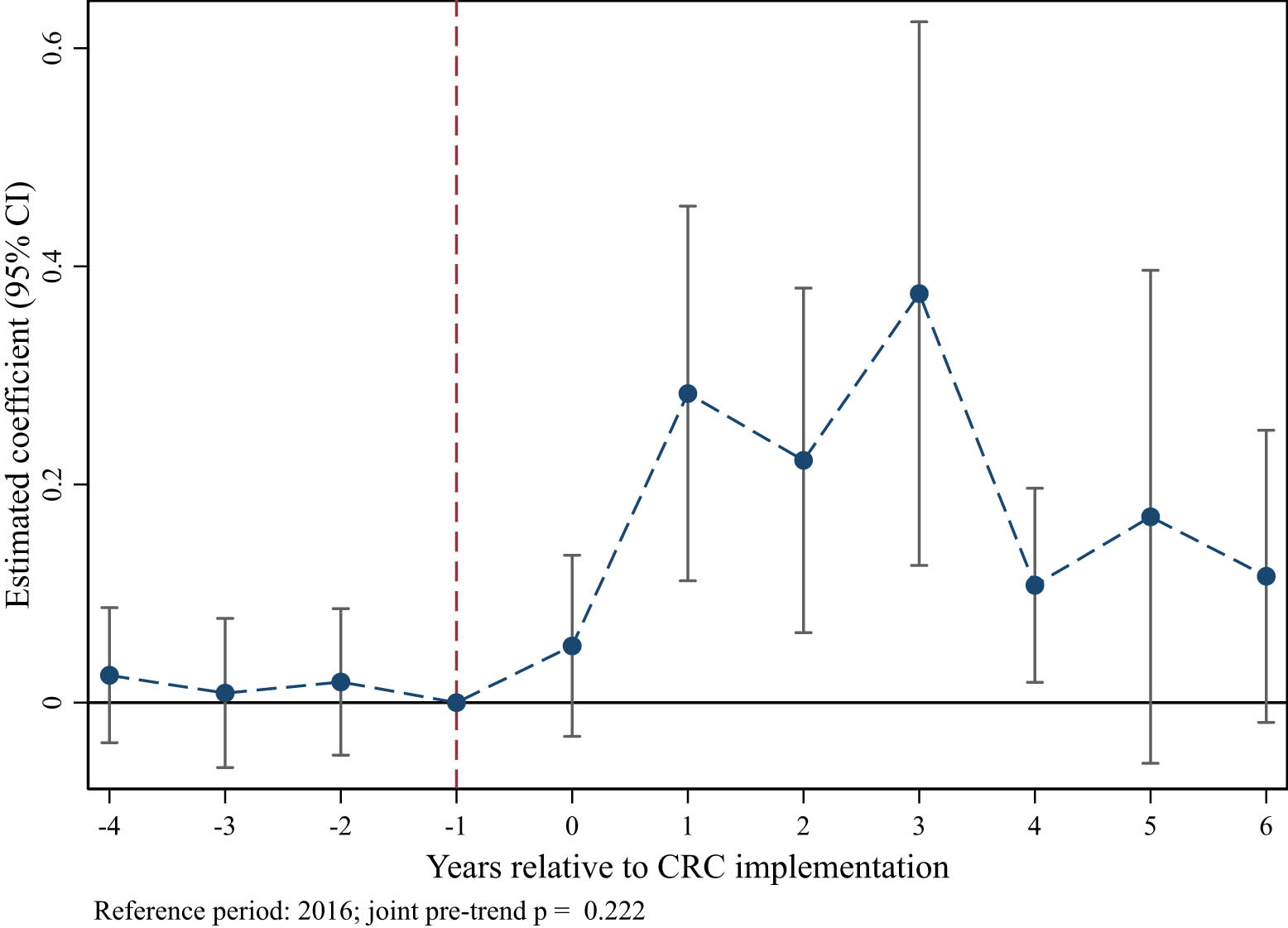
Figure 2
Parallel-trends test results.
4.2.2. Placebo Test
Holding the baseline sample and regression specification constant, we randomly reassign treatment status across cities and repeat the procedure 999 times. Figure 3 shows that the permutation estimates are concentrated around zero and fall well below the actual estimate of 0.139. The actual estimate lies beyond the right tail of the permutation distribution, with an empirical p-value of 0.001. This result suggests that the baseline estimate is unlikely to arise from random policy assignment and provides further support for the positive effect of CRC development on persistent corporate green innovation.
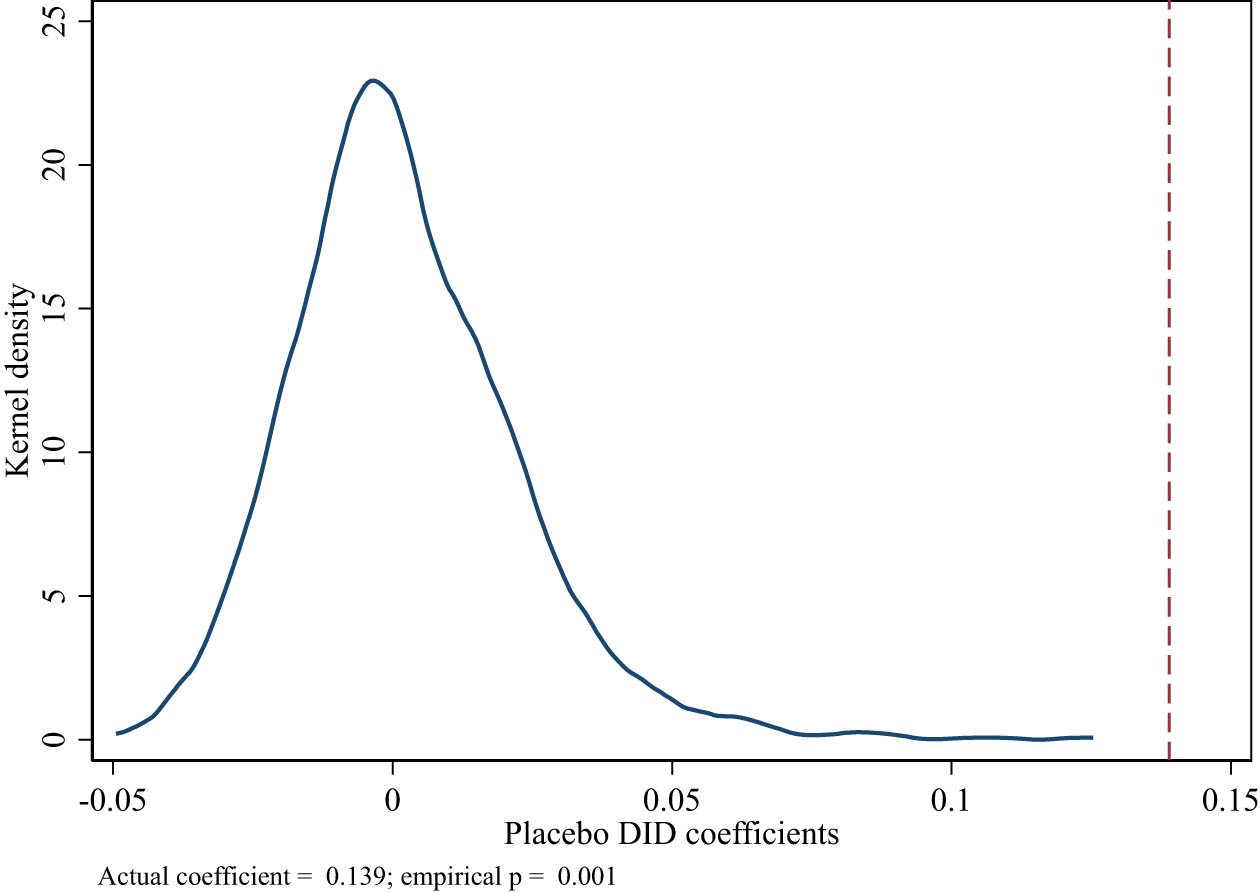
Figure 3
Placebo test.
4.2.3. Other Robustness Tests
Appendix A reports additional results using a different clustering level, one-period lagged controls, a sample excluding municipalities, province-specific linear trends, province-by-year fixed effects, interactions between pre-policy city characteristics and year, and controls for contemporaneous environmental policies. The estimated coefficients are generally positive across these specifications. The estimates with a different clustering level and with both a different clustering level and lagged controls are significant at the 5% level. All other specifications are significant at the 1% level.
5. Mechanism Tests and Heterogeneity Analysis
5.1. Mechanism Tests
The preceding analysis establishes the green innovation effect of CRC development. This section draws on the theoretical analysis to examine the underlying mechanisms through managerial attention to climate issues and environmental investment. Conventional stepwise mediation tests require the mediator to enter the main regression, but mediators are generally endogenous and their estimated coefficients are difficult to interpret causally (Imai et al., 2011). We therefore analyze the effect of the policy shock on each mechanism variable.
5.1.1. Enhancing Management Climate Attention
The Management Discussion and Analysis section of a listed firm’s annual report provides the most direct and verifiable textual trace of managerial attention to climate issues. We collect climate-change keywords from climate-related news reports and science communication materials. Using the text of listed firms’ annual reports, we apply Python to tokenize the reports, extract climate-related keywords, and count their frequency after applying ln(1 + x). The resulting measure serves as a proxy for managerial attention to climate issues (Management Attention to Climate, MgtAtt). The keywords include “climate,” “climate change,” “climate risk,” “rainstorm,” “drought,” and “flood,” capturing direct managerial attention to climate change. A higher frequency indicates greater managerial attention to climate issues, a stronger willingness to participate in climate governance, and stronger endogenous motivation. Changes in this attention can influence long-term green innovation decisions. Column (1) of Table 3 shows that CRC development significantly increases managerial attention to climate change. This finding is consistent with the theoretical prediction that CRC development affects persistent corporate green innovation by strengthening risk perception and managerial climate attention, supporting Hypothesis 2.
Table 3
Mechanism tests.
| Variables | (1) | (2) |
|---|---|---|
| MgtAtt | EnvCap | |
| CRC | 0.262*** | 0.656** |
| (0.094) | (0.293) | |
| Constant | 2.426** | −19.163*** |
| (1.213) | (6.619) | |
| Controls | YES | YES |
| Firm FE | YES | YES |
| Time FE | YES | YES |
| Obs | 2,908 | 2,662 |
| R 2 | 0.873 | 0.576 |
Note: ***, **, and * denote significance at the 1, 5, and 10% levels, respectively. Firm-clustered standard errors are reported in parentheses.
5.1.2. Increasing Corporate Environmental Investment
We measure the scale of corporate environmental investment as the natural logarithm of one plus total environmental investment in the current year. Specifically, we use data reported under construction in progress in listed firms’ annual reports for projects involving desulfurization and acid removal, dust prevention and removal, energy conservation and emissions reduction, renewable energy and resources, technological upgrades to environmental facilities, waste treatment and use, and recycling. These data measure capitalized environmental investment (Environmental Capital Expenditure, EnvCap). Column (2) of Table 3 shows that CRC development significantly increases firms’ environmental capital investment. This finding is consistent with the theoretical predictions of improved resource conditions and the environmental investment channel, supporting Hypothesis 3.
5.2. Heterogeneity Analysis
Firms’ responses to climate governance policy may depend on their external information environment and internal information-processing capabilities. We therefore examine heterogeneous effects of CRC development on PGI across three dimensions of public attention, analyst attention, and digital transformation. For each measure, we split the sample at the median into high and low groups and estimate separate regressions. Figure 4 reports the results.
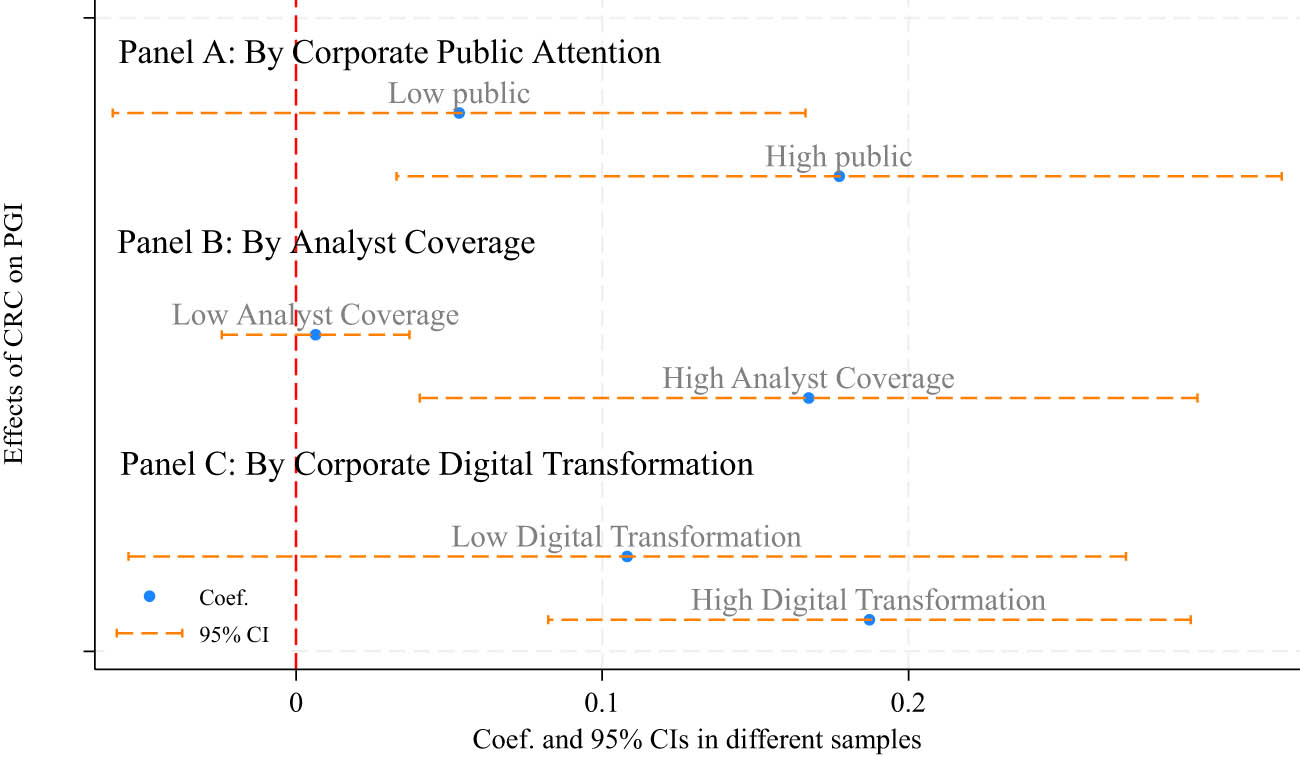
Figure 4
Heterogeneity analysis.
5.2.1. Heterogeneity by Public Attention
Panel A of Figure 4 shows that the estimated coefficient on CRC development is not statistically significant at conventional levels in the low-public-attention group but is significantly positive in the high-public-attention group. The policy point estimate is larger in the group with greater public attention. One possible explanation is that greater public attention makes firms’ environmental behavior more externally visible, allowing the risk and green transformation signals conveyed by climate governance policy to translate more readily into reputational pressure and governance constraints. This strengthens incentives for PGI. Evidence from China links public environmental attention to less corporate greenwashing, with reduced managerial myopia and increased analyst attention identified as potential channels (He et al., 2026). Firms receiving less public attention, by contrast, face more limited external feedback and social monitoring, which may weaken the transmission of policy signals into persistent innovation within the firm.
5.2.2. Heterogeneity by Analyst Attention
Panel B of Figure 4 shows that the estimated policy coefficient is statistically insignificant in the low-analyst-attention group but significantly positive in the high-analyst-attention group. The policy point estimate is larger in the group with greater analyst attention. As information intermediaries in capital markets, analysts can reduce information asymmetry and strengthen external monitoring of firms’ environmental behavior. Consistent with this monitoring role, symbolic environmental responses to external investor pressure have been found to be more pronounced when analyst attention is limited (Hu et al., 2026). Greater analyst attention may therefore help transmit climate governance signals more effectively to firms’ long-term innovation decisions. Firms receiving less analyst attention face weaker information-related constraints from capital markets, which may limit the transmission of external policy signals into PGI decisions.
5.2.3. Heterogeneity by Digital Transformation
Panel C of Figure 4 shows that the estimated coefficient on CRC development is statistically insignificant in the low-digital-transformation group but significantly positive in the high-digital-transformation group. The policy point estimate is larger in the group with more advanced digital transformation. Digital technologies can improve information acquisition, resource allocation, and research and development coordination while strengthening firms’ capacity to identify environmental information and develop green technologies. They thereby reduce the organizational and information costs of PGI. Greater digital capability may consequently improve a firm’s ability to convert external climate governance pressures into PGI.
6. Extended Analysis
The baseline results show that CRC development significantly promotes persistent corporate green innovation. An important question for evaluating the policy’s innovation effects is whether greater persistence primarily reflects an increase in innovation quantity or is also accompanied by improvements in innovation quality. We therefore extend the analysis to examine the effects of CRC development on the quantity and quality of green innovation.
We measure green innovation quantity as the natural logarithm of one plus the total number of green invention and green utility model patent applications. Green innovation quality is measured as the natural logarithm of one plus the sum of annual citations to green invention and green utility model patents. Patent application counts capture the intensity of firms’ green innovation activity, while patent citations provide a partial measure of the technological influence and knowledge value of their innovations. Table 4 reports the estimates. In column (1), the coefficient on CRC development is 0.525 and is positive and statistically significant at the 1% level, indicating that the pilot program significantly increases firms’ green patent application activity. In column (2), however, the coefficient for green innovation quality is only 0.004 and is not statistically significant at conventional levels. The current sample therefore provides insufficient evidence that CRC development significantly improves the citation performance of green patents.
Table 4
Extended analysis.
| Variables | (1) | (2) |
|---|---|---|
| Green innovation quantity | Green innovation quality | |
| GIQ | GIQL | |
| CRC | 0.525*** | 0.004 |
| (0.197) | (0.177) | |
| Constant | −2.894** | −2.132* |
| (1.431) | (1.208) | |
| Controls | YES | YES |
| Firm FE | YES | YES |
| Time FE | YES | YES |
| Obs | 2,908 | 2,907 |
| R 2 | 0.627 | 0.685 |
Note: ***, **, and * denote significance at the 1, 5, and 10% levels, respectively. Firm-clustered standard errors are reported in parentheses.
Overall, the positive effect of CRC development on corporate green innovation currently takes the form of increased innovation quantity, with no statistically significant improvement in quality as measured by patent citations. This finding suggests that adaptation-oriented climate governance encourages firms to undertake more green innovation, whereas improvements in innovation quality may require a longer period of technological accumulation, knowledge diffusion, and market validation. Patent citations, in particular, accrue with a lag, so the subsequent technological influence of more recent green patents may not yet be fully observable.
7. Conclusion
Using China’s CRC pilot program as a quasi-natural experiment and data on textile-related firms listed on the Shanghai and Shenzhen A-share markets from 2013 to 2023, this study applies a difference-in-differences model to examine the effect of adaptation-oriented climate governance on persistent corporate green innovation. The results show that CRC development significantly increases PGI, a finding supported by parallel-trends and placebo tests and a series of robustness checks. Mechanism analysis shows that policy implementation significantly increases managerial attention to climate issues and corporate environmental investment, consistent with the theoretical predictions of two non-price channels based on heightened risk perception and improved resource investment. Subsample regressions yield positive and statistically significant policy coefficients for the groups with greater public attention, greater analyst attention, and more advanced digital transformation. These patterns suggest that a better external information environment and stronger internal information-processing capabilities may help firms recognize and absorb climate governance policy signals and translate them into PGI. Extended analysis shows that CRC development significantly increases the quantity of green innovation but has no statistically significant effect on its quality as measured by green patent citations. The innovation incentives generated by adaptation-oriented climate governance thus primarily reflect an expansion of green innovation activity at this stage, whereas translating greater innovation quantity into technological influence and higher innovation quality may require a longer period of knowledge accumulation and market validation.
7.1. Theoretical Contributions
This study makes the following theoretical contributions.
First, it extends the boundaries of research on how climate policy affects corporate green innovation. Existing studies focus primarily on mitigation instruments such as carbon taxes, emissions trading, and emissions standards (Porter & van der Linde, 1995; Calel & Dechezleprêtre, 2016; Aghion et al., 2016). This study instead examines CRC development and evaluates how a non-price climate policy characterized by risk identification, information sharing, and adaptive capacity building affects corporate green innovation. It thereby provides firm-level evidence on the mitigation co-benefits of adaptation policy.
Second, this study reveals the mechanisms through which adaptation-oriented climate policy affects corporate green innovation from a non-price transmission perspective. Unlike mitigation policies that alter corporate decisions mainly through price signals such as energy prices and emissions costs, we develop an analytical framework based on corporate climate perception and resource investment. Drawing on the attention-based view and resource dependence theory, we examine how the policy affects persistent corporate green innovation by increasing managerial attention to climate issues and environmental capital investment. The findings provide micro-level evidence on the transmission of non-price climate governance into firms’ long-term innovation decisions.
Third, this study identifies firm-level boundary conditions for the innovation effects of adaptation-oriented climate governance. Subsample regressions yield positive and statistically significant policy coefficients for the groups with greater public attention, greater analyst attention, and more advanced digital transformation. Firms’ external information environment and their capacity to recognize and process information may therefore influence the transmission of climate governance policy signals into PGI. These findings enrich our understanding of heterogeneous firm-level responses to climate policy.
Fourth, this study extends research on corporate green innovation from single-period output to persistence across periods and the relationship between innovation quantity and quality. Using a continuous index constructed from firms’ green patent output across years, we examine whether climate governance moves firms from episodic innovation responses toward persistent green technological accumulation. Further analysis shows that CRC development significantly increases the quantity of green innovation but has no statistically significant effect on its quality as measured by patent citations. These findings broaden the study of green innovation persistence and reveal potentially different effects of adaptation-oriented climate governance on innovation quantity and quality.
7.2. Practical Implications
Based on these findings, this study offers the following implications for firms, policymakers, and the textile industry.
First, the transmission of climate governance into firms’ internal decision making should be strengthened. Textile firms should incorporate climate risks into supply-chain, production, and research and development decisions, with particular attention to raw material supplies, water use in dyeing and finishing, and energy use. Local governments can improve climate risk monitoring, early warning, and information disclosure mechanisms and guide firms in converting external climate pressures into green research and development and environmental investment, thereby establishing persistent green technological accumulation.
Second, policymakers should strengthen the role of the external information environment in amplifying climate governance policy effects. The positive and statistically significant policy estimates for firms with greater public and analyst attention are consistent with the view that a stronger external information environment may improve the transmission of policy signals into corporate green innovation decisions. Corporate environmental and climate disclosure mechanisms should therefore be improved to make climate governance information more transparent and accessible. Public monitoring, media communication, and capital-market information intermediaries can also help firms recognize and respond to climate risks and the demands of green transformation.
Third, digital and green transformation should be advanced in a coordinated manner. The estimated policy coefficient is positive and statistically significant in the group with more advanced digital transformation. Policymakers should therefore accelerate energy and emissions monitoring, the traceability of environmental information in supply chains, and the digital management of research and development processes. These measures can harness digital technologies for information identification, resource allocation, and research and development coordination and help firms convert short-term policy responses into PGI capabilities.
7.3. Research Limitations and Future Directions
This study has several limitations that also suggest directions for future research.
First, the sample consists primarily of textile firms listed on the Shanghai and Shenzhen A-share markets. These firms are generally larger and have stronger financing capabilities and governance than unlisted firms, so caution is warranted when generalizing the findings to small and medium-sized enterprises. Green patent measures also cannot fully capture incremental green technological progress involving process optimization, energy-saving upgrades, and trade secrets. Future research could incorporate data on energy consumption, emissions, and revenue from green products to broaden the measurement of green innovation.
Second, the CRC pilot program covers a relatively limited set of locations, and the number of treated firms is substantially smaller than the number of control firms. This imbalance limits the statistical precision of the heterogeneity analysis and some extended tests. Future research could use subsequent expansions of the pilot program and longer panels to examine the persistence of policy effects and heterogeneous responses across different types of firms.
Third, pilot cities were not selected entirely at random. Although parallel-trends, placebo, pilot-selection, and pre-policy city-characteristic tests mitigate potential selection bias, we cannot completely exclude the effects of unobserved time-varying factors. Future research could strengthen causal inference by exploiting additional policy cohorts, longer panels, or stronger identification designs.
Fourth, the mechanism variables are proxies based mainly on annual-report text and environmental investment and cannot fully capture managerial perceptions and internal resource-allocation processes. Future research could combine firm surveys, managerial interviews, and more rigorous mediation identification methods to examine more deeply how climate governance affects PGI.
Author contributions
Hong Yu: Data curation, Software, Writing – original draft, Writing – review & editing. Han Yan: Conceptualization, Writing – original draft, Writing – review & editing. Both authors contributed to manuscript revisions.
Funding information
This study was supported by the projects of Shandong Provincial Natural Science Foundation (Grant No. ZR2023QG142).
Conflict of interest statement
The authors declare no competing interests, financial or otherwise, that could have influenced the work presented in this manuscript.
Ethics approval
This article does not contain any studies with human participants or animals performed by any of the authors. All data used in this study were obtained from publicly available sources.
Informed consent
Not applicable. This research did not involve human participants requiring informed consent.
Use of AI tools
The authors acknowledge the use of Claude 4.5-Sonnet (Anthropic) to refine the language and improve the clarity of this manuscript. The AI tool was used solely for proofreading and language editing purposes using the prompt: “Please proofread and edit the following text to improve clarity and academic tone.” All intellectual content, research design, analysis, and conclusions are entirely the work of the authors.
Data availability statement
The data that support the findings of this study are available on request from the corresponding author, subject to privacy, legal, and ethical restrictions.
Appendices
Appendix A
A.1 Event-Study Coefficients
Table A1
Event-study coefficients.
| Variables | PGI |
|---|---|
| pre_4 | 0.025 |
| (0.032) | |
| pre_3 | 0.009 |
| (0.035) | |
| pre_2 | 0.019 |
| (0.034) | |
| current | 0.052 |
| (0.042) | |
| post_1 | 0.283*** |
| (0.088) | |
| post_2 | 0.222*** |
| (0.081) | |
| post_3 | 0.375*** |
| (0.127) | |
| post_4 | 0.108** |
| (0.045) | |
| post_5 | 0.170 |
| (0.115) | |
| post_6 | 0.116* |
| (0.068) | |
| Controls | YES |
| Firm FE | YES |
| Time FE | YES |
| Obs | 2,908 |
| R 2 | 0.593 |
Note: ***, **, and * denote significance at the 1, 5, and 10% levels, respectively. Firm-clustered standard errors are reported in parentheses. The omitted reference period is 2016 (k = −1), and the joint test of the pre-policy coefficients yields p = 0.222.
A.2 Clustering Level and Lagged Controls
To assess whether the baseline results depend on the clustering level of standard errors or the timing of the controls, we conducted several additional robustness tests. First, after clustering standard errors by city, the estimated coefficient on the CRC pilot program in column (1) of Appendix Table A2 remains positive and statistically significant at the 5% level. The baseline finding therefore does not depend on firm-level clustering. Second, we lag the controls by one period to reduce contemporaneous correlations between firms’ operating characteristics and green innovation decisions. The coefficient in column (2) is statistically significant at the 1% level. Finally, when lagged controls are combined with city-clustered standard errors, the coefficient in column (3) remains statistically significant at the 5% level. The positive effect on persistent corporate green innovation thus remains stable after changing the timing of the controls and the clustering level, supporting the robustness of the baseline finding.
Table A2
Robustness tests I.
| Variables | (1) | (2) | (3) |
|---|---|---|---|
| City-clustered standard errors | One-period lagged controls | City clustering and lagged controls | |
| PGI | PGI | PGI | |
| CRC | 0.139** | 0.133*** | 0.133** |
| (0.057) | (0.047) | (0.056) | |
| Constant | −0.307* | −0.333** | −0.333* |
| (0.174) | (0.151) | (0.170) | |
| Controls | YES | YES | YES |
| Firm FE | YES | YES | YES |
| Time FE | YES | YES | YES |
| Obs | 2,908 | 2,908 | 2,908 |
| R 2 | 0.578 | 0.575 | 0.575 |
Note: ***, **, and * denote significance at the 1, 5, and 10% levels, respectively. City-clustered standard errors are reported in parentheses in columns (1) and (3), and firm-clustered standard errors are reported in column (2).
A.3 Municipalities, Province-Level Trends, Province-by-Year Fixed Effects, and Pre-Policy City Characteristics
To exclude the influence of regional administrative levels and unobserved province-level factors on the baseline findings, we adjust the sample and fixed-effects specifications. Municipalities have distinctive administrative systems, resource allocation, and policy implementation capabilities. We therefore re-estimate the model after excluding Beijing, Shanghai, Tianjin, and Chongqing. Column (1) of Table A3 shows that the estimated coefficient on the CRC pilot program remains positive and statistically significant at the 1% level, indicating that municipalities do not drive the baseline result.
Table A3
Robustness tests II.
| Variables | (1) | (2) | (3) | (4) |
|---|---|---|---|---|
| Excluding municipalities | Province-specific linear trends | Province-by-year fixed effects | Pre-policy city characteristics by year | |
| PGI | PGI | PGI | PGI | |
| CRC | 0.186*** | 0.194*** | 0.225*** | 0.159*** |
| (0.059) | (0.045) | (0.045) | (0.046) | |
| Constant | −0.349** | −0.305* | −0.316** | 0.141 |
| (0.176) | (0.156) | (0.155) | (0.747) | |
| Controls | YES | YES | YES | YES |
| Baseline × Year | — | — | — | YES |
| Firm FE | YES | YES | YES | YES |
| Time FE | YES | YES | YES | YES |
| Obs | 2,620 | 2,908 | 2,846 | 2,847 |
| R 2 | 0.571 | 0.597 | 0.644 | 0.597 |
Note: ***, **, and * denote significance at the 1, 5, and 10% levels, respectively. Firm-clustered standard errors are reported in parentheses. The Baseline × Year variables in column (4) include the number of green patents (GPat × Year), number of extreme high-temperature days (ExtHot × Year), number of extreme low-temperature days (ExtCold × Year), precipitation (Precip × Year), GDP per capita (PGDP × Year), and the share of secondary industry (SecShare × Year).
Note: Year denotes the set of year indicators, and the terms represent interactions with the corresponding pre-policy city characteristics.
Second, to control for province-specific long-term development trends, column (2) of Table A3 adds province-specific linear time trends to the baseline model. The estimated coefficient on the CRC pilot program remains positive and statistically significant at the 1% level, indicating that the program continues to promote persistent corporate green innovation after accounting for heterogeneous provincial development trends. Column (3) further includes province-by-year fixed effects to absorb common economic conditions, industrial policies, and other province-level time-varying shocks in each year. The estimated coefficient remains statistically significant at the 1% level. Overall, the core policy estimate remains significantly positive after excluding jurisdictions with special administrative status and progressively strengthening controls for province-level time-varying factors, further supporting the robustness of the baseline result.
To mitigate potential bias arising from nonrandom pilot-city selection, we further examine the relationship between pre-policy city characteristics and pilot selection and control for their potentially differential time trends. We first estimate a probit model in which the dependent variable indicates whether a city entered the CRC pilot program. The explanatory variables include the pre-policy number of green patents (GPat), number of extreme high-temperature days (ExtHot), number of extreme low-temperature days (ExtCold), precipitation (Precip), GDP per capita (PGDP), and the share of secondary industry (SecShare). Table A4 shows that none of the estimated coefficients on these pre-policy city characteristics is statistically significant at conventional levels. We therefore find no evidence that these observable city characteristics systematically explain pilot selection.
Table A4
Determinants of pilot selection.
| Variables | CRC |
|---|---|
| GPat | 0.131 |
| (0.091) | |
| ExtHot | 0.103 |
| (0.083) | |
| ExtCold | −0.054 |
| (0.033) | |
| Precip | −0.027 |
| (0.028) | |
| PGDP | −0.130 |
| (0.261) | |
| SecShare | −0.004 |
| (0.014) | |
| Constant | −2.359 |
| (3.711) | |
| Obs | 285 |
Note: ***, **, and * denote significance at the 1, 5, and 10% levels, respectively. Robust standard errors are reported in parentheses.
Column (4) of Table A3 further adds interactions between each pre-policy city characteristic and year indicators, labeled Baseline × Year, to the baseline model. These terms control for differential development trends associated with different initial city characteristics. The estimated coefficient on the CRC pilot program remains positive and statistically significant at the 1% level. The policy continues to promote persistent corporate green innovation even when cities with different pre-policy green innovation foundations, climate conditions, levels of economic development, and industrial structures are allowed to follow different time paths. The baseline result is therefore not driven primarily by the preexisting characteristics of pilot cities or their subsequent differential trends.
A.4 Contemporaneous Environmental Policies
Other environmental policies may have affected pilot areas during the sample period, so we control for three related policies. The reform establishing vertically managed monitoring, supervision, and law enforcement by environmental protection agencies below the provincial level, referred to as the environmental vertical reform (EVR), began with pilots in Hebei and other locations in 2016 and achieved national coverage in 2020. By adjusting local environmental management systems and standardizing and strengthening local environmental agencies and personnel (Tang & Liu, 2025), the reform imposed more stringent environmental governance requirements on local governments and firms. The low-carbon city pilot program was introduced in three cohorts in 2010, 2012, and 2017. It covered cities with different locations, stages of development, and resource endowments and helped activate regional endowments and comparative advantages while coordinating the green transformation of energy structures, industrial systems, and environmental governance (Wu et al., 2025). Green finance reform and innovation pilot zones were first established in eight areas across five provinces in 2017. They introduced reforms at the government, financial-institution, and firm levels that specifically targeted green technological innovation (Wang et al., 2025a). Each of these policies may independently affect corporate green innovation. Without controls, their effects could be incorrectly attributed to the CRC pilot program. We therefore construct indicators for whether a province, autonomous region, or municipality participates in the EVR, whether a prefecture-level city belongs to the low-carbon city pilot program (low-carbon pilot, ), and whether a prefecture-level city belongs to a green finance reform and innovation pilot zone (green finance zone, ). We add these policy indicators to the baseline model. Columns (1) – (3) of Table A5 report results that control for each policy separately, while column (4) includes all three policies simultaneously. The estimated coefficient on CRC development remains significantly positive in all four specifications. The policy effect identified in this study is therefore not driven by contemporaneous environmental policies, supporting the robustness of the baseline findings.
Table A5
Controlling for contemporaneous environmental policies.
| Variables | (1) | (2) | (3) | (4) |
|---|---|---|---|---|
| Controlling for environmental vertical reform | Controlling for the low-carbon city pilot program | Controlling for green finance pilot zones | Controlling for all three policies | |
| PGI | PGI | PGI | PGI | |
| CRC | 0.139*** | 0.138*** | 0.155*** | 0.153*** |
| (0.048) | (0.045) | (0.052) | (0.049) | |
| EVR | −0.004 | −0.004 | ||
| (0.007) | (0.007) | |||
| LCP | 0.022* | 0.022* | ||
| (0.011) | (0.012) | |||
| GFZ | −0.004 | −0.005 | ||
| (0.013) | (0.012) | |||
| Constant | −0.304* | −0.353** | −0.277* | −0.289* |
| (0.156) | (0.157) | (0.161) | (0.161) | |
| Controls | YES | YES | YES | YES |
| Firm FE | YES | YES | YES | YES |
| Time FE | YES | YES | YES | YES |
| Obs | 2,908 | 2,857 | 2,808 | 2,808 |
| R 2 | 0.578 | 0.577 | 0.578 | 0.580 |
Note: ***, **, and * denote significance at the 1, 5, and 10% levels, respectively. Firm-clustered standard errors are reported in parentheses.