
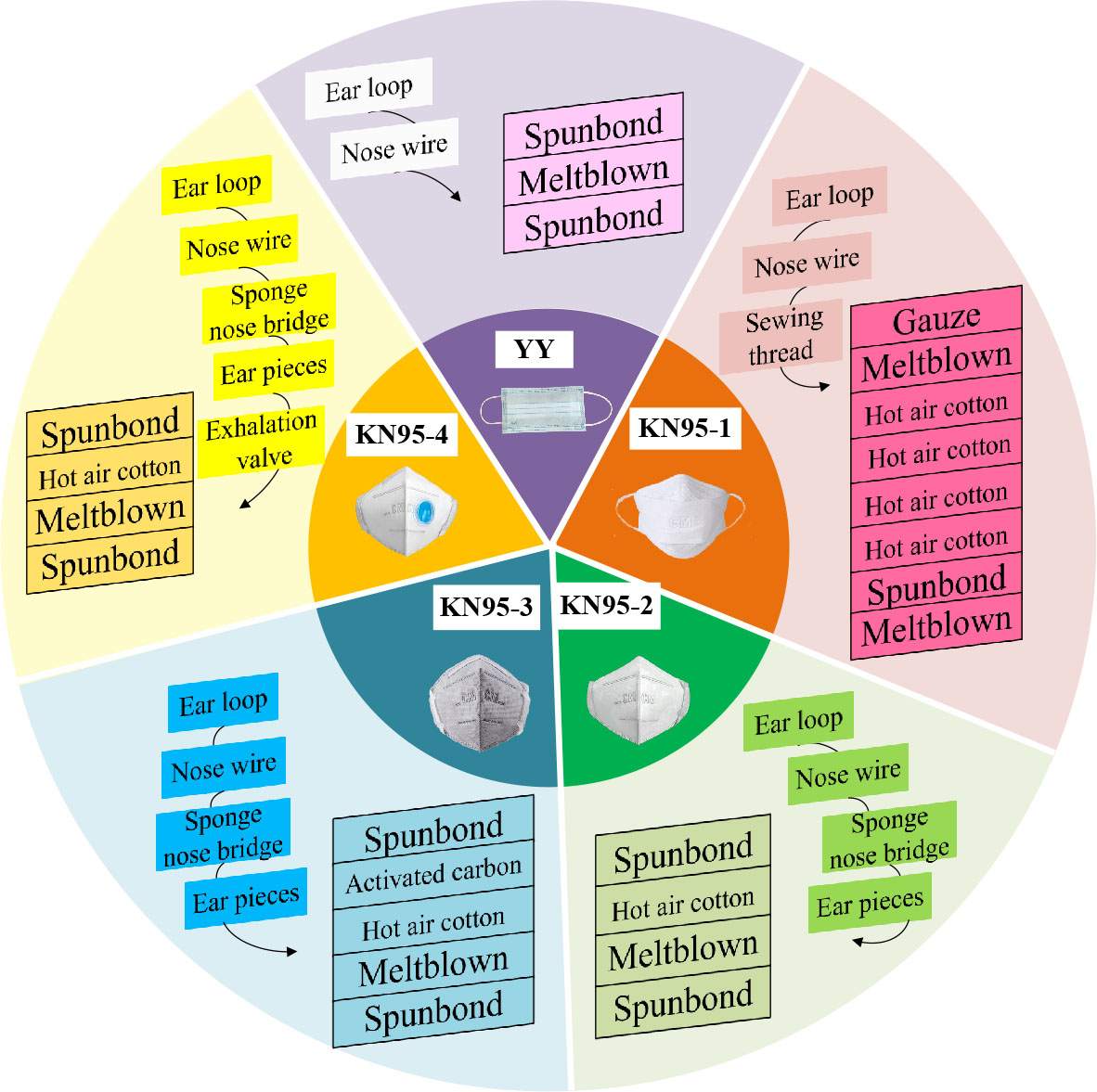
Fig. 1.
Types and composition of masks
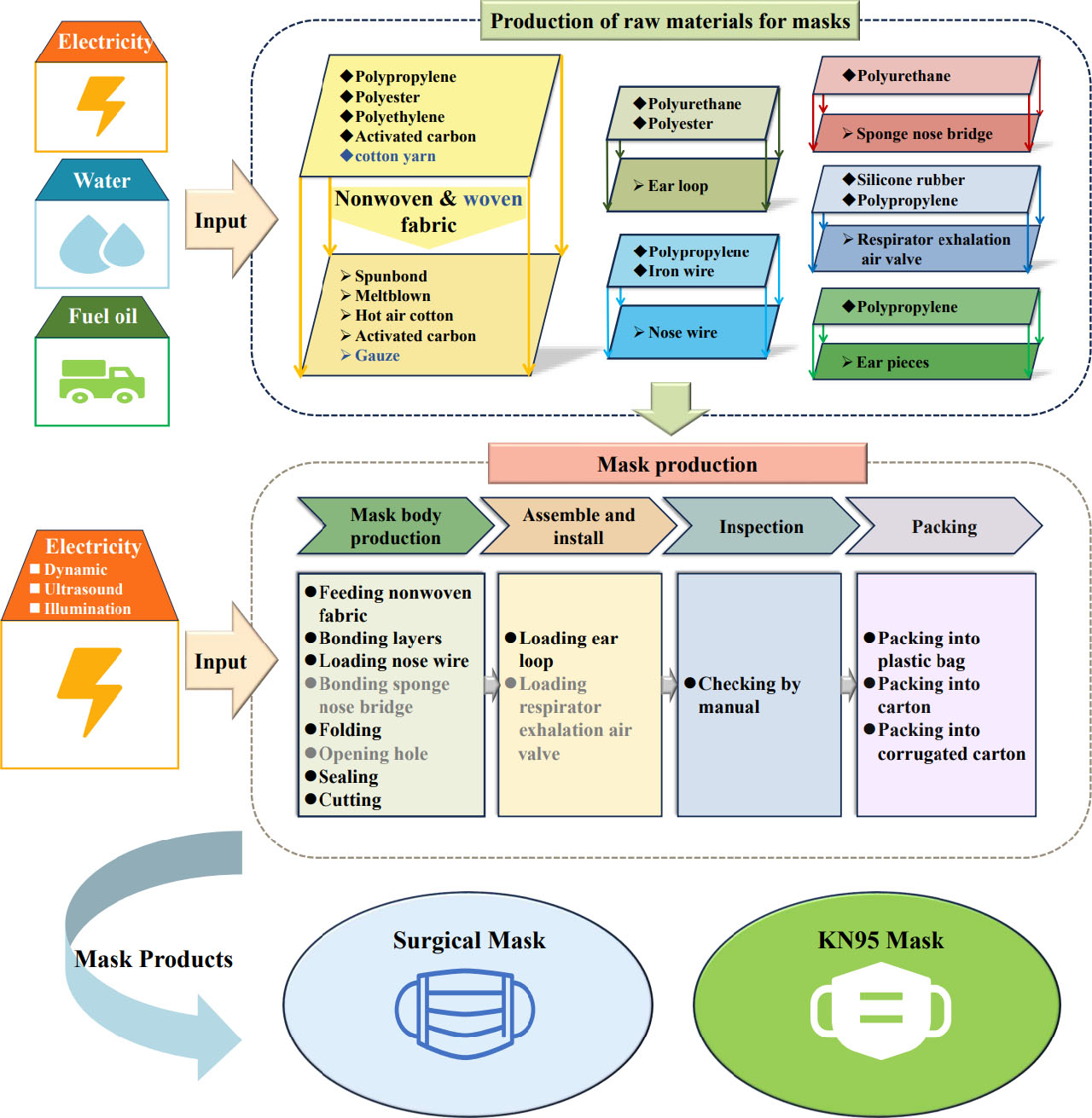
Fig. 2.
System boundary of the study
Table 1.
Source for GHG emissions factors
| Category | GHG emission source | Source |
|---|---|---|
| Material | Polypropylene | CNTAC-LCAPlus |
| Electret masterbatch | Luo et al. [22] | |
| Polyurethane/Polyester blends ear loop | Shao et al. [23] | |
| Iron wire | Yang [24] | |
| Polyester | CNTAC-LCAPlus | |
| Polyethylene | CNTAC-LCAPlus | |
| Cotton yarn | CNTAC-LCAPlus | |
| Activated carbon | Vilén [25] | |
| Polyurethane | CNTAC-LCAPlus | |
| Silicone rubber | Xin et al. [26] | |
| Polypropylene film | CNTAC-LCAPlus | |
| Polyethylene film | CNTAC-LCAPlus | |
| Corrugating medium | Zhao et al. [27] | |
| Energy | Diesel | CNTAC-LCAPlus |
| Electricity | China Regional Power Grids Carbon Dioxide Emission Factors |
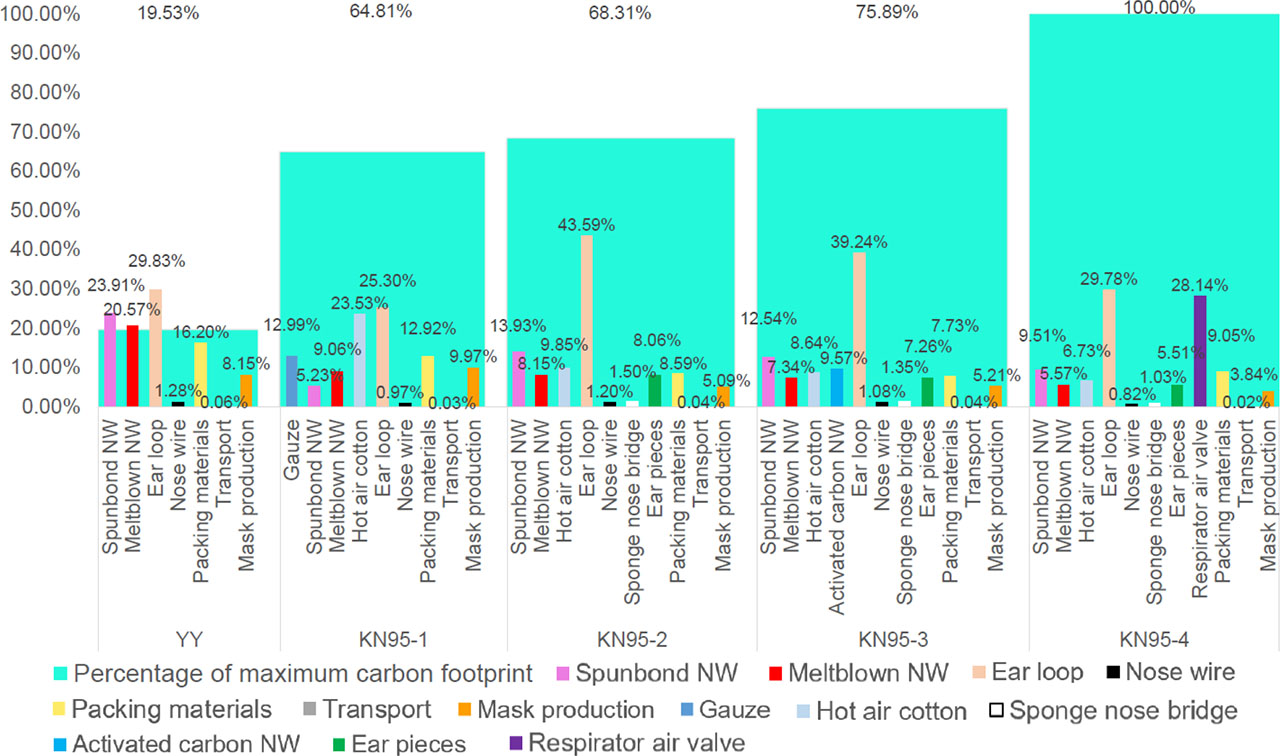
Fig. 3.
Carbon footprint percentages for different raw materials/process units in the life cycle of masks and comparison of the carbon footprint of five mask types
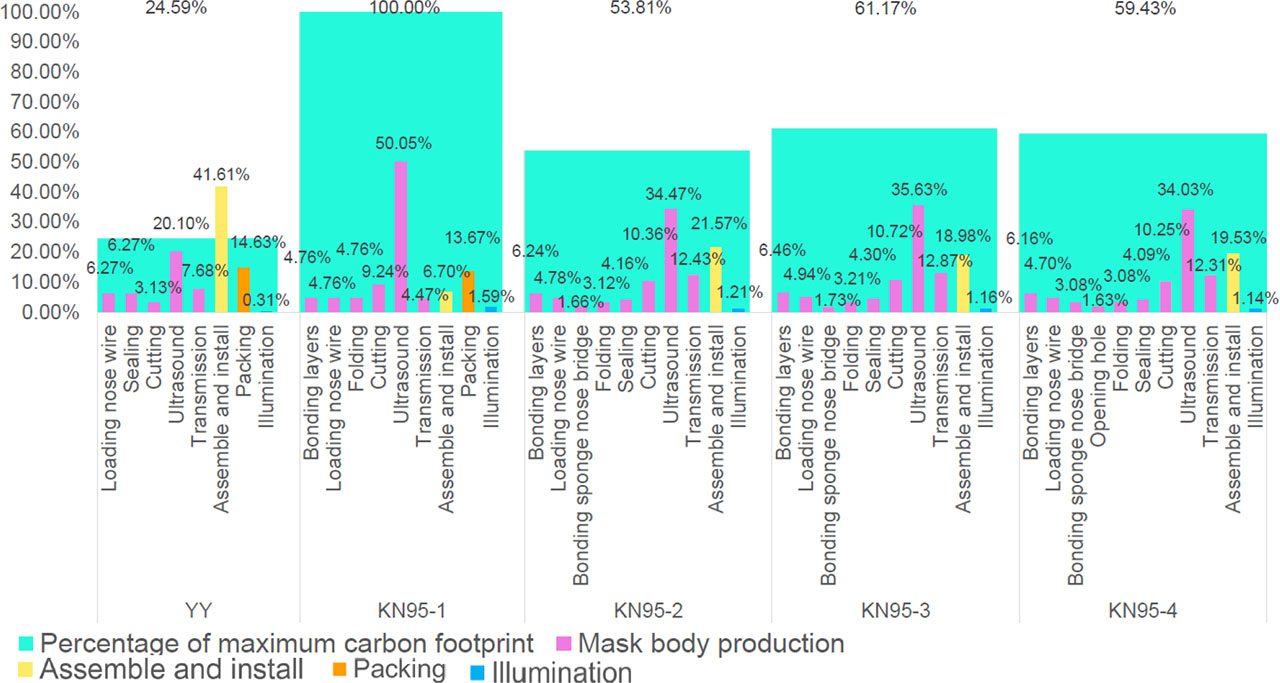
Fig. 4.
Carbon footprint percentages and comparison of the production stages of five masks
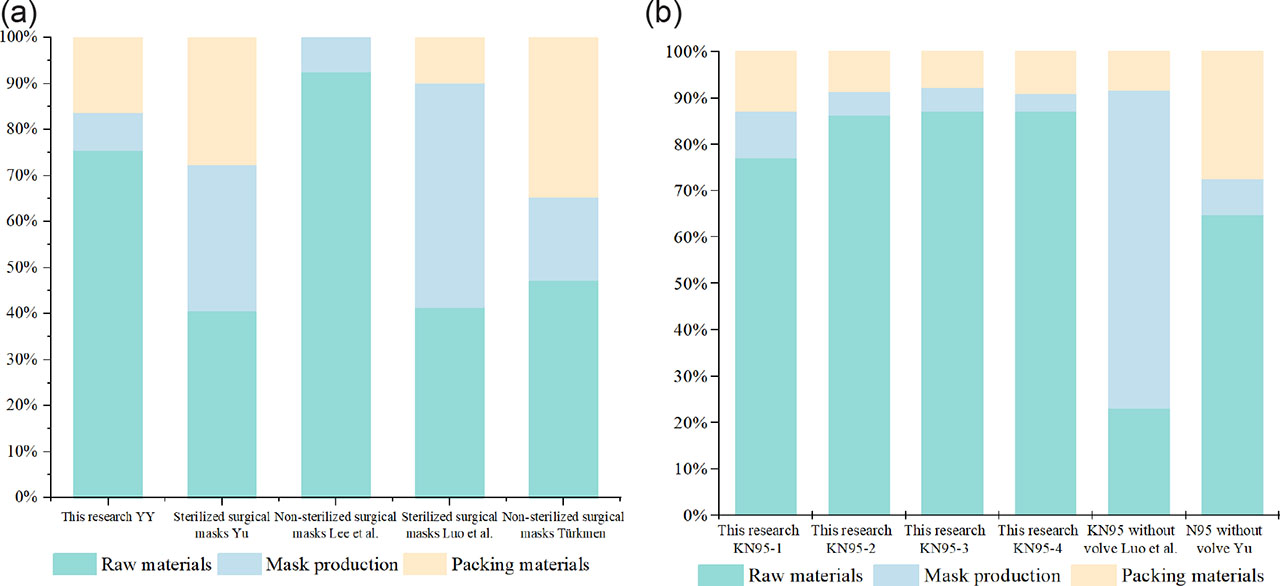
Fig. 5.
(a) Carbon footprint percentages for surgical masks from raw material acquisition to mask production. (b) Carbon footprint percentages for particle respirators from raw material acquisition to mask production
Table 2.
Basic information of particulate protective masks
| Country | Standard number | Standard name | Mask type |
|---|---|---|---|
| China | GB 2626-2019 | Respiratory protection - Non-powered air-purifying particle respirator | KN95 |
| USA | 42 CFR Part 84 | NIOSH guide to the selection and use of particulate respirators | N95 |
| Europe | EN 149: 2001 + A1: 2009 | Respiratory protective devices - Filtering half masks to protect against particles - Requirements, testing, marking | FFP2 |