
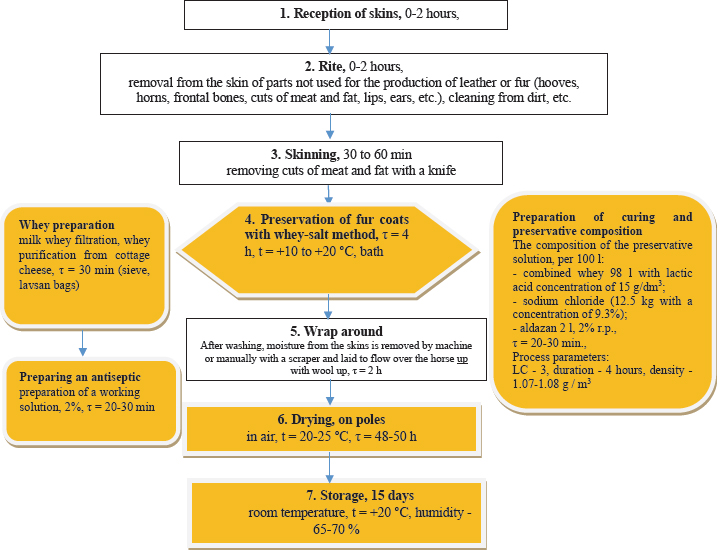
Fig. 1.
Technological scheme for the processing of sheepskin-fur coat raw materials by the whey-salt method
Table 1.
Dynamics of the temperature of the leather tissue shrinkability during storage for 15 days after salting in the experimental curing mixture and in the control curing liquid
| Indicators | Shrinkage temperature of leather tissue by days of storage in experimental batches and control | |||
|---|---|---|---|---|
| 5 days | 7 days | 10 days | 15 days | |
| Experimental variant 1 - (20 %) (n=8) | ||||
| M | 67,13 | 67,75 | 64,75 | 67,88 |
| ±δ | 0,22 | 0,38 | 0,38 | 0,22 |
| CV (%) | 0,33 | 0,56 | 0,59 | 0,32 |
| Experimental variant 2 - (30 %) (n=8) | ||||
| M | 67,25 | 67,88 | 67,13 | 64,13 |
| ±δ | 0,38 | 0,22 | 0,22 | 0,22 |
| CV (%) | 0,57 | 0,32 | 0,33 | 0,34 |
| Experimental variant 3 - (40 %) (n=8) | ||||
| M | 67,5 | 68,13 | 67,63 | 68,88 |
| ±δ | 0,5 | 0,22 | 0,47 | 0,22 |
| CV (%) | 0,74 | 0,32 | 0,69 | 0,32 |
| Experimental variant 4 - (50 %) (n=8) | ||||
| M | 66,88 | 63,63 | 68,5 | 66,63 |
| ±δ | 0,22 | 0,47 | 0,5 | 0,47 |
| CV (%) | 0,33 | 0,74 | 0,73 | 0,71 |
| Control (n=8) | ||||
| M | 67,13 | 62,63 | 62,88 | 62,13 |
| ±δ | 0,22 | 0,47 | 0,22 | 0,22 |
Table 2.
Organoleptic and physico-chemical parameters of combined whey
| Name of indicator | Combination serum options | Normative documentation on research methods | |||
|---|---|---|---|---|---|
| 1 | 2 | 3 | 4 | ||
| Appearance and texture | Homogeneous translucent liquid with the presence of a protein precipitate | The determination of organoleptic indicators is carried out visually and organoleptically at a whey temperature of (22 ±2) °C according to GOST 343522017 “Whey - raw materials. Specifications» | |||
| Color | Pale green | ||||
| Taste and smell | Characteristic of whey, sour | ||||
| Mass fraction of fat, % | 0,4 | 0,2 | 0,2 | 0,3 | GOST 5867-90 “Milk and dairy products. Methods for determining fat « |
| Mass fraction of solids, % | 5,1 | 5,7 | 5,4 | 5,9 | GOST 33957-2016 “Whey and drinks based on it. Acceptance rules, sampling and control methods» |
| Density, kg/m3 | 1025 | 1024 | 1026 | 1028 | |
| Titratable acidity, °T | 88 | 90 | 87 | 91 | |
| Active acidity, pH | 3,96 | 3,85 | 3,98 | 3,98 | |
| Temperature, °C | 6±2 | 6±2 | 6±2 | 6±2 | |
Table 3.
Microbiological parameters of combined whey
| Name of indicator | Norm according to normative documentation | Actual performance | Normative documentation on research methods |
|---|---|---|---|
| Quantity of mesophilic aerobic and facultative anaerobic microorganisms (QMAFAnM), CFU/g | no more than 1×10⁵ | 3,9×10⁴ - 6,5×10⁴ | GOST 34352-2017. Whey - raw material. Specifications |
| Bacteria of the Escherichia coli group (Coliform bacteria) in 0.1 g | not allowed | not detected | |
| Pathogenic, including salmonella in 25 g | not allowed | not detected | |
| S. aureus in 0.1 g | not allowed | not detected | |
| Yeast, CFU/g | not allowed | not detected | |
| Molds, CFU/g | not allowed | not detected |
Table 4.
Chemical, organoleptic, and microbiological parameters of sheepskins treated with NaCl
| Name of indicator | Sheepskin processing options | Normative documentation on research methods | |||
|---|---|---|---|---|---|
| 1 | 2 | 3 | 4 | ||
| Organoleptic indicators | |||||
| Appearance | The hairline of the skin is slightly damp. The skin is soft, not elastic | The hairline of the skin is dry. There is some moisture at the junction of the skin and hair. The skin is elastic | The hairline of the skin is dry. The skin is elastic | The hairline of the skin is dry. There are places with a small touch of salt. The skin is elastic | GOST 28509-90. Leather raw material. Sheepskins are undressed. Specifications |
| Mezdra (a layer of subcutaneous fatty tissue, meat, fat, and pieces of tendons that are removed from the skin in the process of preparatory operations) color | Mezdra gray shade | Mezdra light milky color | Mezdra light milky color | Mezdra with a milky yellow tint | |
| Chemical indicators | |||||
| NaCl concentration, g/l | 70 (20% of saturated solution) | 100 (30% of saturated solution) | 125 (40% of saturated solution) | 150 (50% of saturated solution) | GOST 13105-77 Leather raw materials. Methods for determining the components of preserving |
| Moisture, % | 17,8 | 16,2 | 15,5 | 15,1 | GOST 13104-77. Leather raw material. Methods for determining salt and net weight |
| NaCl, % | 6,7 | 10,6 | 11,7 | 12,8 | GOST 13105-77 Leather raw materials. Methods for determining the components of preserving |
| pH | 5,4 | 5,1 | 4,9 | 4,7 | GOST 32165-2013. Dressed fur and sheepskin skins. Method for determining the pH of an aqueous extract |
| microbiological indicators | |||||
| QMAFAnM, CFU/g | 5×10² | 6×10² | 2×10² | 2×10² | GOST 25311-82. Feed flour of animal origin. Methods of bacteriological analysis. GOST 26670-91. Food products. Methods of cultivation of microorganisms. GOST 10444.15-94. Food products. Methods for determining the number of mesophilic aerobic and facultative anaerobic microorganisms |
| Mold, CFU/g | 1 | Not detected | Not detected | Not detected | |
| Halophiles | Not detected | Not detected | Not detected | Not detected | |
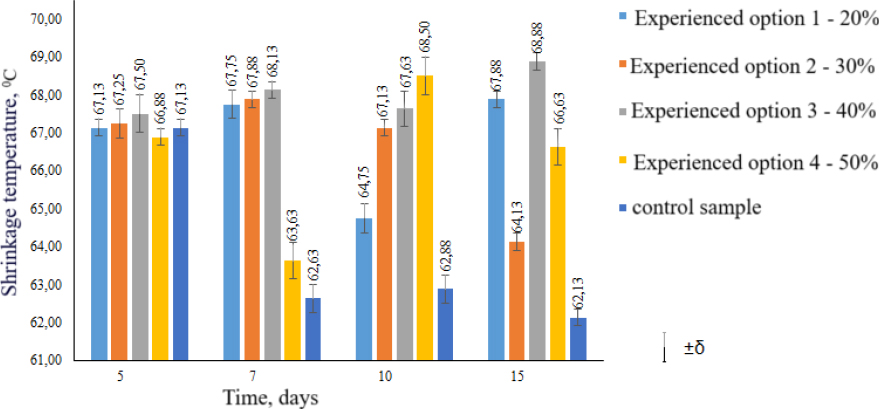
Fig. 2.
Graph of the dependence of the shrinkage temperature of sheepskin leather tissue in the preservation process
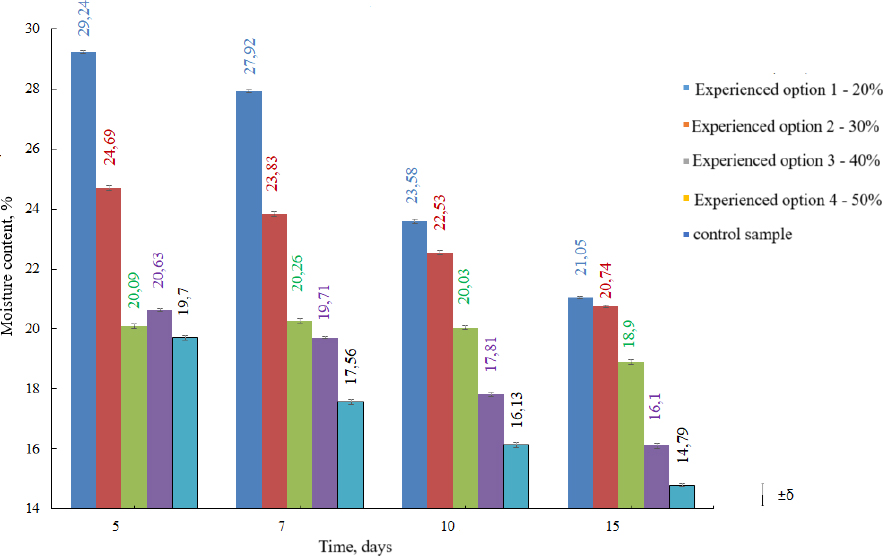
Fig. 3.
Graph of the dependence of the moisture content of sheepskin leather tissue in the preservation process
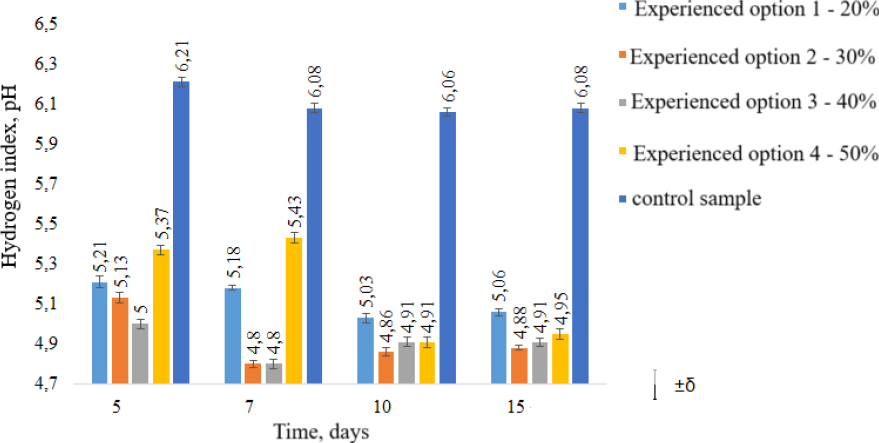
Fig. 4.
Graph of the dependence of the pH of the aqueous extract of the leather tissue of sheepskins in the preservation process
Table 5.
Microbiological indicators of sheepskins after 5,7,10 and 15 days of preservation
| Experienced options | Sheepskins after preservation | |
|---|---|---|
| QMAFAnM, CFU/g | mold, CFU/g | |
| Sheepskins after 5 days of preservation | ||
| paired | 8×10⁶ | 30 |
| 1 option (20%) | 14×103 | 18 |
| 2 option (30%) | 12×103 | 10 |
| 3 option (40%) | 9×10³ | 2 |
| 4 option (50%) | 5×10³ | 1 |
| Control | 13×103 | 16 |
| Sheepskins after 7 days of preservation | ||
| 1 option (20%) | 3×10³ | 18 |
| 2 option (30%) | 2×10³ | 10 |
| 3 option (40%) | 1,2×10³ | 2 |
| 4 option (50%) | 1,1×10³ | 1 |
| Control | 5×10³ | 19 |
| Sheepskins after 10 days of preservation | ||
| 1 option (20%) | 2×10³ | 20 |
| 2 option (30%) | 2×10³ | 12 |
| 3 option (40%) | 1×10³ | 2 |
| 4 option (50%) | 1×10³ | 1 |
| Control | 3×10³ | 20 |
| Sheepskins after 15 days of preservation | ||
| 1 option (20%) | 1,1×10³ | 24 |
| 2 option (30%) | 1,3×10³ | 13 |
| 3 option (40%) | 9×10² | 3 |
| 4 option (50%) | 5×10² | 2 |
| Control | 1×10³ | 26 |