
Table 1
Parameters of tufting needle
| Material | Gauge [in] | Density [g.cm−3] | Length [mm] | Thickness [mm] | Elastic modulus [MPa] | Poisson ratio |
|---|---|---|---|---|---|---|
| Steel | 0.10 | 7.8 | 36 | 3 | 2700 | 0.28 |
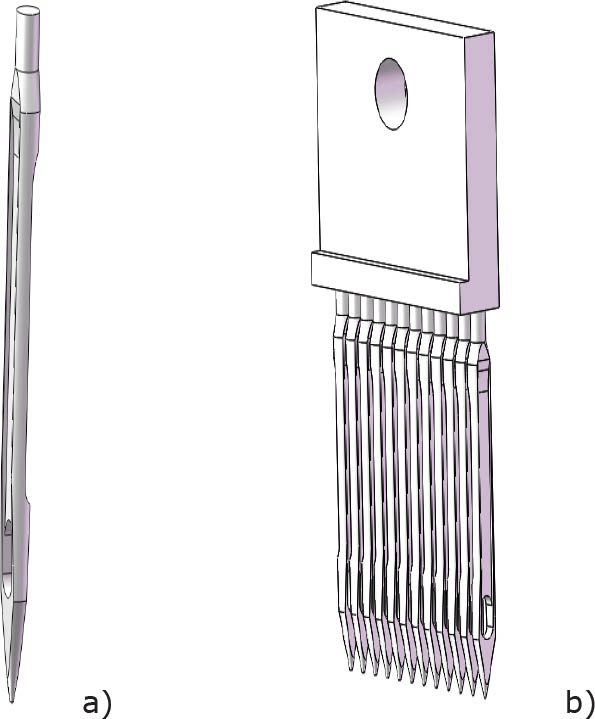
Fig. 1
Models of tufting needles. a) Individual tufting needle; b) 1/10 needle module
Table 2
Mechanical properties of polypropylene woven fabric
| Yarn | Stress [MPa] | Strain | Fracture work [mJ] |
|---|---|---|---|
| Warp | 249.5 | 0.056 | 1400.00 |
| Weft | 243.0 | 0.081 | 1291.31 |
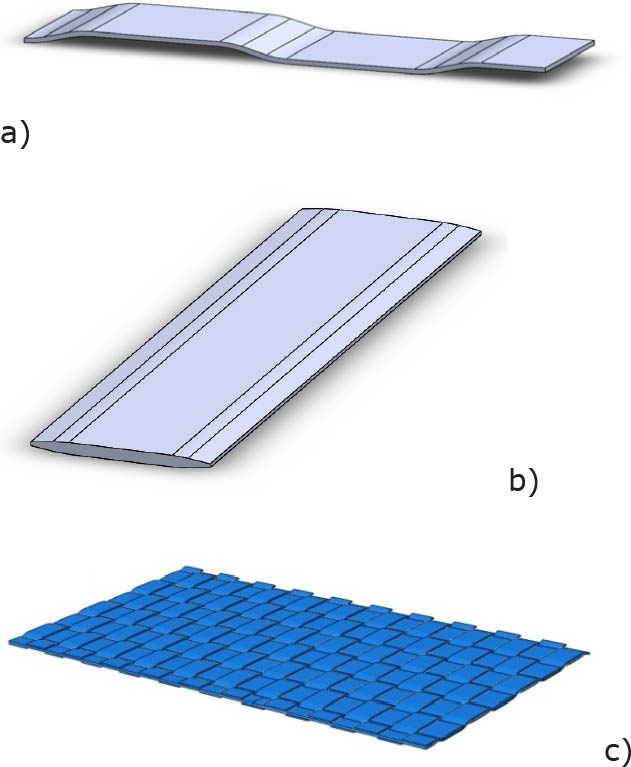
Fig. 2
Model of polypropylene woven fabric a) model of warp, b) model of weft, c) complete model
Table 3
Specification parameters of nonwoven fabrics
| Backing cloth | Fiber fineness [dtex] | Density [g/m2] | Thickness [mm] | Length [mm] | Width [mm] |
|---|---|---|---|---|---|
| Hot-air bonded nonwoven | 1.56 | 110 | 0.24 | 30 | 26 |
| Thermo-calender bonded nonwoven | 1.56 | 65 | 0.35 | 30 | 26 |
Table 4
Mechanical properties of nonwoven fabrics
| Backing cloth | E11 [MPa] | E22 [MPa] | E33 [MPa] | G12 [MPa] | G23 [MPa] | G31 [MPa] | v12 | v23 | v13 |
|---|---|---|---|---|---|---|---|---|---|
| Hot-air bonded nonwoven | 357.59 | 140.04 | 9.80 | 121.98 | 50.01 | 4.86 | 0.41 | 0.41 | 0.41 |
| Thermo-calender bonded nonwoven | 126.75 | 94.56 | 10.00 | 87.88 | 49.66 | 4.86 | 0.41 | 0.41 | 0.41 |
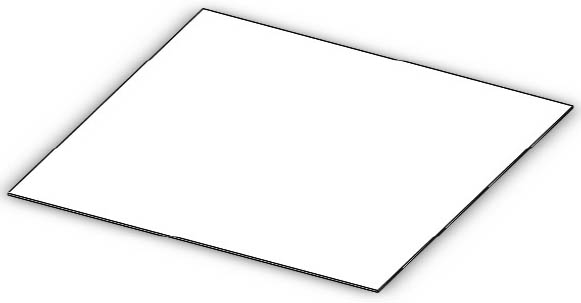
Fig. 3
Model of the nonwoven fabric
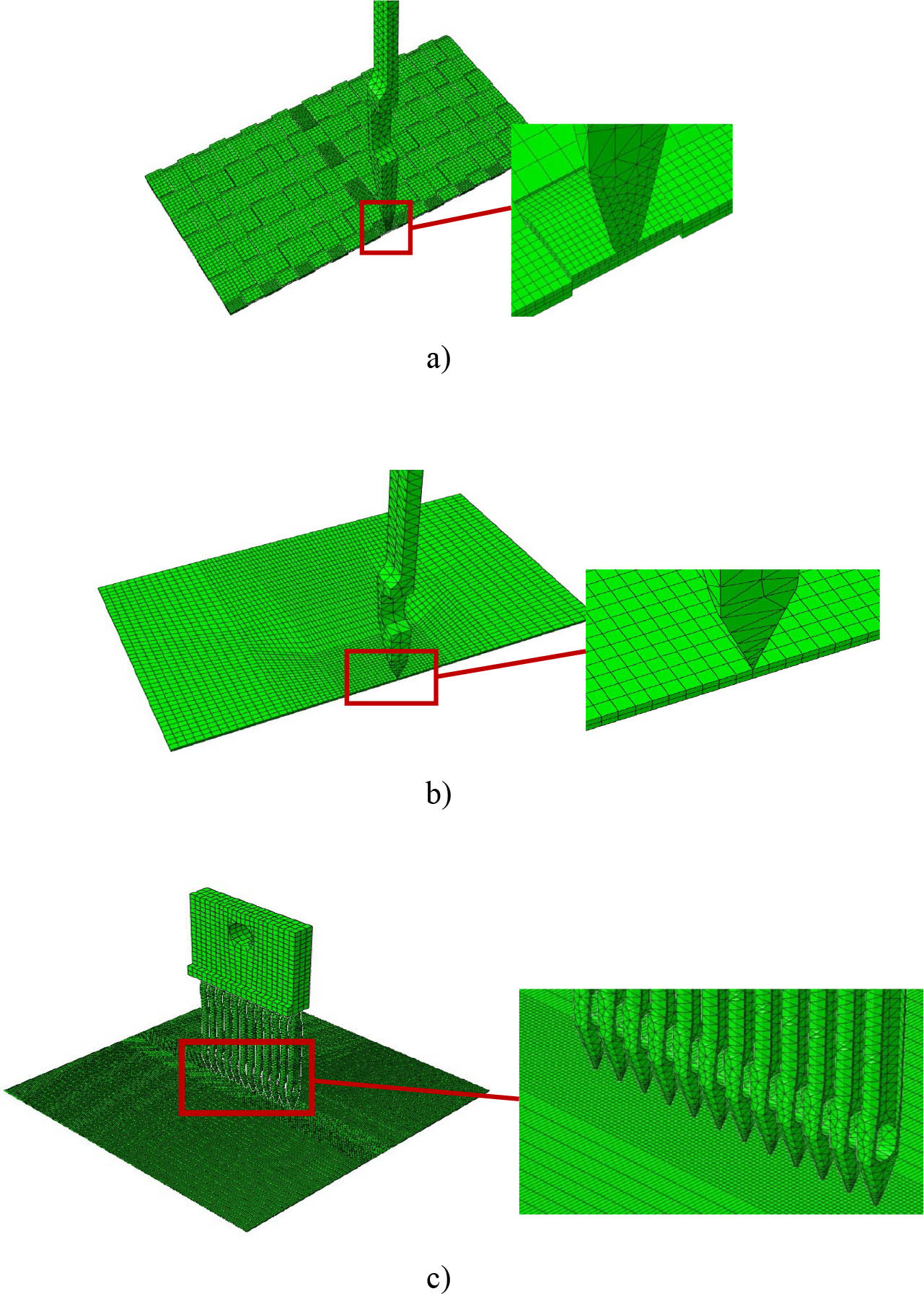
Fig. 4
Meshing in the finite element model a) single needle and polypropylene woven fabric, b) single needle and nonwoven fabric, c) 1/10 needle modules and nonwoven fabric
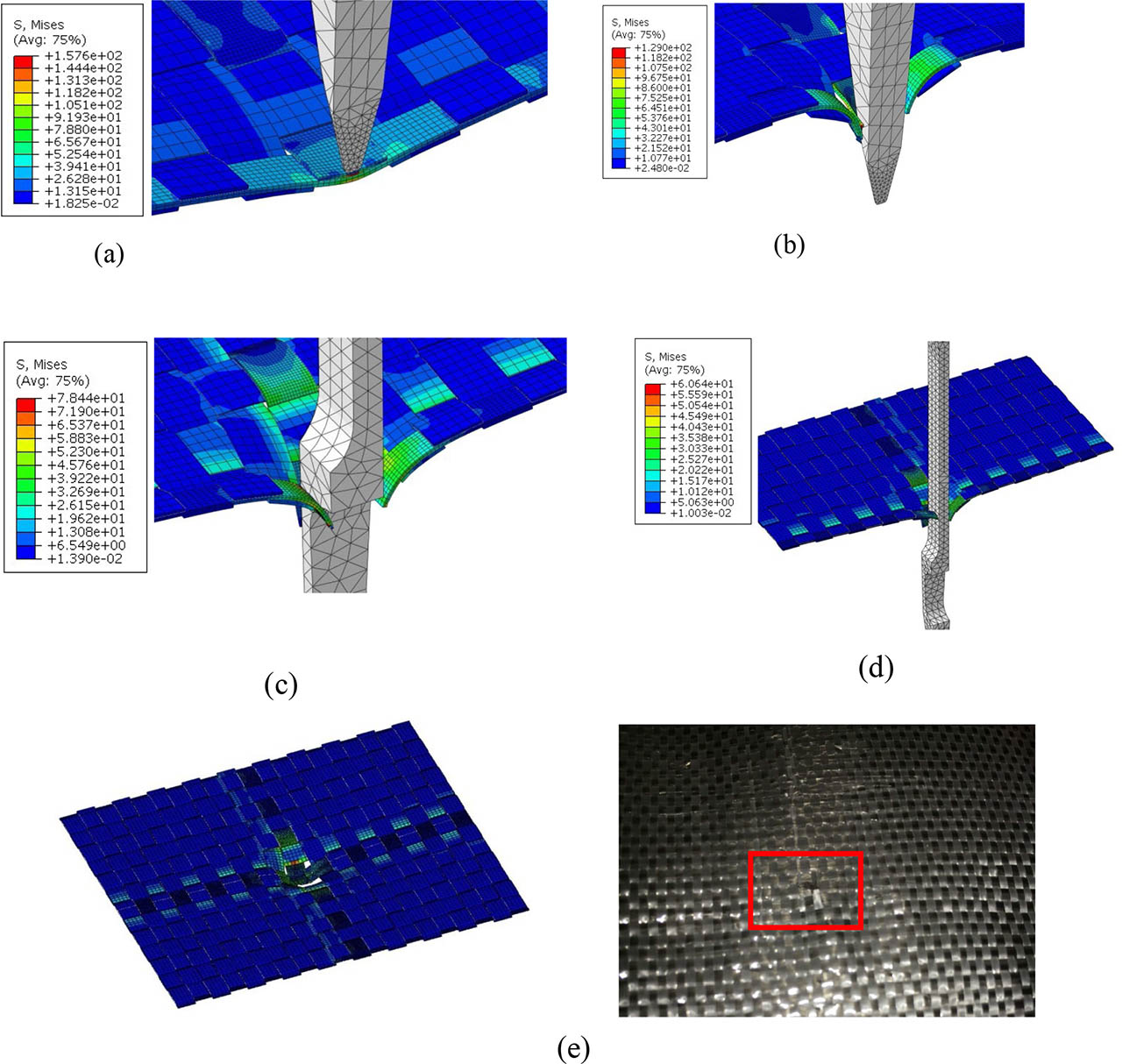
Fig. 5
Deformation of the polypropylene woven fabric at time t: a) t=1.5ms, b) t=3ms, c) t=11.25ms, d) t=15ms, e) hole in fabric in the finite element model and in the actual backing cloth (t=15ms)
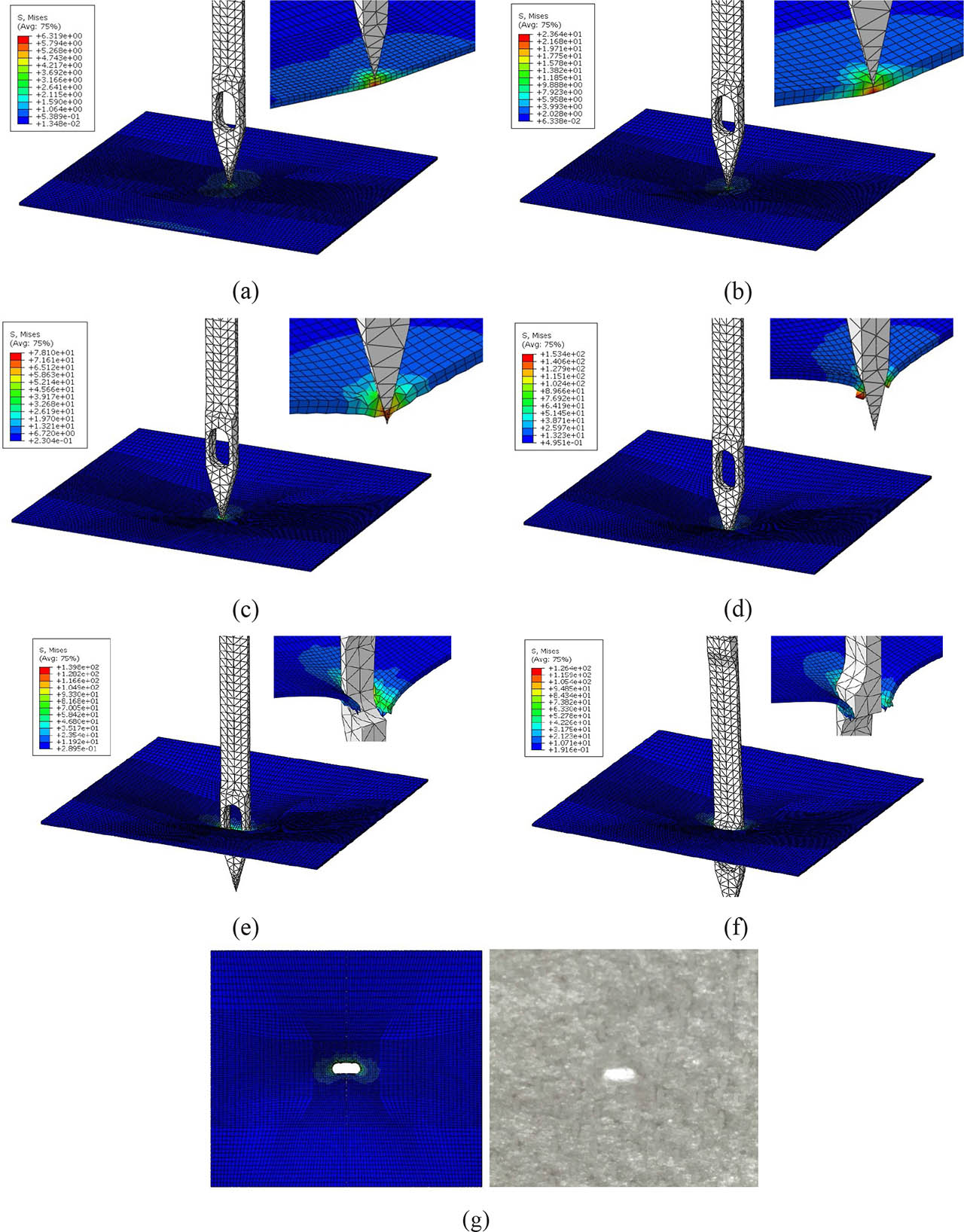
Fig. 6
Deformation of the hot-air bonded nonwoven at time t: a) t=0.65ms, b) t=1.3ms, c) t=2.6ms, d) t=4.55ms, e) t=9.75ms, f) t=13ms, g) hole in fabric in the finite element model and in the actual backing cloth (t=13ms)
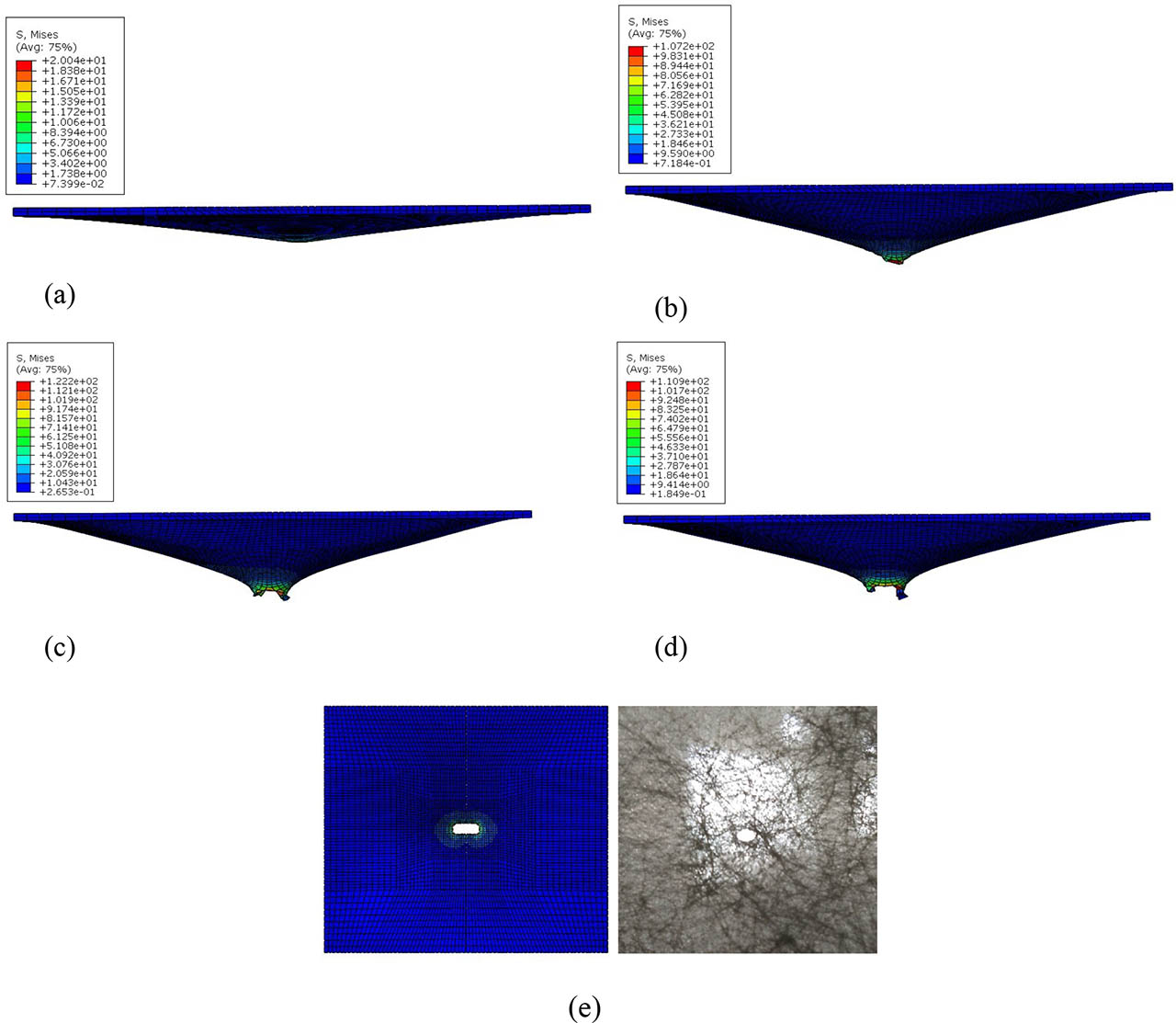
Fig. 7
Deformation of thermo-calender bonded nonwoven at time t: a) t=1.5ms, b) t=4.5ms, c) t=9ms, d) t=15ms, e) hole in fabric in the finite element model and the actual backing cloth (t=15ms)
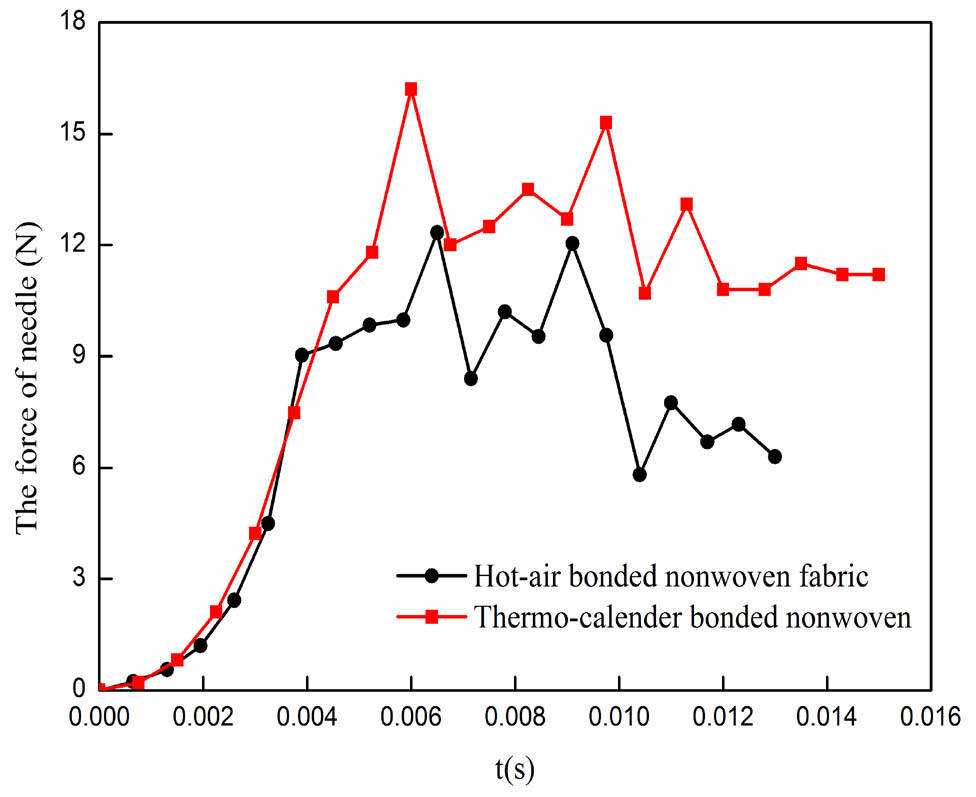
Fig. 8
Needle forces for different backing materials
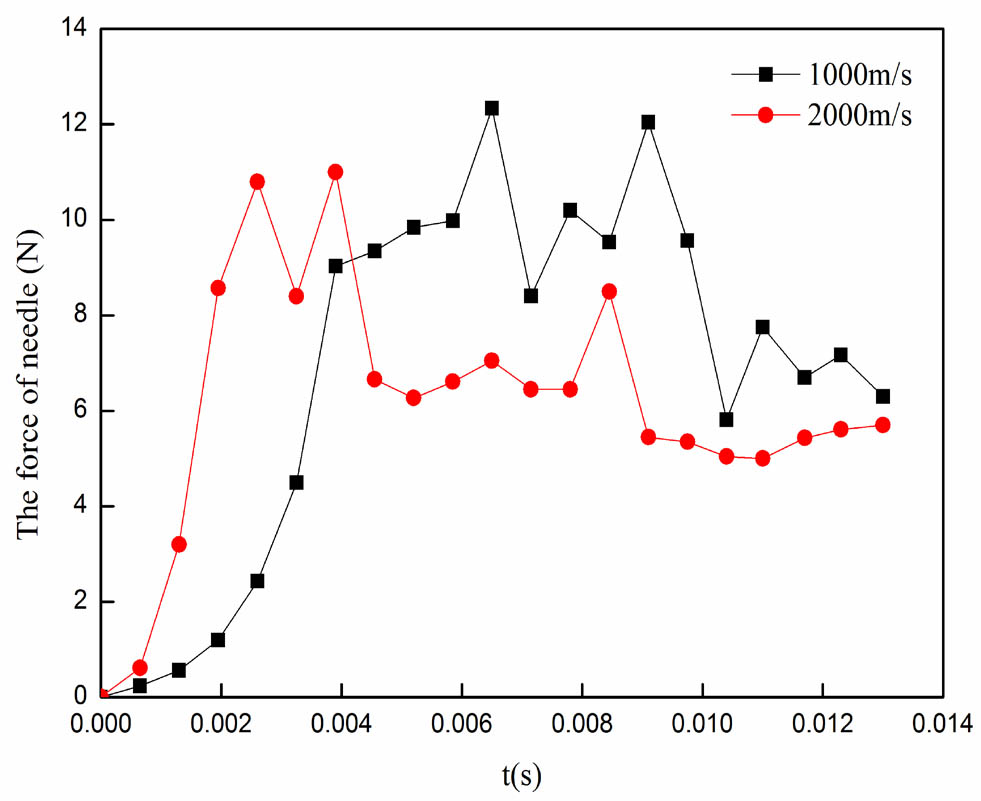
Fig. 9
Needle forces at different needle speeds
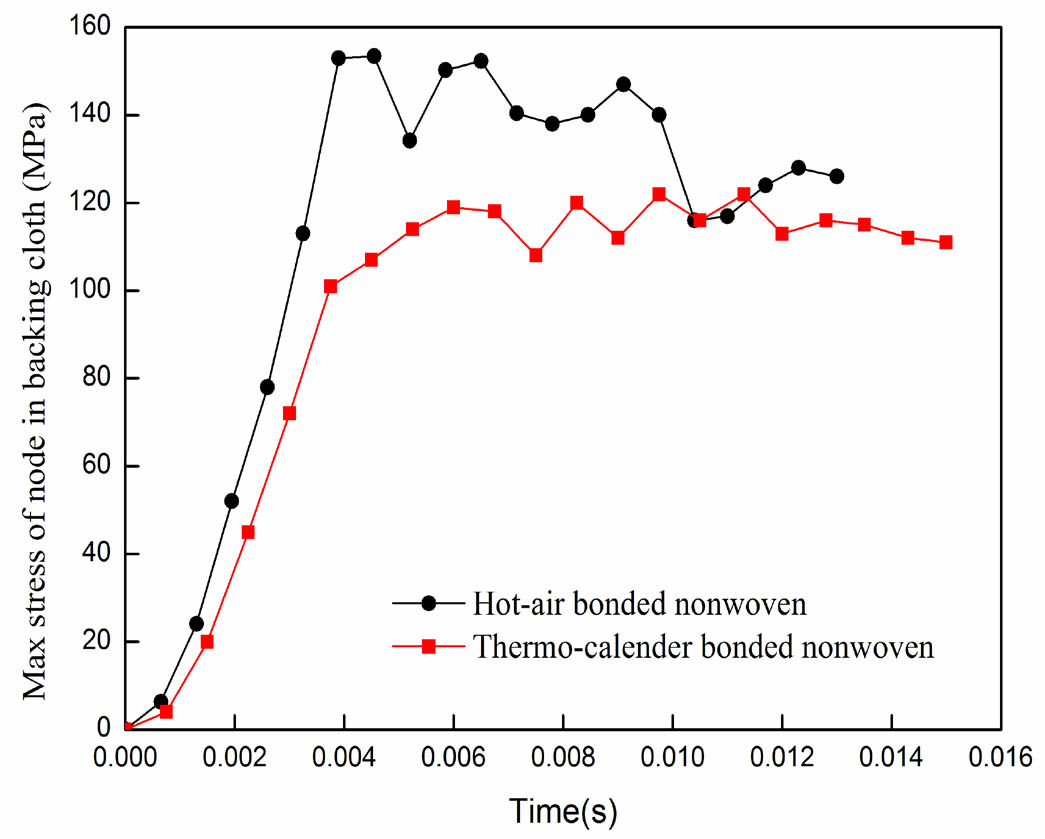
Fig. 10
Maximum stress of the node in the backing cloth

Fig. 11
Deformation of hot-air bonded nonwoven punctured by 1/10 needle modules at time t: a) t=0.75 ms, b) t=3 ms, c) t=3.75 ms, d) t=4.5 ms, e) t=5.25 ms, f) t=10 ms, g) actual backing cloth