
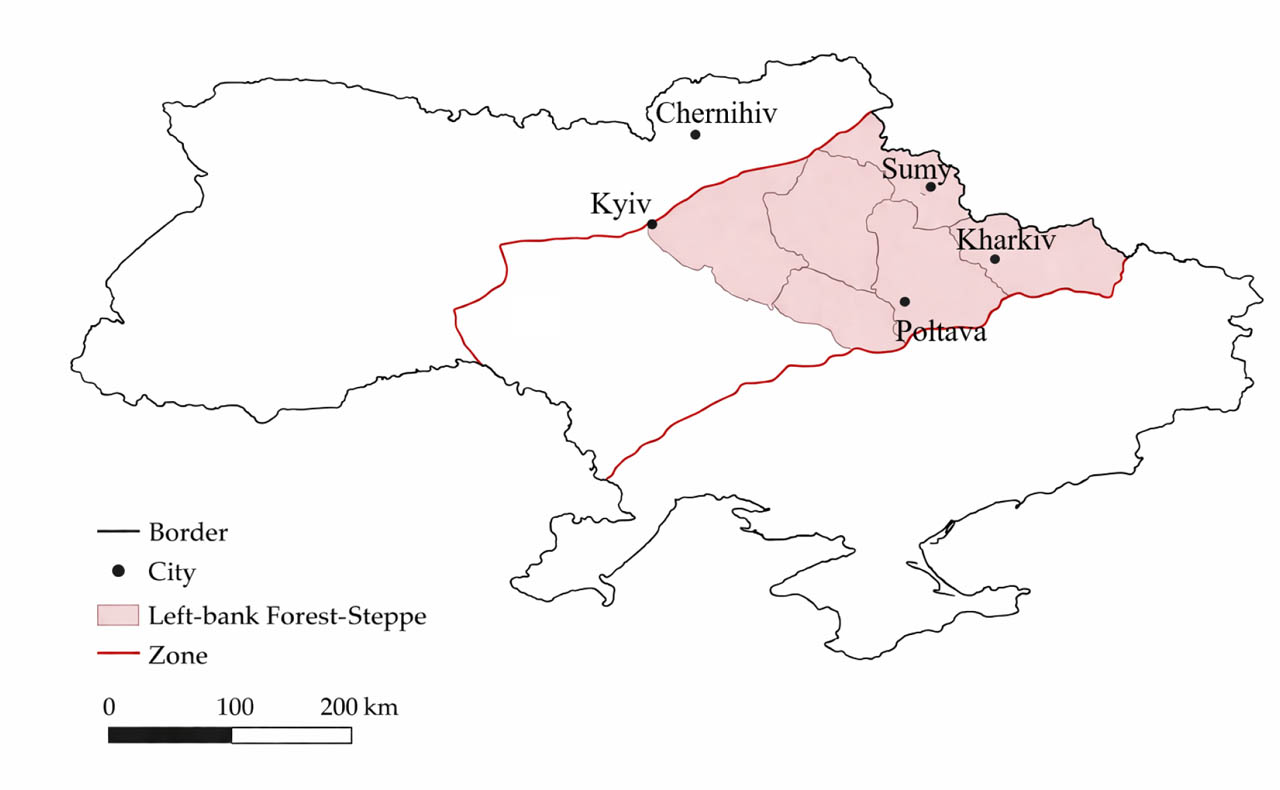
Figure 1.
The map scheme of the Left-Bank Forest-Steppe of Ukraine.
Table 1.
Taxonomic structure of the flora in the studied afforestation belts.
| Nat | Apo | Al | ||
|---|---|---|---|---|
| Asteraceae | 14.5 | 2.3 | 25.6 | 16.9 |
| Rosaceae | 9.8 | 17 | 3.7 | 7.7 |
| Poaceae | 6.8 | 9.1 | 4.9 | 6.7 |
| Apiaceae | 6.8 | 1.1 | 14.6 | 4.6 |
| Lamiaceae | 4.7 | 2.3 | 6.1 | 6.2 |
| Caryophyllaceae | 4.3 | 2.3 | 8.5 | 1.5 |
| Fabaceae | 3.4 | 2.3 | 2.4 | 6.2 |
| Sapindaceae | 2.6 | 3.4 | 0 | 4.6 |
| Brassicaceae | 2.6 | 0 | 2.4 | 6.2 |
| Cyperaceae | 2.1 | 5.7 | 0 | 0 |
| Other | 42.4 | 54.5 | 31.8 | 39.9 |
| Sum of the first 10 | 57.6 | 45.5 | 68.2 | 60.1 |
Table 2.
Comparison of separate indicators in the compared floras.
| Flora of the afforestation belts of the studied region | Flora of the Left-Bank Forest-Steppe (Bayrak, 1997) | Forest and shrub flora of the Northern Black Sea region (Solomakha et al., 2015) | Flora of Southeastern Ukraine (Burda, 1991) | |
|---|---|---|---|---|
| Asteraceae/Cyperaceae | 6.8 | 2.59 | 4.7 | 3.6 |
| Asteraceae/Poaceae | 2.125 | 1.5 | 1.57 | 1.56 |
| Cyperaceae/Fabaceae | 0.625 | 0.94 | 0.547 | 0.631 |
| Number of species/genera | 1.45 | 2.77 | 2.33 | 3.1 |
Table 3.
Biomorphological structure of the flora of the afforestation belts according to Raunkier's classification of biological types (Nat – natural, Apo – apophytic, Aln – alien flora).
| Raunkier's biological types | Sum | Nat | Apo | Aln |
|---|---|---|---|---|
| Hemicryptophyte | 35.9 | 6.0 | 21.5 | 8.4 |
| Phanerophyte | 21.2 | 16.2 | 0.0 | 5.0 |
| Nanophanerophyte | 13.9 | 7.9 | 3.2 | 2.8 |
| Therophyte | 13.8 | 0.0 | 7.9 | 5.8 |
| Chamaephyte | 11.7 | 0.7 | 2.8 | 8.2 |
| Geophyte | 3.4 | 2.2 | 0.8 | 0.4 |
| Other | 0.1 | 0.1 | 0.0 | 0.1 |
Table 4.
The distribution of species with various strategies in the flora of the afforestation belts.
| Graim's strategy type | Sum | Nat | Apo | Aln |
|---|---|---|---|---|
| C (competitors) | 44.2 | 18.5 | 15.5 | 10.3 |
| R (ruderals) | 27.1 | 6.6 | 12.1 | 8.4 |
| S (stress-tolerant) | 28.7 | 12.8 | 11.6 | 4.3 |
| Total | 100 | 37.9 | 39.2 | 23 |
Table 5.
Distribution of the number of species of different types of life forms by layers in the natural and synanthropic flora of the afforestation belts.
| The life form of a species | Sum | Nat | Apo | Aln |
|---|---|---|---|---|
| Herbaceous | 73.2 | 21.7 | 33.6 | 17.9 |
| Shrubs | 15.3 | 8.9 | 1.3 | 5.1 |
| Trees | 11.5 | 6.8 | 0 | 4.7 |
| Total | 100 | 37.4 | 34.9 | 27.7 |
Table 6.
The top 10 species that form the main layers in afforestation belts are sorted by their constancy-abundance index values.
| Species/Layer | Group | Constancy, % | Abundance-average, % | Constancy-Abundance Indicator, % |
|---|---|---|---|---|
| Tree layer | ||||
| Quercus robur | natural | 75.4 | 56.0 | 65.0 |
| Fraxinus excelsior | natural | 46.3 | 28.0 | 36.0 |
| Acer platanoides | natural | 32.3 | 23.0 | 27.2 |
| Acer negundo | kenophyte | 38.3 | 15.0 | 24.0 |
| Ulmus laevis | natural | 35.1 | 16.0 | 23.7 |
| Tilia cordata | natural | 11.9 | 35.0 | 20.4 |
| Robinia pseudoacacia | kenophyte | 13.0 | 32.0 | 20.4 |
| Fraxinus pennsylvanica | kenophyte | 5.6 | 39.0 | 14.8 |
| Ulmus minor | natural | 4.6 | 35.0 | 12.6 |
| Populus nigra | natural | 4.9 | 31.0 | 12.3 |
| Shrub layer | ||||
| Sambucus nigra | hemiapophyte | 57.9 | 15.0 | 29.5 |
| Caragana arborescens | kenophyte | 23.5 | 13.0 | 17.5 |
| Ptelea trifoliata | kenophyte | 7.4 | 18.0 | 16.7 |
| Acer tataricum | natural | 21.4 | 12.0 | 16.0 |
| Prunus spinosa | natural | 20.0 | 5.0 | 10.0 |
| Parthenocissus quinquefolia | kenophyte | 3.2 | 27.0 | 9.2 |
| Cornus sanguinea | natural | 13.3 | 5.0 | 8.2 |
| Euonymus europaeus | natural | 15.1 | 4.0 | 7.8 |
| Cotinus coggygria | kenophyte | 4.2 | 14.0 | 7.7 |
| Crataegus rhipidophylla | natural | 19.7 | 3.0 | 7.7 |
| Herbaceous layer | ||||
| Chelidonium majus | apophyte | 48.1 | 20.0 | 31.0 |
| Impatiens parviflora | kenophyte | 11.9 | 37.0 | 21.0 |
| Elytrigia repens | apophyte | 48.8 | 8.0 | 19.8 |
| Ballota nigra | archaeophyte | 52.6 | 6.0 | 17.8 |
| Urtica dioica | hemiapophyte | 39.3 | 6.0 | 15.4 |
| Alliaria petiolata | apophyte | 21.1 | 11.0 | 15.2 |
| Geum urbanum | hemiapophyte | 48.4 | 4.0 | 13.9 |
| Poa nemoralis | natural | 27.0 | 6.0 | 12.7 |
| Galium aparine | apophyte | 37.9 | 4.0 | 12.3 |
| Poa angustifolia | natural | 13.0 | 10.0 | 11.4 |
Table 7.
The ratio of diagnostic species of different vegetation classes in the natural and synanthropic flora of the afforestation belts.
| Nat | Apo | Aln | |||
|---|---|---|---|---|---|
| 1. | Carpino-Fagetea | 17.4 | 13.9 | 3.4 | 0.1 |
| 2. | Epilobietea angustifolii | 14.4 | 0.8 | 10.5 | 3.1 |
| 3. | Robinietea | 12.9 | 1.7 | 5.6 | 5.6 |
| 4. | Artemisietea vulgaris | 8.8 | 0.1 | 4.5 | 4.1 |
| 5. | Molinio-Arrhenatheretea | 6.0 | 1.4 | 4.6 | 0.0 |
| 6. | Crataego-Prunetea | 5.5 | 4.4 | 0.0 | 1.1 |
| 7. | Trifolio-Geranietea | 4.4 | 3.3 | 1.2 | 0.0 |
| 8. | Quercetea roboripetraeae | 4.2 | 4.1 | 0.0 | 0.1 |
| 9. | Festuco-Brometea | 3.6 | 1.5 | 1.1 | 1.0 |
| 10. | Sisymbrietea | 3.0 | 0.0 | 0.9 | 2.0 |
| Total | 80.2 | 31.2 | 32.0 | 17.1 |
Table 8.
Ratio of indigenous (local) and alien species in the species composition of the afforestation belts.
| Categories | Species group | Count | Fraction, % |
|---|---|---|---|
| Indigenous species | 170 | 72.3 | |
| Natural | 88 | 37.4 | |
| Hemiapophytes | 40 | 17.0 | |
| Apophytes | 42 | 17.9 | |
| Alien species | 65 | 27.7 | |
| Archaophytes | 27 | 11.5 | |
| Kenophytes | 38 | 16.2 | |
| Total | 235 | 100 |
Table 9.
Top five archaeophyte and kenophyte species based on their participation in afforestation belts communities (C, % – constancy; A, % – average projective cover; CAI – combined constancy-abundance geometric mean).
| Rank | Archeophytes | C, % | A, % | CAI, % | Kenophytes | C, % | A, % | CAI, % |
|---|---|---|---|---|---|---|---|---|
| 1 | Ballota nigra | 52.6 | 6.0 | 17.8 | Acer negundo | 38.3 | 15.0 | 24.0 |
| 2 | Lactuca serriola | 39.7 | 2.0 | 8.9 | Impatiens parviflora | 11.9 | 37.0 | 21.0 |
| 3 | Anthriscus cerefolium | 4.2 | 15.0 | 7.9 | Robinia pseudoacacia | 13.0 | 32.0 | 20.4 |
| 4 | Fallopia convolvulus | 18.6 | 3.0 | 7.5 | Caragana arborescens | 23.5 | 13.0 | 17.5 |
| 5 | Artemisia absinthium | 22.5 | 2.0 | 6.7 | Fraxinus pennsylvanica | 5.6 | 39.0 | 14.8 |
| Average (by column) | 27.5 | 5.6 | 9.8 | 18.5 | 27.2 | 19.5 | ||