
Introduction
One of the main forest-forming species in Ukraine is the pedunculated oak (Quercus robur L.), which occupies more than 28% of the total forest area (Kosakivska et al., 2023). The productivity and stability of Q. robur plantations are influenced by planting methods and the quality of the planting material. Acorn sowing represents a relatively simple and cost-effective method that aligns with the natural forest ecosystem (Grossnickle & Ivetić, 2017). These artificial oak plantations are well-suited to environmental conditions, displaying resilience to drought due to their developed taproots and undamaged root systems (Zadworny et al., 2014; Luk'yanets et al., 2022).
Seed induction, maintenance, and release from dormancy are regulated by complex physiological and biochemical mechanisms influenced by various endogenous and exogenous factors. Temperature, water, and light regimes are pivotal exogenous factors (Bewley & Black, 1994), while the phytohormonal system plays a central role among endogenous factors, regulating metabolism and signaling during seed transition from dormancy to germination (Shu et al., 2016; Kosakivska et al., 2019). Exogenous biologically active substances and phytohormones are employed to enhance seed germination. Pre-sowing priming creates optimal conditions for metabolic processes initiation, minimizes issues with seed quality and structure, and ensures uniform robust seedlings. This cost-effective method mitigates the adverse effects of moisture deficit, soil salinity, and temperature fluctuations (Muhie, 2018; Yücedağ et al., 2019; Kosakivska et al., 2022a).
Gibberellins (GAs) encompass more than 130 isoforms of diterpenoid phyto-hormones involved in regulating plant growth (Sponsel & Hedden, 2010). GAs govern seed germination, coordinate cell division and elongation, determine gender, influence pollen and flowers development, flowering, seed and fruit formation (Gantait et al., 2015). Exogenous application of gibberellins has proven to enhance seedling growth characteristics across various tree species (Ameen & Al-Imam, 2007; Kosakivska et al., 2022b).
N-acyl homoserine lactones (AHL) are mediator molecules that coordinate cellular activity within bacterial populations, allowing them to function as multicellular organisms. They facilitate remote signaling between bacteria colonizing the phytosphere enabling responses to external cues and establishment of symbiotic or antagonistic relationships with host plants (Stacy et al., 2012; Shrestha & Schikora, 2020; Babenko et al., 2021, 2024). Pre-sowing treatment of seeds with AHL molecules has proven effective in enhancing plant resistance to biotic and abiotic stresses (Shrestha & Schikora, 2020). Both direct (plant-directed) and indirect (via rhizosphere microflora) effects of N-hexanoyl-L-homoserinlactone priming have been observed, resulting in improved seed germination, coleoptile and root sizes, bio-mass, yield, and grain quality (Moshynets et al., 2019). AHL priming improves plant growth, increases photosynthetic pigment content, alters endogenous phytohormone balance in organs and tissues, and influences the formation of defense mechanisms (Schikora et al., 2016; Shrestha & Schikora, 2020; Kosakivska et al., 2022c; Ortiz et al., 2024).
The objective of our study was to determine and compare the effect of priming with solutions of gibberellic acid (GA3) and N-hexanoyl-L-homoserinlactone (C6-HSL) on acorn germination and the homeostasis of abscisic acid (ABA), indole-3-acetic acid (IAA), gibberellic (GA3 and GA4) and salicylic (SA) acids and cytokinins (CKs) in the organs of 47-day-old Q. robur seedlings. We hypothesized that natural exogenous growth regulators induce changes in hormonal homeostasis, activating growth and the stress-protective system, thereby enhancing seedlings' adaptation to environmental conditions.
Materials and Methods
Plant material and experimental design
The experiments were conducted at the Department of Phytohormonology at the M.G. Kholodny Institute of Botany of the National Academy of Sciences of Ukraine. Acorns of Q. robur were collected in February 2022 from beneath four trees in Feofaniia Park (Kyiv). After natural stratification, we observed the acorn skin cracking and the emergence of an embryonic root. The acorns were sorted using the flotation method by immersing them in water and stirring several times. Healthy, undamaged acorns heavier than water sank to the bottom of the vessel, while hollow or damaged ones floated on the surface. Calibrated intact acorns were sterilized in a 2.5% sodium hypochlorite solution for 10 minutes, washed up to 8 times with water, and dried on filter paper at room temperature. Sixty selected acorns were soaked for 24 hours in water (control) and solutions of gibberellic acid (50 mg/L) and N-hexanoyl-L-homoserinlactone (C6-HSL, 300 ng/ml). In our preliminary dose-response experiment with AGL, we tested concentrations of 100, 200, and 300 ng/ml. Since acorns have a relatively dense shell, the diffusion of AGL is somewhat hindered. Maximum germination was achieved at a concentration of 300 ng/ml. The acorns were planted in containers filled with a mixture of soil and sand (1:1; 2 kg). The acorns were subjected to regulated conditions to germinate: a temperature of +20°C, light intensity of 190 μmol/(m2 · s), a photoperiod of 16/8 h (day/night), and 65±5% relative air humidity. The substrate moisture level was maintained at 60% of full moisture content. Before seedling emergence, watering was carried out every three days at a rate of 50 ml per container, and after their emergence, watering was done daily. The shoots (epicotyl with apical bud), and primary root with lateral roots of 47-day-old Q. robur seedlings were studied.
Extraction of phytohormones
A total of 1.5 g of shoots and roots were frozen and ground in liquid nitrogen using 10 ml of an extraction solution consisting of methanol, distilled water, and formic acid in a 15:4:1 ratio. The homogenate was incubated at +4°C for 24 hours in the dark. The extracts were obtained by 30 min centrifugation at 15.000 RPM and +4°C and separation of the supernatant. The precipitate was resuspended in 5 ml of the extraction solution. After 30 minutes of incubation, the suspension was centrifuged for the second time. The combined supernatants evaporated to an aqueous residue at +40°C using a vacuum evaporator.
Two solid-phase extraction (SPE) cartridges were used for further purification: the Waters C18 Sep-Pak Plus and the Waters Oasis MCX, 6 cc/150 mg. The C18 Sep-Pak Plus cartridge removed proteins, pigments, and lipophilic compounds. The Oasis MCX cartridge was used to absorb and separate phytohormones of various classes. Elution of IAA, ABA, GA3, GA4, and SA (first fraction) was performed with 100% methanol. The second fraction with CKs was obtained using an alkaline solution of methanol (60 ml of methanol, 2.5 ml of 25% ammonia and deionized water to 100 ml). The resulting fractions were dried in concentrator flasks using a vacuum rotary evaporator at a temperature not exceeding +40°C. Each dry residue was dissolved to 200 μl with 45% methanol before analysis.
Analytical quantitation of IAA, ABA, GA3, GA4, SA and CKs
Quantitation of phytohormones in aliquots was performed using high-performance liquid chromatography on Agilent 1200 LC/MS series instrument (USA) with diode-array detector G1315B and single quadrupole mass detector Agilent G6120A. Chromatographic separation was carried out using an Agilent ZORBAX Eclipse Plus C18 column of 4.6 × 250 mm with a lipophilic-modified sorbent, particle size 5 μm (reverse phase chromatography). To analyze the SA, we used the Agilent ZORBAX Eclipse Plus C18 SS 3.0×150 mm column with a sorbent particle size of 3.5 μm. The parameters outlined (Kosakivska et al., 2020) were followed in order to separate phytohormones. The analytes were quantified using Agilent OpenLAB CDS ChemStation Edition chromatograph software (ver. C.01.09).
To create calibration tables for the chromatographic methods of the instrument software, unlabeled ABA, IAA, GA3, GA4, SA, t-Z (trans-zeatin), t-ZG (trans-Zeatinglucoside), t-ZR (trans-zeatinriboside), iP (isopentenyladenine), and iPA (isopentenyladenosine) from Sigma-Aldrich (USA) were used. Employing a mass detector operating in combination mode (electrospray and chemical ionization at atmospheric pressure), the analyte content in the samples was observed during analysis. Analyte molecules ionized in positive polarity for CKs and negative polarity for other analytes. For quantitation of GA3 and GA4, we used the signal of the mass detector in SIM (single ion monitoring of the 345 and 331 m/z values according to the timetable).
Statistical analysis
All biological experiments were conducted in triplicate. All chromatographical measurements had three analytical replications. For all measurements, the averages and standard errors were calculated in MS Excel (Microsoft Inc., USA). Differences between means were assessed by the Tukey test at P < 0.05 and P < 0.01 using MS Excel and Statistics v. 10.0 (Analytical Software, Tallahassee, FL, USA).
Results
Effect of exogenous GA3 and C6-HSL on acorn germination and growth of Quercus robur seedlings
Acorns of Q. robur exhibited a light brown color and elongated shape, with lengths ranging from 3.0±0.15 to 3.5±0.18 cm and a diameter of about 1.5±0.08 cm. Individual shoots were observed 38 days after acorn sowing, with mass shoots appearing between the 40th and 45th day. Priming with GA3 solution resulted in 85.8% germination, surpassing the control by 24.6%. C6-HSL priming yielded 93.4% germination, exceeding the control by 32.2% (Figure 1).
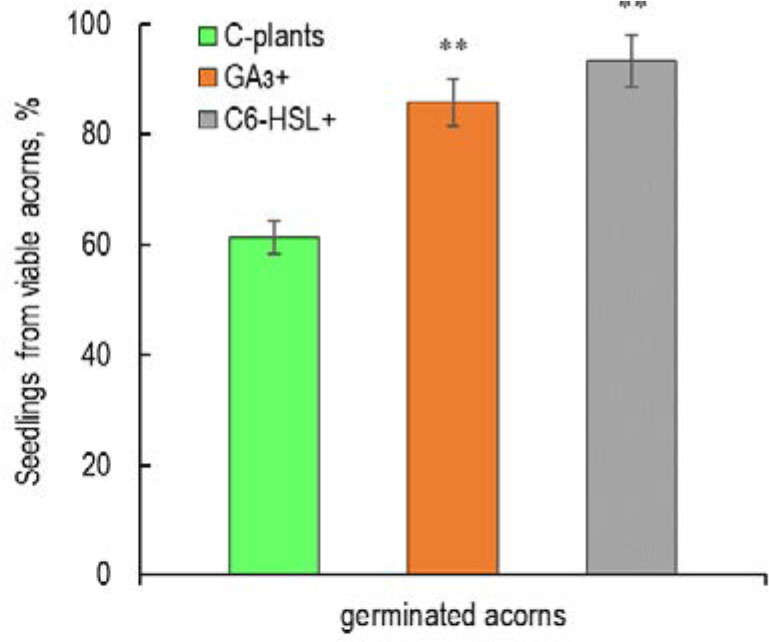
Figure 1.
Effect of pre-sowing treatment with GA3 (50 mg/L) and C6-HSL (300 ng/L) solutions on Quercus robur acorns' germination (47 days, %). Significance at ** - P <0.01 compared with the control on the 47th day of germination; n = 60; the bars represent the standard error (±SE).
The 47-day-old Q. robur seedlings were heterogeneous, displaying varied morphology and ontogenetic stages. Three distinct groups were identified: those with sprouted acorns and roots (first group), seedlings with formed epicotyl shoots, germ leaves, and main roots (second group), and seedlings with unopened real leaves of the juvenile type (third group). The second group predominated, constituting 61.4% in GA3+plants and 53.3% in C6-HSL+plants, selected for further analysis (Figure 2).
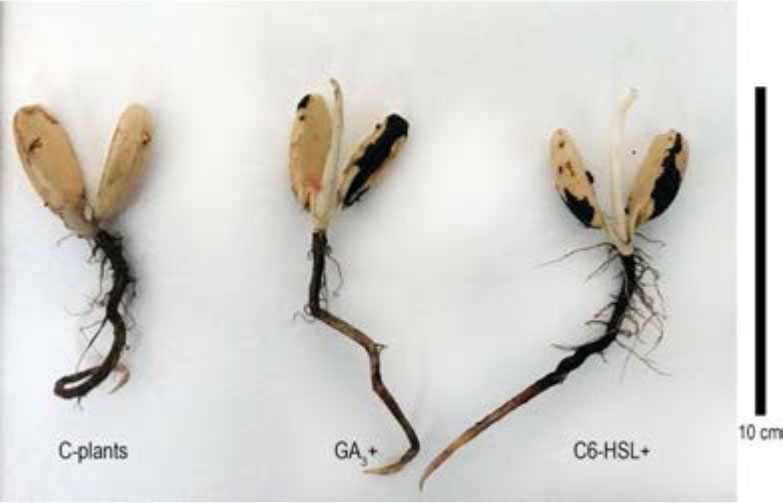
Figure 2.
Seedlings of Quercus robur for 47 days of vegetation in laboratory conditions, grown from non-primed acorns (C-plants); acorns primed with GA3 (GA3+plants) and with C6-HSL (C6-HSL+plants).
Post-germination, cotyledon length remained relatively stable in both GA3+plants and C6-HSL+plants, while FW decreased marginally by 8.9% and 4.5%, respectively. The shoot height of 47-day-old GA3+plants and C6-HSL+plants surpassed that of C-plants by 24% and 13% respectively, with FW exceeding C-plants by 17.8% and 6.7%. Notably, GA3+plants exhibited a 21% increase in epicotyl shoot thickness. Both GA3+plants and C6-HSL+plants demonstrated increased main root length by 16.3% and 37.8%, respectively, with root FW exceeding control by 9.9% and 25.4%, respectively (Figure 3).
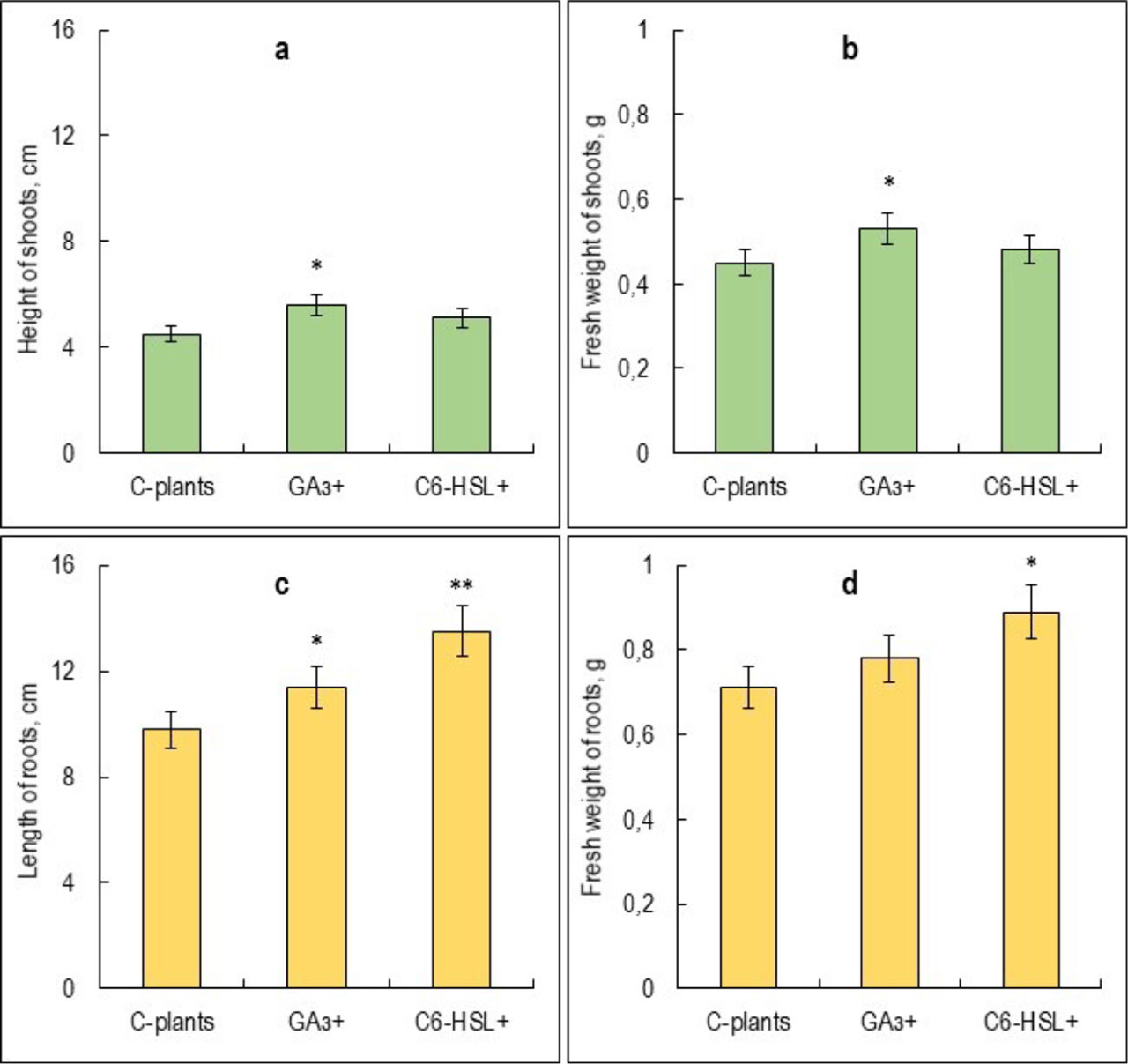
Figure 3.
Morphological characteristics of 47-day-old Quercus robur seedlings grown from non-primed acorns (C-plants); acorns primed with GA3 (GA3+plants) and with C6-HSL (C6-HSL+plants). a, b – height and fresh weight of shoots, c, d – length and fresh weight of roots. Significance at * - P <0.05 and ** - P <0.01 compared with the control on the 47th day of acorn germination; n = 30; the bars represent the standard error (±SE).
DW accumulation in GA3+plants and C6-HSL+plants exceeded C-plants by 24.8% and 51.4%, respectively. Root DW in GA3+plants and C6-HSL+plants were 1.6 and 2.0 times greater than shoots, whereas in C-plants, root DW exceeded shoot weight by 2.7 times. Shoot hydration levels were higher than those in roots (Table 1), with C6-HSL+plants exhibiting increased lateral root growth (Figure 2).
Table 1.
Effect of pre-sowing treatment of acorns with GA3 (50 mg/L) and C6-HSL (300 ng/L) solutions on the accumulation of dry weight (mg) and water content (%) in 47-day-old Quercus robur seedlings' shoots and roots.
| Indices | C-plants | GA3+plants | C6-HSL+plants | |||
|---|---|---|---|---|---|---|
| Shoots | Roots | Shoots | Roots | Shoots | Roots | |
| Dry weight, mg | 60±3.1 | 162±8.1 | 106**±5.3 | 171**±8.6 | 111±5.6 | 225***±11.3 |
| Water content, % | 86.6 | 75.8 | 80.8 | 78.1 | 76.8 | 72.5 |
Overall, exogenous GA3 and C6-HSL did not alleviate the syndrome of unfriendly seedling emergence but enhanced acorn viability and contributed to an increased seedling count (Kosakivska et al., 2022b, 2022c).
Effect of exogenous GA3 and C6-HSL on hormonal homeostasis of Quercus robur seedlings
Priming acorns induced specific changes in the accumulation and distribution of endogenous phytohormones in the organs of 47-day-old seedlings. In the shoots and roots of GA3+plants, the content of endogenous ABA increased by 32% and 14%, respectively. The accumulation of ABA in the roots of primed plants was 2.2 times more active than in the shoots. In the shoots and roots of C6-HSL+plants, the ABA content increased 3.6 and 1.6 times, respectively. These changes were more pronounced than in GA3+plants. In all studied samples, the hormone dominated in the roots (Figure 4).
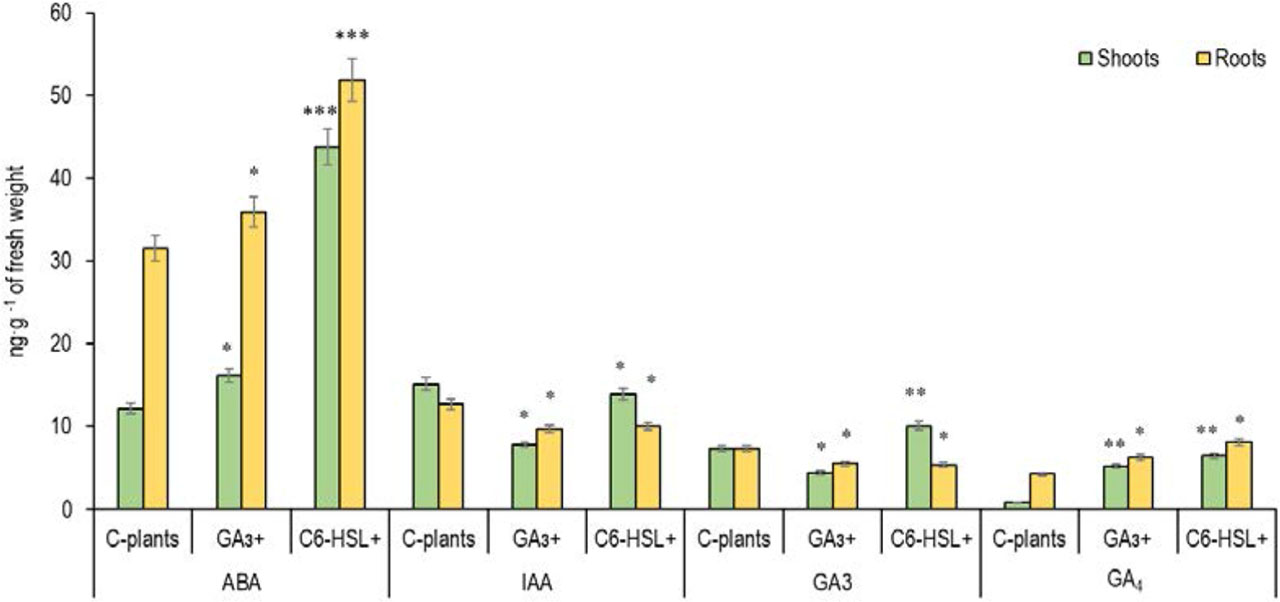
Figure 4.
Effect of pre-sowing treatment of acorns with GA3 and C6-HSL solution on the accumulation and distribution of endogenous ABA, IAA, GA3 and GA4 in 47-day-old Quercus robur seedlings. Significance at * - P <0.05, ** - P <0.01 and *** - P <0.001 compared with the control on the 47th day of acorn germination; n = 9; the bars represent the standard error (±SE).
In GA3+plants, a decrease in IAA content was observed in the shoots by 48.4%, and in the roots by 24.4%. The localization site of IAA in GA3+plants occurred in the roots, whereas in C-plants – in shoots. In the shoots and roots of 47-day-old C6-HSL+plants, the level of IAA decreased by 8.1% and 21.3%, respectively. The hormone dominated in the shoots of C6-HSL+plants, where its content was 1.4 times higher than in the roots (Figure 4).
The content of GA3 in the shoots and roots of GA3+plants decreased 1.7 and 1.3 times, while the level of GA4 increased 6.5 and 1.5 times, respectively. GA3 was equally accumulated in both parts of C-plants, while GA4 was dominant in roots. More pronounced changes in the accumulation of gibberellins were observed in C6-HSL+plants. In the shoots, GA3 and GA4 levels increased 1.4 and 8.1 times, respectively. In the roots, the amount of GA3 decreased 1.4 times, while GA4 increased 1.9 times. In the shoots of primed plants, the level of endogenous GA3 was 46.5% higher, and GA4 was 24.6% lower than in the roots (Figure 4).
Salicylic acid (SA) dominated in the shoots of all studied samples. The content of SA in the shoots of GA3+plants was at the level of C-plants and was 158.3±7.9 ng/g FW. On the other hand, the hormone content in the roots diminished 1.5 times, which was 49.5% less than in the shoots. In the shoots of C6-HSL+plants, the content of SA was 7.6% higher than in the roots, but it was at the level of this indicator in the shoots of C-plants. In the roots, the hormone level after C6-HSL priming rose by 12.7% (Figure 5).
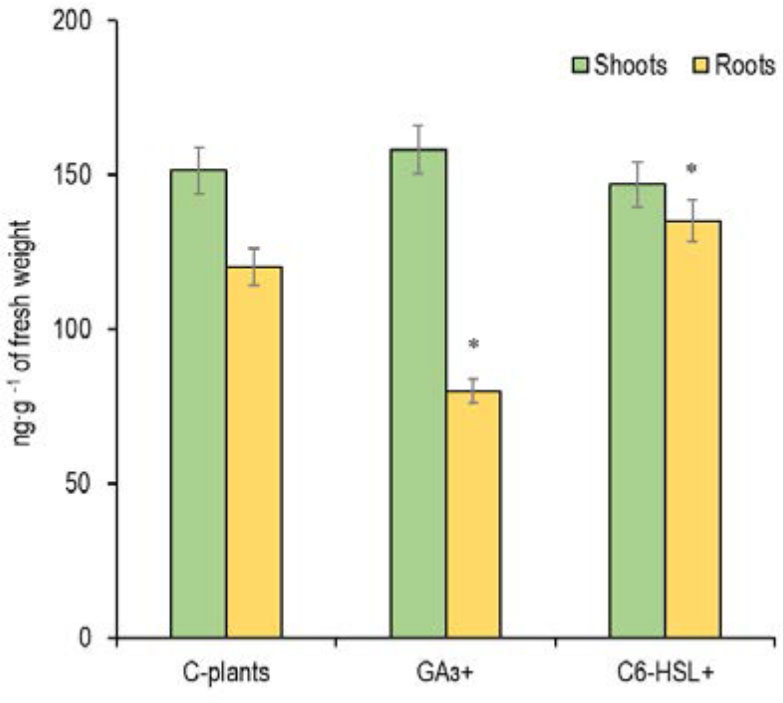
Figure 5.
Effect of pre-sowing treatment of acorns with GA3 and C6-HSL solution on endogenous SA content in 47-day-old Quercus robur seedlings. Significance at * - P <0.05 compared with the control on the 47th day of acorn germination; n = 9; the bars represent the standard error (±SE).
Five forms of cytokinins were identified in 47-day-old seedlings of Q. robur: transzeatin (t-Z), trans-zeatinriboside (t-ZR), trans-zeatin-O-glucoside (t-ZOG), isopentenyladenine (iP), and isopentenyladenosine (iPA). In the roots of GA3+plants, the total content of cytokinins increased 2.6 times, while the indicator for the shoots was at the control level. In the shoots and roots of C6-HSL+plants, the total content of cytokinins rose 1.1 and 2.2 times, respectively. Cytokinins dominated in the shoots of GA3+plants and C6-HSL+plants, where their content was 7.7% and 30.9% higher than that in the roots, respectively (Table 2).
Table 2.
Effect of pre-sowing treatment of acorns with GA3 and C6-HSL solutions on the total content of endogenous cytokinins in the shoots and roots of 47-day-old Quercus robur seedlings, ng/g FW.
| Option experiment | C-plants | GA3 +plants | C6-HSL + plants |
|---|---|---|---|
| Shoots | 49.5±2.5 | 46.7*±2.3 | 52.8*±2.6 |
| Roots | 16.7±0.8 | 43.1**±2.2 | 36.5*±1.8 |
The dominant forms of cytokinins in all studied samples were t-Z and t-ZR. In the shoots of GA3+plants, the content of t-ZOG significantly increased (by 260%), the accumulation of t-Z increased by 23.2%, while the levels of t-ZR and iPA decreased by 18.5% and 48.8%. In the roots of GA3+plants, the content of t-Z, t-ZR and iP rose 2.5, 2.8 and 3.9 times. An increase in iPA content (by 87.5%) was also observed. In the shoots of C6-HSL+plants, the content of t-ZOG rose almost tenfold and the amount of t-Z increased 1.5 times. At the same time, the accumulation of t-ZR, iP and iPA decreased by 24.9%, 18.8% and 11.9%, respectively. In the roots of C6-HSL+plants, the content of all forms of cytokinins rose, with the exception of t-ZOG. The most pronounced changes were found in t-Z and t-ZR, the levels of which increased 2.5 and 2.1 times, respectively. The t-Z localization site moved to the roots of GA3 +plants and C6-HSL + plants (Figure 6).
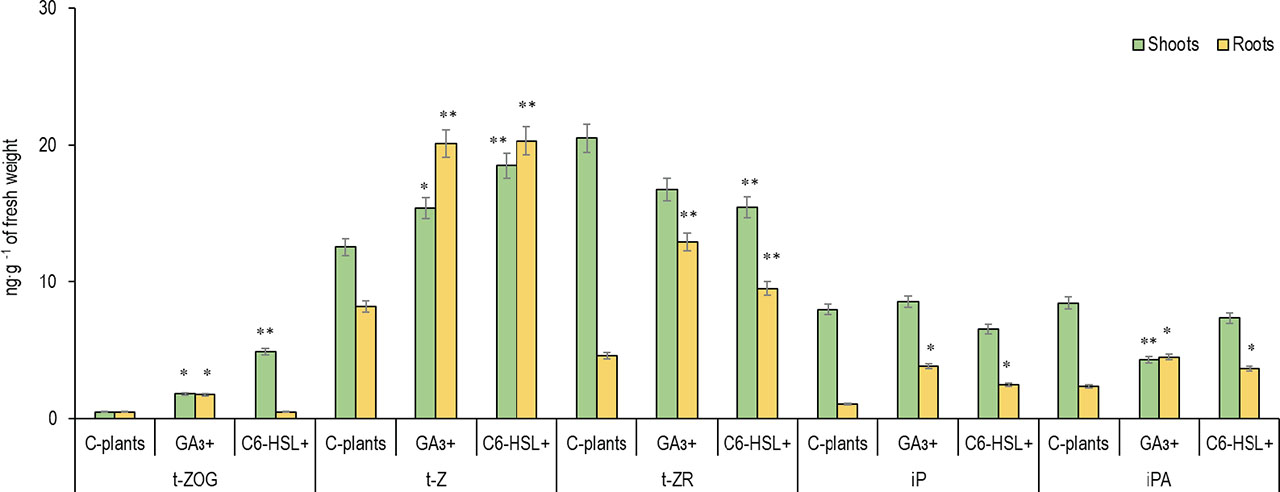
Figure 6.
Effect of pre-sowing treatment of acorns with GA3 and C6-HSL solutions on the content and distribution of endogenous cytokinins in 47-day-old Quercus robur seedlings. Designation: trans-zeatin (t-Z), trans-zeatin riboside (t-ZR), trans-zeatin-O-glucoside (t-ZOG) isopentenyladenine (iP), and isopentenyladenosine (iPA). Significance at * - P <0.05 and ** - P <0.01 compared with the control on the 47th day of acorn germination; n = 9; the bars represent the standard error (±SE).
Table 3.
Effect of pre-sowing treatment of acorns with GA3 and C6-HSL solutions on the total content of endogenous phytohormones in 47-day-old Quercus robur seedlings, ng/g FW.
| Option experiment | Control | GA3 +plants | C6-HSL + plants |
|---|---|---|---|
| ABA | 43.7±2.18 | 52.1*±2.61 | 79.7*±3.98 |
| IAA | 27.8±1.39 | 17.4*±0.87 | 23.9*±1.18 |
| GA3+GA4 | 19.8±0.97 | 21.4±1.08 | 30.1*±1.51 |
| SA | 271.6±13.58 | 238.3*±11.92 | 282.3±14.12 |
| Cytokinins | 66.2±3.30 | 89.8*±4.47 | 89.3*±4.46 |
In general, after priming acorns with GA3 solution, the total content of IAA and SA in 47-day-old seedlings decreased by 37.4% and 12.3%, while the levels of ABA, GA3+GA4 and total cytokinins increased by 19.2%, 8.1% and 36.5%, respectively. Priming with C6-HSL solution induced a rise in the total content of ABA, GA3+GA4 and cytokinins by 82.4%, 52.0% and 34.9%, respectively, while the content of SA remained unchanged and IAA decreased by 12.4% (Table 3).
Therefore, priming of Q. robur acorns with GA3 and C6-HSL solutions induced nonspecific and specific changes in hormonal homeostasis in the 47-day-old seedlings. Both natural growth regulators stimulated an increase in the cytokinin content, primarily through the accumulation of active zeatin forms. Notably, after priming with the bacterial-origin growth regulator C6-HSL, more pronounced changes were observed in the shoots, whereas under the influence of the plant-origin growth regulator GA3, changes were more prominent in the roots. In GA3+plants and C6-HSL+plants, the content of ABA increased, with the effect of C6-HSL being more pronounced. ABA accumulation was consistently observed in the roots across all experimental variants. Both growth regulators negatively impacted IAA accumulation, with GA3 demonstrating a more pronounced effect. After GA3 priming, IAA accumulation shifted from the shoots to the roots, while IAA dominated in the shoots of C-plants and C6-HSL+plants. The total content of gibberellins in primed seedlings increased. However, GA4 accumulated in the organs of GA3+plants, whereas in C6-HSL+plants, GA4 accumulated in the roots and GA3 in the shoots. Overall, the content of gibberellins in C6-HSL+plants exceeded that in GA3+plants by 40.7%. In the roots of GA3+plants, the amount of SA decreased, while in C6-HSL+plants, it increased. The content of SA in the shoots of both primed seedlings remained at the control level.
Discussion
Oak trees are key elements of the Earth's health, linked also to our culture and spirituality. Five oak species grow in Ukraine, among them Quercus robur L., Q. rubra L., Q. petraea (Matt.) Liebl., Q. ilex L. and Q. pubescens Willd. (Kosakivska et al., 2023). The natural renewal of Q. robur is rather complicated, making the germination of acorns and the initial phases of ontogenesis among the most vulnerable stages of the life cycle. Our results demonstrated a positive effect of priming on acorn germination and subsequent seedling growth. C6-HSL was more effective, with pre-sowing treatment inducing the emergence of 93.4% of acorns. GA3 was also quite effective, with the percentage of germination after treatment being 85.8%. Both regulators induced an intensification of the growth processes of shoots and roots. GA3+plants were characterized by a thickened epicotyl shoot, while C6-HSL+plants exhibited the formation of lateral roots. Changes in the morphological indices of woody plants under the influence of gibberellins have been reported in the works of other researchers. For instance, two-year-old seedlings of Quercus frainetto Ten. grown in nature from GA3 (300 ppm) primed acorns had a higher shoot height and root neck diameter (Yücedağ et al., 2019). After the pre-sowing treatment of Cassia fistula L. seeds with GA3 solution at a concentration of 760 ppm, the number of germinated seeds increased by 56.66%, along with improvements in the height of seedlings, length of roots, number of leaves, and accumulation of FW and DW (Rout et al., 2017). Similarly, the percentage of germinated Betula platyphylla Sukaczev seeds, rate and time of germination, hypocotyl height, and FW of seedlings improved after seed priming with GA3 solution (300 ppm). Exogenous GA3 enhanced primary xylem development processes in the hypocotyls of 15-day-old seedlings, and foliar treatment of two-month-old seedlings with 50 μmol GA3 solution activated xylem development, stem elongation, and apical growth (Guo et al., 2015). Fast and uniform germination of Eriobotrya japonica (Thunb.) Lindl. seeds, along with active growth of seedlings, was observed after priming with GA3 solution at a concentration of 250 mg/L. However, concentrations above 300 mg/L reduced the germination rate while increasing the vigor index, shoot height, and seedling root length (Al-Hawezy, 2013). GA3 at a concentration of 200 ppm was found to be the most effective for the germination of Saraca asoca (Roxb.) Willd. seeds, contributing to an increase in plant height, number of leaves, length of branches and roots, and accumulation of FW and DW in seedlings (Rout et al., 2021). We showed that after acorn priming with GA3 solution, the mass of cotyledons of the studied Q. robur plants reduced, indirectly indicating the use of reserve substances and initiated growth of the embryo (Kosakivska et al., 2022b).
A close relationship has been established between gibberellins, ABA, IAA and cytokinins in the regulation of plant growth and development. Gibberellins and ABA act antagonistically during seed germination, stem and root growth, and leaf development (Kosakivska et al., 2019; Fan et al., 2020; Song et al., 2023). Conversely, gibberellins and auxins synergistically interact during the regulation of plant growth and development, coordinating cell elongation, organ growth, and activating formative processes (Ross et al., 2000; Kou et al., 2021). Priming acorns with a solution of exogenous GA3 affected the homeostasis of endogenous phytohormones in 47-day-old Q. robur plants. Thus, the total content of gibberellins in the organs of GA3+plants increased compared to C-plants, primarily due to the accumulation of GA4 (Figure 4; Table 3).
In our experiments, the ABA content increased in GA3+plants, primarily accumulating in the roots, while the IAA level dropped, shifting its accumulation site from shoots to roots. In C-plants, IAA predominated in the roots (Figure 4). Zhao et al. (2015) and Zhang et al. (2023) reported that lateral root development is regulated through crosstalk between ABA and auxin signaling. It has been shown that ABA has a positive effect on the synthesis of auxins and their transport to the tip of the root, which results in the elongation of root hairs (Wang et al., 2017). We observed a higher IAA to ABA ratio in the roots of GA3+plants compared to the roots of C6-HSL+plants. Additionally, the main root length of C6-HSL+plants doubled that of GA3+plants, accompanied by numerous lateral root hairs (Figure 2; Figure 3).
Priming with a GA3 solution induced changes in endogenous phytohormone content in Acrocomia aculeate (Jacq.) Lodd. ex Mart., notably increasing the GA3/ABA ratio in the embryos and endosperm of dry, swollen, ungerminated, and germinated seeds (Bicalho et al., 2015). In our experiments, GA3/ABA and GA3+GA4/ABA ratios in GA3+plants and C6-HSL+plants were lower than in C-plants. However, pre-sowing treatment with both growth regulators increased the GA4/ABA ratio, suggesting the involvement of GA4 in regulating acorn germination.
Gibberellins and cytokinins exert distinct effects on various aspects of plant development and growth. A crucial player in the interaction between GAs and cytokinins is the negative regulator of gibberellin responses, SPY, which inhibits GA3 activity while facilitating cytokinin signaling transduction. As GA3 levels rise, SPY activity decreases, intensifying responses to GA3 while weakening cytokinin signaling (Huang et al., 2003; Greenboim-Wainberg et al., 2005). GA can impede the early stages of the response to cytokinin signaling via a DELLA-independent pathway, whereas cytokinins influence the initial phases of the gibberellin signaling pathway. Therefore, the final version of the reaction is determined by the ratio between these hormones, and not by their content (Fleishon et al., 2011). The antagonistic interplay between cytokinins and gibberellins is evident in regulating shoot and root elongation, shoot regeneration in vitro, cell differentiation and meristem activity (Singh & Roychoudhury, 2022). Our findings demonstrate an increase in the total cytokinin content in GA3+plants, primarily in the roots due to t-Z and t-ZR accumulation (Table 2; Table 3; Figure 6). The cytokinins to gibberellins ratio rose in the shoots and declined in the roots of GA3+plants. Concurrently, the height and FW of GA3+plants shoots surpassed those of C-plants. Zeatin and zeatin riboside play pivotal roles in regulating growth processes in plants, acting as positive growth regulators in shoots and negative ones in roots (Vedenicheva & Kosakivska, 2016).
In the shoots of GA3+plants, the level of SA increased, coinciding with the accumulation of ABA (Figure 5). Exogenous GA3 is known to stimulate SA biosynthesis, enhancing plant defense responses to abiotic stresses (Alonso-Ramírez et al., 2009; Khan et al., 2012; Emamverdian et al., 2020). SA, in turn, modulates photosynthetic activity, transpiration rate, and stomatal conductance through interactions with other hormones (Hu et al., 2022). A synergistic interplay between SA and ABA under drought and ozone pollution influence was demonstrated in three-year-old Quercus ilex plants. Peak SA levels corresponded to heightened ABA activity (Cotrozzi et al., 2017).
In the study by Kościelniak et al. (2024), features of the Quercus robur seedlings' roots development were analyzed using rhizotrons, containers, and containers for transplanting to rhizotrons. The analysis of endogenous phytohormones revealed the highest concentration of auxin (IAA) in the taproot of Quercus robur seedlings. The high level of cytokinins and gibberellins in plants which were in rhizotron ensured taproot growth. Changes in ABA content suggest the hormone's involvement in inhibiting taproot growth of container seedlings. High levels of GA1 and GA3 in the meristematic and elongation zone indirectly indicate the stimulation of taproot growth by gibberellins.
Our work is the first study to determine the effects of AHL priming on phytohormone balance in woody plants. We observed that priming with C6-HSL altered the distribution and accumulation of endogenous phytohormones in the organs of 47-day-old Q. robur seedlings. Specifically, ABA, GA3, GA4, and cytokinins increased, while the level of IAA decreased (Figure 4; Figure 6; Table 2; Table 3). Accumulation of SA was noted in the roots (Figure 5), which could influence their architecture. Previous studies have shown that exogenous SA stimulates additional root formation in Arabidopsis thaliana (L.) Heynh. (Pasternak et al., 2019) and increases root cap size and lateral root emergence in Catharanthus roseus (L.) G.Don plants (Echevarría-Machado et al., 2007).
The impact of AHL on hormonal balance in plants is complex. Short-chain AHLs have been found to enhance root growth in mung bean and Arabidopsis by regulating auxin metabolism (von Rad et al., 2008; Bai et al., 2012; Liu et al., 2012). In Medicago truncatula Gaertn., exposure to long-chain AHLs produced by the symbiotic bacterium Sinorhizobium meliloti altered the expression of numerous proteins, including auxin-induced proteins and enzymes involved in auxin metabolism. The expression of the β-glucuronidase (GUS) reporter gene under the control of the auxin-sensitive GH3 promoter indicates the involvement of auxin in response to AHL action (Mathesius et al., 2003). Additionally, auxin-related genes were expressed after treatment with short-chain C6-HSL and long-chain oxo-C14-HSL pathogen elicitor flg22 in Arabidopsis (von Rad et al., 2008; Schenk et al., 2014).
The involvement of auxin in the oxo-C10-HSL-induced growth of primary and secondary roots in mung bean was demonstrated to occur due to changes in basipetal transport of the hormone, leading to subsequent accumulation of nitric oxide and H2O2 (Bai et al., 2012). Simultaneously, the growth of lateral roots and the development of root hairs under the influence of oxo-C10-HSL were found to be independent of auxin signaling, as indicated by the analysis of the expression of GUS reporter genes under the control of the auxin-regulated DR5 promoter (Ortíz-Castro et al., 2009). Inoculation of Arabidopsis thaliana roots with C6-HSL resulted in root elongation, leading to changes in the transcriptional levels of genes related to plant hormones and a decrease in cytokinin levels along with an increase in auxin. Alteration of the auxin/cytokinin ratio following treatment with short-chain AHLs is considered a potential pathway for regulating primary root growth (von Rad et al., 2008).
Conclusion
Priming of acorns with GA3 and C6-HSL solutions induced unspecific and specific changes in phytohormonal balance, impacting the germination and subsequent growth of 47-day-old Quercus robur seedlings.
Both regulators initiated an increase in the cytokinin content. However, after priming with C6-HSL, more pronounced changes were observed in the shoots, whereas GA3 primarily affected the roots. ABA accumulation was observed predominantly in the roots across all experimental variants with C6-HSL having a more pronounced effect. Both regulators negatively impacted IAA accumulation. After GA3 priming, IAA accumulation shifted from shoots to roots, while IAA dominated in the shoots of C-plants and C6-HSL+plants. The total content of gibberellins increased in primed seedlings. However, GA4 accumulated in the organs of GA3+plants, while in C6-HSL+plants, GA4 accumulated in the roots and GA3 in the shoots. In the roots of GA3+plants, the amount of SA decreased, whereas in C6-HSL+plants, it increased. SA content in the shoots of both primed seedlings remained at the control level.
Overall, both regulators proved to be effective phytostimulants, optimizing acorn germination and promoting further seedling growth. Increased root system growth in C6-HSL+plants and stimulation of shoot growth in GA3+plants are positive factors contributing to seedling survival during the initial stages of ontogenesis.
Acknowledgements
The publication presents the results of research conducted as part of the project funded by the National Academy of Sciences of Ukraine № 8-22 “Determination of structural, functional and molecular features of pedunculated oak (Quercus robur L.) resistance to the aridization of the climate of Ukraine” (2022–2023).