
Introduction
Black locust (Robinia pseudoacacia L.) and poplar (Populus sp.) are the prominent species in the forests of West and Central European countries. Black locust and poplar were the most planted broadleaf species in the world after Eucalyptus spp. (Nicolescu et al., 2020). Ecologically, black locust and poplars are important for soil stabilization, revegetation for mining reclamation, and carbon sequestration (Nicolescu et al., 2020). Furthermore, the development of perennial industrial plantations, such as black locust, poplars, and willows, in marginal land will provide environmental and economic benefits (Amaducci et al., 2017; Matyka & Radzikowski, 2020; Radzikowski et al., 2020). However, the black locust was also listed as an invasive species and threatened the native species in Central Europe (Vítková et al., 2017).
In Hungary, based on data from the National Food Chain Safety Office (2016), the total area of black locust and poplars (hybrid and native) was 13,921 ha (80.44%) of the total 17,305 ha of reforestation and afforestation areas in Hungary. Ecologically, Hungary’s landscape with sandy loam or loamy soils, shallow groundwater, and annual precipitation around 600 mm is suitable for the cultivation of black locust or poplars in long-rotation or short-rotation coppice (SRC) systems (Schiberna et al., 2021). Black locust as a prominent species in reforestation and afforestation projects has shown its eminency as a fast-growing plant, nitrogen-fixing, site-tolerant, high yield providing, and having good quality wood (Rédei et al., 2017a, 2011). Furthermore, the timber production from black locust, hybrid poplars, and native poplars was 1,793, 1,113, and 225 thousand m3 per year (National Food Chain Safety Office, 2013). The harvested black locust and poplar plantation in long rotations are sent to industries to be processed for pulp wood, veneer log, and board. Whereas the products from industrial SRC plantations are utilized for bioenergy purposes (Schiberna et al., 2021). The rotation length of black locust depends on the type of wood product, site index, and regeneration pathway (Nicolescu et al., 2018). According to the table yield of black locust (Rédei et al., 2014) and white poplar (Rédei et al., 2012), the rotation was 45 years in different site indexes.
The development of forest plantations supports energy transition and climate change mitigation in Hungary. The government of Hungary sets the energy target from carbon-neutral and renewable energy sources at least 21% of the total energy consumption by 2030 (International Energy Agency, 2022). Furthermore, based on the data of the International Energy Agency (2022), Hungary’s energy production was 10.8 Mtoe which originates from nuclear energy (38.9%), bioenergy (25.8%), natural gas (12.2%), oil (9.6%), coal (8.6%), solar energy (2.1%), geothermal energy (1.4%), wind energy (0.5%), and hydroenergy (0.2%). The utilization of fast-growing species, such as black locust and poplars, from bioenergy plantations with a short rotation coppice system is a promising solution to support energy transition (Marosvölgyi & Vityi, 2019; Németh et al., 2018). Furthermore, the development of industrial plantations is important to face the shortages of wood supply in the near future (Ábri et al., 2022).
SRC plantations are suitable for supporting bioenergy sources, while long rotation forest plantations supply the wood industries and sequester carbon emissions from the atmosphere during the rotation. The National Clean Development Strategy (NCDS) of Hungary has used the projections and modelling to reduce the greenhouse gas emissions through business as usual (BAU), late action (LA) climate neutrality, and early action (EA) climate neutrality scenarios by 2050 (Ministry for Innovation and Technology, 2021). Furthermore, the Ministry for Innovation and Technology (2021) explained that one of the efforts to achieve net zero emissions by 2050 is increasing the CO2 absorption by forests and maintaining the potential carbon sink in the forest. Estimating forest carbon dynamics in Hungary is important for stakeholders as providing decision tools for climate change mitigation policies (Mulyana et al., 2023a). Therefore the objective of this research was to calculate the potential carbon stock in forest plantation in Hungary through the CO2FIX model in different forest management scenarios.
Materials and Methods
Model parameterization
The CO2FIX software was developed in the CASFOR-II project from 1999 to 2004. The latest update of the CO2FIX software was version 3.1, released in 2004 (Schelhaas et al., 2004a, 2004b). In the CO2FIX software, carbon dynamics are divided into three modules: biomass, soil, and products. Each module required data, such as the current annual increment, climatology data, and wood product allocations (Table 1).
Table 1.
Model parameterization.
Data on the black locust growth was derived from the local black locust yield table developed by Rédei et al. (2014) from 105 sampling plots in the Nyírség region, Hungary. Whereas the growth of white poplar was collected from a local white poplar yield table constructed from 90 sampling plots in the sandy ridges between the rivers Danube and Tisza, Hungary (Rédei et al., 2012). Black locust and white poplar growth were measured until the end of their rotation in 45 years. Thus, this research estimates the forest carbon dynamic for one rotation period (45 years). From yield table data, the data of annual increment was used as the main parameter in the biomass module. The biomass module converted a volumetric annual increment to carbon stock (Lemma et al., 2007).
In the soil module, the primary data was litter production and climatology data. The CO2FIX model has used YASSO modelling to estimate the soil carbon dynamics. YASSO modelling is considered in predicting the soil organic dynamics in the temperate region (Mao et al., 2019). Furthermore, Mao et al. (2019) explained that the YASSO model simulates the annual carbon stock based on the annual litter inputs. The litter inputs come from the turnover (foliage, branches, and roots) and harvest residual data in the biomass module (Lemma et al., 2007; Schelhaas et al., 2004a).
Harvested wood products (HWP) are essential in estimating carbon stock. In the CO2FIX model, the carbon dynamics were affected by product allocations (sawn mill, board, pulp, and firewood) and half-life span for recycling (Schelhaas et al., 2004a). Furthermore, Schelhaas et al. (2004a) explained that carbon is still stored in the products until the products are not used anymore and sent to the mill site dump or landfill or burned as fuelwood.
Model development
In this research, we developed 36 forest carbon dynamic scenarios from two species (black locust and white poplar), three wood utilization (sawn mill, board, and pulp), and six yield classes. We have used the CO2FIX software version 3.1 to estimate the 36 forest carbon dynamics scenarios for the 45-year simulation period. The CO2FIX software has been employed to simulate the forest carbon dynamics in 16 forest types in Europe (Nabuurs & Schelhaas, 2002) and applies to different forest management systems such as afforestation projects, agro-forestry systems, and forest selective harvesting systems (Schelhaas et al., 2004a). Furthermore, CO2FIX also has been applied to a wide range of forest types, such as tropical, temperate, and boreal forests in 27 countries (Mulyana et al., 2023b).
The yield class/site index was derived from the mean height of dominants and co-dominants. The yield class is written in Roman numerals from I (the best site) to VI (the worst site) (Rédei et al., 2014, 2012). Furthermore, Rédei et al. (2014, 2012) developed a yield class classification for black locust and white poplar species in Hungary based on the expected height value of white poplar and black locust at the reference age of 25 years. According to Rédei et al. (2012, 2014), the yield classes were developed based on height parameters of dominant and co-dominant trees at reference age (25 years). The expected height at the reference age of 25 years (H25) for yield classes I, II, III, IV, V, and VI are 24.2, 21.6, 19.0, 16.4, 13.8, and 11.2 m, respectively (Rédei et al., 2012).
Harvested wood products in Hungary in the period of 1964–2020 has been used for fuelwood and industrial roundwood (paper and paperboard, wood-based panel, and sawn wood) (Király et al., 2022). Poplar is used as a bioenergy source, pulp, and solid wood product in temperate regions (Truax et al., 2018). Moreover, in the products module of CO2FIX modelling, product allocation of the production line is divided into sawmill, board, pulp, and firewood (Schelhaas et al., 2004a). Therefore, in this research, wood utilization is grouped into sawmill, board, and pulp. Meanwhile, firewood allocation is not related to the carbon stock but the value of carbon emissions replacing fossil fuels to generate energy.
This research used wood product allocation based on the CO2FIX product module. In the product module, the product allocation depends on the production line data, end products, and recycling life span (Schelhaas et al., 2004a). In the production line, the required data is fraction of raw material allocation and process losses. Meanwhile, in the end products, the fraction is allocated to long, medium, and short term. Furthermore, in the recycling life span, the life span is defined as half-life. Half-life means that in a specific time, 50% of product carbon is left.
Results and Discussion
Overview of forest carbon dynamics
The result of carbon dynamic analysis of black locust and white poplar forest plantation using the CO2FIX model showed that the total carbon at the end of rotation (45 years) in the yield class I was the highest, followed by yield classes II, III, IV, V, and VI (Table 2). Apart from the total carbon at the end of rotation (45 years), the total carbon (biomass, soil, product) from the 1st year to the 44th year also showed that the total carbon in the yield class I was always higher than the other classes, either in black locust or white poplar species. These findings also strengthen the evidence that the total carbon in CO2FIX modelling is closely related to the input data of the current annual increment (CAI) for each yield class. Based on the yield table of black locust (Rédei et al., 2014) and white poplar (Rédei et al., 2012) in Hungary, the CAI of yield class I is consistently higher than the CAI of other classes during the cultivation period.
Table 2.
Total carbon at the end of rotation in different forest management scenarios.
| White poplar | Black locust | |||||
|---|---|---|---|---|---|---|
| Sawmill | Board | Pulp | Sawmill | Board | Pulp | |
| Yield class I | 91.38 | 90.12 | 93.75 | 99.90 | 98.92 | 101.75 |
| Yield class II | 71.70 | 70.69 | 73.58 | 80.84 | 81.13 | 83.50 |
| Yield class III | 53.68 | 52.93 | 55.09 | 63.69 | 63.97 | 66.99 |
| Yield class IV | 39.44 | 38.88 | 40.48 | 50.30 | 49.79 | 51.24 |
| Yield class V | 28.07 | 27.67 | 28.81 | 37.39 | 37.01 | 38.09 |
| Yield class VI | 24.01 | 23.75 | 24.50 | 33.79 | 33.54 | 34.27 |
Based on Table 2, the total carbon at the end of the rotation in the black locust plantation was higher than in white poplar. The high value of total carbon in black locust than white poplar was related to the input data on growth and wood density. At the final harvesting, the black locust and white poplar volumes were 527 and 565 m3/ha (Rédei et al., 2014, 2012). However, the wood density of black locust is higher than poplar, 602 and 336 Kg/m3, respectively (Klašnja et al., 2013). Furthermore, the percentage carbon content of black locust and poplar was 49.3% and 46.1% (Ma et al., 2022; Quinkenstein & Jochheim 2016). Therefore, black locust biomass and carbon stock were higher than in poplar.
The total black locust and white poplar carbon stock were stored in the biomass, soil, and product compartments (Figure 1). Meanwhile, the carbon amount of bio-energy represents the number of potential carbon stocks if the fuelwood substitutes for fossil fuels (Schelhaas et al., 2004a). Generally, the proportion of carbon stock in the soil was higher than in biomass and product. In the first three years of rotation, the percentage of carbon stock in the bio-mass was higher than in the black locust and white poplar soil. From the 4th year to the end of rotation (45 years), the allocation of carbon stock in the soil was higher than biomass and product. Furthermore, the carbon stock of products started in the 5th year when the thinning was carried out. The harvested wood products from thinning were stored in the products (sawn mill, board, or pulp products).
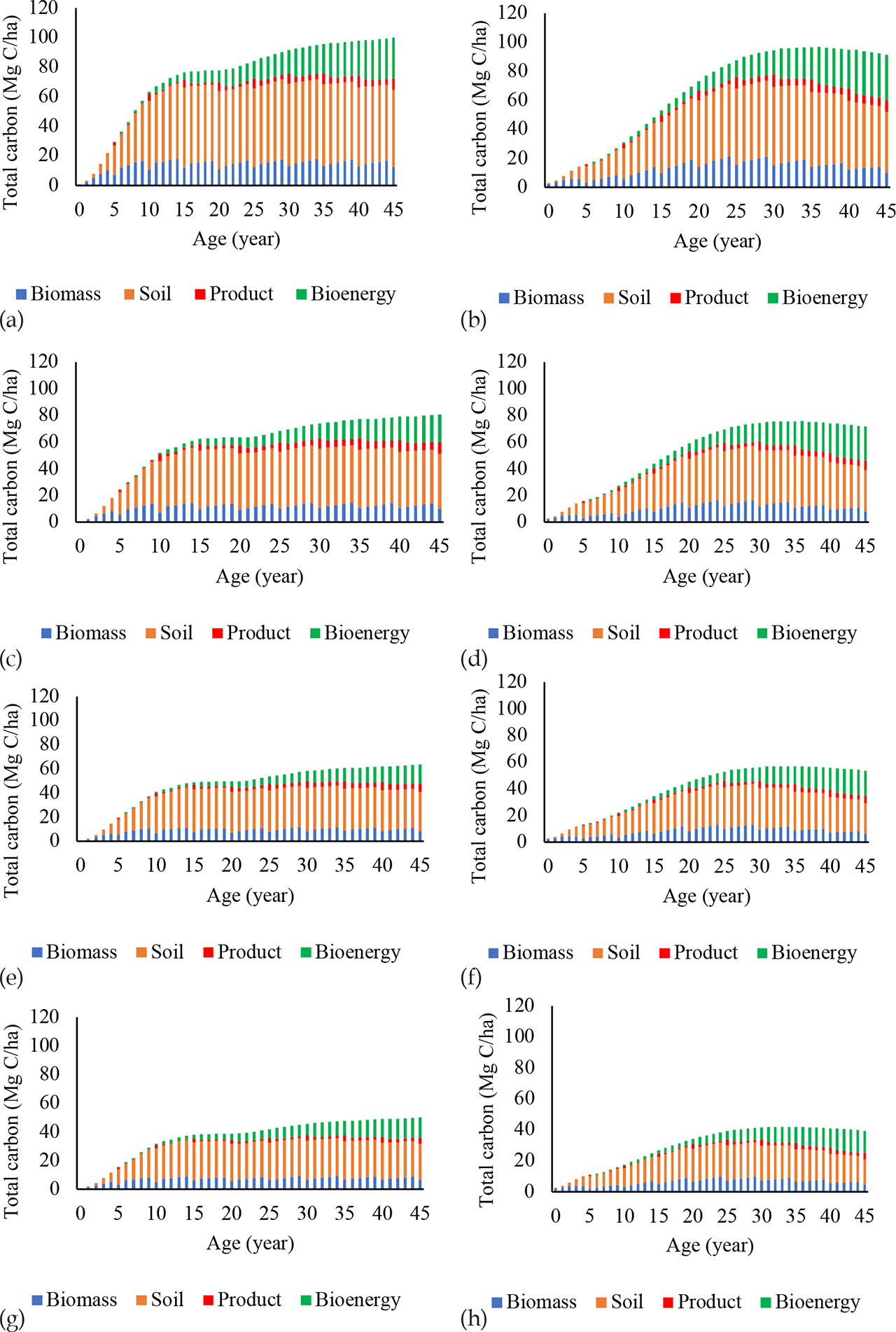
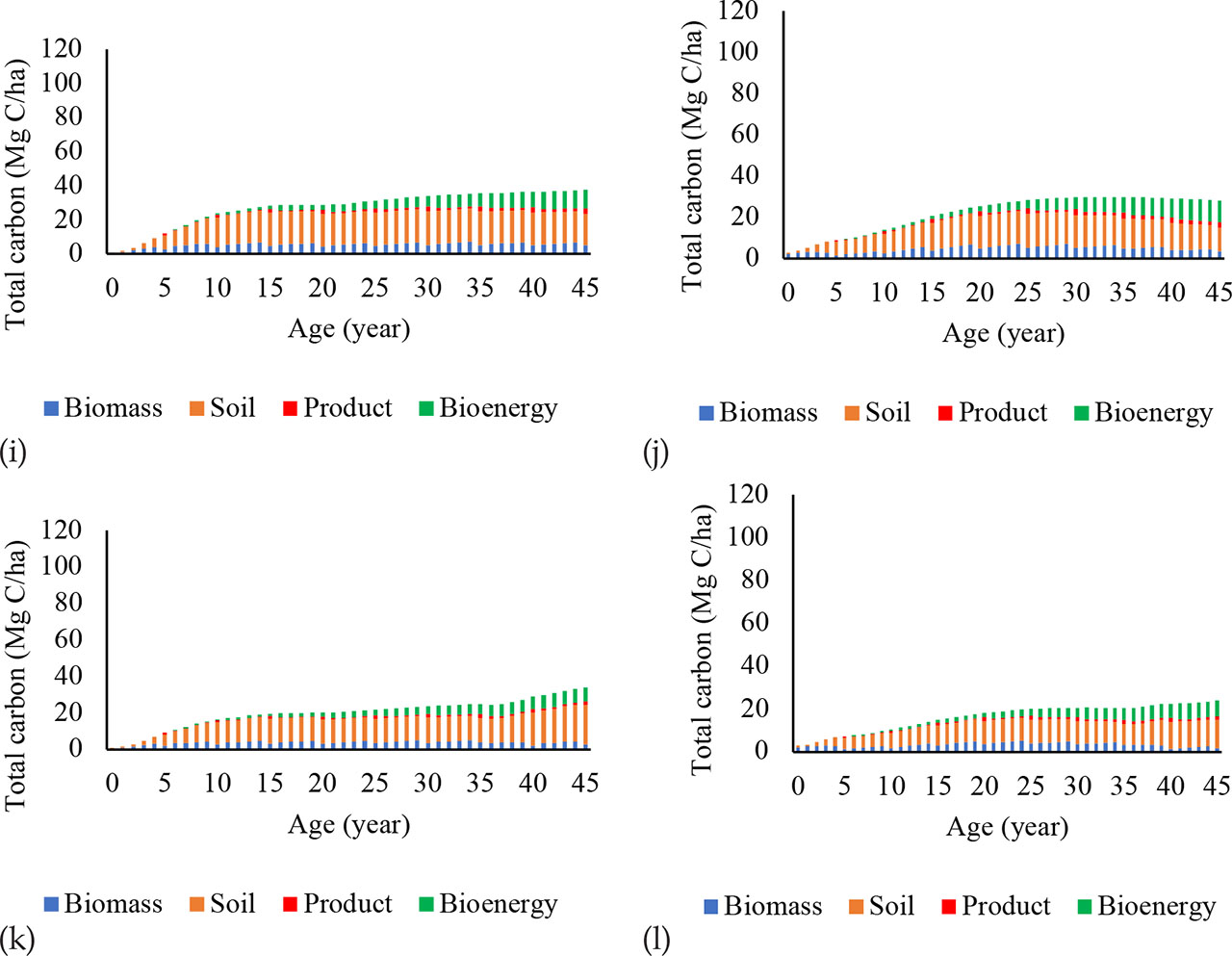
Figure 1.
Forest carbon dynamics for black locust (left) and white poplar (right) in different yield classes (started from yield class I on the upper side and yield class VI on the lower side).
Carbon dynamics in biomass
In the process of photosynthesis, plants absorb carbon dioxide from the atmosphere and store it in their organs, such as foliage, stem, branches, and roots. At the end of the rotation in the black locust and white poplar plantations, the highest carbon stock was stored in the stem, followed by branches, foliage, and root (Figure 2). Research findings similar to biomass allocation are in hybrid poplar in Canada; carbon allocation in stem and branches were 64.8% and 17.4% of the total biomass (Truax et al., 2018). For black locust in China, at the age of 38 years, the carbon allocation in stem was higher than in branches and foliage (Li & Liu, 2014).
Referring to Figure 2, the carbon stock in the individual tree was predominantly stored in the stem organ and followed by branches, foliage, and roots. The phenomena of carbon stock dominance in stems are also found in the tree species in dry forests in Indonesia (Almulqu, 2017), agroforestry system in India (Negash & Kanninen, 2015), woodlot in Zambia (Kaonga & Bayliss-Smith, 2012), bioenergy plantation in Indonesia (Mulyana et al., 2020a, 2020b), and natural regeneration and pine in Chilean Patagonia (Stolpe et al., 2010).
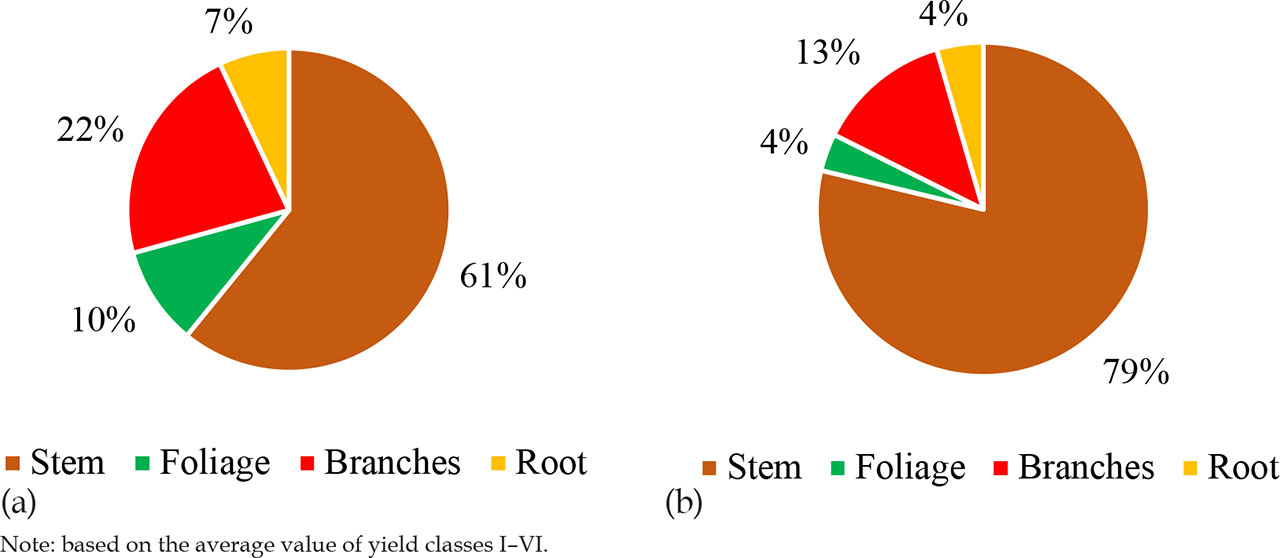
Figure 2.
Carbon allocation in tree’s organs: (a) black locust, (b) white poplar.
During the simulation period of 45 years, the biomass dynamics in black locust for the first five years have shown that the allocation in foliage, stem, branches, and roots were relatively similar around 20–30% (Figure 3). Furthermore, from the 5th to 10th year, carbon allocation in stem and branches was relatively similar, while the carbon stock in foliage and roots began to decline. After 15 years, the carbon allocation in the stem increases around 50–75% of the total tree carbon stock. Meanwhile, the carbon allocation of foliage and roots were less than 10% of the total tree carbon stock. However, the growth of white poplar differed from that of black locust in that the carbon allocation in stem was higher than in branches, foliage, and root. According to the Global Forest Resources Assessment of Hungary, the allocation of forest carbon above ground (stem, branches, leaves) was around four times that of below ground (root) during the period of 1990–2020 (FAO, 2020).
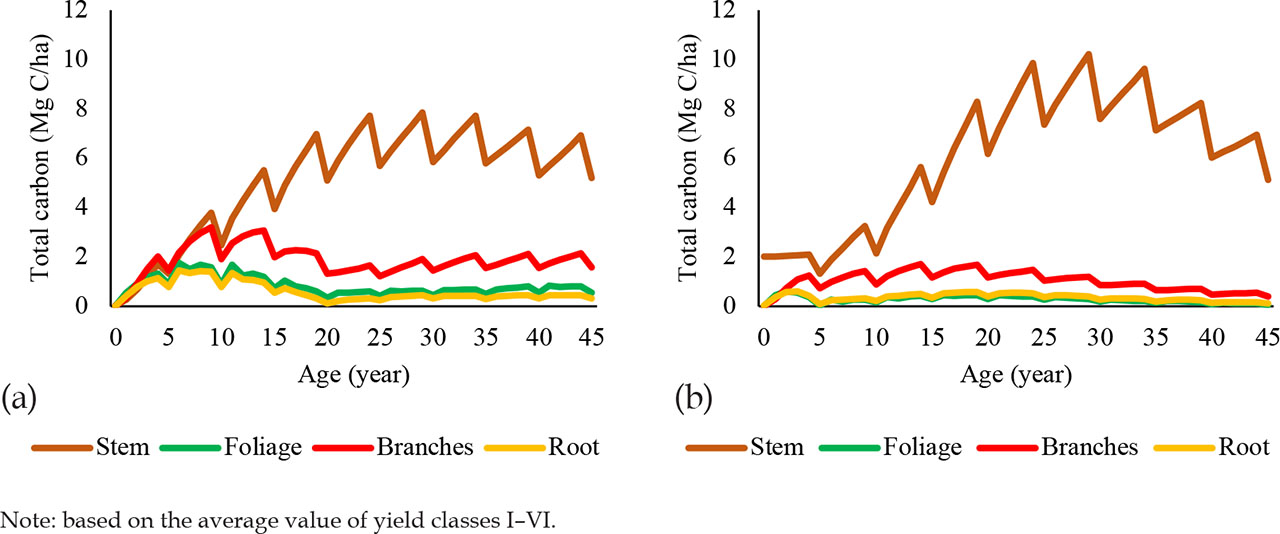
Figure 3.
Carbon dynamics in the biomass; (a) black locust, (b) white poplar.
Carbon dynamics in soil
Above- and below-ground carbon stock in black locust was higher than in the white poplar plantation (Figure 4). During the 45-year simulation, the average value of above-ground carbon stock in black locust and white poplar were 7.76 and 7.29 Mg C/ha, respectively. Moreover, the ratio between below- and above-ground carbon stock in black locust was 5.15, and in white poplar plantation it was 2.85. Below-ground carbon stock (roots and soil) in bioenergy plantations will benefit greatly in the long rotation (Truax et al., 2018). It showed that the carbon stock below ground should get more attention with regard to preserving the forest carbon stock in lithospheres. Disturbance in soil has the potential to reduce the forest carbon stock.
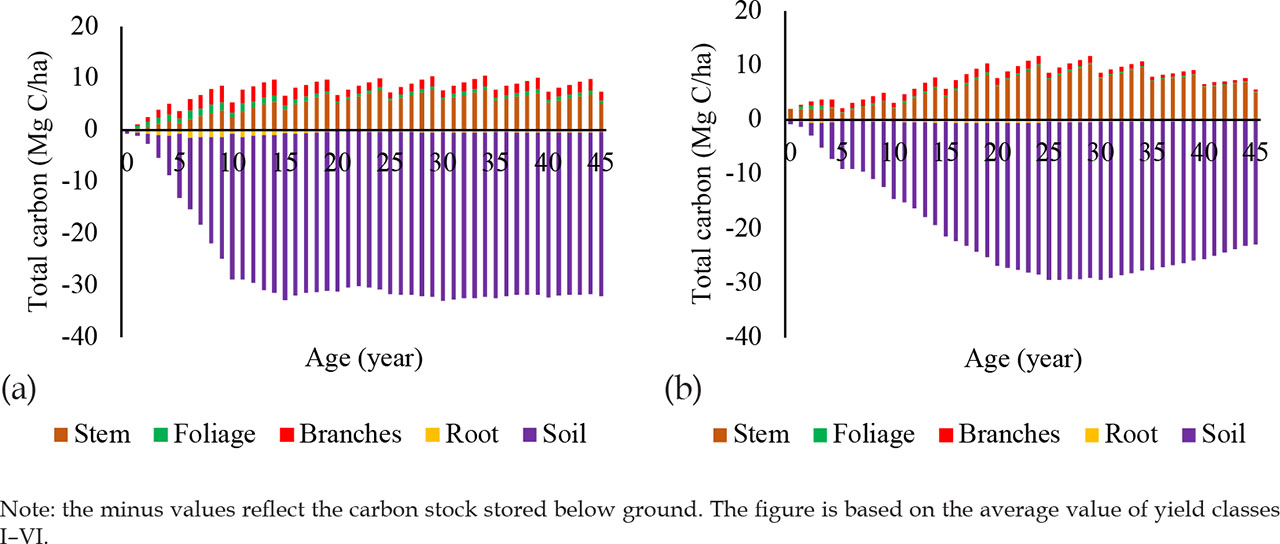
Figure 4.
Carbon dynamics in above- and below-ground carbon; (a) black locust, (b) white poplar.
In reference to Figure 2, the carbon allocation in the roots of black locust and white poplar were 7% and 4% of the total carbon stock. This means that the aboveground carbon in Figure 4 for black locust and white poplar was 93% and 96% of the total carbon stock. The most significant proportion of below-ground carbon stock has come from soil carbon. In this research, the initial carbon stock in the soil layer was 0 Mg C/ha. This followed Lemma et al. (2007), simulating the soil organic sequestration in tree plantation using CO2FIX.
According to research findings from Nabuurs & Schelhaas (2002), for 16 forest types in European countries, the long-term average carbon stock was predominantly stored below ground rather than above ground. A similar finding was also found in India’s agroforestry systems, in which the soil carbon stock was higher than the carbon stock in the tree biomass (Negash & Kanninen, 2015). Kaonga & Bayliss-Smith (2012) simulated the above-and below-ground carbon stock using CO2FIX in the woodlot area in Zambia and showed that the simulated carbon stock below ground was higher than above ground. Furthermore, based on the field measurements of soil in the woodlot area at a depth of 0–200 cm, the results showed that the carbon stock in the soil layer was higher than the simulated value (Kaonga & Bayliss-Smith, 2012). The CO2FIX simulation in a larch (Larix gmelinii var. principis-rupprechtii (Mayr) Pilg.) plantation in Weichang County, China, found that 70% of the total carbon was stored in the soil compartment (Jia et al., 2016).
Dominant factors affecting the high value of soil carbon stock were the higher litter input and composition of fine woody litter (branches and coarse roots) (Lemma et al., 2007). According to Figure 4, the below-ground carbon stock in the black locust plantation was higher than in the white poplar plantation. During the simulation period of 45 years, the average below-ground carbon stock in black locust and white poplar plantations was 35.47 and 21.16 Mg C/ha, respectively. The high value of carbon below-ground stock of black locust compared to white poplar was in line with the finding in Figure 2. In Figure 2, the composition of the leaf biomass of black locust was 10% of the total tree biomass, which is higher than the 4% of white poplar. Both black locust and white poplar are deciduous species that shed their leaves during autumn and winter. Furthermore, the fallen leaves were the input source of soil organic carbon through decomposition.
Carbon dynamics in product and bioenergy
The total carbon in the products compartment at the end of the simulation period for board, sawn mill, and pulp of black locust and white poplar was similar (Figure 5). In the yield class I for black locust plantation, the total carbon in the board, sawn mill, and pulp products was 9.61, 7.86, and 4.68 Mg C/ha, respectively. Meanwhile, the total carbon in the board, sawn mill, and pulp products at the exact class yield for the white poplar plantation were 10.79, 8.53, and 4.43 Mg C/ha. Furthermore, the total carbon for yield classes II–VI decreased gradually.
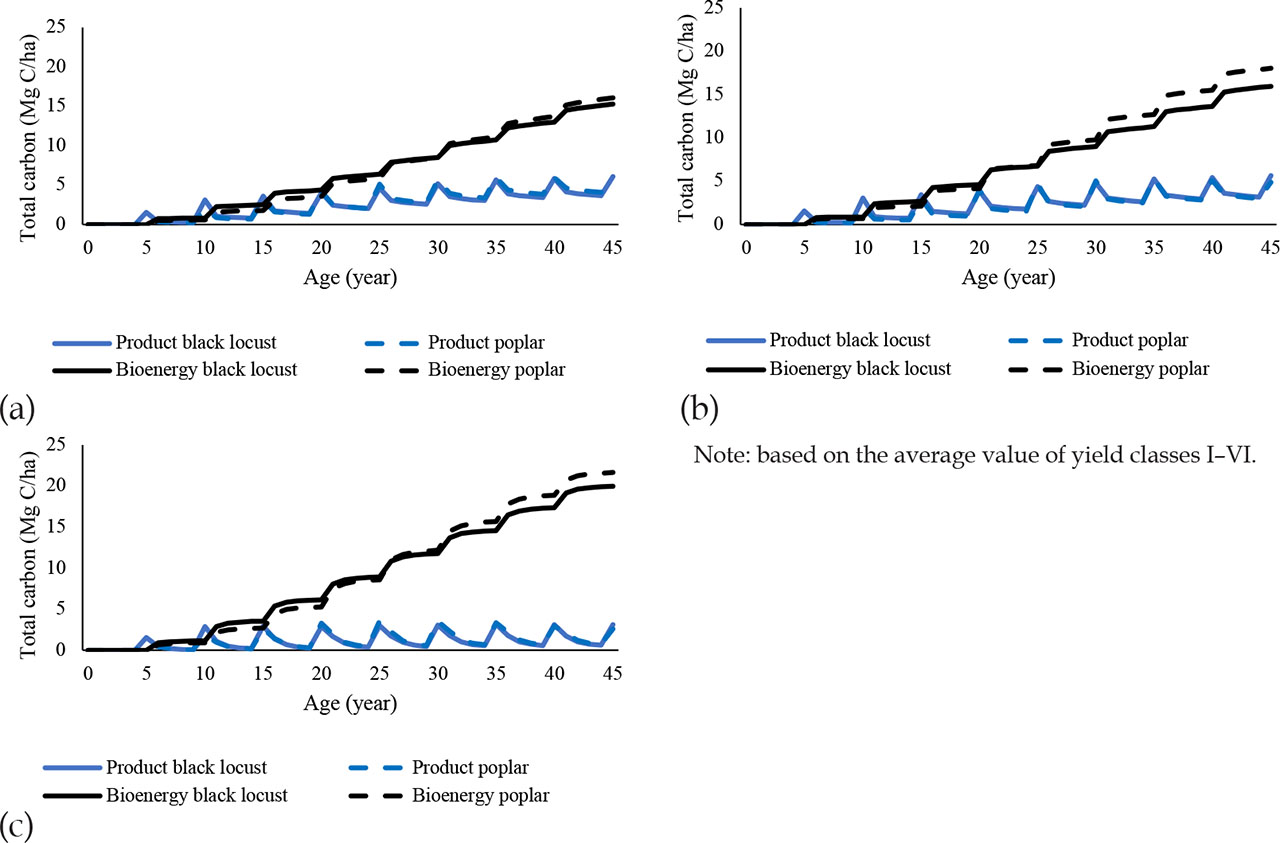
Figure 5.
Carbon dynamic in product and bio-energy compartments for: (a) board, (b) sawn mill, (c) pulp.
Carbon in the product compartment began to appear in the 5th year when the first thinning activity was carried out. Even though the trees have been harvested in the thinning activity, the carbon stock is still stored as carbon in the harvested wood products and wood residue. In this study, we assumed that the wood from thinning will be used as harvested wood product (70%) and fuelwood (30%). There is a decrease in carbon stock at thinning wood products due to the wood deterioration process and combustion of fuelwood. However, the carbon stock will increase again during the second thinning in the 10th year. Thinning activities in black locust and white poplar were carried out every 5 years.
According to Figure 5, the total carbon in the bioenergy compartment between black locust and white poplar was relatively similar. In the bioenergy compartment, the total carbon in black locust was higher in the first half of the rotation than in white poplar. However, from the middle to the end of the rotation, carbon stock in the bio-energy compartment in white poplar was higher than in black locust.
Conclusions
The highest total carbon dynamic in the simulation period of 45 years was the forest management scenario for black locust species in the class yield I to supply for the pulp industry. In contrast, the lowest total carbon dynamic was the forest management scenario for white poplar plantations in the class yield VI to supply for the board industry. Based on class yield, the total carbon dynamic of either black locust or white poplar plantation was the total carbon in class yield I > class yield II > class yield III > class yield IV > class yield V > class yield VI. Furthermore, the total carbon in black locust plantations was higher than in white poplar plantations. Regarding timber utilization, the total carbon for pulp purposes produced the highest total carbon, followed by sawn mill and board purposes.
Carbon stock below ground, especially in the soil, is greater than above ground, both in black locust and white poplar forest plantations. Soil management should pay attention to the potential carbon stock below ground. It should promote increasing the soil organic carbon through maintaining the carbon inputs, such as litter from foliage, branches, and harvested wood residue.
In this research, we realized that there are limitations in data collection. Long-term monitoring of permanent plots will be very useful to develop and validate the CO2FIX model for black locust and white poplar or other species. Due to the authors’ limited knowledge, carbon stock in the soil compartment before planting (year 0) was assumed to be 0. Research on soil carbon stock in forest plantations should be carried out to fill in the lack of information on the initial soil carbon stock. Thus, carbon dynamic modelling can be developed more accurately. However, the research findings can be considered by stakeholders in making climate change mitigation policies.
Acknowledgements
The authors thank the Tempus Public Foundation for providing the Stipendium Hungaricum Scholarship, the government of Indonesia for financial support, and reviewers for valuable comments and feedback.