
Introduction
Trees extend their branches towards light to harvest solar energy. The competition in forest stands for photosynthetically active radiation allows for tree height growth (Lindh et al., 2018; Fransson et al., 2021). The distance between the top of a tree and ground surface can be used to characterize tree height which is one of the most important variables in forest inventories. In forest mensuration, however, the reference level is taken at the position of tree root collar instead of the ground surface (Krigul, 1972; Vaus, 2005). In drained peatlands tree root collars in older forests may be exposed 0.5 m to 1 m above the ground surface, but in natural transitional bogs and raised Sphagnum spp. moss bogs the root collars of old trees are slowly buried (Burns & Honkala, 1990; Ohlson et al., 2001).
Standing tree height measurement in forests is prone to a rich budget of uncertainties (Stereńczak et al., 2019) among which the definition of the tree is the least erroneous. Standing trees in a forest stand determine the height of the stand, which is a statistically estimated variable. In forest inventories, instead of the arithmetic mean of tree heights, the tree basal area weighted mean is commonly used. Other stand height definitions, like dominant height which is based on a selection of the biggest trees of the stand, are used in the modelling of forest structure (Tarmu et al., 2020).
In forest inventories, tree height measurements can be taken from stereoscopic pairs of aerial photos (Spurr, 1948). Active sensor-based remote sensing methods like radar interferometry (Olesk et al., 2016) and airborne laser scanning (ALS) (Næsset et al., 2004) are found to be most practical and precise for forest height measurements in case of wide-territory forest inventories. Global forest height maps are constructed at various spatial resolutions (Lefsky, 2010; Simard et al., 2011) using photon counting laser scanners (lidar) and multispectral scanners on board the satellites orbiting the Earth. The Advanced Topographic Laser Altimeter System (ATLAS) on board of the recently commissioned ICESat-2 has a sufficiently small pulse footprint on top of canopy (20–30 m) which allows for forest canopy height estimation within the area of forest stands (Popescu et al., 2018; Neumann et al., 2019). Although the ATLAS on board ICESat-2 provides only samples and not continuous data cover over the territory, the samples are further used in developing models for various regional and global maps of forest inventory variables and possible systematic errors in forest height propagation into the datasets.
This study uses airborne laser scanning data and forest management inventory data to assess the ATL08 land and vegetation product (Neuenschwander & Pitts, 2019) of the ICESat-2 ATLAS mission over Estonian forests. We used a map of forest stands to extract the samples of ATLAS data. Metrics of sparse point clouds (density 0.5–2 m−2) from a regional ALS mapping database were used to validate the forest canopy heights given in the ATL08 dataset. Regression modelling was used to estimate the significance of forest canopy cover, share of evergreen coniferous trees in stands, forest site type, and ATLAS measurement geometry to the relationships between the 95th percentile of ALS point cloud height distribution and predictions of forest canopy height in the ATL08 dataset.
Material and Methods
Study site
The study includes the entire Estonia except its western islands (Figure 1), covering an area of 40,000 km2. Estonia is located in north-east Europe with its centre coordinates found approximately at 25.6° E, 58.8° N. The ground surface topography is flat with ground elevation rising from the north and west towards the south and east (Arold, 2005). Recognizable hills with local relative height greater than a few dozens of metres can be found in the south and south-east Estonia (Arold, 2005).
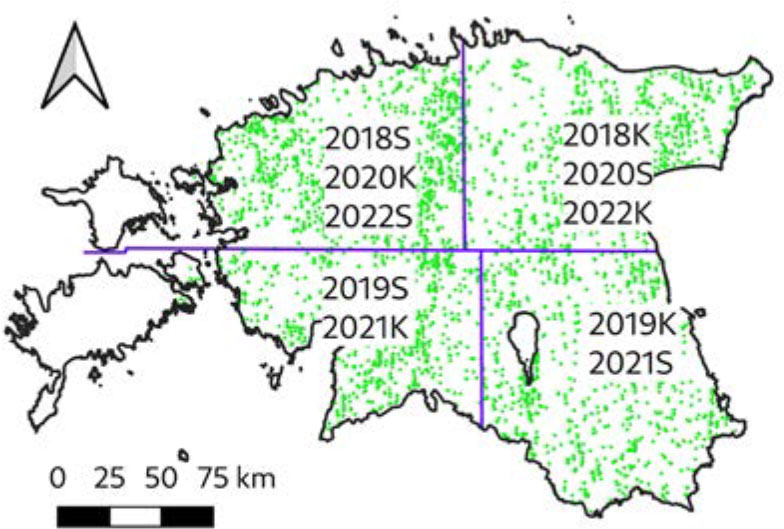
Figure 1.
Density of ICESat-2 ATLAS measurements and years of airborne laser scanning (ALS) data. Labels for the Estonian ALS data are “S” for summer and “K” for spring.
Joonis 1. ICESat-2 ATLAS mõõtmiste paiknemine ja Maa-ameti aerolaserskaneerimise aastad. Märgised näitavad suvist ja kevadist aerolidari andmestikku.
The forests in Estonia are dominantly composed of evergreen coniferous Norway spruce (Picea abies (L.) H. Karst.), Scots pine (Pinus sylvestris L.), and broadleaf deciduous European aspen (Populus tremula L.), silver birch (Betula pendula Roth), downy birch (B. pubescens Ehrh.), black alder (Alnus glutinosa (L.) Gaertn.), and grey alder (A. incana (L.) Moench). A diverse nomenclature of soil types is present in forest land ranging from mineral soils (Leptosols, Cambisols, Luvisols, Rectisols, Luvisols) to Histosols (Kõlli et al., 2004). Abundant grasses and bushes can be found below forest stands growing on fertile soils.
According to the Estonian National Forest Inventory the forest cover in Estonia is 53.5% (Valgepea et al., 2023). Mature forest height remains usually below 35 m (Tappo, 1982). Multi-layer forests are common with Norway spruce and other shade-tolerant species growing below the upper canopy. The average stand size is 1.24 ha, with larger stands found more frequently in state forests (Valgepea et al., 2023). The forests usually develop a dense canopy cover which is modified with thinnings and maintenance fellings in managed forests. Retention forest management is dominant (Gustafsson et al., 2012) with retention trees left growing on regeneration felling areas, including so called clear-cuts. The maximum allowed clear-cut area is 2–7 ha depending on the forest type (Forest Act, 2023) and this yields and maintains a diverse forest landscape. The share of protected forests with limited or entirely prohibited management interventions is 30.3% (Raudsaar et al., 2023).
Forest register and inventory data
The Estonian Forest Register is maintained by the Environment Agency and is a database of forest management inventory data. The database contains tabular data and stand border maps. The database was used to identify forest stands that are sufficiently large to contain at least two ICESat-2 ATLAS observations. The stand boundaries were shrunk by 20 m to exclude edge effects and ICESat-2 ATLAS pixels that extend over different stands. The forest register was used to assign a data flag indicating dominance of evergreen coniferous tree species in ICESat-2 ATLAS pixel locations. Only the ICESat-2 ATLAS pixels were used in the following analyses that had been inventoried in the year of ATLAS measurements.
The ATLAS lidar on board ICESat-2
ATLAS is the only instrument for Earth observation on board ICESat-2. ATLAS is a photon counting laser scanner that emits green light (532 nm) pulses at 10 kHz frequency (Neumann et al., 2019). The pulses are narrow (<1.5 ns) and have an about 17 m footprint size on the ground at 500 km average orbital altitude of ICESat-2. The combination of pulse frequency and spacecraft velocity of about 7 km s−1 yields a ground sampling distance of 0.7 m on the ground.
The laser pulse energy is split into six exiting laser beams from which three strong beams have an energy ratio of about 1:4 compared to weak beams. The distance on ground of weak and strong beams in a pair is approximately 90 m and the three footprints of pairs have an about 3.3 km separation distance in the across track direction (Neuenschwander & Pitts, 2019). At the equator, the distance between the reference ground tracks (the imaginary lines through the six-beam patterns) is 28.8 km. The areas between the reference ground tracks are covered by ICESat-2 ATLAS by the changing off-nadir pointing angle of the satellite after every 91 days (Markus et al., 2017).
The orientation of ICESat-2 is changed 180° about every 9 months to direct radiators away from the sun and to maximize illumination of the solar panels (Brunt et al., 2019) and this operation swaps the strong and weak beams in tracks GT1L, GT1R, GT2L, GT2R, GT3L, and GT3R because the light path inside the ATLAS is fixed.
The canopy height product is quantified within discrete 100-meter segments. Concurrently, canopy height values are derived for smaller 20-meter segments (pixels) from the same measurement dataset. The geographic coordinates corresponding to each canopy height measurement are centred within the 100-meter segment from which the measurement originates.
Preparation of ICESat-2 ATLAS ATL08 dataset
In our analysis, ICESat-2 data (version 006) were acquired from the NASA Earth-data website for Estonia during the years 2019–2022, focusing on the summer and early autumn months (June, July, August, and September). Our examination concentrated on the juxtaposition of the canopy height data obtained at 20-meter segments with the information contained within the Forest Registry. Only ICESat-2 data points situated at a minimum of 20 metres inward from the perimeter of forest compartments were chosen for analysis. Furthermore, the ICESat measurements and the inventory dates recorded in the Forest Registry had to originate from the same calendar year. To ensure adequate spatial representation, a minimum of two ICESat pixels per compartment were required for inclusion in the analyses. Adhering to these criteria, the mean ICESat-derived canopy height per parcel was computed and juxtaposed with the corresponding height recorded in the Forest Registry.
Airborne laser scanning data
The ALS measurements are done by the Estonian Land Board using Riegl VQ-1560i (RIEGL Laser Measurement Systems GmbH, Riedenburgstraße 48, A-3580 Horn, Austria) operated in discrete return registration mode. In this study we used data from the years 2018 until 2022 (Figure 1). The point clouds have a density of 0.8 m−2 in summertime measurements and 2.0 m−2 in spring measurements which result in a lower flight altitude. The ALS pulse footprint in nadir direction is 0.56 m in summertime data. The springtime ALS measurements start after snowmelt and are carried out for one quarter of Estonia. Usually, the measurements are completed before final leaf unfolding of the trees. The summertime ALS measurements are carried out after final leaf unfolding when the springtime project is completed.
The ALS data processing was done using FUSION/LDV (McGaughey, 2020) tools. The ground surface elevation model was obtained from the Estonian Land Board. All pulse returns with a height over ground greater than 1 m were used for height distribution metrics. First returns were used to calculate canopy cover (Lang, 2010; Jennings et al., 1999) (KALS, %) at a 2 m reference height over ground. All ALS metrics were calculated for 20 m that extended over each dataset shown in Figure 1. The constructed map pixels are about the same size as the ICESat-2 ATLAS ATL08 pixel on the ground. The ATL08 pixel boundaries were transformed into the Estonian base map coordinate system EPSG:3301. The ZonalStatistics plugin in QGIS 3.18 was used to extract ALS metrics for each ATL08 pixel.
Dataset cleaning and outlier removal
Preliminary analysis showed that the best matching ALS metrics to ATL08 forest height from ALS was the 95th percentile (HALS) of point cloud height distribution. The finding was in concordance with conclusions made by Neuenschwander & Pitts (2019). However, before further seeking the possible influential factors that may be significant for the ATL08 forest height (HICESat) determination, the combined ALS and ATL08 dataset had to be cleaned from outliers. Filters were imposed on the data-set to remove pixels: (1) where ATL08 forest height was greater than 35 m, (2) that were located within forest stands where the KALS and HALS decreased substantially between ALS measurements (ALS data from 2018 was used for this filter), (3) that were located in stands where the range of HALS was greater than 8 m, and finally (4) that were in stands with less than one remaining ATL08 pixel. About 100 pixels were removed manually according to scatterplots of data. The outliers were mostly found in stands with larger retention trees and low canopy cover.
After removal of outliers the dataset contained 12,711 observations from summers in 2019–2022 with HICESat mean value in the range of 15–17 m which in turn was very similar to the mean forest height (HFI) estimated from the forest inventory data (Table 1). The relative standard deviation around the mean values was 30–40% of mean height which is explained by the diversity of stands in the sample. The determination coefficient was 0.85 for a linear model fitted for 3,065 stands between stand mean HICESat and HFI with the model residual error remaining 2.7 m. The average HICESat was about 0.3 m greater than HFI, and the difference may be a combined result from forest height definitions and the underlying methods in both datasets.
Table 1.
The counts of ICESat-2 ATLAS ATL08 dataset pixels, their mean height (H) and standard deviation of height (SH) by measurement year and month compared to the forest mean height.
Tabel 1. Metsa keskmine kõrgus (H) ja standardhälve (SH) ICESat-2 ATLAS pikslitel andmestikus ATL08 mõõtmisaja järgi võrrelduna puistute takseeritud kõrguse keskmisega.
| Year-month Aasta-kuu | ICESat-2 ATLAS ATL08 | Forest inventory / Puistud | ||||
|---|---|---|---|---|---|---|
| Count Arv | H (m) | SH (m) | Count* Arv | H (m) | SH (m) | |
| 2019-06 | 568 | 16.9 | 8.1 | 144 | 16.7 | 8.2 |
| 2019-07 | 204 | 15.0 | 5.9 | 57 | 15.0 | 5.9 |
| 2019-08 | 650 | 17.5 | 7.2 | 165 | 17.0 | 7.1 |
| 2019-09 | 546 | 18.6 | 7.7 | 144 | 18.3 | 7.7 |
| 2020-06 | 520 | 18.0 | 6.5 | 128 | 17.6 | 6.6 |
| 2020-07 | 1269 | 17.7 | 7.0 | 312 | 17.5 | 7.2 |
| 2020-08 | 613 | 18.0 | 6.7 | 144 | 17.4 | 7.1 |
| 2020-09 | 1019 | 17.7 | 6.8 | 255 | 17.3 | 6.7 |
| 2021-06 | 1316 | 16.7 | 6.7 | 308 | 16.2 | 7.0 |
| 2021-07 | 1158 | 17.5 | 7.1 | 269 | 17.2 | 6.8 |
| 2021-08 | 504 | 17.3 | 6.8 | 150 | 17.2 | 6.9 |
| 2021-09 | 377 | 17.0 | 6.9 | 98 | 16.8 | 6.6 |
| 2022-06 | 926 | 18.1 | 6.8 | 245 | 18.3 | 6.7 |
| 2022-07 | 1034 | 17.1 | 6.8 | 274 | 17.0 | 6.6 |
| 2022-08 | 959 | 17.7 | 7.2 | 243 | 17.2 | 7.2 |
| 2022-09 | 1048 | 17.4 | 6.6 | 250 | 17.3 | 6.6 |
Analysis of terrain elevation models
Canopy height metrics in laser scanning are calculated relative to ground surface elevation. For the ALS dataset we used the digital terrain model constructed by the Estonian Land Board. The ICESat-2 ATLAS ATL08 dataset includes ground surface elevation estimates for each pixel calculated from the photon tracking. We used regression modelling to discover relationships between the two ground elevation estimates which use different projection and geodetic datums. The ATL08 pixel location geographic coordinates were tested as explanatory variables in the models.
Relationships between canopy surface models
In the analysis, subsets of observations were drawn from the database with the condition of equality of the ALS measurement year and ICESat-2 ATLAS measurement years. Since only summertime data was used from the ICESat-2 ATLAS ATL08 dataset, the measurement month information was not used in data partitioning.
We assumed linear relationships between HICESat and HALS. Following the observations made by Moudrý et al. (2022) about the influence of beam energy on canopy height predicted from ICESat-2 ATLAS data, we first analysed the dependence of the difference HALS-HICESat on the measurement track. With the help of box-plots (Figure 2) it was confirmed that the beam energy in combination with the track may have a small systematic influence, and track label (six levels) and also the beam energy level factor (according to the sc orient parameter in ATL08) were included into models. While canopy cover may have an influence on the HICESat according to Neuenschwander & Pitts (2019) the ALS-based KALS was included into models. The factor of coniferous evergreen species dominance on pixels was included to account for deeper pulse penetration into the canopy in case of springtime ALS measurements. Because forest canopy structure may depend on growth conditions, we used a factor discriminating between deep peat soils from other soils. We used a threshold of 15% of organic carbon content in soil imposed to the dataset published by Kmoch et al. (2021). The threshold separated the deep Histosols from other soils well when results were checked against other soil maps in Estonia and forest site type codes in the forest inventory database.
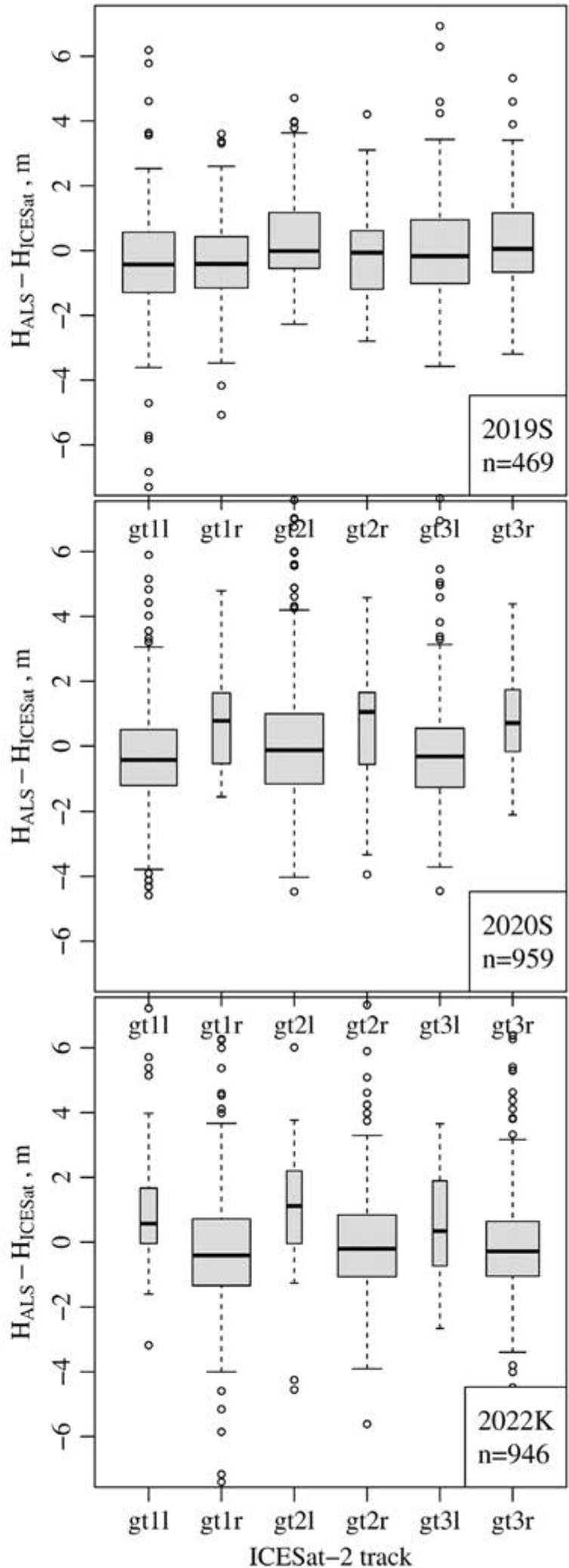
Figure 2.
Examples of the influence of ICESat-2 ATLAS scanning track on height difference of canopy surface height calculated from airborne laser scanning (ALS) data and ICESat-2 data ATLAS. The legend shows the ALS measurement time and number of observations. Labels for ALS data are “S” for summer and “K” for spring. Only strong impulses are shown for 2019; in 2020 and 2022 individual tracks contained only strong or weak impulses.
Joonis 2. Näiteid satelliidi ICESat-2 ATLAS skaneerimisraja mõjust satelliidilt ja lennukilt laserskanneriga (ALS) mõõdetud taimkatte pinna kõrguse erinevusele. Legendil on toodud ALS mõõtmisaeg ja ICESat-2 ATLAS pikslite arv. 2019. aasta suve andmetes on näidatud ainult tugevad impulsid, 2020. ja 2022. aasta andmetes sisaldasid rajad ainult nõrku või tugevaid impulsse.
Model equations (1) – (7) were constructed where bx are estimated parameters, Sspecies is a factor for evergreen coniferous dominance, Psoil is an indicator of deep peat soil, TICESat.trac is the factor for ATLAS track, TICESat.beam is a binary factor separating strong and weak energy beams in the ATL08 dataset, and ε is the model residual error. The model parameters were estimated with least squares fitting in R version 4.2.2 (R Core Team, 2022). The determination coefficient, model residual error and significance of parameters were used to assess the impact of factors that may explain the relationships between the observed HALS and HICESat.
Results
Ground surface elevation models
On average, the ground surface elevation in ICESat-2 ATLAS ATL08 (ZICESat) was 18.92 m greater (standard deviation 1.21) than the Estonian digital ground surface model (ZALS). The systematic difference is caused by geodetic datums, because there was almost a functional linear relationship
with the residual standard error of 1.2 m and determination coefficient R2=0.9982 at 3476 degrees of freedom. However, scatterplots (Figure 3) revealed that there are systematically deviating clusters from the main relationship.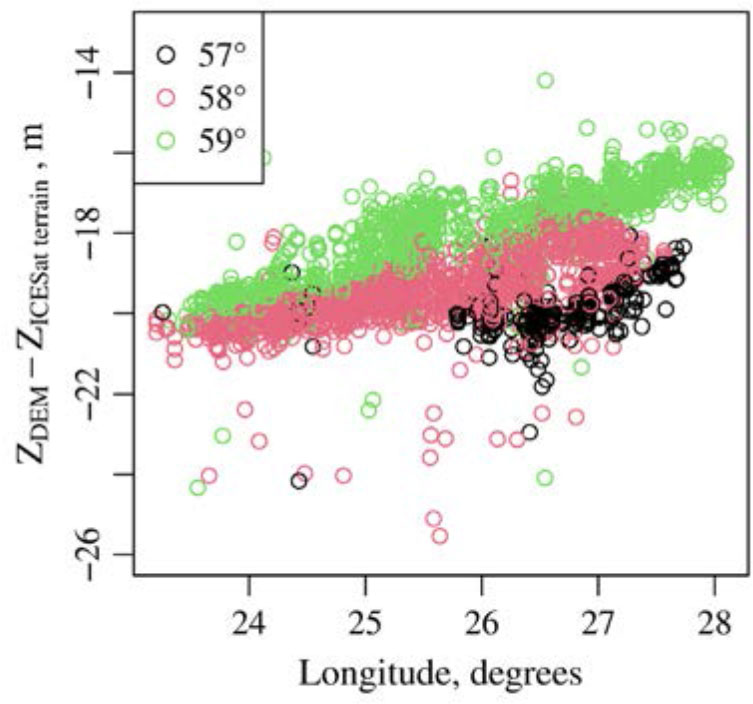
Figure 3.
Difference between the Estonian digital terrain elevation model (DEM) and the model used for ICESat-2 ATLAS ATL08 as a function of longitude and latitude (expressed with colour).
Joonis 3. Eesti ja ICESat-2 ATLAS ATL08 maapinna kõrgusmudelite erinevus sõltuvalt geograafilisest asukohast (värv vastab laiuskraadile).
We found that the geographic latitude λ and longitude φ of pixel location explained most of the clustering shown in Figure 3 when inserted into the regression model
The model (9) had R2=0.9997 and a much decreased residual error of 0.51 m. Other variables like soil type, the share of coniferous trees, and forest canopy cover were not significant if added additionally into the model (9). This residual error indicates that ground elevation errors in the ICESat-2 ATLAS ATL08 dataset do introduce some uncertainty into the canopy height predictions. The error is comparable to grass layer and shrub layer height in forest under-storey. The reasons for outliers in Figure 3 were not explained by the variables in our datasets. For comparison, the ZICESat was converted to the reference system of ZALS that is based on the EST-GEOID2017 model (Ellmann et al., 2019). We used a converter published on the Estonian Land Board web page. The ZICESat remained on average 15 cm higher than ZALS with a standard deviation of 41 cm. This is about the same uncertainty as shown by the model (9).
The airborne lidar data-based canopy height explained 89–95% of the variability in canopy height prediction in the ICESat-2 ATLAS ATL08 dataset according to the determination coefficient of linear models (Table A1.1 in Appendix 1). The residual error remained between 1.6 m and 2.0 m. Surprisingly, the additional variables that described forest canopy cover, site conditions and ICESat-2 ATLAS measurement geometry had only marginal power to explain the rest of variability. Even if parameter estimates for the additional model variables were frequently significant (Table A1.2 in Appendix 1), the increase in the model determination coefficient was marginal and model residual error decreased less than 10–20 cm. Neither the visual inspection of scatterplots (Figure 4) nor inclusion of pixel location data into models revealed any dependence of the variability in the geographic location of pixels as it was found in the case of ground elevation models. The unexplained residual scatter is probably related to the small number of registered backscattered photons (0–4) per emitted pulse (Neuenschwander et al., 2022).
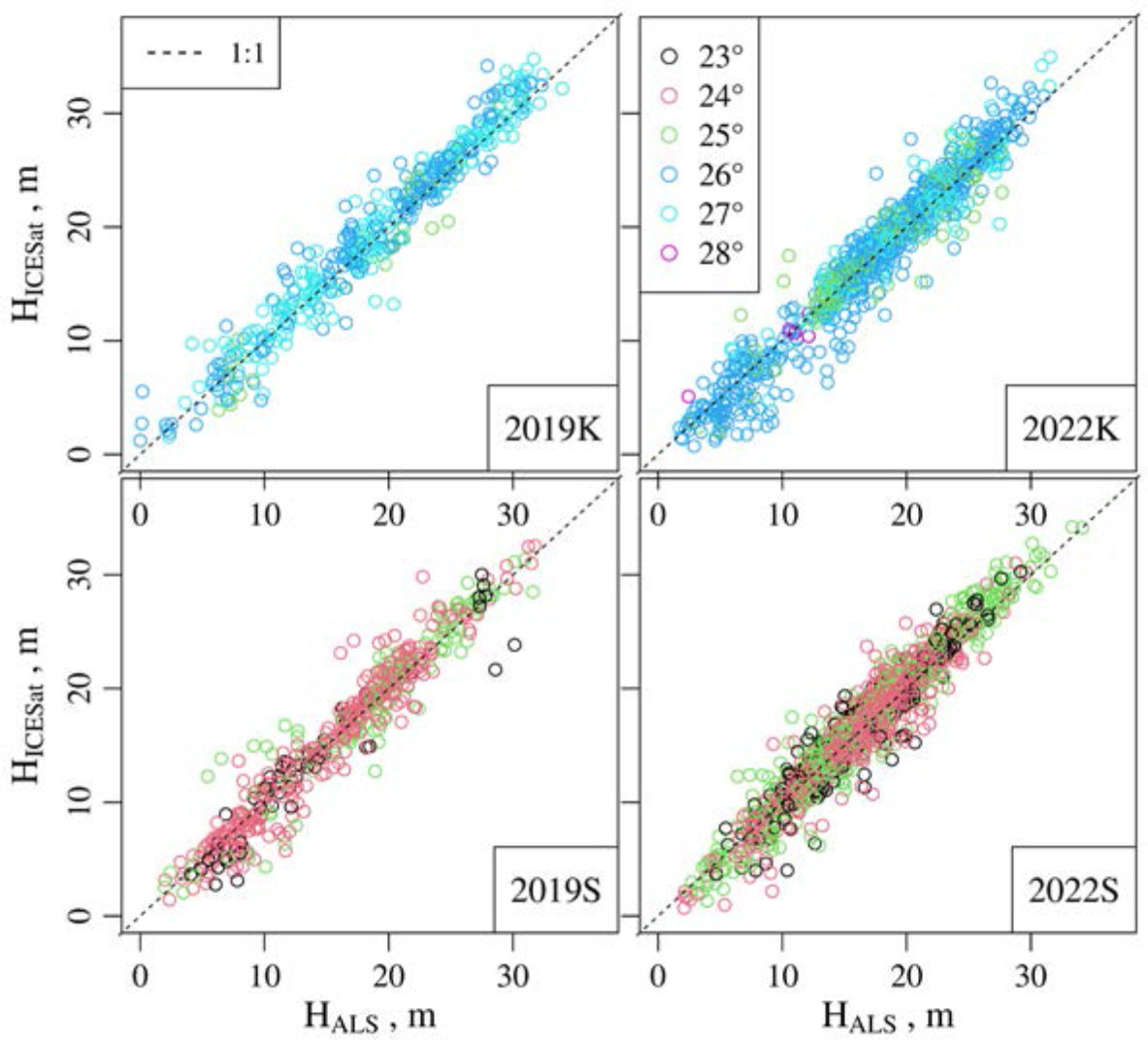
Figure 4.
Examples of the 95th percentile of airborne laser scanning (ALS) point cloud height distribution and ICESat-2 ATLAS canopy surface height by year and growth season when ALS was done. The symbol colour corresponds to the ICESat-2 pixel location longitude.
Joonis 4. Lennukilt (ALS) ja kosmoselidariga ICESat-2 ATLAS tehtud lasers-kaneerimise andme-test arvutatud puistu pinnamudeli võrdlus ALS mõõtmisaja järgi. Sümboli värv kirjeldab ICESat-2 piksli asukoha geograafilist idapikkust.
Canopy cover was almost always a significant variable if added alone or with others into the models. The share of evergreen coniferous trees in stand species composition was also significant in most of the models. The indicator of peat soil was significant, but the significance was much less compared to canopy cover (Table A1.2 in Appendix 1). The beam energy indicator variables were significant for measurements from the year 2020 and later. Most likely, the residual error is caused by the uncertainties in the ICESat-2 ATLAS pixel location coordinates, noise in the photon counting, and errors in determining ground surface elevation. Part of the unexplained residual variability is related probably to the optical properties and structure of trees combined with the spatial location pattern of the trees on the ICESat-2 ATLAS pixel.
Discussion and Conclusion
In forest inventories, stand height is a statistical basal area weighted mean of individual tree heights, but in the case of large footprint-based signal ranging measurements the result of photon vertical distribution interpretation is more likely a variable that describes the canopy surface. In managed forests the HFI can be assumed to have a strong correlation with canopy surface maximum height, and this was confirmed by our datasets where HICESat was on average only about 0.3 m greater than HFI, however, the residual error of the linear relationship was 2.7 m. The residual error is 15.8% of the mean HFI, and the result is similar to the conclusions of Moudrý et al. (2022). However, in our test area, there was no such systematic underestimation of HFI as 2.1 m reported by Moudrý et al. (2022), which may be the effect of more versatile terrain topography in their test area. Feng et al. (2023) compared a new 30 m × 11 m spatial resolution version of the ATL08 height product to airborne laser scanning data-based canopy height and report root mean square error of 4.57 m and a 0.88 m greater mean height in the case of ATL08.
One error source in ranging systems-based forest height prediction is ground elevation data. In our test site the ATL08 ground elevation almost followed the 1:1 line with the Estonian official terrain model elevation except a 19 m systematic difference caused by geodetic datums. If pixel location geographic coordinates were included as regression model predictive variables, the unexplained residual was only 0.51 m. This is about six times smaller compared to the 3.19 m shown by Feng et al. (2023), who had a test area in North America with 215,487 ATL08 samples, however, their test site had many mountainous regions. Feng et al. (2023) conclude that topography and particularly slope is one of the major factors regulating terrain elevation accuracy and, hence, the precision of canopy height predictions.
The design of ICESat-2 ATLAS includes three beams with high energy and three beams with low energy. Moudrý et al. (2022) show that canopy height underestimation occurs in pixels targeted with the weak beams compared to strong beams. While the influence of ATLAS beam power on the ATL08 canopy height was confirmed in our preliminary analyses too, the factor was included as an explanatory variable into models. However, the influence on the residual error and determination coefficient in regression models for predicting HICESat from HALS was marginal. While the evergreen coniferous species dominance and deep peat soil indicator were also significant, the canopy cover was the only variable somewhat increasing the predictive power of the models. However, the decrease in the model residual error was only 10–20 cm compared to using HALS alone which is much less than the residual error of 1.6–2 m of the models. The sources of the unexplained variability cannot be explained with ALS metrics or tree species composition, and this indicates the limit of precision achievable for homogeneous forest canopy height prediction using summertime ICESat-2 ATLAS photon counting and ranging measurements.
From the study we conclude that both ICESat-2 ATLAS beam types can be used for forest canopy height prediction if they are identified in the models to account for the beam data characteristics. This can substantially increase the number of ICESat-2 ATLAS observations. Information about tree species and canopy cover can be also significant in explaining variability in ICESat-2 ATLAS ATL08 canopy height, however, from an application perspective, the variable values have to be known beforehand to use them in predictive models. In summary, the ICESat-2 ATLAS ATL08 canopy height is a reliable data source for forest canopy height over hemiboreal managed forests growing on flat terrain.
Acknowledgements
The study was supported by the Estonian Research Council grant PRG2214 and by the Cross-Sectoral Mobility Measure (SekMo) project no. 2021–2027.1.01.23-0169, co-funded by the European Union and administered by the State Shared Service Centre. The authors thank the Estonian Land Board for making its ALS data available for the study. They also thank anonymous referees for reviewing their manuscript.
Puistute kõrguse hindamine kosmoselidari ICESat-2 ATLAS andmestikust ATL08 metsa takseerimiseks ja seosed aerolidari punktiparve meetrikaga
Mait Lang, Tauri Tampuu ja Heido Trofimov
Kokkuvõte
Puu kõrgus on vertikaalne vahemaa juurekaela tasandist puu ladva tasandini (Krigul, 1972; Vaus, 2005). Kasvavate puude kõrguse mõõtmisel esineb määramatusi ning vigu (Stereńczak et al., 2019). Puistu kõrgus on statistiline suurus, mida hinnatakse puude kõrguste kaudu ja kasutusel on erinevaid definitsioone (Tarmu et al., 2020). Metsa takseerimisel saab puistu kõrgust mõõta aerofotode stereopaaridelt (Spurr, 1948) ja tänapäeval mitmesuguste aktiivsete vahekauguse mõõtmise sensorite nagu radarite ja lidarite abil (Næsset et al., 2004; Olesk et al., 2016). Kosmoselidar Advanced Topographic Laser Altimeter System (ATLAS) satelliidil ICESat-2 sondeerib maapinnal 20–30 m läbimõõduga alasid (Popescu et al., 2018; Neumann et al., 2019), mis võimaldab saada puistu kõrguse hinnanguid. Siinses töös analüüsiti ICESat-2 ATLAS aastatel 2019–2022 suviste mõõtmiste tulemis ATL08 (Neuenschwander & Pitts, 2019) oleva taimkatte kõrgust iseloomustava tunnuse HICESat sobivust Eesti puistute kõrguse hindamiseks. Katseala hõlmas praktiliselt kogu Eestit (joonis 1) ja peale erindite eemaldamist jäi andmestikku 12 711 ATL08 20×20 m pikslit, mis asusid 3065 ühtlase võrastikuga puistus. Taimkatte kõrguste andmestiku analüüsimiseks kasutati regressioonmudeleid (1) – (7), mille abil seostati HICESat takseeritud kõrguse HFI või Maa-ameti aerolidari andmestikust arvutatud punktipilve kõrgusjaotuse 95-protsentiiliga HALS, arvestades okaspuude domineerimisega (Sspecies), sügava turbamulla (Psoil) esinemisega ja ATLAS skaneerimisraja ja laserkiire energiasisalduse (TICESat.trac ja TICESat.beam) mõjuga ATL08 pikslitel (joonis 2). Maapinna kõrguse määrangute täpsust ATL08 pikslitel uuriti Maa-ameti loodud maapinna kõrgusmudeli suhtes ja leiti, et piksli geograafilise asukoha (joonis 3) arvestamisel on seose determinatsioonikordaja R2=99,97% ja mudeli (9) jääkhälve 0,51 m. Umbes 19-meetrine süstemaatiline erinevus tulenes maapinna kõrguse referentssüsteemide erinevusest.
Puistute takseeritud kõrgus oli keskmiselt väga lähedane HICESat keskmisele (tabel 1) ja puistute tasemel lineaarseose R2 = 85% ja jääkhälve δ = 2,7 m. HFI oli keskmiselt 0,3 m väiksem kui HICESat. Kosmosest mõõdetud puistute kõrguste variatsiooni (joonis 4) seletas väga hästi HALS (89% ≤ R2 ≤ 95%, 1,6 m ≤ δ ≤ 2,0 m), muud tunnused olid ka mudelites olulised, aga nende lisamine mudeli statistikuid praktiliselt ei parandanud (tabel A1.1 ja A1.2 lisas 1). Tulemustest saab järeldada, et tulemi ATL08 taimkatte kõrguse hinnang sobib Eestis ühtlase võrastikuga puistute kõrguse hindamiseks. Praktilistes rakendustes on soovitav kaasata mudelitesse ICESat-2 ATLAS kiire energiasisalduse faktor, et arvestada suure ja vähese tugevusega laserkiirte tagasipeegelduse andmete tõlgendamisel tekkiva mõningase süstemaatilise erinevustega taimkatte kõrgust prognoosides.
Appendices
Appendix 1.
Models
Lisa 1. Mudelid
Table A1.1.
Model coefficients. Abbreviations and variables: Eq. no – model equation number; Veg.p – vegetation period (‘k’=spring, ‘s’=summer); DF – degrees of freedom; HALS – 95th percentile of airborne lidar point cloud height distribution (m); KALS – canopy cover at 2 m reference height over ground; Conifers – TRUE if evergreen conifers dominate the pixel; Peatland – TRUE if soil is deep peat; Weak.beam – TRUE if track was illuminated by weak beam; Track – label in ICESat-2 ATLAS ATL08 dataset (GT1L, GT1R, GT2L, GT2R, GT3L, GT3R).
Tabel A1.1. Mudelite parameetrid. Lühendid ja tähised: Eq. no – võrrandi number; Veg.p – kasvuperiood (‘k’=kevad, ‘s’=suvi); DF– vabadusastmete arv; HALS – aerolidari punktipilve kõrgusjaotuse 95-protsentiil; KALS – võrastiku katvus 2 m kõrgusel maapinnast; Conifers – TRUE, kui pikslil domineerisid igihaljad okaspuud; Peatland – TRUE, kui piksel asus sügaval turbamullal; Weak.beam – TRUE nõrga impulsiga valgustatud raja korral; Track – vaatluste rada ICESat-2 ATLAS ATL08 andmestiku järgi (GT1L, GT1R, GT2L, GT2R, GT3L, GT3R).
| Model | Model variables | Track | ||||||||||||||
|---|---|---|---|---|---|---|---|---|---|---|---|---|---|---|---|---|
| Eq. No | Year | Veg.p | DF | R2 | RSE (m) | Intercept | HALS (m) | KALS (%) | Conifers | Peatland | Weak. beam | GT1R | GT2L | GT2R | GT3L | GT3R |
| 1 | 2019 | k | 422 | 0.95 | 1.77 | 0.232 | 1.015 | |||||||||
| 2 | 2019 | k | 421 | 0.951 | 1.76 | 0.073 | 0.985 | 0.012 | ||||||||
| 3 | 2019 | k | 420 | 0.951 | 1.76 | 0.077 | 0.984 | 0.013 | −0.081 | |||||||
| 4 | 2019 | k | 419 | 0.951 | 1.75 | 0.222 | 0.971 | 0.017 | −0.099 | −0.513 | ||||||
| 5 | 2019 | k | 421 | 0.95 | 1.77 | 0.311 | 1.012 | −0.379 | ||||||||
| 6 | 2019 | k | 420 | 0.951 | 1.76 | 0.159 | 0.98 | 0.013 | −0.46 | |||||||
| 7 | 2019 | k | 415 | 0.952 | 1.75 | 0.123 | 0.976 | 0.014 | −0.041 | 0.037 | −0.163 | 0.321 | 0.307 | −1.172 | ||
| 1 | 2019 | s | 499 | 0.933 | 1.88 | −0.387 | 1.026 | |||||||||
| 2 | 2019 | s | 498 | 0.934 | 1.87 | −1.124 | 0.987 | 0.018 | ||||||||
| 3 | 2019 | s | 497 | 0.935 | 1.85 | −1.561 | 0.987 | 0.02 | 0.558 | |||||||
| 4 | 2019 | s | 496 | 0.935 | 1.85 | −1.578 | 0.987 | 0.02 | 0.606 | −0.207 | ||||||
| 5 | 2019 | s | 498 | 0.932 | 1.88 | −0.396 | 1.026 | 0.115 | ||||||||
| 6 | 2019 | s | 497 | 0.934 | 1.87 | −1.180 | 0.986 | 0.018 | 0.281 | |||||||
| 7 | 2019 | s | 492 | 0.936 | 1.84 | −1.057 | 0.99 | 0.018 | 0.607 | −0.169 | −0.561 | −0.551 | −0.625 | −0.773 | ||
| 1 | 2020 | k | 1144 | 0.914 | 1.72 | −0.203 | 1.045 | |||||||||
| 2 | 2020 | k | 1143 | 0.917 | 1.70 | −0.543 | 1.00 | 0.017 | ||||||||
| 3 | 2020 | k | 1142 | 0.917 | 1.70 | −0.482 | 0.992 | 0.021 | −0.259 | |||||||
| 4 | 2020 | k | 1141 | 0.917 | 1.69 | −0.355 | 0.983 | 0.022 | −0.239 | −0.26 | ||||||
| 5 | 2020 | k | 1143 | 0.917 | 1.70 | −0.009 | 1.04 | −0.953 | ||||||||
| 6 | 2020 | k | 1142 | 0.919 | 1.67 | −0.347 | 0.995 | 0.017 | −0.944 | |||||||
| 7 | 2020 | k | 1137 | 0.92 | 1.66 | −0.204 | 0.994 | 0.018 | −0.157 | −1.299 | −0.397 | −0.791 | 0.017 | −0.984 | ||
| 1 | 2020 | s | 957 | 0.942 | 1.74 | −0.588 | 1.039 | |||||||||
| 2 | 2020 | s | 956 | 0.942 | 1.73 | −0.985 | 1.011 | 0.012 | ||||||||
| 3 | 2020 | s | 955 | 0.945 | 1.69 | −1.328 | 0.989 | 0.015 | 0.816 | |||||||
| 4 | 2020 | s | 954 | 0.945 | 1.69 | −1.357 | 0.99 | 0.014 | 0.801 | 0.089 | ||||||
| 5 | 2020 | s | 956 | 0.943 | 1.73 | −0.526 | 1.039 | −0.811 | ||||||||
| 6 | 2020 | s | 955 | 0.943 | 1.72 | −0.898 | 1.013 | 0.011 | −0.768 | |||||||
| 7 | 2020 | s | 950 | 0.947 | 1.66 | −1.015 | 0.99 | 0.014 | 0.89 | −1.264 | −0.546 | −0.855 | −0.274 | −1.396 | ||
| 1 | 2021 | k | 434 | 0.892 | 2.0 | 0.665 | 0.987 | |||||||||
| 2 | 2021 | k | 433 | 0.896 | 1.97 | 0.218 | 0.947 | 0.019 | ||||||||
| 3 | 2021 | k | 432 | 0.895 | 1.97 | 0.211 | 0.948 | 0.018 | 0.028 | |||||||
| 4 | 2021 | k | 431 | 0.896 | 1.96 | 0.242 | 0.941 | 0.021 | 0.117 | −0.48 | ||||||
| 5 | 2021 | k | 433 | 0.893 | 1.99 | 0.889 | 0.98 | −0.599 | ||||||||
| 6 | 2021 | k | 432 | 0.897 | 1.96 | 0.443 | 0.94 | 0.019 | −0.61 | |||||||
| 7 | 2021 | k | 427 | 0.898 | 1.94 | 0.4 | 0.95 | 0.017 | −0.023 | 0.143 | −1.613 | −0.008 | −1.2 | −0.223 | ||
| 1 | 2021 | s | 791 | 0.939 | 1.82 | −0.602 | 1.052 | |||||||||
| 2 | 2021 | s | 790 | 0.94 | 1.81 | −1.174 | 1.021 | 0.014 | ||||||||
| 3 | 2021 | s | 789 | 0.94 | 1.81 | −1.221 | 1.016 | 0.015 | 0.153 | |||||||
| 4 | 2021 | s | 788 | 0.94 | 1.81 | −1.313 | 1.022 | 0.014 | 0.096 | 0.22 | ||||||
| 5 | 2021 | s | 790 | 0.939 | 1.82 | −0.544 | 1.052 | −0.518 | ||||||||
| 6 | 2021 | s | 789 | 0.94 | 1.80 | −1.154 | 1.019 | 0.015 | −0.589 | |||||||
| 7 | 2021 | s | 784 | 0.941 | 1.79 | −0.633 | 1.017 | 0.015 | 0.121 | −0.432 | −1.751 | −0.625 | −1.381 | −0.631 | ||
| 1 | 2022 | k | 944 | 0.936 | 1.78 | −0.665 | 1.043 | |||||||||
| 2 | 2022 | k | 943 | 0.936 | 1.77 | −1.13 | 1.014 | 0.013 | ||||||||
| 3 | 2022 | k | 942 | 0.936 | 1.77 | −1.122 | 1.014 | 0.014 | −0.045 | |||||||
| 4 | 2022 | k | 941 | 0.936 | 1.77 | −1.133 | 1.015 | 0.013 | −0.047 | 0.048 | ||||||
| 5 | 2022 | k | 943 | 0.937 | 1.77 | −0.521 | 1.038 | −0.863 | ||||||||
| 6 | 2022 | k | 942 | 0.937 | 1.76 | −0.94 | 1.014 | 0.012 | −0.763 | |||||||
| 7 | 2022 | k | 937 | 0.937 | 1.76 | −2.184 | 1.017 | 0.011 | 0.012 | 1.306 | 0.303 | 1.061 | 1.172 | 1.204 | ||
| 1 | 2022 | s | 1374 | 0.923 | 1.64 | −0.405 | 1.041 | |||||||||
| 2 | 2022 | s | 1373 | 0.925 | 1.62 | −1.371 | 1.01 | 0.018 | ||||||||
| 3 | 2022 | s | 1372 | 0.926 | 1.60 | −1.788 | 0.999 | 0.021 | 0.508 | |||||||
| 4 | 2022 | s | 1371 | 0.926 | 1.61 | −1.771 | 0.997 | 0.021 | 0.515 | −0.037 | ||||||
| 5 | 2022 | s | 1373 | 0.924 | 1.63 | −0.303 | 1.039 | −0.497 | ||||||||
| 6 | 2022 | s | 1372 | 0.925 | 1.62 | −1.216 | 1.011 | 0.016 | −0.41 | |||||||
| 7 | 2022 | s | 1367 | 0.927 | 1.59 | −1.995 | 1 | 0.019 | 0.544 | 0.376 | −0.532 | 0.266 | 0.051 | 0.459 | ||
Table A1.2.
Significance (‘***’ 0.001 ‘**’ 0.01 ‘*’ 0.05 ‘.’ 0.1 ‘ ’ 1) of model coefficients. Abbreviations and variables are the same as in Table A1.1.
Tabel A1.2. Mudelite parameetrite olulisus (‘***’ 0.001 ‘**’ 0.01 ‘*’ 0.05 ‘.’ 0.1 ‘ ’ 1). Lühendid ja tähised on samad nagu tabelis A1.1.
| Model | Significance / Olulisus | ||||||||||||
|---|---|---|---|---|---|---|---|---|---|---|---|---|---|
| Eq. No | Year | Veg.p | Intercept | HALS (m) | KALS (%) | Conifers | Peatland | Weak. beam | GT1R | GT2L | GT2R | GT3L | GT3R |
| 1 | 2019 | k | *** | ||||||||||
| 2 | 2019 | k | *** | * | |||||||||
| 3 | 2019 | k | *** | * | |||||||||
| 4 | 2019 | k | *** | * | * | ||||||||
| 5 | 2019 | k | *** | ||||||||||
| 6 | 2019 | k | *** | * | |||||||||
| 7 | 2019 | k | *** | * | ** | ||||||||
| 1 | 2019 | s | . | *** | |||||||||
| 2 | 2019 | s | *** | *** | ** | ||||||||
| 3 | 2019 | s | *** | *** | ** | *** | |||||||
| 4 | 2019 | s | *** | *** | *** | *** | |||||||
| 5 | 2019 | s | . | *** | |||||||||
| 6 | 2019 | s | *** | *** | ** | ||||||||
| 7 | 2019 | s | ** | *** | ** | *** | * | * | * | ||||
| 1 | 2020 | k | *** | ||||||||||
| 2 | 2020 | k | ** | *** | *** | ||||||||
| 3 | 2020 | k | ** | *** | *** | * | |||||||
| 4 | 2020 | k | * | *** | *** | * | * | ||||||
| 5 | 2020 | k | *** | *** | |||||||||
| 6 | 2020 | k | * | *** | *** | *** | |||||||
| 7 | 2020 | k | *** | *** | *** | ** | ** | *** | |||||
| 1 | 2020 | s | *** | *** | |||||||||
| 2 | 2020 | s | *** | *** | *** | ||||||||
| 3 | 2020 | s | *** | *** | *** | *** | |||||||
| 4 | 2020 | s | *** | *** | *** | *** | |||||||
| 5 | 2020 | s | *** | *** | *** | ||||||||
| 6 | 2020 | s | *** | *** | ** | *** | |||||||
| 7 | 2020 | s | *** | *** | *** | *** | *** | *** | * | . | *** | ||
| 1 | 2021 | k | * | *** | |||||||||
| 2 | 2021 | k | *** | *** | |||||||||
| 3 | 2021 | k | *** | ** | |||||||||
| 4 | 2021 | k | *** | *** | . | ||||||||
| 5 | 2021 | k | ** | *** | * | ||||||||
| 6 | 2021 | k | *** | *** | * | ||||||||
| 7 | 2021 | k | *** | ** | * | * | |||||||
| 1 | 2021 | s | ** | *** | |||||||||
| 2 | 2021 | s | *** | *** | ** | ||||||||
| 3 | 2021 | s | *** | *** | *** | ||||||||
| 4 | 2021 | s | *** | *** | ** | ||||||||
| 5 | 2021 | s | ** | *** | * | ||||||||
| 6 | 2021 | s | *** | *** | *** | ** | |||||||
| 7 | 2021 | s | *** | *** | ** | ** | |||||||
| 1 | 2022 | k | *** | *** | |||||||||
| 2 | 2022 | k | *** | *** | *** | ||||||||
| 3 | 2022 | k | *** | *** | *** | ||||||||
| 4 | 2022 | k | *** | *** | *** | ||||||||
| 5 | 2022 | k | ** | *** | *** | ||||||||
| 6 | 2022 | k | *** | *** | ** | *** | |||||||
| 7 | 2022 | k | *** | *** | ** | *** | ** | * | ** | ||||
| 1 | 2022 | s | ** | *** | |||||||||
| 2 | 2022 | s | *** | *** | *** | ||||||||
| 3 | 2022 | s | *** | *** | *** | *** | |||||||
| 4 | 2022 | s | *** | *** | *** | *** | |||||||
| 5 | 2022 | s | * | *** | *** | ||||||||
| 6 | 2022 | s | *** | *** | *** | ** | |||||||
| 7 | 2022 | s | *** | *** | *** | *** | * | * | * | ||||