
Introduction
Human activities on a global scale enable an increasing number of species to colonise regions outside of their native range, establish self-sustaining populations and expand further into natural habitats. This phenomenon is known as biological invasion (Elton, 1958; Nentwig et al., 2018). Some alien species have a considerable negative environmental and socio-economic impact on their newly occupied habitats, requiring large efforts to mitigate this impact (Vilá et al., 2008; 2010; Nentwig et al., 2018).
Exotic species have long been considered valuable and desirable souvenirs imported from distant places (Nutt & Kubjas, 2020). A study of the economic uses of plant species that are invasive in various parts of the world showed that most are ornamentals (Weber, 2003). These species have been introduced for horticultural use by nurseries, botanical gardens, and horticultural enthusiasts (Reichard & White, 2001). Some of the exotic species introduced to Europe, initially planted in botanical gardens and later in parks and as urban greenery, have now become invasive (Stace & Crawley, 2015).
After the introduction of non-native tree and shrub species into Europe, their acclimatization and propagation for landscape gardening began. Alien tree and shrub species were often planted in parks and urban greeneries. In the 17th – early 18th century, mainly non-native berry bushes like Cerasus avium (L.) Moench, Cerasus vulgaris Mill., Cydonia oblonga Mill., Malus domestica Borkh., Ligustrum vulgare L., and other taxa were planted in manor gardens in Latvia (Janelis, 2010). The oldest known tree species introduced as greenery in Latvia is Salix euxina I.V. Belyaeva (syn. S. fragilis L.). The first documented evidence about this species dates from 1791 (Evarts-Bunders, 2005). More information about the introduction of non-native tree and shrub species was published in a catalogue of ornamental trees and shrubs in 1805 (Mauriņš & Zvirgzds, 2006). In the 19th century, many parks and urban greeneries were created in Latvia, which created a demand for a wide assortment of woody plants, and the first nurseries with a large range of trees and shrubs appeared (the most famous nursery business owners in Latvia were Johann Zigra, Karl Wagner and Cristian Schoch). Tree and shrub species and varieties were introduced from Germany, France and Russia (Mauriņš & Zvirgzds, 2006). In 1878, Maximilian von Sivers established the Skrīveri Arboretum and introduced many exotic plant species to Latvia (Cinovskis et al., 1991; Mauriņš & Zvirgzds, 2006).
Dendrological plantations in Latvia were intensively studied in the 20th century. The dendroflora of urban and rural parks and dendrological plantations (in total 4,806 sites), including trees and shrubs was investigated between 1971–1990 by dendrologists of the Botanical Garden of the Latvian SSR Academy of Sciences under the leadership of Dr Raimonds Cinovskis (Cinovskis et al., 1974; Laiviņš et al., 2009). In the study of Laiviņš et al., (2009), the list of dendrological plantations included parks, old fragments of parks, miniparks, the largest old private collections in Latvia. However, plantings in cemeteries and private houses were not assessed in this study.
Over the last 200 years, the number of alien tree and shrub taxa in synanthropic habitats have significantly increased. Most were introduced as garden and park plants. Furthermore, plant species invasions begin in these greeneries. In the context of global warming trends, the number of such taxa escaping from greeneries will increase in the near future (Laiviņš et al., 2009). Currently, however, the rate of human-assisted migration (i.e., invasion sensu Pyšek et al. (2004)) of tree and shrub species is relatively faster than 150 years ago. Humans have been relocating plant species for centuries, but human-assisted plant migration is currently accelerating due to increased international trade (Rejmánek et al., 2013).
Currently, the largest dendrological plantations in Latvia are found in the National Botanic Garden (about 4,000 tree and shrub taxa) and the Kalsnava Arboretum (2,268 taxa; Evarts-Bunders et al., 2021). Considering that a total of 112 tree and shrub species are found in nature in Latvia, the number of species, subspecies, varieties, and hybrids, cultivated in these collections is huge. Many of these taxa are introduced from areas with a similar climate to Latvia – North America, Asia, and therefore, these taxa can easily move to the wild in Latvia.
Recently the global database of invasive trees and shrubs was updated, including a total of 751 species (434 trees and 317 shrubs) from 90 families (Rejmánek & Richardson, 2013; Rejmánek, 2014). The first list of alien organism species in Latvia was compiled in 2007 and includes 637 vascular plant taxa, of which 155 are trees and shrubs (Svilāns et al., 2007). However, due to global climate change that is facilitating the rapid expansion of alien species, several of which are also invasive, it is necessary to combine knowledge about the occurrence of all alien tree and shrub species in Latvia.
Successful invasion by alien species is almost irreversible, because most invasive alien plant species are successively established in large numbers before they are observed. Subsequently, they are almost impossible and very expensive to eliminate (Anonymous, 2019). Some of the most significant invasive plant species are cultivated trees and shrubs, which have been cultivated for a long time, successfully naturalized, and are now classified as invasive, ecologically aggressive ‘problematic’ plants. All seed-producing (and even some sterile) trees and shrubs have the ability to spread (Rejmánek et al., 1982; Huntley & Birks, 1983; MacDonald, 1993; Petit et al., 2004; Bialozyt et al., 2012; Rejmánek, 2014). Therefore, it is necessary to assess the current level of invasiveness of alien tree and shrub species, as well as the invasiveness risk level of these species in Latvia.
The aim of the study is to increase knowledge about alien tree and shrub species distribution in Latvia and to evaluate their invasiveness in relation to significant species traits. The objectives of the study are: 1) to update the list of alien tree and shrub species in Latvia; 2) to evaluate the invasiveness of alien trees and shrubs (degree of naturalization); 3) to assess the invasiveness risk in association with species origin and important traits: status and reproduction strategy. Our hypotheses are as follows: 1) species introduced to Latvia from distant regions (e.g., Asia, North America) will have a significantly higher invasiveness risk; 2) the risk of invasiveness and the status of the species are closely related to their reproduction strategy.
Material and Methods
Compiling data for an annotated list of invasive tree and shrub species
The list of invasive tree and shrub species was updated based on earlier research of woody flora in dendrological plantations in Latvia conducted from 1971 to 1990 under the guidance of the dendrologist Raimonds Cinovskis of the Botanic Garden of the Latvian Academy of Sciences (currently the National Botanic Garden), when a total of 4,806 dendrological plantations were inventoried. The lists of native and alien tree and shrub species were later published in the Atlas of Latvian Woody Plants (Laiviņš et al., 2009), with information about the number of locations and potential invasiveness. In this study, previous knowledge on the occurrence of taxa and comments on species invasiveness have been used and are presented in detail. The list of Latvian alien species from 2007 was also used in updating the list of invasive species (Svilāns et al., 2007). The updated annotated list of 178 alien taxa with traits of invasiveness in Latvia has been compiled in Appendix 1. In order to update the list of invasive tree and shrub species, a total of 145 dendrological plantations and parks in the territory of Latvia in the period from 2006 to 2020 were inventoried (Figure 1). During the dendrological inventory, the presence of invasive tree and shrub species in the park and its vicinity was assessed – within a radius of approximately 50 m around park boundaries. Active vegetative and generative reproduction was assessed, also assessing whether the species grows in sites where it has not been planted previously. Some dendrological plantations have been inspected twice in this period – if it was not possible to collect qualitative data (e.g., due to mowing, or an inappropriate season) – Alūksne Park, Aizvīķu Parks, Eleja Park, Hoftenberga Park, Ilga Park, Juzefova Park, Kalsnava Arboretum, Kazdanga Park, Krāslava Park, Krote Park, Lielauce Park, Lielezere Park, National Botanic Garden, Preiļi Park, Skrīveri Arboretum, Talsi Dendrological Park, Vabole Park, Vecsaule Park, Vilce Park, Višķi Park, Zentene Park.
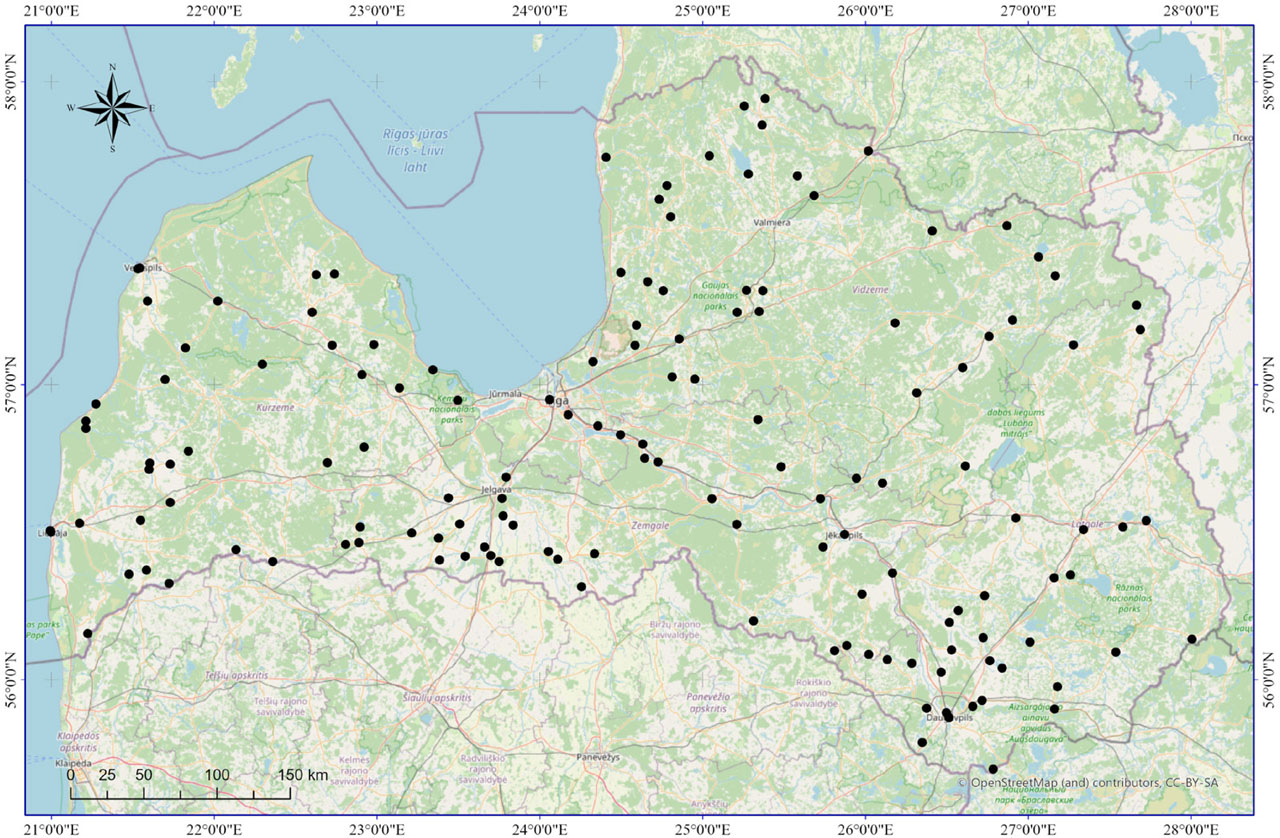
Figure 1
The locations of the studied dendrological plantations in Latvia.
In order to provide as detailed information as possible on the 178 listed tree and shrub taxa, the following information is provided in Appendix 1:
Taxonomic affiliation of the listed trees and shrubs to genera.
First report in the area. This column provides a summary of when the non-native woody plant species were introduced into the territory of Latvia, based on the first publication date (Laiviņš et al., 2009).
Origin.
Non-native tree and shrub species were classified as alien, casual alien, naturalized, invasive and transformers or weeds following Pyšek et al. (2004) accordingly: Casual alien plants: alien plants that under favourable conditions can occasionally reproduce in the wild but are unable to form sustainable populations. These fail to exist in the area for an extended period without re-introduction. Naturalized alien plants: alien plants that sustain self-replacing populations for more than 10 years, supplemented by offspring that are able to grow independently. Invasive plants: plants which are naturalized, that produce fertile offspring, commonly in very large numbers, and thus are able to spread over a large area. Transformers: invasive plants that degrade ecosystems in a substantial area. Dual status: species, which occur naturally in some parts of Latvia, but, at the same time, have been cultivated and spread in the wild.
Vector. The mode of entry into Latvia is indicated for each taxon. The status describes the types of introduction of alien species as classified according to Stace & Crawley (2015). The evaluated trees and shrubs have two types of introduction in Latvia: F – as edible (human food), including herbs and spices, plant seeds, fruits and other plant parts; H – horticultural introductions.
The type of spreading indicates whether the species reproduces in Latvia from seed and/or by vegetative propagation. The data were summarized based on the authors’ observations and literature.
Species distribution in Latvia was estimated by applying the square method, which is related to the geographical coordinates, where one square corresponds approximately to 7.6 × 9.3 km or 71 km2 for Latvia. The total number of the grid cells in Latvia is 1,017, from which 822 are completely and 195 partially located in the territory of Latvia (Laiviņš et al., 2009).
Invasiveness risk. There are many challenges facing the field of risk assessment of species invasiveness. After revision of previously used methods (e.g., Pheloung, 1995; Van Wilgen et al., 2001; Andersen et al., 2004; Genovesi & Shine, 2004; Burgiel & Muir, 2010; Verbrugge et al., 2010; Crossman et al., 2011; McDougall et al., 2011; Sandvik et al., 2013) we have decided to follow the methodology of Weber & Gut (2004), where fairly simple criteria were used for assessing the potential risk of invasive woody plant species. The rating system allocates scores to the species for biogeographical, ecological, and experience-linked aspects. In this work the authors used 12 questions for the assessment, for which points have been awarded. We adapted the selected scheme to Latvian conditions and made corresponding changes. The term “Europe” has been changed to “Northern Europe”. It was important to change this criterion, as a number of species found in nature in Central Europe have been introduced in Latvia and exhibit features of invasiveness.
Risk class. Each non-native woody plant species was assigned to one of the three risk classes, based on the total point score as follows (Weber & Gut, 2004): 3–20 low risk – species is unlikely to pose a threat to natural communities; 21–27 intermediate risk – species requires further observation; 28–38 high risk – species is likely to become a threat to natural communities if naturalized.
Data analysis
We applied Pearson’s Chi-squared test for count data corresponding to the number of species (Hope, 1968) to evaluate the dependence between species invasiveness risk class and the following species characteristics: native distribution range (Europe, North America, Asia/Eastern Asia, Eurasia, Europe/Asia Minor, Eurosiberia, cultivar) for 178 species, status (transformer, invasive, casual, dual, natural) for 178 species and reproduction strategy (seeds, vegetative, seeds and vegetative) for 171 species.
To identify the most contributing associations of the Pearson’s Chi-squared test results among species invasiveness risk class and native distribution range and among invasiveness risk class and status, Pearson’s residuals were calculated from the Pearson’s Chi-squared test results and visualized using the ‘corrplot’ package (Wei & Simko, 2017). All data analyses were conducted in R (R Core Team, 2020).
Results
Updated list of invasive trees and shrubs
The new annotated list of invasive trees and shrubs includes 178 taxa. The previous list of alien species (Svilāns et al., 2007) has been supplemented with 46 new tree and shrub taxa (Appendix 1). Three species have naturalized – Salix daphnoides Vill., S. × fragilis L., Syringa villosa Vahl; six taxa are invasive – Aronia × prunifolia ‘Floribunda’, Populus longifolia Fisch., P. ‘Lettland’, Rosa × malyi A. Kern., R. × regeliana Linden & Andr, Spiraea × rosalba Dippel; one species has dual status – Salix acutifolia Willd. We identified eleven most widespread casual alien tree and shrub species – Acer tataricum L. subsp. ginnala (Maxim.) Wesm., Celastrus orbiculatus Thunb., Forsythia × intermedia Zabel, Juglans mandshurica Maxim., Juniperus sabina L., Malus sieboldii (Regel) Rehder, Padus maackii (Rupr.) Kom., Philadelphus coronarius L., Pinus strobus L., Spiraea japonica L., Syringa josikaea Jacq. Fil. ex Rchb.
In total, 23 taxa from the previous alien plant list are not included in the current updated list. We did not find confirmation of the migration of these 23 alien taxa into the wild in the areas inspected during the study, for example, Crataegus × media Bechst., C. × uhrovae Soó, Genista pilosa L., Malus dasyphylla Borkh., Rosa acicularis Lindl., R. multiflora Thunb., and R. alba L.
Number and composition of taxa
The list of alien tree and shrub species in Latvia includes representatives from 28 families. There are five families with at least 10 species classified as alien that together comprise 62.36% of the total alien taxa of the country. The most frequent are from the Rosaceae family, containing 51 taxa (corresponding to 28.65% of all alien tree and shrub species), the Salicaceae family with 20 taxa (11.24%), the Aceraceae family with 15 taxa (8.43%), the Fabaceae family with 13 taxa, (7.30%), and the Pinaceae family with 12 taxa, (6.74%) (Appendix 1).
Of the taxa analysed, conifers are represented by 14 taxa (7.86%), belonging to two families Cupressaceae – 2 taxa (1.12%) and Pinaceae – 12 taxa (6.74%). The remaining 92.14% of species belong to deciduous trees. Acer – 15% of taxa, Spiraea – 11%, Populus – 10% and Salix – 10%. These are the most represented genera in the updated list of invasive alien species.
Plant traits
Most of the 178 alien taxa introduced in Latvia are native to North America (46 taxa, 26%), and Europe (39 taxa, 22%), the rest originated from Eurasia (17 taxa, 10%), East Asia (20 taxa, 11%) or are cultivars – decorative varieties, hybrids and other taxa without a natural native area (32 taxa, 18%; Figure 2, Appendix 1). In total, 18% of the studied alien taxa are cultivars.
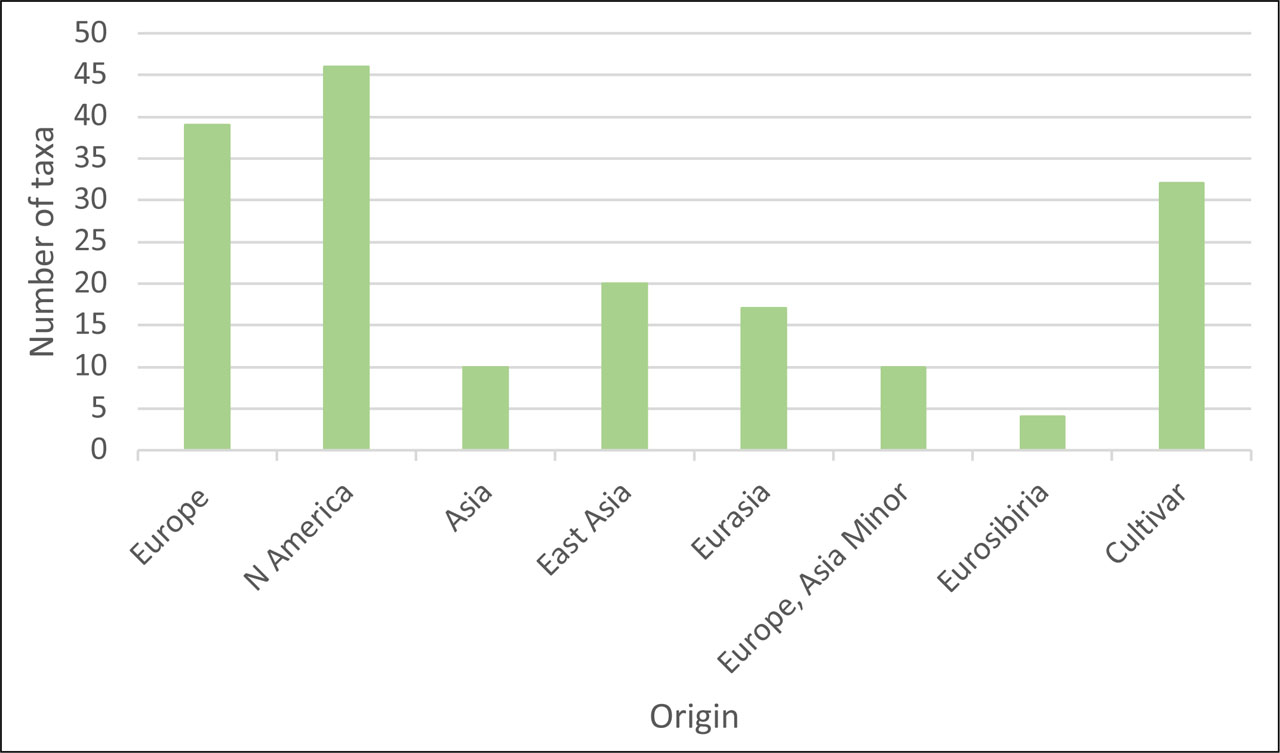
Figure 2
Share of the assessed species by origin.
During this study, 178 tree and shrub taxa were evaluated according to the selected criteria. In Latvia, all these species are successful at self-reproducing, of which two species (1%) are recognized as transformers: Acer negundo L. and Sorbaria sorbifolia (L.) A. Braun. Altogether, 42 species are considered invasive (24%), 23 – naturalized (13%); dual status was assigned to nine species (5%) and 104 species (57%) have casual status (Figure 3). After evaluating all alien tree and shrub species, which showed possible invasiveness, 44 taxa (25%) have been classified as aggressive invasive species in Latvia.
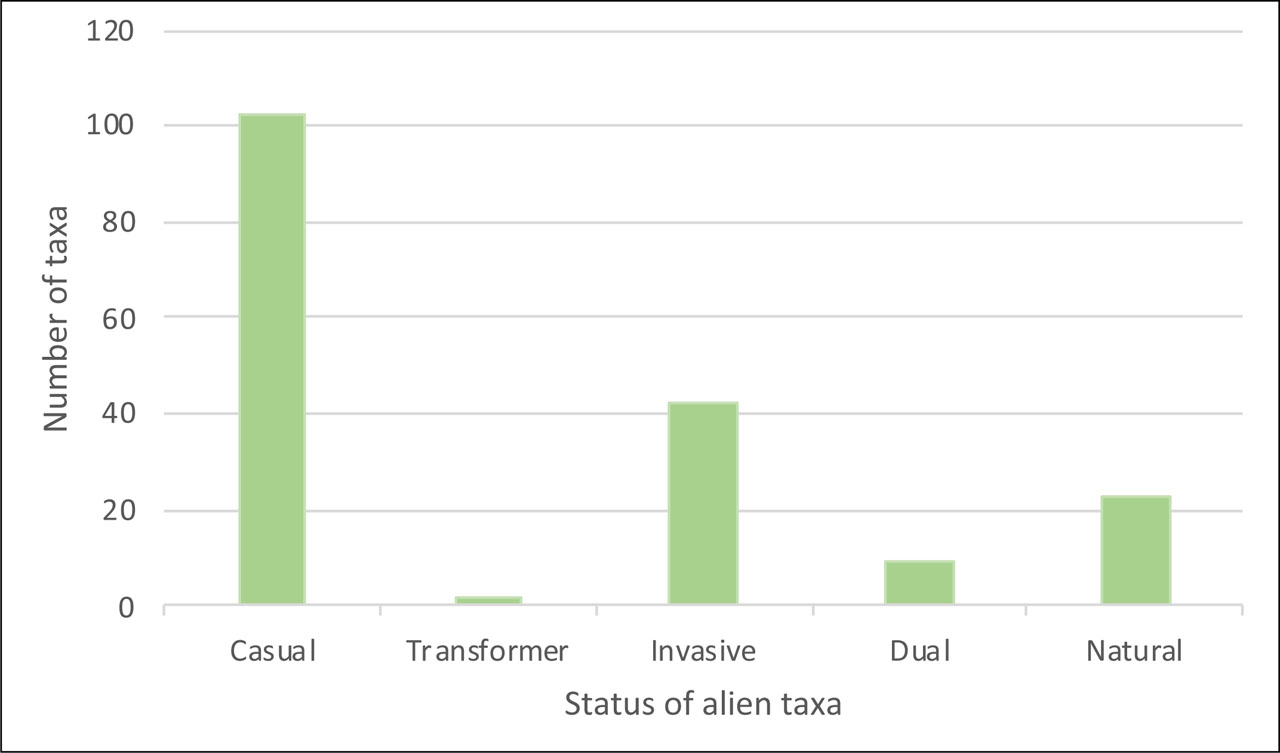
Figure 3
Distribution of alien trees and shrubs by invasiveness status.
The results show that 89% of the identified invasive plants dispersed from horticulture, 6% as edible plants, including herbs and plant seeds, fruits and other plant parts, 3% horticulture and human food and 2% horticulture and timber.
Risk assessment
This study provides a risk assessment of invasive plants for all 178 tree and shrub taxa that show signs of invasiveness after introduction in Latvia. According to the scores obtained through the risk assessment, the taxa are divided into three risk classes. Class III (high risk) includes 32 species (18%). The alien taxa to belong to the high-risk class are: Acer negundo L., A. pseudoplatanus L., A. tataricum L. subsp. ginnala (Maxim.) Wesm., Amelanchier spicata (Lam.) K. Koch, Celastrus orbiculatus Thunb., Cotoneaster lucidus Schlecht., Elaeagnus argentea Pursh., Hippophaë rhamnoides L., Parthenocissus quinquefolia (L.) Planch., Populus laurifolia Ledeb., P. longifolia Fisch., Rosa rugosa Thunb., Salix alba L., Spiraea × billardii Herincq., S. × rosalba Dippel.
Class II (intermediate risk) includes 123 taxa or 69% of the alien species, while class I (low risk) includes 23 taxa or 13% of all alien taxa (Appendix 1). All three risk classes were present in each of the five alien species status categories (Figure 4). Class III included 23 species from the invasive taxa group (Appendix 1), the transformer Acer negundo and four species from the casual taxa group – Acer tataricum subsp. ginnala, Celastrus orbiculatus, Cerasus tomentosa (Thunb.) Wall., Salix alba ‘Vitellina’. Class III also included taxa with dual status (Salix alba) and three taxa from the naturalized taxa group (Salix alba ‘Sericea’, Salix daphnoides, Salix × fragilis) (Figure 4).
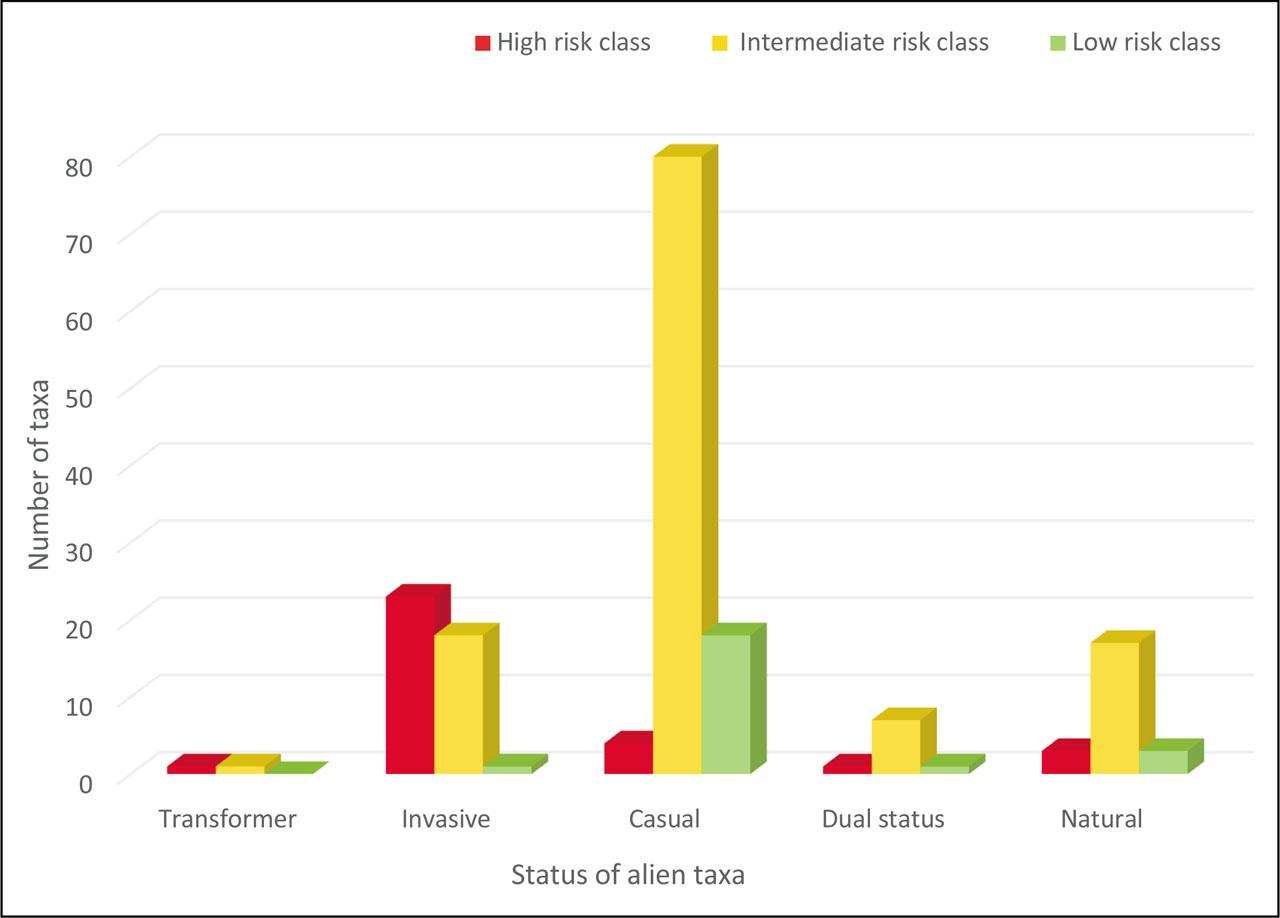
Figure 4
Number of studied tree and shrub taxa among invasiveness statuses and risk classes.
We did not find significant differences between the area of origin of the taxa and invasiveness risk classes (X2=16.26, p=0.28). Of the 32 taxa in Class III (high-risk class), 10 taxa or 31.25% are cultivated, 8 taxa or 25% are of North American origin, and four are from East Asia. Eurosiberian taxa were not found in Class III (Figure 5, Appendix 1).
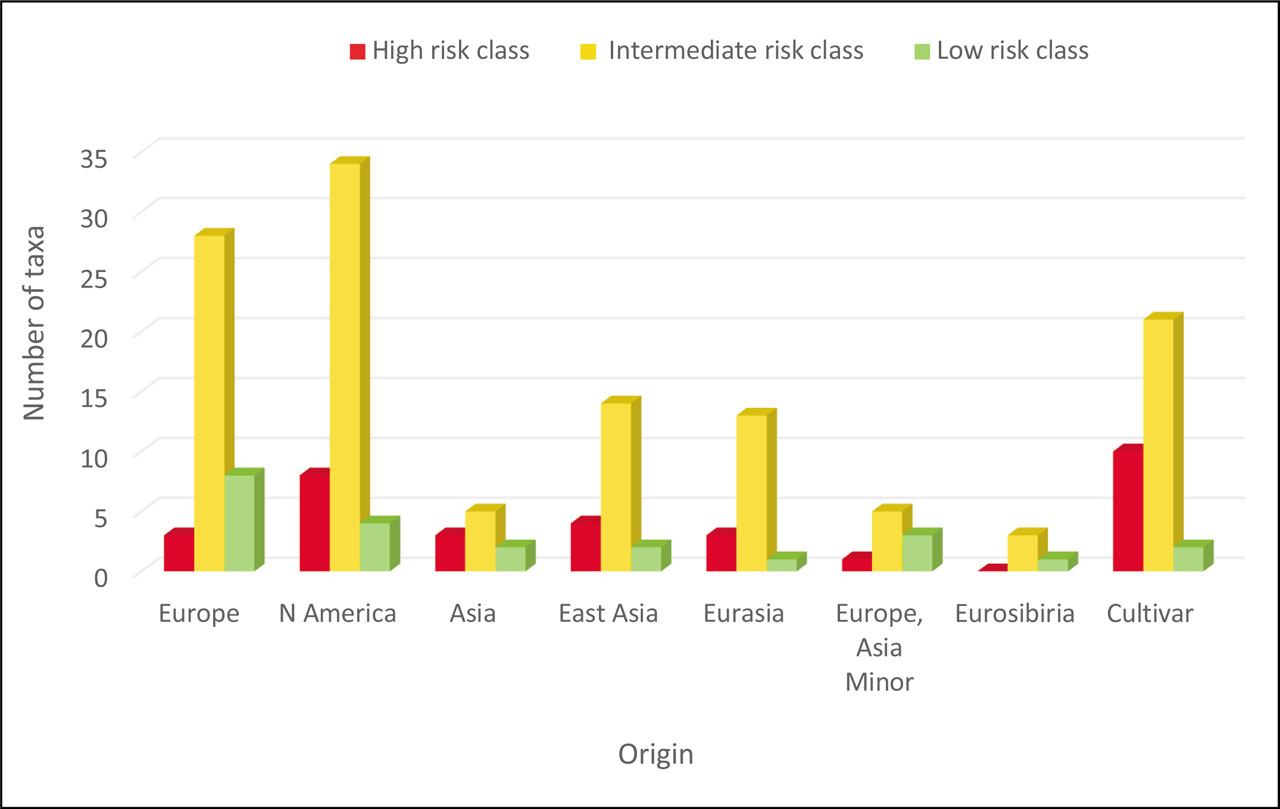
Figure 5
Number of studied tree and shrub taxa among origins and risk classes.
Associations between invasiveness risk classes and plant traits of trees and shrubs with different origin
We did not find a significant association between the studied species invasiveness risk class and species native distribution range (X2=16.26, p=0.30). A significant association was found between the species invasiveness risk class and species status (X2=55.92, p<0.01) and between the invasiveness risk class and species reproduction strategy (X2=61.25, p<0.01).
Pearson’s residuals showed the association between all three invasiveness risk classes and invasive and casual species status (Figure 6 A) which contributed to Pearson’s Chi-squared test results. The highest positive association was found between a high invasiveness risk class and invasive species status, but the highest negative association was found between a high invasiveness risk class and casual species status (Figure 6 A).
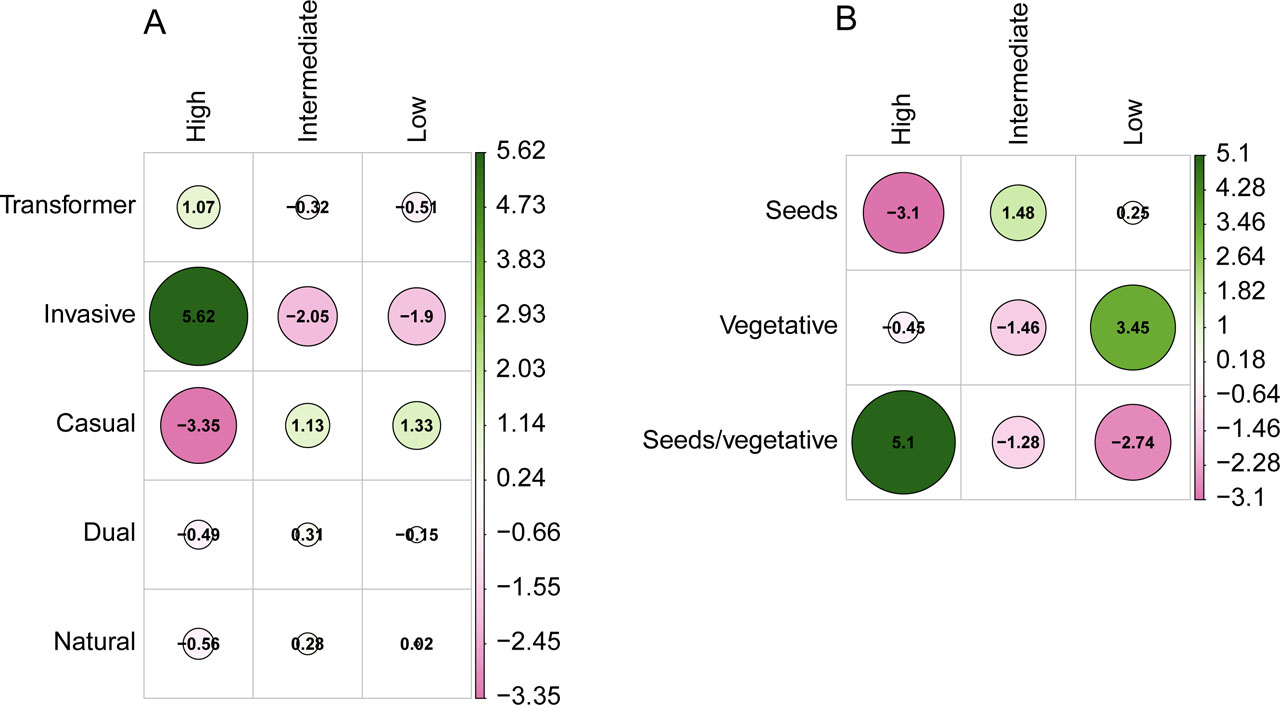
Figure 6
Contributing associations between species invasiveness risk classes (High, Intermediate, Low) and species statuses (Transformer, Invasive, Casual, Dual, Natural) (A) and species invasiveness risk classes and species reproduction strategies (Seeds, Vegetative, Seeds/Vegetative) (B) based on Pearson’s residuals obtained from the Chi-squared test results. The colour map refers to Pearson’s residual values and the circle size refers to the magnitude of positive or negative associations.
Pearson’s residuals showed the association between all three invasiveness risk classes and all three reproduction strategies (Figure 6 B) which contributed to the Pearson’s Chi-squared test results. The highest contribution was found between a high invasiveness risk class and species having both seed and vegetative reproduction strategies, which showed a positive association. A high contribution was also found in the positive association between vegetative reproduction and low invasiveness risk. A high contribution was also found in the negative association between a high invasiveness risk class and species reproducing by seeds (Figure 6 B).
Discussion
As a result of this study, a national list of alien tree and shrub species was compiled, assessing observed invasiveness traits for the included species. The aim of a risk assessment for invasive trees and shrubs was to estimate which species should be listed on the national invasive plant list and to decide which new species infestations should be controlled or removed in order to prevent their spread and associated ecological consequences (Weber & Gut, 2004).
We did not prove the hypothesis that species from distant locations like Asia and North America show more pronounced invasiveness traits, namely, a higher risk class of invasiveness (Figure 5). This can be explained by the number of cultivars in our dataset. Accordingly, in other similar research (Andreu & Vilá, 2010; Fayvush et al., 2018; Nutt & Kubjas, 2020), no associations were established between species origin and invasiveness classes.
In the present study, of the 32 tree and shrub taxa included in the high-risk invasiveness class, a considerable number of them were cultivars or hybrids of horticultural origin – 10 (31.25%), and an addition eight (25%), originated from North America. The majority of cultivars with a high risk of invasiveness belong to Rosaceae: Cerasus vulgaris, Rosa × malyi, R. pimpinellifolia L., R. × regeliana, Spiraea × billardii, S. × rosalba. The following cultivars are also in the high-risk invasiveness group: Salix alba ‘Sericea’, Salix alba ‘Vitellina’ and Acer pseudoplatanus ‘Purpurascens’.
The family Rosaceae is the most widely represented in the list of invasive tree and shrub taxa (51 taxa, corresponding to 28.65% of all trees and shrubs aliens). Asia is the major source of invasive Rosaceae shrubs, as well as invasive Oleaceae species. Most of the invasive Salicaceae are of Eurasian origin. Because of increasing connections with many Asian countries, even more invasive tree and shrub species will be introduced from Asia (Rejmánek, 2014). The number of tree and shrub species with Asian origin has increased in Latvian nurseries in recent years, for example, Ailanthus altissima (Mill.) Swingle, Lespedeza bicolor Turcz., Morus alba L., Paulownia tomentosa (Thunb.) Steud. and Wisteria floribunda (Willd.) DC. (Anonymous, 2021). With increasing trade, we can expect that more alien tree and shrub taxa will sooner or later become invasive in the Baltic region. At present, in the first half of the 21st century, Ailanthus altissima, Paulownia tomentosa and Wisteria floribunda suffer from frost damage in Latvia, but in suitable climatic conditions they can survive.
The second hypothesis stated that the risk of invasiveness and the status of the species is closely related to the reproduction strategy. We have shown that species that reproduce both vegetatively and by seed dispersion are more aggressive and invade larger areas more quickly in comparison to other alien species (Stace & Crawley, 2015). For example, Acer negundo, Elaeagnus argentea, Hippophaë rhamnoides, Parthenocissus quinquefolia, Physocarpus opulifolius. (L.) Maxim. Such species may be used for berry production in plantations only under strict control. For aggressive invasive alien species, varieties with variegated leaves with slowed photosynthesis are recommended for landscape gardening (Gaskin & Kazmer, 2009), so that the taxon grows slowly and is less aggressive. Interspecific hybrids that do not produce germinating seeds are also recommended for landscape gardening as self-seeding is not possible for such taxa (Gaskin & Kazmer, 2009).
When creating parks, squares, and backyard greeneries, we recommend avoiding taxa included in the high invasiveness risk class in order to prevent the invasion of large areas by adult trees and shrubs that are already capable of producing seeds. In old parks where they were planted, taxa such as Spiraea, Swida and Syringa, are currently migrating to natural areas. Invasive species in natural habitats need to be controlled so that they do not destroy natural ecosystems.
Conclusions
Our study resulted in the compilation of an updated list of 178 alien tree and shrub taxa, that were identified as migrating into natural ecosystems (self-seeding). A total of 44 tree and shrub taxa have been identified as aggressive invasive species, either potentially invasive (with transformer status) or invasive.
Three classes of invasiveness risks were distinguished. The majority of alien tree and shrub species are already invasive – 18% of evaluated species belong to the high-risk class of invasiveness, or have a great potential to become invasive in future – 69% of species belong to the intermediate invasiveness risk group, and only few alien taxa (12% of species) have a low risk of invasiveness. High-risk class species should be given special attention and monitoring in order to prevent the invasion of large areas by these species in the future. In addition, species with intermediate risk of invasiveness also require monitoring and periodic assessment as these taxa may become potentially hazardous over time.
Invasiveness risk and species status are closely related to reproduction strategy. We have proved that species that are able to reproduce both vegetatively and by seed dispersion are more aggressive and invade larger areas more quickly than species with only vegetative reproduction (have low risk of invasiveness). The planting of invasive species with both reproduction strategies should therefore be avoided. Therefore, we recommend planting varieties and hybrids that do not produce germinating seeds, thus avoiding self-seeding.
The Weber and Gut method is suitable for risk assessment of alien tree and shrub taxa in Latvia. Subsequently, the assessment of the tree and shrub taxa yielded interesting and reliable results, which can be used to assess the potential invasiveness risk of a species. The updated tree and shrub species list can be included in the list of invasive species of Latvia. The results of the present study can be used in future studies about alien tree and shrub species’ distributional changes due to the global climate change. The results also contribute to practical nature conservation and landscape gardening in regions with similar climatic conditions.
Acknowledgements
Part of the work was supported by Daugavpils University project “Taxonomical and chorological studies on rare and autochthonous species of genus Rosa L. in Latvia.” (Nr. 14-95/2022/4). The study was partly financially supported by the Fundamental and Applied Science project of Latvian Council of Science: No. lzp-2020/1-0314 “Bryophyte and lichen successional and spatial patterns in deciduous forests”. Thanks to Inita Svilāne (Daugavpils University, Latvia) for creating the cartographic material. We are grateful to Dainis Edgars Ruņģis for consultation in English language and the reviewers for valuable comments that helped to improve the article.
Appendices
Appendix 1
Updated list of invasive tree and shrub taxa with traits of invasiveness in Latvia.
Abbreviations: Vector: F – edible plants, including herbs and spices, and fruit seeds or fruits; H – horticultural introductions, mainly ornamentals, but also grassland, hedging, game cover and green manure; T – with timber (Stace & Crawley, 2015); Type of spreading – indicates whether the species reproduces in Latvia from seed (s) and/or from vegetative propagation (v); Species distribution in Latvia – according to our data and literature (Laiviņš et al., 2009); - no data.
| No | Species | Family | First reported in the area | Origin | Status of alien taxa | Vector | Type of spreading | Species distribution in Latvia (grid cells) | Invasiveness risk | Risk class |
|---|---|---|---|---|---|---|---|---|---|---|
| 1. | Abies alba Mill. | Pinaceae | 1817 | Europe | casual | H | s | 150 | 22 | II |
| 2. | Abies balsamea (L.) Mill. | Pinaceae | 1805 | N America | casual | H | s | 172 | 24 | II |
| 3. | Abies concolor (Gordon & Glend.) Lindl. ex Hildebr. | Pinaceae | 1888 | N America | casual | H | s | 147 | 24 | II |
| 4. | Abies nordmanniana (Stev.) Spach | Pinaceae | 1867 | Europe | casual | H | s | 22 | 24 | II |
| 5. | Abies sibirica Ledeb. | Pinaceae | 1856 | Asia | casual | H | s | 362 | 21 | II |
| 6. | Abies × phanerolepis Fernald | Pinaceae | - | N America | casual | H | s | 204 | 23 | II |
| 7. | Acer barbinerve Maxim. | Aceraceae | 1957 | East Asia | casual | H | s | 8 | 22 | II |
| 8. | Acer campestre L. | Aceraceae | 1805 | Europe, Asia Minor | casual | H | s | 73 | 26 | II |
| 9. | Acer circinatum Pursh | Aceraceae | 1963 | N America | casual | H | s | 8 | 22 | II |
| 10. | Acer mono Maxim. var. mayrii (Schwer.) Nakai | Aceraceae | 1969 | East Asia | casual | H | s | 5 | 22 | II |
| 11. | Acer negundo L. | Aceraceae | 1817 | N America | transformer | H | s/v | 498 | 34 | III |
| 12. | Acer palmatum Thunb. subsp. amoenum (Carriėre) Hara | Aceraceae | 1958 | Eurasia | casual | H | s | 1 | 21 | II |
| 13. | Acer platanoides ‘Crimson King’ | Aceraceae | - | Cultivar | casual | H | s | 17 | 24 | II |
| 14. | Acer platanoides ‘Schwedleri’ | Aceraceae | 1883 | Cultivar | casual | H | s | 44 | 26 | II |
| 15. | Acer pseudoplatanus L. | Aceraceae | 1804 | Eurasia | invasive | H | s | 210 | 31 | III |
| 16. | Acer pseudoplatanus ‘Purpurascens’ | Aceraceae | 1805 | Cultivar | invasive | H | s | 17 | 29 | III |
| 17. | Acer pseudosieboldianum (Pax) Kom. | Aceraceae | - | East Asia | casual | H | s | 10 | 24 | II |
| 18. | Acer saccharinum L. | Aceraceae | 1805 | N America | casual | H | s | 119 | 25 | II |
| 19. | Acer tataricum L. subsp. ginnala (Maxim.) Wesm. | Aceraceae | 1876 | Eurasia | casual | H | s | 280 | 29 | III |
| 20. | Acer tataricum L. subsp. tataricum | Aceraceae | 1805 | Eurasia | casual | H | s | 178 | 27 | II |
| 21. | Acer tegmentosum Maxim. | Aceraceae | 1880 | Eurasia | casual | H | s | 9 | 22 | II |
| 22. | Aesculus hippocastanum L. | Hippocastanaceae | 1805 | Europe, Asia Minor | casual | H | s | 996 | 20 | I |
| 23. | Amelanchier spicata (Lam.) K. Koch | Rosaceae | 1888 | N America | invasive | H | s | 1235 | 31 | III |
| 24. | Aralia elata (Miq.) Seem. | Araliaacee | 1877 | East Asia | casual | H | v | 38 | 20 | I |
| 25. | Aronia × prunifolia ‘Floribunda’ | Rosaceae | 1902 | Cultivar | invasive | H | s/v | 371 | 27 | II |
| 26. | Artemisia abrotanum L. | Asteraceae | - | Europe | casual | H | - | 178 | 21 | II |
| 27. | Berberis thunbergii DC | Berberidaceae | 1880 | East Asia | casual | H | s | 324 | 26 | II |
| 28. | Berberis vulgaris ‘Atropurpurea’ | Berberidaceae | - | Cultivar | casual | H | s | - | 26 | II |
| 29. | Caragana arborescens Lam. | Fabaceae | 1805 | East Asia | invasive | H | s/v | 1256 | 28 | III |
| 30. | Caragana frutex (L.) K. Koch | Fabaceae | 1817 | Eurosibiria | invasive | H | s/v | 269 | 26 | II |
| 31. | Carpinus betulus L. | Corylaceae | - | Europe | dual status | H | s | 190 | 21 | II |
| 32. | Celastrus orbiculatus Thunb. | Celastraceae | 1873 | East Asia | casual | H | s/v | 60 | 29 | III |
| 33. | Cerasus avium (L.) Moench | Rosaceae | 1778 | Europe, Asia Minor | invasive | F | s/v | 314 | 25 | II |
| 34. | Cerasus tomentosa (Thunb.) Wall. | Rosaceae | 1930 | East Asia | casual | F | s/v | 43 | 29 | III |
| 35. | Cerasus vulgaris Mill. | Rosaceae | - | Cultivar | invasive | F | s/v | - | 29 | III |
| 36. | Chaenomeles japonica (Thunb.) Lind. ex Spach | Rosaceae | 1867 | East Asia | casual | F,H | s | 365 | 25 | II |
| 37. | Chamaecytisus ratisbonensis (Schaeff.) Rothm. | Fabaceae | 1888 | Europe, Siberia | casual | H | s/v | 21 | 25 | II |
| 38. | Clematis recta L. | Ranunculaceae | 1976 | Europe | casual | H | s/v | 12 | 27 | II |
| 39. | Cotoneaster dammerii C. K. Schneid. | Rosaceae | 1960 | East Asia | casual | H | s | 26 | 24 | II |
| 40. | Cotoneaster lucidus Schlecht. | Rosaceae | 1884 | Asia | invasive | H | s | 612 | 29 | III |
| 41. | Cotoneaster multiflorus Bunge | Rosaceae | 1888 | Asia | casual | H | s | 18 | 22 | II |
| 42. | Crataegus alemanniensis Cinovskis | Rosaceae | 1971 | Europe | naturalized | H | s | 358 | 25 | II |
| 43. | Crataegus douglasii Lindl. | Rosaceae | 1867 | N America | casual | H | s | 64 | 24 | II |
| 44. | Crataegus flabellata (Bosc) K. Koch | Rosaceae | 1965 | N America | casual | H | s | 71 | 24 | II |
| 45. | Crataegus laevigata (Poir.) DC | Rosaceae | - | Europe | dual status | H | s | - | 25 | II |
| 46. | Crataegus monogyna Jacq. | Rosaceae | 1859 | Europe | casual | H | s | 23 | 25 | II |
| 47. | Crataegus submollis Sarg. | Rosaceae | 1856 | N America | casual | H | s | 216 | 24 | II |
| 48. | Cytisus scoparius (L.) Link | Fabaceae | 1892 | Europe | invasive | H | s | 42 | 22 | II |
| 49. | Elaeagnus angustifolia L. | Elaeagnaceae | 1817 | Eurasia | casual | H | s/v | 15 | 22 | II |
| 50. | Elaeagnus argentea Pursh. | Elaeagnaceae | 1877 | N America | invasive | H | s/v | 187 | 31 | III |
| 51. | Euonymus nanus M. Bieb. | Celastraceae | 1867 | Eurasia | casual | H | s/v | 32 | 25 | II |
| 52. | Fagus sylvatica L. | Fagaceae | 1805 | Europe | invasive | H | s | 263 | 23 | II |
| 53. | Fagus sylvatica ‘Purpurea Latifolia’ | Fagaceae | - | Cultivar | invasive | H | s | - | 24 | II |
| 54. | Forsythia suspensa (Thunb.) Vahl | Oleaceae | 1880 | East Asia | casual | H | v | 64 | 24 | II |
| 55. | Forsythia × intermedia Zabel | Oleaceae | 1894 | Cultivar | casual | H | v | 123 | 24 | II |
| 56. | Fraxinus pennsylvanica Marchall | Oleaceae | 1821 | N America | casual | H | s | 117 | 24 | II |
| 57. | Fraxinus pennsylvanica Marchall var. subinetegerrima (Vahl) Fern. | Oleaceae | 1856 | N America | casual | H | s | 117 | 24 | II |
| 58. | Genista tinctoria L. | Fabaceae | 1805 | Eurosibiria | casual | H | s | 23 | 20 | I |
| 59. | Grossularia reclinata (L.) Mill. var. reclinata | Grossulariaceae | - | Europe | naturalized | F | s | 481 | 27 | II |
| 60. | Grossularia reclinata (L.) Mill. var. uva-crispa (L.) Berger | Grossulariaceae | - | Europe | naturalized | F | s | - | 24 | II |
| 61. | Hedera helix L. var. helix | Araliaceae | 1817 | Europe | casual | H | v | 41 | 18 | I |
| 62. | Hedera hibernica (Kirchn.) Bean | Araliaceae | 1867 | Europe | casual | H | v | 9 | 18 | I |
| 63. | Hippophaë rhamnoides L. | Elaeagnaceae | 1817 | Eurasia | invasive | F,H | s/v | 230 | 28 | III |
| 64. | Hydrangea paniculata ‘Grandiflora’ | Hydrangeaceae | 1884 | Cultivar | casual | H | s | 49 | 24 | II |
| 65. | Hyssopus officinalis L. | Labiatae | - | Europe | casual | F | s | - | 19 | I |
| 66. | Juglans ailanthifolia Carriėre | Juglandaceae | 1884 | East Asia | casual | H | s | 52 | 27 | II |
| 67. | Juglans cinerea L. | Juglandaceae | 1847 | N America | casual | H | s | 242 | 27 | II |
| 68. | Juglans mandshurica Maxim. | Juglandaceae | 1910 | East Asia | casual | H | s | 119 | 27 | II |
| 69. | Juniperus sabina L. | Cupressaceae | 1819 | Eurasia | casual | H | s | 143 | 24 | II |
| 70. | Larix decidua Mill. | Pinaceae | 1805 | Europe | naturalized | H | s | 763 | 25 | II |
| 71. | Lavandula angustifolia Mill. | Labiatae | - | Europe | casual | F,H | s | 7 | 16 | I |
| 72. | Ligustrum vulgare L. | Oleaceae | 1805 | Europe, Asia Minor | naturalized | H | s | 378 | 22 | II |
| 73. | Lonicera caerulea L. | Caprifoliaceae | 1805 | Eurasia | casual | H | s | 26 | 22 | II |
| 74. | Lonicera caprifolium L. | Caprifoliaceae | 1805 | Europe | casual | H | s/v | 377 | 24 | II |
| 75. | Lonicera periclymenum L. | Caprifoliaceae | 1805 | Europe | casual | H | s/v | 112 | 24 | II |
| 76. | Lonicera tatarica L. | Caprifoliaceae | 1805 | Eurasia | naturalized | H | s | 573 | 27 | II |
| 77. | Lycium barbarum L. | Solanaceae | 1805 | Eurasia | casual | H | s/v | 27 | 21 | II |
| 78. | Mahonia aquifolium L. | Berberidaceae | 1853 | N America | casual | H | s | 178 | 24 | II |
| 79. | Malus baccata (L.) Borkh. | Rosaceae | 1805 | East Asia | casual | H | s | 33 | 27 | II |
| 80. | Malus domestica Borkh. | Rosaceae | 1778 | Cultivar | invasive | F | s | 117 | 27 | II |
| 81. | Malus pumila Mill. | Rosaceae | 1805 | Cultivar | casual | H | s | 4 | 22 | II |
| 82. | Malus × purpurea (Barbier) Rehder | Rosaceae | 1956 | Cultivar | casual | H | s | 29 | 24 | II |
| 83. | Malus sachalinensis Juz. | Rosaceae | 1959 | East Asia | casual | H | s | 7 | 24 | II |
| 84. | Malus sieboldii (Regel) Rehder | Rosaceae | 1885 | East Asia | casual | H | s | 20 | 24 | II |
| 85. | Malus sieversii (Ledeb.) M. Roem. | Rosaceae | 1888 | Asia | casual | H | s | 27 | 24 | II |
| 86. | Oxycoccus macrocarpus (Aiton) Pursh. | Ericaceae | - | N America | casual | F | s | - | 27 | II |
| 87. | Padus maackii (Rupr.) Kom. | Rosaceae | 1956 | N America | casual | H | s | 28 | 23 | II |
| 88. | Padus serotina (Ehrh.) Borkh. | Rosaceae | 1805 | N America | casual | H | s | 38 | 23 | II |
| 89. | Parthenocissus inserta (A. Kern.) Fritsch | Vitaceae | 1929 | N America | casual | H | s/v | 24 | 26 | II |
| 90. | Parthenocissus quinquefolia (L.) Planch. | Vitaceae | 1847 | N America | invasive | H | s/v | 210 | 31 | III |
| 91. | Pentaphylloides fruticosa (L.) O. Schwarz | Rosaceae | - | Cultivar | dual status | H | s | 86 | 24 | II |
| 92. | Philadelphus coronarius L. | Hydrangeaceae | 1805 | Europe | casual | H | s | 1229 | 21 | II |
| 93. | Philadelphus pubescens Loisel. var. verrucosus (Schrad.) S.Y.Hu | Hydrangeaceae | 1856 | N America | casual | H | s | 474 | 23 | II |
| 94. | Physocarpus opulifolius (L.) Maxim. | Rosaceae | 1805 | N America | invasive | H | s/v | 366 | 29 | III |
| 95. | Picea glauca (Moench) Voss | Pinaceae | 1805 | N America | casual | H | s | 194 | 24 | II |
| 96. | Pinus mugo Turra | Pinaceae | 1805 | Europe | casual | H | s | 103 | 22 | II |
| 97. | Pinus strobus L. | Pinaceae | 1805 | N America | casual | H,T | s | 166 | 27 | II |
| 98. | Populus alba L. | Salicaceae | 1805 | Eurasia | invasive | H | s/v | 451 | 27 | II |
| 99. | Populus alba ‘Nivea’ | Salicaceae | - | Cultivar | casual | H | v | - | 26 | II |
| 100. | Populus balsamifera L. | Salicaceae | 1805 | N America | naturalized | H | s/v | 618 | 26 | II |
| 101. | Populus × berolinensis K. Koch | Salicaceae | 1879 | Europe | casual | H | - | 118 | 20 | I |
| 102. | Populus × canadensis Moench | Salicaceae | - | Cultivar | naturalized | H | v | 251 | 20 | I |
| 103. | Populus × canescens (Aiton) Sm. | Salicaceae | - | Europe, Asia Minor | naturalized | H | v | 173 | 20 | I |
| 104. | Populus ‘Lettland’ | Salicaceae | - | Cultivar | invasive | H | v | 349 | 20 | I |
| 105. | Populus laurifolia Ledeb. | Salicaceae | 1856 | Asia | invasive | H,T | s/v | 69 | 29 | III |
| 106. | Populus longifolia Fisch. | Salicaceae | 1847 | N America | invasive | H | s/v | 298 | 29 | III |
| 107. | Populus trichocarpa Torr. & A. Gray | Salicaceae | 1913 | N America | casual | H,T | v | 33 | 20 | I |
| 108. | Prunus cerasifera Ehrh. var. divaricata (Ledeb.) Bailey | Rosaceae | 1883 | Europe, Asia Minor | invasive | F,H | s/v | 366 | 29 | III |
| 109. | Prunus domestica L. var. instititia (L.) C.K. Schneid. | Rosaceae | 1888 | Europe | invasive | F,H | s/v | 15 | 29 | III |
| 110. | Prunus spinosa L. | Rosaceae | - | Europe | dual status | H | s/v | - | 27 | II |
| 111. | Pseudotsuga menziesii (Mirb.) Franco var. menziesii | Pinaceae | 1888 | N America | casual | H | s | 153 | 24 | II |
| 112. | Pseudotsuga menziesii (Mirb.) Franco var. glauca (Beissn.) Franco | Pinaceae | 1883 | N America | casual | H | s | 162 | 24 | II |
| 113. | Pterocarya fraxinifolia (Poir.) Spach | Juglandaceae | 1867 | Asia | casual | H | v | 14 | 20 | I |
| 114. | Pyrus communis L. | Rosaceae | - | Europe | casual | F | s | - | 25 | II |
| 115. | Quercus petraea (Matt.) Liebl. | Fagaceae | 1968 | Europe | casual | H | s | 13 | 18 | I |
| 116. | Quercus rubra L. | Fagaceae | 1859 | N America | invasive | H,T | s | 183 | 27 | II |
| 117. | Rododendron catawbiense Michx. | Ericaceae | 1872 | N America | casual | H | s | 32 | 24 | II |
| 118. | Rododendron japonicum (A.Gray) J.V. Suringar | Ericaceae | 1877 | East Asia | casual | H | s | 50 | 24 | II |
| 119. | Rhus typhina L. | Anacardiaceae | 1817 | N America | casual | H | v | 152 | 20 | I |
| 120. | Ribes nigrum L. | Grossulariaceae | - | Eurasia | dual status | F | v/s | 1646 | 26 | II |
| 121. | Ribes rubrum L. | Grossulariaceae | - | Europe | naturalized | F | s | 1408 | 27 | II |
| 122. | Robinia luxurians (Diec ex Goehabitatze) C.K. Schneid. | Fabaceae | 1909 | N America | invasive | H | s | 67 | 22 | II |
| 123. | Robinia pseudoacacia L. | Fabaceae | 1805 | N America | invasive | H | s | 323 | 25 | II |
| 124. | Robinia pseudoacacia ‘Semperflorens’ | Fabaceae | - | Cultivar | invasive | H | s | - | 22 | II |
| 125. | Robinia viscosa var. hartwigii (Koehne) Ashe | Fabaceae | 1961 | N America | invasive | H | s | 45 | 22 | II |
| 126. | Rosa glabrifolia C.A. Mey. ex Rupr. | Rosaceae | 1894 | Europe, Siberia | naturalized | H | s | 172 | 24 | II |
| 127. | Rosa glauca Pourr. | Rosaceae | 1888 | Europe | naturalized | H | s | 195 | 27 | II |
| 128. | Rosa × malyi A. Kern. | Rosaceae | - | Cultivar | invasive | H | s/v | - | 29 | III |
| 129. | Rosa pimpinellifolia L. | Rosaceae | 1805 | Cultivar | invasive | H | s/v | 1140 | 29 | III |
| 130. | R. pomifera Herrm. subsp. pomifera | Rosaceae | 1894 | Europe, Asia Minor | casual | H | s | 156 | 26 | II |
| 131. | Rosa × regeliana Linden & Andr | Rosaceae | - | Cultivar | invasive | H | s/v | - | 31 | III |
| 132. | Rosa rugosa Thunb. | Rosaceae | 1888 | East Asia | invasive | H | s/v | 872 | 33 | III |
| 133. | Rubus odoratus L. | Rosaceae | 1805 | N America | naturalized | H | s/v | 64 | 24 | II |
| 134. | Rubus parviflorus Nutt. | Rosaceae | 1859 | N America | casual | H | s/v | 15 | 24 | II |
| 135. | Salix acutifolia Willd. | Salicaceae | - | Europe | dual status | H | s/v | 510 | 27 | II |
| 136. | Salix acutifolia × S. daphnoides | Salicaceae | - | Cultivar | dual status | H | s/v | 167 | 27 | II |
| 137. | Salix alba L. | Salicaceae | - | Europe | dual status | H | s/v | 1349 | 29 | III |
| 138. | Salix alba ‘Britzensis’ | Salicaceae | - | Cultivar | casual | H | s/v | - | 26 | II |
| 139. | Salix alba ‘Sericea’ | Salicaceae | 1875 | Cultivar | naturalized | H | s/v | 417 | 29 | III |
| 140. | Salix alba ‘Vitellina’ | Salicaceae | 1805 | Cultivar | casual | H | s/v | 129 | 29 | III |
| 141. | Salix daphnoides Vill. | Salicaceae | 1839 | Europe | naturalized | H | s/v | 271 | 29 | III |
| 142. | Salix euxina I.V. Belyaeva | Salicaceae | 1791 | Europe | naturalized | H | s/v | 1974 | 27 | II |
| 143. | Salix purpurea ‘Lambertiana’ | Salicaceae | - | Cultivar | casual | H | s/v | - | 26 | II |
| 144. | Salix × fragilis L. | Salicaceae | 1853 | Cultivar | naturalized | H | s/v | 92 | 28 | III |
| 145. | Sambucus nigra L. | Caprifoliaceae | 1805 | Europe, Asia Minor | invasive | H | s | 487 | 23 | II |
| 146. | Sambucus racemosa L. | Caprifoliaceae | 1805 | Eurasia | invasive | H | s | 1048 | 27 | II |
| 147. | Sambucus racemosa ‘Plumosa’ | Caprifoliaceae | - | Cultivar | casual | H | s | - | 24 | II |
| 148. | Sorbaria sorbifolia (L.) A. Braun | Rosaceae | 1805 | Asia | transformer | H | s/v | 705 | 27 | II |
| 149. | Spiraea alba Du Roi | Rosaceae | 1885 | N America | invasive | H | s/v | 717 | 28 | III |
| 150. | Spiraea betulifolia Pall. | Rosaceae | 1960 | East Asia | casual | H | s | 18 | 21 | II |
| 151. | Spiraea × billardii Herincq. | Rosaceae | 1856 | Cultivar | invasive | H | v | 283 | 28 | III |
| 152. | Spiraea chamaedryfolia L. | Rosaceae | 1805 | Asia | invasive | H | s | 702 | 22 | II |
| 153. | Spiraea douglasii Hook. | Rosaceae | 1847 | N America | casual | H | s/v | 12 | 23 | II |
| 154. | Spiraea japonica L. | Rosaceae | 1859 | Cultivar | casual | H | - | 113 | 22 | II |
| 155. | Spiraea latifolia (Aiton) Borkh. | Rosaceae | 1817 | N America | casual | H | - | 47 | 20 | I |
| 156. | Spiraea media F. Schmidt | Rosaceae | 1856 | Eurasia | naturalized | H | - | 405 | 21 | II |
| 157. | Spiraea menziesii Hook. | Rosaceae | 1913 | N America | casual | H | - | 5 | 20 | I |
| 158. | Spiraea nipponica Maxim. | Rosaceae | 1964 | East Asia | casual | H | - | 14 | 18 | I |
| 159. | Spiraea × rosalba Dippel | Rosaceae | - | Cultivar | invasive | H | v | 47 | 29 | III |
| 160. | Swida alba (L.) Opiz | Cornaceae | 1805 | Asia | invasive | H | v | 441 | 29 | III |
| 161. | Swida alba ‘Sibirica’ | Cornaceae | - | Cultivar | casual | H | v | - | 25 | II |
| 162. | Swida sericea L. | Cornaceae | 1817 | N America | casual | H | v | 25 | 26 | II |
| 163. | Swida sericea ‘Flaviramea’ | Cornaceae | - | Cultivar | casual | H | v | - | 25 | II |
| 164. | Symphoricarpos albus (L.) S. F. Blake var. laevigatus (Fernald) S. F. Blake | Caprifoliaceae | 1805 | N America | invasive | H | s/v | 932 | 33 | III |
| 165. | Syringa josikaea Jacq. Fil. ex Rchb. | Oleaceae | 1847 | Europe | casual | H | s | 349 | 17 | I |
| 166. | Syringa villosa Vahl | Oleaceae | 1955 | Asia | naturalized | H | s | 376 | 19 | I |
| 167. | Syringa vulgaris L. | Oleaceae | 1805 | Europe | invasive | H | v | 1565 | 26 | II |
| 168. | Teucrium chamaedrys L. | Labiatae | - | Europe | dual status | H | s | - | 19 | I |
| 169. | Thuja occidentalis L. | Cupressaceae | 1805 | N America | casual | H | s | 1047 | 25 | II |
| 170. | Thymus marschallianus Willd. | Labiatae | 1932 | Eurasia | casual | H | s | 9 | 17 | I |
| 171. | Tilia platyphyllos Scop. subsp. cordifolia | Tiliaceae | 1805 | Europe | naturalized | H | s | 190 | 25 | II |
| 172. | Toxicodendron pubescens Mill. | Anacardiaceae | - | N America | casual | H | v | - | 23 | II |
| 173. | Ulmus minor Mill. | Ulmaceae | 1877 | Europe | naturalized | H | s | 88 | 22 | II |
| 174. | Ulmus minor Mill. f. suberosa (Moench) Cin. | Ulmaceae | - | Europe | casual | H | s | 18 | 22 | II |
| 175. | Ulmus pumila L. | Ulmaceae | 1956 | N America | naturalized | H | s | 15 | 24 | II |
| 176. | Viburnum lantana L. | Caprifoliaceae | 1805 | Europe | naturalized | H | s | 157 | 25 | II |
| 177. | Vinca major L. | Apocynaceae | 1856 | Europe, Asia Minor | casual | H | v | 4 | 19 | I |
| 178. | Vinca minor L. | Apocynaceae | 1856 | Europe, Asia Minor | invasive | H | v | 136 | 26 | II |