
1. Introduction
Stunting has become a significant global issue among children under 5 in developing countries, including Indonesia.1,2 Globally, in 2021, approximately 149.2 million children under the age of 5 were stunted, accounting for 22% of the total population in this age group.3 In Indonesia, the 2018 stunting rate was 24.4%,2 and in Pekalongan Regency, Central Java Province, the rate was 11% in 2022. Stunting contributes to increased child mortality and impairs cognitive and motor development, while also elevating risks of malnutrition, noncommunicable diseases, and reduced productivity in adulthood.4 One of the underlying factors contributing to stunting is inadequate food safety.5
From a nursing and midwifery perspective, addressing stunting requires a comprehensive approach that includes not only nutritional adequacy but also the promotion of food safety practices within families. Midwives and community nurses are positioned at the frontline of maternal and child health services, providing preventive and promotive education to empower mothers to adopt safe feeding behaviors. Food security is closely linked to food safety, which ensures that food remains free from biological, chemical, or physical contaminants that may pose a health risk.6 Families with poor food safety practices are more likely to have stunted children,7 underscoring the essential role of nursing-led health education in preventing foodborne illness and promoting optimal growth.
Toddlers have an inherently fragile immune system, making them highly vulnerable to infections caused by foodborne pathogens.8 Such infections often arise through contamination by bacteria, viruses, fungi, parasites, or toxins.8,9 According to the World Health Organization, growth faltering typically begins at 6 months of age, when exclusive breastfeeding ends and complementary feeding starts.10 Inappropriate diets, early or delayed introduction of supplementary food, and unhygienic food preparation contribute to malnutrition and stunting.4 Children aged 6–24 months from households neglecting food safety have a 2.7-fold higher risk of stunting.7
Because food is a vital determinant of health, food safety must be considered a foundation of public health and nursing care. Globally, unsafe food remains a persistent concern, with millions falling ill and hundreds of thousands dying annually from food-borne illnesses.11 These conditions disproportionately affect vulnerable groups, including young children, older adults, and the immunocompromised.12 An estimated one in six people (about 48 million) are affected annually, leading to 128,000 hospitalizations and 3000 deaths.13 Diarrheal disease, often caused by unsafe food handling and poor sanitation, remains one of the leading causes of child mortality. 13,14,15,16,17,18 Toddlers who frequently experience diarrhea have a 3.6-fold higher risk of stunting compared to those who do not.10 In Indonesia, the prevalence of diarrheal disease rose sharply from 2.4% in 2013 to 11% in 2018,2 with cases in Pekalongan District increasing from 5853 in 2021 to 10,954 in 2022.19
Recognizing this, the Indonesian government launched the Stunting Reduction Acceleration Program (Ministerial Decree No. Kep. 101/M.PPN/HK/06/2022) and community-level initiatives by the National Agency of Drug and Food Control (Badan Pengawas Obat dan Makanan/BPOM), including the formation of village-level food safety cadres.17 However, as nursing and midwifery practice emphasizes, sustainable improvement depends largely on family engagement and maternal empowerment. Families often face barriers, including limited knowledge, motivation, and awareness of food safety principles.9,20
Educational interventions are therefore essential to strengthen mothers’ knowledge and attitudes toward safe supplementary feeding. For nurses and midwives, health education is a core professional function that supports behavioral change, maternal competence, and family-centered care. Empowering mothers through practical, hands-on training promotes safe food management practices, which reduce the risk of foodborne illness and improve child nutrition.4,21
Preliminary observations by the researchers indicated that many community health centers primarily focus on nutrition education without incorporating food safety principles into their supplementary feeding practices. Consequently, there is a need for nursing and midwifery-led educational and training programs that integrate both nutrition and food safety. This study aimed to determine the effect of education and supplementary food processing training on the knowledge, attitudes, and motivation of mothers of stunted children, thereby supporting nurses’ and midwives’ roles in promoting safe, evidence-based feeding practices for improved child health.
2. Methods
2.1. Research design and setting
This study was a quasi-experiment, one-group pretestposttest design conducted in the working area of the Karangdadap Health Center, Pekalongan Regency, Central Java, Indonesia. Karangdadap Health Center is a rural area health center under the Ministry of Health of Republic Indonesia Regulation no.75 of 2014 concerning health centers whose working area includes areas that meet at least 3 of the 4 criteria for rural areas, including activities of more than 50% of the population in the agricultural sector, having facilities among others schools with a radius of less than 2 km, markets with a radius of less than 1 km, urban areas with more than 2 km, referral hospitals include Kraton Hospital in Pekalongan City, Central Java, with a radius of more than 10 km, Kajen Hospital Pekalongan Regency, Central Java, with a radius of more than 10 km and Pekajangan Hospital, Pekalongan Regency, Central Java, with a radius of more than 5 km. The Karangdadap Health Center provides essential public health services and developmental health initiatives, including the Chronic Disease Management Program (in Bahasa Indonesia, referred to as Prolanis/Program Pengelolaan Penyakit Kronis). Innovation efforts at the center encompass support services for pregnant women taking iron supplements (Fe), nutrition care classes for mothers, community health workers (cadres), infants/toddlers, and Family Welfare Movement members (in Bahasa Indonesia: Pembinaan Kesejahteraan Keluarga/PKK mothers). However, a preliminary survey at the Karangdadap Health Center reveals that there has been no training, education, or demonstration on food processing based on food safety principles for toddlers.
2.2. Population and sample
The study’s population consisted of mothers with toddlers aged 6 months to 2 years. A purposive sampling approach was employed, with 30 respondents participating in this study, a sample size comparable to that of a previous study conducted in Indonesia,22 and meeting the minimum sample size requirement for feasibility trials.23
The small sample size was due to difficulties in reaching mothers of stunted children who were available to participate in the research. The inclusion criteria were mothers with children in the stunting category, who could read and write, were willing to participate as respondents, were cooperative in the research, and were physically and mentally healthy. The exclusion criteria were children with tuberculosis (TB) and intestinal worms, children whose mothers did not complete the training and education program, and those who failed to fill out the posttest.
2.3. Variables and research instrument
The variables examined in this study included education and training, knowledge, attitudes, and motivation. These variables were measured using a validated questionnaire.
Education on safe supplementary food preparation was delivered through lectures, question-and-answer sessions (Q&A), and demonstrations conducted by the research team. The counseling materials were presented through lectures and Q&A sessions, covering topics such as the definition of food safety for toddlers, factors affecting food safety, aspects of hygiene, safe food preparation methods, and selecting safe foods for toddlers. After the lecture and Q&A sessions, mothers were provided with demonstrations on how to prepare supplementary foods for toddlers safely. Additionally, they were allowed to practice food preparation directly through a cooking class.
2.3.1. Mothers’ knowledge
Mothers’ knowledge was measured using a “right-false” questionnaire consisting of 18 questions based on previous research, with a maximum score of 18 and a minimum of 0. The points asked included hand hygiene, safe food selection, proper processing, correct storage, avoiding food ingredients unsafe for toddlers, and paying attention to allergies and signs of food reactions. The questionnaire used Bahasa Indonesia as the medium language with validity and reliability scores of 0.449–0.620 and 0.759, respectively.
2.3.2. Mothers’ attitude
The attitude questionnaire covers aspects of food safety in toddlers, featuring both favorable and unfavorable statements, and contains 14 statements using a 1–5 Likert scale. For favorable statements, score “1” to strongly disagree, “2” to disagree, “3” to neutral, “4” to agree, and “5” to strongly agree. On the unfavorable statement, score “1” strongly agrees, score “2” agrees, score “3” neutral, score “4” disagree, and score “5” strongly disagree. The maximum total score was 70, and the minimum score was 14. The higher the score, the more positive the mothers’ attitude toward managing additional food and paying attention to food safety principles for toddlers. The questionnaire was used in Indonesian, with validity and reliability scores of 0.458–0.688 and 0.737, respectively.
2.3.3. Mothers’ motivation
The motivation questionnaire covered aspects of food safety in toddlers, featuring both favorable and unfavorable statements, with 10 statements using a 1–5 Likert scale. For favorable statements, score 1 to strongly disagree, score “2” to disagree, score “3” to neutral, score “4” to agree, and score “5” to strongly agree. On the unfavorable statement, score “1” strongly agrees, score “2” agrees, score “3” neutral, score “4” disagree, and score “5” strongly disagrees. The maximum total score was 50, and the minimum score was 10. The higher the score, the better the mothers’ motivation to manage additional food by paying attention to the food safety principles of toddlers. The questionnaire was in Bahasa Indonesia with validity and reliability scores of 0.459–0.752 and 0.747, respectively.
2.4. Data collection
The researchers conducted a preliminary identification at the Karangdadap Health Center through random interviews with 10 mothers of children under 5. The results revealed that 80% of the mothers were unaware of food safety practices for toddlers. Based on this data, the research was conducted in the Karangdadap area. After obtaining ethical approval, the researchers identified potential respondents and provided them with informed consent forms for signature.
Subsequently, respondents completed a pretest questionnaire using a predesigned instrument. The intervention involved providing an educational program and practical training on managing supplementary feeding, with a focus on food safety for toddlers aged 6–24 months. The program included education on food safety principles and practical demonstrations on safe and healthy food management for toddlers. The intervention was conducted in small groups during community health service visits (in Bahasa Indonesia: Pos Pelayanan Terpadu/Posyandu) over 1 month. After 1 month, a posttest was administered using the same questionnaire to gather final data from the respondents.
The intervention was designed and implemented by midwifery academics, reflecting a collaborative approach to community-based education. Training materials incorporated nursing and midwifery principles of participatory learning, adult education, and behavioral motivation theory. The sessions were conducted during community health service (Posyandu) visits, an established outreach platform managed by nurses and midwives.
2.5. Ethical consideration
This study received an ethics certificate from the University of Muhammadiyah Pekajangan, Pekalongan, Central Java, Indonesia, with approval number No. 18/KEP-UMPP/IV/2024. After obtaining permission from the research setting, the researcher provided information and informed consent to the participants. This is a voluntary study; participants were allowed to withdraw their participation at any time. Confidentiality and privacy of participants were maintained. No name or identification number will be published anywhere.
2.6. Data analysis
The purpose of data processing is to produce research information that is in accordance with the specified objectives. The stages of data processing include Editing (checking the completeness of the data), coding (providing code to the data that has been collected), processing (entering the data from the coding done in the previous stage into the computer program), and cleaning (checking the data that has been entered into the computer program and ensuring that all the data entered is correct.24
Data analysis was conducted after the data were processed. Univariate analysis was applied to describe the characteristics of the respondents, as well as their knowledge and attitudes, which will be presented in the form of frequency distributions and average scores. The normality test was conducted with a P-value of <0.05. Bivariate analysis was performed to analyze the mean difference in knowledge, attitude, and motivation before and after intervention. Since the data were normally distributed, the bivariate statistical test used on each variable was the Wilcoxon test.24
3. Results
The majority of mothers were between 20 years and 35 years old (70%), with an average age of 29.6 years. The majority of respondents (70%) had a secondary education, and more than half of the mothers (56.7%) were not working (refer to Table 1).
Table 1.
Characteristics of respondents (n = 30).
| Variables | n | % |
|---|---|---|
| Age (years) | ||
| <20 | 0 | 0 |
| 20–35 | 21 | 70 |
| >35 | 9 | 30 |
| The number of children | ||
| 1 child | 12 | 40 |
| 2–4 children | 16 | 53 |
| >4 children | 2 | 7 |
| Education level | ||
| Primary | 5 | 16.7 |
| Secondary (junior and senior high school) | 21 | 70 |
| University | 4 | 13.3 |
| Occupation | ||
| Employed | 17 | 56.7 |
| Unemployed | 13 | 43.3 |
Table 2 indicates that although the sample consisted of 30 respondents, the standard deviation for the variables of knowledge, attitude, and motivation was >10% of the mean value.25 This suggests that the data variability is normal, and the sample used can be considered representative.
Table 2.
Variable mean and standard deviation values
| Variable | n | Minimum | Maximum | Mean | SD | Variance |
|---|---|---|---|---|---|---|
| Knowledge | 30 | 7 | 16 | 10.33 | 2.279 | 5.195 |
| Attitude | 30 | 34 | 61 | 48.17 | 6.298 | 39.661 |
| Motivation | 30 | 24 | 45 | 34.03 | 5.014 | 25.137 |
The scores of mothers’ knowledge, attitude, and motivation before and after the intervention are shown in Figure 1.
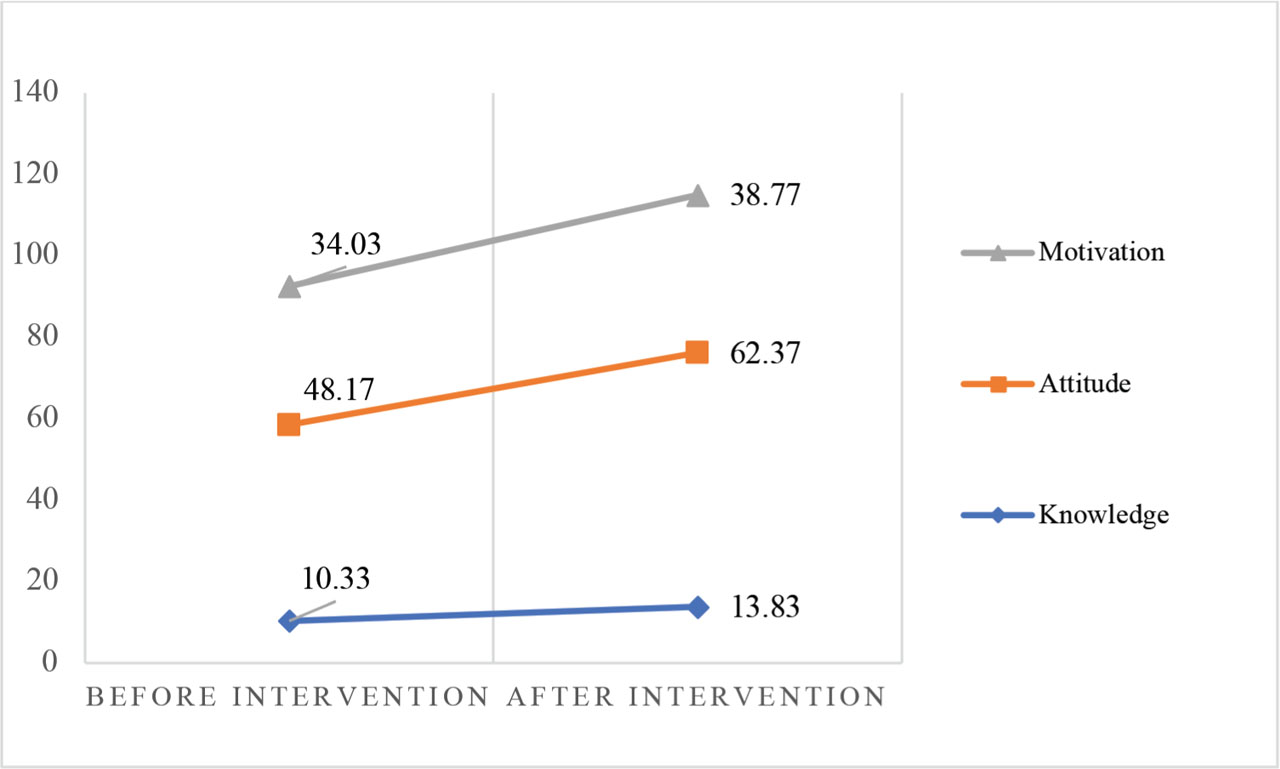
Figure 1.
The average value of improvement in knowledge, attitudes, motivation, and implementation of food safety before and after the intervention.
Figure 1 demonstrates that the mothers’ knowledge improved from an average score of 10.33 before the intervention to 13.83 after. Regarding maternal attitude, the average score increased from 48.17 before the intervention to 62.37 after the intervention. Additionally, the average motivation score for mothers was 34.03 before the intervention and rose to 38.77 after the intervention.
Before conducting a bivariate test, assessing the data for normality is essential, as this determines the appropriate statistical test to use. Given that the number of respondents was <50, the Shapiro–Wilk test was employed for the normality assessment. The results indicated that the data did not follow a normal distribution, as the P-value was <0.05. Therefore, the Wilcoxon test was selected for further analysis. The results of the data normality test are summarized in Table 3.
Table 3.
Normality test.
| Variable | Sig | Result |
|---|---|---|
| Pretest knowledge | 0.002 | Not normal |
| Posttest knowledge | 0.152 | Normal |
| Pretest attitude | 0.746 | Normal |
| Posttest attitude | 0.005 | Not normal |
| Pretest motivation | 0.710 | Normal |
| Posttest motivation | 0.007 | Not normal |
Table 4 shows that maternal knowledge significantly increased after providing education programs and supplementary feeding practices. Specifically, 29 respondents demonstrated an increase in knowledge, while one respondent showed no improvement, and none experienced a decrease in knowledge. The Z value was −4.72, and with a significance level of 0.05 and a two-tailed test, the critical Z value range is between −1.96 and 1.96. The P-value was <0.001, indicating a significant difference in knowledge before and after the intervention.
Table 4.
Results of the bivariate test of knowledge, attitude, and motivation before and after the intervention (n = 30).
| Variable | Min | Max | Mean ± SD | Z score | P-value* |
|---|---|---|---|---|---|
| Knowledge | −4.72 | <0.001 | |||
| Before intervention | 7 | 16 | 10.33 ± 2.27 | ||
| After intervention | 11 | 18 | 13.83 ± 1.66 | ||
| Attitude | −4.46 | <0.001 | |||
| Before intervention | 34 | 52 | 48.17 ± 6.29 | ||
| After intervention | 61 | 68 | 62.37 ± 4.06 | ||
| Motivation | −3.38 | 0.001 | |||
| Before intervention | 24 | 45 | 34.03 ± 5.01 | ||
| After intervention | 28 | 48 | 38.77 ± 6.05 |
In the attitude variable, 26 respondents showed an improvement, 4 respondents maintained their attitudes, and no respondents exhibited a decline in attitude. The Z value was −4.46, and using the same significance level and two-tailed test, the critical Z value range remains between −1.96 and 1.96. Additionally, the P-value of <0.001 suggests a significant difference in maternal attitudes before and after the intervention.
Regarding motivation, 17 respondents reported an increase, 10 maintained their motivation, and 3 experienced a decrease. The Z value was −3.38, and with a significance level of 0.05 and a two-tailed test, the critical Z value remains between −1.96 and 1.96. The P-value of 0.001 indicates a statistically significant difference in motivation before and after the educational intervention and supplementary feeding practice.
A robustness check was conducted to evaluate sensitivity for each variable, as provided in Table 5.
Table 5.
Robustness check.
| Variable | t-score | P-value | 95% CI |
|---|---|---|---|
| Knowledge | |||
| Handling of raw food and contamination risks | −2.112 | 0.043 | −0.262, −0.004 |
| Cleanliness and hygiene in food preparation | −2.408 | 0.023 | −0.308, −0.025 |
| Safe food storage | −3.247 | 0.003 | −0.435, −0.099 |
| Safe cooking techniques | −2.693 | 0.012 | −0.352, −0.048 |
| Food safety in toddler consumption | −3.808 | 0.001 | −0.474, −0.126 |
| Prevention of choking risks | −1.795 | 0.083 | −0.214, 0.014 |
| Use of harmful substances in food processing | −2.971 | 0.006 | −0.394, −0.073 |
| Attitude | |||
| Beliefs and perceptions regarding food safety | 11.298 | <0.001 | 2.020, 2.913 |
| Behavior in food product safety checks | 11.937 | <0.001 | 2.066, 3.001 |
| Safe food handling and processing practices | 12.740 | <0.001 | 2.132, 2.934 |
| Attitudes toward potential food contamination risks | 12.917 | 0.014 | 2.212, 3.055 |
| Attitudes toward food source and purchase locations | 17.750 | 0.004 | 2.507, 3.160 |
| Attitudes toward increasing knowledge of food safety | 16.078 | <0.001 | 2.647, 3.419 |
| Motivation | |||
| Value motivation | −6.151 | <0.001 | −1.954, −0.979 |
| Action motivation | −2.140 | 0.041 | −0.978, −0.200 |
| Cognitive motivation | −3.084 | 0.004 | −0.942, −0.191 |
The analysis results indicate that food safety education had a significant impact on improving the knowledge of mothers with toddlers. Almost all aspects of knowledge showed meaningful improvement, such as handling raw food, cleanliness and hygiene, safe storage, cooking techniques, toddler food safety, and the use of harmful substances. The only aspect that did not show a significant change was the prevention of choking risks, which should be addressed in future improvements to educational material.
In terms of attitude, all sub-variables showed a highly significant effect, with a P-value <0.05 and large t-values. This suggests that the education program was effective in shaping a strong, positive attitude toward food safety checks, safe food processing practices, perceptions of contamination risks, food source selection, and the motivation to improve knowledge about food safety continually. All positive confidence intervals reinforce that these changes are statistically meaningful.
The motivation variable also showed significant improvement in the aspects of value, action, and cognitive motivation. Although the t-value was negative, this does not indicate a decrease; rather, it reflects the direction of the score difference calculation. With confidence intervals that do not cross zero and a P-value <0.05, it can be concluded that the education was effective in increasing the internal drive of mothers to apply food safety practices in food preparation and serving for toddlers. Overall, the intervention was proven effective in improving mothers’ knowledge, attitudes, and motivation in ensuring food safety.
4. Discussion
This study analyzed the impact of food safety education and practice on mothers’ knowledge, attitudes, and motivation. From a nursing and midwifery perspective, these findings emphasize the critical role of health education in community empowerment and stunting prevention. The majority of participating mothers were aged 20–35 years, a productive period when women often assume key caregiving responsibilities. As individuals mature, they develop greater stability in decision-making and comprehension, which supports improved engagement in health education activities.26 This finding aligns with a previous study, which stated that mothers aged 26–30 exhibit higher knowledge acquisition compared to younger mothers aged 21–25.27 Thus, nursing-led interventions should be tailored to reach both young and experienced mothers, ensuring accessible education that accommodates varying life stages and learning capacities.
Regarding educational background, most mothers of stunted children in this study had secondary-level education, while only a few had tertiary qualifications. Education has a significant influence on health literacy and the ability to absorb information.28 Higher educational attainment enhances critical thinking and openness to health innovations, while lower educational levels often limit mothers’ ability to adopt health-promoting behaviors.29 Nurses and midwives, therefore, play a central role in bridging educational disparities by delivering health information in culturally appropriate and easy-to-understand formats. Encouraging women’s access to education not only improves maternal knowledge but also indirectly contributes to reducing future stunting rates.12
In terms of occupation, more than half of the mothers of stunted children were employed. Working mothers frequently face the dual burden of professional and domestic responsibilities, often relying on caregivers or family members to manage child nutrition.30 When these caregivers lack adequate understanding of food safety, children’s nutritional quality and health may be compromised. This finding aligns with prior studies showing that working mothers are at higher risk of having children with stunting.31 From a nursing practice standpoint, this highlights the importance of inclusive health education strategies that involve not only mothers but also care-givers and family members. Midwives and community nurses should advocate for family-centered interventions, as well as workplace policies, such as flexible schedules and breastfeeding-friendly environments, that enable mothers to maintain optimal childcare and feeding practices.
Although many mothers were employed, occupation was not significantly associated with food safety knowledge. This finding is consistent with previous research indicating that employment status does not necessarily correlate with better health knowledge.32,33,34 The nature of most participants’ jobs (trading, tailoring, labor, teaching) suggests limited exposure to health education. Nurses and midwives thus serve as essential sources of community-based knowledge transfer, ensuring that all mothers, regardless of occupation, receive accurate and practical food safety education.35 Such interventions can help improve health literacy, particularly among women working outside the healthcare field.
This study found that mothers’ knowledge increased significantly following education and training. This improvement supports earlier studies that have shown positive changes in knowledge and attitudes following food safety education among workers and mothers.29,36 Enhanced maternal knowledge enables safer food preparation and reduces the risk of malnutrition.37 Conversely, insufficient understanding may lead to poor dietary diversity and unsafe feeding practices, directly contributing to stunting.38 Nurses and midwives play a pivotal role in reinforcing these behavioral changes through continuing education and community health promotion, particularly in rural and low-resource settings where foodborne diseases remain prevalent. Repeated and structured education sessions, delivered by health professionals, have been shown to increase knowledge retention and improve food-handling behavior among caregivers.4,13,39,40 Integrating food safety training into existing stunting reduction and maternal-child health programs is, therefore, a practical and sustainable approach for nursing. This action is supported by a previous study, which stated that education can improve knowledge, complementary food practices, and food safety,41,42 as well as enhance food hygiene, food storage, and food preparation.43
The results also revealed a significant improvement in mothers’ attitudes after receiving education. Positive attitudes toward food safety are known to enhance healthy food management and hygiene practices.40,44,45 In this context, nurses and midwives play a crucial role in shaping health attitudes through participatory education and consistent reinforcement during routine maternal and child health visits. Behavioral improvements are often influenced by prior exposure to health education, training, and access to reliable information.46 Conversely, negative attitudes toward food safety can perpetuate malnutrition, diarrhea, and infection among children.47 Evidence also suggests that mothers with higher levels of education and greater knowledge are more likely to hold positive attitudes toward food safety.48 Training conducted by nurses and midwives can further strengthen these attitudes, fostering lasting behavioral change.47,49 Continuous, structured, and hands-on training, such as cooking demonstrations or food preparation workshops, should become a standard approach in nursing and midwifery to empower families in managing their daily food needs.
Motivation also improved significantly following the intervention. Motivation is a key psychological driver influencing the adoption of behavior, and it can be strengthened through education, family support, and community engagement.50 From a nursing and midwifery perspective, motivation enhancement reflects successful health promotion, where individuals internalize health messages and commit to behavioral change. These findings align with prior studies demonstrating that food safety socialization programs effectively increase consumer motivation and awareness, thereby reducing the risk of foodborne illness.51,52 Nurses and midwives, as educators and advocates, must, therefore, integrate motivational strategies, such as goal setting, peer learning, and recognition, into their health promotion sessions to sustain long-term behavior change.
From a practical standpoint, this study highlights the role of nurses and midwives in serving as catalysts for enhancing maternal and family health literacy. By applying the nursing process, including assessment, planning, implementation, and evaluation, health professionals can design tailored interventions that address the local determinants of stunting. Community-based nurses and midwives, working through programs such as Posyandu (Integrated Health Service Posts), are particularly well-positioned to deliver ongoing education, monitor progress, and ensure the adoption of food safety practices that support healthy child growth. In addition, technology-based services can be integrated into health education programs to strengthen impact on both mother and children.53
Limitation
The primary limitation of this study is its small sample size. Moreover, the researchers did not conduct daily observations to ensure that their knowledge and behavior were affected by their daily practice of providing food for their children. However, despite these limitations, the findings offer valuable insight into how nursing and midwifery-led education can strengthen mothers’ knowledge, attitudes, and motivation toward safe food preparation, contributing to community-based stunting prevention in Indonesia.
5. Conclusions
Education and training on supplementary food processing significantly improved mothers’ knowledge, attitudes, and motivation in implementing food safety for toddlers. These results highlight the importance of incorporating nursing and midwifery-led food safety education into maternal and child health programs. Health workers, especially midwives, should play an active role in promoting food safety through regular community education at Posyandu and toddler health sessions, enabling parents to make informed decisions that reduce the risk of foodborne illness and support optimal child growth. Future studies with larger samples, family involvement, and direct behavioral observation are recommended to develop a more comprehensive understanding of the long-term effects of such interventions. Furthermore, mixed-method research integrating quantitative and qualitative approaches may provide deeper insights into mothers’ experiences and the sustainability of behavior changes achieved through nursing-led education.
Implications for nursing and midwifery practice
The findings of this study reinforce the crucial role of nurses and midwives as frontline educators in promoting maternal and child health through education on food safety. By integrating nutritional safety into community-based programs, nurses and midwives can effectively bridge knowledge gaps among mothers, promote health-promoting behaviors, and contribute to reducing stunting. Strengthening their role in preventive health interventions can improve early childhood nutrition outcomes and overall community well-being.
In clinical and community settings, midwives and nurses should incorporate structured food safety education into their routine maternal and child health services. This action includes participatory learning activities, practical demonstrations, and counseling tailored to mothers’ educational levels and local dietary practices. Incorporating such education into Posyandu sessions, toddler classes, or postnatal visits enables consistent reinforcement of healthy food-handling habits. It enhances mothers’ confidence in providing their children with safe and nutritious meals.
From a policy and leadership standpoint, nursing and midwifery professionals should advocate for capacity-building programs that enhance their competencies in nutrition and food safety promotion. Collaboration with public health institutions, local governments, and nongovernmental organizations can ensure sustained implementation of food safety interventions. Establishing interprofessional networks among nurses, midwives, nutritionists, and community health workers will strengthen multidisciplinary strategies to prevent stunting and promote optimal child development.
Declaration of generative AI and AI-assisted technologies in the writing process
During the preparation of this work, the author(s) used Grammarly and ChatGPT to check for grammatical errors and sentence structure, ensuring the clarity of the writing. After using this tool/service, the author(s) reviewed and edited the content as needed and take full responsibility for the content of the publication.
Acknowledgment
The author would like to thank LPPM Universitas Muhammadiyah Pekajangan Pekalongan for facilitating research licensing and funding. We also thank the Community Health Service, village midwives, and health cadres in the Karangdadap Health Center, Pekalongan Regency, Central Java, who have helped in the smooth and successful conducting of this research.
Notes
[4] Supported by This project was supported by the University Muhammadiyah Pekajangan Pekalongan, Central Java, Republic of Indonesia.
[5] Ethical approval
Ethical clearance for conducting the research was obtained from the Research Ethics Committee of the Universitas Muhammadiyah Pekajangan Pekalongan (No.18/KEP-UMPP/IV/2024). This study strictly adheres to the ethical standards outlined in the Helsinki Declaration (2013 Revision) and follows the International Ethical Guidelines for Health-Related Research Involving Humans (2016).
[6] Conflicts of interest Conflicts of interest
All contributing authors declare no conflicts of interest.
[7] Contributed by Author contribution
Siti Khuzaiyah Conceptualization, validation, draft writing, visualization, and revision.
Nur Chabibah Conceptualization, research administration, and investigation.
Nina Zuhana Conceptualization, research administration, and investigation.
Wahyu Ersila Conceptualization, research administration, investigation, validation, data analysis, and draft writing.