
Table 1.
Composition and detailed components of the resource repository.
| Resource repository module | Key components |
|---|---|
| Marital relationship support | Effective couple communication |
| Couples’ coping skills training | |
| Cognitive-behavioral modification | |
| Sexual health education | |
| Parent–child relationship support | Self-emotion management |
| Effective parent–child communication | |
| Harmonious parent–child relationship | |
| Effective acquisition of social support | |
| Patient–parent relationship support | Effective communication with parents |
| Understanding and supporting parents | |
| Policy guidance | Comprehensive social assistance policies |
| Basic medical insurance policies | |
| Medical aid and critical illness insurance policies | |
| Medical rehabilitation security policies | |
| Healthcare prevention and wellness policies | |
| Health guidance | Education on breast cancer disease knowledge |
| Education on breast cancer treatment options | |
| Education on managing treatment-related symptoms | |
| Rehabilitation guidance | |
| Lifestyle guidance | |
| Guidance on long-term follow-up and surveillance | |
| Coping strategies for managing fear of recurrence | |
| Screening recommendations for High-risk individuals | |
| Information on peer support networks and resources | |
| Information on clinical trial enrollment |
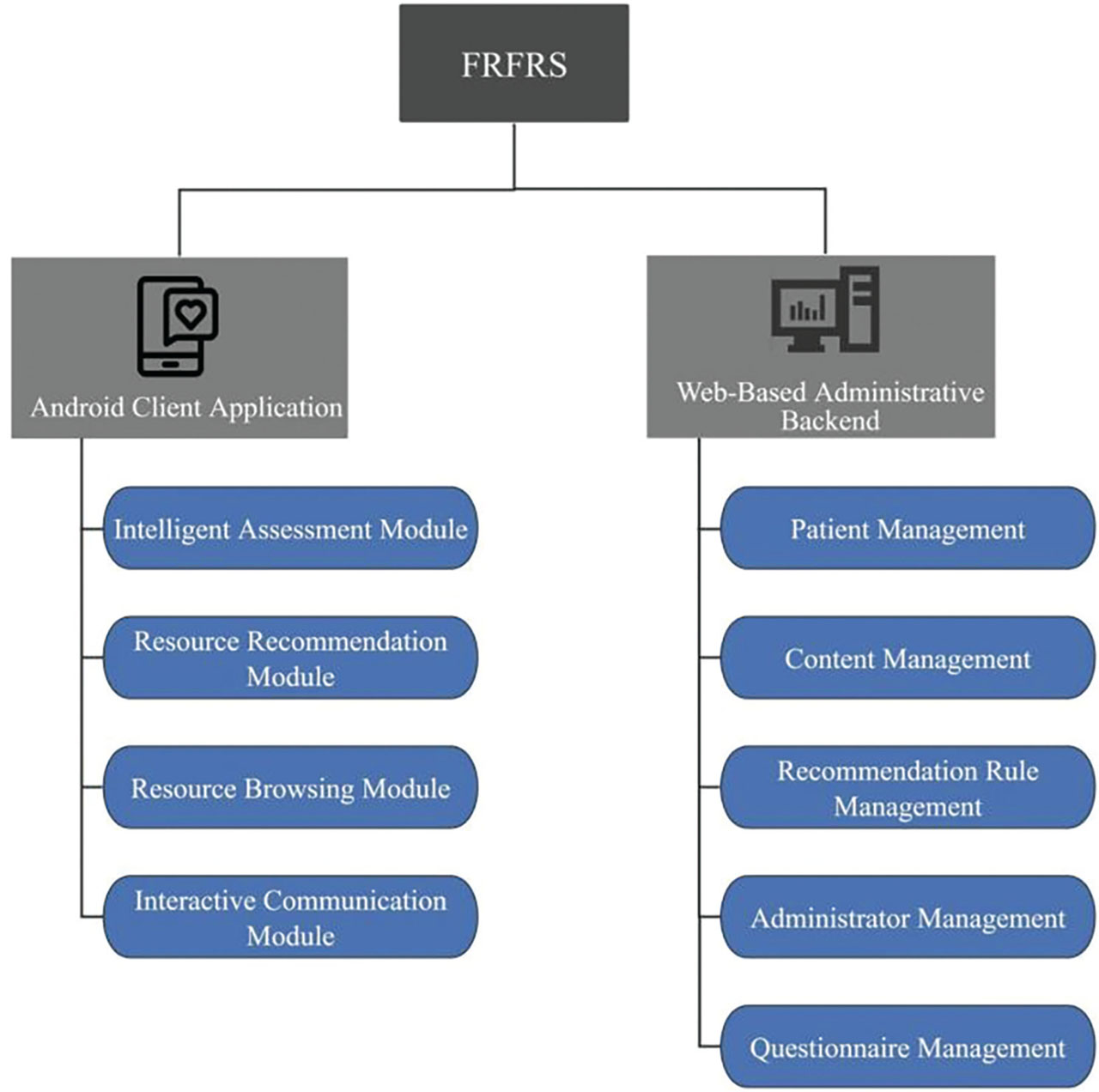
Figure 1.
Architecture and core functional modules of the FRFRS. Abbreviation: FRFRS, family role-focused recommendation system.
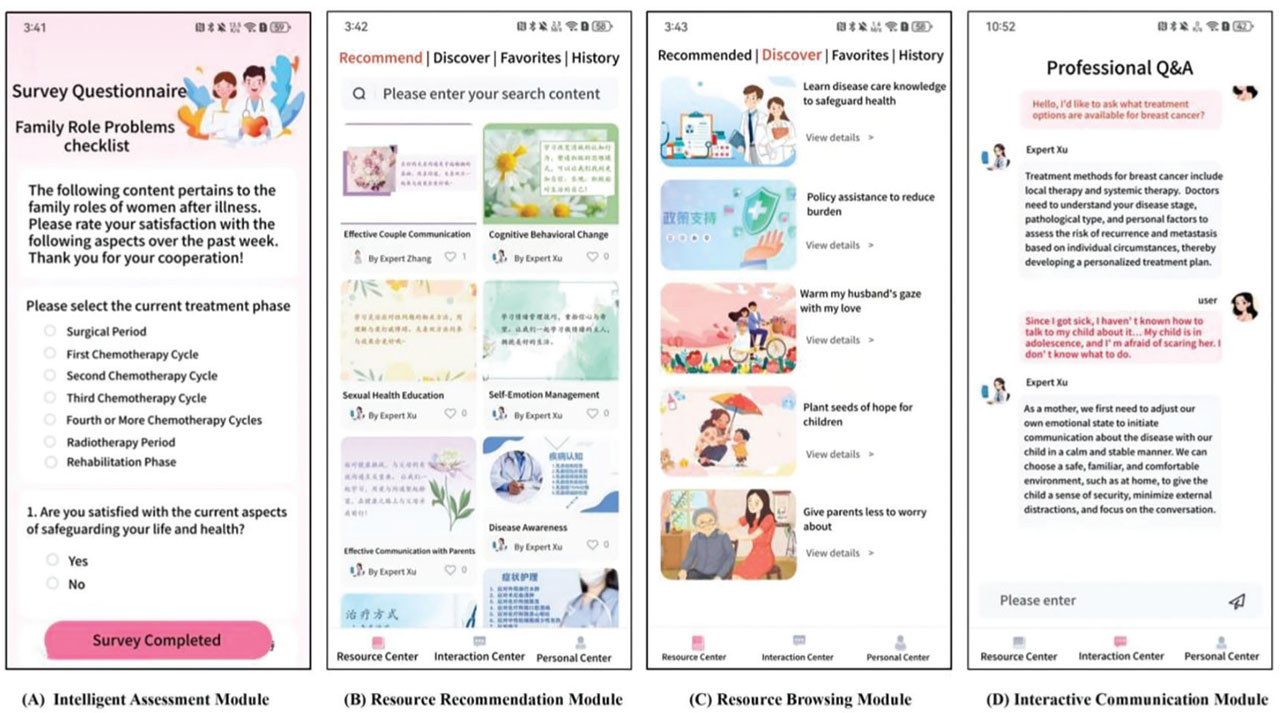
Figure 2.
Core functional modules of the patient-facing Android client application. (A) Intelligent assessment module. (B) Resource recommendation module. (C) Resource browsing module. (D) Interactive communication module.
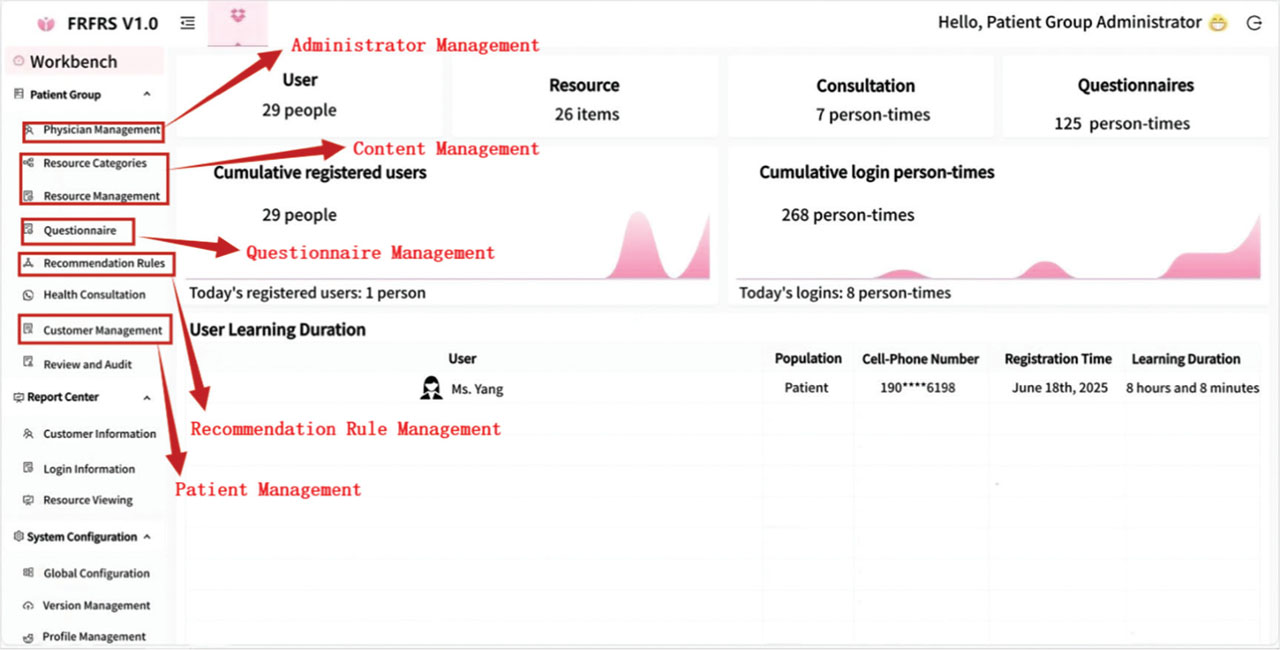
Figure 3.
Core functional modules of the web-based administrative backend.
Table 2.
Demographic details of participants involved in the usability evaluation of the FRFRS (n = 21).
| Variable | Number (%) or mean (SD) |
|---|---|
| Age (years) | 36.95 (1.88) |
| Marital duration | 15.43 (2.96) |
| Education level | |
| College degree or above | 8 (38.1) |
| Senior middle school | 3 (14.3) |
| Middle school | 7 (33.3) |
| Primary school or below | 3 (14.3) |
| Work status | |
| Returned to work | 2 (9.5) |
| Not returning to work | 19 (90.5) |
| HMIPC | |
| ≥2999 | 14 (66.7) |
| 3000–4999 | 5 (23.8) |
| 35000 | 2 (9.5) |
| Medical insurance | |
| Resident basic medical insurance | 19 (90.5) |
| Commercial health insurance | 2 (9.5) |
| Number of children | |
| 1 | 3 (14.3) |
| 2 | 13 (61.9) |
| >2 | 5 (23.8) |
| Cancer stage | |
| Stage I | 5 (23.8) |
| Stage II | 9 (42.9) |
| Stage III | 7 (33.3) |
| Time since diagnosis | |
| <6 months | 8 (38.1) |
| 6–12 months | 7 (33.3) |
| >12 months | 6 (28.6) |
| Current treatment phase | |
| Surgical period | 5 (23.8) |
| First chemotherapy cycle | 4 (19.0) |
| Second chemotherapy cycle | 4 (19.0) |
| Third chemotherapy cycle | 1 (4.8) |
| Fourth or more chemotherapy cycles | 4 (19.0) |
| Radiotherapy period | 3 (14.3) |
| Surgical approach | |
| Breast conserving surgery | 4 (19.0) |
| Mastectomy | 17 (81.0) |
Table 3.
Evaluation of system usability (n = 21).
| Item | Average score | Converted score |
|---|---|---|
| 1. I think that I would like to use this system frequently | 4.43 | 3.43 |
| 2. I found the system unnecessarily complex | 2.00 | 3.00 |
| 3. I thought the system was easy to use | 4.05 | 3.05 |
| 4. I think that I would need the support of a technical person to be able to use this system | 2.10 | 2.90 |
| 5. I found the various functions in this system were well integrated | 3.86 | 2.86 |
| 6. I thought there was too much inconsistency in this system | 1.71 | 3.29 |
| 7. I would imagine that most people would learn to use this system very quickly | 4.43 | 3.43 |
| 8. I found the system very cumbersome to use | 1.67 | 3.33 |
| 9. I felt very confident using the system | 4.19 | 3.19 |
| 10. I needed to learn a lot of things before I could get going with this system | 1.76 | 3.24 |
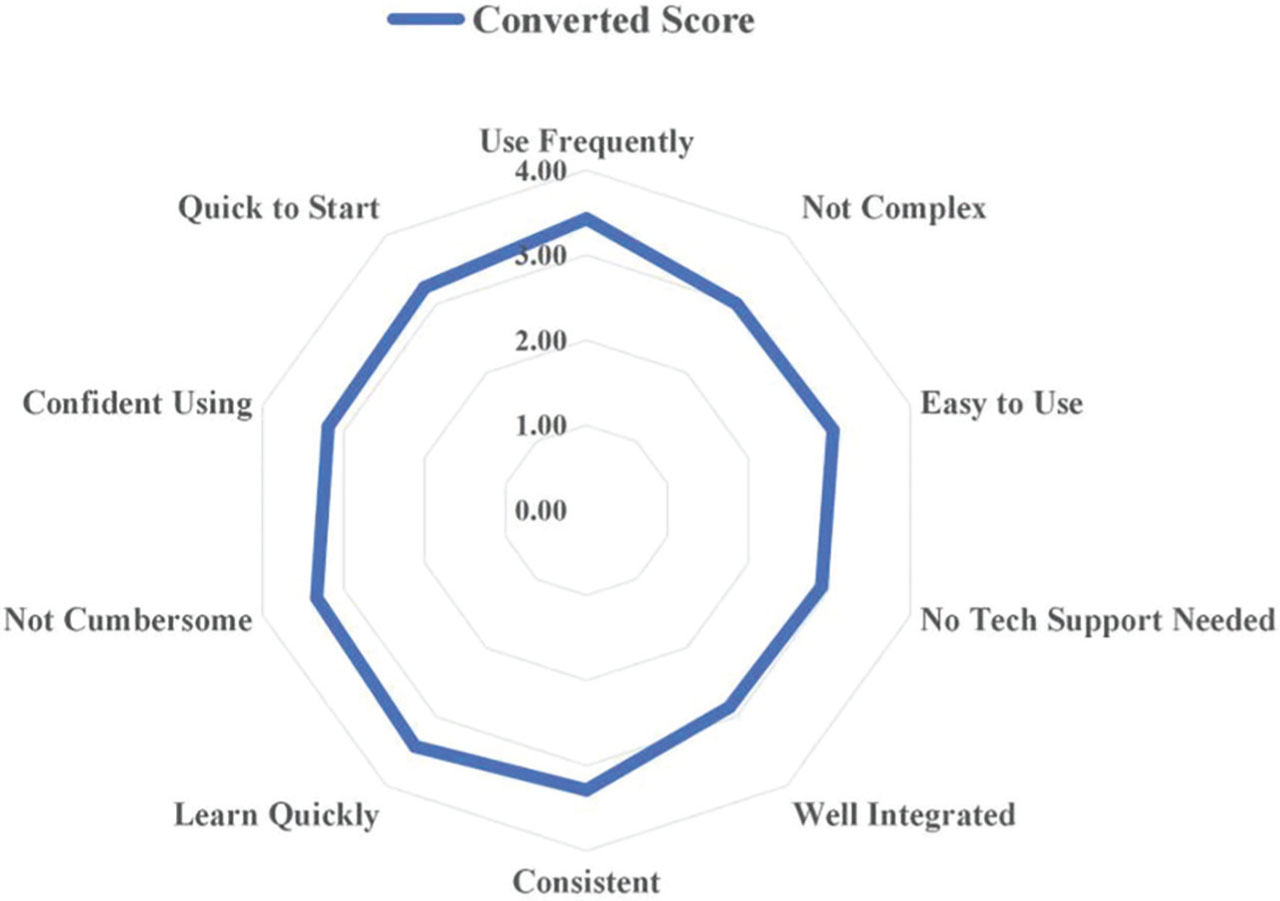
Figure 4.
Radar chart of the converted SUS scores.
Note: Scores for all SUS items were transformed following the standard SUS scoring procedure, such that higher converted scores indicate more positive user experiences. SUS, System Usability Scale.