
1. Introduction
Breast cancer is the most common malignant tumor among women worldwide. According to GLOBOCAN data, it is estimated that approximately 2.3 million new breast cancer cases were diagnosed in women in 2022, accounting for 23.8% of all female cancer diagnoses globally.1 In recent years, the age at breast cancer onset has been decreasing globally, a trend mirrored in China.2 The European School of Oncology and the European Society for Medical Oncology define female patients diagnosed with breast cancer before age 40 as young women with breast cancer.3 Compared with older breast cancer patients, young breast cancer patients experience a higher symptom burden, more complex psychosocial distress, and more prominent family challenges.4 While young women are often primary family caregivers, their compromised health due to breast cancer substantially impairs their capacity to fulfill these essential caregiving duties.
Studies indicate that young patients often encounter complex and multifaceted family role challenges, including difficulties in household management, impaired marital intimacy, compromised parent–child relationships, and reduced capacity for eldercare.5,6,7 As a chronic disease, breast cancer requires long-term management, during which patients’ family role challenges evolve dynamically and are often interrelated.8,9 These family challenges significantly exacerbate patients’ psychological distress, reduce their quality of life, and may ultimately hamper recovery.10,11,12
With the advancement of psycho-oncology care, a growing number of studies have implemented interventions designed to support breast cancer patients in coping with family role challenges.13,14 Fergus et al.13 developed a couple-based intervention programs for young couples facing breast cancer, aimed at enhancing both partners’ ability to cope with the disease through professionally guided modular sessions, which were shown to improve positive dyadic coping. John et al.14 developed a mother-child dyadic rehabilitation and prevention intervention, which was effective in improving the psychological health and quality of life of mothers with breast cancer and their children during the rehabilitation phase. Furthermore, targeted health education and policy support can help patients address family role challenges.15,16
However, current interventions are often narrowly focused on a single dimension of family roles, with limited health education and policy support, rendering them inadequate to address multifaceted challenges in family roles. Moreover, these interventions rely on structured designs and target only specific treatment phases, which may result in failing to address the challenges encountered at different stages of treatment. Consequently, there is an urgent need to develop integrated and personalized support strategies that provide dynamic, continuous, and comprehensive support to young breast cancer patients throughout the disease trajectory.
Recommendation systems (RS) have emerged as a promising solution to meet the personalized, evolving needs of users by filtering and recommending content through continuous analysis of individual preferences.17 Specifically in healthcare, RS can provide intelligent, precise, and personalized guidance by integrating patient-specific characteristics, symptoms, and disease status.18 The content of the RS in the field of cancer care mainly focuses on providing information about diseases, treatments, and health preservation,19 symptom management,20 decision support,21 remote home-based management, and follow-up care.22 However, most of these applications are predominantly aimed at supporting patients’ physical recovery, while generally overlooking interventions designed to address the challenges associated with their complex family roles.
Therefore, this study aimed to develop an RS designed to provide family role support for young breast cancer patients. Within this development process, the assessment of usability constitutes an essential phase in digital health product development, a determinant of its successful implementation, and a vital strategy for enhancing user adoption and compliance.23,24 Accordingly, this study conducted a usability evaluation of the proposed RS among the target population.
2. Methods
2.1. Overview of the development process
2.1.1. Construction of the resource repository
Relevant literature, clinical guidelines, and expert consensus documents were reviewed to identify both support measures addressing patients’ family roles (as wives, mothers, and daughters) and relevant health education content. In addition, national and regional policy documents concerning cancer care and patient support were analyzed to extract key policy themes. These support resources preliminarily constituted the content and structural framework of the resource repository.
A rule-based recommendation framework was then established. Initial recommendation tags were derived from prior qualitative studies6,7 on family role problems among young breast cancer patients and refined through research team discussions. Support resources were matched with corresponding recommendation tags to define “problem-resource” matching rules. Based on findings from our previous network analysis that identified core role problems across different treatment stages, “treatment stage-core problem-resource” matching rules were further developed and integrated to form a comprehensive recommendation rule set.
Finally, experts from medicine, nursing, and psychology participated in a Delphi consultation to evaluate and refine the content, recommendation rules, and classification structure of the resource repository. After consensus was reached, the finalized resources were converted into multimedia formats, including videos, audio, and posters.
2.1.2. Development of the RS
The development of the RS followed a structured multistage process. A joint team of researchers and software engineers was first established to ensure interdisciplinary collaboration and technical feasibility. Informed by the Technology Acceptance Model,25 a system implementation plan was then defined to clarify core functions and architecture. The system framework was developed, consisting of an Android client application for patient use and a web-based administrative backend for data and rule management. Subsequently, multimedia resources and predefined recommendation rules from the resource repository were uploaded and configured through the backend to enable rule-based delivery within the client application. The system underwent internal testing and iterative optimization to verify functional completeness, workflow integrity, and interface clarity across both the client and the backend. After testing and refinement, the family role-focused recommendation system (FRFRS) version 1.0 was finalized and prepared for deployment in the subsequent usability evaluation phase.
2.2. Usability evaluation of the FRFRS
2.2.1. Participants and sample size
Eligible participants were required to meet all of the following criteria: (1) a pathological diagnosis of stage I–III breast cancer, with full awareness of their diagnosis; (2) age under 40 years; (3) married female status with at least one dependent child; (4) at least one surviving parent; (5) ownership and proficiency in using an Android smartphone; and (6) willingness to provide written informed consent. Participants were excluded for any of the following: (1) presence of metastatic or recurrent breast cancer or any other concurrent malignancy; (2) a diagnosis of consciousness disorders or cognitive impairment; or (3) a documented history of psychiatric disorders.
For sample size determination, usability research indicates that approximately 5–15 participants can identify most critical issues.26 To adopt a conservative approach and ensure adequate data saturation, a minimum of 25 participants were invited to take part in the study.
2.2.2. Procedures
This usability study was conducted at the Breast Center of a tertiary hospital in China in 2025. Participants were recruited from the center’s inpatient wards via purposive sampling. Following enrollment, the study objectives and procedures were explained, and a researcher assisted each participant in installing the FRFRS application on their personal smartphone. The researcher then guided participants through account registration and the entry of basic demographic information and provided a detailed demonstration of all core features of the FRFRS.
Participants were then instructed to use the FRFRS freely in their daily lives for 4 weeks. They were encouraged to contact the research team via phone or WeChat if they encountered any technical or operational issues during this phase. At the end of the 4-week usage period, the System Usability Scale (SUS) was administered to quantitatively assess the perceived usability of the FRFRS. In addition, a subset of participants underwent semi-structured interviews to explore their user experiences with the system.
2.2.3. Intervention fidelity
Intervention fidelity was assessed by monitoring participants’ system usage through the administrative back-end. During the study period, the FRFRS automatically sent weekly reminders prompting participants to update their assessment results, which were used to generate personalized recommendations. The backend system recorded detailed usage data, including the frequency of assessment completion and access to recommended content. Participants were considered to have had sufficient exposure to the intervention if, over the 4-week study period, they completed the assessment each week and accessed the system-generated personalized recommendations at least once.
2.2.4. Data collection
Sociodemographic and clinical data
Participants completed a basic sociodemographic questionnaire at enrollment (e.g., age, marital duration, educational level, work status, and number of children). Clinical information, including time of diagnosis, cancer stage, current treatment phase, and surgical approach, was extracted from the electronic health records.
Usability assessment
The perceived usability of the FRFRS was assessed using the 10-item SUS, with each item rated on a 5-point Likert scale.27 The conversion of raw survey responses into the converted score followed a 2-step process: for odd-numbered items, the contribution to the total raw sum was the scale position minus 1; for even-numbered items, the contribution was 5 minus the scale position. The overall SUS score was calculated by summing the converted scores for all items and multiplying the total by 2.5, yielding a range from 0 to 100. A higher score indicates better perceived usability. The SUS scores were interpreted using letter grades and adjective ratings as follows: >80.3 (A, Excellent), 68–80.3 (B, Good), 68 (C, Okay), 51–68 (D, Poor), and < 51 (F, Awful).28 The Cronbach’s alpha coefficient of SUS was 0.84.27 In this research, the Cronbach’s alpha coefficient was 0.77.
Qualitative interviews
To comprehensively evaluate the usability of the FRFRS, we employed purposive sampling to select a subset of patients who had completed the system use period for semi-structured interviews, aiming to collect detailed user feedback and experiences. All interviews were performed by a trained qualitative researcher following established protocols, with each session lasting approximately 30 minutes. The number of interviewees was determined by information saturation, defined as 2 consecutive interviews yielding no new thematic information. All interviews were audio-recorded and subsequently transcribed verbatim for thematic analysis.
2.2.5. Data analysis
Sociodemographic characteristics and SUS scores were summarized using descriptive statistics. Specifically, categorical variables were described with frequencies and percentages. Continuous variables were reported as the mean with the standard deviation (SD). All statistical analyses were performed using SPSS Statistics (version 27.0; IBM Corp., Armonk, NY, USA).
Following each interview, the principal investigator promptly transcribed the audio recordings within 24 hours and imported them into NVivo 12.0 Plus (QSR International, Burlington, MA, USA) for analysis. The transcripts were analyzed systematically using inductive thematic analysis as described by Braun and Clarke.29 Two researchers first repeatedly reviewed the transcripts to familiarize themselves with the data. Open coding was then performed independently by both researchers. All transcripts were re-examined to cross-check the codes, with disagreements resolved by a third researcher. Codes with similar content were merged into subthemes, which were then defined and categorized into main themes. Representative quotes were selected to illustrate the subthemes and were discussed by the research team.
2.3. Ethical consideration
This study received approval from the Medical Ethics Committee of the hospital (Approval No. XYFY2025-KL382-01) and was registered at the Chinese Clinical Trial Registry (ChiCTR2500108143). All procedures adhered to the ethical principles of the Declaration of Helsinki. Before the study began, all participants provided written informed consent after receiving a comprehensive explanation of the study. They were assured of voluntary involvement, free withdrawal, and data confidentiality.
3. Results
3.1. The content of FRFRS
3.1.1. Composition of the resource repository
The expert panel comprised professionals from medicine, nursing, and psychology, with an authority coefficient of ≥0.85. Following rounds of expert revision and consensus-building, the finalized resource repository was structured into 5 core modules: marital relationship support, parent–child relationship support, patient–parent relationship support, policy guidance, and health guidance (Table 1).
Table 1.
Composition and detailed components of the resource repository.
| Resource repository module | Key components |
|---|---|
| Marital relationship support | Effective couple communication |
| Couples’ coping skills training | |
| Cognitive-behavioral modification | |
| Sexual health education | |
| Parent–child relationship support | Self-emotion management |
| Effective parent–child communication | |
| Harmonious parent–child relationship | |
| Effective acquisition of social support | |
| Patient–parent relationship support | Effective communication with parents |
| Understanding and supporting parents | |
| Policy guidance | Comprehensive social assistance policies |
| Basic medical insurance policies | |
| Medical aid and critical illness insurance policies | |
| Medical rehabilitation security policies | |
| Healthcare prevention and wellness policies | |
| Health guidance | Education on breast cancer disease knowledge |
| Education on breast cancer treatment options | |
| Education on managing treatment-related symptoms | |
| Rehabilitation guidance | |
| Lifestyle guidance | |
| Guidance on long-term follow-up and surveillance | |
| Coping strategies for managing fear of recurrence | |
| Screening recommendations for High-risk individuals | |
| Information on peer support networks and resources | |
| Information on clinical trial enrollment |
3.1.2. Functional overview of the FRFRS
The FRFRS was developed as an integrated digital health platform comprising 2 complementary components: an Android client application for personalized support and a web-based administrative backend for systematic management. Figure 1 illustrates the core functional modules of the FRFRS platform.
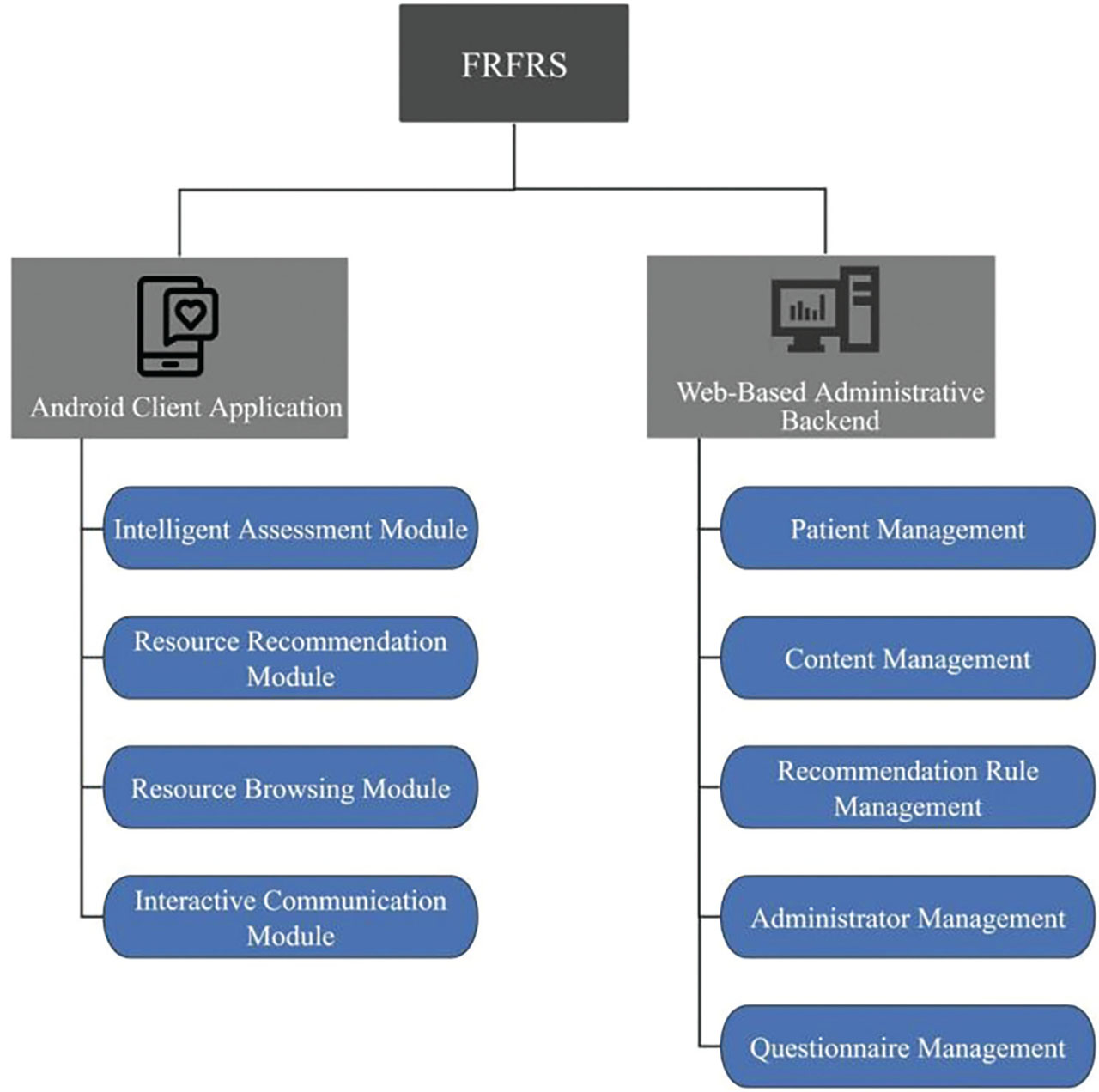
Figure 1.
Architecture and core functional modules of the FRFRS. Abbreviation: FRFRS, family role-focused recommendation system.
Patient-facing Android client application
The client application was designed to generate personalized resource recommendations by synthesizing users’ self-reported treatment phase and their family role problems. As illustrated in Figure 2, it integrates 4 core functional modules. (1) Intelligent Assessment Module (Figure 2A): This module is used to assess family role problems from multiple dimensions using a structured checklist. The checklist was developed by our research team based on qualitative interviews, stakeholder consultations, and pilot testing. It evaluates challenges in the patient’s functioning as a wife, mother, and daughter, as well as overall family functioning and self-perception. (2) Resource Recommendation Module (Figure 2B): This module operationalizes predefined recommendation rules to deliver personalized support. It first analyzes the user’s assessment results, then filters and prioritizes relevant support resources from the repository using these rules. The tailored resource list is automatically generated and presented to the user. The module also provides a keyword-based search function. (3) Resource Browsing Module (Figure 2C): This module provides users with comprehensive, unrestricted access to the entire resource repository. It supports independent exploration, allowing users to navigate, filter, and browse all available support resources at their own pace and based on their personal interests. (4) Interactive Communication Module (Figure 2D): This module establishes a direct communication channel within the platform, enabling patients to initiate online consultations with healthcare providers. Its primary function is to facilitate timely, text-based communication for online consultation.
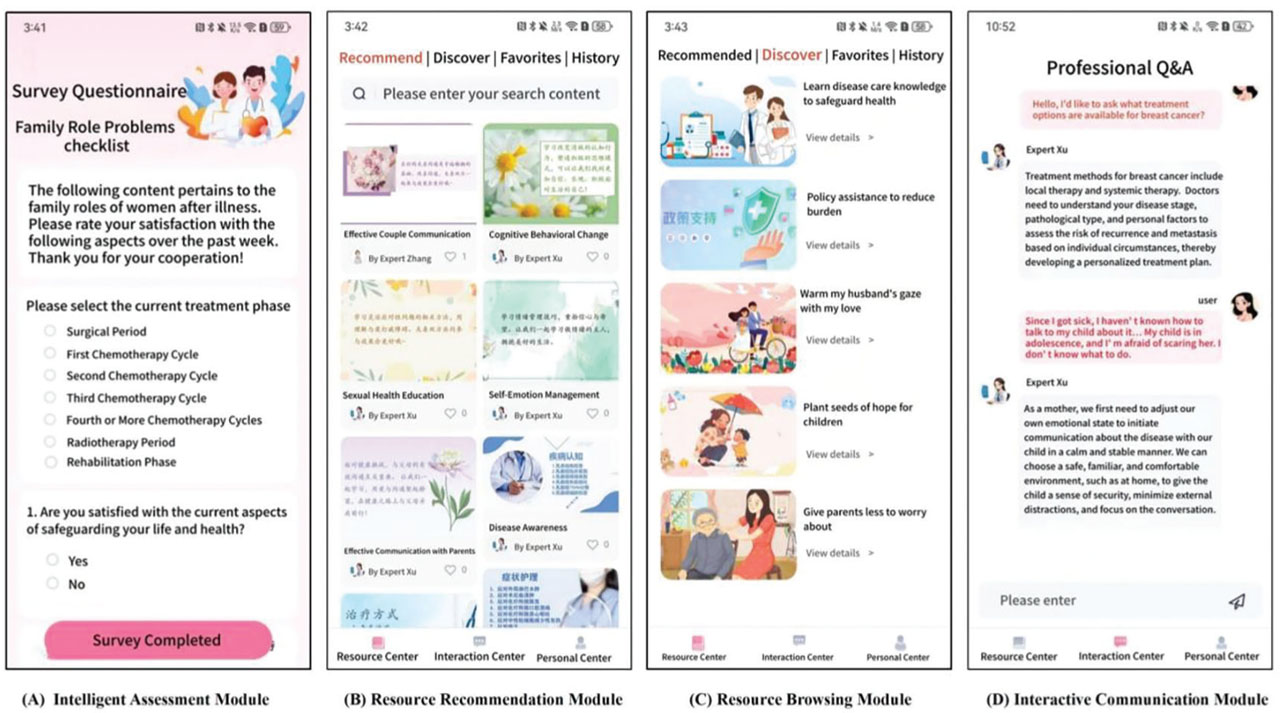
Figure 2.
Core functional modules of the patient-facing Android client application. (A) Intelligent assessment module. (B) Resource recommendation module. (C) Resource browsing module. (D) Interactive communication module.
Web-based administrative backend
The backend provides a centralized, web-based management platform for healthcare teams, enabling systematic oversight and configuration. As shown in Figure 3, its core operational functions include 5 modules: (1) Patient Management—This module provides a centralized interface for tracking and reviewing all patient interactions. It supports the longitudinal monitoring of individual patient profiles by recording detailed browsing logs (e.g., resources viewed and time spent), all assessment outcomes, and complete consultation histories. This functionality allows healthcare providers to holistically assess patient engagement and evolving role problems. (2) Content Management—This module allows administrators to manage all support resources in the system. It supports ongoing content maintenance, including creating new materials, reviewing existing materials, and removing outdated items. Resources can be categorized and updated as needed, ensuring that all information remains current, accurate, and useful for patients. (3) Recommendation Rule Management—This module allows administrators to adjust the rules used for generating personalized resource recommendations to better align patient assessment results with the most appropriate support resources. (4) Administrator Management—This module oversees account and permission management for all system specialists and administrators. (5) Questionnaire Management—This module allows administrators to upload and modify assessment questionnaires used in the system.
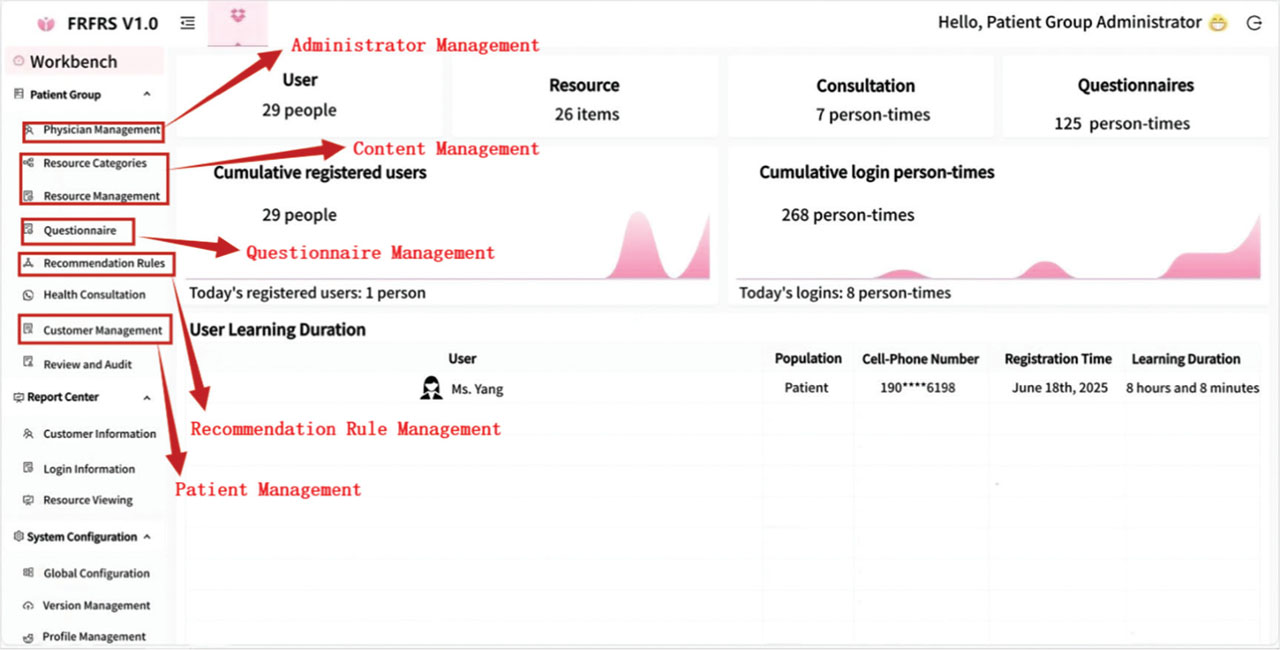
Figure 3.
Core functional modules of the web-based administrative backend.
3.2. Results of the usability evaluation
3.2.1. Participant characteristics
Following a 4-week usage period, 21 of the 25 participants (84%) completed the usability evaluation of the FRFRS. Their demographic characteristics are summarized in Table 2. Four participants did not complete the study due to personal reasons or loss to follow-up.
Table 2.
Demographic details of participants involved in the usability evaluation of the FRFRS (n = 21).
| Variable | Number (%) or mean (SD) |
|---|---|
| Age (years) | 36.95 (1.88) |
| Marital duration | 15.43 (2.96) |
| Education level | |
| College degree or above | 8 (38.1) |
| Senior middle school | 3 (14.3) |
| Middle school | 7 (33.3) |
| Primary school or below | 3 (14.3) |
| Work status | |
| Returned to work | 2 (9.5) |
| Not returning to work | 19 (90.5) |
| HMIPC | |
| ≥2999 | 14 (66.7) |
| 3000–4999 | 5 (23.8) |
| 35000 | 2 (9.5) |
| Medical insurance | |
| Resident basic medical insurance | 19 (90.5) |
| Commercial health insurance | 2 (9.5) |
| Number of children | |
| 1 | 3 (14.3) |
| 2 | 13 (61.9) |
| >2 | 5 (23.8) |
| Cancer stage | |
| Stage I | 5 (23.8) |
| Stage II | 9 (42.9) |
| Stage III | 7 (33.3) |
| Time since diagnosis | |
| <6 months | 8 (38.1) |
| 6–12 months | 7 (33.3) |
| >12 months | 6 (28.6) |
| Current treatment phase | |
| Surgical period | 5 (23.8) |
| First chemotherapy cycle | 4 (19.0) |
| Second chemotherapy cycle | 4 (19.0) |
| Third chemotherapy cycle | 1 (4.8) |
| Fourth or more chemotherapy cycles | 4 (19.0) |
| Radiotherapy period | 3 (14.3) |
| Surgical approach | |
| Breast conserving surgery | 4 (19.0) |
| Mastectomy | 17 (81.0) |
3.2.2. System usage fidelity
All 21 participants who completed the study met the predefined criteria for sufficient system exposure. Specifically, participants completed all 4 weekly assessments and accessed the system-generated personalized recommendations at least once per week throughout the study period. The FRFRS resources were accessed a total of 1080 times, corresponding to an average of 51.4 views per participant over the study period. The most frequently accessed resource was Recommendations for Effective Couple Communication (mean 4.2 views per participant), followed by Policy Guidance (3.8 views) and Education on Breast Cancer Disease Knowledge (3.4 views).
3.2.3. Quantitative usability results
The usability evaluation results are summarized in Table 3 and visualized in Figure 4. The FRFRS achieved a mean SUS score of 79.29, corresponding to a “Good” (Grade B) usability rating. Item-level analysis based on converted scores showed that items 1 and 7 received the highest ratings (3.43 each), indicating strong user agreement with intended system use and perceived ease of learning. In contrast, item 5 received the lowest converted score (2.86), followed by item 4 (2.90), suggesting that users were relatively less positive about the integration of system functions and reported a comparatively greater need for technical support.
Table 3.
Evaluation of system usability (n = 21).
| Item | Average score | Converted score |
|---|---|---|
| 1. I think that I would like to use this system frequently | 4.43 | 3.43 |
| 2. I found the system unnecessarily complex | 2.00 | 3.00 |
| 3. I thought the system was easy to use | 4.05 | 3.05 |
| 4. I think that I would need the support of a technical person to be able to use this system | 2.10 | 2.90 |
| 5. I found the various functions in this system were well integrated | 3.86 | 2.86 |
| 6. I thought there was too much inconsistency in this system | 1.71 | 3.29 |
| 7. I would imagine that most people would learn to use this system very quickly | 4.43 | 3.43 |
| 8. I found the system very cumbersome to use | 1.67 | 3.33 |
| 9. I felt very confident using the system | 4.19 | 3.19 |
| 10. I needed to learn a lot of things before I could get going with this system | 1.76 | 3.24 |
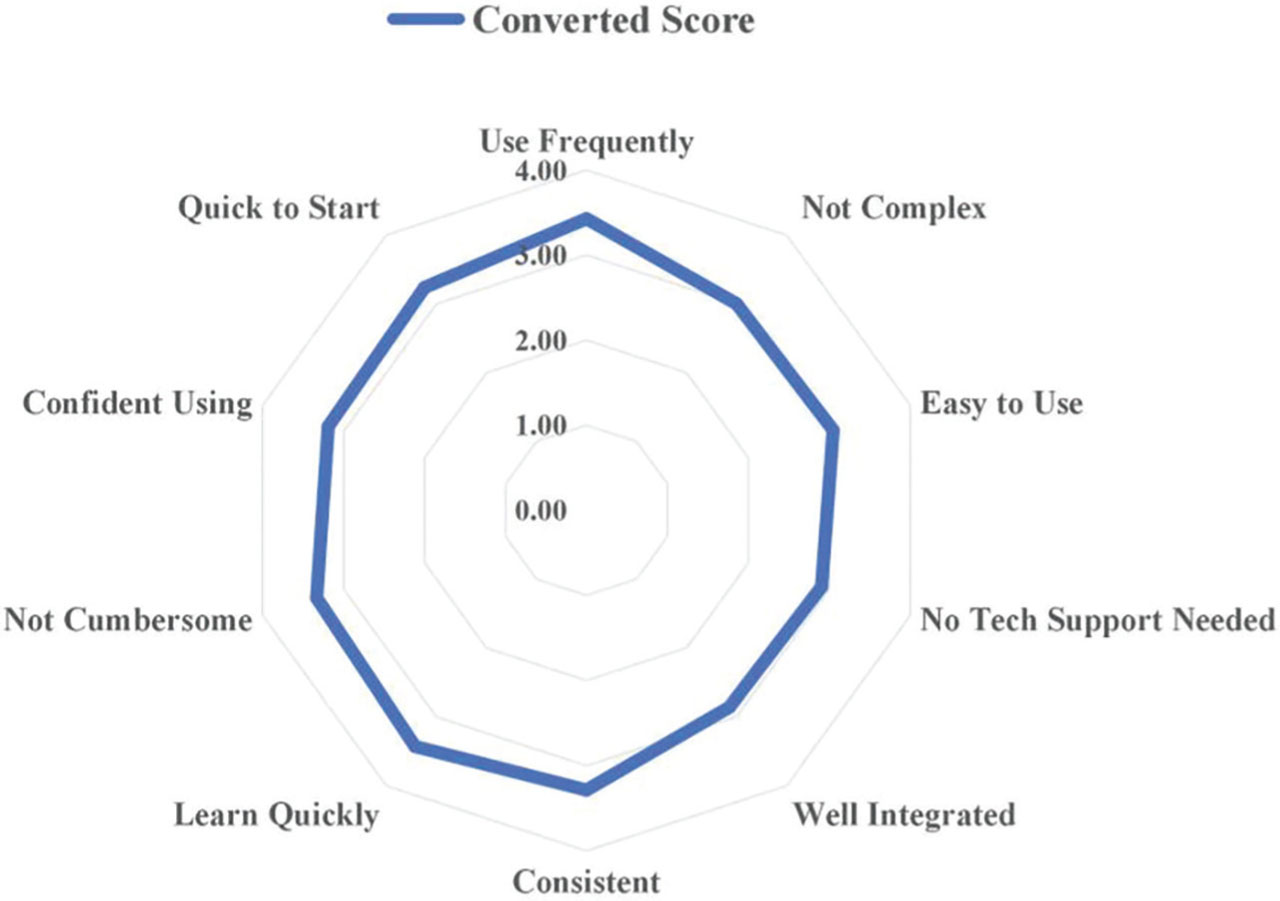
Figure 4.
Radar chart of the converted SUS scores.
Note: Scores for all SUS items were transformed following the standard SUS scoring procedure, such that higher converted scores indicate more positive user experiences. SUS, System Usability Scale.
3.2.4. Qualitative findings
Ten semi-structured interviews were conducted, and data saturation was reached after the eighth interview. Thematic analysis revealed 5 subthemes, which were grouped into 2 overarching themes: positive user experiences with the FRFRS and limitations or unmet user needs.
Theme 1: Positive user experiences of the FRFRS.
This theme reflects participants’ positive perceptions of the FRFRS, including its practical usefulness, ease of use, and their willingness to continue using and recommending the system.
Subtheme 1: Perceived usefulness of the system. Participants described the system as a useful tool that enhanced their understanding of disease-related information and offered practical guidance for addressing family role problems.
“I knew nothing before and was very lost. After reading the content, I at least have a general understanding of my condition.” (P1) “The cases provided in it also offered me some help. I can refer to those cases to learn how to communicate with my family.” (P5)
Subtheme 2: Perceived ease of use of the system. Participants reported that the system had a user-friendly interface that was easy to operate. The inclusion of an integrated knowledge base further supported convenient access by eliminating the need to search across multiple platforms.
“It’s convenient to use on phone. The interface is clear and simple after logging in.” (P1) “This design is really great. It has saved me a lot of time. I no longer need to search everywhere for relevant information. It’s all right here when I click on this.” (P7)
Subtheme 3: Willingness to continue using and recommend the system. Several participants reported a clear intention to continue using the system and to recommend it to others. This intention was largely attributed to the system’s professional content, as well as its free access.
“I am willing to continue using it because my own professional knowledge is limited.” (P6) “Yes, I would recommend anything that is free; I wouldn’t if it charged.” (P1)
Theme 2: Limitations and unmet user needs of the FRFRS.
Participants described several limitations of the FRFRS, mainly related to the lack of detailed content and difficulties in navigating certain system features.
Subtheme 1: Insufficient specificity of content. Participants reported that some of the system content lacked sufficient detail to meet their practical needs. In particular, they expressed a desire for more specific and targeted guidance regarding diet management and medication-related information.
“The information about diet is quite general. During chemotherapy or after surgery, I want more specific guidance, such as what I should eat for breakfast, lunch, and dinner, so that I can follow it in my daily life.” (P1) “You could add the types, contraindications, and adverse reactions of commonly used drugs, so I can learn more.” (P6)
Subtheme 2: Difficulties in content comprehension and presentation. Some participants indicated that certain professional content was difficult to understand due to specialized language and information-heavy presentation and suggested the use of clearer and more accessible language. Additionally, users pointed out limitations in the structure of video content and recommended improvements such as adding quick navigation or positioning functions to enhance usability.
“Some of the content is written in a very professional way, which makes it difficult for non-professionals like me to understand. I think the information could be presented in a more plain and easy-to-understand manner.” (P7) “When I first opened the video, I wanted to directly locate the specific part I needed, particularly the section about communication methods. However, I couldn’t fast-forward to it, which made me feel a bit anxious.” (P8)
4. Discussion
This study successfully developed the FRFRS, which is intended to provide personalized, continuous digital support for the dynamic and multifaceted family role problems faced by young breast cancer patients throughout their treatment trajectory. The usability evaluation results indicated that the target population perceived the usability of the FRFRS positively.
In recent years, a growing body of research has demonstrated the potential of digital health guidance and RS in supporting patients with chronic diseases and cancer. For example, Ormel et al.21 developed a mobile app-based video RS using patient narratives to prepare women for breast cancer surgery during the perioperative period, demonstrating good usability and emotional engagement. In the context of chronic disease management, a dietary recommender system (DIETOS) provided personalized dietary recommendations based on a knowledge-based, rule-driven framework to support long-term disease monitoring and management.30 This enables the system to deliver tailored dietary advice to users with varying health statuses. Similarly, Wang et al.31 developed a knowledge-based health RS to deliver personalized educational materials to patients with chronic diseases. Overall, existing health guidance and RS primarily focus on disease management and information delivery, aiming to support symptom control, treatment adherence, and patient education. However, limited attention has been given to psychosocial rehabilitation, particularly support related to family role problems. Moreover, some systems provide only stage-specific support, such as perioperative preparation or short-term interventions at isolated treatment points, rather than continuous support across the entire illness trajectory. In contrast, the FRFRS was specifically designed to support family role rehabilitation among young breast cancer patients throughout the illness trajectory.
In terms of recommendation strategy, FRFRS adopts a knowledge-based, rule-driven approach, consistent with the methods used in most existing health RS.32 This strategy generates personalized recommendations based on predefined domain knowledge and explicit rules, which are particularly valuable in health-care systems for their security, interpretability, and cold-start performance. Within this framework, the FRFRS recommendation rules consist of 2 complementary components. One component is assessment-driven and provides problem-specific guidance by matching patients’ evaluation results with corresponding support resources (“problem-resource” matching rules). The other component incorporates evidence derived from prior network analysis, which identified core family role problems at different treatment stages. Research on network analysis suggests that core problems act as central hubs within problem networks, and intervening at these hubs may produce broader effects on the overall network structure and associated difficulties.33 FRFRS applies “treatment stage-core problem-resource” matching rules to enable the delivery of anticipatory support tailored to different stages of the treatment trajectory. This anticipatory support may contribute to improved psychosocial coping and family role adjustment.
The overall SUS score confirms the FRFRS’s good usability, and the elevated ratings on relevant items indicate positive user perceptions of use intention and perceived learnability. These quantitative findings are further supported by the qualitative results, in which participants consistently described the system as useful, easy to use, and worth continued use and recommendation. The favorable usability may be attributed to its key design features. First, the recommendation content was developed through the integration of literature evidence, policy analysis, and multiple rounds of expert consultation, thereby ensuring its professional relevance and applicability.31,34 This enhanced users’ trust in the credibility of the recommendations, a perception also reflected in participants’ qualitative accounts. Second, developed within the Technology Acceptance Model, the system provides support resources relevant to patients’ family role problems, along with easy-to-use features and actionable advice. This design approach effectively enhances patients’ perceived usefulness and perceived ease of use.25 Third, the system utilizes rule-based recommendations to tailor support content according to patients’ individual family role problems and specific treatment phases, demonstrating continuous relevance and dynamic adaptability. This strategy aligns with the design principles of just-in-time adaptive interventions, which, studies have shown, can effectively enhance user engagement.35,36
Low scores for 2 SUS items reflected 2 key usability issues: suboptimal integration among the system’s functional modules and an over-reliance on technical support from end users. These quantitative findings are consistent with the qualitative results, which showed that participants had difficulty understanding some professionally presented content and challenges in efficiently locating relevant sections within video-based resources. The primary reason for this inadequate integration may be that the transitions between modules, although logically valid from a workflow perspective, lack clear and continuous visual cues or operational guidance. This deficiency is likely to result in a fragmented user experience, leading users to feel strongly that external technical support is necessary to utilize the system’s capabilities fully.37 In subsequent optimization of the system, we will incorporate interactive tutorial guidance or contextual prompts that are triggered during a user’s initial engagement with core functional modules. In parallel, system content will be further simplified by reducing specialized terminology, optimizing information density, and enhancing the structural clarity of multimedia resources. These improvements aim to facilitate content comprehension, improve navigation efficiency, and foster greater autonomy and confidence in independent system use.
Limitations
This study has several limitations. First, the system was developed exclusively for the Android platform, limiting its immediate accessibility for iOS users and potentially affecting the generalizability of the usability findings. Second, this usability study cannot establish the efficacy of the FRFRS. A clinical trial is needed to determine its effectiveness on young breast cancer patients’ family role problems.
5. Conclusions
The present study successfully developed the FRFRS, which integrates 2 core components: an Android client application that delivers personalized, patient-centric support services, and a web-based administrative back-end that enables efficient, systematic management of patient data and intervention workflows. Preliminary usability assessments of the system have yielded promising results. Future research should focus on iteratively refining the system based on targeted user feedback and rigorously evaluating its efficacy in improving psychosocial outcomes and addressing family role problems among young breast cancer patients.
Notes
[2] Supported by This project was supported by the Noncommunicable Chronic Diseases-National Science and Technology Major Project (Grant No. 2024ZD0524300, 2024ZD0524305); the National Natural Science Foundation of China (Grant No. 72204209).