
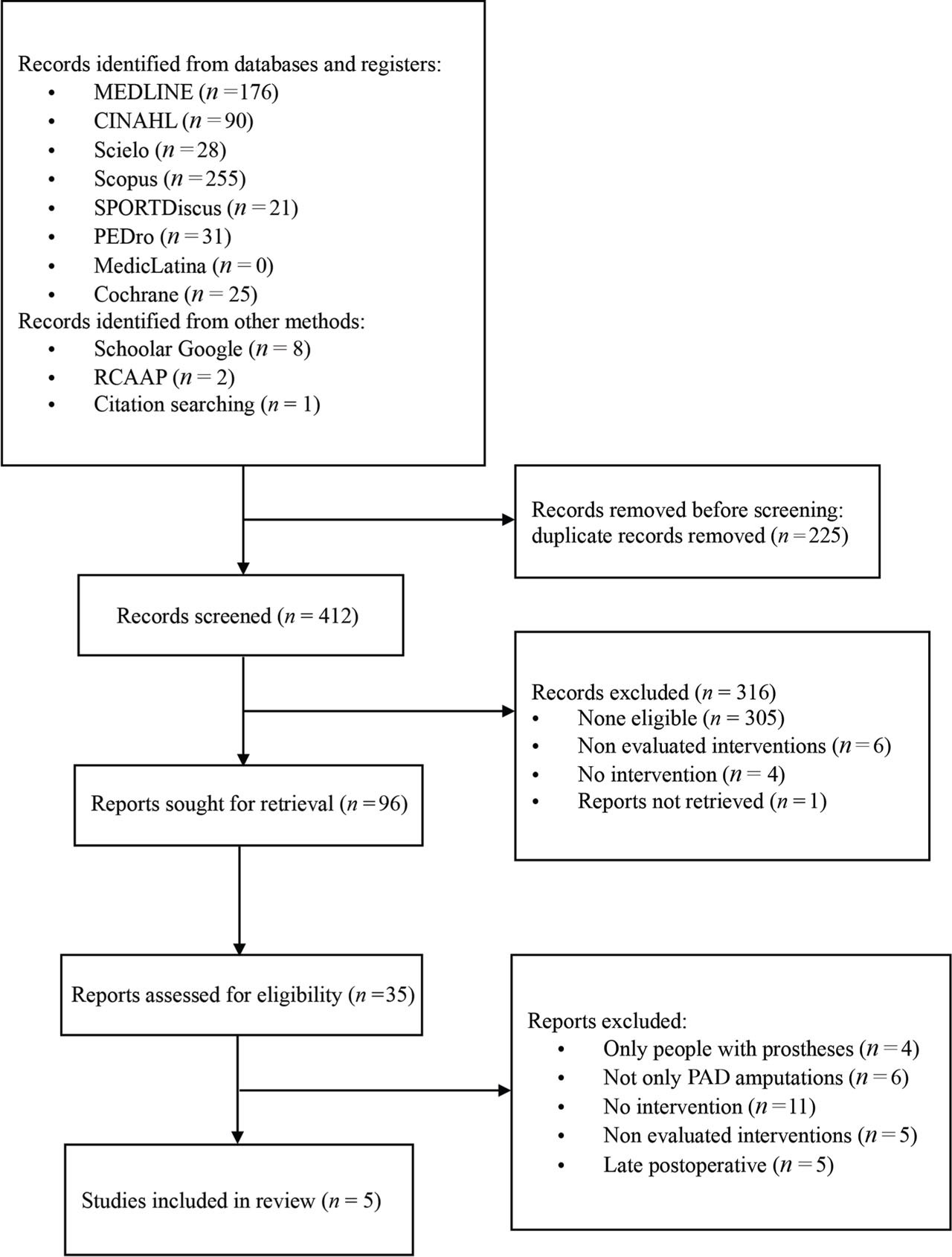
Figure 1.
Adapted flowchart - PRISMA-ScR. RCAAP, Open Access Scientific Repositories of Portugal.
Table 1.
Studies included in the scoping review.
| No. | Study (author, year) | Title | Country | Type of study |
|---|---|---|---|---|
| S1 | MarzenGroller et al. (2008)36 | “Testing the effectiveness of the AMP: a pilot study” | USA | Observational: pre and post program implementation |
| S2 | Sheikh et al. (2024)38 | “Tailored physiotherapy combined with exercises for enhanced recovery post-below-knee amputation in a diabetic patient with PAD: a case report” | India | Case report |
| S3 | O’Banion et al. (2020)39 | “Outcomes of major lower extremity amputations in dysvascular patients: room for improvement” | USA | Observational, retrospective study |
| S4 | Hermodsson & Ekdahl (1999)40 | “Early planning of care and rehabilitation after amputation for vascular disease by means of Katz index of activities of daily living” | Sweden | Observational, predictive study |
| S5 | Wong et al. (2024)35 | “A scoping review of postoperative early rehabilitation programs after dysvascular - related amputations” | USA | Scoping Review: 8 studies: 2 retrospective cohort studies, 3 case-control studies, 2 single-group interventional studies, and 1 case study |
Table 2.
Rehabilitation interventions.
| Study | Main components of interventions or programs |
|---|---|
| S1 | AMP with divergent interventions between people with BKA or AKA amputation:
|
| S2 | Components of the Rehabilitation process:
|
| S3 | Rehabilitation interventions in surgery or vascular services:
|
| S4 |
|
| S5 | postoperative mobilization in the first 3 postoperative days. |
Table 3.
Assessment of rehabilitation interventions.
| Study | Start phase | Assessment moments | Indicators/instruments |
|---|---|---|---|
| S1 |
| Assessment with the modified FIM Scale in the preoperative period Assessment throughout hospitalization after amputation. |
|
| S2 |
| Second postoperative day Fourth week |
|
| S3 | Between the day of surgery and the fourth postoperative day | One day before surgery or between the first and fourth postoperative day After completing rehabilitation (in units or at home) |
|
| S4 | Early post-operative period–starting on the third day |
|
|
| S5 | Early postoperative period | Not applicable |
|
Table 4.
Characteristics of inventions.
| Study | Frequency (sessions/week) | Duration, intensity, periodicity |
|---|---|---|
| S1 | Interventions carried out daily | 5-month program Hospitalization with an average duration of approximately 18.3 d |
| S2 | Exercises performed daily
| Duration per session: Cryotherapy for 15–20 min; infrared radiation for 10–15 min per week for healing and 20 min in the fourth week for scar management; gait training for 10–15 min 4-week intervention |
| S3 | Daily | Upper limb strengthening exercises and non-weight-bearing exercises can be initiated preoperatively In the first intervention, the person is transferred from the bed to the chair during hospitalization |
| S4 | No information | Does not specify duration, intensity, and periodicity Program can be continued at home |
| S5 | No information | Variable in different studies with and without prosthesis |
Table 5.
Health professionals implementing the intervention.
| Study | Context | Professionals involved |
|---|---|---|
| S1 | Acute care unit (vascular medical-surgical unit in an academic community hospital) | Multidisciplinary team (nurses, physiotherapists, researchers, and vascular surgeon) |
| S2 | Phase - in hospitalization | Physiotherapist Nursing team |
| S3 | Regional hospital | Multidisciplinary team (surgeons, physiotherapists) |
| S4 | Orthopedic service | Multidisciplinary team (nursing, therapists, surgeons) |
| S5 | Acute postoperative care | Multidisciplinary team |
Table 6.
Results related to functional independence.
| Study | Length of hospital stay | Walking ability/mobility | Level of independence |
|---|---|---|---|
| S1 |
|
|
|
| S2 |
|
|
|
| S3 | Average length of stay in the surgical unit:
Total rehabilitation time (in institution or at home): 224 d (95–567 d) |
| Functional independence on day 5–7 (Katz index):
|
| S4 |
| No information | No information |
| S5 |
| Safe early mobilization
|
|
Table 7.
Complications and adaptation to the prosthesis.
| Study | Complications | Adaptation to the prosthesis |
|---|---|---|
| S1 |
| No information |
| S2 |
| Pre-prosthetic training for future adaptation to the prosthesis: pre-prosthetic teachings carried out |
| S3 |
| Received prosthesis: 44% Rehabilitation brought forward delivery by about 1 month |
| S4 |
| After 1 month of surgery: 0 people with prosthesis |
| S5 |
| Temporary prostheses in 5/8 studies (132 patients) associated with faster prosthetic fitting (2–2.4 months versus 5.1 months for those without temporary prosthesis) |