
1. Introduction
Peripheral arterial disease (PAD) is a progressive vascular condition caused by stenosis or occlusion of peripheral arteries due to atherosclerosis.1,2 It is estimated to affect between 10% and 20% of individuals over the age of 60 and is considered one of the leading causes of lower limb amputations.3,4 Clinical manifestations typically begin asymptomatically and progress to intermittent claudication. In more advanced stages, patients may develop critical limb ischemia, characterized by rest pain, tissue necrosis, and gangrene.2,5
Amputation becomes necessary when interventions such as bypass grafting, angioplasty, or other revascularization procedures fail.1,6,7 Amputations are categorized as either minor or major, with major amputations associated with significantly higher morbidity, mortality, and functional impairment.7 More than 80% of lower limb amputations are vascular in origin, commonly linked to comorbidities such as diabetes, hypertension, renal failure, and cardiovascular disease.8,9
The implications of amputation extend beyond physical loss, profoundly impacting mobility, autonomy, mental health, and overall quality of life for both patients and their families.10,11 Postoperative complications may be local, such as pain, infection, necrosis, dehiscence, neuroma, or phantom limb pain, or systemic, including thromboembolism, myocardial infarction, renal or cardiac failure, and pneumonia.7,12 The 5-year mortality rate following major amputation ranges from 53% to 100%, particularly high among transfemoral amputees.13
Early rehabilitation, initiated during hospitalization, is associated with reduced mortality, lower risk of reamputation, increased functional independence, and shorter hospital stays.14,15 However, implementation is often hindered by advanced age, multiple comorbidities, pain, and poor adherence.12,16,17,18,19 Rehabilitation outcomes are shaped by factors such as amputation level, preoperative functional status, cognitive ability, pain management, motivation, social support, age, and availability of resources.12,20,21 Positive outcomes are more likely in patients with fewer comorbidities, higher preoperative function, and robust family support.7 Transtibial amputees are generally more likely to achieve independent ambulation than transfemoral amputees, though ambulation demands greater energy expenditure and is associated with lower prosthetic success rates.7
While early mobilization is challenging and requires individualized strategies, it remains critical for optimizing recovery.22 Structured rehabilitation programs, even those not involving prosthetic use, have been shown to improve functionality and reduce mortality.23 Ensuring continuity of care across hospital, community, and home settings is essential to prevent loss of function. Evidence-based interventions, including those applied after prosthetic training, have demonstrated improvements in mobility.24 However, rehabilitation processes are frequently interrupted by complications such as poor wound healing or clinical deterioration, underscoring the necessity for individualized rehabilitation plans.25
In the psychosocial domain, depression affects approximately 60.6% of amputees, often linked to chronic pain, social isolation, and loss of independence.9,26 Integrated approaches that combine specialized rehabilitation, peer support, caregiver training, and community-based initiatives appear to offer the most promise.11,12,20
Pre-amputation clinical and functional status are among the strongest predictors of successful rehabilitation and long-term survival.21 Nevertheless, the limited number of studies focusing specifically on elderly individuals with vascular-related amputations and multiple comorbidities hampers the development of robust, evidence-based guidelines.20,22 Furthermore, although several protocols and guidelines are available, their implementation has varied across contexts, complicating efforts to evaluate their effectiveness and identify the most appropriate interventions or programs.18,19,27,28,29
To assess the existing evidence base, a preliminary search was conducted in Medline (via PubMed), the Cochrane Database of Systematic Reviews, International Prospective Register of Systematic Reviews (PROSPERO), and the Open Science Framework (OSF). This search did not identify any published or ongoing systematic or scoping reviews specifically focused on postoperative rehabilitation in individuals undergoing lower limb amputation due to PAD.
Therefore, this scoping review was undertaken to fill that gap by mapping rehabilitation interventions implemented in the acute postoperative period, before prosthetic fitting, in individuals who have undergone lower limb amputation due to PAD.
2. Methods
A scoping review was conducted to provide a comprehensive overview of the topic, map the existing evidence, identify knowledge gaps, and inform future decision-making.30 This review followed the Joanna Briggs Institute (JBI) methodology for scoping reviews30,31 and the Preferred Reporting Items for Systematic Reviews and Meta-Analyses Extension for Scoping Reviews (PRISMAScR) guidelines.31 The protocol was registered in the OSF: DOI 10.17605/OSF.IO/PW5C4 and published elsewhere.32
2.1. Eligibility criteria
The eligibility criteria for this review were organized according to the PCC mnemonic: Participants, Concept, and Context. The population included individuals aged 18 years or older who had undergone lower limb amputation due to PAD, regardless of the level of amputation. The concept focused on rehabilitation interventions or programs that had been effectively implemented in clinical practice and whose outcomes had been evaluated. These interventions were expected to enhance functional independence, shorten hospital stays, facilitate early ambulation, and promote successful adaptation to a prosthesis.
The context encompassed various surgical settings in which lower limb amputations due to PAD were performed, and where patients remained until they were discharged home or transferred to another institution. Only interventions implemented during the acute postoperative period, defined as the initial inpatient rehabilitation phase prior to prosthesis application,33 were considered. Studies that exclusively addressed preoperative, late postoperative, or post-prosthetic phases were excluded, as the review specifically aimed to map rehabilitation interventions initiated during hospitalization and the immediate postoperative stage.
2.2. Research question
The primary research question guiding this review was: What rehabilitation interventions were implemented and evaluated for individuals who underwent lower limb amputation due to PAD in the postoperative period? In addition, the review explored several secondary aspects, including the characteristics of these interventions (such as frequency, duration, intensity, periodicity, and continuity after discharge), the health professionals responsible for implementing them, the types of amputation covered, and the reported outcomes in relation to functional independence, including hospital length of stay, ambulation capacity, independence levels, complication rates, and prosthetic adaptation.
2.3. Research strategy
A wide range of study designs was considered, including experimental and quasi-experimental studies, clinical trials, before-and-after studies, and interrupted time series. Prospective and retrospective cohort studies, case-control studies, analytical and descriptive cross-sectional studies, case series, individual case reports, and relevant systematic reviews were also eligible for inclusion, provided they met the other criteria.34
No restrictions were applied regarding language or publication date to ensure the comprehensiveness of the search. The following databases were searched: Medline (via PubMed), Cumulative Index to Nursing and Allied Health Literature (CINAHL) via Elton Bryson Stephens Company (EBSCO), Cochrane Database of Systematic Reviews, Scopus, Physiotherapy Evidence Database (PEDro), Web of Science, Scientific Electronic Library Online (SciELO), SPORTDiscus with full text (via EBSCO), and MedicLatina (via EBSCO). To supplement the database search, gray literature was explored using Google Scholar, MedNar, and the Open Access Scientific Repositories of Portugal (RCAAP). The research was conducted using the following information sources and databases: Medline (via PubMed), CINAHL (via EBSCO), Cochrane Database of Systematic Reviews, Scopus, PEDro, Web of Science, SciELO, SPORTDiscus with full text (via EBSCO), MedicLatina (via EBSCO). Research was also carried out in sources of unpublished studies and gray literature: Google Scholar, MedNar, and RCAAP.
The research process was conducted in 3 stages between May and June 2025. Initially, a limited search was performed in MEDLINE and CINAHL to identify relevant articles and extract keywords and indexing terms from titles and abstracts. These terms were then used to construct a comprehensive search strategy, which was adapted for all selected databases and information sources. Finally, the reference lists of all included studies were reviewed to identify additional publications relevant to the research objectives.34
The results obtained from the different databases were exported to Mendeley Desktop (version 1.19.4, Elsevier Ltd., London, UK). Duplicate records were identified and removed. All study titles and abstracts were screened for inclusion and exclusion criteria by 2 independent reviewers. Subsequently, all full articles that met the inclusion criteria or that raised questions due to insufficient clarity in the abstract were retrieved. After reading the primary selected articles in full, 2 independent reviewers analyzed them, and whenever necessary, a third researcher was consulted.
3. Results
The results of the review were organized following the preferred reporting items for systematic reviews and meta-analyses extension for scoping reviews (PRISMAScR) guidelines for scoping reviews. Eleven additional studies were identified through gray literature sources.
After full-text screening, several studies were excluded for not meeting the inclusion criteria. The adapted PRISMA-ScR flowchart (Figure 1) illustrates the process of study selection, including the number of articles identified, screened, included, and excluded, along with reasons for exclusion. Ultimately, 5 studies were included in the final review.
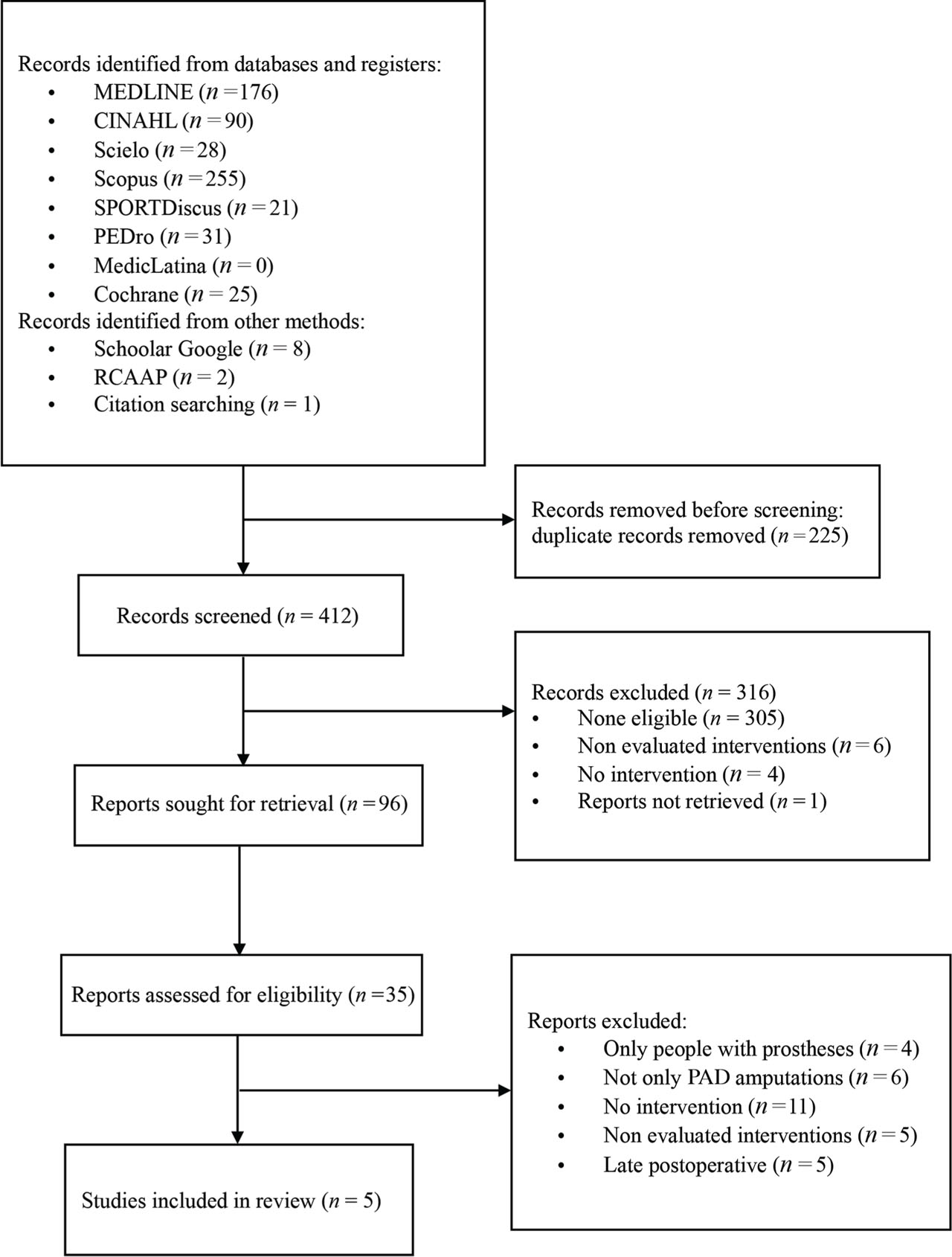
Figure 1.
Adapted flowchart - PRISMA-ScR. RCAAP, Open Access Scientific Repositories of Portugal.
In accordance with JBI methodological guidance, the study by Wong et al.35 was included, although it incorporates 2 studies already represented in the review, those by Marzen-Groller et al.36 and O’Banion et al.8 leading to overlap. To avoid duplication, the synthesis accounts for this overlap, and data from these studies are presented only once. Wong et al.’s inclusion is justified as it contributes relevant information on early postoperative rehabilitation in amputees without prosthetic fitting.
The 5 included studies span a publication period from 1999 to 2024 and originate from 3 countries: the United States (n = 3), India (n = 1), and Sweden (n = 1). The study designs were diverse, comprising observational studies (pre-post comparative, retrospective, predictive), case reports or protocol descriptions, and one scoping review (Table 1).
Table 1.
Studies included in the scoping review.
| No. | Study (author, year) | Title | Country | Type of study |
|---|---|---|---|---|
| S1 | MarzenGroller et al. (2008)36 | “Testing the effectiveness of the AMP: a pilot study” | USA | Observational: pre and post program implementation |
| S2 | Sheikh et al. (2024)38 | “Tailored physiotherapy combined with exercises for enhanced recovery post-below-knee amputation in a diabetic patient with PAD: a case report” | India | Case report |
| S3 | O’Banion et al. (2020)39 | “Outcomes of major lower extremity amputations in dysvascular patients: room for improvement” | USA | Observational, retrospective study |
| S4 | Hermodsson & Ekdahl (1999)40 | “Early planning of care and rehabilitation after amputation for vascular disease by means of Katz index of activities of daily living” | Sweden | Observational, predictive study |
| S5 | Wong et al. (2024)35 | “A scoping review of postoperative early rehabilitation programs after dysvascular - related amputations” | USA | Scoping Review: 8 studies: 2 retrospective cohort studies, 3 case-control studies, 2 single-group interventional studies, and 1 case study |
These studies addressed various aspects of postoperative rehabilitation for individuals undergoing lower limb amputation due to PAD. One study was itself a scoping review, conducted by Wong et al.35, which synthesized 8 primary studies. However, several of those included in Wong et al.’s review were not deemed relevant to the current review because they focused exclusively on patients already fitted with prostheses during the acute postoperative period, an uncommon scenario in many care settings.
The objectives of the studies varied widely. Study S2 focused on evaluating the effects of a rehabilitation program on pain relief, muscle strength, wound healing, and the recovery of functional capacity and self-sufficiency. Study S3 examined the relationship between early mobilization, discharge destination, and outcomes such as hospital length of stay and walking resumption. Study S4 investigated the predictive value of the Swedish version of the Katz Index of Activities of Daily Living for hospital stay duration, likelihood of discharge to home, and 1-month mortality. Study S5 mapped existing evidence on early mobilization in the postoperative period among people with amputations (Table 2).
Table 2.
Rehabilitation interventions.
| Study | Main components of interventions or programs |
|---|---|
| S1 | AMP with divergent interventions between people with BKA or AKA amputation:
|
| S2 | Components of the Rehabilitation process:
|
| S3 | Rehabilitation interventions in surgery or vascular services:
|
| S4 |
|
| S5 | postoperative mobilization in the first 3 postoperative days. |
The studies implemented rehabilitation interventions that differed in composition, frequency, duration, and timing of initiation. Study S1 described the amputee mobility protocol (AMP), which included pre-operative assessment, progressive gait training, and early ambulation, initiated within 24 h of surgery and maintained for 5 months. Study S2 reported a standardized rehabilitation and postural correction program applied to a single case, starting on the second postoperative day and continuing for at least 4 weeks. The intervention included active mobilization, rigid stump dressing, edema control, transcutaneous electrical nerve stimulation (TENS), cryotherapy, and strengthening and balance training, among other components. In Study S3, physical therapist consultation occurred on or before the first postoperative day, followed by rapid transfer to an acute rehabilitation unit and implementation of standardized discharge criteria. Study S4 began intervention within the first 3 d post-surgery, emphasizing functional assessment, muscle strengthening, and transfer training. Study S5 reinforced early mobilization, both with and without temporary prosthesis use, as a frequent practice in the acute hospital setting. It included overlapping data from Studies S1 and S3 (Table 2).
In terms of outcome evaluation, some studies extended their assessments beyond the immediate postoperative period (S2, S3, S4), while others confined their evaluation to the inpatient phase until discharge from the acute care setting (S1) (Table 3). The sample sizes varied significantly, ranging from a single participant in Study S2 to 1634 participants in Study S5. The average participant age ranged from 56.7 years (S5) to 78 years (S4).
Table 3.
Assessment of rehabilitation interventions.
| Study | Start phase | Assessment moments | Indicators/instruments |
|---|---|---|---|
| S1 |
| Assessment with the modified FIM Scale in the preoperative period Assessment throughout hospitalization after amputation. |
|
| S2 |
| Second postoperative day Fourth week |
|
| S3 | Between the day of surgery and the fourth postoperative day | One day before surgery or between the first and fourth postoperative day After completing rehabilitation (in units or at home) |
|
| S4 | Early post-operative period–starting on the third day |
|
|
| S5 | Early postoperative period | Not applicable |
|
Regarding the characteristics of the rehabilitation interventions (Table 4), daily frequency was the most reported schedule (S1, S2, S3), although only Study S2 specified the number of sets and repetitions for individual exercises. While several studies did not clearly report the total duration of interventions, Study S1 documented a 5-month program, Study S2 indicated 4 weeks, and Study S4 noted that the program continued at home. Study S2 also provided detailed information on the intensity and periodicity of its components. Continuity of rehabilitation following the acute postoperative period occurred in the same care setting in Studies S1, S2, and S4, and through transfer to other institutions or home-based care in Studies S3 and S4.
Table 4.
Characteristics of inventions.
| Study | Frequency (sessions/week) | Duration, intensity, periodicity |
|---|---|---|
| S1 | Interventions carried out daily | 5-month program Hospitalization with an average duration of approximately 18.3 d |
| S2 | Exercises performed daily
| Duration per session: Cryotherapy for 15–20 min; infrared radiation for 10–15 min per week for healing and 20 min in the fourth week for scar management; gait training for 10–15 min 4-week intervention |
| S3 | Daily | Upper limb strengthening exercises and non-weight-bearing exercises can be initiated preoperatively In the first intervention, the person is transferred from the bed to the chair during hospitalization |
| S4 | No information | Does not specify duration, intensity, and periodicity Program can be continued at home |
| S5 | No information | Variable in different studies with and without prosthesis |
The interventions were implemented in varied clinical settings (S1–S4) and were consistently carried out by multidisciplinary teams. Physiotherapists played a central role across all studies, working in collaboration with nurses, vascular surgeons, and, in some cases, academic researchers (Table 5).
Table 5.
Health professionals implementing the intervention.
| Study | Context | Professionals involved |
|---|---|---|
| S1 | Acute care unit (vascular medical-surgical unit in an academic community hospital) | Multidisciplinary team (nurses, physiotherapists, researchers, and vascular surgeon) |
| S2 | Phase - in hospitalization | Physiotherapist Nursing team |
| S3 | Regional hospital | Multidisciplinary team (surgeons, physiotherapists) |
| S4 | Orthopedic service | Multidisciplinary team (nursing, therapists, surgeons) |
| S5 | Acute postoperative care | Multidisciplinary team |
The types of amputation addressed by the rehabilitation interventions in the included studies were predominantly major amputations, although one study also included cases of minor amputation (S1). Among the major amputations, the following were reported: above-the-knee amputation (AKA), also referred to as transfemoral or supracondylar (S1, S3, S5); below-the-knee amputation (BKA), also known as transtibial or infracondylar (S1, S2, S3, S4, S5); and transmetatarsal amputation (TMA) (S1). All cases resulted from peripheral vascular pathology.
Functional independence was a common outcome, typically assessed using indicators such as the functional independence measure (FIM) score, walking capacity, hospital length of stay, complication rates, and prosthetic adaptation.
Study S1 reported an average hospital stay of 18.3 d in the post-protocol group. In contrast, Study S3 found significantly shorter stays - averaging 4 d ± 3 d - for patients referred to acute rehabilitation, compared to those discharged home (5 d ± 3 d) or to long-term care institutions (8 d ± 8 d) (Table 6).
Table 6.
Results related to functional independence.
| Study | Length of hospital stay | Walking ability/mobility | Level of independence |
|---|---|---|---|
| S1 |
|
|
|
| S2 |
|
|
|
| S3 | Average length of stay in the surgical unit:
Total rehabilitation time (in institution or at home): 224 d (95–567 d) |
| Functional independence on day 5–7 (Katz index):
|
| S4 |
| No information | No information |
| S5 |
| Safe early mobilization
|
|
Improvements in walking capacity and mobility were consistently observed. Study S1 noted gains of 1–2 points in FIM transfer scores and increased walking distances, particularly among patients with TMA. Study S2 reported enhanced muscle strength, range of motion, and perceived quality of life. Study S3 showed that early initiation of physical therapy contributed to faster ambulation. Finally, the scoping review (S5) supported the safety and efficacy of early mobilization, linking it to functional improvements and higher FIM mobility scores.
Regarding complications, Study S1 reported no thrombotic events in the post-protocol group, compared to a 10% incidence in the pre-protocol group. Study S3 documented a 15% rate of surgical site infections, 15% hospital readmissions, and a 7% mortality rate. Study S4 reported a mortality rate of 4% at 1 month and 25% at 6 months post-amputation. Study S5 noted a higher frequency of revision surgeries and falls among patients who did not use a temporary prosthesis, along with wound healing issues in both groups—with and without temporary prosthesis use (Table 7).
Table 7.
Complications and adaptation to the prosthesis.
| Study | Complications | Adaptation to the prosthesis |
|---|---|---|
| S1 |
| No information |
| S2 |
| Pre-prosthetic training for future adaptation to the prosthesis: pre-prosthetic teachings carried out |
| S3 |
| Received prosthesis: 44% Rehabilitation brought forward delivery by about 1 month |
| S4 |
| After 1 month of surgery: 0 people with prosthesis |
| S5 |
| Temporary prostheses in 5/8 studies (132 patients) associated with faster prosthetic fitting (2–2.4 months versus 5.1 months for those without temporary prosthesis) |
Prosthetic adaptation was evaluated as a key outcome in several studies. Study S2 suggested that incorporating pre-prosthetic training may support more effective prosthesis fitting. In Study S3, 44% of participants received a prosthesis, and early rehabilitation was associated with a reduction in waiting time for fitting by approximately 1 month. Study S5 reported that the use of a temporary prosthesis may lead to faster definitive prosthetic fitting - ranging from 2 months to 2.4 months -compared to an average of 5.1 months among individuals who did not use a temporary prosthesis.
4. Discussion
The findings of this scoping review directly address the central question of characterizing postoperative rehabilitation interventions for individuals who have undergone lower limb amputation due to PAD. Although the heterogeneity of designs and outcomes limits the depth of comparison, this mapping approach allows a comprehensive understanding of existing rehabilitation interventions and their implications. The identified interventions span the continuum of care from immediate postoperative management to social reintegration, highlighting the complex and multifaceted nature of rehabilitation in this population.
Even though the interventions varied in composition, frequency, duration, and timing, there was consistent emphasis on key elements: early mobilization, the use of structured protocols, effective pain management, and psychosocial support. These interventions were typically delivered by multidisciplinary teams. The reported outcomes suggest improvements in mobility and functional independence, shorter hospital stays, and enhanced success in prosthetic adaptation.
The critical role of early rehabilitation is well supported in the literature. Study S3 demonstrated that initiating ambulation preoperatively or on the first postoperative day significantly accelerated recovery. Similarly, Studies S1 and S2 reported gains in mobility, muscle strength, and joint range of motion following early mobilization protocols, including improved scores on the FIM and increased ambulation distances, particularly in patients with TMAs. Other studies further reinforce that early mobilization contributes to functional improvements and reduced hospital stays, underscoring its essential role in postoperative recovery.12,35
Limited mobility after amputation is associated with complications, including delayed healing, a higher risk of re-amputation, and increased postoperative mortality.19 Furthermore, walking with a prosthesis requires greater energy expenditure due to the weight of the device.
Early mobilization is unanimously considered essential,19,22,35,36,37,38,39,40 promoting functional gains, albeit modest, in terms of mobility, strength, and joint range of motion.12,36,38 However, the heterogeneity of the assessment moments and scales used limits the consistent measurement of effectiveness.
Other dimensions of the rehabilitation process, such as edema control, emotional assessment, psychosocial interventions, pre-prosthetic training, pain relief, atrophy prevention, promotion of stump healing, muscle strengthening, and caregiver involvement, are described heterogeneously in studies.35 Walking training, in turn, is associated with gains in walking speed.41 However, in cases of immobility or prior deconditioning, rehabilitation should prioritize strength, extremity mobility, transfer ability, and wheelchair use, achieving the highest possible level of independence.8,21 From this perspective, the importance of aligning the objectives, content, intensity, and duration of rehabilitation programs with the preferences and goals of patients and professionals is highlighted.41
In addition to physical interventions, some strategies related to postoperative management are not addressed in all studies. The application of rigid dressings in transtibial amputations may improve edema control and early mobilization, but comparative evidence with soft dressings remains uncertain regarding healing, ambulation, and time to prosthesis fitting.41,42,43
Phantom limb pain management is crucial, with gabapentin as a first-line treatment and limited opioid use. Mirror therapy, applied early, shows potential in reducing pain and enhancing phantom limb awareness, though more studies are needed. The effectiveness of TENS and other interventions remains inconclusive.29,41,42,44 Psychosocial intervention is vital for amputation acceptance, rehabilitation adherence, and improving functional outcomes and quality of life, especially given the high prevalence of depression and anxiety.12,41
Complications after lower limb amputation significantly impact quality of life and rehabilitation, affecting functional independence. Common issues include thrombotic events, infections, readmissions, pain, muscle weakness, malnutrition, re-amputation, falls, and stump healing problems. Mortality rates remain high, particularly after major amputations, due to surgical complexity, aging, and comorbidities. Stump deformities like knee, hip flexion, and abduction can be prevented with proper positioning and stretching exercises.19,45,46,47 Other complications include hematomas, necrosis, neuromas, and infections. Amputation is also linked to reduced balance, strength, mobility, depression, and social isolation, underlining the need for integrated physical and psychosocial interventions.9,12,48
Previous studies consistently show the importance of a multidisciplinary approach in the rehabilitation process, emphasizing that collaboration between healthcare professionals is crucial to optimize functional recovery and the quality of care.2,19,41,48 In this multidisciplinary approach, teams involve surgeons, nurses, rehabilitation nurses, physiatrists, physiotherapists, occupational therapists, and prosthetists, reflecting the complexity and diversity of this population’s needs.2,19,41 This approach is particularly relevant for people with arterial disease, whose complex comorbidity requires specialized knowledge and coordination between different areas of intervention.2 In some countries, however, there is no specialized rehabilitation nurse role,49 with responsibility often assigned solely to the physiotherapist, who assumes the assessment, planning, and implementation of the rehabilitation plan.
The findings reinforce the need to prioritize quality rehabilitation services, especially given the rising incidence of diabetes and atherosclerotic disease. The high mortality rate and the demand for specialized care pose critical challenges for health policies, stressing the urgency of structured and integrated rehabilitation programs.48
Prosthetic fitting is one of the central objectives of the post-amputation rehabilitation process, as evidenced throughout this review. Effective prosthetic fitting training and the inclusion of pre-prosthetic education are essential components.38,40 Early intervention can accelerate prosthetic use, offering significant benefits for functional recovery.39
The use of temporary prostheses accelerates fitting, reducing the average adaptation time from 5.1 months to 2–2.4 months,35 and early inclusion in rehabilitation programs increases prosthetic fitting success rates.39,50 However, limitations persist in specific populations, with only a 15% prosthetic fitting rate and an average wait of 16.33 months, reflecting challenges in the provision and preparation of prostheses.12
These limitations contrast with the rates observed in other amputation etiologies, highlighting the specific challenges of the population with arterial disease. Associated comorbidities influence postoperative ambulation and the setting of realistic goals, requiring individualized approaches that consider the individual’s overall clinical context.22
Therefore, understanding individual characteristics before and after surgery is essential to establish realistic postoperative goals, recognizing that not all patients will be able to resume walking with a prosthesis, depending on their functional limitations and comorbidities.12,19
In this context, rehabilitation nurses play a pivotal role in coordinating and ensuring continuity of care, monitoring wound healing, preventing complications such as contractures and falls, and promoting autonomy through education and self-management training. Their integration in multidisciplinary teams is essential to ensure individualized and holistic rehabilitation, particularly in elderly patients with complex comorbidities.
5. Conclusions
This scoping review aimed to map and describe the rehabilitation interventions implemented and evaluated in the postoperative period for individuals undergoing lower limb amputation due to PAD. While the interventions identified were heterogeneous in terms of composition, frequency, duration, intensity, and continuity, there was a recurring emphasis on early mobilization, the use of structured protocols, pain management, and psychosocial support.
The interventions were most often carried out by physiotherapists and nurses, often within multidisciplinary teams. Reported benefits included improvements in mobility, functional independence, shorter hospital stays, and enhanced prosthetic adaptation, particularly when rehabilitation was initiated early. However, these findings should be interpreted cautiously, given the limited number of studies and variability in study designs.
Despite these positive indications, several challenges persist. Postoperative complications, such as infections, readmissions, early mortality, and wound healing difficulties, continue to hinder rehabilitation outcomes. Additionally, the absence of standardized protocols and the wide variability in interventions limit both the replicability of results and the consistent application of best practices.
The current evidence base remains limited, characterized by a scarcity of randomized controlled trials, small sample sizes, and inconsistent outcome measures. These limitations highlight the need for more rigorous and targeted research to inform the development of rehabilitation protocols tailored to the clinical complexity of this population.
While the available evidence is preliminary, it suggests that an integrated, early, and multidisciplinary approach to rehabilitation, one that encompasses pre-prosthetic preparation, psychosocial support, and the establishment of realistic recovery goals, may be beneficial. Advancing such approaches represents a meaningful step toward improving the quality of life and functional outcomes for individuals with PAD-related amputations. Despite the limited number and variability of available studies, this scoping review provides an integrative synthesis that supports future clinical trials and the development of standardized, evidence-based rehabilitation guidelines for PAD-related amputations.
Limitations
There remains a notable gap in the literature regarding high-quality clinical trials and systematic reviews on post-amputation rehabilitation for individuals with PAD. In particular, there is a lack of evidence establishing standardized protocols that define the content, frequency, intensity, and duration of interventions, as well as their timing, both in the postoperative and preoperative phases, and the use of consistent outcome measures across different levels of amputation.35,41,51,52,53 This lack of standardization limits the replication of effective interventions and poses challenges for their practical implementation in clinical settings.12,25,41 These gaps also hinder the validation of structured protocols and underscore the urgency for more rigorous research.
As a scoping review, this study was not designed to evaluate causal relationships or the effectiveness of specific interventions, but to map and summarize available evidence. The limited number and heterogeneity of studies are inherent to the topic and highlight the need for standardized protocols and higher-level studies. Therefore, the analysis of the available studies further emphasizes the need for randomized clinical trials involving larger and more representative samples across different levels of amputation, using standardized outcome measures.12,35,41 As a scoping review, this study is limited by its focus on breadth over depth and the potential exclusion of relevant data not captured in the selected databases or gray literature sources.
Recommendations
The literature highlights several priority areas, including the development of standardized rehabilitation protocols, the evaluation of emerging technologies, and the conduct of robust studies focused on specific populations. Many existing multidisciplinary programs are designed for broader vascular populations and often implement interventions that have not been specifically tested in individuals with PAD-related amputations.8,27,28,54,55
Gait and mobility training must balance standardization and personalization, adapting objectives, intensity, and duration to patients’ goals. However, the lack of clinical trials and systematic reviews limits evidence-based protocols, leaving practice largely dependent on professional experience.41
Findings highlight the need for rigorous clinical trials to clarify context, target populations, and implementation strategies, ensuring validation and replication. Psychosocial support is essential due to high rates of anxiety and depression, while family involvement promotes autonomy, home adaptation, and fall prevention.2,11,28,56 Rehabilitation should go beyond functional recovery, integrating social participation, professional reintegration, and sexuality, with early intervention being crucial.12,41
In complication management, uncertainty remains regarding the ideal dressing type. Immediate rigid dressings may prevent edema, but evidence is insufficient.41,42,43 For phantom limb pain, gabapentin remains first-line therapy, while mirror therapy shows initial but limited benefits. Other approaches, such as TENS, remain inconclusive, reinforcing the need for larger randomized trials.42,44
Future rehabilitation programs should explicitly define the contribution of rehabilitation nurses in postoperative care, emphasizing their leadership in patient education, complication prevention, and functional recovery.