
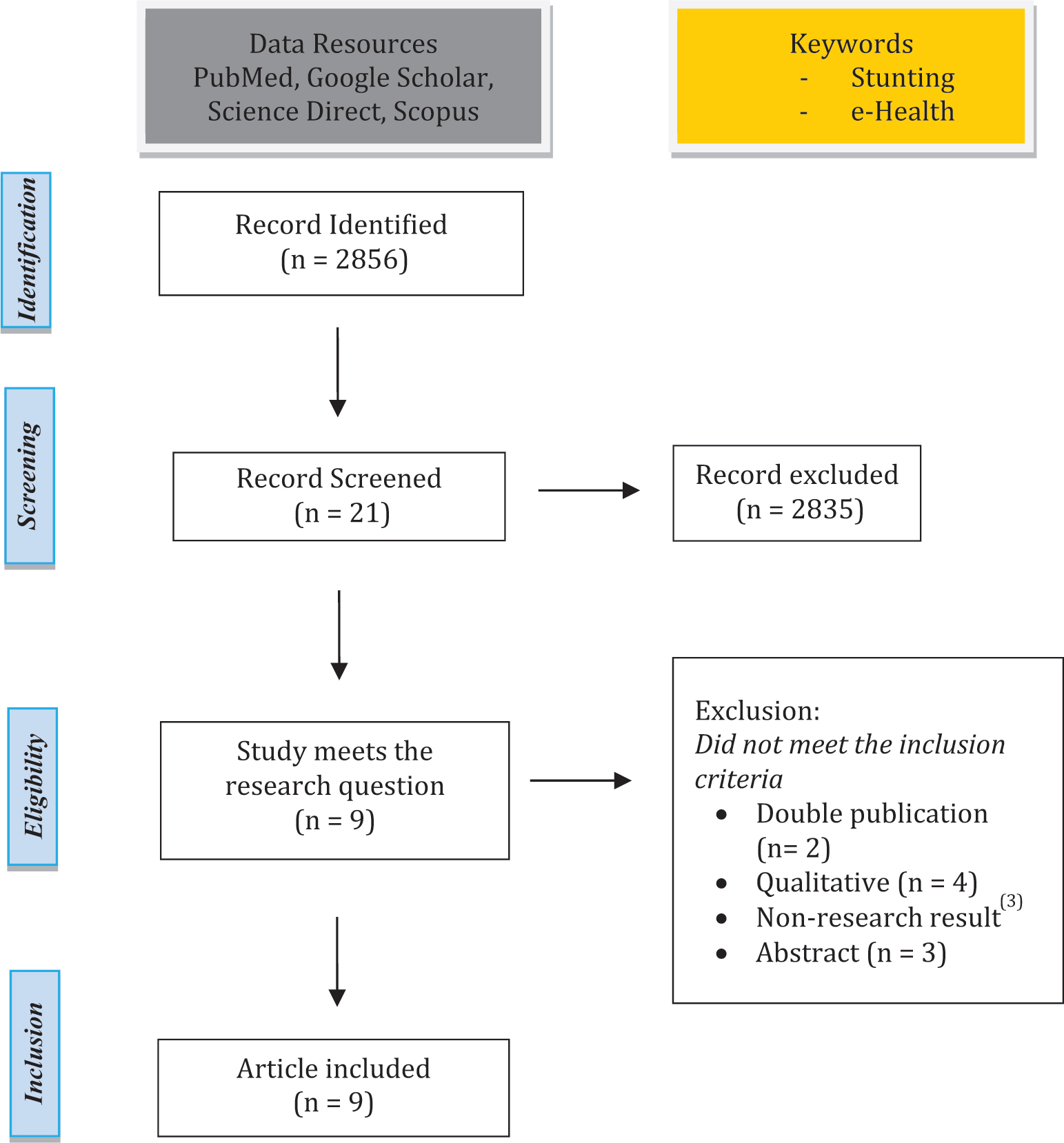
Figure 1.
Flow chart article diagram.
Table 1.
Synthesis of articles on stunting prevention using e-Health.
| Author and city | Research design | Purpose of the study | Sample size | Application name and model | Result |
|---|---|---|---|---|---|
| Permana et al.21 Tangerang | Waterfall | To create a nutrition monitoring application that recommends nutrition based on individual’s nutritional status. | 20 female respondents were recruited. | The “Nutrimo” application is accessed online with a special menu for Posyandu officers, divided into five menus: register, monitoring, user data, prescription input, and notification input. For parents, it is divided into four menus: child information, KMS graph, news, and recipes. | The Nutrimo application scored above 80%, indicating that it is easy to use and informative for monitoring nutritional status. |
| Rianti, Triwinarto, and Lukman Bogor22 | Mixed method | To design an Android-based application for ensuring compliance of pregnant mothers in taking Iron Supplement to prevent children from being born stunted. | 71 pregnant mothers were involved | The “Prevent Stunting in Children” (ACALS) application was created using the Use Case MCH book and is developed as two separate applications. One application serves as a companion for pregnant mothers during pregnancy, especially for ensuring compliance in taking Iron supplements, with 10 application features. For Posyandu officers, there are 13 application features. | Qualitative results from pregnant respondents and midwives indicate that the ACALS application is beneficial, especially in monitoring the regular intake of iron supplementation tablets and facilitating prenatal check-ups at health care facilities for pregnant mothers. |
| Syaroni and Munir11 Probolinggo | Waterfall | To facilitate the data collection process for officers and assist the community in monitoring the growth of children affected by stunting. | The sample consists of 2 respondents who assessed the benefits of the stunting service application. | The Android-based Stunting Service Information System Application was developed using the Android programming language and utilizes a MySQL database. The application features a stunting service dashboard menu within the app, which includes family data, detailed child data, types of services, service details, and child data. | Internal test yielded a result of 95.8%, indicating that the application successfully supports the establishment of a stunting service center for the community. |
| Kasjono and Suryani23 Yogyakarta | Mixed method | To determine the effect of the GASING application on stunting prevention behavior among female high school students in the Kalibawang District, Kulon Progo. | 218 individuals were involved | The Gerakan Anti Stunting (GASING) application was designed to facilitate the monitoring of respondents’ behaviors. Therefore, after finishing a meal and practicing clean and healthy habits, respondents were required to fill out the application. The application requested several information, including email address, name, height, weight, age, date of filling, time of filling, nutrition (carbohydrates, protein, fat, minerals, and vitamins), and clean and healthy living behavior (not smoking, consuming fruits and vegetables daily, engaging in physical activities, eradicating mosquito breeding sites, using proper sanitation facilities, handwashing, using clean water). | The stunting prevention behavior increased by 15.67 among the GASING application users, while the group provided with leaflets showed an increase of 3.54. The results from the Wilcoxon and Mann Whitney tests yielded a P-value of 0.000 (P-value <0.05), indicating that the use of the GASING application resulted in a significantly higher improvement in stunting prevention behavior compared to providing leaflets. |
| Utario and Sutriyanti24 Bengkulu | To improve the knowledge of Posyandu cadres regarding stunting and its prevention. | The sample for this activity consisted of 25 Posyandu cadres working in the Puskesmas Perumnas. | This offline stunting prevention application can be accessed using smartphones/Android devices, allowing users to access it anywhere and anytime. It has an attractive interface and can be easily disseminated to the community. The application contains materials presented in the main menu, including an explanation of stunting, its causes, impacts, prevention methods, as well as guidance on how to measure body length and height, as well as measuring length-for-age and height-for-age. | The results indicate an improvement in the cadres’ knowledge about stunting and its prevention. Furthermore, all cadres were able to download and use the offline application. | |
| Andayani and Syafiih25 Probolinggo | Literature Study | To support mothers’ understanding of the nutritional needs of toddlers in the Probolinggo Regency. | The sample consisted of the Probolinggo Regency Government. | PODO CETING is an online Android-based application, with a homepage featuring the menus “What is Stunting,” “What is Nutrition and its Benefits,” and “Check Your Child’s Condition.” The application also provides a material page that explains age, weight, and height. Furthermore, the Nutrition Category Page provides information on the nutritional content of various food portions. | The research results show that the PODO CETING application serves as a platform for the community to understand the risks of stunting in toddlers, as it provides direct information about stunting risks, positive stunting, and acute stunting. |
| Hadi and Rahayu26 Yogyakarta | R&D | To develop an Android-based application as an early stunting prevention effort. | The sample consists of 19 mothers with children aged 0–36 months in Patalan village. | This application is called “Sahabat Bunda Cegah Stunting” and can be accessed through Google Play. The language used is easily understood, with attractive visuals and a user-friendly interface. The application’s interface includes registration, child menu, child growth menu, Child Development Pre-Screening (KPSP) menu, child immunization menu, child health information, recipe menu, nutrition calculation, and forum menu. | The average ratings from media experts were 100.66 (80.53%) in the “appropriate” category; from subject matter experts, the average rating was 80.33 (80.33%) in the “appropriate” category; in the small-group trial, the average rating was 110.5 (83.08%) in the “highly appropriate” category. Finally, the application was implemented with 19 respondents, yielding an average total score of 111.5263 (83.86%) in the “highly appropriate” category. |
| Kumar, et al.27 India | Lot quality assurance sampling | To promote self-care, increase coverage, and enhance collaboration across sectors. | The research sample consisted of 100 villages in the Bilaspur Environment Block (with a population of 101,893). | m-Health (SMS and phone calls) was developed based on a national and international literature review, adapting messages to fit the local culture and writing them in English within the allowed 160-character limit. The messages were targeted toward beneficiaries to trigger discussions during home visits by ASHA and to be part of group discussions in Anganwadi meetings, village health meetings, nutrition day meetings, and voluntary mothers’ club meetings. | The results show that SMS messages were received, read, and practiced by caregivers and service providers in the intervention block at a significantly higher rate than in the control block. There was a significant improvement in malnutrition and wastage. However, the reduction in stunting in the Bilaspur intervention area was still lower compared to the Khizrabad and Mullana control blocks. |
| Ballout et al.28 Palestine | Observational study | To assess the impact of the e-Health system on health care delivery. | The sample consisted of 129 primary health centers, including records of 3 million patients and managing over 8 million visits per year. | The e-Health system developed by UNRWA allows health care providers to assess preventive care services, such as the percentage of targeted individuals aged 40 and above who are screened for diabetes, the percentage of pregnant women with live births attending at least four antenatal visits, and the prevalence of growth problems (underweight, stunting, wasting, and overweight or obesity) in children under 5 years old. | Significant improvements were observed from 2012 to 2017 since the e-Health system started sending alerts to center staff. The prevalence of diabetes increased from 13% to 21% (P < 0.00001), and the percentage of pregnant women with live births attending four antenatal visits increased from 87% to 92%. The prevalence of underweight, stunting, wasting, and overweight or obesity in children under 5 years old increased from 3%, 4%, 2%, and 2% in 2014 to 5%, 7%, 4%, and 5% in 2017, but this can be attributed to improved detection of growth problems through the e-Health system. |
Table 2.
The following a summary of several stunting application models.
| No | Application name (author) | Application model |
|---|---|---|
| 1 | Nutrimo (Permana et al.21) | This application can only be accessed online and displays data on children’s nutritional status and provides recommendations that consist of two menus, 1 for Posyandu officers and another for parents. |
| 2 | ACALS Rianti, Triwinarto, and Lukman22 | This app focuses on ensuring pregnant women get adequate iron intake and fulfill ANC visits to monitor pregnancy progress regularly. This application aims to prevent stunting in children by ensuring that the health of a mother is in good condition during pregnancy. |
| 3 | Android-based Stunting Service Information System (Syaroni and Munir11) | This application aims to develop new habits, such as healthy living behavior, that support stunting prevention. This application requires participants to fill in data after eating and to adopt a clean and healthy life. |
| 4 | GASING (Kasjono and Suryani23) | This Android-based application is designed to assist the service team in the input and archiving process so that data management is more efficient and organized, thereby improving the quality of stunting monitoring and prevention through an integrated and easily accessible information system. |
| 5 | Offline stunting prevention application (Utario and Sutriyanti24) | An offline-based application aimed at helping Posyandu cadres by providing education about stunting from definition to prevention. With this application, it is hoped that Posyandu cadres will become more skilled in providing effective education and monitoring so that the incidence of stunting will be reduced in the community. |
| 6 | PODO CETING (Andayani and Syafiih25) | This application is a tool for educating and monitoring children’s nutrition for parents to prevent stunting in children. This application involves various components that can store, display, and generate reports based on data entered by the user. |
| 7 | Sahabat Bunda Cegah Stunting (Hadi and Rahayu26) | This application is designed to replace the role of health workers, especially midwives, as an educational medium for maternal and child health. The application uses simple language that is easy for mothers to understand, is informative, visually attractive, practical, and easy to use, and can be accessed many times. This application makes it easy for parents to monitor, record, and understand their children’s development and nutritional needs so that they can support efforts to prevent stunting and improve the overall quality of maternal and child health. |
| 8 | Evidence-based interventions and m-Health (Kumar et al.27) | Evidence-based interventions and m-Health (SMS messages and phone calls) were implemented to explore cross-sector collaboration as well as strengthen home visits and services. This intervention is used to strengthen health services at the community level, encourage further interaction between beneficiaries and service providers, and support cross-sector collaborative efforts to improve maternal and child health. |
| 9 | The e-Health system developed by UNRWA (Ballout et al.28) | This service system uses 3 categories of indicators to measure the impact on public health services of preventive care services, such as the percentage of individuals aged 40 years and over who were screened for diabetes, the rate of pregnant women with live births who attended at least four antenatal visits, and the prevalence of developmental problems. (underweight, stunting, wasting, and overweight or obese) in children under 5 years. |