
1. Introduction
Stunting is the result of malnutrition, developed by suboptimal physical growth due to nutritional deficiencies during the first 1000 days of life, which can affect children’s growth and cognitive abilities.1 The issue of malnutrition in toddlers in 2020 showed that over 149 million children experienced stunting or being severely short, while over 45 million were severely underweight, and nearly 39 million were overweight. Moreover, in 2021, more than half of the global cases of stunting in toddlers occurred in Asia, accounting for 54% (418 million), followed by Africa with 39% (282 million), and the least proportion was in Latin America and the Caribbean.2
Data from the Basic Health Research in Indonesia showed that the prevalence of stunting in toddlers in 2018 reached 30.8%.3 Moreover, based on the Indonesian Survey on Nutritional Status of Children under Five (SSGBI) in 2021, the prevalence of stunting was still 24.4% (5.33 million).4 This proves that the prevalence of stunting in Indonesia remains a public health issue as it exceeds the threshold, <20%, set by the WHO.5 If this issue is not addressed, it will have short-term and long-term impacts, including decreased cognitive, motor, and language development, impacting school performance, learning capacity, and the child’s potential.6,7 Additionally, stunting can also increase health care expenses and the likelihood of more frequent child care costs, leading to decreased work capacity and productivity, resulting in higher morbidity and mortality rates.8,9
Currently, the government has implemented numerous interventions to ensure the health of mothers and children nationwide, such as providing iron tablets to female adolescents, prospective brides, and pregnant women, promoting exclusive breastfeeding and breastfeeding support, antenatal classes, balanced nutrition, and the Healthy Living Community Movement (GER-MAS) with a focus on three activities: increasing physical activity, consuming fruits and vegetables, and early detection of diseases.5,9 However, the prevalence of stunting in Indonesia remains alarmingly high, necessitating more innovative interventions.10 One of the best interventions is the use of a mobile health or e-Health program, which involves the interaction between medical informatics that is expected to reduce the prevalence of stunting in Indonesia by improving health care services and delivering or enhancing information through the utilization of technology.11,12 This is supported by the increasing use of mobile phones, which have reached and affected all segments of society, as evidenced by global mobile phone user data, which accounts for more than two-thirds (67.1%) of the world’s population.13 One form of e-Health that has been widely developed is in the form of Android applications.14,15
Several e-Health applications that have been developed have the potential to prevent stunting through education and more efficient health monitoring. However, there are no articles summarizing the models and benefits of such applications related explicitly to stunting, although a summary of application models is required even for sustainability, which will be a reference for integrating applications into one national platform. Therefore, we conducted a systematic review to summarize the models and benefits of Android-based e-Health applications to help in preventing stunting.
2. Methods
The method used in this writing was a systematic review, which is a rigorous methodology that establishes reference standards for summarizing evidence.16 The search protocol based on systematic review was designed and used to search four scientific databases, aiming to identify, extract, and analyze all relevant publications.17 The compilation of this Systematic Review used the Preferred Reporting Items for Systematic Reviews and Meta-Analyses (Prisma) Checklist 2020 guidelines, consisting of a 27-item checklist that assists authors in selecting the acquired literature.18 To assess the eligibility of articles for inclusion, the authors utilized the Critical Appraisal Skills Programme (CASP)19 and the tools provided by the Centre for Evidence-Based Medicine (CEBM).20
Literature search was conducted in four databases: PubMed (n = 39), Google Scholar (n = 70), Science-Direct (n = 2745), and Scopus (n = 2). A total of 2856 articles were identified from the four database searches, filtered to include the literature only from the past 5 years. After screening 1273 articles, 21 articles relevant to the research topic were analyzed further. These articles were screened based on inclusion and exclusion criteria to check their eligibility. Out of the 21 relevant articles, 12 articles were excluded due to not meeting the inclusion criteria, including double publication (n = 2), qualitative study design (n = 4), not presenting research findings (n = 3), and abstracts (n = 3). As a result, 9 articles met the inclusion criteria (Figure 1). The included articles (1) focused on stunting and e-Health, (2) were written in English, (3) were published within the past 5 years (2017–2022), and (4) were related to stunting prevention applications.
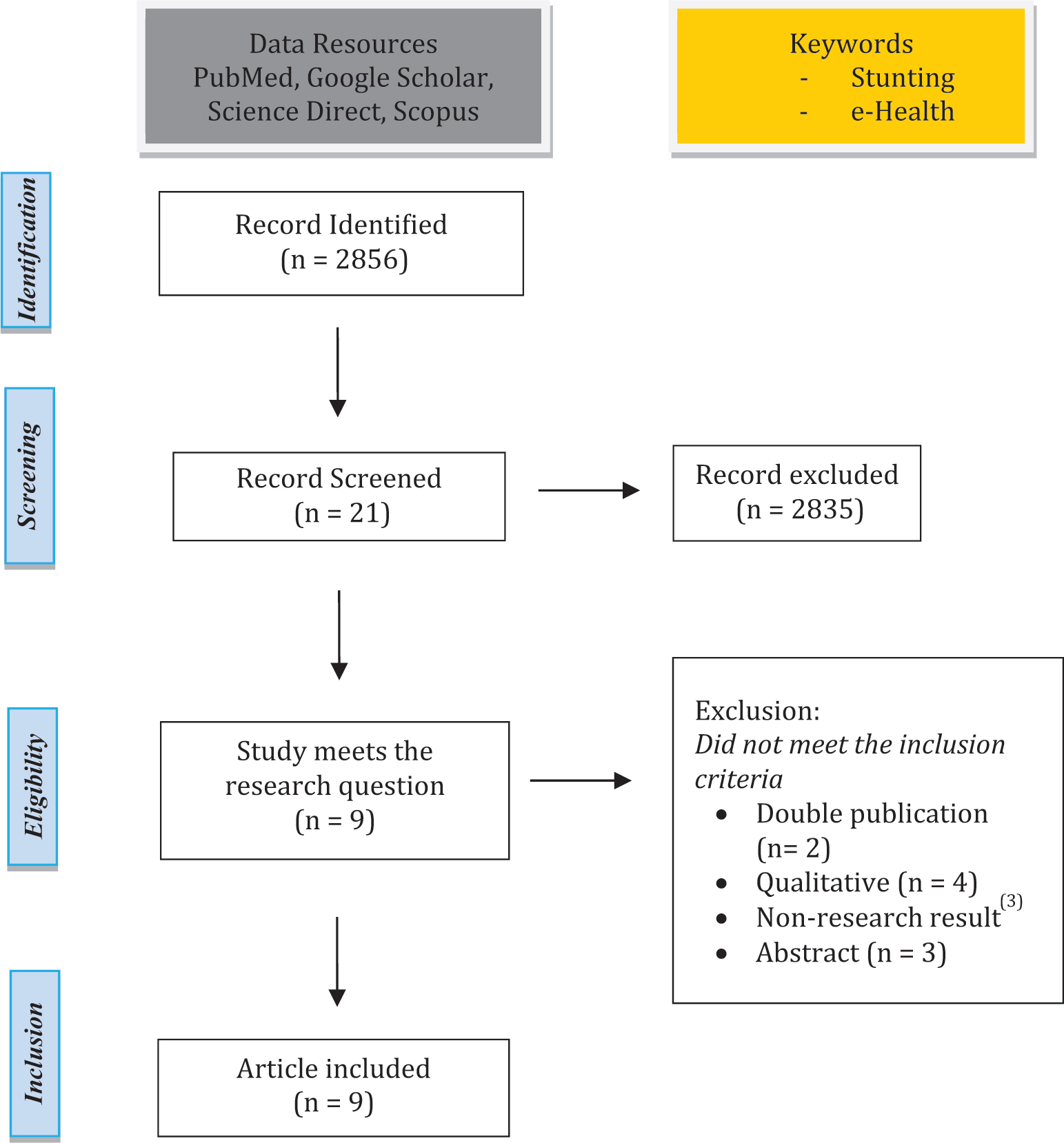
Figure 1.
Flow chart article diagram.
3. Results
Studies have been conducted to evaluate the role of e-Health in stunting prevention, utilizing both offline and online applications. As stated earlier, 9 articles met the inclusion criteria. For the selected 9 articles, 7 different research methods were used, including Waterfall method (n = 2), Mixed methods (quantitative and qualitative) (n = 2), Survey, Literature Review, Research and Development (R&D), Lot Quality Assurance Sampling (LQAS), and Observational study. Out of the 9 articles, 7 studies were conducted in Indonesia, while 1 study used LQAS method in India, and the remaining 1 used the Observational study method in Palestine (Table 1).
Table 1.
Synthesis of articles on stunting prevention using e-Health.
| Author and city | Research design | Purpose of the study | Sample size | Application name and model | Result |
|---|---|---|---|---|---|
| Permana et al.21 Tangerang | Waterfall | To create a nutrition monitoring application that recommends nutrition based on individual’s nutritional status. | 20 female respondents were recruited. | The “Nutrimo” application is accessed online with a special menu for Posyandu officers, divided into five menus: register, monitoring, user data, prescription input, and notification input. For parents, it is divided into four menus: child information, KMS graph, news, and recipes. | The Nutrimo application scored above 80%, indicating that it is easy to use and informative for monitoring nutritional status. |
| Rianti, Triwinarto, and Lukman Bogor22 | Mixed method | To design an Android-based application for ensuring compliance of pregnant mothers in taking Iron Supplement to prevent children from being born stunted. | 71 pregnant mothers were involved | The “Prevent Stunting in Children” (ACALS) application was created using the Use Case MCH book and is developed as two separate applications. One application serves as a companion for pregnant mothers during pregnancy, especially for ensuring compliance in taking Iron supplements, with 10 application features. For Posyandu officers, there are 13 application features. | Qualitative results from pregnant respondents and midwives indicate that the ACALS application is beneficial, especially in monitoring the regular intake of iron supplementation tablets and facilitating prenatal check-ups at health care facilities for pregnant mothers. |
| Syaroni and Munir11 Probolinggo | Waterfall | To facilitate the data collection process for officers and assist the community in monitoring the growth of children affected by stunting. | The sample consists of 2 respondents who assessed the benefits of the stunting service application. | The Android-based Stunting Service Information System Application was developed using the Android programming language and utilizes a MySQL database. The application features a stunting service dashboard menu within the app, which includes family data, detailed child data, types of services, service details, and child data. | Internal test yielded a result of 95.8%, indicating that the application successfully supports the establishment of a stunting service center for the community. |
| Kasjono and Suryani23 Yogyakarta | Mixed method | To determine the effect of the GASING application on stunting prevention behavior among female high school students in the Kalibawang District, Kulon Progo. | 218 individuals were involved | The Gerakan Anti Stunting (GASING) application was designed to facilitate the monitoring of respondents’ behaviors. Therefore, after finishing a meal and practicing clean and healthy habits, respondents were required to fill out the application. The application requested several information, including email address, name, height, weight, age, date of filling, time of filling, nutrition (carbohydrates, protein, fat, minerals, and vitamins), and clean and healthy living behavior (not smoking, consuming fruits and vegetables daily, engaging in physical activities, eradicating mosquito breeding sites, using proper sanitation facilities, handwashing, using clean water). | The stunting prevention behavior increased by 15.67 among the GASING application users, while the group provided with leaflets showed an increase of 3.54. The results from the Wilcoxon and Mann Whitney tests yielded a P-value of 0.000 (P-value <0.05), indicating that the use of the GASING application resulted in a significantly higher improvement in stunting prevention behavior compared to providing leaflets. |
| Utario and Sutriyanti24 Bengkulu | To improve the knowledge of Posyandu cadres regarding stunting and its prevention. | The sample for this activity consisted of 25 Posyandu cadres working in the Puskesmas Perumnas. | This offline stunting prevention application can be accessed using smartphones/Android devices, allowing users to access it anywhere and anytime. It has an attractive interface and can be easily disseminated to the community. The application contains materials presented in the main menu, including an explanation of stunting, its causes, impacts, prevention methods, as well as guidance on how to measure body length and height, as well as measuring length-for-age and height-for-age. | The results indicate an improvement in the cadres’ knowledge about stunting and its prevention. Furthermore, all cadres were able to download and use the offline application. | |
| Andayani and Syafiih25 Probolinggo | Literature Study | To support mothers’ understanding of the nutritional needs of toddlers in the Probolinggo Regency. | The sample consisted of the Probolinggo Regency Government. | PODO CETING is an online Android-based application, with a homepage featuring the menus “What is Stunting,” “What is Nutrition and its Benefits,” and “Check Your Child’s Condition.” The application also provides a material page that explains age, weight, and height. Furthermore, the Nutrition Category Page provides information on the nutritional content of various food portions. | The research results show that the PODO CETING application serves as a platform for the community to understand the risks of stunting in toddlers, as it provides direct information about stunting risks, positive stunting, and acute stunting. |
| Hadi and Rahayu26 Yogyakarta | R&D | To develop an Android-based application as an early stunting prevention effort. | The sample consists of 19 mothers with children aged 0–36 months in Patalan village. | This application is called “Sahabat Bunda Cegah Stunting” and can be accessed through Google Play. The language used is easily understood, with attractive visuals and a user-friendly interface. The application’s interface includes registration, child menu, child growth menu, Child Development Pre-Screening (KPSP) menu, child immunization menu, child health information, recipe menu, nutrition calculation, and forum menu. | The average ratings from media experts were 100.66 (80.53%) in the “appropriate” category; from subject matter experts, the average rating was 80.33 (80.33%) in the “appropriate” category; in the small-group trial, the average rating was 110.5 (83.08%) in the “highly appropriate” category. Finally, the application was implemented with 19 respondents, yielding an average total score of 111.5263 (83.86%) in the “highly appropriate” category. |
| Kumar, et al.27 India | Lot quality assurance sampling | To promote self-care, increase coverage, and enhance collaboration across sectors. | The research sample consisted of 100 villages in the Bilaspur Environment Block (with a population of 101,893). | m-Health (SMS and phone calls) was developed based on a national and international literature review, adapting messages to fit the local culture and writing them in English within the allowed 160-character limit. The messages were targeted toward beneficiaries to trigger discussions during home visits by ASHA and to be part of group discussions in Anganwadi meetings, village health meetings, nutrition day meetings, and voluntary mothers’ club meetings. | The results show that SMS messages were received, read, and practiced by caregivers and service providers in the intervention block at a significantly higher rate than in the control block. There was a significant improvement in malnutrition and wastage. However, the reduction in stunting in the Bilaspur intervention area was still lower compared to the Khizrabad and Mullana control blocks. |
| Ballout et al.28 Palestine | Observational study | To assess the impact of the e-Health system on health care delivery. | The sample consisted of 129 primary health centers, including records of 3 million patients and managing over 8 million visits per year. | The e-Health system developed by UNRWA allows health care providers to assess preventive care services, such as the percentage of targeted individuals aged 40 and above who are screened for diabetes, the percentage of pregnant women with live births attending at least four antenatal visits, and the prevalence of growth problems (underweight, stunting, wasting, and overweight or obesity) in children under 5 years old. | Significant improvements were observed from 2012 to 2017 since the e-Health system started sending alerts to center staff. The prevalence of diabetes increased from 13% to 21% (P < 0.00001), and the percentage of pregnant women with live births attending four antenatal visits increased from 87% to 92%. The prevalence of underweight, stunting, wasting, and overweight or obesity in children under 5 years old increased from 3%, 4%, 2%, and 2% in 2014 to 5%, 7%, 4%, and 5% in 2017, but this can be attributed to improved detection of growth problems through the e-Health system. |
The sample in Permana et al.21 consisted of 20 female respondents. Meanwhile, a study by Rianti, Triwinarto, and Lukman, 202022 had a sample of 71 pregnant women. Syaroni and Munir11 involved 2 respondents, while Kasjono and Suryani23 included a sample of 218 individuals. The participants are from Utario and Sutriyanti24 study consisted of 25 Posyandu cadres. In their study, Andayani and Syafiih25 did not mention the specific sample size; instead, the study focused on the government of Probolinggo Regency. Additionally, a study by Hadi and Rahayu26 involved a sample of 19 individuals. In a study by Welfare, 2021,27 a sample of 100 villages in the Bina Block of Bilaspur area (with a total population of 101,893) was selected. Lastly, the study by Ballout et al.28 examined a sample of 129 primary health centers, which managed over 3 million patient records and facilitated more than 8 million visits annually (Table 2).
Table 2.
The following a summary of several stunting application models.
| No | Application name (author) | Application model |
|---|---|---|
| 1 | Nutrimo (Permana et al.21) | This application can only be accessed online and displays data on children’s nutritional status and provides recommendations that consist of two menus, 1 for Posyandu officers and another for parents. |
| 2 | ACALS Rianti, Triwinarto, and Lukman22 | This app focuses on ensuring pregnant women get adequate iron intake and fulfill ANC visits to monitor pregnancy progress regularly. This application aims to prevent stunting in children by ensuring that the health of a mother is in good condition during pregnancy. |
| 3 | Android-based Stunting Service Information System (Syaroni and Munir11) | This application aims to develop new habits, such as healthy living behavior, that support stunting prevention. This application requires participants to fill in data after eating and to adopt a clean and healthy life. |
| 4 | GASING (Kasjono and Suryani23) | This Android-based application is designed to assist the service team in the input and archiving process so that data management is more efficient and organized, thereby improving the quality of stunting monitoring and prevention through an integrated and easily accessible information system. |
| 5 | Offline stunting prevention application (Utario and Sutriyanti24) | An offline-based application aimed at helping Posyandu cadres by providing education about stunting from definition to prevention. With this application, it is hoped that Posyandu cadres will become more skilled in providing effective education and monitoring so that the incidence of stunting will be reduced in the community. |
| 6 | PODO CETING (Andayani and Syafiih25) | This application is a tool for educating and monitoring children’s nutrition for parents to prevent stunting in children. This application involves various components that can store, display, and generate reports based on data entered by the user. |
| 7 | Sahabat Bunda Cegah Stunting (Hadi and Rahayu26) | This application is designed to replace the role of health workers, especially midwives, as an educational medium for maternal and child health. The application uses simple language that is easy for mothers to understand, is informative, visually attractive, practical, and easy to use, and can be accessed many times. This application makes it easy for parents to monitor, record, and understand their children’s development and nutritional needs so that they can support efforts to prevent stunting and improve the overall quality of maternal and child health. |
| 8 | Evidence-based interventions and m-Health (Kumar et al.27) | Evidence-based interventions and m-Health (SMS messages and phone calls) were implemented to explore cross-sector collaboration as well as strengthen home visits and services. This intervention is used to strengthen health services at the community level, encourage further interaction between beneficiaries and service providers, and support cross-sector collaborative efforts to improve maternal and child health. |
| 9 | The e-Health system developed by UNRWA (Ballout et al.28) | This service system uses 3 categories of indicators to measure the impact on public health services of preventive care services, such as the percentage of individuals aged 40 years and over who were screened for diabetes, the rate of pregnant women with live births who attended at least four antenatal visits, and the prevalence of developmental problems. (underweight, stunting, wasting, and overweight or obese) in children under 5 years. |
4. Discussion
The research results indicate several applications that can be used to monitor nutritional status through the utilization of e-Health. One of the applications developed was developed by Permana et al.21 The application was called “Nutrimo” or Nutritional Monitoring, which displays diagnosed data in the form of nutritional status followed by recommendations based on the patient’s nutritional status. There are two menus: one for parents and another for Posyandu officers. The menu for Posyandu officers is divided into five types: the Registration Menu for patient registration, the Monitoring Menu for inputting the child’s weight and height data, user data, the Prescription Input Menu, and the Notification Input Menu for inputting notifications regarding Posyandu activities and nutritional prescription recommendations for patients. The menu for parents is divided into four types: the Child Information Menu, the KMS Graph Menu for viewing the child’s nutritional status, the News Menu, and the Prescription Menu.21 This application can potentially increase the efficiency of monitoring and managing children’s nutritional health, providing steps to prevent stunting. However, further development is still needed, such as integration into the broader health system and introduction of the application to Posyandu officers and parents for long-term sustainability.
A similar application was created by Rianti, Trinarto, and Lukman, 202022 under the name “ACALS” (Aplikasi Cegah Anak Lahir Stunting or Application to Prevent Stunting in Children), which focuses on the health of pregnant women during pregnancy, especially in terms of compliance with taking iron supplement. The application for pregnant women consists of 10 features, while the application for health care workers consists of 13 features to monitor, evaluate, and intervene in the health conditions of pregnant women and compliance with antenatal care (ANC).22 This application provides essential steps to prevent stunting through early intervention, such as monitoring the health of pregnant women by consuming iron supplements and antenatal care with various features tailored for pregnant women and health workers. However, this application requires integration into the national health system, for further use.
Furthermore, the Kasjono and Suryani23 developed an application called “Gerakan Anti Stunting” (GASING or Anti-Stunting Movement) to deliver balanced nutrition and clean and healthy living behavior information. To facilitate the monitoring of respondents’ behaviors, participants were required to fill out the application after meals and practicing clean and healthy living. The application requested several information, including email address, name, height, weight, age, date of filling, time of filling, nutrition (carbohydrates, protein, fat, minerals, and vitamins), and clean and healthy living behavior (not smoking, consuming fruits and vegetables daily, engaging in physical activities, eradicating mosquito breeding sites, using proper sanitation facilities, handwashing, using clean water). The administrator monitored all through regular observations to develop new habits and behaviors related to stunting prevention.23 This application provides an efficient solution for monitoring healthy living habits in preventing stunting, but to achieve maximum impact, it requires strengthening integration and developing features that are more inclusive for the entire community.
The Android-based Stunting Service Information System Application was designed by Syaroni and Munir11 to assist service teams in data input and archiving, ensuring that the data are safe, remain valid, and help mothers better understand stunting during their child’s growth and development. The application includes a Dashboard Menu that contains family data, detailed child data, types of services, service details, and child data. The Family Data Form Menu consists of Household ID, Father’s ID Number, Father’s Name, address, date of birth, gender, occupation, religion, family status, and mother’s name. The Detailed Child Data Menu shows the Child’s Household ID, Child’s ID Number, Child’s Name, date of birth, gender, and birth order. The Service Menu displays information on immunization, height, weight, vitamin C, and vitamin A. The child’s family data menu is shown through the Household ID, ID Number, Child’s Name, date of birth, gender, and birth order.11 This application helps improve parents’ understanding of monitoring children’s growth and development to prevent stunting. However, integrating this application with of the government’s health system will help to use this application widely and the data collected can be used more effectively in preventing stunting nationally.
Utario and Sutriyanti24 introduced an offline application on stunting to Posyandu cadres, which features main menus such as definition, causes, impacts, and prevention of stunting. Moreover, the use of this offline application for education can improve knowledge on measuring the child’s length and height, as well as determining classifications based on charts for an early detection for stunting. The education on using this application is focused on Posyandu cadres, who will then share the information with the community, especially pregnant women, mothers of infants, and toddlers.24 It appears that this application can improve the ability of Posyandu cadres to carry out nutritional monitoring and provide education to the community so that they can carry out their duties more effectively due to the limited technical problems that can occur with online-based applications. However, integration with the more extensive health system is needed to ensure the sustainability of this application,
Andayani and Syafiih25 developed the Android application “PODO CETING” (Prevent Stunting) to support mothers’ understanding of the nutritional needs of toddlers. The generated database can store and display recorded data, as well as generate reports needed by users. The application features a Home Page with menus such as “What is Stunting,” “What is Nutrition,” and their benefits, as well as a “Check Your Child’s Condition” feature. There is also a Material Page that explains the categorization of children based on age, weight, and height. If they fall below the normal range, they can be classified into three categories: at risk of stunting, positive stunting, and acute stunting based on the standard weight for age of 0–5 years. Furthermore, the Nutrition Category Page provides information on the nutritional content of various food portions. This category menu indicates that children at risk of stunting, positive stunting, and acute stunting should meet the nutritional intake standards according to the Android-based application’s programming algorithm.25 This application can be the right tool to increase mothers’ awareness and knowledge about the importance of fulfilling children’s nutrition. Increasing public awareness about the importance of monitoring children’s nutrition will help reduce the prevalence of stunting. So, integration with the national health system is required to provide maximum contribution in preventing stunting.
In 2022, Hadi et al., developed a system to replace the role of health care workers, particularly midwives, and it can be used as an educational medium for maternal and child health. The application uses simple language that can be understood by mothers, and is informative, visually appealing, practical, and user-friendly, and can be accessed many times. The application includes a Children’s Menu, which includes fields for name, date of birth, gender, weight, birth height, birthplace, and the child’s photo. The Activity Notes Menu serves as a reminder for activities related to the child, such as filling out developmental questionnaires, attending Posyandu visits, and receiving immunizations. The Child’s Growth Menu includes data on weight, height, head circumference, and chest circumference, along with graphs and recommendations. The Child’s Development Menu covers basic motor development, fine motor skills, socialization and independence, as well as language and speaking abilities. The Child’s Immunization Menu serves as a reminder for immunization schedules. The Child’s Health Info Menu includes data results such as the child’s weight, height, head circumference, and arm circumference, along with articles on child health and information about stunting. The Food Recipes Menu provides examples of meals, including preparation methods, benefits, and nutritional content. The Nutrition Calculation Menu helps users determine whether the child’s food consumption meets the recommended nutrient intake (RNI). Lastly, the Forum Menu allows users to consult and ask questions.26 This application provides complete and structured information about children’s health so that it can help parents in making decisions about their children’s care and nutritional needs. This is a very useful supporting tool in monitoring and improving maternal and child health. So, integrating the application with the wider public health system will increase the impact of this application.
In Kumar et al.27 research, evidence-based and m-Health interventions (SMS messages and phone calls) were applied to explore cross-sector collaboration and strengthen home visits and services. The messages were developed based on national and international literature reviews of best practices, adapted to the local culture, written in English script, and consolidated to fit within the 160-character limit. The messages were targeted toward beneficiaries to trigger discussions during home visits by ASHA and to be part of group discussions in Anganwadi meetings, village health meetings, nutrition day meetings, and voluntary mother’s club meetings. Over a period of 34 months, a total of 915 messages were developed at the end of the project, and 15,640,630 SMS messages were sent to beneficiaries and providers, showing a progressive increase in the number of messages as the project scaled up from 10 to 100 villages.27 This shows that m-Health can have a significant impact on improving public awareness and participation in stunting prevention. So, it is necessary to expand the use of this technology, and 1 way of accomplishing this is by integrating it with the government or national health system.
The research28 focused on describing the effect of the e-Health system using 3 categories of indicators: the percentage of people aged 40 and above screened for diabetes, the percentage of pregnant women with live births attending at least 4 antenatal visits, and the prevalence of growth issues (underweight, stunting, wasting, overweight, or obesity) in children under 5 years old. A significant increase was observed in the diabetes screening rate, from 13% in 2012 to 21% in 2017 (P < 0.00001), since the e-Health system began to send alerts to health care providers at the health center. The percentage of pregnant women with live births attending at least 4 antenatal visits increased from 87% in 2012 to 92% in 2017, when the e-Health system allowed health care providers to track all pregnant women who missed appointments. As for the percentage of underweight, stunting, wasting, and overweight or obese children under 5 years old, they increased from 3%, 4%, 2%, and 2% in 2012 to 5%, 7%, 4%, and 5% in 2017, respectively. However, this increase was attributed to improved detection of growth issues through the e-Health system. This reveals that the use of e-health technology can detect health problems early, help young people track their health, and provide timely intervention to the community. In the future, it is necessary to integrate this application with broader health programs such as the national health system.
Some of the applications above support stunting prevention, and agree with previous research results that the use of applications can provide more effective. education, monitoring, and communication in efforts to prevent and reduce stunting cases.29–31 However, some applications have similar features and are not integrated, and many have not yet been implemented in health service facilities. So, further development can be done by incorporating these applications on 1 platform or with existing health systems, as well as by improving features to accommodate user needs, such as ease of access through offline mode optimally.
5. Conclusions
The e-Health aids in preventing stunting by providing accessible and self-conducted educational and monitoring tools, eliminating the need for physical visits to health care facilities, as well as improving the health of pregnant women and infants. Several models and ways of e-Health in stunting prevention include applications such as Nutrimo for monitoring children’s nutrition, the ACALS application to monitor the regular intake of iron supplementation tablets, the GASING application for delivering balanced nutrition and clean and healthy living behavior information, the Android-based Stunting Service Information System Application to support the establishment of stunting service centers for the community to receive appropriate services, the Offline Application on Stunting to enhance the knowledge of cadres regarding stunting, Podo Ceting to support mothers’ understanding of the nutritional needs of toddlers, Sahabat Bunda as an educational medium to comprehend the phenomenon of stunting for early prevention, m-Health (SMS and phone calls) to promote and assist maternal and child health, and e-Health, to enhance health monitoring and facilitate health care services.
Notes
[3] Ethical approval
Ethical issues are not involved in this paper.
[4] Conflicts of interest Conflicts of interest
All contributing authors declare no conflicts of interest.