

1. Introduction
Based on the standpoints of Sun et al. (2025), environmentally sensitive regions are generally defined by resource scarcity, ecological vulnerability, and relative socio-economic underdevelopment. These regions encounter substantial developmental obstacles, comprising resource constraints, environmental degradation, and insufficient infrastructure (Sun et al., 2025). In recent years, public sector organisations (PSOs) have adopted a strategy of organisational reform focused on sustainability principles and issues (Roberto et al., 2020). According to Bauer and Greiling (2025), the public sector serves as a policymaker and regulator, and through its PSOs, is crucial in facilitating and executing sustainable development. As stated by Rizwan et al. (2024), a tranquil and equitable society must actively pursue progress through economic, social, and political strategies. The predominance of effective governance methods – grounded in peace, justice, the rule of law, and equality – reflects a nation’s capacity to address its social challenges and foster an environment of universal prosperity (Rizwan et al., 2024). Consequently, Sustainable Development Goal 16 (SDG 16) and its associated targets are seen as the most crucial objectives, establishing the foundation for the implementation of the UN’s other Sustainable Development Goals (SDGs) (Rizwan et al., 2024).
Inclusive green growth (IGG) is essential for attaining SDG 16 since it fosters the social and economic conditions conducive to peace, fairness, and effective governance. IGG is a composite framework for sustainable development encompassing economic, social, and ecological components (Yu et al., 2025). According to Wang et al. (2025), IGG has been acknowledged as a crucial avenue for sustainable development, and it encapsulates the tenets of economic progress, social inclusion, and environmental conservation. Advancing IGG and achieving the enduring sustainability of economic growth has emerged as a crucial strategy for global sustainable development (Wang et al., 2025).
Based on the viewpoints of Shobande et al. (2025), the circular economy, supported by IGG, can significantly promote the development of new technologies and innovations that address environmental issues. The circular economy is recognised as a revolutionary framework for minimising waste and improving resource efficiency via recycling and reuse (Shobande et al., 2025). Circular economy practices (CEEs) are sustainable strategies that involve the optimisation of resources, the reduction of waste, and the extension of the lifecycles of products and materials by reusing resources within closed loops (Ferasso et al., 2023). Succinctly, the circular economy seeks to optimise resource utilisation and enhance the cycle of consumption and resource circularity (Rajpal et al., 2025). Circular economy principles foster economic growth by enhancing efficiency in product and process across many manufacturing stages while avoiding waste and optimising product lifecycle utilisation (Vrontis et al., 2023).
Digital technologies are seen as essential for advancing the circular economy. Artificial intelligence is broadly described as a collection of transformational technologies capable of simulating cognitive activities or functions commonly associated with human intellect (Dennis et al., 2023). In the public sector, artificial intelligence is anticipated to exert a more significant influence (Alshahrani et al., 2022). It can promote access to and delivery of public services, improve service quality and efficiency, and foster better public trust in government (Drobotowicz et al., 2023; Gaozhao et al., 2023). The swift advancement of artificial intelligence is revolutionising multiple sectors, including accounting (Roos et al., 2025). The utilisation of artificial intelligence is increasing rapidly and is anticipated to revolutionise specific accounting operations (Alghazzawi, 2025). Accounting information systems assist in the management of financial data and decision-making processes, providing critical insights for strategic decision-making and resource allocation. In this research, artificial intelligence-powered accounting information system (AIA) is identified as the integration of artificial intelligence into accounting information system to automate repetitive work, improve decision-making, and reposition accountants toward more important functions. The artificial intelligence in accounting will offer unparalleled chances for the public sector to improve numerous aspects of organisational skills to attain SDG 16, establish a CEE, and facilitate IGG execution. Nonetheless, the interaction among these elements remains inadequately investigated. The primary objective of this study is to investigate the potential function of an AIA in facilitating PSO to adopt CEE and IGG to attain SDG 16. Research questions are systematically formulated based on the articulated rationale to fulfil the analysis of the study’s primary objectives.
RQ1. What is the impact of AIA on SDG 16?
RQ2. What is the impact of AIA on IGG?
RQ3. Does CEE mediate the relationship between AIA on IGG?
RQ4. Does CEE mediate the relationship between AIA on SDG 16?
The findings of this research are a valuable addition to the limited literature on the significance of achieving SDG 16 in the public sector of developing countries. At the micro level, sustainable development is also significantly influenced by the public sector (Soberón et al., 2020). Consequently, it must be regarded as an active participant in the economic system, as it acquires, consumes, administers, and disposes of a significant quantity of resources. Public institutions are able to comply with global governance standards, establish international partnerships, and provide services that promote equality and human rights by aligning with SDG 16. In essence, SDG 16 assists the public sector in the establishment of robust, transparent, and inclusive institutions that are essential for the pursuit of all other SDGs. Indeed, Chan et al. (2026) discovered that social objectives, specifically SDG 16 and SDG 17, have garnered comparatively less focus. In addition, this research enriches the sparse literature on SDG 16 in the public sector by offering a comprehensive analysis of the relationship between AIA and SDG 16. Recent multidisciplinary accounting research underscores the significance of accounting information systems in the processing, storage, and reporting of financial data, while also addressing regulatory and operational challenges (Susanto and Rambano, 2022). The application of artificial intelligence in accounting is a subject that has been extensively examined in the scholarly study (Kureljusic and Karger, 2024). The results of this study also contribute to the theoretical literature on circular economy in the context of the public sector in developing countries. The circular economy has emerged as a critical model for attaining sustainability in resource-limited environments (Tanveer et al., 2025). In contrast to the conventional linear approach of “take–make–consume–dispose,” this model is designed to reduce waste and resource depletion (Kumar et al., 2025). According to Khan et al. (2025), the shift toward CEE presents an attractive avenue for formulating and implementing a holistic strategy to address environmental concerns for a sustainable future in emerging nations. Although the notion of the circular economy has swiftly transitioned from a peripheral concept to a fundamental framework in international dialogues concerning sustainability and resource efficiency (Longsheng and Shah, 2025), the public sector has received minimal attention, while the majority of organisational-level research has concentrated on the implementation of the circular economy in privately owned enterprises (Rajpal et al., 2025). By emphasising the potential of IGG to enhance and elevate the achievement of SDG 16 within the public sector in developing nations, this research makes a valuable contribution to the existing body of literature regarding the potential applications of IGG in public sector settings. One of the most contentious issues in international forums is the promotion of IGG, which is regarded as a significant concern by all countries worldwide (Okombi and Ndoum Babouama, 2024). According to Fan et al. (2023a), a novel approach to sustainable development is IGG, which is predicated on the coordination of the economy, society, and environment. To achieve IGG, both developed and emerging nations have implemented a green growth strategy that aims to promote social inclusivity by balancing economic development with environmental sustainability (Khurshid et al., 2025).
The components of this study are organised as detailed below. Section 2 presents an illustration of the theoretical framework and conceptual components, followed by the development of the hypothesis and research model in Section 3. Section 4 provides a detailed exposition of the research methodology. Following this, the research findings are outlined in Section 5. The investigation culminates with a discussion of the findings, a delineation of its limitations, and recommendations for subsequent research in Section 6.
2. Literature Review
2.1. Theoretical Underpinning
The theoretical frameworks of stakeholder theory (Freeman, 1984) and the resource-based view (Barney, 1991) are employed in this study for the proposed model investigation. These two theories offer significant insights into the internal and external drivers of organisational transformation and sustainable practices. The resource-based view provides valuable insight into enhancing an organisation’s performance through its existing resources and internal expertise (Corbett and Claridge, 2002). The resource-based view centres on the organisation as the primary unit of analysis, positing that organisations possessing rare, valuable, and unique assets can achieve a sustainable competitive advantage by executing innovative, value-generating strategies that are challenging for rivals to replicate (Barney, 1991).
This study illustrates how the resource-based view emphasises AIA’s role in improving efficiency through process optimisation, minimising inefficiencies, and augmenting operational capability. By integrating artificial intelligence with accounting information system, PSOs can enhance resource efficiency and refine decision-making processes. This study emphasises how PSOs can leverage AIA potential to foster innovation, hence advancing societal and environmental objectives. By utilising these internal resources, PSOs can adopt CEE and IGG strategies to attain SDG 16. According to Cornelissen (2023), stakeholder theory is articulated as a strategy instrument applicable across all sectors, notwithstanding its origins in the business domain (Moloney and McGrath, 2020). Stakeholder theory addresses ethical considerations, stakeholder interests, and organisational management to promote ethical, effective, and pragmatic approaches for managing uncertainties (Freeman and Dmytriyev, 2017). This theory offers researchers a framework to perform comprehensive and insightful investigations concerning stakeholders (Tallberg et al., 2022). Stakeholder theory motivates authors globally to do further research to comprehend valuable insights for organisations (Freeman, 1984). Furthermore, its theory aids strategic management in disseminating strategies by including other views and domains, including environmental considerations (Donaldson and Preston, 1995). The alignment of sustainable management and stakeholder theory is evidenced by their shared long-term perspective and strategic planning characteristics. As stated by Dumay et al. (2010), PSOs should assume a crucial role in promoting sustainable development. PSOs are obligated to meet the expectations linked to fulfilling the requisite requirements of organisational effectiveness and efficiency in public service delivery. Besides, PSOs should include sustainability strategies that mitigate adverse environmental and social effects while fostering a more sustainable society. The use of digital technology is presumed to enhance the incentive of various stakeholders to engage, foster reciprocal contributions, share perceived decision-making power, and augment the potential public value of co-creation (Lember et al., 2019). In a nutshell, the resource-based view suggests that PSOs should optimize their internal resources and capabilities, while stakeholder theory emphasizes the importance of engaging stakeholders and using these resources accountably to advance SDG 16.
2.2. Conceptual Framework
2.2.1. AI-powered Accounting Information System
At present, artificial intelligence technologies, including autonomous vehicles, facial recognition, and voice recognition, are having a profound and transformative impact on the lives of individuals (Kökver et al., 2025). In 1956, the term “artificial intelligence” is established as the science and engineering of developing intelligent machines (McCarthy, 2004, p.2) which is now widely considered the birth of artificial intelligence (Copeland, 1993). The development and research of artificial intelligence solutions did not commence on a significant scale until the 1970s (Marr, 1977). However, artificial intelligence has only acquired momentum with the advent of industry 4.0, which resulted in a substantial increase in the number of technical devices that generate, collect, and distribute data (Oldemeyer et al., 2025). Since the 2010s, there has been an exponential increase in the development of artificial intelligence-based technologies in all sectors of the scientific and industrial sectors (Wadoux, 2025). Panda et al. (2025) analyse the impact of artificial intelligence on the public sector, highlighting trends in global artificial intelligence ethics and policy challenges, artificial intelligence adoption and governance, the obstacles and prospects of artificial intelligence implementation in public administration, and artificial intelligence’s influence on economic and public transformation. Anshari et al. (2025) propose for simulating the convergence of public service delivery with artificial intelligence to attain sustainable development. The findings of Tveita and Hustad (2025) indicate that the implementation of artificial intelligence in the public sector can improve efficiency, enhance service delivery, and optimise resource allocation via automation and sophisticated artificial intelligence applications. In contrast, their research highlights obstacles in the adoption of artificial intelligence. The intricacies of the adoption process need the resolution of trust concerns, ethical considerations, and human resource management. Furthermore, proficient change management is essential in the adoption process.
Through the automation of processes, the improvement of operational efficiency, and the enhancement of accuracy in financial reporting, fraud prevention, and regulatory compliance execution, artificial intelligence is revolutionising the field of accounting (Alruwaili and Mgammal, 2025). Awwad et al. (2025) demonstrate that the quality of accounting information characteristics (relevance, faithful representation, and verifiability) is enhanced by the application of artificial intelligence techniques (expert systems, machine learning, neural networks, and algorithms). Kureljusic and Karger (2024) provide a comprehensive overview of the current state of research regarding the application of artificial intelligence in financial accounting for the purpose of forecasting. In this research, AIA is identified as the integration of artificial intelligence into accounting information system to automate repetitive work, improve decision-making, and reposition accountants towards more important functions. Roos et al. (2025) assert that the effective integration of artificial intelligence in accounting relies on various requirements, including an appropriate information technology infrastructure, access to high-quality data, adherence to regulations, and staff upskilling. The digital landscape, defined by automation and artificial intelligence, is transforming the accounting profession (Elnakeeb and Elawadly, 2025). Eisikovits et al. (2025) demonstrate that accounting and auditing professionals must comprehend critical aspects of artificial intelligence utilisation, such as data ownership, governance, and bias, to properly leverage artificial intelligence technologies. As technology continues to advance rapidly, the accounting profession must adapt to emerging technologies and their influence on the accountant's role to remain relevant and enhance its value. Strydom and Mohammadali-Haji (2025) underscore the necessity for lifelong learning and collaboration between industry and academia to prepare future accountants with digital proficiency. Abu Afifa et al. (2025) demonstrate that digital transformation and a transformational leadership approach positively impact artificial intelligence in accounting. Moreover, the transformational leadership style exhibits a substantial moderating influence on the relationship between digital transformation and artificial intelligence in accounting. The findings of Nguyen et al. (2025b) indicate that artificial intelligence in accounting serves as a catalyst for sustainable competitive performance and enterprise risk management. Enterprise risk management enhances sustainable competitive performance and serves as a mediator in the indirect influence of artificial intelligence in accounting on sustainable competitive performance. Furthermore, managerial information technology infrastructure amplifies the positive impact of artificial intelligence in accounting on corporate risk management.
2.2.2. Sustainable Development Goal 16
Sustainable development is characterised as a strategy that addresses both present and future requirements (Dincă et al., 2022; Wilkes-Allemann et al., 2023). The 17 issues (objectives) for evaluating the implementation of the concept of sustainable development are also intricate (Pakkan et al., 2023). According to Milton (2021), SDGs constitute an ambitious, comprehensive framework that integrates environmental concerns, social inequalities, and peace into global development standards, and the 2030 Agenda addresses the detrimental effects of violence and insecurity on development by incorporating peace as a fundamental theme and establishing SDG 16. Although issues addressed by SDG 16, such as violence reduction, the rule of law, and governance, are relevant to all societies, Milton (2021) emphasises fragile and conflict-affected nations as facing particularly significant challenges in attaining SDG 16. Knox and Orazgaliyev (2024) examine the relationship between effective governance and the execution of SDGs in authoritarian regimes. Hope (2020) analyses the significance of SDG 16 for the attainment of all SDGs, evaluates the current progress in its implementation, identifies the primary challenges faced by countries in this regard, and proposes a series of policy solutions to address these challenges. The analysis of Khorram-Manesh (2023) substantiates the influence of disasters and public health crises on two principal SDGs, namely, SDG 16 and SDG 17, highlighting the necessity for global collaboration (SDG 17) to attain peace, justice, and robust institutional frameworks (SDG 16) as essential prerequisites for fulfilling the comprehensive United Nations development objectives.
2.2.3. Circular Economy Practices
The notion of circular economy has gained traction in recent years to address issues related to waste generation and ultimately attain net zero (Bressanelli et al., 2021). It signifies a fundamental transition from conventional linear production models of extraction, manufacture, and disposal to a regenerative framework that prioritizes the reuse and recycling of materials (Zameer et al., 2021). The shift to a circular economy is a global necessity with significant environmental, economic, and societal implications (Pozzetto and Leoni, 2025). Given their substantial workforce and responsibility to serve local and national stakeholders, PSOs play a crucial role in implementing CEE that go beyond policy execution and public value generation (Torfing, 2019). The public sector fosters innovation and digital transformation, which can be augmented by incorporating sustainable circular economy concepts (Rajpal et al., 2025). The circular economy has arisen as a revolutionary framework for advancing sustainable development within the public sector (Monciardini et al., 2024). Public authorities can enhance environmental quality, attain sustainable objectives, and stimulate economic growth by adopting circular economy concepts (Obeidat et al., 2023). The integration of circular economy techniques remains a formidable challenge (Kua et al., 2024). However, the tangible advancement of public sector involvement in the circular economy is constrained (Clifton et al., 2024; De Laurentis et al., 2024), and the examination of circular economy within PSOs is still underdeveloped (Droege et al., 2021).
2.2.4. Inclusive Green Growth
In 2012, the UNs Conference on Sustainable Development (UNCSD) introduced the idea of IGG, emphasising the importance of a synergistic relationship across economic, social, and environmental systems (Zhang et al., 2022). IGG, which puts an accent on the delicate equilibrium between economic expansion, ecological sustainability, and social well-being (Ren et al., 2024), has garnered substantial scholarly attention since its introduction in 2012 (Jia et al., 2023; Ren et al., 2024). Okombi and Ndoum Babouama (2024) investigate the influence of the environmental tax on IGG in developing countries from 2000 to 2021. Li et al. (2023a) utilize provincial panel data from 2004 to 2020 to establish an innovative evaluation system for China’s IGG. The patterns of economic development, social structure, and ecological environment, which are the essential elements of IGG, have undergone fundamental changes as the digital economy has flourished (Xie et al., 2023). Ofori and Figari (2023) employ macrodata from 23 African countries to investigate whether economic globalisation and good governance interact to promote IGG. Xin et al. (2023) empirically and theoretically investigate the influence of the digital economy on IGG by investigating the panel data of 281 cities in China from 2011 to 2020. By using data from 281 Chinese prefecture-level cities from 2007 to 2020, Fan et al. (2025) evaluate the influence of smart city initiatives on IGG. According to Fang and Wen (2025), digital finance is a cutting-edge financial paradigm that significantly enhances the accessibility and broadens the scope of financial services, which is crucial for promoting green growth.
3. Hypothesis Development
Organisations are progressively addressing the challenge of sustainability and expanding their development initiatives to preserve environmental integrity and optimize the utilisation of natural resources (Joyce and Paquin, 2016). The objective of CEE is to construct a more sustainable and resilient economy by establishing a restorative and regenerative economic model that considers the entire product lifecycle, from its inception to its disposal (end of life) (Julkovski et al., 2023). According to Johri (2025), an accounting information system, which is a computer-based mechanism, is designed to efficiently and effectively collect, process, store, and present financial and accounting information for an organisation. Accounting information system produces indispensable financial reports, which provide valuable insights that improve strategic planning and organisational transparency. The artificial intelligence advent and its relevance to several societal facets encompasses its capacity to assess sustainable development outcomes (Agrawal et al., 2022). Artificial intelligence, with its proficiency in massive data processing, analysis, and machine learning, can automate intricate and labour-intensive accounting procedures (Abu Afifa et al., 2025). Artificial intelligence significantly impacts accounting by enabling the identification of patterns within extensive accounting data, hence aiding organisations’ decision-making and facilitating financial assessments by stakeholders (Lehner et al., 2022). AIA can enhance resource use by delivering comprehensive insights into resource tracking and tracing, which is essential for circular economy strategies like recycling and material reuse. In this regard, the hypothesis in this investigation is posited as follows.
Hypothesis 1 (H1). AIA is likely to have a significantly direct influence on CEE.
The integration of digital innovation and sustainable development has become a fundamental aspect of contemporary studies, illustrating the combination of technology advancement with societal improvement (John et al., 2025). SDG 16 underscores the essential role of PSOs and public servants in fostering and sustaining societal cohesion and prosperity. An accounting information system that provides timely and relevant financial information assists management in making educated decisions about the organisation’s activities, investments, and financial health (Hendrawan et al., 2023). An accounting information system that produces information based on pertinent accounting principles guarantees that the financial data is accurate, reliable, and adheres to legal standards (Oladejo and Yinus, 2020). Artificial intelligence can process input data, reconcile records, and generate reports, minimising errors and conserving time, so enabling accountants to manage increasingly complex jobs (Alsmadi et al., 2023). Han et al. (2023) and Nguyen et al. (2025a) contend that artificial intelligence yields optimal advantages when included into accounting systems, since it can forecast and identify risks and accounting fraud. This efficiency enables PSOs to allocate resources more effectively, providing transparency and accountability in financial operations. In this regard, the hypotheses in this investigation are posited as follows.
Hypothesis 2 (H2). AIA is likely to have a significantly direct influence on IGG.
Hypothesis 3 (H3). AIA is likely to have a significantly direct influence on SDG 16.
Based on the perspectives of Geisendorf and Pietrulla (2018), circular economy principles illustrate the importance of long-term sustainability and influence both the organisation’s internal operations and economy. The shift to a circular economy is a global necessity with extensive environmental, economic, and social implications (Pozzetto and Leoni, 2025). Circular economy seeks to minimize resource inputs, waste, emissions, and energy leakage by decelerating, closing, and narrowing material and energy loops (Rathi et al., 2022). The circular economy is a viable paradigm for confronting the obstacles to sustainable development (Cagno et al., 2023). Molinaro et al. (2026) have suggested that CEE may generate co-benefits that extend beyond resource utilisation and may result in climate mitigation. By adopting circular economy practices, PSOs can reduce operational costs, enhance service efficiency, and contribute to environmental sustainability while generating public value through resource reuse and waste minimisation. It is accomplished via consistent reporting, stakeholder involvement, and governance frameworks integrated into social interactions. Inclusive governance constitutes a fundamental element of SDG 16. Remarkably, the PSO should be regarded not only as a significant participant in the economic system, engaging in the acquisition, consumption, management, and disposal of considerable resources but also as a regulator and policymaker (Klein et al. 2020). In this regard, the hypotheses are posited as follows.
Hypothesis 4 (H4). CEE is likely to have a significantly direct influence on IGG.
Hypothesis 5 (H5). CEE is likely to have a significantly direct influence on SDG 16.
SDG 16 addresses issues such as human rights, violence, corruption, accountable and transparent institutions, and responsible and inclusive decision-making (Fraisl et al., 2025). IGG has emerged as a global consensus for attaining sustainable development goals (Fan et al., 2023b). IGG is an economic development model that aims to achieve a harmonious equilibrium between economic growth, social welfare, and ecological protection by facilitating the coordinated advancement of economic, social, and environmental systems (Jia et al., 2023). Remarkably, IGG has the potential to implement reforms that improve the rule of law and guarantee that justice systems are accessible to all, with a particular emphasis on marginalised communities. This is essential for the realisation of SDG 16 to ensure that all individuals have access to justice. In this regard, the hypothesis in this investigation is posited as follows.
Hypothesis 6 (H6). IGG is likely to have a significantly direct influence on SDG 16.
According to Li et al. (2023b), IGG is an essential strategic choice for high-quality development. IGG is introduced as an innovative framework to align economic development with environmental sustainability and social fairness (Shobande et al., 2025). Digitalisation has markedly expedited technology diffusion, facilitated the removal of technological obstacles, and substantially improved factor efficiency while decreasing energy consumption (Ghasemaghaei and Calic, 2019). An efficient accounting information system must generate reports and data relevant to the specific requirements of diverse users, including managers, executives, auditors, and regulatory bodies (Al-Okaily et al., 2023). Artificial intelligence systems rapidly analyse data and identify patterns that may elude human observation (Khan et al., 2023). These characteristics are particularly crucial in the dynamic environment, where vast quantities of data, encompassing both financial and non-financial information, require effective management on a regular basis. Artificial intelligence can aid in fraud detection by recognising probable patterns and trends indicative of fraud (Alghazzawi, 2025). Indeed, artificial intelligence substantially improves accounting processes by enhancing efficiency, accuracy, speed, and the quality of accounting information (Chukwuani and Egiyi, 2020). AIA can evaluate historical data, market trends, and additional variables in budget planning to produce more precise budget estimates (Nguyen et al., 2025b). By doing so, PSOs may reduce their ecological consequences while concurrently enhancing operational efficiency and effectiveness. In this regard, the investigation’s hypothesis is posited as follows.
Hypothesis 7 (H7). AIA is likely to have a significantly indirect influence on IGG through CEE.
SDG 16 seeks to foster peaceful and inclusive communities for sustainable development, ensure universal access to justice, and establish effective, accountable, and inclusive institutions at all levels (Bachmann et al., 2022). Artificial intelligence augments automated information systems by streamlining tasks, enhancing data precision, and facilitating predictive analytics. These enhancements result in superior financial reporting, auditing, and compliance, which are crucial for upholding transparency and accountability inside organisations. Augmented openness and accountability are essential for the realisation of SDG 16, as they facilitate the establishment of robust institutions and the advancement of justice. Artificial intelligence substantially enhances the circular economy by maximising resource utilisation, improving recycling methods, and promoting material reutilisation. Circular economy ideas have gained prominence as sustainable frameworks that surpass conventional trash reduction measures (Bag et al., 2021). The circular economy is globally acknowledged as an economic paradigm for attaining long-term sustainability (Kazancoglu et al., 2022). The circular economy is a method aimed at tackling sustainability concerns, alleviating climate change, and fostering sustainable development (Alonso‐Almeida et al., 2020). By implementing circular economy principles, PSOs can enhance resource efficiency and minimize waste. Optimal resource utilisation and waste minimisation can support the establishment of effective and sustainable institutions. In this regard, CEE can strengthen accountability and transparency within organisations by requiring clearer monitoring, reporting, and evaluation of resource flows and environmental outcomes. This can be achieved through consistent reporting, stakeholder involvement, and governance frameworks embedded in organisational decision-making processes. These practices guarantee that PSOs are accountable for their actions, thereby aligning with the objectives of SDG 16. In this regard, the hypothesis in this investigation is posited as follows.
Hypothesis 8 (H8). AIA is likely to have a significantly indirect influence on SDG 16 through CEE.
Therefore, all the aforementioned hypotheses and variables are illustrated in Figure 1 as shown below.
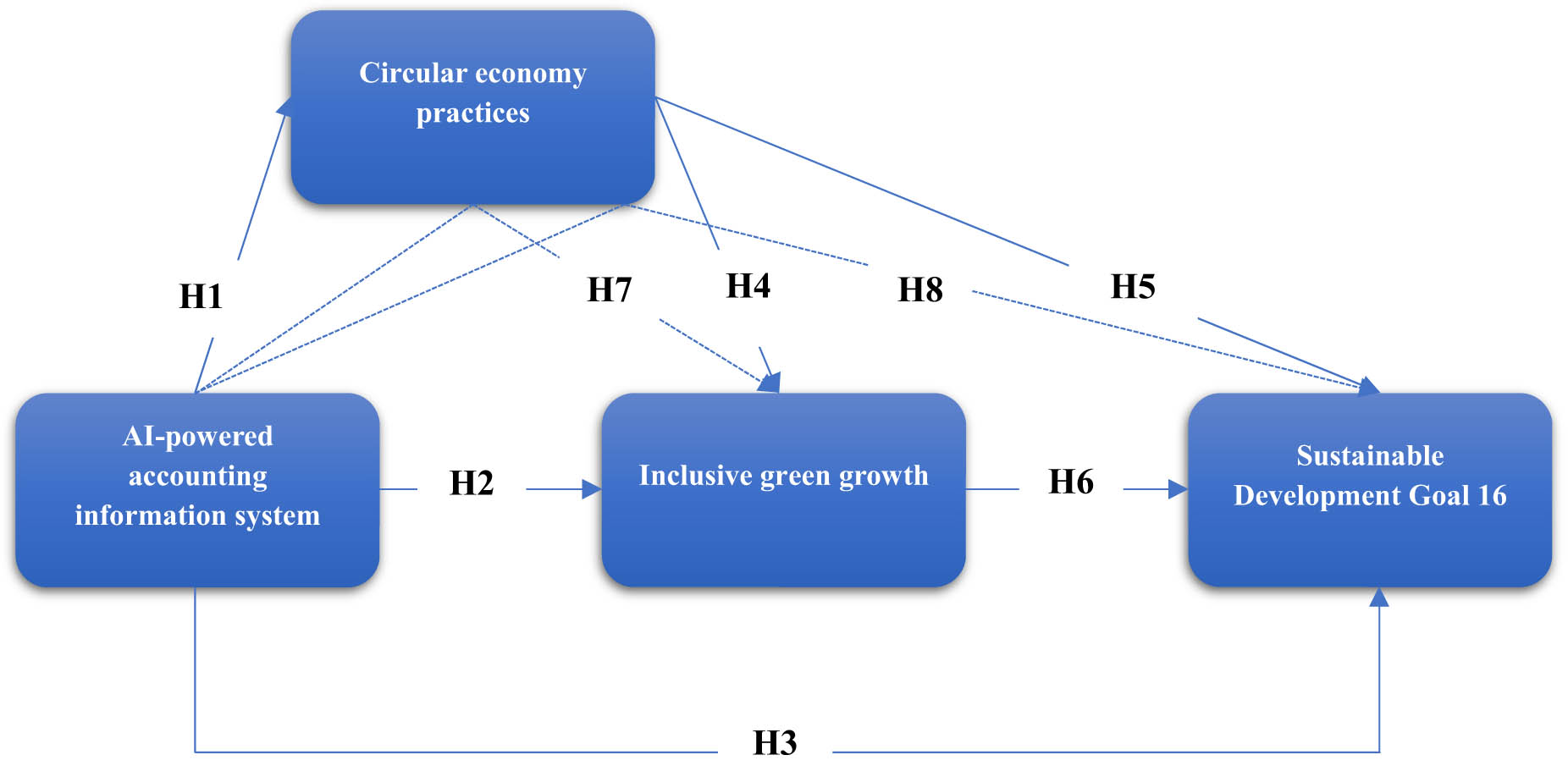
Figure 1
Research model and hypotheses.
(Source: Authors’ own proposal)
4. Research Methodology
4.1. Measurement Scale Development
The questionnaire was first composed in English and subsequently translated into Vietnamese by bilingual specialists to guarantee linguistic precision. To evaluate content validity, three academic experts in sustainable development examined the questionnaire with a 7-point Likert-type scale. A pilot test involving 30 individuals was conducted following initial comments. A small-scale pilot study was conducted with three principal objectives: to evaluate the validity of the measuring scales; to enhance the clarity and quality of the survey questions; and to modify and finalize questionnaire. Multiple modifications were implemented to improve clarity, guarantee accurate replies, and reduce potential biases prior to the deployment of the final survey. The reliability scores for all constructs above 0.70, deemed acceptable. The research variables were indicated in Table 1.
Table 1
Variables and items.
| Variables | Items | Description | Sources |
|---|---|---|---|
| Artificial intelligence-powered accounting information system | AIA1 | Our organisation acknowledges the integration of artificial intelligence in accounting processes, enhancing the efficiency of the accounting system | Abu Afifa et al. (2025) |
| AIA2 | Our organisation acknowledges that artificial intelligence in accounting processes enhances efficiency in budget planning and performance evaluation methods | ||
| AIA3 | Our organisation acknowledges that artificial intelligence in accounting processes enhances the efficiency of decision support systems | ||
| AIA4 | Our organisation acknowledges that artificial intelligence in accounting processes enhances efficiency in planning and control | ||
| AIA5 | Our organisation acknowledges that artificial intelligence in accounting methods enhances efficiency in responsibility accounting | ||
| Circular economy practices (CEE) | CEE1 | Our organization proactively shares certain resources to enhance collective efficiency | Kuzma et al. (2021); Hazen et al. (2021); Pizzi et al. (2022) |
| CEE2 | Our organization encourages energy conservation | ||
| CEE3 | Our organization promotes waste recycling | ||
| CEE4 | Our organization takes initiative in generating useful contributions for partners inside the public service supply chain | ||
| CEE5 | Our organization actively addresses operational matters by implementing a suitable organisation model aligned with circular economy principles | ||
| Sustainable Development Goal 16 | SDG_16_1 | Our organization contributes to promoting peace and reducing violence in society | Greenland et al. (2023) |
| SDG_16_2 | Our organization supports diversity and social harmony | ||
| SDG_16_3 | Our organization promotes fair laws and justice for all | ||
| SDG_16_4 | Our organization supports industry regulation and accountability | ||
| SDG_16_5 | Our organization promotes accountable governments and public institutions | ||
| Inclusive green growth | IGG1 | Our organization's inclusive green growth practices recognize the contributions of marginalized groups as stakeholders | Bouma and Berkhout (2015), Kourula et al. (2017), Chapman and Shigetomi (2018) |
| IGG2 | Our organization’s inclusive green growth practices promote social equity | ||
| IGG3 | Our organization’s inclusive green growth practices enhance ecological environments | ||
| IGG4 | Our organization’s inclusive green growth practices have the potential to support long-term growth by reducing poverty and expanding the middle class | ||
| IGG5 | Our organization’s inclusive green growth practices create employment opportunities and enhance resilience to economic shocks |
(Source: Author’s contribution)
Inclusive green growth. This investigation utilised five items that were derived from those suggested by Bouma and Berkhout (2015); Kourula et al. (2017); Chapman and Shigetomi (2018) to evaluate IGG.
Circular economy practices. This investigation utilised five items that were derived from those suggested by Kuzma et al. (2021); Hazen et al. (2021); Pizzi et al. (2022) to evaluate CEE.
Artificial intelligence-powered accounting information system. This investigation utilised five items that were derived from those suggested by Abu Afifa et al. (2025).
Sustainable Development Goal 16. This investigation utilised five items that were derived from those suggested by Greenland et al. (2023).
4.2. Target Population and Data Collection
The research model and hypotheses were evaluated utilising data from PSOs in Vietnam. Based on the perspective of Huynh et al. (2025), Vietnam has been acknowledged as an expeditiously industrialising nation in Southeast Asia. The nation is experiencing structural transformation propelled by government-led development, digitisation efforts, and a heightened focus on innovation-driven growth (Mai et al., 2024). According to Thai et al. (2025), the anticipated investment demand in Vietnam is forecast to reach approximately $30 billion by 2030. The establishment of a comprehensive infrastructure system is essential for the nation to attain sustainable development objectives and improve national competitiveness in a coordinated and contemporary fashion, meeting the demands of socio-economic advancement (Thai et al., 2025). Vietnam is implementing a significant governmental and provincial reorganisation to enhance administrative efficiency, governance, and economic competitiveness.
Effective 1 March 2025, Vietnam’s Government organizational structure was streamlined from 18 to 14 ministries and from four to three ministerial-level agencies, with the aim of reducing institutional overlap and enhancing inter-agency coordination. Significant mergers encompass the consolidation of the Ministry of Finance with the Ministry of Planning and Investment, alongside the establishment of new entities such as the Ministry of Ethnic and Religious Affairs. The government merged 63 provinces and cities into around 34 larger administrative units at the provincial level, facilitating enhanced resource distribution and local governance. The elimination of district-level administration effective 1 July 2025 has established a two-tier governance structure – provincial and commune – thereby lowering bureaucracy and expenses. Successful implementation of these reforms necessitates robust coordination, openness, and stakeholder engagement to assure stability, uphold investor confidence, and actualize Vietnam’s goal for a modern, responsive government. Examining Vietnam is essential for comprehending its distinctive developmental trajectory and for extracting insights relevant to other developing economies undergoing analogous transformations. Recently, Vietnam has enacted numerous policies to manage, efficiently use, and sustainably employ natural resources, fuels, and raw materials, promoting the creation of environmentally friendly products that are renewable, reusable, and recyclable (Quang et al., 2025).
According to Barbera et al. (2024), global academic experts acknowledge accounting as a tool of authority and regulation inside organisations and society. Accounting systems have become increasingly prevalent in the public sector, frequently offering the tools and techniques to convert public sector reform concepts into routine practices and behaviours (Miller and Power, 2013). In addition, accountants significantly contributed to the measurement, disclosure, and assurance of all organisational information, particularly with corporate social responsibility (Huang and Watson, 2015). Collectively, accountants can serve as a crucial element in fostering sustainable growth within the public sector by ensuring transparency, accountability, and the effective allocation of public resources. As a result, accountants were chosen as the participants in this study. Before administering the survey, participants were apprised of the study’s objectives and their entitlement to decline participation or withdraw from the study at any moment. Targeted questionnaires were distributed to accountants of PSOs to gather empirical data using a combination of convenience and snowball sampling techniques. As noted by Hair et al. (2018), large samples may cause statistical significance to become overly sensitive, resulting in a type I error. A large sample size could render any link statistically significant, regardless of its actual validity (Hair et al., 2018; Kline, 2023). In this regard, Boreham et al. (2020) asserted that the integrity of a sample was more contingent upon the meticulous selection of respondents than on the sample size itself. Hair et al. (2018) argued that the sample-to-variable ratio indicated a requisite minimum observation-to-variable ratio of 5:1. In the meantime, ratio of 15:1 or 20:1 was recommended as more favourable (Hair et al., 2018). In this research, the ratio of 20:1 was employed. Data were gathered from September 2024 to April 2025. The questionnaire was distributed to 770 individuals. A total of 723 responses were gathered, of which 712 were complete and appropriate for the study. The final sample size was determined by removing 11 responses due to incompleteness or inadequate information. Table 2 provided a detailed summary of the demographic data gathered during the survey.
Table 2
Demographic characteristics of survey respondents.
| Items | Frequency | Percentage |
|---|---|---|
| Gender of respondent | ||
| Male | 235 | 33.01 |
| Female | 477 | 66.99 |
| Age of respondent | ||
| Under 30 | 26 | 3.65 |
| 30 to under 40 | 287 | 40.31 |
| 40 to under 50 | 319 | 44.80 |
| Over 50 | 80 | 11.24 |
| Experience of respondent (years) | ||
| Under 10 | 42 | 5.90 |
| 10 to under 20 | 398 | 55.90 |
| 20 to under 30 | 215 | 30.20 |
| Over 30 | 57 | 8.01 |
| Education | ||
| Undergraduate | 677 | 95.08 |
| Postgraduate | 35 | 4.92 |
(Source: Extracted from statistical software and authors’ own study)
4.3. Data Analysis Technique
This research utilised IBM AMOS 28, SPSS 30.0, Smart-PLS 4.1.0.9, and fsQCA 4.1 for the assessment of the suggested model. A descriptive analysis was conducted utilising SPSS software to assess the fundamental attributes of the data. Dash and Paul (2021) asserted that covariance-based structural equation modelling (CB-SEM) using AMOS-produced superior model fit indices relative to partial least squares structural equation modeling (PLS-SEM), which has been evolving its fit indices. Therefore, CB-SEM was utilised to evaluate the model fit indices in this research. The measurement and structural models were analysed using the PLS-SEM technique to validate the associations between independent and dependent variables. PLS-SEM was selected for its appropriateness in assessing causal links among latent constructs and for quantifying the degree and importance of these interactions using path coefficients (Oroni et al., 2025). Despite its efficiency as a robust analytical tool, PLS-SEM’s reliance on mean-centred symmetric model estimate may mask nuanced effects within empirical data, particularly in asymmetrical or nonlinear connections (Sukhov et al., 2023). To mitigate these constraints and enhance comprehension of the data, the study additionally utilised fsQCA, an asymmetric methodology. The final method employed in this work was fsQCA utilising version 4.1 software by Ragin (2023), which provided an asymmetric analytical approach. This methodology adeptly addressed theoretical complexity while offering both theoretical and practical insights into the dependent variable (Pappas and Woodside, 2021). The fsQCA was employed to investigate random data configurations, as it did not depend on pinpointing a singular “optimal” model. According to Chanda et al. (2025), fsQCA facilitated the simultaneous evaluation of many causal configurations, allowing for the analysis of nonlinear and intricate interactions that the SEM method may neglect.
5. Result Analysis
5.1. Common Method Bias
To mitigate this common method bias (CMB), two approaches were implemented: statistical measures and procedural measures. Requirements for procedural measures included the elucidation of questionnaire items and the assurance of respondents’ confidentiality. To mitigate social desirability bias, respondents were guaranteed anonymity and confidentiality. By deliberately rearranging the presentation order and omitting construct titles from the survey, the questionnaire was intended to obfuscate the distinct association between constructs. The variance of the first factor in Harman’s single-factor analysis was 38.441%, which was below the recommended threshold of 50% in the context of statistical methods. Additionally, the variance inflation factor (VIF) was implemented to assess comprehensive collinearity in this investigation, requiring a value of less than 3.3 (Kock 2015). The collinearity analysis of this study revealed that the VIF fell within the range of 1.684–2.315, which was substantially lower than the 3.3 threshold. Consequently, these findings indicated that the results of this investigation were not influenced by CMB. As a result, this approach enhanced confidence in the quality of the data and the reliability of the subsequent analysis.
5.2. Model Fit
CFA was conducted using the maximum likelihood technique, and the support of AMOS 28.0. A thorough assessment of the model’s fitness, considering several parameters, was conducted through CFA. The CFA outcomes were assessed based on five key model fit indices namely the Chi-square/df ratio, goodness-of-fit index (GFI), comparative fit index (CFI), Tucker–Lewis index (TLI), and root mean square error of approximation (RMSEA). All indicators for model fitness of the proposed model presented in Figure 2 adhered to the specific criteria, rendering the model acceptable across all aspects. Consequently, the Chi-square/df was 1.410 (criterion: ≤ 3), RMSEA was 0.024 (criterion: < 0.080); GFI was 0.969 (criterion: > 0.9), CFI was 0.991 (criterion: > 0.9), and TLI was 0.989 (criterion: > 0.9) (Kline, 2023).
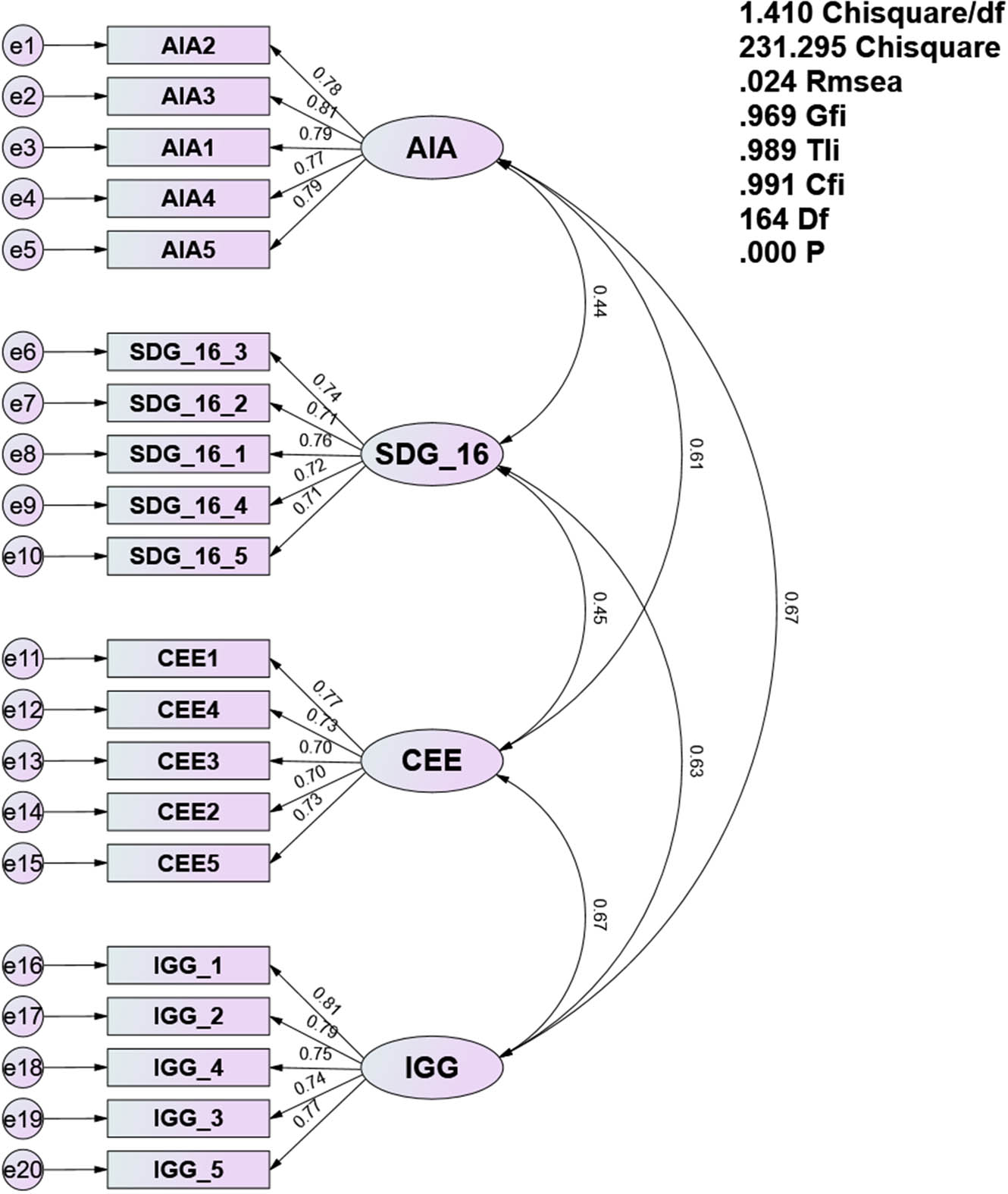
Figure 2
CFA result.
(Source: Extracted from statistical software and authors’ own study)
5.3. Measurement Model Assessment
This investigation followed the procedures established by Hair et al. (2024) for assessing the internal consistency, reliability, and convergent validity of the measurement model. This study utilised Cronbach’s alpha, composite reliability (rho_c), and composite reliability (rho_a) for evaluation. Cronbach’s alpha and composite reliability (rho_c) must exceed the criterion of 0.7 (Hair et al., 2024). Table 3 revealed that Cronbach’s alpha values varied from 0.848 to 0.891, while composite reliability (rho_c) values ranged from 0.892 to 0.920. Composite reliability (rho_a) must exceed 0.7 (Dijkstra and Henseler, 2015). The composite reliability values (rho_a) varied from 0.849 to 0.892, as demonstrated in Table 3. Convergent validity was evaluated by the average variance extracted (AVE) and factor loadings. Table 3 indicated that all model constructs had an AVE ranging from 0.622 to 0.696, surpassing the threshold of 0.5. Consequently, these outcomes confirmed convergent validity (Hair et al., 2024). Furthermore, the factor loadings displayed in Table 3 varied from 0.768 to 0.852, surpassing the 0.708 threshold (Hair et al., 2024). Thus, the findings validated the establishment of convergent validity and construct reliability.
Table 3
Construct reliability and convergent validity.
| Constructs and operationalisation | Convergent validity | Construct reliability | Result | |||||||||
|---|---|---|---|---|---|---|---|---|---|---|---|---|
| Factor loading ranges | AVE | Cronbach’s alpha | Composite reliability (rho_c) | Composite reliability (rho_a) | ||||||||
| Artificial intelligence-powered accounting information system | AIA | 0.821–0.848 | 0.696 | 0.891 | 0.920 | 0.892 | Retained | |||||
| Circular economy practices | CEE | 0.768–0.818 | 0.622 | 0.848 | 0.892 | 0.849 | Retained | |||||
| Inclusive green growth | IGG | 0.798–0.852 | 0.676 | 0.880 | 0.912 | 0.881 | Retained | |||||
| Sustainable development goal 16 | SDG_16 | 0.774–0.814 | 0.625 | 0.850 | 0.893 | 0.853 | Retained | |||||
(Source: Extracted from statistical software and authors’ own study)
Discriminant validity was evaluated using the heterotrait–monotrait ratio (HTMT) and the Fornell–Larcker criterion. To meet the Fornell–Larcker criterion for discriminant validity, the square root of AVE for each construct must exceed its correlations with all other constructs in the model (Fornell and Larcker, 1981). The results in Table 4 confirmed the existence of discriminant validity for all constructs in the proposed model. The discriminant validity of the measurement model was evaluated using the HTMT. In accordance with Henseler et al. (2015), the threshold for HTMT values must not exceed 0.9. According to the HTMT ratio, Table 4 demonstrated that the measurement model exhibited discriminant validity.
5.4. Structural Model Assessment
Table 5 and Figure 3 illustrated the coefficient of determination (R 2), cross-validated redundancy (Q 2), and effect size (f 2). Figure 2 displayed the outcomes of PLS-SEM, resulting in an R 2 value of 0.278 for CEE. In other words, over 20% of the variance in CEE could be accounted for by AIA. The value of R 2 was 0.453 for IGG. As such, over 40% of the variance in IGG could be accounted for by the AIA and CEE. The value of R 2 was 0.309 for SDG_16. As such, over 30% of the variance in SDG_16 could be accounted for by the AIA, CEE, and IGG. Cross-validated redundancy, or Q 2, quantified the predictive importance of exogenous constructs, with values exceeding 0 signifying that the model possessed predictive relevance. The values of Q 2 were 0.172 for CEE; 0.304 for IGG; and 0.189 for SDG_16, signifying that the model possessed predictive relevance (Hair et al., 2024). According to Table 5, the direct effects of AIA on CEE (β = 0.528; t-value = 19.406; p-value = 0.000) was significant with a large effect (f 2 = 0.386) and on IGG (β = 0.390; t-value = 11.796; p-value = 0.000) was significant with a medium effect (f 2 = 0.201). Conversely, the direct effect of AIA on SDG_16 (β = 0.080; t-value = 2.199; p-value = 0.028) was significant with a small effect (f 2 = 0.006). Although the effect magnitude was modest, it nonetheless signified that AIA exerted a significant direct impact on SDG_16. The direct effect of CEE on IGG (β = 0.380; t-value = 12.314; p-value = 0.000) was significant with a medium effect (f 2 = 0.191). The direct effect of CEE on SDG_16 (β = 0.077; t-value = 2.166; p-value = 0.030) was significant with a small effect (f 2 = 0.005). Although the effect magnitude was modest, it nonetheless signified that CEE exerted a significant direct impact on SDG_16. In addition, IGG was confirmed to affect SDG_16 (β = 0.454; t-value = 11.634; p-value = 0.000) in a significant and positive manner with a medium effect (f 2 = 0.163). Hence, H1–H6 were supported. Hence, H1–H6 were supported.
Table 5
Results summary of hypotheses acceptance.
| Relevant path | Path coefficient | Standard deviation (STDEV) | 95% Confidence interval | VIF | t-value | p-value | Result |
|---|---|---|---|---|---|---|---|
| Direct effect | |||||||
| AIA → CEE | 0.528 | 0.027 | [0.471–0.579] | 1.000 | 19.406 | 0.000 | Supported |
| AIA → IGG | 0.390 | 0.033 | [0.324–0.454] | 1.386 | 11.796 | 0.000 | Supported |
| AIA → SDG_16 | 0.080 | 0.037 | [0.009–0.153] | 1.664 | 2.199 | 0.028 | Supported |
| CEE → IGG | 0.380 | 0.031 | [0.316–0.438] | 1.386 | 12.314 | 0.000 | Supported |
| CEE → SDG_16 | 0.077 | 0.036 | [0.006–0.145] | 1.650 | 2.166 | 0.030 | Supported |
| IGG → SDG_16 | 0.454 | 0.039 | [0.374–0.527] | 1.829 | 11.634 | 0.000 | Supported |
| Mediating effect | |||||||
| AIA → CEE → IGG | 0.201 | 0.020 | [0.163–0.240] | — | 10.231 | 0.000 | Supported |
| AIA → CEE → SDG_16 | 0.041 | 0.019 | [0.004–0.079] | — | 2.141 | 0.032 | Supported |
| R 2 | |||||||
| f 2 | |||||||
| Q 2 | |||||||
(Source: Extracted from statistical software and authors’ own study)
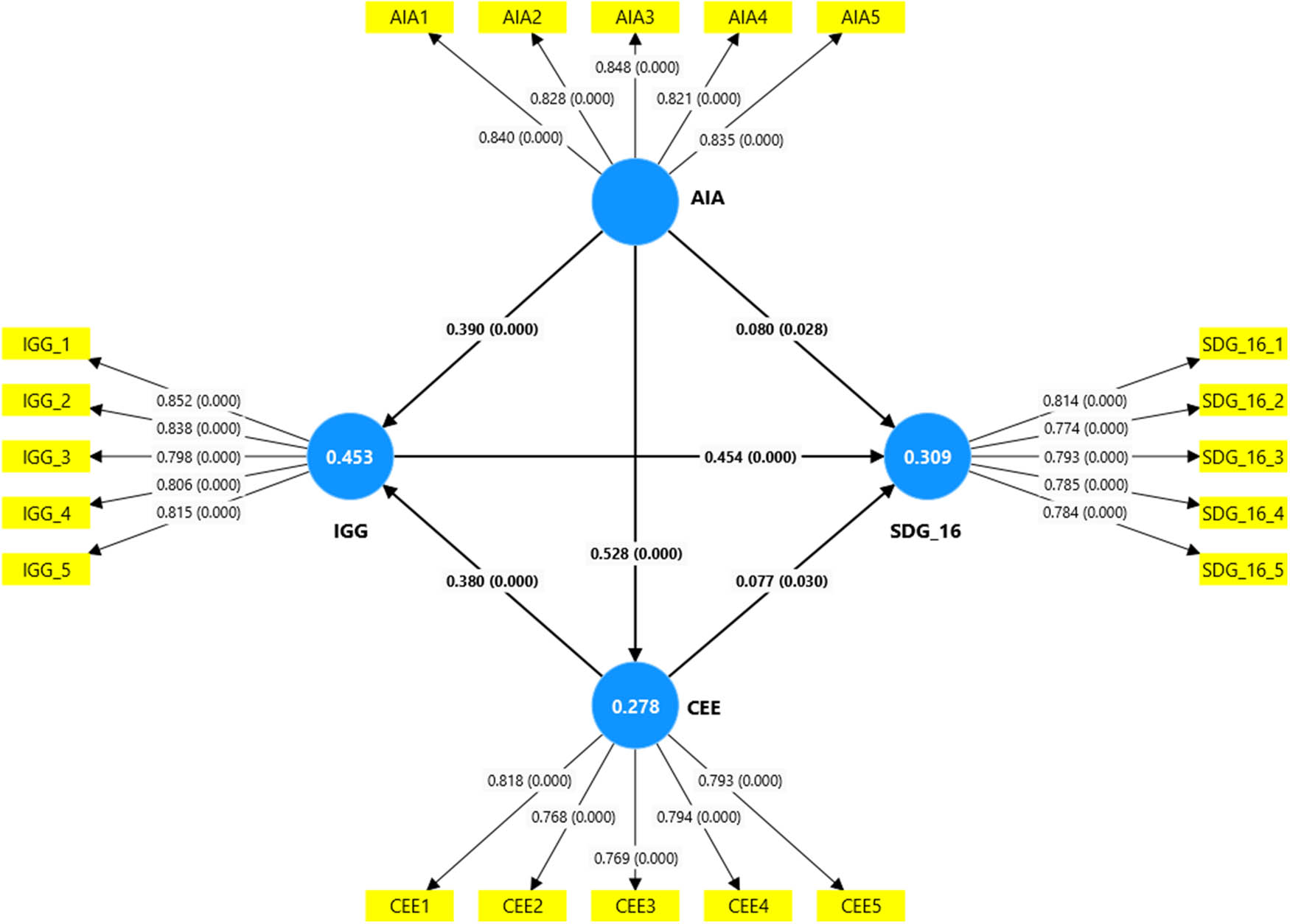
Figure 3
Structural model.
(Source: Extracted from statistical software and authors’ own study)
The significance of AIA’s indirect effects on IGG and SDG_16 through CEE were assessed. Given that the direct effect of AIA on IGG was also supported and that the indirect effect was significant (β = 0.201; t-value = 10.231; p-value = 0.000), it disclosed that CEE partially mediated the relationship between AIA and IGG. Given that the direct effect of AIA on SDG_16 was also supported and that the indirect effect was significant (β = 0.041; t-value = 2.141; p-value = 0.032), it disclosed that CEE partially mediated the relationship between AIA and SDG_16. Hence, H7 and H8 were supported.
5.5. Fuzzy-set Qualitative Comparative Analysis
Calibration. The preliminary stage in fsQCA analysis was calibration (Pappas and Woodside, 2021). The initial phase involved data calibration, wherein raw data (survey data) was converted into scores representing set memberships (Ali et al., 2025). The initial 7-point Likert scale was recalibrated to a range of values between 0 and 1. A score of 0 signified complete non-membership, a score of 1 denoted full membership, and a score of 0.5 showed the crossover point. In accordance with Pappas and Woodside’s (2021) recommendation, this study calculated 95%, 50%, and 5% of the metrics as three anchors and adjusted the original data into full membership, crossover, and full non-membership, respectively. However, Tho and Trang (2015) proposed setting the full membership threshold at a rating of 6, the full non-membership threshold at a rating of 3, and the crossover point at 4.5. This study established the definitive non-membership criterion at 3, as opposed to the threshold of 2 utilised by Ordanini et al. (2014). This was because Vietnamese employees demonstrated a propensity to choose the right side (strongly agree) of the scale when answering survey questions (Tho and Trang, 2015).
Concerning the impacts of AIA and CEE on IGG, for a causal configuration or a singular condition to be deemed sufficient, consistency must surpass 0.80 and coverage must exceed 0.20 (Pappas and Woodside, 2021). The findings from fsQCA displayed in Table 6 highlighted that the three fsQCA solutions (complex, parsimonious, and standard) produced identical configurations. The scores for consistency and coverage of AIA and CEE in Table 6 surpassed the recommended thresholds (Consistency > 0.80, Coverage > 0.20). The findings indicated that none of these antecedent requirements above the 0.9 consistency criterion for need, signifying that they did not represent or resemble necessary conditions for IGG achievement. In light of these findings, we conducted a further analysis of the interplay between factor combinations and IGG achievement utilising fsQCA 4.0 software.
Table 6
fsQCA results (consistency threshold: 0.80).
| Model: fIGG = f(fAIA, fCEE) | |||
| --- Complex Solution, Parsimonious Solution, Intermediate Solution --- | |||
| Frequency cutoff: 80 | |||
| Consistency cutoff: 0.849204 | |||
| Raw coverage | Unique coverage | Consistency | |
| fAIA | 0.674014 | 0.199743 | 0.848564 |
| fCEE | 0.603794 | 0.129522 | 0.857721 |
| Solution coverage: 0.803536 | |||
| Solution consistency: 0.821044 | |||
(Source: Extracted from statistical software and authors’ own study)
Researchers using fsQCA were advised to present two analyses: one with a relatively permissive consistency threshold and another with a more restrictive consistency threshold. This study conducted an additional analysis in accordance with this proposal, employing a consistency threshold of 0.90. A comprehensive examination of the configurations underscored the fact that none of the conditions could be considered adequate for the attainment of the IGG. However, it was possible to combine these conditions. This was an INUS condition, which was a condition that was insufficient yet necessary for the outcome, despite being superfluous in itself (Mackie, 1965). The configuration in Table 7, characterised by a significant integration of AIA and CEE as fundamental elements, exhibited a consistency of 0.912807 and a raw coverage of 0.474271. This combination underscored a robust pathway towards elevated IGG attainment, signifying the collective significance of these elements.
Table 7
fsQCA results (consistency threshold: 0.90).
| Model: fIGG = f(fAIA, fCEE) | |||
| --- Complex Solution, Parsimonious Solution, Intermediate Solution --- | |||
| Frequency cutoff: 80 | |||
| Consistency cutoff: 0.912807 | |||
| Raw coverage | Unique coverage | Consistency | |
| fAIA*fCEE | 0.474271 | 0.474271 | 0.912807 |
| Solution coverage: 0.474271 | |||
| Solution consistency: 0.912807 | |||
(Source: Extracted from statistical software and authors’ own study)
Concerning the impacts of AIA, CEE, and IGG on SDG_16, the findings from fsQCA displayed in Table 8 highlighted that the three fsQCA solutions (complex, parsimonious, and standard) produced identical configurations. The scores for consistency and coverage of AIA, CEE, and IGG surpassed the recommended thresholds (consistency > 0.80, coverage > 0.20). The findings indicated that none of these antecedent requirements above the 0.9 consistency criterion for need, signifying that they did not represent or resemble necessary conditions for SDG_16 achievement. In light of these findings, we conducted a further analysis of the interplay between factor combinations and SDG_16 achievement utilising fsQCA 4.0 software.
Table 8
fsQCA results (consistency threshold: 0.80).
| Model: fSDG16 = f(fAIA, fCEE, fIGG) | |||
| --- Complex Solution, Parsimonious Solution, Intermediate Solution --- | |||
| Frequency cutoff: 16 | |||
| Consistency cutoff: 0.896712 | |||
| Raw coverage | Unique coverage | Consistency | |
| fAIA | 0.59314 | 0.0377332 | 0.838442 |
| fCEE | 0.542559 | 0.0245547 | 0.865376 |
| fIGG | 0.738079 | 0.120791 | 0.828712 |
| Solution coverage: 0.832996 | |||
| Solution consistency: 0.795891 | |||
(Source: Extracted from statistical software and authors’ own study)
Table 9 illustrated several solutions identified that contributed to significant attainment of SDG_16, classified into concise solutions.
Table 9
fsQCA results (consistency threshold: 0.90).
| Model: fSDG16 = f(fAIA, fCEE, fIGG) | |||
| --- Complex Solution, Parsimonious Solution, Intermediate Solution --- | |||
| Frequency cutoff: 16 | |||
| Consistency cutoff: 0.903828 | |||
| Raw coverage | Unique coverage | Consistency | |
| fAIA*fCEE | 0.423493 | 0.0326294 | 0.915166 |
| fAIA*fIGG | 0.522778 | 0.131913 | 0.87086 |
| fCEE*fIGG | 0.485375 | 0.0945106 | 0.902587 |
| Solution coverage: 0.649917 | |||
| Solution consistency: 0.859673 | |||
(Source: Extracted from statistical software and authors’ own study)
Configuration 1, characterised by a significant integration of AIA and CEE as fundamental elements, exhibited a consistency of 0.915166 and a raw coverage of 0.423493. This combination underscored a robust pathway towards elevated SDG_16 attainment, signifying the collective significance of these elements.
Configuration 2, characterised by a significant integration of AIA and IGG as fundamental elements, exhibited a consistency of 0.87086 and a raw coverage of 0.522778. This combination underscored a weak pathway towards elevated SDG_16 attainment.
Configuration 3, characterised by a significant integration of CEE and IGG as fundamental elements, exhibited a consistency of 0.902587 and a raw coverage of 0.485375. This combination underscored a robust pathway towards elevated SDG_16 attainment, signifying the collective significance of these elements.
6. Concluding Remarks
6.1. Discussion and Implication
6.1.1. Implication in Theory
The statistical results align with the researchers’ expectations, illuminating the potential impact of AIA on SDG 16. This research’s findings can expand the literature regarding the potential impact of digital accounting systems on the attainment of the Sustainable Development Goals (i.e., Jaradat et al. 2026). Accounting is a fundamental organisational function that supports financial management, decision-making, tax compliance, budgeting, performance evaluation, and company governance (Carnegie et al., 2021). Artificial intelligence is significantly influencing accounting practices, revolutionising conventional processes and enhancing overall precision and efficiency (Agustí and Orta-Pérez, 2023). Artificial intelligence revolutionizes accounting processes via automation, enhancing precision and identifying intricate fraud tendencies. By doing so, AIA empowers PSOs to establish transparent, accountable, and inclusive public institutions – essential facilitators for attaining SDG 16.
The statistical results are consistent with the researchers’ expectations and provide insight into the potential impact of AIA on IGG. To our knowledge, this research is one of the few studies examining the impact of digital accounting systems on the attainment of IGG. Artificial intelligence has profoundly altered the accounting and disclosure operations of organisations by improving efficiency, effectiveness, and decision-making quality. Artificial intelligence capabilities encompass satisfying data and information requirements, conducting real-time financial analysis and predictive analytics, minimising manual errors, and enhancing the promptness of financial reports (Al-Okaily, 2025) for the management of green investments. AIA can evaluate extensive amounts of financial and environmental data to discern sustainable spending trends, monitor carbon-related expenses, and project the long-term economic effects of green policies.
The statistical results elucidate the possible influence of CEE on the links between AIA and SDG 16, as well as AIA and IGG, in line with the predictions of the researchers. To our knowledge, this may be one of the few studies focusing on the mediating role of CEE in these connections. The advantageous impacts of CEEs on an organisation’s sustainable performance have been extensively investigated and statistically validated in prior studies. The circular economy aims to conserve, manage, and utilize resources efficiently to safeguard, enhance, and advance the environment, economy, and society (Dzhengiz et al., 2023). The circular economy is an economic framework designed to minimise waste and pollution while maintaining materials and resources in active use and circulation for extended periods (Sabale et al., 2024). Mishra and Yadav (2021) assert that Industry 4.0 technologies furnish resources to facilitate the adoption and management of circular economy ideas. The integration of Industry 4.0 technology into circular economy frameworks enhances the efficiency, innovation, and environmental responsibility of current PSOs’ operations. The implementation of circular economy techniques in PSOs is regarded as a more expedient route to achieving sustainable development objectives, highlighting its advantageous implications for both the environment and the economy.
6.1.2. Implication in Practice
Significant insights into improving the policies and practices of PSOs are provided by the findings of this study, which emphasize the significance of AIA, CEE, and IGG. It is recommended that specific techniques and interventions be implemented to enhance the implementation of AIA. To execute the AIA, it is necessary to meticulously allocate time, funding, and staff. To enhance the capacity of organisational personnel for AIA implementation and promote interdepartmental collaboration, executives in PSOs should prioritize workforce development through training initiatives. Professional competencies in accounting processes and the maintenance of personnel’s awareness of contemporary digital technologies should be the primary objectives of these training sessions. CEE and IGG should be integrated into the operations of managers through the assessment and investment of sustainable solutions that mitigate environmental impacts. In addition, it is imperative that PSOs actively collaborate with both internal and external stakeholders to jointly develop solutions that promote sustainable practices. The government performs a dual role: it simultaneously supports PSO in its digital transformation and imposes regulatory measures to promote sustainable innovation.
6.2. Limitation and Agenda for Future Research
The research was inevitably impeded by certain limitations. The execution of this investigation in Vietnam was the primary constraint. Consequently, future research may focus on a variety of national and cultural contexts to facilitate comparisons with the findings of the current study. Second, the participants in this study were selected through a combination of non-random convenience and snowball sampling techniques. Thus, the generalizability of our findings may be improved through additional research that utilizes systematic sampling techniques to obtain a large sample size. Third, the data used for analysis were self-reported, which further restrict the generalizability of the research findings. The responses to the accountant survey were extremely beneficial; however, the findings may have been influenced by respondents’ subjective perceptions and potential common method bias. In addition, because the study adopted a cross-sectional design, it could not fully capture changes in the relationships among the variables over time. Consequently, future research should employ longitudinal designs to examine the stability and development of these relationships across different time periods. Finally, future research should integrate additional mediating or moderating variables to provide a more comprehensive explanation of the proposed relationships.
Funding Information
This research was funded by University of Economics Ho Chi Minh City.
Author Contributions
Conceptualization, P.Q.H.; methodology, P.Q.H. and V.K.P.; software, V.K.P.; validation, P.Q.H. and V.K.P.; formal analysis, P.Q.H. and V.K.P.; investigation, P.Q.H. and V.K.P.; writing – original draft preparation, P.Q.H.; writing – review and editing, P.Q.H.; offering final approval of the version to publish, P.Q.H. All authors have read and agreed to the published version of the manuscript.
Conflict of Interest Statement
The authors report there are no competing interests to declare.
Ethics Approval
This article does not contain any animal studies performed by any of the authors.
Consent to Participate
Not applicable.
Consent for Publication
Not applicable.
Data Availability Statement
The data presented in this study are available on request from the corresponding author.