

1. Introduction
In today’s rapidly evolving economic and technological landscape, understanding the foundations of competitive advantage remains essential. In this context, Teece et al. (1997) classified competitive advantage into three paradigms: competitive forces, strategic conflict, and the resource-based view (RBV), later introducing a fourth, dynamic capabilities. The first two are product-market oriented, with Porter’s (1980) competitive framework emphasizing industry structure and positioning.
Building on this foundation, Michaelis et al. (2020) expanded on the RBV, originally proposed by Barney (1991) and developed further by Wernerfelt (1984) and Peteraf (1993), which views resources as central to competitive advantage but remains static and insufficiently responsive to environmental shifts. To address this, Teece et al. (1997) developed the dynamic capabilities framework, aligning advantage with rapidly evolving contexts.
In a related perspective, Garrido-Moreno et al. (2020) underscores the increasing relevance of dynamic capabilities since the 1990s amid technological shifts and changing consumer demands. However, Teece (2007) cautions that such changes entail both risks and opportunities. Teece (2009) later delineates three core capabilities: sensing opportunities and threats, seizing them, and transforming the organization through continuous asset renewal.
Regarding value creation, Bocken et al. (2014) argued that the traditional economic lens is evolving to include social and environmental dimensions. Freudenreich et al. (2020) advocated for stakeholder co-creation in this expanded view, a stance supported by Hart and Milstein (2003), who call for alignment between business and societal goals. Similarly, Prahalad and Ramaswamy (2004) highlighted the co-creation with customers as a source of competitiveness, while Bocken et al. (2014) extended this into sustainable business strategy.
Studies increasingly link dynamic capabilities to value creation. Matarazzo et al. (2021) demonstrated that digital tools enhance innovation and customer experience. Gualtero et al. (2019) proposed a model for SMEs based on exploration, exploitation, and reconfiguration. Giniuniene and Jurksiene (2015) showed that learning and innovation-driven capabilities contribute to improved performance.
Research also reveals that adaptive and technological dynamic capabilities significantly influence organizational outcomes. Leadership and control effectiveness are mediated by these capabilities, shaping managerial and employee performance (Bieńkowska and Tworek, 2022; Ludwikowska and Tworek, 2022). Strengthening these dynamics enhances organizational performance and control processes.
Moreover, dynamic capabilities are instrumental in shaping strategy, fostering innovation, and sustaining competitive advantage. They facilitate resource diversification and organizational adaptability. The strategic application of data analytics and technology improves decision-making, accelerates innovation, and supports market responsiveness (Sáenz et al., 2022; Liu and Wang, 2024; Zehir and Vural Allaham, 2024; Fakhreddin et al., 2025).
Despite their potential, rural communities face persistent structural challenges, including limited access to employment, housing, education, and essential services. These deficiencies constrain microenterprise development and often drive migration in search of better opportunities. Indeed, rural enterprises encounter a wide range of challenges, including inadequate infrastructure, limited basic services, a lack of innovation, corruption, restricted access to potable water, and limited financing opportunities, among others (Gusmanov et al., 2021; Kyriakopoulos, 2024; Mulibana and Tshikovhi, 2024; Behera et al., 2025; Thao and Tien, 2025).
Regarding the study of rural enterprises, several areas can be identified where there is a lack of understanding of how these types of organizations operate. For instance, such areas include the profile of rural entrepreneurs (Ruiz et al., 2019), the flow of knowledge between microenterprises and their collaborative networks (Arras et al., 2015), the efficiency of government support programs (Maguiña et al., 2021), and the role of social capital in microenterprise management (Ojeda et al., 2010). These thematic areas illustrate the limited research available on microenterprises in rural contexts.
Most existing studies have focused on large firms, leaving rural microenterprises underrepresented. This study addresses this gap by examining the role of dynamic capabilities in rural contexts, integrating multiple variables to explore their collective impact on business development.
Therefore, the lack of studies examining dynamic capabilities and sustainable value creation (SVC) in rural contexts, along with the scarcity of research that integrates the impact of these capabilities and their effect on SVC within a single model, reveals a knowledge gap that can be addressed to enhance the understanding of the variables analyzed in this study. Accordingly, the objective of this study is to assess how dynamic capabilities influence the SVC of rural microenterprises, focusing on their economic, social, and environmental dimensions.
2. Literature Review and Hypothesis
2.1 Sensing as a Dynamic Capability
For SMEs to generate sustainable value, they must develop and integrate their dynamic capabilities within a clear competitive strategy. Among these, the coordination capability can be considered the most influential, followed by integration and opportunity sensing. Therefore, the most competitive SMEs are those that rapidly identify opportunities, integrate knowledge, and effectively coordinate their resources. In this sense, the value generated for customers should not be measured solely in financial terms but also in terms of innovation capacity (i.e., novel products and services) and customer retention through greater consumer satisfaction (Rashidirad and Salimian, 2020).
Similarly, opportunity sensing and resource transformation are key to generating value, achieving sustainable competitive advantages, and improving business performance. This value creation can be expressed in functional, experiential, symbolic, and cost-related dimensions. Thus, value creation acts as a mediator between dynamic capabilities and organizational success, particularly when it is customer oriented. Moreover, the effective use of digital technologies and the ability to adapt to market changes also become critical factors (Zehir and Vural Allaham, 2024).
From the perspective of public-sector innovation, Karttunen et al. (2024) explored dynamic capabilities in public procurement, finding that their impact depends on whether processes are innovative or conventional. In innovative settings, these capabilities foster transformation; in conventional ones, they enhance efficiency and quality. The study shows that opportunity sensing, resource management, and transformation support strategic value creation, though widespread reliance on traditional procurement limits this potential.
In the context of digital transformation, Matarazzo et al. (2021) examined digital transformation in SMEs, showing that digital tools enable business model innovation, new channels, and personalization. Sensing and learning capabilities are critical for identifying technological opportunities and integrating strategic knowledge, thereby strengthening customer engagement through digital platforms.
A complementary insight comes from Wirtz et al. (2021), who investigated dynamic capabilities in digital public service development. They found that citizen expectations required responsive and adaptive systems, where sensing, seizing, and transforming capabilities underpin sustainable public value. Their proposed framework, centered on user orientation, public value, and adaptability, emphasizes open innovation and citizen collaboration.
Based on the above, the following hypothesis is proposed:
H1 Sensing as a dynamic capability positively affects SVC.
2.2 Absorptive Capacity as a Dynamic Capability
In the case of social enterprises, a higher absorptive capacity enhances social value creation, which in turn strengthens economic value. Moreover, social value, understood as the generation of societal benefits prioritized over economic gain, serves as a bridge between these two dimensions, reinforcing sustainability and competitive advantage through shared value creation (Campos-Climent and Sanchis-Palacio, 2017).
Furthermore, absorptive capacity drives imitation and innovation strategies by facilitating the assimilation and transformation of external knowledge. This enables firms to generate new ideas, adapt successful practices, and strengthen their competitive advantage. This process is closely linked to SVC, as a sustained advantage reflects a firm’s ability to create and capture long-term value (Algarni et al., 2023). Complementarily, absorptive capacity also enhances environmental performance and contributes to long-term organizational sustainability (Dzhengiz and Niesten, 2020).
Looking at public-interest enterprises, Abdullah et al. (2019) highlighted that public-interest enterprises use dynamic capabilities to drive innovation and sustainability across economic, social, and environmental dimensions. Strategic training, technology adoption, and human capital development enhance both performance and accountability in dynamic contexts.
Adding to this, Dzhengiz and Niesten (2020) also linked environmental competencies to absorptive capacity, finding that managers who can acquire external knowledge more effectively develop sustainability-oriented capabilities. These findings underscore the strategic importance of absorptive capacity in improving environmental outcomes and ensuring organizational resilience.
In light of the foregoing, the following hypothesis is formulated:
H2 Absorptive capacity as a dynamic capability positively affects SVC.
2.3 Coordination and Integration as Dynamic Capabilities
Integration and coordination capabilities are essential for creating value through customer satisfaction, but their effectiveness depends on alignment with a competitive strategy (Rashidirad and Salimian, 2020). Similarly, coordination capability is critical for the sustainability of models that integrate small producers into value chains, as it facilitates market access and promotes inclusive and efficient schemes. Value creation materializes through the generation of synergies by combining horizontal coordination (among small farmers) and vertical coordination (with suppliers and other value chain actors), thereby promoting the integration of small producers into more inclusive value chains (Kilelu et al., 2016).
Adding another perspective, Kaya (2023) investigated agile leadership and found that dynamic capabilities mediate its effect on value creation. Agile leaders support value generation by enabling the integration, development, and reconfiguration of resources in response to change. These firms achieve sustainable competitive advantage by aligning leadership with advanced dynamic capabilities.
Based on the above, the following hypotheses are proposed:
H3 Dynamic coordination capability has a positive effect on SVC.
H4 Dynamic integration capability has a positive effect on SVC.
2.4 Dynamic Innovation Capability
Chirico and Nordqvist (2010) used the term transgenerational value creation, which is understood as the value that extends from one generation to the next, particularly in family businesses. The authors argue that organizational culture is crucial for developing dynamic capabilities, especially when it fosters knowledge transfer and strategic adaptation. Investment in technology, innovation, and an entrepreneurial mindset also become relevant factors. In other words, firms that successfully combine tradition and innovation and effectively recombine their resources are those that sustain generational competitiveness in dynamic environments, thereby promoting transgenerational value creation.
Building on this, Achtenhagen et al. (2013) linked sustained value creation in growth firms to adaptive business models. They identified three enabling capabilities: experimentation, balanced resource use, and alignment among leadership, culture, and employee engagement. These elements allow firms to renew models in response to environmental shifts.
Further evidence is provided by Dyduch et al. (2021), who further showed that resource reconfiguration supports organizational resilience. Firms maintaining liquidity and production during crises leveraged autonomy, innovation, and efficient technology use. Strategic planning and resource optimization proved central for navigating uncertainty, highlighting dynamic capabilities as essential for sustainability in crisis contexts.
Considering the above analysis, this leads to the formulation of the following hypothesis:
H5 Dynamic innovation capability has a positive effect on SVC.
Figure 1 illustrates the hypothetical model derived from the literature review, in which the hypotheses to be tested are proposed.
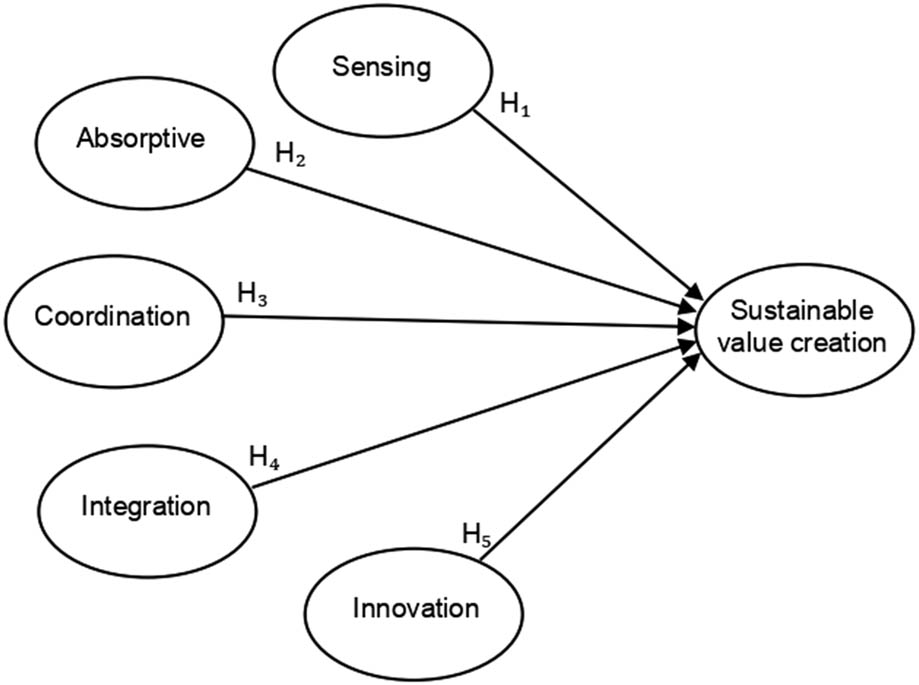
Figure 1
Hypothetical model
(Source: Own elaboration)
3. Methodology
According to data from the National Institute of Statistics and Geography (Instituto Nacional de Estadística y Geografía (INEGI), 2023), ten rural communities were identified in northwestern Mexico, specifically within the municipality of Cajeme: 31 de Octubre, Centauro del Norte, Cócorit, Cuauhtémoc, Esperanza, Estación Corral, Marte R. Gómez (Tobarito), Providencia, Pueblo Yaqui, and Quechehueca (Table 1).
Table 1
Microenterprises in rural communities of Cajeme
| Localities | Microenterprises |
|---|---|
| Esperanza | 1,615 |
| Pueblo Yaqui | 746 |
| Marte R. Gómez (Tobarito) | 371 |
| Cócorit | 345 |
| Providencia | 257 |
| Quetchehueca | 105 |
| Cuauhtémoc (Campo Cinco) | 69 |
| Estación Corral | 70 |
| 31 de Octubre | 29 |
| Centauro del Norte | 2 |
(Source: Author’s own elaboration based on data from INEGI (2023))
As shown in Table 1, the communities with the most registered establishments, based on INEGI data, are Esperanza, Pueblo Yaqui, Marte R. Gómez, Cócorit, and Providencia, which together account for 3,334 microenterprises, 92.38% of the total in Cajeme. Overall, the ten localities registered 3,609 microenterprises.
Ramos-Vera (2020) highlighted that defining an adequate sample size is essential for research validity, though often complex. Westland (2010) found that 80% of the related studies use insufficient samples, affecting reliability. To address this, Soper (2020) proposed a method for estimating sample size in structural equation modeling (SEM), considering statistical power, effect size, significance level, and the number of latent and observed variables. Ramos-Vera (2020) also described Soper’s online calculator as useful for determining optimal SEM sample sizes in both probabilistic and non-probabilistic designs.
The sample selection was carried out in two stages. First, the communities with the highest concentration of microenterprises in the municipality of Cajeme were identified, based on official data from the National Institute of Statistics and Geography (Instituto Nacional de Estadística y Geografía (INEGI), 2023). Using this criterion, the communities of Esperanza, Pueblo Yaqui, Marte R. Gómez, Providencia, and Cócorit were selected, which together represent more than 90% of all registered microenterprises in the municipality. In the second stage, a non-probabilistic, accidental (convenience) sampling method was applied, as participation depended on the accessibility and willingness of business owners to complete the questionnaire. A total of 203 microenterprises participated. Inclusion criteria for each enterprise were: (a) formal registration as a microenterprise in the community, (b) voluntary consent of the owner to respond to the instrument, and (c) having no more than ten employees.
The instrument focused on two variables: dynamic capabilities, adapted from García-Valenzuela et al. (2023), and SVC, based on Ruiz (2006) and Gómez (2021). These instruments were selected as the basis for the questionnaire because they were specifically designed for application in microenterprises and analyzed the same variables as the present study.
Finally, Rodríguez-Rodríguez and Reguant-Álvarez (2020) defined Cronbach’s alpha as a measure of internal consistency. The reliability results of both variables are shown in Table 2.
Table 2
Cronbach’s alpha
| Variable | Alfa de Cronbach |
|---|---|
| Sensing dynamic capability (CDD) | 0.798 |
| Absorptive capacity dynamic capability (CDAC) | 0.824 |
| Integration dynamic capability (CDINT) | 0.778 |
| Coordination dynamic capability (CDC) | 0.812 |
| Innovation dynamic capability (CDINNO) | 0.879 |
| Sustainable value creation (Environmental) (CVSDA) | 0.794 |
| Sustainable value creation (Economic) (CVSDE) | 0.709 |
| Sustainable value creation (Social) (CVSDS) | 0.740 |
(Source: Own elaboration using IBM SPSS Statistics v.27)
As shown in Table 2, the results obtained from the internal consistency analysis using Cronbach’s Alpha indicate values greater than 0.70. According to Ventura-León and Peña-Calero (2021), coefficients equal to or above 0.70 are considered indicative of good internal consistency.
4. Results
After completing the fieldwork in the rural communities, the data collected were entered and processed using IBM SPSS Statistics v.27. This allowed for an initial descriptive analysis to better understand the general characteristics of the measurement instrument and the rural microenterprises. Subsequently, a confirmatory factor analysis was conducted to validate the structure of the latent variables of the proposed theoretical construct.
To evaluate the causal relationships between the dimensions of dynamic capabilities and SVC, a covariance-based SEM (CB-SEM) approach was employed. This statistical technique allows for the analysis of hypothesized relationships between observed and latent variables, measuring the strength of these relationships and testing the hypotheses proposed in the structural model (Kline, 2015; Schumacker and Lomax, 2016). In the present study, the maximum likelihood estimation procedure was used, implemented directly in IBM AMOS v.29.
4.1 Descriptive Results
This analysis highlights key aspects that reflect the main characteristics of the rural micro-enterprises studied in the communities of Cajeme. Notably, 93.1% of these microenterprises operate with a workforce ranging from 1 to 5 employees, indicating that most function on a small scale and are limited in terms of personnel. Additionally, 6.4% fell within the range of 5–10 employees, suggesting a slightly greater staffing capacity in some cases. Only 0.5% of the businesses have between 10 and 15 employees (Table 3). In total, 203 rural microenterprises were analyzed, confirming that most operate with minimal labor structures.
Table 3
Number of employees and years of operation
| Number of employees | Frequency | Percentage |
|---|---|---|
| 1 a 5 | 189 | 93.1 |
| 5 a 10 | 13 | 6.4 |
| 10 a 15 | 1 | 0.5 |
| Total | 203 | 100 |
| Years of operation | Frequency | Percentage |
|---|---|---|
| 0–5 years | 90 | 44.3% |
| 6–10 years | 49 | 24.1% |
| 11–15 years | 19 | 9.4% |
| 15 or more | 45 | 22.1% |
| Total | 203 | 100 |
(Source: Own elaboration)
The analysis of the years of operation for microenterprises in the rural communities shows that the majority have been in business for 0–5 years, accounting for 44.3%. Meanwhile, 24.1% fall within the 6–10 years range, followed by 9.4% with 11–15 years of operation. Finally, 22.2% of the microenterprises have been operating for 15 years or more (Table 3).
4.2 Confirmatory Factor Analysis
This analysis corresponds to the dynamic capability variable, with results related to the factor loadings (Table 4). According to Jordan Muiños (2021), this analysis allows for testing the hypothesis by examining the relationship between the indicators and the latent dimensions. The model fit is evaluated using two types of indices: incremental and absolute (Domínguez-Lara, 2019). As noted by McNeish et al. (2017), incremental fit indices assess the improvement of the proposed model compared to a baseline model. These indices include the comparative fit index (CFI), the goodness-of-fit index (GFI), and the Tucker–Lewis index (TLI).
Table 4
Factor loadings dynamic capability variable
| Estimate | |||
|---|---|---|---|
| Innovation dynamic capability (items) (CDINOVA)17 | ← | CDINN | 0.736 |
| CDINOVA18 | ← | CDINN | 0.737 |
| CDINOVA19 | ← | CDINN | 0.891 |
| CDINOVA20 | ← | CDINN | 0.829 |
| CDD1 | ← | CDD | 0.716 |
| CDD2 | ← | CDD | 0.826 |
| CDD3 | ← | CDD | 0.725 |
| CDAC5 | ← | CDAC | 0.630 |
| CDAC7 | ← | CDAC | 0.845 |
| CDAC8 | ← | CDAC | 0.784 |
| CDI9 | ← | CDINT | 0.711 |
| Integration dynamic capability (items) (CDINTE)10 | ← | CDINT | 0.667 |
| CDINTE11 | ← | CDINT | 0.667 |
| CDINTE12 | ← | CDINT | 0.720 |
| CDC14 | ← | CDC | 0.778 |
| CDC15 | ← | CDC | 0.879 |
| CDC16 | ← | CDC | 0.639 |
(Source: Data were analyzed using IBM AMOS Version 29)
Absolute fit indices indicate the extent to which the observed covariance matrix matches the covariance matrix implied by the model, with lower values indicating a better model fit (Chen, 2007). Among these indices is the root mean squared error of approximation (RMSEA), for which Curran et al. (2003) recommended a minimum sample size of 200 cases.
For this analysis, the incremental fit indices obtained were CFI = 0.921, GFI = 0.884, and TLI = 0.900, while the absolute fit index RMSEA was 0.077. Additionally, the results show that all items have statistically significant factor loadings greater than 0.60 across the dimensions of dynamic capabilities. It is important to note that for the dynamic capability construct, items 4, 6, 13, and 21 were removed.
The factorial loading results for the SVC (SVC) variable, concerning the incremental fit indices, are CFI = 0.982, GFI = 0.973, and TLI = 0.973, while the absolute fit index RMSEA = 0.061. Additionally, the results indicate that all items have statistically significant factor loadings greater than 0.60 (Table 5) for each dimension of SVC. Regarding the SVC construct, items 24, 25, 30, and 31 were removed.
Table 5
Factor loadings SVC variable
| Estimate | |||
|---|---|---|---|
| Environmental value creation (Item) (CVDA)22 | ← | Sustainable value creation (Environmental) (CVSDA) | 0.781 |
| CVDA23 | ← | CVSDA | 0.877 |
| Economic value creation (Item) (CVDE)26 | ← | Sustainable value creation (Economic) (CVSDE) | 0.785 |
| CVDE27 | ← | CVSDE | 0.699 |
| Social value creation (Item) (CVDS)32 | ← | Sustainable value creation (Social) (CVSDS) | 0.781 |
| CVDS33 | ← | CVSDS | 0.879 |
| CVDS34 | ← | CVSDS | 0.650 |
(Source: Data were analyzed using IBM SPSS AMOS (Version 29). The table was prepared by the author)
4.3 Structural Model Validation
Figure 2 presents the results of the structural equation model, which indicates that dynamic capabilities explain 67% of the variance in SVC, as shown by the R 2 value of 0.67. These results are statistically significant, supported by the fit indices: CFI = 0.933, RMSEA = 0.070, GFI = 0.899, and TLI = 0.911. To improve the model, items 5, 11, and 16 were removed from the dynamic capabilities construct, and an error covariance was added between e16 and e17, which contributed to achieving adequate fit indices for the factorial analysis of this variable.
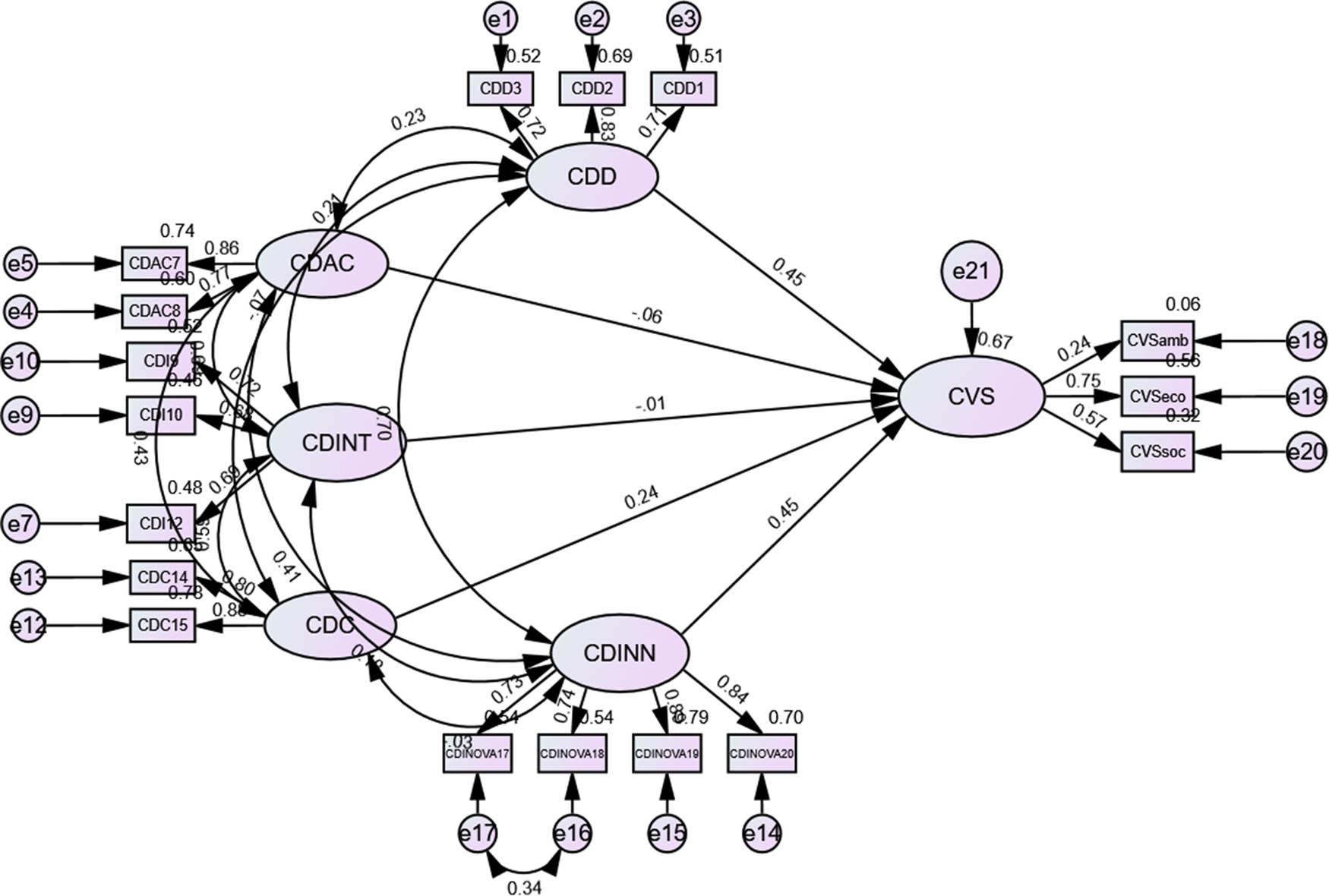
Figure 2
Structural equation model
(Source: Own elaboration based on results from IBM AMOS Version 29)
Table 6 presents the hypothesis testing results regarding the impact of dynamic capabilities on SVC. Of the five hypotheses proposed, only three were supported: H1, H4, and H5, indicating that the dynamic capabilities of sensing, integration, and innovation have a positive and significant effect on SVC.
Table 6
Hypothesis testing
| Hypothesis | Indicator | Acceptance rejection | |
|---|---|---|---|
| H1 | The dynamic capability of sensing has a positive effect on SVC. | 0.024 | Accepted |
| H2 | The dynamic capability of absorption has a positive effect on SVC. | 0.716 | Rejected |
| H3 | The dynamic capability of coordination has a positive effect on SVC. | 0.960 | Rejected |
| H4 | The dynamic capability of integration has a positive effect on SVC. | 0.072 | Accepted |
| H5 | The dynamic capability of innovation has a positive effect on SVC. | 0.027 | Accepted |
(Source: Own elaboration based on the results from IBM SPSS AMOS Version 29)
In contrast, hypotheses H2 and H3, corresponding to absorptive capacity and coordination, did not show statistically significant evidence and were therefore rejected. This suggests that, within the studied context, the ability to assimilate external knowledge and coordinate resources is not significantly linked to SVC.
5. Discussion
This study offers a comprehensive view of the role of dynamic capabilities in generating sustainable value within rural communities. In line with Dyduch et al. (2021), the findings confirm that capabilities such as innovation and rapid decision-making are essential for resilience, enabling SMEs to sustain production, retain employees, and preserve income in times of crisis.
In support of these findings, Zehir and Vural Allaham (2024) also emphasized the importance of opportunity sensing, resource integration, and continuous innovation in fostering sustainable competitiveness and performance. These capabilities are directly linked to customer satisfaction and differentiation through the creation of functional, symbolic, and experiential value. The present study corroborates these insights, highlighting that innovation and sensing are more relevant than coordination and absorptive capacity in the rural context.
Similarly, Karttunen et al. (2024) argue that sensing, seizing, and reconfiguring capabilities are crucial for value creation in public procurement, enhancing innovation and process quality. Although their findings relate to public sector settings, they underscore the broader applicability of dynamic capabilities. In contrast, this study suggests that, for rural enterprises, internal innovation and opportunity sensing are more strategic for optimizing economic value.
A related perspective is offered by Chirico and Nordqvist (2010), who find that innovation and strategic adaptation support transgenerational value in family businesses. Their emphasis on entrepreneurial orientation, knowledge integration, and resource renewal resonates with the present study, which also highlights innovation and opportunity sensing as critical for sustainability and growth in rural firms.
Furthermore, Wirtz et al. (2021) demonstrated the importance of dynamic capabilities in developing digital public services. Sensing, seizing, and transforming processes enable public institutions to adapt to changing citizen needs. However, in rural communities, limited access to technology may hinder the effective implementation of such capabilities, pointing to the need for contextualized strategies.
Likewise, Ndou and Passiante (2009) showed that absorptive capacity enhances value creation in SMEs through environmental scanning, internal communication, and learning from stakeholders. Although this study finds absorptive capacity to be less influential than innovation and sensing, the role of knowledge integration remains important, especially where open communication and collaborative learning are present.
Regarding the practical implications derived from the results of this study, it is important to emphasize the promotion of continuous innovation and organizational learning through ongoing training systems that enable the absorption of new knowledge and the generation of innovative ideas. In this context, practices for continuous monitoring of the competitive environment can be established to identify emerging opportunities. Additionally, it is recommended to invest in the diversification of innovative products or services that respond both to local needs and global market trends, aligning these strategies with social objectives such as job creation and the improvement of quality of life in communities.
With respect to public policy, it is essential to develop financial and technological support programs that facilitate rural microenterprises’ access to economic resources and technological tools, incentivize the adoption of digital technologies, and promote training in technological capabilities.
Furthermore, the integration capability of microenterprises can be manifested through the establishment of collaborative networks with universities, research centers, and regional suppliers. These alliances provide timely access to technical knowledge, machinery, and specialized advisory services aimed at enhancing SVC.
Similarly, innovation should be conceived as an accessible resource adapted to the characteristics of microenterprises. In this way, affordable digital technologies can be utilized, such as mobile payment platforms, the incorporation of complementary services, and the adoption of biodegradable packaging. These initiatives not only contribute to greater environmental responsibility but also generate added value perceived by increasingly conscious consumers.
On the other hand, the results show that not all dynamic capabilities have an effect on value creation. This may suggest that there is a relative importance among these capabilities depending on the specific characteristics of the firms being analyzed, such that each dynamic capability exerts a differentiated effect on the creation of economic, social, or environmental value. Additionally, the context may play a predominant role in determining this relative importance, as it is assumed that the rural business environment exhibits less dynamism than urban or global contexts – due either to lower competitive intensity or to the fact that firms operate within a more limited market in terms of customer base. This finding aligns with that of Cooper-Thomas et al. (2014) and Stadler et al. (2017), who emphasized the concept of the relative importance of certain independent variables in explaining dependent variables.
Finally, the fact that absorptive and coordination capabilities appear to be irrelevant in explaining SVC may be due to the nature of the firms analyzed, which are microenterprises. Given their size, these firms typically possess few processes, basic organizational structures, and a small number of employees. While these resources should allow for the absorption of external information and its integration into the firm, such absorption and integration processes may be limited by the simplicity of their organizational structures and the low complexity of their processes and personnel functions.
6. Limitations
The main limitation of this study is that it employed a cross-sectional CB-SEM approach, which involves analysis at a single point in time. For future research, it is recommended to use longitudinal CB-SEM techniques to examine changes in the trajectories of the latent variables analyzed. This technique could capture temporal fluctuations in the conditions faced by rural microenterprises, allowing for two or more measurements over time to establish longitudinal hypotheses that support causal relationships while minimizing seasonality bias (Newsom, 2015; Geiser, 2021). In this way, it would be possible to confirm the magnitude of the effect, over time, between dynamic capabilities and the creation of economic, social, and environmental value.
7. Conclusion
This study analyzed how dynamic capabilities influence SVC in rural Mexican microenterprises, particularly in contexts of vulnerability. Results show that sensing capabilities, especially in identifying environmental opportunities, support innovative strategies that enhance resilience and operational efficiency.
The findings also highlight that continuous training and idea assimilation improve internal processes and foster employment, reinforcing the role of organizational learning in social development. Innovation in products, services, and processes significantly contributes to competitiveness, profitability, and alignment with local needs.
Furthermore, knowledge integration and resource allocation enable efficient input use, cost reduction, and responsible practices, contributing to both productivity and community well-being.
Overall, the research confirms that some dynamic capabilities, specifically sensing, integration, and innovation, are important for adapting to changing environments and generating sustainable economic, social, and environmental outcomes. Their combination can provide microenterprises with a sustainable competitive advantage that can help to support rural development and quality of life improvements.
Finally, it is concluded that certain dynamic capabilities, specifically absorptive and coordination capabilities, exhibit no significant effects on SVC. This finding suggests the existence of a relative importance among these capabilities in generating economic, social, or environmental value, particularly when considering the specific characteristics of the firms analyzed and the context in which they operate.
Funding Information
Authors wish to thank to SECIHTI and PROFAPI.
Author Contributions
Andrea Guadalupe RUIZ-BENITEZ: Conceptualization and writing – original draft; Carlos Armando JACOBO-HERNANDEZ: Supervision and methodology; José Guadalupe FLORES-LÓPEZ: Writing – review & editing; Analí Estrella AGUIAR-IBARRA: Writing – review & editing.
Conflict of Interest Statement
Authors state no conflict of interest.