

1. Introduction
In the context of fierce competition and deepening economic integration, along with the development of scientific technology and digital transformation, human resources always have been an important key for businesses to survive and develop sustainably. Businesses with a team of talented, enthusiastic, committed employees are considered more successful than businesses with good financial conditions but poor quality staff. Employees committed to the organization will work hard and conscientiously, enhance the value of the organization’s services and products, and continuously improve. Employees with high levels of organizational commitment are less likely to leave the organization and work more effectively, thereby contributing to increased productivity (Shahid and Azhar, 2013; Jacobsen and Fjeldbraaten, 2020). Therefore, increasing the organizational commitment of employees and retaining talented workers are an essential part of long-term business strategy of many senior managers.
Nowadays, organizational commitment is a challenging issue for many firms when job hopping is widely spreading. Because of the decrease in organizational commitment, companies are losing many qualified and high-skilled employees, which leads to worse business performance. Especially, after COVID-19 pandemic, the disruption in labor market has become even more pronounced when employees’ intention to leave the company and change their jobs is increasing. Organizational commitment of employees continues to decrease. This has led to the necessity in researching organizational commitment and the factors influencing organizational commitment.
Theoretically, there have been numerous of studies around this topic. Some examine the impacts of demographic factors such as sex, age, marital status, and job tenure on the commitment of employees (Visanh and Xu, 2018; Kumar, et al., 2018; Li, et al., 2018; Shortland, 2018; Nabahani and Riyanto, 2020). In addition, some research explore the effects of human resource management on organizational commitment, which reveals positive influence of these factors on employee commitment (Nguyen, 2015; Suryani, et al., 2019; Nabahani and Riyanto 2020; Ashraf, 2020; Nguyen, et al., 2020; Bai, et al., 2023). Some other studies test the mediating effects of satisfaction and organizational commitment in the relationship between human resource management practices and performance outcomes or turnover intentions. However, it is noteworthy that most of previous studies focus on organizational commitment of all employees within a particular industry or organization, regardless of generational characteristics. Moreover, the factors that influence organizational commitment are diverse. These factors may vary depending on different research contexts. In addition, up-to-date research on this topic in emerging economies is quite limited. Therefore, it is necessary to have further research to investigate the factors that influence organizational commitment in emerging economies like Vietnam. These are the research gaps that this research aims to address.
Gen Y (also known as millennial employees) is the core workforce in the labor structure of countries. They are considered a competent and experienced generation, who contribute significantly to social development. Being born between 1980 and 1995, Gen Y has its own characteristics due to technological developments and social changes. Differing from other previous generations, millennial employees are described as a generation with flexible thinking, creative, enjoying meaningful work, and long-term commitment. They are optimistic, open-minded, self-reliant and independent and do not rely on others. They are eager to learn and ready to change. They are also considered very effective in studying and working. In addition, millennial employees in the workplace often do not like to be dominated and directed; they develop best once they feel comfortable, not stereotyped. Differences in mentality, lifestyle, and needs of millennials also lead to different job requirements. Millennials are said to be the least committed to staying with the same company compared to other generations (Islam, et al., 2011; Goh, 2012). Millennials tend to leave their jobs, especially when their jobs do not meet their expectations and when they feel that they do not add much value to the organization. In some cases, once they do not receive a salary commensurate with their qualifications, are not assigned suitable work, or do not have development opportunities, they will be willing to quit the organization. Therefore, retaining this generation has become a challenge for organizations.
In Vietnam, Gen Y represents a significant portion of the experienced workforce (about 35% of the population) and is actively shaping values and contributing to the country’s GDP. Hanoi is one of the most developed economic centers of Vietnam and the most densely populated city. In a chaotic business environment, organizational commitment of Gen employees in Hanoi is also falling, posing many major challenges for organizations. Therefore, studying the factors affecting the organizational commitment of Gen Y is very necessary for businesses in a developing country like Vietnam. The goal of this paper is to investigate and measure the factors affecting the organizational commitment of Gen Y employees in Hanoi, the capital of Vietnam. Based on this, the paper discusses and proposes some recommendations to improve and increase the organizational commitment of Gen Y employees. To achieve the objective of this research, the foundation theory used in this study is social exchange theory. The scope of this paper is to study the factors affecting organizational commitment from the perspective of human resource management.
2. Theoretical Background and Research Model
2.1. Organizational Commitment
Developed by Becker’s theory (1960), organizational commitment can be interpreted as the result of an exchange relationship between the individual and the organization (Baba and Jamal, 1979). Organizational commitment can be seen as an employee’s willingness to devote energy and loyalty to an organization (Kanter, 1968). It can be explained as the loyalty and trust of employees to the organization, with a positive working attitude in the organization and the desire to maintain the membership, beliefs, and acceptance of the organization’s values and goals (Meyer and Allen, 1991). According to Nabhan and Munajat (2023), organizational commitment can be defined as the firmness in oneself to keep and fulfill promises or agreements to an organization. It is expected that every employee carries out their work diligently, taking responsibility for the successful completion of assigned tasks and responsibilities. Thus, there have been some different definitions of organizational commitment. On the whole, organizational commitment in this paper can be explained as consisting of three factors, namely, strong belief in the organization’s goals and values, willingness to work hard for the organization, and loyalty and engagement to the organization.
Researchers have come to agree that organizational commitment is the main factor affecting the working process and results of employees. Organizational commitment is the key to forecast indicators related to employees’ work, such as revenue, employee productivity, and employee behavior. Moreover, organizational commitment has a significant impact on job performance (Nabhan and Munajat, 2023).
2.2. Characteristics of Generation Y
The concept of generation Y or millennials is said to have been created by two authors, William Strauss and Neil Howe. They coined the concept in 1987, this is around the time children born in 1982 enter kindergarten, and the media first talks about this generation’s connection to the new millennium. Gen Y employees are often known as the digital generation, having early and strong exposure to the internet, technology, and social media. According to many research results, millennial employees always know how to balance their time between work and life. No matter how busy they have to work, they still try to spend their free time with their loved ones. Millennials tend to be connected, so they like community activities, be responsible, have the ability to suffer together, and always strive to assert their own value in a group. Generation Y employees at work often do not like to be dominated and directed, and they develop best when they feel comfortable, not stereotyped. They also appreciate creativity in work; their outlook on life tends to be open and positive. They are not afraid to express their personal views, especially on issues related to human sovereignty.
Differences in mentality, lifestyle, and needs of millennials also lead to different job requirements. Millennials are said to be the least committed to staying with the same company compared to other generations (Islam, et al., 2011; Goh, 2012). As a result, the engagement and retention of millennials has become one of the most difficult challenges facing business organizations today and one that organizations cannot be ignored. Some studies also indicated that the factor contributing to the above phenomenon may be due to the trend of increasing generational diversity in the current working context, including differences in the work value between different generations in the workplace, and the work environment does not meet the specific needs of generation Y employees.
2.3. Factors affecting employee commitment to the organization
Research on employee commitment to organization and other affecting factors has been conducted for a long period. Some studies focus on the influence of demographic factors on organizational commitment, such as gender, age, educational level, and job tenure (Visanh and Xu, 2018; Kumar, et al., 2018; Li, et al., 2018; Shortland, 2018; Nabahani and Riyanto, 2020). Many studies show that organizational commitment is directly or indirectly influenced by human resource management factors, such as training and development, performance appraisal, and compensation (Nguyen, 2015; Suryani, et al., 2019; Nguyen, et al., 2020), as well as organizational support for employees (Landsman, 2008; Nguyen, 2020; Bai, et al., 2023) or job satisfaction (Zandi, et al., 2018; Nabahani and Ri-yanto, 2020; Ashraf, 2020). Work-life balance also plays an important role in organizational commitment (Vijaya and Hemamalini, 2012; Muhammad, et al., 2014). Some studies examine the influence of psychological capital on organizational commitment or turnover intentions (Yan, et al., 2021) or are conducted in specific industries such as the hospitality and hotel industry (Nguyen, et al., 2020; Yan, et al., 2021), manufacturing (Yücel, 2012; Dalkrani and Dimitriadis, 2018), IT sector (Shah et al., 2014), and SMEs (Valaei and Rezaei, 2016; Suryani, et al., 2019; Ashraf, 2020). Suryani, et al. (2019) examine the relationship between employee compensation and organizational commitment in the small- and medium-sized enterprises (SME) sector of Bali Province in Indonesia and find a positive association between them. Recent research of Ashraf (2020) indicates that job satisfaction and paying system are crucial factors affecting organizational commitment of faculty members in private universities in Bangladesh.
In Vietnam, a number of studies on employee engagement with the organization have also been carried out. Nguyen indicated that human resource management functions have a positive impact on employee commitment (Nguyen, 2015). Research on employee engagement in organizations at three-star hotels in Da Nang by Nguyen, et al. had shown seven factors including direct management, organizational support, career development opportunities, training and development, empowerment, compensation and benefits, and job characteristics; all have a positive impact on employee engagement (Nguyen, et al., 2020).
In most studies on organizational commitment, Social Exchange Theory is widely used as the theoretical basis of this issue. This theory suggests that to achieve the goals, there is an exchange of activities, tangible or intangible, with associated rewards or costs, between at least two people or parties. In a business context, when employees receive positive signals such as good compensation, fair rewards, and support from organizations, their intentions to stay with the company in long-term will more likely to increase. Therefore, the Social Exchange Theory is used to develop the model and conduct research.
2.4. Research model and hypotheses
The proposed research model is inherited with adjustments from the studies of Haq, et al., Muhammad et al., and Yi because these studies measured organizational commitment of employees either in industries with high job turnover or in millennial employees in Asian countries (Haq, et al., 2014; Muhammad, et al., 2014; Yi, 2014). To ensure that the model is suitable for the research context in Hanoi, Vietnam, we interviewed and discussed the research model with eight experts, including researchers, lecturers on human resource management, and business leaders in Hanoi to calibrate the model. All experts agreed on six factors affecting the organizational commitment of millennial employees, including compensation and benefits, the relationship between managers and employees, working conditions, career opportunities, job satisfaction, and work–life balance. Other factors, namely, organizational justice and the organization’s support for employees’ families, are removed because they are not suitable for the context of Vietnamese enterprises. Although Hanoi is the capital, a major political, economic, cultural, and social center of Vietnam, organizational justice and the organization’s support for employees’ families are only carried out in certain typical enterprises, not representative for all enterprises in Hanoi. Therefore, the proposed research model only consisting of six factors mentioned above is shown in Figure 1.
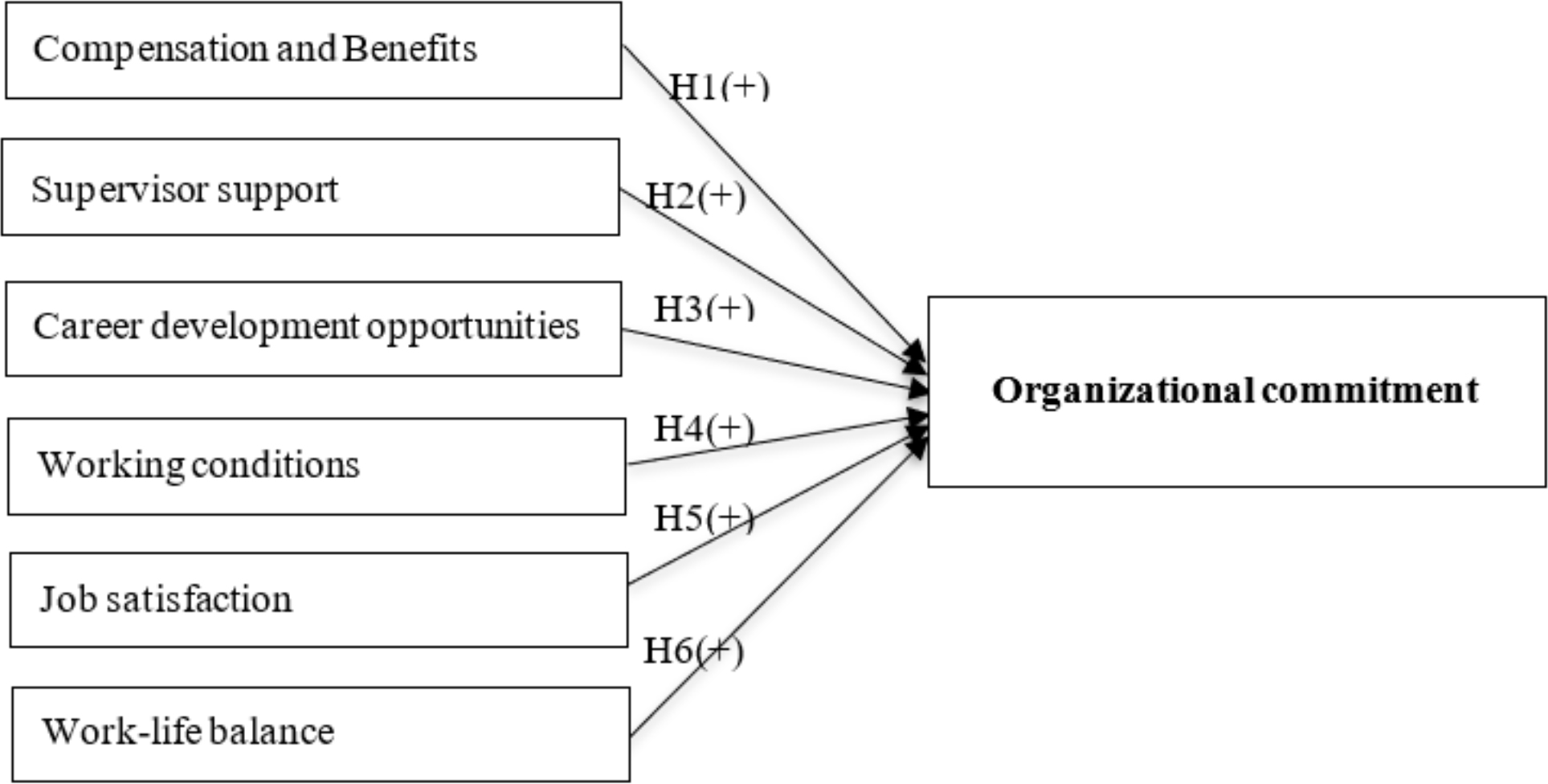
Figure 1.
Conceptual framework
(Source: Authors’ own research)
Based on a research literature review, the research hypotheses are developed as follows:
Compensation and benefits are the financial and nonfinancial rewards that employees receive from their organizations. This is an important human resource management technique to retain employees. The bigger the reward is the more the organization cares about employees and recognizes their effort and contributions. Moreover, the reward also tells how much the company invests in their workforce and wants them to have a better living conditions in order to achieve higher working results. When employees receive more salaries and other remunerations, they will make more efforts to complete assigned tasks and commit more to the organization. Recent empirical studies show that compensation influences job satisfaction and ultimately organizational commitment (Shortland, 2018; Suryani, et al., 2019). Compensation structure is important in influencing organizational commitment (Ashraf, 2020). Thus, it leads us to the following hypothesis:
H1:Compensation and benefits have a positive effect on employee commitment.
Regardless of skill level, even employees who have high-level professional capacity will need the support and consideration from managers, especially their direct supervisors. The effective support that employees receive from their supervisors will inspire them, therefore enhancing the working efficiency (Gallie, et al., 2012). Moreover, the support not only demonstrates the dedication of supervisors but also represents the organization as a whole. Building a positive working relationship between managers and staffs shows the company’s consideration and orientation in human resource management.
Furthermore, giving employees support and guidance will improve their ability and satisfaction (Turkyilmaz, et al., 2011), leading to an increase in the company’s proficiency as well as employees’ loyalty and affection toward the firm.
Therefore, hypothesis 2 of this study is stated as follows:
H2:The support of direct supervisors has a positive effect on employee commitment.
Career development is the training process to enhance employee’s knowledge and skills or advance employees up in their career ladders (Muhammad, et al., 2014). With that idea, offering personnel career development opportunities is an opinion supported by many firms. Research by Robinson et al. indicated that career advancement opportunities and human resource development served as the factors that promote the bond between employees and the firm. In general, employees tend to be more engaged in the organizations that pay attention to their personal growth and help them to meet their career goals, which aligns well with the company’s mission. Therefore, opportunities for career development will certainly attract talented staffs as well as boost their motivation and productivity (Deepti and Rani, 2019).
So, this hypothesis is stated as follows:
H3:Career development opportunities have a positive effect on employee commitment.
Working conditions includes the job’s attributes and working environment, where employees perform on a daily basis. The working condition considered favorable and appreciative should be the place where employees possess a stable, well-suited position, while they still have freedom and the authority to complete their works. This will make people feel valued, trusted, educated, and developed; therefore, they love and commit toward company more. Thus, most employees seek for a safe and comfortable working environment to keep their motivation and commitment last long. There is a significant relationship between working condition and employees’ commitment (Anitha, 2014). Some researchers have suggested that working condition and environment are important factors that affect the engagement of working with an organization (Anitha, 2014; Mohd, et al., 2016). A supportive working environment will allow employees to try new experiences and even failures without any concern about consequences.
Therefore, we propose the following hypothesis:
H4:Working conditions have a positive effect on employee commitment.
Job satisfaction is defined as the positive and happy emotion of employees toward their job and the firm. It represents employee’s assessment and attitude for the work. Being satisfied, they will be more willing to dedicate themselves to the organization and vice versa; if employees do not like their job, the demotivation will prevent them from trying their best to work. Employee job satisfaction is an important factor influencing the organizational commitment of the faculty members in the private universities in Bangladesh (Ashraf, 2020). The lack of adequate job satisfaction may result in demotivation that will reduce organizational commitment (Eslami and Gharakhani, 2012; Bashir and Gani, 2019).
Therefore, it leads us to the following hypothesis:
H5:Job satisfaction has a positive effect on employee commitment.
work-life balance has been increasingly receiving attention from researchers, leaders, business managers, and employees in organizations. This concept is understood as an awareness of the differences between the role of work and other non-work factors in personal life. Employees who have a good work–life balance often experience less pressure and conflict at work as well as achieve more job satisfaction, thereby stay more committed and engaged with the organization. The relationship between work-life balance and organizational commitment has been conducted in previous studies, and the results indicated that there is a positive relationship between those two elements (Vijaya and Hemamalini, 2012; Muhammad, et al., 2014).
Based on the literature review, hypothesis 6 of this study is stated as follows:
H6:work–life balance has a positive effect on employee commitment.
3. Methodology
3.1. Measurement
Preliminary items are inherited from previous studies. In which, the measurements of the dependent variable (organizational commitment) are inherited from the questionnaire set developed by Mowday, et al. (1979). The measurements of the independent variables are adopted and adapted from the research of Eisenberger, et al. (1986) and Yi (2014). To ensure that the items are interpreted clearly, in accordance with the research context in Vietnam, the authors interviewed eight experts who are leaders of the enterprises and conducted a preliminary survey of ten Gen Y employees who are working at Hanoi-based enterprises. Most of the experts and survey staffs agreed to keep the original items but re-interpret them for ease of understanding. Items of organizational commitment are aggregated. As a result, the variable compensation and benefits include four items, the relationship between managers and employees includes five items, career development opportunities include five items, working conditions include four items, job satisfaction includes six items, and work–life balance includes six items. The dependent variable includes seven items. The questionnaire was designed on a 5-point Likert scale with meanings ranging from 5, “strongly disagree,” to 1, “strongly agree.”
3.2. Sampling and Data Collection
The official survey was conducted by sending online questionnaires to employees working at businesses in Hanoi city. Some questionnaires were sent directly to employees' emails through permission of human resources departments and leaders of companies. Some questionnaires were collected through sending questionnaire links on social networking sites such as Facebook, Instagram, and Zalo. Respondents are generation Y employees identified through the introduction of the survey and the question of the employee’s age. Millennial employees are selected between the ages of 27 and 42. A convenient random sampling method was used.
To ensure the representativeness of the study sample, the sample calculation formula of Hair, et al. was used, in which the sample size was at least 5 times the number of scales in the study (Hair, et al., 1998). The formal study was conducted from March 2023 to May 2023. The survey results obtained are 278 answer sheets (from millennial employees) of which 242 are valid. Data were cleaned and processed by SPSS 26.
4. Results and Discussions
The survey was completed with 242 valid questionnaires, of which men participating in the survey accounted for 49.1%, the rest were women; the age group from 27 to 42 years old accounted for 64.2%, the rest were from 32 to 42 years old; undergraduate and graduate degrees account for 70.7%; major occupations are marketing staff and office workers in companies in Hanoi.
The variables and scales in the research model were tested for reliability through Cronbach’s alpha analysis. Six groups of factors affecting organizational commitment all had Cronbach’s alpha values greater than 0.6; all 37 scales in the model had a total correlation coefficient greater than 0.5 (Table 1). Thus, the variables and scales in the proposed model were reliable and can be used for further analysis (Nunally and Burnstein 1994; cited by Tho and Trang, 2009).
Table 1.
Reliability Statistics
(Source: Authors’ own research)
| Variables | Cronbach’s alpha | Number of items |
|---|---|---|
| 1. Compensation and benefits (CB) | .896 | 4 |
| 2. Supervisor support (MR) | .912 | 5 |
| 3. Career development opportunities (CD) | .892 | 5 |
| 4. Working conditions (WC) | .846 | 4 |
| 5. Job satisfaction (JS) | .890 | 6 |
| 6. Work–life balance (WB) | .907 | 6 |
| 7. Organizational commitment (OC) | .895 | 7 |
Then, exploratory factor analysis (EFA) was conducted to identify the structure of observed data and the relationships between variables and factors. KMO coefficient for independent variables had a value of 0.850, and the significance of Bartlett’s test is 0.000 < 0.05; KMO coefficient for dependent variables had a value of 0.715, and the significance of Bartlett’s test was 0.000 < 0.05, demonstrating the suitability of the data with the method of factor analysis (Hair, et al., 1998). The total variance extracted by the factors was 75.468%, which exceeds the 50% threshold. This indicates that the extracted factors accounted for 75,468% of the total variation in the observed variables (Table 2).
Table 2.
KMO and Bartlett’s Test
(Source: Authors’ own research)
| *KMO and Bartlett’s test for independent variables | - | - |
|---|---|---|
| Kaiser–Meyer–Olkin coefficient (KMO) | 0.850 | |
| Bartlett’s test | The approximate chi-squared value | 5243.630 |
| Df | 435 | |
| Sig. | 0.000 | |
| *KMO and Bartlett’s test for dependent variable | - | - |
| Kaiser–Meyer–Olkin coefficient (KMO) | 0.715 | |
| Bartlett’s test | The approximate chi-squared value | 306.359 |
| Df | 3 | |
| Sig. | 0.000 | |
| *Total extracted variance | - | 75.468% |
Analysis of the rotation matrix of the components in the model showed the convergence value of 30 scales belonging to 6 independent variables (Table 3).
Table 3.
Rotated Component Matrix
(Source: Authors’ own research)
| Component | ||||||
|---|---|---|---|---|---|---|
| 1 | 2 | 3 | 4 | 5 | 6 | |
| WB4 | .899 | - | - | - | - | - |
| WB3 | .892 | - | - | - | - | - |
| WB2 | .821 | - | - | - | - | - |
| WB1 | .819 | - | - | - | - | - |
| WB6 | .772 | - | - | - | - | - |
| WB5 | .749 | - | - | - | - | - |
| JS4 | - | .792 | - | - | - | - |
| JS5 | - | .783 | - | - | - | - |
| JS2 | - | .737 | - | - | - | - |
| JS3 | - | .735 | - | - | - | - |
| JS6 | - | .647 | - | - | - | - |
| JS1 | - | .594 | - | - | - | - |
| MR4 | - | - | .859 | - | - | - |
| MR2 | - | - | .836 | - | - | - |
| MR3 | - | - | .832 | - | - | - |
| MR5 | - | - | .830 | - | - | - |
| MR1 | - | - | .781 | - | - | |
| CD2 | - | - | - | .863 | - | - |
| CD1 | - | - | - | .803 | - | - |
| CD5 | - | - | - | .795 | - | - |
| CD3 | - | - | - | .764 | - | - |
| CD4 | - | - | - | .762 | - | - |
| CB2 | - | - | - | - | .809 | - |
| CB1 | - | - | - | - | .854 | - |
| CB3 | - | - | - | - | .842 | - |
| CB4 | - | - | - | - | .773 | - |
| WC3 | - | - | - | - | - | .812 |
| WC4 | - | - | - | - | - | .791 |
| WC2 | - | - | - | - | - | .762 |
| WC1 | - | - | - | - | - | .738 |
The Pearson correlations between the independent and dependent variables had positive values, ranging from 0.140 to 0.592; correlation significant values (p < 0.05) indicate a correlation of the independent variables on the dependent variable. These results are shown in Table 4.
Table 4.
Correlations among variables in the model
(Source: Authors’ own research)
| N | OC | CB | MR | CD | WC | JS | WB |
|---|---|---|---|---|---|---|---|
| 1.OC | 1 | .436** | .482** | .462** | .592** | .671** | .140* |
| 2. CB | - | 1 | .318** | .245** | .336** | .349** | -.069** |
| 3. MR | - | - | 1 | .272** | .266** | .447** | -.094* |
| 4. CD | - | - | - | 1 | .307** | .505** | -.390* |
| 5. WC | - | - | - | - | 1 | .487** | -.004* |
| 6. JS | - | - | - | - | - | 1 | -0.33 |
| 7. WB | - | - | - | - | - | - | 1 |
| *. Sig. level at **. Sig. level at | 0.05 0.01 | - | - | - | - | - | - |
Pearson correlations between independent variables were quite low; correlation significant values <0.05 suggest that there was a connection among independent variables. However, the results of checking the multi-collinearity of six independent variables showed that the VIF value was from 1.034 to 1.827 (all < 2), showing that multi-collinearity does not occur. These results are shown in Table 5. The model is further run to perform regression analysis.
Table 5.
Results of Regression Analysis
(Source: Authors’ own research)
| Model | Standardized Coefficients | T | Sig. | Collinearity Statistics | ||
|---|---|---|---|---|---|---|
| Beta | Tolerance | VIF | ||||
| 1 | (Constant) | - | -7.225 | .000 | - | - |
| 2 | CB | .139 | 3.273 | .001 | .810 | 1.235 |
| 3 | MR | .185 | 4.234 | .000 | .768 | 1.302 |
| 4 | CD | .142 | 3.169 | .002 | .730 | 1.370 |
| 5 | WC | .275 | 6.124 | .000 | .723 | 1.383 |
| 6 | JS | .366 | 7.075 | .000 | .547 | 1.827 |
| 7 | WB | .237 | 6.090 | .000 | .967 | 1.034 |
| 8 | R2 | .657 | - | - | - | - |
| 9 | F | 74.861 (sig = 0.000 | - | - | - | - |
Regression analysis results (Table 5) showed that R2 = 0.657 and F = 74.861 with Sig. < 0.05). These results indicated that 65.7% of the variation in organizational commitment was explained by the six groups of factors in the model, and this is statistically significant. The independent variables had coefficients β > 0, showing that the variables: (1) compensation and benefits; (2) supervisor support; (3) career development opportunities; (4) working conditions; (5) job satisfaction; and (6) Work–life balance all had positive influences on the organizational commitment of millennial employees in Hanoi. These results confirmed that the research hypotheses H1, H2, H3, H4, H5, and H6 were accepted.
The linear regression equation of factors affecting organizational commitment of millennial employees in Hanoi can be rewritten as follows:
The results of this research align with previous findings on organizational commitment, as seen in the research by Nguyen, et al. (2020), Muhamad, et al. (2014), Yi (2014), and others. An interesting finding from this study is that job satisfaction (β = 0.366) is the most important factor affecting organizational commitment of Gen Y in Hanoi. This can be explained by the fact that millennials tend to engage more actively and diligently in their work when they are satisfied with their jobs. Job satisfaction increases employees’ belief in the organization’s goals and values, which directly influences their emotional commitment to companies. This result matches the characteristics of Gen Y employees who value satisfaction and comfort in their work. In Vietnam, Gen Y employees were born and grew up during the period of rapid national development and technological, social media, and communication boom. This ensures that they have a solid knowledge base compared to previous generations, and they also emphasize the positive emotional values that work brings them. This finding is similar to other studies (Yi, 2014; Saha, 2016; Syahreza, et al., 2017; Ashraf, 2020).
Furthermore, in this study, working conditions (β = 0.275) and work-life balance (β = 0.237) are important factors in establishing organizational commitment of Gen Y employees. In the context of Vietnam, a developing country with average income and high proportion of medium and small companies, not many organizations have sufficient resources to create an ideal working environment and conditions for workers. Therefore, organizations that provide a favorable working environment enable employees to perform their tasks smoothly, thereby increasing organizational commitment. Additionally, work-life balance is an important factor impacting organizational commitment of Gen Y employees. The working environment in big cities like Hanoi is highly competitive and pressured, often leading to fatigue and stress for employees. Gen Y employees are known not only for their focus on careers but also for valuing personal and family time. They prefer a flexible work environment where they can experience life while achieving professional success. The widespread loss and consequences of COVID-19 pandemic have further highlighted life’s intrinsic value for employees. Therefore, arranging work in a way that allows employees to have balance between their professional and personal lives fosters greater commitment to organizations. This result aligns with previous studies by Nguyen (2015), Muhammad, et al. (2014), and others.
Finally, the relationship between managers and employees (β = 0.185), career development opportunities (β = 0.142), and compensation and benefits (β = 0.139) are confirmed to have positive influence on Gen Y employees’ commitment to the organization. When employees feel the care and support from managers both within and outside of work, they tend to develop a sense of loyalty toward the organization, which enhances their commitment. Additionally, organizations that provide learning and career development opportunities, along with fair compensation and benefits, make employees feel secure in their jobs, fostering stronger organizational commitment. These findings align with previous research, such as Bai, et al. (2023), Nguyen, et al. (2020), and Landsman (2008).
Moreover, the research result revealed a negative relationship between the compensation, rewards, and benefits variable and some other independent variables in the study model. In other words, changes in compensation and benefits policies may impact other independent factors and vice versa. This result may be explained by the fact that in the context of developing country as Vietnam, it is quite difficult for businesses to have all good resources simultaneously. Compensation adjustment policies can put pressure on employees, leading to changes in other factors. This finding highlights further experimental research on this topic in the future.
5. Implications and Conclusions
5.1. Theoretical Implications
The research findings reaffirm six factors impacting organizational commitment of Gen Y employees in the context of a transitioning economy like Vietnam. They are compensation and benefits, supervisor support, career development opportunities, working conditions, job satisfaction, and Work–life balance. Conducting this study in a new context may yield fresh insights to supplement existing literature. Additionally, measurements of organizational commitment and influencing factors developed in Western countries have been adapted and applied in the context of an emerging economy, especially post-COVID-19. Conducting experimental research in this new setting has further contributed to the existing theoretical foundation on employee organizational commitment.
5.2. Practical Implications
In Vietnam, generation Y represents a significant portion of the experienced workforce (about 35% of the population) and is actively shaping values and contributing to the country’s GDP. They are positioning itself as a key driver of Vietnam’s future development. A decline in organizational commitment poses challenges for businesses, highlighting the need for organizations to foster employee engagement in order to enhance business performance and effectiveness. The research finding indicates that, job satisfaction is the most crucial factor influencing organizational commitment. To boost job satisfaction and strengthen Gen Y’s commitment, organizations should focus on understanding employee’s needs, regularly assessing job satisfaction, and addressing various aspects that contribute to employee contentment. Companies are encouraged to increase training programs, grant employees more autonomy, and create a good working environment that encourages freedom and creativity aligned with their preferences and work habits.
Gen Y employees highly valued work-life balance and expect good working conditions. Organizations should design diverse work arrangements, such as flexible working schedules and family-friendly holiday programs, to help employees find a Work–life balance. Companies should also manage working hours effectively, allowing employees to perform well while having adequate rest time after intensive work periods and opportunities to pursue personal interests. Achieving this balance requires shared commitment and fair benefits between employers and employees. Additionally, companies should provide a conducive working environment, ensuring employees have the suitable resources and facilities to complete their tasks effectively. Organizations should also promote autonomy in work, especially in roles where high discipline is not essential, while maintaining a reasonable structure for achieving efficient results. Allowing for flexibility in how tasks are accomplished fosters a productive yet accommodating environment that aligns with Generation Y's preferences for independence and creativity in the workplace.
In order to further enhance employee commitment, organizations should actively create more learning and career development opportunities. In an era of digital transformation and rapidly evolving technology, the pressure on employees to continuously upskill is significant. Therefore, businesses must prioritize training and retraining programs, enabling employees to excel in their roles while unlocking creativity and hidden talents within each individual. Additionally, clear communication of expectations, company values, and views on career development opportunities is essential.
Organizations should establish transparent and accessible mechanisms for advancement, offering clear career paths and promotion criteria. This approach not only reinforces organizational commitment but also fosters a culture of growth, where they feel valued and aligned with the organization's vision for their longterm career journey.
Finally, businesses need to foster strong, positive relationships with employees, making them feel the genuine support and care of their direct leaders. Managers should regularly provide support, communicate openly, and encourage employees, especially during challenging situations. Enhancing employee salaries and benefits also plays a role in strengthening their commitment. Although salary and bonuses are not the most influential factor in this study, the cost of living in big cities like Hanoi places considerable financial pressure on employees, making them lean toward organizations that provide better pay and quality of life. To retain talent, companies should establish fair and transparent compensation policies. Salary structures and evaluations should be open and equitable, ensuring employees feel valued and fairly rewarded for their work. Beyond financial incentives, organizations should also maintain a clear, public disciplinary policy to instill a sense of responsibility and accountability among employees. This balanced approach of recognition, reward, and structured discipline can significantly reinforce employee commitment and loyalty to the organization.
5.3. Limitations and Future Research suggestions
This study has some limitations. First, the research model is limited to six groups of factors in aspect of human resource management that affecting the organizational commitment of Gen Y employees. The adjusted R2 value of 65.7% indicates that 65.7% of the variation in organization commitment is explained by these six variables. However, there may be other influential factors not included in this study. Second, conducting survey on Gen Y employee commitment in a big city (such as Hanoi) limits the sample size and geographic scope, affecting the generalizability of the findings. Additionally, the use of convenience sampling may introduce potential biases in the sample and findings.
To address these limitations, we propose that future research expands the model to include additional variables, such as demographic factors, technology and artificial intelligence, or organizational culture. Moreover, we suggest that future studies increase the sample size to enhance the generalizability of the research findings. Expanding the range of variables and including a more diverse sample could provide a more comprehensive understanding of the factors influencing organizational commitment of Gen Y, especially in the unique context of a rapidly developing economy like Vietnam.