

1. Introduction
In today's interconnected and rapidly evolving agribusiness landscape, networking has evolved from being an optional skill into a fundamental necessity for fostering sustainable growth and resilience within enterprises. Agribusiness supply chains thrive not only on the ability to form connections but also on cultivating strategic, enduring collaborations that promote resource sharing and drive innovation (Dyer, 2000; Vickery, et al., 2003). Central to these interactions is the concept of social capital, which refers to the network of relationships that facilitates coordination and cooperation within and across organizations (Burt, 1982; Coleman, 1990). Social capital enhances the efficiency of firms by building trust, lowering transaction costs, and improving access to vital resources (Nahapiet and Ghoshal, 1998).
However, the effectiveness with which agribusiness professionals leverage social capital is often shaped by their underlying “lay theories,” implicit beliefs about whether social capital is malleable or fixed (Kuwabara, et al., 2018). These lay theories are known to influence a wide range of behaviors from cognitive engagement to interpersonal dynamics (Chiu, Dweck, Tong and Fu, 1997; Dweck, 2000). For instance, individuals who view social capital as expandable may engage more proactively in networking, while those with fixed beliefs may see their networks as static, limiting their involvement.
Despite the recognized importance of social capital for driving collaboration and innovation within supply chains, the role of these implicit beliefs remains underexplored, particularly in agribusiness (Granovetter, 1985; Uzzi, 1997; Vu, Binh and Duong, 2023). Although there is a general consensus that social capital is critical for improving organizational outcomes, few studies have examined how lay theories shape professionals' networking behaviors, collaborative efforts, and their capacity for innovation, especially in Taiwan's agribusiness sector, where traditional practices intersect with modern technology (Freeman, 2004).
With collaboration and innovation crucial for responding to market volatility and competitive pressures, understanding how beliefs about social capital influence networking behaviors could provide actionable insights for enhancing supply chain performance (Gulati and Gargiulo, 1999; Podolny, 2001). This study aims to explore the relationship between lay theories and social capital within Taiwan’s agribusiness sector, particularly how these implicit beliefs affect networking behaviors, collaboration, and innovation outcomes. The research focuses on identifying the dominant lay theories held by agribusiness professionals, analyzing how these beliefs encourage or inhibit networking, and assessing their impact on collaborative practices and innovation within supply chains.
By addressing these dynamics, the study aims to provide agribusiness professionals and policymakers with strategies to more effectively leverage social capital, thus boosting collaboration and fostering innovation across the sector. To achieve these objectives, the study addresses several key questions: What are the prevailing lay theories about social capital among Taiwan’s agribusiness professionals? How do these beliefs shape networking behaviors within the supply chain? In what ways do these network practices influence collaboration and innovation? Lastly, how can a deeper understanding of social capital dynamics be harnessed to improve collaboration and innovation across Taiwan’s agribusiness sector?
This research is significant not only for its theoretical contribution but also for its practical applications. By exploring how lay theories shape networking behaviors, the study enhances our understanding of social capital’s pivotal role in fostering collaboration and innovation within complex supply chains. For policymakers and industry leaders, these findings will offer a strategic framework for strengthening networks, fostering innovation, and enhancing collaboration, ultimately contributing to the competitiveness and sustainability of Taiwan’s agribusiness sector in the global marketplace.
2. Literature Review
2.1. Social Capital and Networking
Social capital is a multifaceted concept that refers to the value derived from networks of relationships among individuals or organizations. It functions as a key resource that enables cooperation, coordination, and resource exchange within networks, facilitating a variety of social and economic transactions (Burt, 1982). According to Coleman (1990), social capital is deeply embedded in the obligations, expectations, and trust within social structures, and it significantly influences organizational outcomes. In the context of agribusiness, social capital is crucial for establishing networks that foster trust, improve the flow of information, and enhance collaboration throughout the supply chain (Gulati and Gargiulo, 1999; Al-Omoush, et al., 2022;). These networks are integral to coordinating diverse stakeholders, including farmers, suppliers, and distributors, and are vital for effective supply chain management and the promotion of innovation. Kumar, Scheer, and Steenkamp (1995) emphasize that the perceived interdependence and trust within such networks are fundamental for the success of collaborative efforts, particularly in agribusiness, where long-term relationships are key to sustainability and growth.
2.2. Influence on Collaboration and Innovation
The role of social capital in promoting collaboration and innovation within organizations has been widely recognized in scholarly literature. Burt (1987) highlights how social contagion within networks can stimulate innovation, particularly when individuals or organizations bridge structural gaps, leading to new connections and ideas. In agribusiness, social capital plays a central role in enabling collaborative innovation, where trust and interdependence within networks drive the adoption of new agricultural practices and the advancement of products (Angeles and Nath, 2001). By creating a collaborative environment, agribusiness professionals can harness social capital to enhance their innovation capabilities, thus contributing to the overall success of their operations.
2.3. Lay Theories, Behavior and Engagement in Networking and Collaboration
Lay theories are implicit beliefs individuals hold about their abilities and traits, commonly conceptualized as either fixed or malleable mindsets (Dweck, 2000; Kuwabara, et al., 2018; Vu, et al., 2023). Fixed mindsets imply that abilities are static, while malleable mindsets suggest that abilities can be developed through effort and experience. These underlying beliefs play a critical role in shaping how individuals approach networking and collaboration. Professionals who view social capital as fixed may shy away from networking, perceiving little potential for growth. In contrast, those with malleable beliefs see networking as an opportunity for personal and professional development, engaging more actively in collaborative efforts (Chiu, et al., 1997; Dweck, 2000; Nesbitt, et al., 2024). This dynamic is particularly relevant in agribusiness, where building and sustaining networks are essential for fostering innovation and maintaining competitiveness in an increasingly complex and interconnected market (Luo, 2003).
2.4. Supply Chain Collaboration in Agribusiness
Collaboration within supply chains is crucial for the success of agribusinesses. Effective collaboration ensures seamless integration across the supply chain, leading to better resource management, enhanced product quality, and greater innovation. Dyer (2000) notes that collaboration provides a competitive advantage by facilitating partnerships that promote the sharing of knowledge and resources. In the agribusiness sector, collaboration is vital for managing the complexities of agricultural production and distribution (Burt, 1987). In Taiwan, the transition from traditional practices to more integrated models of supply chain collaboration is driven by the need for increased efficiency and the pressures of growing competition (Freeman, 1979). While challenges such as mistrust and misaligned objectives can impede collaboration, strengthening social capital within networks can mitigate these obstacles, encouraging more effective partnerships (Gulati and Gargiulo, 1999).
2.5. The Role of Innovation in Agribusiness Supply Chains
Innovation is key to improving the efficiency and effectiveness of agribusiness supply chains. It enables companies to adapt to shifting market conditions, enhance product quality, and reduce operational costs. Innovation often emerges from the intersection of social capital and network dynamics, where collaboration fosters the development of new solutions (Podolny, 2005). In Taiwan's agribusiness sector, innovation resulting from collaborative efforts within supply chains is essential for maintaining competitiveness and ensuring long-term sustainability (Freeman, 2004).
2.6. Networking and Collaboration Drive Innovation
Networking and collaboration are powerful drivers of innovation within the agribusiness sector. Through networking, professionals gain access to new information, share resources, and collaborate on developing innovative solutions (Burt, 1987, Al-Omoush, et al., 2022;). These collaborative activities stimulate innovation within supply chains, allowing agribusinesses to create new products and optimize their processes (Dyer, 2000). Furthermore, collaboration within networks enables the pooling of expertise and fosters creativity, leading to improved problem-solving capabilities (Angeles and Nath, 2001). By engaging in proactive networking and collaborative activities, agribusiness professionals can enhance their ability to innovate and respond to evolving market demands.
2.7. Impact of Social Capital Beliefs on the Innovation Process
Beliefs about social capital significantly influence the innovation process within networks. Individuals who view social capital as malleable are more likely to participate in collaborative innovation efforts, seeing these as opportunities for mutual growth and development. Conversely, those with fixed beliefs may hesitate to engage, potentially stifling innovation within their networks (Dweck, 2000). In the context of agribusiness, fostering a mindset that perceives social capital as dynamic can enhance collaboration and stimulate innovation throughout the supply chain (Luo, 2003). By embracing malleable beliefs, agribusiness professionals can unlock greater potential for innovation and drive the long-term success of their enterprises.
3. Methodology
3.1. Conceptual Framework and hypotheses Development
This study draws on the theoretical insights of lay theories to investigate how agribusiness professionals’ beliefs about social capital shape their networking behaviors, and how these behaviors, in turn, influence collaboration and innovation outcomes. The conceptual framework (see Figure 1) articulates the proposed relationships among four core constructs: lay beliefs about social capital (malleable vs. fixed), proactive networking behaviors, collaboration within supply chains, and innovation outcomes. This model is grounded in the assumption that beliefs serve as cognitive antecedents that influence individual motivation and behavior within interorganizational contexts.
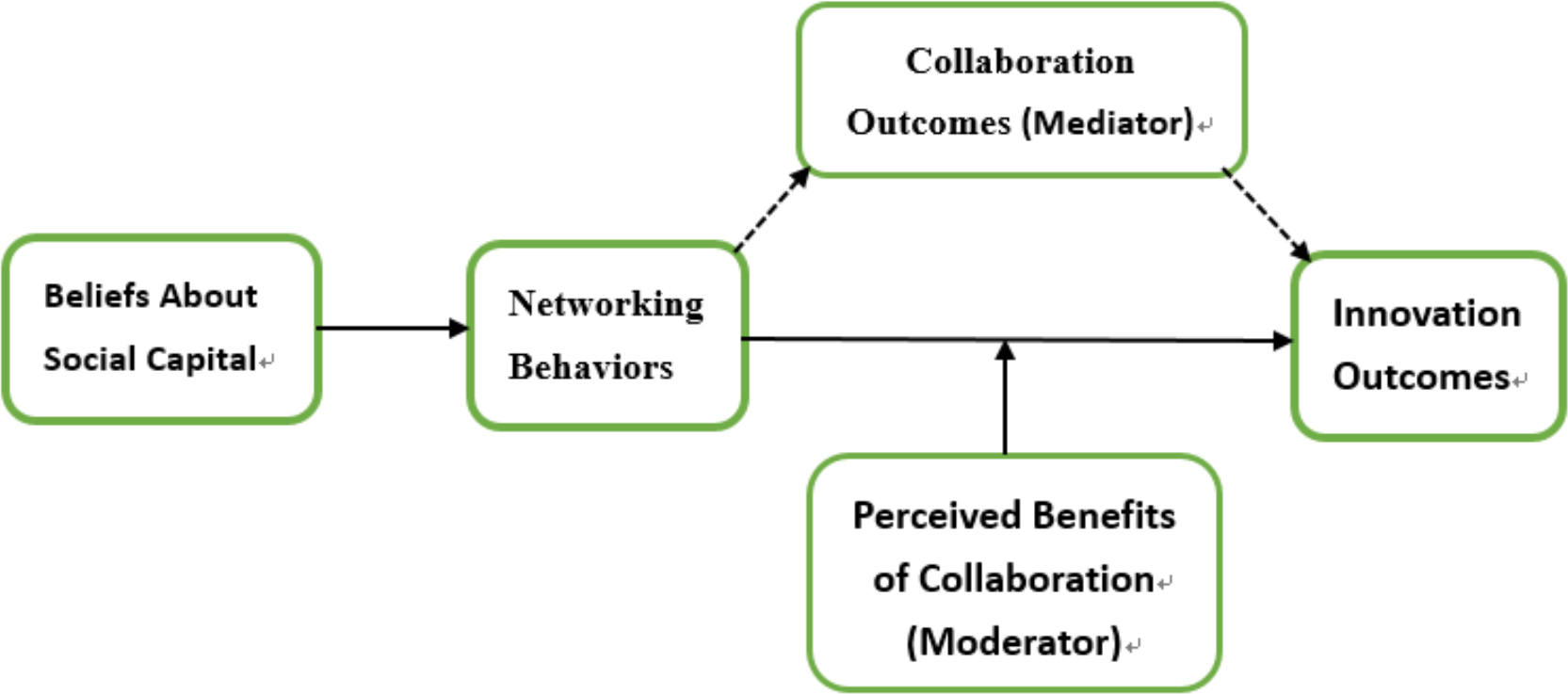
Figure 1.
Conceptual framework (Source: Author’s own research)
Specifically, we posit that individuals who hold malleable beliefs regarding social capital those who perceive relationships as expandable through effort and initiative will be more likely to engage in proactive networking behaviors. These behaviors are theorized to facilitate collaboration across organizational boundaries, which in turn enables innovation in processes, products, or practices. Collaboration thus functions as a mediating mechanism, transmitting the effects of networking behavior to innovation outcomes. Furthermore, the perceived benefits of collaboration are hypothesized to moderate the effect of networking on innovation, amplifying its impact when such benefits are highly valued.
The following hypotheses guide this research:
Hypothesis 1: Agribusiness professionals who endorse malleable beliefs about social capital will engage in higher levels of proactive networking behaviors compared to those with fixed beliefs. This proposition aligns with previous research on lay theories (Kuwabara, et al., 2018; Dweck, 2000), which suggests that malleable beliefs encourage effortful behavior in domains where outcomes are perceived to be improvable.
Hypothesis 2: Proactive networking behaviors are positively associated with the level of collaboration within agribusiness supply chains. Consistent with Burt’s (1992) theory of structural holes, individuals who network proactively act as bridges across disconnected actors, thereby facilitating knowledge exchange and relational coordination.
Hypothesis 3: Higher levels of collaboration are positively associated with innovation outcomes in agribusiness supply chains. As shown in Podolny’s (2005) work, collaborative environments foster the recombination of ideas and the development of novel solutions, which are critical for innovation.
Hypothesis 4: Agribusiness professionals with malleable beliefs about social capital will report greater innovation outcomes than those with fixed beliefs. Building on the work of Chiu, et al. (1997), we argue that belief systems encouraging relationship cultivation lead to environments conducive to innovation.
Hypothesis 5: The relationship between proactive networking behaviors and innovation outcomes is mediated by collaboration within the supply chain. Collaboration is theorized as the conduit through which networking behaviors manifest into tangible innovations (Gulati and Gargiulo, 1999).
Hypothesis 6: The perceived benefits of collaboration moderate the indirect effect of proactive networking on innovation by strengthening the intermediary role of collaboration, such that the relationship is stronger when perceived benefits are high. This hypothesis draws on evidence that subjective appraisals of collaborative utility shape the intensity and outcomes of interorganizational exchanges (Kumar, Scheer and Steenkamp, 1995).
Together, these hypotheses offer a comprehensive account of how individual belief systems influence broader organizational outcomes by shaping networking practices and their downstream effects on collaboration and innovation.
3.2. Instruments and Samples
This study utilizes a mixed-methods approach, employing both qualitative and quantitative research instruments to ensure a comprehensive validation of the conceptual framework and hypotheses. By integrating these methods, the study aims to provide a nuanced understanding of how agribusiness professionals’ beliefs about social capital influence networking behaviors, collaboration, and innovation outcomes in Taiwan’s agribusiness sector. The qualitative component centers on semistructured interviews. These interviews are designed using Dweck’s (2000) theory of fixed and malleable beliefs, focusing on participants’ perceptions of social capital within the context of agribusiness. Insights from foundational studies, such as Burt’s (1987) work on networking behaviors and Dyer’s (2000) research on collaboration, inform the development of interview questions. The interviews aim to explore how professionals perceive and utilize social capital and how their implicit beliefs drive or hinder their engagement in networking and collaboration efforts. The quantitative survey is developed using validated scales to measure key constructs, including beliefs about social capital, networking behaviors, collaboration, and innovation outcomes. The survey is divided into six sections: demographics, beliefs about social capital, networking behaviors, collaboration outcomes, innovation outcomes, and perceived benefits of collaboration. These sections draw on established frameworks, such as Dweck’s (2000) work on social capital beliefs, Burt’s (1987) research on networking behaviors, and Kumar, Scheer, and Steenkamp’s (1995) collaboration outcomes framework. The inclusion of these scales ensures the survey’s construct validity. Besides, a pilot test involving 25 agribusiness professionals will be conducted to assess the clarity and reliability of the survey before full deployment. To ensure a comprehensive and representative sample, the study employs a two-phase sampling strategy. A purposive sample of 25 participants will be selected for the interview phase, ensuring diversity across stakeholder groups such as farmers, suppliers, distributors, and policymakers. The selection criteria will encompass factors like experience and role within the sector, capturing perspectives from various geographical regions and subsectors of Taiwan’s agribusiness industry. In the quantitative phase, a random sampling strategy will be used to select 282 respondents for the survey. This approach will ensure representation across different industry subsectors, company sizes, geographical regions, and supply chain roles. The use of stratified sampling ensures that the study captures a balanced and representative view of Taiwan’s agribusiness professionals, enhancing the generalizability of the findings. By combining qualitative interviews and quantitative survey data, this mixed-methods approach provides a robust framework for examining how psychological beliefs about social capital and networking behaviors drive collaboration and innovation outcomes within agribusiness supply chains.
3.3. Data Collection Methods
The data collection for this study will proceed in two distinct phases to ensure both qualitative depth and quantitative breadth. Phase 1, Qualitative Data Collection: Semistructured, in-depth interviews will be conducted with a purposive sample of agribusiness professionals. These interviews are designed to explore participants' lay theories about social capital and their influence on networking behaviors and collaboration within the agribusiness supply chain. The qualitative data collected will offer rich insights into the implicit beliefs held by professionals and how these beliefs shape their engagement with social capital in the sector. Phase 2, Quantitative Data Collection:
Building on the insights from Phase 1, a structured survey will be administered to a broader sample of 282 agribusiness professionals. Data collection will occur both in person at the 6th National Agricultural Conference (held from September 7 to 8, 2018) and through online channels, with surveys distributed via email or SMS between September 3 and September 28, 2018. The final data set comprises 282 valid responses, 178 of which were collected physically and 104 through online submissions. This dual-method approach ensures a comprehensive analysis of Taiwan’s agribusiness sector. The mixed-methods design allows for empirical testing of the interplay between lay theories, networking behaviors, collaboration, and innovation. By utilizing both physical and online survey methodologies, the research gains a more nuanced understanding of the sector, providing valuable insights for both agribusiness professionals and policymakers.
4. Results
4.1. Demographic Profile of the Sample
The sample of 282 valid responses offers a well-rounded and diverse representation of Taiwan's agribusiness sector. Table 1 provides a detailed demographic profile, demonstrating the broad distribution of respondents across various categories, which enhances the study’s validity. The age distribution of respondents is well-balanced, with the majority of professionals falling within the 26-45 age group, highlighting a strong representation of mid-career individuals. Specifically, 12.5% of respondents were aged 18-25, 20.5% were aged 26-35, 24.0% were aged 36-45, 19.5% were aged 46–55, 14.0% were aged 56–65, and 9.5% were 66 years or older. This spread ensures that insights from both younger professionals and seasoned veterans of the industry are captured, contributing to a comprehensive analysis. Respondents held various roles within the agribusiness supply chain, ensuring that the study captures a wide range of perspectives. Farmers comprised the largest group at 30.5%, followed by suppliers at 25.0%, distributors at 15.5%, retailers at 10.5%, industry experts at 10.0%, and others at 8.5%. This diversity ensures that the perspectives of key stakeholders involved in Taiwan's agribusiness networks are well represented. Experience levels also varied across the sample. Approximately 15.5% of respondents had less than 5 years of experience in agribusiness, 22.0% had 5-10 years, 26.5% had 11-15 years, 20.0% had 16-20 years, and 16.0% had over 20 years of experience. This broad range of experience levels ensures that the study reflects both emerging and well-established professionals, offering a complete view of the sector’s workforce. The sample also includes respondents from businesses of different sizes, with 38.5% representing small companies (1-49 employees), 41.0% from medium-sized companies (50–249 employees), and 20.5% from large companies (250 or more employees). This distribution ensures that the study captures the perspectives of firms operating at various scales, adding to the robustness of the findings. Geographically, respondents were distributed across Taiwan, ensuring regional diversity. Specifically, 29.5% were from Northern Taiwan, 25.0% from Central Taiwan, 30.0% from Southern Taiwan, 10.0% from Eastern Taiwan, and 5.5% from other regions. This ensures that the study reflects both urban and rural perspectives, providing a comprehensive understanding of the unique regional dynamics within Taiwan's agribusiness sector.
Table 1.
Demographic Profile of Sample (Source: Author’s own research)
| Category | Subcategory | Frequency | Percent (%) |
|---|---|---|---|
| Age | 18–25 | 35 | 12.50% |
| 26–35 | 58 | 20.50% | |
| 36–45 | 68 | 24.00% | |
| 46–55 | 55 | 19.50% | |
| 56–65 | 39 | 14.00% | |
| 66 and above | 27 | 9.50% | |
| Role | Farmer | 86 | 30.50% |
| Supplier | 71 | 25.00% | |
| Distributor | 44 | 15.50% | |
| Retailer | 30 | 10.50% | |
| Industry expert | 28 | 10.00% | |
| Other | 24 | 8.50% | |
| Years of experience | Less than 5 years | 44 | 15.50% |
| 5–10 years | 62 | 22.00% | |
| 11–15 years | 75 | 26.50% | |
| 16–20 years | 56 | 20.00% | |
| More than 20 years | 45 | 16.00% | |
| Company size | Small (1–49) | 109 | 38.50% |
| Medium (50–249) | 115 | 41.00% | |
| Large (250 or more) | 58 | 20.50% | |
| Geographical location | Northern Taiwan | 83 | 29.50% |
| Central Taiwan | 71 | 25.00% | |
| Southern Taiwan | 85 | 30.00% | |
| Eastern Taiwan | 28 | 10.00% | |
| Other | 15 | 5.50% |
4.2. Reliability, Validity and Discriminant Analysis
The reliability and validity of the five key constructs, social capital (SC), networking behaviors (NB), collaboration outcomes (CO), innovation outcomes (IO), and benefits of collaboration (BC), were rigorously assessed through multiple statistical tests. To evaluate internal consistency, Cronbach's alpha was utilized, with a threshold of 0.7 considered acceptable, following the recommendations by Nunnally (1978). As demonstrated in Table 2, all constructs displayed Cronbach's alpha values above 0.8, indicating a high level of internal consistency and reliability across the measured items. In addition to reliability, the study measured convergent validity through average variance extracted (AVE) and composite reliability (CR).
Table 2.
Reliability and Validity Analysis (Source: Author’s own research)
| Variable | Factor | Cronbach's Alpha | AVE | CR |
|---|---|---|---|---|
| Social Capital (SC) | Fixed Beliefs | 0.885 | 0.555 | 0.833 |
| Malleable Beliefs | 0.888 | 0.556 | 0.835 | |
| Networking Behaviors (NB) | Proactive Networking | 0.856 | 0.582 | 0.839 |
| Sustaining Relationships | 0.830 | 0.635 | 0.878 | |
| Collaboration Outcomes (CO) | Resource Sharing | 0.862 | 0.623 | 0.868 |
| Joint Problem Solving | 0.830 | 0.621 | 0.831 | |
| Innovation Outcomes (IO) | Process Innovation | 0.822 | 0.607 | 0.822 |
| Product Innovation | 0.837 | 0.623 | 0.868 | |
| Benefits of Collaboration (BC) | Perceived Collaboration Benefits | 0.856 | 0.582 | 0.839 |
According to the criteria set forth by Fornell and Larcker (1981), AVE values should exceed 0.5, ensuring that over 50% of the variance in the observed variables is accounted for by their respective latent constructs. In this research, all constructs met this criterion, confirming satisfactory convergent validity. Furthermore, CR values for all constructs exceeded 0.8, which further reinforced the robustness of the measurement model and its validity, as supported by Hair, Babin, Anderson, and Tatham (2010). The comprehensive results from these tests validate the reliability and accuracy of the measurement instruments employed, providing a solid foundation for confidence in the subsequent analyses and findings. This confirms the appropriateness of the constructs and the overall robustness of the model.
4.3. Factor Analysis Results
To evaluate the data set’s suitability for factor analysis, two key preliminary tests were conducted. Bartlett's Test of Sphericity produced a highly significant result (12983.384, p < 0.000), confirming that the correlation matrix was appropriate for factor analysis (Bartlett, 1954). Additionally, the Kaiser-Meyer-Olkin (KMO) Measure of Sampling Adequacy returned a robust score of 0.924, indicating that the sample size and data structure were suitable for factor analysis (Kaiser, 1970). These findings provided the necessary confidence to proceed with Exploratory Factor Analysis (EFA). The analysis, utilizing the VARIMAX orthogonal rotation method, revealed five underlying factors that aligned with the study’s key constructs: Social Capital, Networking Behaviors, Collaboration Outcomes, Innovation Outcomes, and Benefits of Collaboration (Hair, et al., 2010). All factor loadings were above 0.4, demonstrating strong correlations between the items and their respective constructs. Furthermore, the communalities showed that each item made significant contributions to the variance within its assigned factor, ensuring robust construct validity.
4.4. Overall Model Fit
After conducting the EFA, a Confirmatory Factor Analysis (CFA) was performed to validate the factor structure. Several goodness-of-fit indices were used to assess the overall model fit, and the results confirmed a strong model fit. The CMIN/DF (Chi-square/degree of freedom) value was 1.079, which is well below the threshold of 3, signifying a good fit between the model and the data (Kline, 2015). The GFI (Goodness-of-Fit Index) value of 0.959, surpassing the 0.9 benchmark, indicated a high-quality fit (Jöreskog and Sörbom, 1989). Additional indices supported the model’s explanatory power, with the NFI (Normed Fit Index) at 0.956 and the RFI (Relative Fit Index) at 0.948. The IFI (Incremental Fit Index) of 0.997 highlighted the superior fit of this model relative to alternative models. Minimal residual error was reflected in the RMR (Root Mean Square Residual) value of 0.024, while the RMSEA (Root Mean Square Error of Approximation) score of 0.012, well below the 0.08 threshold, signaled a strong fit (Hu and Bentler, 1999). Collectively, these indices confirm the excellent overall fit of the measurement model, providing a robust foundation for further analysis.
4.5. Convergent and Discriminant Validity
Construct Reliability (CR) and Average Variance Extracted (AVE) were examined to assess convergent validity. As shown in Table 3, all CR values exceeded 0.7, while AVE values surpassed 0.5, meeting the established criteria (Fornell and Larcker, 1981). These findings confirm that the items within each construct effectively measured their intended dimensions, ensuring high convergent validity. Discriminant validity was also verified using the AVE method, whereby the square root of the AVE for each construct was greater than the correlations with other constructs. This result, shown in Table 4, met the required criterion, establishing strong discriminant validity (Fornell and Larcker, 1981). The results from the factor analysis and model fit assessments affirm the robustness of the study’s measurement model. The five constructs (Social Capital, Networking Behaviors, Collaboration Outcomes, Innovation Outcomes, and Benefits of Collaboration) were shown to be reliable and valid for capturing the complexities of Taiwan's agribusiness sector.
Table 3.
Discriminant Analysis (Source: Author’s own research)
| Variable | SC | NB | CO | IO | BC |
|---|---|---|---|---|---|
| SC (Social Capital) | 0.745 | - | - | - | - |
| NB (Networking Behaviors) | 0.467** | 0.797 | - | - | - |
| CO (Collaboration Outcomes) | 0.426** | 0.372** | 0.779 | - | - |
| IO (Innovation Outcomes) | 0.444** | 0.365** | 0.411** | 0.801 | - |
| BC (Benefits of Collaboration) | 0.458** | 0.389** | 0.428** | 0.391** | 0.779 |
Table 4.
Summary for regression analysis and hypotheses testing (Source: Author’s own research)
| Hypothesis | Relationship | β | t | p-value | Result |
|---|---|---|---|---|---|
| H1: Malleable beliefs about social capital → Proactive networking behaviors | Malleable Beliefs (SC) → Proactive Networking (NB) | 0.451 | 6.745 | <0.001 | Supported |
| H2: Proactive networking behaviors → Collaboration | Proactive Networking (NB) → Collaboration (CO) | 0.372 | 5.823 | <0.001 | Supported |
| H3: Collaboration → Innovation Outcomes | Collaboration (CO) → Innovation Outcomes (IO) | 0.411 | 6.231 | <0.001 | Supported |
| H4: Malleable beliefs about social capital → Innovation Outcomes | Malleable Beliefs (SC) → Innovation Outcomes (IO) | 0.386 | 5.892 | <0.001 | Supported |
Table 5.
Summary for mediation analysis (Source: Author’s own research)
| Relationship | Direct Effect | Indirect Effect | Total Effect | Sobel Test (Z) | p-value |
|---|---|---|---|---|---|
| Proactive Networking → Innovation | 0.210 | 0.160 | 0.370 | 2.998 | 0.002 |
Table 6.
Summary for moderation analysis (Source: Author’s own research)
| Predictor | Dependent variable | β | t | p-value |
|---|---|---|---|---|
| Proactive Networking (NB) | Innovation Outcomes (IO) | 0.324 | 4.587 | <0.001 |
| Perceived Benefits (BC) | Innovation Outcomes (IO) | 0.124 | 2.115 | <0.05 |
The solid model fit and evidence of both convergent and discriminant validity confirm the model’s efficacy in understanding the impact of social capital and collaboration on innovation and competitive advantage in agribusiness.
4.6. Outcomes of the Statistical Analyses
This section outlines the outcomes of the statistical analyses employed to test the study’s hypotheses. A series of regression analyses, mediation analyses, and moderation tests were conducted to evaluate the relationships between the constructs. Detailed statistical findings are presented alongside the results of the hypotheses tests.
A regression analysis was conducted to examine the effect of malleable beliefs on proactive networking behaviors. The results indicate a significant positive relationship between malleable beliefs about social capital and proactive networking behaviors (β = 0.451, p < 0.001), supporting H1. Agribusiness professionals who view social capital as expandable through effort and engagement tend to engage more actively in proactive networking behaviors. The significant positive effect suggests that individuals with a growth mindset about social capital are more likely to engage in proactive networking activities, supporting Dweck's (2000) theory on malleable beliefs.
Regression analysis revealed that proactive networking behaviors significantly predict the level of collaboration within agribusiness supply chains (β = 0.372, p < 0.001). Professionals engaging more in proactive networking foster better collaboration with supply chain partners. These findings align with Burt's (1987) theory that active networking creates opportunities to broker relationships, facilitating collaboration. This enhances the collaboration dynamics within agribusiness networks.
The results from regression analysis demonstrate a significant positive relationship between collaboration and innovation outcomes (β = 0.411, p < 0.001). This supports the hypothesis that higher collaboration levels lead to greater innovation in products, processes, and practices. Collaboration within agribusiness supply chains facilitates the exchange of diverse ideas, confirming Podolny's (2005) argument that collaboration enables innovation through shared knowledge and resources.
Regression results indicate that malleable beliefs about social capital significantly predict higher innovation outcomes (β = 0.386, p < 0.001), supporting H4. These results support Chiu et al. (1997), suggesting that individuals with malleable beliefs are more inclined to engage in behaviors that promote innovation, such as fostering collaboration and seeking new ideas.
A mediation analysis was performed using the Baron and Kenny (1986) method. The results indicate that the effect of proactive networking behaviors on innovation outcomes is partially mediated by collaboration levels within the supply chain. The direct effect of proactive networking on innovation remained significant (β = 0.210, p < 0.01), while the indirect effect through collaboration was also significant (β = 0.160, p < 0.01). This confirms Gulati and Gargiulo’s (1999) theory that collaboration plays a mediating role, enhancing the effect of proactive networking on innovation. Collaboration serves as a critical mechanism through which networking efforts translate into innovation.
A moderation analysis was conducted to test the moderating role of perceived benefits of collaboration. The interaction term between proactive networking behaviors and perceived benefits was found to be significant (β = 0.124, p < 0.05), indicating that the perceived benefits of collaboration strengthen the relationship between networking behaviors and innovation outcomes. These findings support Kumar, et al. (1995) by demonstrating that when agribusiness professionals perceive greater benefits from collaboration, the positive impact of proactive networking on innovation is amplified. The statistical analyses provide strong support for all six hypotheses. The findings underscore the importance of malleable beliefs about social capital, proactive networking behaviors, and collaboration in fostering innovation within agribusiness. Besides, the perceived benefits of collaboration play a crucial role in strengthening the impact of networking on innovation.
5. Conclusion
This study advances our understanding of how agribusiness professionals’ implicit beliefs about social capital shape organizational outcomes, particularly through their influence on proactive networking, collaboration, and innovation. Drawing on the lay theories of networking framework, the findings highlight those professionals who perceive social capital as malleable are more inclined to invest in relationship-building behaviors that facilitate interorganizational collaboration and yield meaningful innovation. Rather than viewing social capital as a static asset, the results suggest that it is a dynamic construct, shaped by individual cognition and actively cultivated through social engagement. This insight carries important implications for how firms might train, incentivize, and structure professional interactions, suggesting that fostering a growth-oriented mindset around networking may be as vital as investing in technical capabilities or infrastructure. Moreover, by situating these findings within a rapidly evolving agri-food economy, the study contributes to a more nuanced understanding of how psychological dispositions interface with structural conditions to affect innovation. While aligned with recent studies (e.g., Al-Omoush, et al., 2022; Vu, et al., 2023) that emphasize the enabling role of social capital in crisis and entrepreneurial contexts, this research also responds to newer critiques (Nesbitt, et al., 2024) that call for more structural, network-level metrics in evaluating collaborative potential. Ultimately, this research invites agribusiness stakeholders to consider not only what networks exist but also how they are perceived and enacted. In doing so, it reframes social capital not merely as a resource to be possessed, but as a set of beliefs to be nurtured, beliefs that, when aligned with strategic intent, can drive resilience, adaptability, and sustained innovation in an increasingly complex supply chain environment.
5.1. Findings
Malleable Beliefs as Catalysts for Proactive Networking
This study supports the notion that professionals with malleable beliefs, viewing social capital as expandable, are more inclined to engage in proactive networking. This aligns with Dweck’s (2000) concept of growth mindsets, where individuals perceive abilities and resources as developable over time. In the agribusiness context, such beliefs drive relationship building, enhancing social capital. Recent research by Vu, et al. (2023) reinforces this, showing that SMEs in Vietnam with growth-oriented mindsets leverage social capital for entrepreneurial success, supporting the idea that malleable beliefs foster higher-quality, durable relationships (Kuwabara, et al., 2018). However, Nesbitt, et al. (2024) suggest a shift, noting that while social capital enhances collaboration in environmental governance, its effectiveness may depend on network density rather than mindset alone, indicating a potential evolution in how malleable beliefs influence networking outcomes. Earlier works by Granovetter (1985) and Coleman (1990) continue to underscore the role of trust and reciprocity in long-term collaboration, though contemporary studies highlight a growing emphasis on structural network metrics over individual beliefs.
Networking as the Engine of Collaboration
Proactive networking emerges as a vital mechanism for fostering collaboration within agribusiness supply chains. Drawing on Burt’s (1992) structural hole theory, professionals acting as intermediaries bridge disconnected individuals, facilitating information and resource flows that enhance collaboration. This is particularly effective in interdependent sectors like agribusiness, where trust and shared understanding drive innovation (Uzzi, 1997). Recent findings by Oudeniotis and Tsobanoglou (2022) among social enterprises in Greece align with this, demonstrating that interorganizational networking strengthens social capital and collaboration. However, Al-Omoush, et al. (2022) note that during the COVID-19 crisis, the reliance on digital networks altered traditional collaboration dynamics, suggesting a temporal shift where virtual connectivity has become increasingly critical, potentially challenging the physical intermediary role emphasized by Burt (1992).
Collaboration and Innovation are Symbiotic
The study reaffirms the symbiotic relationship between collaboration and innovation, consistent with established research (Chesbrough, 2003; Tidd and Bessant, 2013). Collaboration enables the exchange of ideas, resources, and knowledge, fueling joint problem-solving and innovation, which is strategically vital in complex agribusiness operations. Podolny (2001) highlights how strong collaborative ties promote experimentation and knowledge sharing, leading to breakthroughs. Recent evidence from Vu, et al. (2023) supports this, showing that collaborative innovation in Vietnamese SMEs enhances market competitiveness. Conversely, Nesbitt, et al. (2024) indicate that over time, the focus has shifted toward measuring collaboration’s impact through network metrics, suggesting a refinement in understanding its innovation outcomes compared to earlier, more qualitative assessments.
Malleable Beliefs Drive Direct Innovation Outcomes
The finding that malleable beliefs about social capital directly enhance innovation outcomes, independent of networking, adds a novel dimension to social capital research. Individuals with growth-oriented beliefs are more likely to pursue creative solutions, amplifying idea generation and implementation. This builds on Chiu, et al.’s (1997) observation that a malleable resource view fosters innovative relationships. Recent work by Al-Omoush, et al. (2022) during the COVID-19 crisis supports this, showing that adaptable mindsets directly spurred innovative responses in organizations. However, Oudeniotis and Tsobanoglou (2022) suggest a potential contradiction, noting that in some contexts, innovation may rely more on collective social capital structures than individual beliefs, indicating a possible evolution where structural factors increasingly mediate this relationship over time.
5.2. Practical Implications
The present study offers actionable insights for agribusiness managers seeking to enhance supply chain collaboration and foster innovation through the cultivation of social capital. Central to our findings is the notion that beliefs about the malleability of social capital significantly shape networking engagement. Managers can therefore benefit from actively cultivating a growth-oriented view of social relationships within their organizations. This might include developing training programs that frame networking not as an innate skill but as a competency that can be expanded through deliberate effort, akin to leadership development or technical skill acquisition.
To operationalize these beliefs, organizations should institutionalize structures that incentivize and normalize proactive networking behaviors. For example, firms could implement peer-mentorship programs that match junior professionals with seasoned networkers or sponsor participation in interorganizational forums, agricultural trade shows, and cross-sector workshops. These initiatives offer repeated, low-risk opportunities to build relational ties, especially across traditional organizational boundaries.
Equally important is the provision of collaborative infrastructures. Firms that invest in digital platforms enabling shared resource planning or co-innovation dashboards can facilitate real-time information exchange, critical for navigating uncertain or fragmented supply networks. For instance, a producer cooperative might use a shared CRM or logistics app to synchronize deliveries and product innovations across farms and processing centers. These tools can help transform informal interactions into structured routines that promote trust and transparency.
Finally, aligning innovation strategies with social capital development initiatives ensures that creativity does not occur in isolation. Innovation task forces, for example, may be more effective when composed of members drawn from diverse network positions. Encouraging cross-functional collaboration, especially among those previously unconnected, can catalyze the diffusion of novel ideas. In this way, embedding relationship building into innovation pipelines not only enhances problem-solving capacity but also increases professionals’ motivation to contribute to collective outcomes.
By recognizing and shaping the cognitive foundations of social capital, agribusiness leaders can implement targeted interventions that strengthen both the structural and behavioral dimensions of collaboration, ultimately positioning their organizations to respond more effectively to evolving industry demands.
5.3. Recommendations
Agribusiness firms should incorporate psychological interventions that develop a malleable mindset in the workforce, aligning these efforts with organizational goals to create a culture of continuous improvement and innovation, and simultaneously invest in relationship-driven technologies, such as CRM systems and digital collaboration platforms, to nurture professional connections and enhance communication across regions. Moreover, agribusiness leaders should view supply chains as strategic assets for driving innovation by promoting collaboration at different levels, thereby tapping into the creative potential of their partners and fostering joint ventures, innovation hubs, and collaborative research projects. Additionally, establishing metrics to monitor networking behaviors and collaboration effectiveness is crucial, with key performance indicators (KPIs) related to new contacts, relationship strength, and engagement in collaborative projects providing valuable insights into the health of social capital and its potential for driving innovation.
5.4. Limitations and Directions for Future Research
While this study offers valuable insights into the role of lay theories and social capital in shaping collaboration and innovation outcomes in Taiwan’s agribusiness sector, several limitations should be acknowledged to contextualize the findings and guide future research. First, the analysis was based on cross-sectional survey data from 245 agribusiness professionals. Although the sample size is sufficient for structural equation modeling, it may not fully capture the heterogeneity across Taiwan’s diverse agribusiness landscape. Moreover, the use of a nonprobability sampling method, specifically, a combination of purposive and snowball sampling, introduces potential selection bias. Participants may have shared similar social or professional networks, possibly inflating associations between networking behaviors and outcomes.
Second, the sample, though diverse within the Taiwanese agribusiness context, may limit generalizability to other sectors or national settings. Agribusiness supply chains often exhibit sector-specific characteristics, such as deep-rooted interpersonal relationships and cultural norms around collaboration, which may not fully translate to more industrialized or digitally mediated supply networks. Future research might explore how these lay theories operate across various industries or cultural contexts to assess their broader applicability.
Third, although self-reported survey data are commonly used to capture internal cognitive orientations and perceptions, they are also susceptible to social desirability bias. Respondents may overstate their engagement in proactive networking or the benefits they derive from collaboration. Incorporating behavioral or observational data in future research could strengthen the validity of these findings.
Lastly, the theoretical framework was largely derived from established constructs in organizational behavior and social psychology. While this approach yields robust explanatory power, integrating interdisciplinary perspectives, such as behavioral economics or innovation systems theory, may enrich our understanding of how cognitive beliefs interact with structural conditions in shaping collaborative practices.
Future research should aim to address these limitations by employing mixed-method designs, expanding to cross-national comparative studies, and examining additional moderators such as institutional support or digital platform usage. Such efforts would deepen the theoretical and practical contributions of lay theories to the study of network dynamics and innovation in complex organizational environments.