

1. Introduction
The relationship between organizational activities and environment is inseparable (Järvilehto, 1998), and such a relationship may result in adverse environmental outcomes, such as pollution, ecological damage, and electrical energy inefficiency. Environmental problems are a big issue today, and we pay extra attention to them (Sun, et al., 2022). On the other side, creating a sustainable environment is the responsibility of any institution (Cheema, et al., 2020), including educational institutions (Crawford and Cifuentes-Faura, 2022; Kohl, et al., 2022).
Efforts to bring about environmental change require exemplary leadership figures. Leaders are responsible for environmental and institutional issues (Althnayan, et al., 2022; Fry and Egel, 2021). Fry and Egel (2021) offer the concept of global leadership, namely, leadership based on spirituality, self-transcendence, and interconnectedness. Althnayan, et al. (2022) and Sun, et al. (2022) demonstrate transformational leadership to support sustainability performance.
However, previous studies have shown that leadership could be more effective in realizing sustainability (Ahmad, et al., 2022), especially in various contexts and problems. Efforts to optimize the role of educational institutions in sustainability are increasingly complex (Obrecht, et al., 2022). In addition, the framework for realizing these goals has not been widely explored in universities (Ruiz-Mallén and Heras, 2020). Althnayan, et al. (2022) also suggest that the mechanism by which leadership influences institutions to realize real support for sustainability remains unclear.
Based on the study, the construction of leadership to optimize the role of universities in realizing sustainability still needs to be made clear. Various leadership options must pay attention to the context and diversity of issues. Leaders who translate ethical values as fundamental principles for the interaction and functionalization of leadership to encourage changes in employee behavior are the key to this success. The presence of a leader with ethical concern for the environment and the ability to interact and enforce environmental and moral norms in HR practice can solve problems regarding ecological performance.
The process for optimizing the role of the leader needs to be explained further based on its relationship with the structure and subordinates. The leadership has a strategic role in ensuring sustainable processes and practices of HR systems and governance. Leaders who advocate sustainability have the same caring and critical characteristics as ethical leadership. According to Arar et al. (2016), the leader is described as a caring ethic, an ethic of justice, and an ethical critique who supports organizational orientation toward ethical issues. Leaders with caring ethics view human relationships as pivotal. An ethic of caring recognizes the individual's right to be himself, openness to recognition of individuality, and loyalty to relationships. Ethics of justice is sourced from a philosophical point of view and is related to the nature of the world, and it shows the relationship between humans and the state. Ren, et al. (2020) present ethical leadership, green HR practices, and individual environmental performance. However, more than a leadership position is required to moderate a green HR practice system within a partially green-oriented HR structure.
Company’s HR management system today begins to shift to green HR practice. This practice can be viewed from some companies' efforts in redesigning and revitalizing HR practices by eliminating harmful activities and promoting environmental friendliness (Guerci, et al., 2016). Green HR practice is also done by designing and implementing HRM systems that support a proactive and positive approach to addressing environmental problems (Afedzie, et al., 2020). Some companies even view green HRM as part of a more sustainable business management strategy (Jerónimo, et al., 2020).
Green HR practice focuses on the employees' environmentally aware contributions. In this regard, higher educational institutions are also responsible for educating the community by exhibiting an example of green HR practices to raise public awareness of environmental problems. Green HR practice orientation is for employees who are concerned with sustainability issues. Employees' ecological behavior makes sustainability values a reference for behavior. This behavior describes a form of individual responsibility as part of a collective effort to achieve sustainability that causes minimal environmental damage and even benefits the environment (Steg and Vlek, 2009). In an environment-friendly HR management system, employees' ecological behavior determines the organization's collective efforts in realizing the demands for sustainability. The individual performance measurement system is formulated based on attributes such as the tangible manifestation of individual environmental performance to ensure a directed orientation. As one of the agents of change, it also experiences a change in point of view in understanding sustainability. This orientation can be seen in HR management's organizational structure and functionalization, which establishes sustainability values as its basis.
The mechanism can be explained through the leader–member exchange focusing on value. The leader–member exchange (LMX) theory describes the interactions between leaders and subordinates (Du, et al., 2023). Lee (2020) proposed the LMX framework to explain the creation of sustainable value for stakeholders. This research contributes first to explaining the process for an ethical leader to influence his subordinates and to embed awareness values in a structured manner through green HR practice. The interaction between leaders and subordinates is a methodological communicative interaction, not merely a social transaction. Both are brought together in the structure of green HR practice. A leader's critical reflection may encourage behavioral change by activating norms in green HR practices. The leadership is interested in building emancipatory awareness based on a process of self-formation that is aware of ecological problems that become a shared orientation.
Leaders also develop mechanisms to influence subordinates based on personality characteristics, LMX perspectives, and the norm activation model (NAM). Environment-oriented interactions require norm support to strengthen the structure and provide environment-friendly human resources practice. Activating norms based on environmental ethics directed by the leadership can encourage efforts to produce more effective individual performance. Applying LMX and activation norm theory explains processes related to individual environmental performance through green HR practice as a logical process, not based on teleology or obligations. Environment-friendly behavior is a form of emancipatory awareness based on a ratio. Leaders act as models, motivators, and a source of value for solving environmental and behavioral problems (Asghar, et al., 2022). The leadership is interested in building emancipatory awareness based on a process of self-formation that is aware of ecological problems that become a shared orientation. Integrating the LMX and the NAM may provide a more robust prediction of environmental moral-related behavior. Altruism in NAM is challenging to deny existence. However, it cannot ignore the selfish side of the individual, which can be seen from the interaction and exchange of values between leaders and subordinates. Joanes (2019) suggests that NAM Schwartz (1977) can be used in eco-friendly behavior. It is a fundamental theory in social psychology to study environment-friendly altruistic behavior, including energy conservation behavior. This study aims to analyze the effect of ethical leadership on employees' ecological behavior and individual environmental performance through green HR practices in higher education.
2. Literature review
2.1. Ethical leadership
Ethical leadership is rooted in ethical values. According to Eisenbeiss (2012), leadership should be run with a high ethical and moral standard. Ethical leadership based on values may develop awareness and unconsciousness of actions, attitudes, speech, and behavior. Personal values are desirable and valuable for oneself, the community, and the organization. Riggio, et al. (2010) determine the motivation behind the ethical behavior of leaders and focus on critical virtues. Similarly, Özbağ (2016) concludes that ethical leadership has two essential dimensions: personal moral dimension and moral administration. Ethical leadership is a leadership idea developed based on value to overcome shortcomings in leadership (Molly and Johan, 2017). Bäckström, et al. (2018) resolve ethical dilemmas in decision making.
2.2. Green human resources practices
Sustainable human resource (HR) management may be one of the company's realizations of its environmental awareness. Kainzbauer and Rungruang (2019) argue that the sustainability of human resource management (S-HRM) is a process of a paradigm shift that includes ecological responsibility. Renwick, et al. (2016) suggest that a green HRM model integrates policies in green HRM to be translated into practice. HR practices involve recruitment, performance management appraisal, training, development, employment relations, pay, and rewards. The redesign and revitalization of HR activities impact the decrease of harmful activities and promote green prospects (Guerci, et al., 2016). Thus, green HRM is part of a more sustainable strategy for business management (Jerónimo, et al., 2020).
2.3. Employees' ecological behavior
Ecology-oriented behavior has become an organizational orientation. Environmental assumptions are voluntary behavior and initiative outside the workplace (Lülfs and Hahn, 2014). Employees' Ecological Behavior (EEB) is employee engagement in environment-friendly activities. Banwo and Du (2019) show an approach motivated by a pro-social model with norm activation as the theoretical basis for pro-environmental behavior. Norm activation models, valuebelief–norm theory, and identity theory have normative premises as the basis for pro-environmental behavior. The second approach is self-interest, with Ajzen (2012) theory of planned behavior as a basis. Behaviors that motivate environment-friendly action include engagement to change the status quo (Tariq, et al., 2020).
2.4. Individual environmental performance
The organization's collective awareness drives changes to performance measurement based on principles such as integrity and responsibility toward nature. HR management directs individuals to have a new paradigm and behaviors that can be considered solutions to ecological crises. Individuals have a responsibility toward ecology, which is implemented in environment-friendly behavior. The level owned by certain employees involved in actions, activities, and behavior gives positive results regarding protecting the natural environment (Paillé and Meija-Morelos, 2019). According to Tariq, et al. (2020), the concept of individual environmental performance (EEP) refers to actions that are not required in their job description but still voluntarily do to protect the environment from damage due to business activities. The EEP concept is in line with the different roles of employees in supporting collective efforts to protect the environment based on environmental ethics.
2.5. Ethical leadership and employees' ecological Behavior
Leadership with various styles has the potential to realize sustainability through its influence on subordinates (Althnayan, et al., 2022; Kohl, et al., 2022). Du, et al. (2023) show that ethical leaders model and lead to actions based on ethics. They are placing honesty, trustworthiness, fairness, principled decision making, care, and fairness for employees and society as ethical values to influence employee behavior through deliberate and visible role modeling of ethical action and rewards and punishments to hold individuals accountable for actions (Jordan, et al., 2013).
2.6. Ethical leadership and green HR practices
The interaction between leaders and subordinates is a social interaction and exchange process. Ethical leadership that focuses on the environment emphasizes employees' understanding of environmental and ethical responsibilities. Leaders emphasize and control the personal and interpersonal dynamics of how employees influence each other toward common goals (Northouse, 2019). Skubinn and Herzog (2016) argue that ethical leadership is more than a social role for subordinates but describes a form of ethical principles embedded in ethical leadership that is not based on internalizing the moral subjectivity of the leader himself. Toytok and Kapusuzoglu (2016) argued that ethical leadership is related to the ethical values that organizations need to form and develop an organization.
2.7. Ethical leadership, green HR practice, and employees' ecological behavior
Leaders facilitate and encourage the operation of HR governance systems that have an orientation to the green behavior of their followers. HR activities that provide direction, reward, and discipline for environment-friendly behavior influence the tendency to behave environmentally friendly. Green HR limits and directs employees to have environment-friendly behavior. Kim, et al. (2019) added the influence of personal norms and pro-environmental on green HR practices. The focus of green HR practice directs behavior through institutional norms, which are internalized into subjective norms of employees (Naz, et al., 2022). Ercantan and Eyupoglu (2022) and Li, et al. (2023) show the influence of HRM practices on environment-friendly behavior. Implementing HRM practices is where employees send messages concerning what behavior is expected and appreciated. Alzgool (2019) explains that company values integrated into the system affect the attitudes and behavior of environment-friendly employees.
Green HRM practices as a system and process to ensure the availability of human resources who meet the criteria to realize efforts to support the environment in a structured manner on a more measurable and collective scale. Green HR practice plays a role in mediating leadership toward environment-friendly employee behavior (Farrukh, et al., 2022; Chen and Wu, 2022). Ahmad, et al. (2022) and Islam, et al. (2021) more specifically put forward the role of ethical leadership in shaping environment-friendly behavior through green HR practice.
2.8. Ethical leadership, employees' ecological behavior, and individual environmental performance
Interaction with leadership based on ethics will direct the ethical behavior of subordinates, as stated by Dey, et al. (2022). Based on the NAM perspective, Song, et al. (2019) explain that there is a feeling of pride as a handle that encourages someone to take part in environment-friendly behavior, while feelings of regret or guilt will lead to the opposite result. Changing attitudes to be more critical of morality related to nature (ecocentrism) as critical thinking about morality sayings that describe the interrelationships of all organisms in ecosystems, directing employee work behavior to be more efficient in using resources, more friendly in using energy and disposing of waste to the minimal point even zero-waste.
The attitude and behavior of employees are more friendly in working based on the view of deep ecology in eco-centrism; humans are nature, and nature is human. This view can be obtained through his interaction with the leadership. Tariq, et al. (2020) show a theoretical framework that explains how environment-oriented leaders affect environmental performance through behavior. The proposed model in this study is shown in Figure 1.
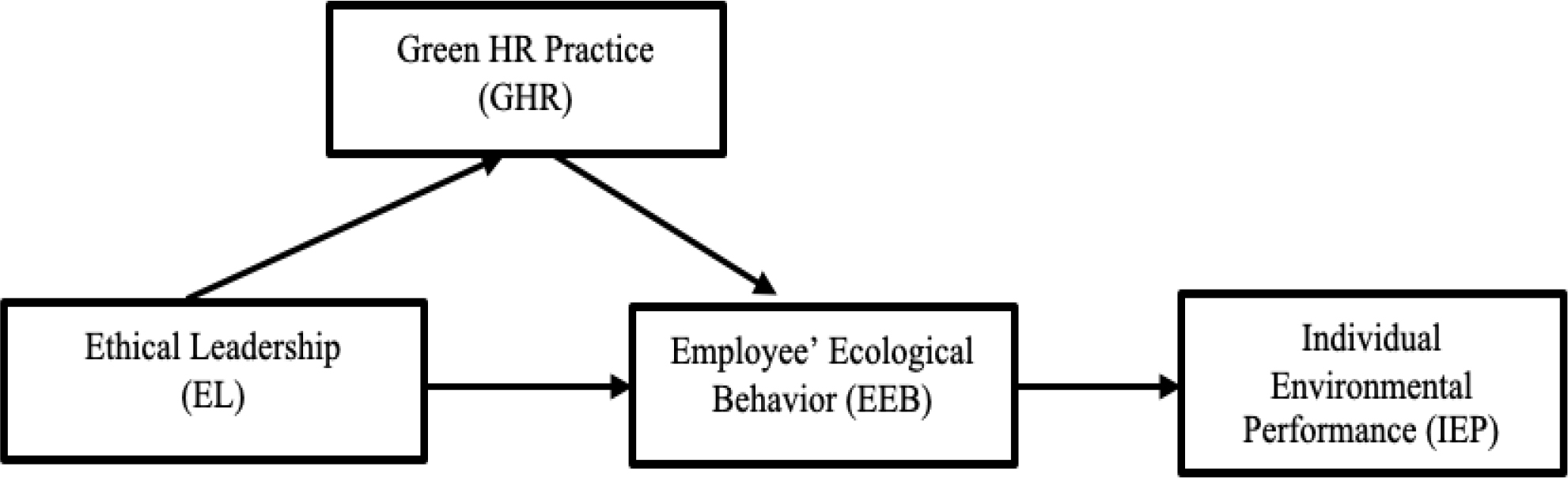
Figure 1.
Proposed model, developed for this study
(Source: Own elaboration)
The following hypotheses are proposed:
H1: Ethical leadership is positively associated with employees’ ecological behavior.
H2: Green HR practice mediates the impact of ethical leadership on employees’ ecological behavior.
H3: The impact of ethical leadership on individual environmental performance will be mediated by employees’ ecological behavior.
3. Methodology
Respondents in this study were academics from universities in the provinces of West Java and Banten, Indonesia. The data were collected by distributing research instruments via email and social media. Before distributing the questionnaire, researchers first recorded the respondents who were the target population. Initial identification is to determine the target number of samples based on the research objectives of 388 staff and lecturers. Both are permanent and contract employees, working for at least 3 months. Employees interact with leaders in daily activities. The perception of leadership is a leader who directly interacts with lecturers and staff.
Furthermore, researchers set university targets based on representation and determine the most relevant social media platforms for research: Facebook and WhatsApp. Researchers use lines of communication through friendship lines and relevant associations, including employment relationships. Next, the researcher compiled a questionnaire to be distributed. The questionnaire is compiled based on relevant references. Ethical leadership in this study was measured using the instrument developed by Ren, et al. (2020), namely, personal life in an ethical way. It defines success not only by results but also by the process of listening to subordinates. Meanwhile, the Renwick, et al. (2016) questionnaire measured green HR practices. It includes recruitment and selection, training and development, involvement and empowerment, pay and reward systems, and performance management. Refer Tariq, et al. (2020) for measurement of employees' ecological behavior. It involved activities such as printing on both sides of the paper, turning off the lights, advising to reduce environmental impact, helping colleagues clean up accidental spills, and reporting sources of pollution. Refer Paillé and Meija-Morelos (2019) for the measurement of individual environmental performance, which suggests the dimensions of EEP based on the concepts of Boiral and Paillé (2012): eco initiative, eco-civic engagement, and ecohelping.
Respondents' answers using a semantic differential scale from 1 to 5 began with not true at all (1), almost not true (2), slightly true (3), true (4), and very true (5). For 2 months, researchers collected data and obtained responses from 388 respondents. Researchers adhere to research ethics and respect user privacy by not uploading email addresses or WhatsApp groups. The stages in data analysis using SEM procedures start from model construction, discriminant validity testing, and composite reliability to goodness-of-fit evaluation and hypothesis testing. Researchers use the maximum likelihood estimation method and ensure that assumptions are met and free of outliers.
4. Results
The demographic characteristics of staff and lecturers are is shown in Table 1.
Table 1.
Demographic characteristic respondents
(Source: Own elaboration)
| Demographic characteristics | Amount | Percentage |
|---|---|---|
| Gender: | ||
| •Male | 216 | 55.7% |
| •Female | 172 | 44.3% |
| Age: | ||
| •Under 30 years old | 47 | 12.1% |
| •30 to 35 years old | 108 | 27.8% |
| •36 to 40 years old | 132 | 34.0% |
| •Over 40 years old | 101 | 26.0% |
| Education level: | ||
| •Bachelor | 38 | 9.8% |
| •Continuing master's degree | 52 | 13.4% |
| •Master’s degree | 242 | 62.4% |
| •Continuing doctoral degree | 39 | 10.1% |
| •Doctoral | 17 | 4.4% |
| Total respondents | 388 | 100% |
Data in Table 1 show that the majority of respondents are men. The age of the majority, 36 to 40, is 34%. The majority of educational background is S2 amounting to 62.4%. This shows that the respondents, staff, and lecturers have higher education backgrounds. The measurement model is used to measure the research model because it is reflective and can show how the manifest or observed variables represent latent constructs. The test is carried out by testing the validity and reliability of the indicators forming the latent construct through confirmatory factor analysis. We can analyze the data processing results based on the measurement model to get overall model fit data. Table 2 shows the measurement results of this study's overall model fit analysis. The value in the second parameter results from model improvement using the modification indices procedure in AMOS software.
Table 2.
Overall model fit analysis
(Source: Own elaboration)
| Goodness-of-fit parameters | 1st estimated parameters | 2nd estimated parameters | Cut-off value | Testing conclusion |
|---|---|---|---|---|
| Absolute fit: | ||||
| Chi-square (X2)/degree of freedom | 12.03 | 1.99 | < 2.00 | Good fit |
| P-value of chi-square (X2) | .000 | 0.000 | ≥ 0.05 | Poor |
| Root mean square error of approximation (RMSEA) | 0.17 | 0.05 | ≤ 0.08 | Good fit |
| Goodness-of-fit index (GFI) | 0.60 | 0.92 | > 0.90 | Good fit |
| Standardized root mean square residue (SRMR) | 0.05 | 0.02 | < 0.08 | Good fit |
| Expected cross-validation index (ECVI) | 7.74 | 1.50 | < 1.50 | Marginal fit |
| Incremental fit: | ||||
| Comparative fit index (CFI) | 0.77 | 0.98 | > 0.90; > 0.95 | Good fit |
| Normed fit index (NFI) | 0.75 | 0.97 | > 0.90; > 0.95 | Good fit |
| Tucker–Lewis Index (TLI) | 0.74 | 0.98 | > 0.90; > 0.95 | Good fit |
| Incremental fit index (IFI) | 0.77 | 0.98 | > 0.90; > 0.95 | Good fit |
| Relative fit index (RFI) | 0.72 | 0.95 | > 0.90; > 0.95 | Good fit |
| Adjusted goodness-of-fit index (AGFI) | 0.50 | 0.90 | ≥ 0.90 | Good fit |
| Parsimonious fit: | ||||
| Parsimony goodness-of-fit index (PGFI) | 0.49 | 0.63 | > 0.60 | Good fit |
| Akaike information index (AIC) | 3088.4 | 597.91 | < 600.00 | Good fit |
| Consistent Akaike information criterion (CAIC) | 3347.9 | 1072.10 | < 2097.43 | Good fit |
Based on Table 2, there are 13 good fits, 1 marginal fit, and 1 poor, and then, we can conclude that the fit between the data and model is a good fit. The RMSEA is better also now: 0.05, good fit. Then, we can continue the subsequent testing: measurement model fit analysis. Table 3 shows the result of the measurement model fit analysis. Measurement model fit analysis for validity testing can be conducted by conducting: 1. construct validity test, 2. convergent validity test, and 3. reliability test. In this step, we will do the construct validity test first by looking at the "CR (critical ratio)" score than the "P” (probability). Suppose the CR is > 1.96 (1.96 is the critical value at the significant level 0.05) and P < 0.05, then the indicator is valid, which is able to reflect the latent variable. If the "P" score shows "***," then it means that the "P" score is significant, targeted < 0.001.
Table 3.
Overall model fit analysis
(Source: Own elaboration)
| - | - | - | Estimate | S.E. | C.R. | P | Label |
|---|---|---|---|---|---|---|---|
| GHR | <--- | EL | .459 | .035 | 13.114 | *** | par_1 |
| EEB | <--- | EL | .064 | .018 | 3.578 | *** | par_2 |
| EEB | <--- | GHR | 1.033 | .092 | 11.177 | *** | par_3 |
| IEP | <--- | EEB | .948 | .042 | 22.318 | *** | par_24 |
| EL1 | <--- | EL | 1.000 | - | - | - | - |
| EL2 | <--- | EL | 1.080 | .066 | 16.353 | *** | par_4 |
| EL3 | <--- | EL | .965 | .046 | 21.047 | *** | par_5 |
| EL4 | <--- | EL | 1.301 | .061 | 21.188 | *** | par_6 |
| EL5 | <--- | EL | 1.081 | .066 | 16.310 | *** | par_7 |
| EL6 | <--- | EL | 1.024 | .064 | 15.980 | *** | par_8 |
| EL7 | <--- | EL | 1.291 | .062 | 20.918 | *** | par_9 |
| EL8 | <--- | EL | 1.306 | .062 | 20.996 | *** | par_10 |
| EL9 | <--- | EL | .770 | .048 | 15.931 | *** | par_11 |
| EL10 | <--- | EL | .979 | .060 | 16.276 | *** | par_12 |
| HRP1 | <--- | GHR | 1.000 | - | - | - | - |
| HRP2 | <--- | GHR | 1.244 | .086 | 14.537 | *** | par_13 |
| HRP3 | <--- | GHR | .747 | .075 | 10.019 | *** | par_14 |
| HRP4 | <--- | GHR | .612 | .066 | 9.321 | *** | par_15 |
| HRP5 | <--- | GHR | 1.156 | .095 | 12.175 | *** | par_16 |
| EEB6 | <--- | EEB | 1.000 | - | - | - | - |
| EEB5 | <--- | EEB | .874 | .045 | 19.227 | *** | par_17 |
| EEB4 | <--- | EEB | .906 | .050 | 18.025 | *** | par_18 |
| EEB3 | <--- | EEB | .890 | .043 | 20.751 | *** | par_19 |
| EEB2 | <--- | EEB | .859 | .048 | 17.828 | *** | par_20 |
| EEB1 | <--- | EEB | .786 | .048 | 16.377 | *** | par_21 |
| IEP1 | <--- | IEP | 1.000 | - | - | - | - |
| IEP2 | <--- | IEP | 1.030 | .039 | 26.366 | *** | par_22 |
| IEP3 | <--- | IEP | .747 | .053 | 14.003 | *** | par_23 |
Based on Table 3, we can see from Amos output that all observed variables have CR score > 1.96 and P score shows “***,” which means < 0.05. We conclude that the measurement model fit analysis fits the construct validity test. Then, we can continue the next step with the convergent validity test, testing the indicator to determine whether it has a high variance proportion. All the items/observed variables/indicators of a latent variable should converge or share the high variance proportion. The convergent validity test can be done by looking at the "loading factor" or the "standardized loading factor/SLF" score. If the SLF score is high, it shows that the observed variable and its latent variables converge or are valid. It will be converged/valid if the SLF score is ≥ 0.70. Table 4 shows the result of the convergent validity test.
Table 4.
Standardized regression weights
(Source: Own elaboration)
| - | - | - | Estimate |
|---|---|---|---|
| GHR | <--- | EL | .702 |
| EEB | <--- | EL | .088 |
| EEB | <--- | GHR | .923 |
| IEP | <--- | EEB | .948 |
| EL1 | <--- | EL | .728 |
| EL2 | <--- | EL | .787 |
| EL3 | <--- | EL | .693 |
| EL4 | <--- | EL | .993 |
| EL5 | <--- | EL | .786 |
| EL6 | <--- | EL | .771 |
| EL7 | <--- | EL | .983 |
| EL8 | <--- | EL | .987 |
| EL9 | <--- | EL | .629 |
| EL10 | <--- | EL | .675 |
| HRP1 | <--- | GHR | .761 |
| HRP2 | <--- | GHR | .955 |
| HRP3 | <--- | GHR | .645 |
| HRP4 | <--- | GHR | .583 |
| HRP5 | <--- | GHR | .915 |
| EEB6 | <--- | EEB | .874 |
| EEB5 | <--- | EEB | .796 |
| EEB4 | <--- | EEB | .810 |
| EEB3 | <--- | EEB | .810 |
| EEB2 | <--- | EEB | .787 |
| EEB1 | <--- | EEB | .747 |
| IEP1 | <--- | IEP | .883 |
| IEP2 | <--- | IEP | .914 |
| IEP3 | <--- | IEP | .672 |
Based on Table 4, all observed variables have the “standardized loading factor/SLF” ≥ 0.70, leading to the conclusion that all the variables are valid. However, there are five observed variables, namely, EL3, EL9, EL10, HRP3, and HRP4, which have an SLF score ≤ 0.70. Those five observed variables are still valid if the SLF score is ≥ 0.05. Table 5 shows the summary of all the validity testing results.
Table 5.
Summary up all the validity testing results
(Source: Own elaboration)
| Observed variables | Ethical leadership | Green HR practice | Employees ecological behavior | Individual environmental performance | Validity conclusion | ||||||||
|---|---|---|---|---|---|---|---|---|---|---|---|---|---|
| CR | P | SLF | CR | P | SLF | CR | P | SLF | CR | P | SLF | - | |
| EL1 | * | 0.000 | .728 | - | - | - | - | - | - | - | - | - | Valid |
| EL2 | 16.353 | 0.000 | .787 | - | - | - | - | - | - | - | - | - | Valid |
| EL3 | 21.047 | 0.000 | .693 | - | - | - | - | - | - | - | - | - | Valid |
| EL4 | 21.188 | 0.000 | .993 | - | - | - | - | - | - | - | - | - | Valid |
| EL5 | 16.310 | 0.000 | .786 | - | - | - | - | - | - | - | - | - | Valid |
| EL6 | 15.980 | 0.000 | .771 | - | - | - | - | - | - | - | - | - | Valid |
| EL7 | 20.918 | 0.000 | .983 | - | - | - | - | - | - | - | - | - | Valid |
| EL8 | 20.996 | 0.000 | .987 | - | - | - | - | - | - | - | - | - | Valid |
| EL9 | 15.931 | 0.000 | .629 | - | - | - | - | - | - | - | - | - | Valid |
| EL10 | 16.276 | 0.000 | .675 | - | - | - | - | - | - | - | - | - | Valid |
| HRP1 | - | - | - | * | 0.000 | .761 | - | - | - | - | - | - | Valid |
| HRP2 | - | - | - | 14.537 | 0.000 | .955 | - | - | - | - | - | - | Valid |
| HRP3 | - | - | - | 10.019 | 0.000 | .645 | - | - | - | - | - | - | Valid |
| HRP4 | - | - | - | 9.321 | 0.000 | .583 | - | - | - | - | - | - | Valid |
| HRP5 | - | - | - | 12.175 | 0.000 | .915 | - | - | - | - | - | - | Valid |
| EEB1 | - | - | - | - | - | - | 16.377 | 0.000 | .747 | - | - | - | Valid |
| EEB2 | - | - | - | - | - | - | 17.828 | 0.000 | .787 | - | - | - | Valid |
| EEB3 | - | - | - | - | - | - | 20.751 | 0.000 | .810 | - | - | - | Valid |
| EEB4 | - | - | - | - | - | - | 18.025 | 0.000 | .810 | - | - | - | Valid |
| EEB5 | - | - | - | - | - | - | 19.227 | 0.000 | .796 | - | - | - | Valid |
| EEB6 | - | - | - | - | - | - | * | 0.000 | .874 | - | - | - | Valid |
| IEP1 | - | - | - | - | - | - | - | - | - | * | 0.000 | .883 | Valid |
| IEP2 | - | - | - | - | - | - | - | - | - | 26.366 | 0.000 | .914 | Valid |
| IEP3 | - | - | - | - | - | - | - | - | - | 14.003 | 0.000 | .672 | Valid |
Reliability testing with construct reliability (CR) test measures the data's reliability and consistency. A CR score ≥ 0.70 shows good reliability in the latent variable/construct. However, 0.60 ≥ CR ≤ 0.70 is still acceptable if the validity testing results for the indicator are valid. We can count the CR score for the latent variables with the above formula. Another reliability test uses the average variance extracted (AVE) to complete the CR score. The AVE score ≥ 0.50 shows good convergence in the latent variable/construct. The CR and VE scores are provided in Table 6, summarizing all the reliability testing results.
Table 6.
Summary of all the reliability testing results
(Source: Own elaboration)
| Latent variables | CR score | VE score | Conclusion |
|---|---|---|---|
| Ethical leadership (EL) | 0.95 ≥ 0.70 | 0.67 ≥ 0.50 | Reliable |
| Green HR practice (GHR) | 0.89 ≥ 0.70 | 0.62 ≥ 0.50 | Reliable |
| Employees ecological behavior (EEB) | 0.92 ≥ 0.70 | 0.65 ≥ 0.50 | Reliable |
| Individual environmental performance (IEP) | 0.87 ≥ 0.70 | 0.69 ≥ 0.50 | Reliable |
Based on Table 6, we can conclude that all latent variables are reliable. Therefore, as all the variables pass the reliability testing, we can continue to the following testing fit analysis: structural model fit analysis or hypothesis analysis. The critical decision in structural model fit or hypothesis testing is checking the P-value with a significant level (alpha) at 0.05 or comparing the CR (critical ratio) score with the t-table (1.96). Table 7 shows the result for testing fit-structural model fit analysis (hypothesis testing).
Table 7.
Hypothesis testing
(Source: Own elaboration)
| Hypothesis | Path | Standardized loading | P-value | CR score | Conclusion |
|---|---|---|---|---|---|
| 1 | EEB <--- EL | .088 | 0.000 | 3.578 | Significant |
| 2 | GHR <--- EL | .702 | 0.000 | 13.114 | Significant |
| 2 | EEB <--- GHR | .923 | 0.000 | 11.177 | Significant |
| 3 | IEP <--- EEB | .948 | 0.000 | 22.318 | Significant |
Based on Table 7, all relationships have a CR (critical ratio) score > 1.96, all P-values are < 0.05 as well, and evaluating the standardized loading factor, all are <1.00. Therefore, we conclude that all the hypotheses are accepted.
5. Discussion
The results show that the role of ethical leadership is very significant both directly and through a structured mechanism, namely, green HR practice. In line with Arar, et al. (2016) regarding ethical leadership that serves to solve ethical dilemmas and Molly and Johan (2017), Bäckström, et al. (2018), and Riggio, et al. (2010) who show that ethical leadership provides a critical foundation for directing individual systems and behaviors to be more environment friendly (Islam, et al., 2021, Althnayan, et al., 2022; Kohl, et al., 2022;). Bui, et al. (2022) demonstrate that ethical leaders serve as a role model, influencing actions that are based on ethics; ethical leadership can function to facilitate the HR governance system to be oriented to shape behaviors that support sustainability. Leaders can realize environment-friendly subordinate behavior and environmental performance through direct mechanisms in social exchange interaction (LMX) as well as through green HR practice as described by Farrukh, et al. (2022).
Environment-oriented HR management is carried out based on the ethical awareness of the organization on ecological issues. The ethical leader directs human resource practice to reflect on norms and principles or moral values that are oriented and place nature and humans as one unit, as stated by Ahmad, et al. (2022) and Islam, et al. (2021). Activities such as designing green job descriptions for employees (and green goals are included in the job description) or recruiting environmentally aware employees as part of the interview can be held with a value system and the underlying principles. As Julius and Nagel (2020) hold, HR management is a critical reflection of what individuals must do to face moral choices related to environmental issues.
In the training process and the implementation of environmental management in the green HR management system, a curriculum has been developed to encourage awareness of environmental ethics. Activating environmental norms in the green HRM system is an operational training framework. Values of environmental awareness may establish the basis for training needs analysis. HR management integrates training instruction, skill development, and employee competencies based on their orientation to ecological issues. The green HRM practice system actualizes the company's support for collective efforts to solve ecological problems based on the results of critical reflection. Activation of norms requires the support of a green HRM system in the form of involvement. Employee participation in green schemes includes encouraging employees to use environment-friendly transportation and setting up structures, including CEOs, to increase environmental action. HRM is at more than just the technical or operational level. Green HRM is a strategic partner that determines environment-friendly company policies through the organizational structure. Moral values in the environment are applied more broadly in organizational life. Green HRM is a critical reflection on the role of employees in facing moral choices related to sustainability issues. It becomes the basis for companies to assess performance from an environmental awareness perspective.
The interaction between leaders and subordinates as a model is a social learning process that can encourage subordinates' normative awareness of their behavior and performance. Green HRM activities determine changes in behavior that affect performance levels. Ethical leadership is one of the sources of value that encourages green HR practices to orient environment-friendly individual performance. The theoretical implication is the development of LMX theory about normative activation. The practical implication is to develop relationships between leaders and subordinates both directly and through existing structures, namely, green HR practices, to encourage changes in employee behavior that are environment friendly.
Leaders influence subordinates by two mechanisms: directly or through green HR practices. Both mechanisms are built on LMX and interactions that create awareness of environmental norms and responsibilities. In line with Tariq, et al. (2020) in their research, which proves the influence of leadership and green HRM on attitude and performance, both aim to form employees' ecological behavior for environmental performance. Ethical leaders as a driving force for the operation of an environment-friendly HR management system are in line with Northouse (2019), Skubinn and Herzog (2016), and Toytok and Kapusuzoglu (2016), who show the position of ethical leaders in organizational behavior.
The formation of employees' ecological behavior is influenced by ethical leadership in line with the research by Jordan, et al. (2013) through interactions between leaders and subordinates using exchange and learning mechanisms. Leadership as a role model realizes itself not only as a social being but also as an example of an ecological creature. Leaders recognize and respect diversity and ecological complexity through their interactions with subordinates. Ethical leadership orientation is the exchange and learning of the sources of existence and sources of life for organisms in nature. Leaders and subordinates have a moral responsibility based on a critical awareness of the position of humans and nature. Leaders play a role in creating learning relationships to activate environmental norms. Leaders encourage the growth of normative awareness with influence, trust, and ethical learning. Leaders encourage the learning process by showing and setting examples of environment-friendly behavior and still showing the interest of employees in them to live better. Leaders understand how to influence subordinates to learn about environmental norms, facilitate processes and leadership, and influence subordinates to participate in collective efforts to solve environmental problems. The legitimacy of modeling success and communicating the vision can be seen from the subordinates' normative awareness of the environment.
The process for establishing employees' ecological behavior (EEB) through green HRM practice is based on values that indicate responsibility for the environment in line with Kim, et al. (2019) and Alzgool (2019). Integrating values oriented toward solving environmental problems into the HR management system affects the attitudes and behavior of environment-friendly employees. Recruitment is a realization of responsibility for the environment in selecting employees and interviewers in recruitment. Involvement and training practices encourage normative awareness of the environment. This reflective awareness is emancipatory.
6. Conclusions
Green HRM practices encourage employees to integrate environment-friendly behaviors into their routines, such as reducing energy consumption, minimizing waste, and promoting recycling. By promoting these behaviors, organizations can significantly reduce their ecological footprint and contribute to the larger goal of environmental preservation. Furthermore, companies that actively involve their employees in environmental initiatives foster a culture of sustainability, attracting like-minded individuals who seek to make a positive impact. Green HRM practices are pivotal in driving organizational change toward environmental sustainability. By promoting ethical awareness, encouraging eco-friendly behaviors, involving employees in collective activities, and integrating sustainability into decision-making processes, companies can make a meaningful contribution to solving environmental problems while fostering a positive work environment and enhancing their long-term success.
6.1. Theoretical Contributions
The formation of employees' ecological behavior (EEB) is influenced by ethical leadership, through interactions between leaders and subordinates using exchange and learning mechanisms. Leadership as a role model realizes itself not only as a social being but also an example of an ecological creature. Leaders show recognition and respect for diversity and ecological complexity through their interactions with subordinates. Ethic leadership orientation is the exchange and learning of the sources of existence and sources of life for organisms in nature. Leaders and subordinates have a moral responsibility based on a critical awareness of the position of humans and nature. Leaders play a role in creating learning relationships to activate environmental norms. Leaders encourage the growth of normative awareness with influence, trust, and ethical learning. Leaders encourage the learning process by showing and setting examples of environment-friendly behavior and still showing the interests of employees in them to live better. Leaders understand how to influence subordinates to learn about environmental norms, facilitate processes and leadership, influence subordinates to participate in collective efforts to solve environmental problems. The legitimacy of modeling success and communicating the vision can be seen from the subordinates' normative awareness of the environment.
6.2. Practical Contributions
The process for establishing employees' ecological behavior (EEB) through green HRM practice is based on values that indicate responsibility for the environment. The integration of values oriented toward solving environmental problems into the HR management system affects the attitudes and behavior of environmentfriendly employees. Recruitment is a realization of responsibility for the environment, both in selecting employees and interviewers in recruitment. Involvement and training practices encourage normative awareness of the environment. This reflective awareness is emancipatory. Radical changes in green HRM practices can manifest an ecological crisis and an organization's collective contribution to the environment. HR practice to shape employee ecological behavior is based on critical awareness of moral norms and rules that govern both employee behavior and organizations in dealing with nature. Green HRM practice as a joint agenda between companies and employees is based on ethical awareness of biocentrism and eco-centrism to save life and the whole ecosystem.
6.3. Limitation
This study has limitations in scope as it is one of the first studies to examine the multi-mediated effects of ethical leadership on individual environmental behavior. The study was conducted in Indonesia, which is culturally unique. The respondents were lecturers and staff at universities that did not involve companies with a significant environmental impact, such as mining, plastics, and pesticides. Further research could extend to various companies with a significant environmental impact. One theoretical limitation of this study is its limited scope in examining the multi-mediated effects of ethical leadership on individual environmental behavior. As one of the first studies in this area, it may only capture part of the full range of variables and mechanisms contributing to the relationship between ethical leadership and environmental behavior. Further research is needed to explore additional factors and potential mediators or moderators that could enhance our understanding.
Appendices
8 APPENDICES: QUESTIONNAIRE DEVELOPMENT
ETHICAL LEADERSHIP (Ren, et al., 2020)
Conducting personal life in an ethical manner.
Defining success is not only my results but also by how it is obtained.
Listen to what employees have to say.
Discipline employees who violate ethical standards.
Make fair and balanced decisions.
Can be trusted.
Discussing business ethics or values with employees.
Setting examples of how to do things the right way ethically.
Putting the best interests of employees in mind.
When making a decision ask what is the right thing to do?
GREEN HR PRACTICE (Renwick, et al., 2016)
Recruitment and Selecting
There is an environment-friendly job description for the employee (and green goals are included in the job description).
Perceptions of green practice graduates (applicants use environment-friendly criteria).
Candidates for environment-friendly workers.
Recruitment of “green aware” employees as part of the interview.
Green company image (green employer).
Environment-friendly aspects are introduced to the induction process (introduction) of prospective employees.
Training and Development
There is training and process/use of materials regarding environmental management.
There is a training needs analysis on environmental management.
Integration of training instruction and green value generalizations.
Development of employee skills and competencies to build environmental management.
Socialization of value/environment-friendly management.
Use of an environment-friendly team (environmental management).
Train staff to improve skills in environment-friendly workspace analysis.
Job rotation to train environment-friendly managers/employees in the future.
Integrate training to increase staff knowledge.
Training in environmental management aspects such as safety, energy efficiency, waste management, and recycling.
Safety assurance for employees in providing environment-friendly field data.
Build employee personal skills development that is environmentally friendly.
Retraining due to loss of staff who pollute the environment.
Involvement and Empowerment
Employee involvement and participation in an environment-friendly suggestion and problem-solving recommendation scheme.
Independence of staff to form and experiment environment-friendly ideas
Integrate employee engagement and participation (EI and P) to staff for maintenance (cleaning).
Employee helpline for guidance on environmental issues.
Adjust the environment-friendly employee engagement and participation (EI and P) scheme according to industry/company standards.
Increased pathways/supervision that supports environment-friendly behavior.
Unions negotiate environment-friendly work place agreements.
Training of union representatives in environmental management.
Environment-friendly elements are part of the process of improving health and safety.
Encourage employees to use environment-friendly transportation.
Prepare a structure including the CEO to increase action in the environment management.
Introducing a whistleblowing helpline regarding eco-friendly customer/support.
Discipline and/or dismissal due to environmental management violations.
Payment and Reward Systems
An environment-friendly payment/reward system for employees.
Customize packages with eco-friendly skill acquisition rewards.
Use of monetary-based pay rewards for environment-friendly employees (bonus, cash, premium).
The use of nonmonetary benefits based on environment-friendly management (sabbatical, leave, gifts).
Recognition-based uses of rewards in environmental management (awards, dinners, publicity, external roles, daily praise).
Develop support in environmental management (criticism, warnings, suspensions for deviations).
Develop positive rewards in environmental management (feedback).
Formulate policies for all employees to get environment-friendly/citizenship/OCB assignments (especially seniors).
Link the suggestion scheme to the reward system.
Link participation in eco-friendly initiatives for promotion/career advantage (advanced managers support staff in EM).
Use environment-friendly tax breaks.
Have a reward system that motivates environmental management employees.
Performance Management
Green communication schemes for all levels of staff through dialogue on green issues at all levels.
Target setting based on friendly goals and environmental responsibility.
The role of managers in achieving Green results is included in the assessment.
Write and integrate environment-friendly criteria into assessments.
Environmentally friendly incident number assessment and assessment.
Responsible use of environmental policy communications.
Penalties for noncompliance with targets for environmental management.
Employees' ECOLOGICAL BEHAVIOR (EEB) (Tariq, et al., 2020)
Print on both sides of the paper.
Turning off the lights leaving the office.
Prefer reusable items rather than disposable.
Using public transportation rather than private cars.
Prefer bicycles for traveling in the area.
Assist organizations in greening activities and taking action to protect the natural environment.
INDIVIDUAL ENVIRONMENTAL PERFORMANCE (IEP) (Boiral and Paillé, 2012)
I voluntarily carry out activities and initiatives to protect the environment in my daily work (eco-initiative).
I volunteer for projects, businesses, or events that discuss environmental issues in my organization (eco-civic engagement).
I stay informed about my company's environmental initiatives (eco-helping).