

1. Introduction
Strategic orientation plays a crucial role in influencing an enterprise’s ability to absorb information from the outside (Akgün and Polat, 2022). The connection between strategic orientation and in to business performance is well-documented in the literature, indicating that it serves as a guiding force for companies, leading them toward achieving a competitive advantage, ensuring business sustainability, and improving performance by understanding market dynamics (Sawal Sartono, et al., 2024; Ibini, et al., 2024).
Leo, et al. (2022) have highlighted the dynamic characteristics of the agribusiness sector, which is marked by rapid changes and uncertainty. Consequently, it becomes imperative for enterprises operating in this sector to consistently adjust to evolving demands and uphold their competitive advantage (Sachitra and Siong-Choy, 2019). According to Tekleselassie (2021), among Ethiopia’s manufacturing sectors, the agribusiness sector, particularly the food and beverage sector, contributes the highest value to both the country’s GDP and employment opportunities. Due to this, the sector plays an essential role in the country’s strategy for industrialization, emphasizing industries that possess significant export potential and can effectively utilize affordable labor and agricultural resources on a broader scale (Ahmad, 2022). As a result, the establishment of competitive agribusiness enterprises becomes essential for generating employment opportunities and income prospects (Samuel, 2019).
According to Leitão, et al. (2023), specific capabilities, such as market orientation, entrepreneurial orientation, organizational learning, technology and innovation capability, knowledge management, and absorptive capacity, are critical for increasing the performance of agribusiness firms. In light of the above arguments, it is fascinating to examine how the configuration of strategies and capabilities explains the performance of agribusiness firms in a volatile business climate. According to existing literature, strategic orientation has been identified as a key factor influencing firm performance (Han, et al., 2022; Wang, 2022; Dameshifa, et al., 2023; Maclean, et al., 2023). Nevertheless, scholars have mainly concentrated on investigating the impact of individual strategic orientations and acknowledged their beneficial impact on company performance (Lestari, et al., 2023; Karaev and Mercan, 2023; Nakabuye, et al., 2023).
Moreover, current empirical data indicate that companies that depend only on one strategic orientation are at risk of experiencing failure in the long term (Schweiger, et al., 2019; Khizar, et al., 2023a). Moreover, over the past few years, there has been a growing acknowledgment of the significance of the complementary effects that arise when different strategic orientations are combined (Hakala, 2011; Schweiger, et al., 2019; Beliaeva, et al., 2020; Khizar, et al., 2023a) drawing on the understanding that companies actively adopt and strives to balance multiple strategic orientations to attain superior performance (Ho, et al., 2016; Ho and Plewa, 2020; Khizar, et al., 2023a).
Scholars in this field are increasingly reaching a consensus that the performance of a company is influenced by the alignment of various factors, including the firm’s characteristics, strategies, and external conditions (Fainshmidt, et al., 2019; Ho and Plewa, 2020; Khizar, et al., 2023b). Previous studies have argued that by adopting a strategic orientation, organizations can develop a resilient and adaptable ability to innovate, leading to a distinct competitive advantage (Maclean, et al., 2023). Fu, et al. (2021) argued that the performance of a firm is influenced by a synergistic interplay between its internal capabilities and the variabilities of its external environment, including factors such as environmental dynamism. Ruba, et al. (2023) propose that the contingency perspective puts forth the idea that a company’s performance is dependent on the dynamic nature and stability of the business environment.
Although some configurational studies exist, such as Deutscher, et al. (2016), Ho, et al. (2016), Ho and Plewa (2020), Khizar, et al. (2023b), and Soetanto, et al. (2024), they often overlook the complex interdependencies and trade-offs among multiple strategic orientations and innovation capabilities in a complex and evolving business landscape. More empirical studies are needed to validate the configurational approach in diverse contexts, particularly within the agribusiness firms in Ethiopia, to establish transparent causal relationships and practical implications. This study employed fuzzy-set qualitative comparative analysis (fsQCA) to examine how internal and external variables work together, providing a comprehensive view where “the whole is best understood from a systematic perspective and should be viewed as a constellation of interconnected elements” (Fiss, et al., 2013, p.2).
The adoption of the fsQCA approach is becoming increasingly common in the field of strategic orientation literature (Deutscher, et al., 2016; Ho, et al., 2016; Ho and Plewa, 2020; Khizar, et al., 2023b; Soetanto, et al., 2024). As a result, this research utilized a configurational approach to analyze the combinations of strategic orientations such as market, entrepreneurial, learning, and technology orientations along with innovation capability and environmental dynamism to elucidate their synergistic impact on agribusiness firm’s performance.
This research provides several innovative insights into the existing strategic management body of knowledge. To the best of our knowledge, previous studies have not combined the impact of strategic orientation dimensions, innovation capability, and environmental dynamism on firm performance despite extensive research on the topic. Therefore, this study examines how different configurations of strategic orientation dimensions, innovation capability, and environmental dynamism enhance firm performance by using fsQCA. Examining the configuration of strategic orientation, innovation capability, and environmental dynamism in influencing Ethiopian agribusiness firms’ performance is very crucial due to the sector’s significant contribution to Ethiopia’s economy, significantly contributing to GDP and employment. Adopting a configurational perspective offers a comprehensive analysis of how strategic orientation, innovation, and environmental factors interact in influencing agribusiness firm performance. This study fills the existing literature gap as there are no studies that specifically examine these relationships within the context of Ethiopian agribusiness firms. The study can provide valuable insights for policymakers and contribute to a better understanding of performance drivers. Additionally, this research is specifically carried out in the setting of emerging economies (Agribusiness companies in Ethiopia), while the majority of past studies concentrated on developed economies. Hence, this research helps in broadening the applicability of studies on strategic orientation by examining this concept within a distinct setting.
The rest of this paper is organized as follows: the first section presents the literature review, followed by the methodology described in section 2. Subsequently, the study presents the results and discussion. Finally, the paper concludes with a section that encompasses conclusions, implications, limitations, and suggestions for future research.
2. Literature review
2.1. Configurational theory
In the field of management, configurational theory asserts that organizations should be viewed as “clusters of interconnected structures and practices, rather than as modular or loosely coupled entities whose components can be understood in isolation” (Fiss, 2007, p.1180). Configurational theorizing redirects researchers’ focus from evaluating the “net effects” of causal conditions to gaining a deeper contextual comprehension of the various ways in which causal conditions can interact to generate a specific outcome (Ragin, 2008). Configurational theorizing operates under the premise that the outcome of interest should be associated with specific combinations or configurations of causally relevant conditions. Instead of focusing on individual variables, this approach emphasizes the importance of examining how a particular condition can have varying effects on the outcome depending on its interaction with other conditions (Iannaci and Kraus, 2023). Thus, this study was guided by configurational theory because it allows the researcher to examine which configurations combining strategic orientation dimensions: market, entrepreneurial, learning, technology orientation, innovation capability, and environmental dynamism that enable agribusiness firms to achieve superior performance.
2.2. The complementary effect of strategic orientation on performance
Many studies only look at one orientation or the direct effects of each orientation, and there is limited empirical evidence about how they might work together as a whole. However, Hakala (2011) proposes that adopting a complementary approach would be the most fruitful way to improve knowledge of orientations as principles and adaptive behaviors that contribute to a firm’s performance. Additionally, the author argues that additional emphasis should be paid to previously understudied pairs (technology, learning, and entrepreneurial orientations) and the interaction of three or more orientations. Using a configurational viewpoint, Deutscher, et al. (2016) investigated the combined effect of entrepreneurial, market, and learning orientations on high-technology firm growth-based performance. The results show that the performance of high-technology firms is dependent on configurations, with firms with high levels of entrepreneurial, market, and learning orientation outperforming firms with lower levels of these characteristics.
Ho, et al. (2016) also found that the combinations of market, entrepreneurial, relationship, and technology orientation lead to high profitability. As stated by Beliaeva, et al. (2020), various strategic orientations offer distinct methods for sustaining a competitive advantage. These orientations can synergistically complement each other, produce additional value, and enhance overall business performance. In research conducted by Wales, et al. (2020), it was found that the complementary effects of entrepreneurial, market, and learning orientation have a vital role in explaining a significant portion of the variations observed in sales growth. Khizar, et al. (2023a) conducted fsQCA and found that the financial performance of SMEs is influenced by the configuration of entrepreneurial orientation, market orientation, sustainability orientation, and competition intensity. The preceding points indicate that the firm performance is influenced by the configuration of market, entrepreneurial, learning, and technology orientation. In this study, the researcher examined the configuration of market, entrepreneurial, learning, and technological orientation in the context of agribusiness firms’ performance to test the complementarity between strategic orientations in explaining the firm’s performance. Therefore, the researcher proposes:
P1 Market, entrepreneurial, learning, and technology orientation can contribute to performance, but an individual dimension alone is not sufficient to produce high levels of performance.
2.3. Innovation capability and performance
Organizations with innovation capabilities can successfully encourage innovation by integrating critical capabilities and resources within their organizations (Stronen, et al., 2017). According to Magni, et al. (2022), innovation is a crucial component of competitive advantage and performance, as well as the primary driver of economic growth. Innovation capability acts as a vital and necessary dynamic competence that empowers enterprises to adapt and respond effectively to the dynamic business environment while simultaneously enhancing their ability to transform operational procedures to create new and distinctive products and services (Maclean, et al., 2023; Sarwar, et al., 2023). As a result, this study proposes the following:
P2: Innovation capability can contribute to performance, but innovation capability alone is not sufficient to produce high levels of performance.
2.4. The role of environmental dynamism
Previous studies have examined the effect of environmental dynamism as a moderating variable in the relationship between strategic orientation dimensions and performance (Sajjad, et al., 2022; Karpacz and Wojcik-Karpacz, 2023). According, to Fu, et al. (2021), performance is influenced by both the internal capabilities of a company and the dynamics of its external environment, including factors like environmental dynamism. Ruba, et al. (2023) further argued that the performance of a company is determined by the dynamism and stability of the business environment from a contingency perspective. Beliaeva, et al. (2020) suggest that analyzing the core distinctions in strategic orientations among firms enhances understanding and valuable insights into how organizations can effectively arrange their internal operations and position themselves externally to address the challenges posed by their competitive surroundings effectively. As a result, this study proposes the following:
P3: Environmental dynamism can contribute to performance, but environmental dynamism alone is not sufficient to produce high levels of performance.
2.5. The interplay of strategic orientations, innovation capability, and environmental dynamism
The competitiveness of a firm and its ability to gain a competitive advantage is heavily influenced by the resources and capabilities it possesses (Schweiger, et al., 2019). As stated by Hakala (2011), strategic orientation is considered as “principles that direct and influence the activities of a firm and generate the behaviors intended to ensure the viability and performance of the firm” (p. 200). Furthermore, numerous empirical studies have highlighted the importance of synergistic effects stemming from the combination of multiple strategic orientations based on the notion that firms regularly employ and strive to balance multiple strategic orientations to achieve superior performance (Deutscher, et al., 2016; Ho, et al., 2016; Ho and Plewa, 2020; Khizar, et al., 2023a).
Previous research has contended that when an organization embraces a strategic orientation, it has the potential to cultivate a resilient and flexible capacity for innovation, thereby resulting in a unique competitive edge (Maclean, et al., 2023). Innovation capability serves as a crucial and indispensable dynamic competence that enables businesses to effectively adapt and respond to the ever-changing business landscape. It also strengthens their capacity to transform operational processes and generate novel, unique products, and services (Maclean, et al., 2023; Sarwar, et al., 2023). According to Zhani, et al. (2021), a company can gain a competitive advantage in its business operations by embracing a strategic orientation that establishes both direction and culture.
Moreover, significant progress has been made in strategic management research, with a growing emphasis on the need to explore complex causal relationships within the internal and external environments of organizations (Ho and Plewa, 2020; Fainshmidt, et al., 2019; Khizar, et al., 2023b). In line with this argument, this study proposes that the configuration of strategic orientation dimensions, innovation capability, and environmental dynamism leads to superior performance. In summary, the above arguments suggest that the strategic orientation dimensions, in combination with innovation capability and environmental dynamism, will likely enhance firm performance. The conceptual framework is presented in Figure 1.
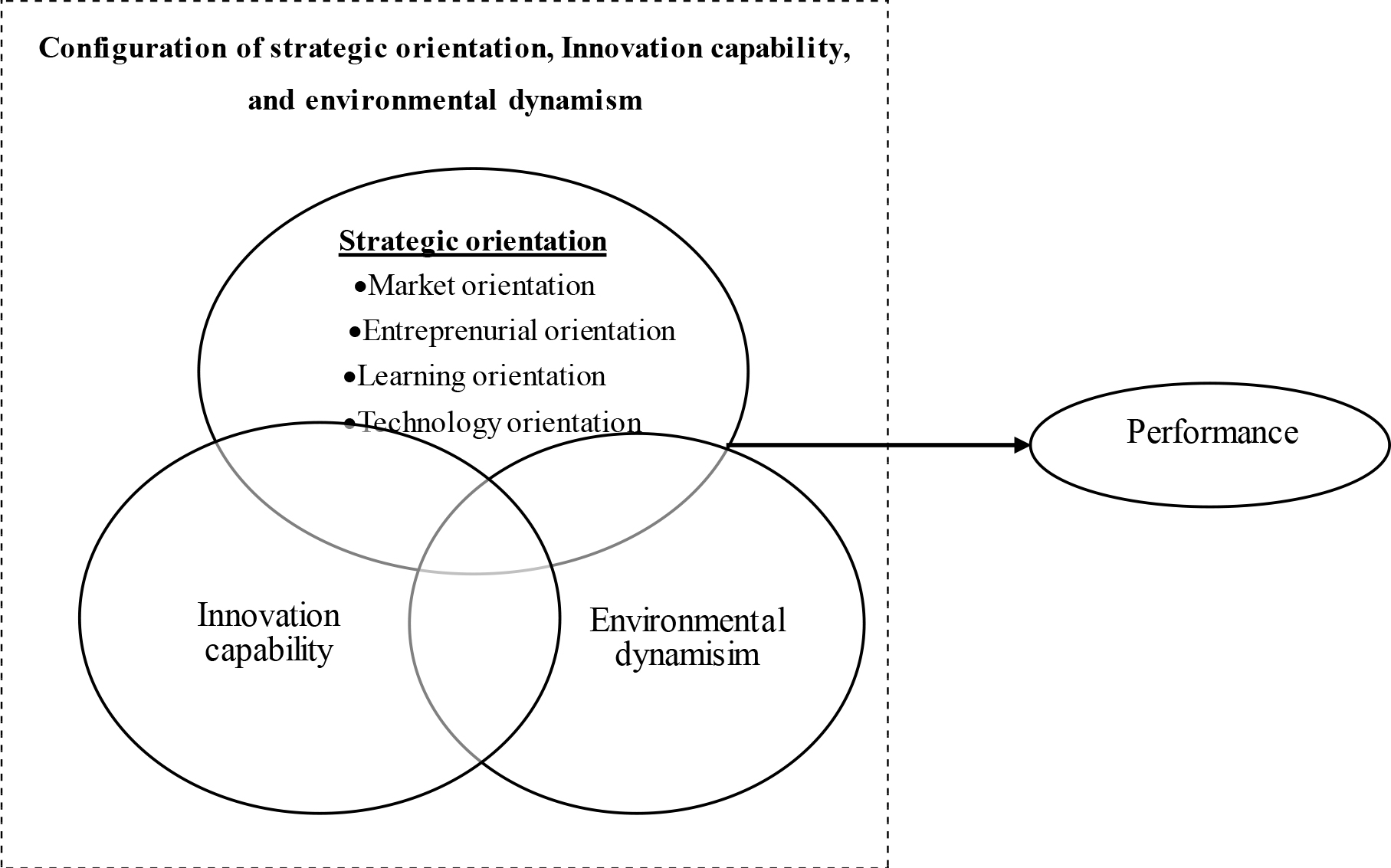
Figure 1.
Conceptual framework
(Source: Authors’ own research)
Thus based on the above argument, the study proposes:
P4. Strategic orientation dimensions, innovation capability, and environmental dynamism complement each other to enhance firm performance.
3. Methodology
3.1. Research design
The study employed a quantitative research design to examine causal relationships among multiple variables. Using fsQCA, researchers can explore how various configurations of strategic orientation and innovation capabilities interact with environmental factors to influence firm performance. fsQCA is particularly suited for analyzing complex causal configurations. A quantitative approach allows for the systematic investigation of these interactions, revealing how different combinations of factors contribute to varying performance outcomes.
3.2. Research paradigm
The study employed a positivist research paradigm to investigate configurations of strategic orientation dimensions, innovation capability, and environmental dynamism in explaining agribusiness firms’ performance. This approach aligns with the research objective of determining particular configurations that lead to improved performance of agribusiness firms. The positivist research paradigm underlies the notion that these interactions can be empirically tested and validated, providing a robust framework for analyzing the interplay between strategic orientations, innovation capabilities, and environmental factors.
3.3. Study context and sampling
Although strategic orientations are equally essential for any business irrespective of their sizes, scopes, and industries, the specific focus of the current study is on agribusiness firms operating in and around Addis Ababa due to the concentration of industries in Ethiopia within and around the capital city (Tigabu and Gebeyehu, 2020). The sample firms were selected by using a stratified random sampling technique based on their geographic location. Stratified random sampling enables the researcher to minimize sampling bias and increase sample representativeness as it ensures that important subgroups are not underrepresented or overrepresented. It allows researchers to make valid inferences about the entire population or specific subgroups within it.
The data were collected from the top managers (such as owners, CEOs, and senior managers) representing agribusiness firms located in Addis Ababa and its surroundings. A self-administered questionnaire was employed to collect data from agribusiness firms in Ethiopia. To accomplish the study objective, the unit of analysis encompasses top managers who are likely to have the knowledge required to answer the questionnaire. Furthermore, only firms that have been operating for at least five years were included to assess the long-term impact of strategic orientation on performance.
From the sample frame, a total of 1,251 agribusiness firms were identified using the Ethiopian Investment Commission database. Consequently, applying the Yamane (1967) formula, a sample size of 303 respondents was determined. Additionally, to account for potential low response rates or inappropriate responses and to enhance the generalizability of the findings, 10% of the sample size was added. A total of 333 respondents were proportionally selected from agribusiness firms operating in Addis Ababa and its surrounding areas, including the Oromia Special Zone, Adama, Modjo, Dukam, and Bishoftu. Data collection occurred from August 2022 to February 2023, targeting top managers such as owners, CEOs, and senior managers from these firms. Of the 333 questionnaires distributed, 301 were returned; however, only 288 questionnaires (86.5%) were fully completed and considered valid for further analysis. To attain an 86% response rate, the researcher employed various strategies, including targeting relevant respondents who were interested in the research topic. The survey was designed to be concise, promoting completion. Additionally, the researcher sent reminders to encourage timely responses to the questionnaire.
3.4. Construct measurement
Likert scales with five points, from 1 (strongly disagree) to 5 (strongly agree), were used to rate each item in the questionnaire. To ensure the content validity of the variables, the measurement of constructs was adapted from the existing literature to develop a questionnaire. The details of the study constructs are given hereunder. The measurement of strategic orientation is grounded in four dimensions: technology, market, entrepreneurial, and learning (Hakala, 2011; Lee, et al., 2014). The market orientation scale was adopted by Narver and Slater (1990) and comprised three dimensions: customer orientation (six items), competitor orientation (four items), and inter-functional coordination (five items). The entrepreneurial orientation scale consisted of nine items classified into three dimensions: innovativeness, pro-activeness, and risk taking (Covin and Slevin, 1991).
For the measurement of learning orientation, the researcher adopted 11 items and was measured on three dimensions: commitment to learning (four items), shared vision (four items), and open-mindedness (three items) (Sinkula, et al., 1997). Technology orientation was measured by using four items adopted from Lee, et al. (2014). Six items were adopted from Akman and Yilmaz (2019) to measure innovation capability. Environmental dynamism was measured using four items adopted from Han, et al. (2022a). For measuring performance, the outcome of interest, the study used nine items with three dimensions: financial returns, operational excellence, and marketing performance (three items for each dimension), adopted from Wu, et al. (2015) and Ilmudeen, et al. (2020).
3.5. Data analysis technique
Before conducting fsQCA, it is essential to evaluate the reliability and validity of the constructs. Accordingly, the reliability and validity tests were performed, and the data met the validity and reliability issue. The research utilized the fsQCA method to investigate the study’s proposition. As described by Ragin (2008), fsQCA is an approach that employs set theory and fuzzy logic to conduct comparative configurational analysis. The main aim of fsQCA is to find a group of combinations that can effectively clarify a specific result (Woodside, 2014).
According to Fiss (2011), fsQCA examines the complex causal relationships between antecedent conditions and a specific result. Previous research studies by Deutscher, et al. (2016), Ho, et al. (2016), Ho and Plewa (2020), Cheng, et al., (2023), and Khizar, et al.(2023b) have shown that using fsQCA to analyze the impact of strategic orientation, firm capabilities, and external environment on performance is a valid approach. Because of the complex relationship between internal and external factors influencing company performance, fsQCA appears to be an appropriate methodology for this research. The fsQCA allows the researcher to identify potential combinations of strategic orientations, innovation capability, and environmental dynamism that show strong associations with positive results, like improved firm performance.
4. Results and discussion
4.1. Results
This section presents the necessary condition analysis, sufficient condition analysis, and a discussion of the findings.
4.1.1. Fuzzy-set qualitative comparative analysis result
Data calibration
This research employed a direct approach to calibrate the six causal conditions and the outcome variable. The method required changing the data to the log-odds scale, guaranteeing that all numbers were between 0 and 1. Three levels of membership were created based on three specific points: “0.95 for full membership, 0.50 for the crossover, and 0.05 for non-membership.” This calibration method aligns with prior fsQCA research conducted by Ho and Plewa (2020), Latif et al. (2021), and Tran, et al. (2023). The research used percentiles to determine the values in the dataset that matched 0.95, 0.50, and 0.05. This method enabled the calibration of all measurements, regardless of their original value, through the use of fuzzy sets. Table 1 shows the calibration values for all conditions.
Table 1.
Calibration values
| Variables | Thresholds | ||
|---|---|---|---|
| Full membership (0.95) | Cross over point (0.5) | Full non-membership (0.05) | |
| Market orientation | 4.50 | 3.50 | 2.50 |
| Entrepreneurial orientation | 4.44 | 3.67 | 2.55 |
| Learning orientation | 4.50 | 3.60 | 2.40 |
| Technology orientation | 4.50 | 3.50 | 2.50 |
| Innovation capability | 4.75 | 3.75 | 2.25 |
| Environmental dynamism | 4.75 | 3.75 | 2.50 |
| Performance | 4.66 | 3.55 | 2.33 |
Necessary conditions analysis
Before utilizing the fuzzy-set truth table method, it is crucial to assess the necessity of each factor separately. As Ragin (2008) stated, a causal condition is considered necessary when its score is above 0.9. The results of the necessity analysis carried out on the data using the Necessary Conditions analysis feature in the fsQCA 3.0 software are shown in Table 2. The results show that when the consistency coefficient of individual conditional variables is less than 0.9, it indicates the lack of necessary conditions for achieving high performance. The result indicates that the result is dependent on a specific mix of two or more causal factors.
Table 2.
Analysis of necessary conditions for the outcome variable performance
| Conditions tested | Presence of performance | Absence of performance | ||
|---|---|---|---|---|
| Consistency | Coverage | Consistency | Coverage | |
| MO1 | 0.7886 | 0.8334 | 0.6020 | 0.5783 |
| ~MO1 | 0.6010 | 0.6242 | 0.8266 | 0.7804 |
| EO1 | 0.8006 | 0.8058 | 0.6074 | 0.5557 |
| ~EO1 | 0.5585 | 0.6102 | 0.7877 | 0.7821 |
| LO1 | 0.7566 | 0.7899 | 0.6208 | 0.5891 |
| ~LO1 | 0.6064 | 0.6376 | 0.7786 | 0.7440 |
| TO1 | 0.7860 | 0.7762 | 0.6664 | 0.5982 |
| ~TO1 | 0.5931 | 0.6617 | 0.7507 | 0.7613 |
| IC1 | 0.7733 | 0.8660 | 0.5852 | 0.5955 |
| ~IC1 | 0.6389 | 0.6289 | 0.8683 | 0.7771 |
| ED1 | 0.7629 | 0.7893 | 0.5900 | 0.5547 |
| ~ED1 | 0.5696 | 0.6045 | 0.7759 | 0.7485 |
Truth table
Once all variables have been calibrated, the researcher can proceed to the next step of implementing the fuzzy-set algorithm and creating the truth table. The truth table evaluates every possible configuration, leading to a total of 2k rows. In this case, k represents the amount of outcome predictors, with each row presenting a unique combination. Next, the truth table should be arranged according to frequency, and consistently, the information appears. For samples of over 150 cases, a frequency threshold of 3 or more can be used, while for smaller samples, a threshold of 2 can be applied (Fiss, 2011). With a sample size of 288 in this study, a threshold of 3 is established to exclude combinations with lower frequencies from additional analysis.
Sufficiency analysis
The sufficiency analysis represents the final stage of fsQCA. Within this framework, fsQCA generates three potential solutions: complex, parsimonious, and intermediate solutions. According to several studies employing fsQCA methodology, the intermediate solution consistently outperforms the other two alternatives (Pappas and Woodside, 2021; Cangialosi, 2023).
Configuration for the presence of high performance
The intermediate solution is presented in Table 3, which aligns with earlier research findings (Fiss, 2011; Pappas and Woodside, 2021; Cangialosi, 2023).
Table 3.
Configurations for achieving high performance
| Configuration | Solutions | ||||||
|---|---|---|---|---|---|---|---|
| P1 | P2 | P3 | P4 | P5 | P6 | P7 | |
| Market orientation | - | • | • | • | • | • | - |
| Entrepreneurial orientation | ⊗ | • | • | • | • | - | • |
| Learning orientation | • | • | - | - | - | - | - |
| Technology orientation | • | • | • | • | - | • | • |
| Innovation capability | - | - | • | - | • | • | • |
| Environmental dynamism | • | - | - | • | • | • | • |
| Consistency | 0.9555 | 0.9658 | 0.9611 | 0.9759 | 0.9774 | 0.9689 | 0.9710 |
| Raw coverage | 0.3648 | 0.5129 | 0.5299 | 0.4978 | 0.5108 | 0.4967 | 0.5088 |
| Unique coverage | 0.0279 | 0.0094 | 0.0074 | 0.0144 | 0.0483 | 0.0105 | 0.0355 |
| Overall solution coverage | 0.7318 | - | - | ||||
| Overall solution consistency | 0.9260 | - | - | ||||
Both the measures of consistency and coverage play significant roles in fuzzy-set analyses. Consistency is a crucial indicator, showing how often cases produce the desired outcome based on their configurations. To ensure reliable results, previous studies, including Fiss (2011) and Woodside (2013), suggest that consistency ratings should be no less than 0.75. The study findings indicate that the individual solution consistency, which falls within the range of 0.95-0.97 and the “overall solution consistency” of 0.92, satisfies the minimum recommended threshold. These results demonstrate that all configurations are sufficient for explaining performance.
According to Ragin (2008), the raw coverage of a configuration is a measure of its empirical importance, reflecting the proportion of cases that follow the given configuration. In addition, unique coverage represents the proportion of cases that are exclusively explained by a configuration, and it is expected to be greater than zero. The configurations exhibit raw coverage scores ranging from 0.36 to 0.52. Collectively, these configurations account for 73% of the membership in the outcome, indicating that a significant portion of the outcomes can be attributed to the configurations.
As described in Table 3, the configurations of strategic orientation dimensions, innovation capability, and environmental dynamism are sufficient for high performance. The intermediate solutions consist of seven configurations that lead to high performance. Configuration 1 suggests that the joint presence of learning, technology orientation, and environmental dynamism, in combination with the absence of entrepreneurial orientation, contribute to superior performance, where innovation capability and environmental dynamism are irrelevant. Configuration 2 implies that a combination of market, entrepreneurial, learning, and technology orientation is sufficient to produce superior, where innovation capability and environmental dynamism are irrelevant. As indicated in configuration 3, the combination of market, entrepreneurial, and technology orientation with innovation capability is sufficient for superior performance, where learning orientation and environmental dynamism are irrelevant.
Configuration 4 implies that a combination of market, entrepreneurial, and technology orientation is sufficient to achieve superior performance under a dynamic business environment, where learning orientation and innovation capability are irrelevant. Configuration 5 implies that the configuration of the market and entrepreneurial orientation combined with innovation capability is sufficient to achieve high performance under a dynamic business environment, where learning and technology orientation is irrelevant. Configuration 6 implies that the configuration of market and technology orientation combined with innovation capability is sufficient to achieve superior performance under a dynamic business environment, where learning and entrepreneurial orientation are irrelevant. Configuration 7 implies that the configuration of entrepreneurial and technology orientations combined with innovation capability is sufficient to achieve superior performance under a dynamic business environment, where market and learning orientation is irrelevant.
Robustness checks
The researcher conducted robustness checks consistent with prior research conducted using fsQCA (Huang, et al., 2021; Soetanto, et al., 2024). The purpose of these assessments was to examine the factors that lead to the absence of the outcome while also making adjustments to the sufficiency analysis thresholds. Initially, the researcher conducted a sufficiency analysis to identify the conditions under which performance was absent. The result is presented in Table 4. As presented in Table 4, it can be observed that three configurations (A1-A3) are sufficient for the absence of firm performance. The overall consistency of the solutions is above the threshold of 0.75, while the overall coverage of the solutions amounts to 0.59. The study reveals three distinct configurations that are associated with the absence of firm performance, which are distinct from the configurations linked to its presence. The finding indicates that no contradictory configurations were identified in the result (Ragin, 2008).
Table 4.
Configurations for low performance
| Configurations | Solutions | ||
|---|---|---|---|
| A1 | A2 | A3 | |
| Market orientation | ⊗ | ⊗ | ⊗ |
| Entrepreneurial orientation | ⊗ | ⊗ | ⊗ |
| Learning orientation | - | ⊗ | ⊗ |
| Technology orientation | ⊗ | - | ⊗ |
| Innovation capability | ⊗ | ⊗ | ⊗ |
| Environmental dynamism | ⊗ | ⊗ | - |
| Consistency | 0.9716 | 0.9653 | 0.9589 |
| Raw coverage | 0.4753 | 0.4606 | 0.4724 |
| Unique coverage | 0.0711 | 0.0563 | 0.0682 |
| Overall solution coverage | 0.5999 | ||
| Overall solution consistency | 0.9524 | ||
This study aims to examine the robustness of the fsQCA findings mentioned earlier by modifying various parameters such as the consistency threshold, frequency threshold, and calibration thresholds, as suggested by previous studies (Ho and Plewa, 2020; Khizar, et al., 2023b; Cheng, et al., 2023). By employing these adjustments, the researcher seeks to evaluate the stability of the conclusions derived from fsQCA. The researcher performed fsQCA, making several adjustments to the threshold values. The consistency threshold was increased from 0.8 to 0.85 while maintaining a constant frequency threshold of 3. Additionally, the frequency threshold was raised from 3 to 4 while keeping the consistency threshold at 0.8. Furthermore, the researcher recalibrated the data using different percentiles, specifically the 90th, 50th, and 5th percentiles. In all cases, the analysis produced comparable solutions, and the robustness test confirmed the stability of the results.
5. Discussion
This finding strengthens the core proposition of the research, asserting that organizations should simultaneously adopt multiple strategic orientations to improve their overall performance. The findings show that it is necessary to have at least two strategic orientation dimensions, confirming the proposition that one dimension alone is not enough for superior performance. In addition, this finding provides proof that companies leverage complementary resources in order to attain better results, which is in line with the complementarity concept of the RBV (Kozlenkova, et al., 2014). The results of this study align with the findings of previous researchers, Wales, et al. (2020), who found that the complementary influences of entrepreneurial, market, and learning orientations account for a substantial proportion of the variation observed in sales growth.
The research conducted by Deutscher, et al. (2016) also revealed that the growth of high-technology companies was closely linked to the interplay of entrepreneurial, market, and learning orientation. According to the findings of Ho, et al. (2016), the attainment of high profitability was attributed to various combinations of market, entrepreneurial, relationship, and technology orientations. As indicated by a recent research carried out by Khizar, et al. (2023a), the combination of multiple strategic orientations, namely entrepreneurial, market, and sustainability orientation, has synergistic effects on the performance of SMEs. The research findings indicate the importance of taking a comprehensive approach to assessing strategic orientation dimensions, as they have a collective impact on performance. The study’s results demonstrate that achieving superior performance necessitates the cohesive integration of all four dimensions of strategic orientation, namely, technology, learning, market, and entrepreneurial orientation.
The configuration of market, entrepreneurial, learning, and technology orientations significantly influences the performance of agribusiness firms by creating a synergistic framework that enhances adaptability and competitiveness. When these orientations are effectively integrated, firms can better respond to market demands, innovate in product development, and leverage technological advancements, leading to improved operational efficiency and customer satisfaction. The finding was in line with previous studies (Deutscher, et al., 2016; Ho, et al., 2016; Wales, et al., 2020; Khizar, et al., 2023).
According to propositions 2 and configurations 3, 5, 6, and 7, innovation capability is not sufficient to achieve superior performance. The superior performance also depends on combining innovation capability with strategic orientation dimensions. The findings align with the assertions made by earlier studies, which argue that when an organization adopts a strategic orientation, it can develop a resilient and adaptable capacity for innovation. As a result, this enhances a distinct competitive advantage (Maclean, et al., 2023).
The configuration of market, entrepreneurial, learning, technology orientations, and innovation capabilities plays a critical role in enhancing the performance of agribusiness firms by fostering a holistic approach to growth and adaptability. By integrating these orientations with robust innovation capabilities, agribusiness firms can develop new products and processes that not only meet market demands but also drive competitive advantage, leading to enhanced overall performance and sustainability in a dynamic agricultural environment. The finding was consistent with the study conducted by Wang (2022), which revealed various configurations of strategic orientation dimensions such as market, entrepreneurial, and technology orientation in combination with business model innovation contribute to enhanced enterprise performance.
According to propositions 3 and 4, configurations 1, 4, 5, 6, and 7 demonstrate that environmental dynamism alone is not sufficient for achieving superior performance. Instead, the presence of both strategic orientation dimensions along with innovation capability is sufficient for achieving success in a dynamic business environment. Fu, et al. (2021) also assert that a company’s performance is shaped by a combination of its internal capabilities and the dynamics of its external environment, such as environmental dynamism.
The configuration of strategic orientation dimensions, innovation capability, and environmental dynamism is pivotal for enhancing the performance of agribusiness firms in a competitive landscape. This integrated approach enables agribusiness firms to navigate the complexities of a rapidly changing environment by aligning their strategic orientations with market needs and technological advancements. The result was also consistent with previous empirical evidence from Fainshmidt, et al. (2019), Ho and Plewa (2020), and Khizar, et al. (2023b).
6. Conclusion and implication
The study employed fsQCA methodology to examine the configuration of strategic orientation dimensions, namely, market, entrepreneurial, learning, technology orientation, innovation capability, and environmental dynamism influence the performance of agribusiness firms. The findings derived from the analyses lead to the following key insights:
First, the individual causal conditions, strategic orientation dimensions, innovation capabilities, or environmental dynamism alone is not sufficient conditions for achieving high performance of agribusiness firms. Second, according to the principles of configurational theory, the findings indicate that for optimal performance, there must be a minimum of two strategic orientation dimensions present in all configurations. The finding supports the proposition that individual dimensions alone cannot result in superior performance. Additionally, there are seven different ways that agribusiness firms can reach high performance by combining strategic orientation dimensions, innovation capability, and environmental dynamism, leading to numerous paths to achieving success in business. Three paths are identified for the absence of high performance in agribusiness firms, with an asymmetric relationship to the paths that lead to high performance in these firms. In conclusion, the findings indicate that strategic orientation dimensions, in combination with innovation capability and environmental dynamism, have a synergistic effect on agribusiness firm performance.
7. Theoretical implication
The study draws upon configurational theory’s assumptions and advances the existing understanding by offering empirical evidence. Consequently, this study extends configurational theory by examining the interdependency among firm attributes, such as strategic orientations, innovation capability, and environmental dynamism, and their combined effect on firm performance. This study builds upon a configurational perspective to provide a deeper understanding of strategic orientation literature by examining the interplay between different dimensions of strategic orientation and how they collectively impact performance rather than considering them in isolation. Through this approach, the study shed light on the complex dynamic and synergistic effects that arise when multiple dimensions of strategic orientation are considered together. This study contributes to a more holistic understanding of the complex interplay between strategic orientation, innovation capability, and environmental dynamism by analyzing their collective influence on organizational performance. Moreover, it emphasizes the importance of exploring different methodological approaches like fsQCA to grasp the interconnectedness of organizational components. Previous research has typically used regression or path analysis to examine how strategic orientations, innovation capability, and environmental dynamism affect performance. However, this study emphasizes the significance of configurational approaches in comprehending the impact of these factors on collective performance.
8. Managerial implication
The findings have profound implications for owners and managers of agribusiness firms. The study shed light on the strategies that can be employed to leverage multiple strategic orientations, innovation capability, and environmental dynamism, ultimately leading to superior performance. To achieve superior performance, firms must adopt a holistic approach to managing the market, entrepreneurial, learning, and technology orientations, innovation capability, and environmental dynamism. The findings of the study indicate that solely focusing on one causal condition is inadequate to achieve superior performance. Therefore, agribusiness firms should consider the interplay and configuration of these factors to manage their operations and achieve optimal outcomes effectively.
The findings of this study show that to obtain superior firm performance, agribusiness firms can complement the strategic orientation dimensions with innovation capability; they should also align the combination of strategic orientation dimensions and innovation capability with the market environment in which they operate. A comprehensive analysis of strategic orientation, innovation capability, environmental dynamism, and performance offers valuable insights to managers, enabling them to make well-informed decisions regarding strategy formulation, resource allocation, organizational design, and performance management. This study provides insight for organizations to strengthen their competitive advantage and enhance performance by aligning their strategic orientation, innovation capability, and responsiveness to the dynamic business environment with the specific configurations that drive success within their industry and unique context.
9. Limitation and direction for future study
While the research adds value to current literature, it is essential to recognize its constraints that can guide future studies. First, the study concentrates on agribusiness firms situated in Addis Ababa and its surrounding areas. Consequently, it is advisable for forthcoming research to incorporate larger sample sizes to augment the generalizability of the conclusions. Second, although the current study includes companies from various agribusiness sectors, the generalizability of the results may vary across different sectors. Hence, it is better if future research endeavors conduct sector-specific investigations aimed at comprehensively examining the relationship between strategic orientation dimensions, innovation capability, environmental dynamism, and their combined influence on firm performance. The study employed subjective measures to evaluate firm performance. In the future, researchers may incorporate financial data to validate if the configurations found in the current study align with financial performance results. Future scholars are encouraged to consider longitudinal data to acquire a nuanced understanding of the interactions among strategic orientation, innovation capability, and environmental dynamism, which collectively impact organizational performance.
Notes
[12] Contributed by 10 Author contributions
Conception and design: A.A., analysis and interpretation of the data: A.A., interpretation of the data: A.A, the drafting of the paper: A.A, revising it critically for intellectual content: C.A, Z.L, the final approval of the version to be published: A.A., C.A, Z.L. All authors have read and agreed to the published version of the manuscript.
[13] 11 Disclosure statement
The authors report that there are no relevant financial or non-financial competing interests to report.
[14] 12 Funding
The authors would like to acknowledge Jimma University for providing financial support to conduct this study.
[15] 13 Data availability
The data that support the findings of this study are available from the corresponding author upon reasonable request.