
INTRODUCTION
Melon (Cucumis melo L.) is rich in carbohydrates, citric acid, carotenoids, as well as B vitamins, vitamin C (Shahwar et al., 2023), with crispy and refreshing flesh and excellent taste and flavour. Melon also contains rich medicinal value, with the effects of relieving heat, diuresis and improving damp heat headaches.
The development and utilisation of saline soil are of great significance for agricultural production and sustainable land development (Yang et al., 2024), but seed germination and seedling growth are extremely sensitive to environmental salt concentration. Once the salt concentration in the culture medium exceeds a specific threshold, it will interfere with the ion balance and water balance inside and outside the cell, resulting in a decrease in seed germination rate, shortened embryonic root length and reduced vigour index (Chevilly et al., 2021). With the continuous extension of salt stress time, the plant height, petiole length and leaf number of sweet melon show a significant downward trend, while stem thickness, petiole thickness and leaf thickness show a significant increase (Chevilly et al., 2021). Previous studies have shown that exogenous bioactive substances have a significant effect on regulating plant growth in adversity; therefore, utilising bioactive substances to enhance the germination and salt resistance of melon seeds under salt stress is of great significance.
With the continuous deepening of research on bioactive substances both domestically and internationally, these substances have been widely applied in production practice. They can effectively regulate crop growth, enhance crop adaptability to abiotic stress and improve plant absorption and utilisation of water and nutrients (Elshafie et al., 2023). Among them, plant-derived bioactive substances such as diethyl aminoethyl hexanoate (DA-6) and brassinolide (BR) have been widely studied due to their long application history and relatively mature research background. DA-6 has shown significant effects in increasing the yield of various crops, enhancing stress resistance, disease resistance and promoting early maturity due to its excellent biological activity (Wang et al., 2007). BR is a typical bioactive substance that significantly promotes plant growth and development at appropriate concentrations. It can regulate gene expression, relax cell wall structure and reduce cell wall pressure, thereby reducing water potential and promoting the transport of water and nutrients into the cell. This series of physiological regulation processes significantly increased cell volume, germination rate, germination vigour and seed vigour (Lv et al., 2022; Lu et al., 2024), while significantly increasing leaf area (Ye et al., 2023). On this basis, BR can also maintain the vigorous growth ability of plant tissues, effectively resist salt stress and further enhance plant stress resistance (Song, 2006).
In production practice, various natural active ingredients have been widely used, including alginate and potassium humate. These components can not only improve the photosynthetic efficiency of crops and enhance their stress resistance, but also improve the soil environment. Alginate is a natural polysaccharide that mainly exists in the cell walls of brown algae (Craigie, 2011; Nieweś et al., 2022). Potassium humate is an organic compound with the chemical formula C9H8K2O4, which is transformed from animal and plant residues through microbial decomposition and geochemical processes. Potassium humate is a complex formed by activating Potassium humate through weathering coal ammonification, and compounding it with potassium hydroxide (Nardi et al., 2021), which has a wide range of applications. Potassium humate can significantly promote crop growth, reduce soil conductivity, decrease proline exudation in plants, and enhance crop salt stress resistance by improving soil with base fertiliser, foliar spraying with drought-resistant agents, or irrigation and fertilisation to promote root development. This has a positive effect on alleviating soil salinisation problems (Garcia-Martinez et al., 2010).
At present, further research is needed on the mechanism of action of bioactive substances in plant salt stress resistance. This study conducted a systematic comparative analysis of the effects of four bioactive substances, namely alginate, DA-6, BR and potassium humate, on the germination and growth of melon seeds under normal growth and salt stress conditions using the same batch of melon seeds according to a unified experimental design standard. The reason for choosing alginate, aspartame, BR and potassium humate as exogenous regulators of plant growth is that these substances can significantly enhance plant germination, stress resistance and growth performance. However, the specific effects vary depending on the concentration and ratio, so further experimental verification is needed. Compared with previous research, these four bioactive substances are mostly studied on crops such as rice, corn and cabbage, and there are few reports on their use in melons. Therefore, we chose these four bioactive substances to study their growth regulatory effects on melon under a salt stress environment. Our aim in this study is to evaluate the dose-response of four biostimulants under salt stress in sweet melon. The aim was to clarify the optimal concentrations of these bioactive substances under different conditions and their effects on the salt resistance of melon seeds, in order to provide a theoretical basis for the promotion and application of bioactive substances in agricultural production.
MATERIALS AND METHODS
Plant materials and treatments
The material used in this experiment is the seeds of the ‘Emerald’ melon variety, provided by the Anhui Watermelon and Melon Biological Breeding Engineering Research Center of Huaibei Normal University. The experiment was conducted in the Biology Laboratory of Huaibei Normal University (Anhui province, China) in July 2024, and the soaking concentration settings of various bioactive substances are shown in Table 1. The specific operation is to soak the melon seeds in different concentrations of bioactive substance solutions for 6 hr, and then air-dry them naturally.
Seed soaking test
In order to investigate the effects of different soaking treatments on the germination of melon seeds, this experiment first conducted strict screening and disinfection treatment on melon seeds. Specifically, selected melon seeds that are plump and have consistent colour and soaked the seeds in a 5% (V/V) concentration of HClO solution for 15 min. Subsequently, clean the seeds repeatedly with distilled water to ensure thorough removal of residual hypochlorous acid, with a cleaning frequency of 3 times. Next, soak the seeds in a 70% (V/V) ethanol solution for 3 min for further disinfection, wash them three times with distilled water to remove ethanol, and finally air dry naturally. The treated seeds were immersed in different concentrations of alginate solution (seaweed extract, SW), DA-6 solution, BR solution and potassium humate (HA) solution for seed soaking treatment. The group treated with distilled water was set as the control group (CK) for comparative analysis. All soaking times for processing were set to 6 hr. After soaking the seeds, rinsed them carefully with distilled water three times to remove any residual solution, and then let them air dry naturally. After completing the above processing, place the seeds in a sterilised culture dish with a diameter of 10 cm. The dish was covered with two layers of filter paper, and about 10 mL of distilled water was added to keep the filter paper moist. Sowed 20 seeds per dish, repeated 3 times, the experiment was repeated three times with each culture dish as a statistical unit, observed once every day and recorded the changes in germination number. After 7 days of cultivation, the hypocotyl length, embryonic root length and seedling height of melon seeds soaked in various bioactive substances were measured.
Salt stress test
This experiment used a 100 mmol · L−1 NaCl solution to apply salt stress treatment to melon seeds. Melon seedlings under 50 mmol · L−1 NaCl stress promote root growth and antioxidant enzyme activity, but exceeding 100 mmol · L−1 inhibits root development and exacerbates membrane lipid peroxidation. Therefore, 100 mmol · L−1 can serve as an important threshold for evaluating salt tolerance in sweet melons. The conductivity of a 100 mmol · L−1 NaCl solution was about 2.2 × 10⁻² S · m−1, the pH value was 7, and it is a neutral solution. Selected high-quality melon seeds with large and uniform colour, soaked them in a 5% hypochlorous acid solution for 5 min for disinfection, then the same method was followed for salt stress, soaking them in a 70% ethanol solution for 3 min for further disinfection, rinsed them three times with distilled water again, and finally air-dried them naturally. Based on the relevant literature, 1000 mg · L−1 alginate, 10 mg · L−1 DA-6, 0.2 mg · L−1 BR and 50 mg · L−1 potassium humate were selected for soaking treatment of melon seeds. After processing, the seeds were placed in sterilised culture dishes with two layers of filter paper at the bottom, each with a diameter of 10 cm. The experimental group’s filter paper was wetted with 10 mL of 100 mmol · L−1 NaCl solution, while the control group was wetted with an equal amount of distilled water. 20 seeds were placed in each culture dish for each experiment, and three biological repeated experiments were set up to ensure the reliability of the experimental results. Subsequently, all culture dishes were placed in a constant temperature incubator for further cultivation. First, germination treatment was carried out for 24 hr in a dark environment at 25°C. During the experiment, air conditioning was used to maintain a constant temperature in the cultivation room. During the experiment, the number of germinated seeds in each culture dish was continuously recorded. Next, seeds was left in continuous darkness for 24 hr and then moved to 16 hr light and 8 hr of dark conditions per day, under the same constant temperature of 25°C, the relative humidity of the cultivation room is between 65% and 75%, the light intensity is controlled at 1600 lux, such light and dark conditions were applied for 7 days. Throughout the experiment, regularly observe and record the germination of the seeds, and add an appropriate amount of distilled water as needed to ensure that the filter paper remains moist at all times.
Indicator measurement
This study used the criterion of determining seed germination when the embryonic root length reached more than half of the seed length, and recorded the number of germinated seeds daily. On the 3rd day after processing, calculate the germination potential (%), and on the 7th day, calculate the germination rate (%). At the same time, the hypocotyl length, embryonic root length and seedling height of melon seedlings were measured.
The calculation formula for relevant indicators is as follows (Wang et al., 2015):
Germination potential (%) = number of germinated seeds on the 3rd day/total number of seeds × 100%,
Germination rate (%) = number of germinated seeds on the 7th day/total number of seeds × 100%,
Germination index (GI) = ∑(Gt/Dt), where Gt represents the number of germinated seeds on day t and Dt is the corresponding number of germination days,
Vigour index = GI × S, where S is the average root length.
After 7 days of seed germination, the measurement of embryonic root length, hypocotyl length, root length and seedling height is all taken directly with a Vernier calliper.
Statistical analysis
The data were presented as the means and assayed using IBM SPSS 25.0 (International Business Machines Corporation) and statistical software, with three replications of data were analysed using twoway Analysis of Variance (ANOVA) with Bonferroni post hoc tests (*shows p < 0.05 and **shows p < 0.01 significant difference). All figures were generated using Excel 2010 and Microsoft Office PowerPoint (Liu et al., 2024a; Liu and Li, 2025).
RESULTS
The impact on the germination of melon seeds under normal conditions
According to the data in Table 2, compared to the control group, the bioactive substances used significantly affected the germination of melon seeds at different concentrations. Specifically, as the concentration of bioactive substances increases, their effect on seed germination shows a trend of first promoting and then inhibiting. When treating melon seeds with concentrations of 1000 mg · L−1 alginate, 10 mg · L−1 DA-6, 50 mg · L−1 potassium humate and 0.2 mg · L−1 BR, the promotion effect on seeds is extremely significant, manifested in significantly higher germination potential, germination rate, GI and vigour index than the control group. Among them, alginate treatment can maximise the GI, with an average of 26.7. DA-6 had the best effect on promoting the growth of the radicle and the most significant promotive effect, with embryonic root length and hypocotyl length reaching 95.0 mm and 11.8 mm, respectively. Potassium humate can also effectively improve seed germination rate and vigour index, with mean values of 91.5% and 217.4%, respectively. BR can effectively improve the vigour index of seeds, reaching 241.6.
Table 2.
Effects of different bioactive substances on melon seed germination.
| Treatment | Concentration (mg · L−1) | Germination potential (%) | Germination rate (%) | GI | Vigour index | Radicle length (mm) | Hypocotyl length (mm) |
|---|---|---|---|---|---|---|---|
| CK | 0 | 86.5 c | 93.5 ab | 26.5 a | 210.3 b | 79.3 b | 10.4 b |
| SW-1 | 100 | 81.5 d | 85.0 b | 25.2 b | 198.8 b | 78.9 b | 10.2 b |
| SW-2 | 200 | 90.0 b | 91.5 b | 26.6 a | 181.7 c | 68.2 c | 12.3 a |
| SW-3 | 500 | 85.0 c | 90.5 b | 26.6 a | 215.8 a | 81.1 a | 12.1 a |
| SW-4 | 1000 | 85.0 c | 88.5 c | 26.7 a | 220.7 a | 82.7 a | 10.8 b |
| SW-5 | 1500 | 80.0 d | 88.5 c | 25.2 b | 194.4 b | 77.1 b | 8.9 c |
| DA-6-1 | 1 | 88.5 c | 98.5 a | 27.0 b | 216.5 b | 80.2 b | 11.5 a |
| DA-6-2 | 5 | 88.5 c | 93.5 ab | 27.9 a | 233.7 b | 83.8 b | 11.4 a |
| DA-6-3 | 10 | 95.0 a | 98.5 a | 29.0 a | 275.0 a | 95.0 a | 11.8 a |
| DA-6-4 | 15 | 86.5 c | 91.5 b | 27.3 b | 203.5 c | 74.5 c | 9.2 b |
| DA-6-5 | 50 | 83.5 d | 91.5 b | 26.4 b | 207.9 b | 78.7 b | 9.3 b |
| BR-1 | 0.1 | 88.5 c | 95.0 a | 25.7 b | 207.2 b | 80.7 b | 10.8 b |
| BR-2 | 0.2 | 88.5 c | 91.5 b | 28.0 a | 241.6 a | 86.4 a | 11.4 ab |
| BR-3 | 0.5 | 91.5 b | 95.0 a | 27.4 ab | 229.0 a | 83.6 a | 11.2 b |
| BR-4 | 1 | 80.0 d | 91.5 b | 23.6 b | 163.5 c | 69.3 c | 10.5 b |
| BR-5 | 10 | 90.0 b | 95.0 a | 27.2 ab | 224.8 a | 82.6 a | 12.6 a |
| HA-1 | 1 | 83.5 d | 85.0 c | 25.5 a | 186.1 c | 73.0 c | 9.1 c |
| HA-2 | 5 | 80.0 d | 83.5 d | 24.7 ab | 188.2 c | 76.3 b | 10.5 b |
| HA-3 | 10 | 80.0 d | 85.0 c | 24.7 ab | 189.7 c | 76.9 b | 9.9 c |
| HA-4 | 15 | 86.5 c | 90.0 b | 26.2 a | 205.2 b | 78.3 b | 10.9 b |
| HA-5 | 50 | 86.5 c | 91.5 b | 26.7 a | 217.4 a | 81.5 a | 12.0 a |
In the treatment of different concentrations of DA-6, the promotion effect on the germination potential, germination rate, vigour index, and embryonic root length of melon seeds was most significant when the concentrations were 5 mg · L−1 and 10 mg · L−1. Especially, the treatment with 10 mg · L−1 had the best effect, which was 7.3%, 7.7%, 3.6%, and 10.0% higher than that of 0.2 mg · L−1 BR, respectively. When the concentration of alginate is 1000 mg · L−1, it has a significant effect on melon seeds, with GI, vigour index and embryonic root length being 0.0%, 1.5% and 1.5% higher than those of 50 mg · L−1 potassium humate, respectively. The concentration of BR at 0.2 mg · L−1 has a significant promoting effect on the germination potential, GI, vigour index and embryonic root length of melon seeds, which are 2.3%, 4.9%, 11.1% and 6.0% higher than those of 50 mg · L−1 potassium humate, respectively; Compared with the control, potassium humate at a concentration of 50 mg · L−1 promoted GI, vigour index, embryonic root length and hypocotyl length, which were 0.8%, 3.4%, 2.8%, and 15.4% higher, respectively.
The effect on the growth of melon embryonic roots and hypocotyls under normal conditions
According to Figure 1, under normal conditions, soaking seeds with different growth active substances has a promoting effect on the embryonic root length of melon seeds, and the effect is significantly higher than that of the control. Among them, alginate and DA-6 have the most significant effect, followed by BR and potassium humate, which not only significantly increase the length of the main root, but also significantly increase the number and length of lateral roots. According to Table 2, compared with the control, different concentrations of BR, DA-6, alginate and potassium humate all have varying degrees of effects on the growth of melon hypocotyls. In the experiment, the most significant effects of 10 mg · L−1 of DA-6, 0.2 mg · L−1 of BR, 1000 mg · L−1 of alginate and 50 mg · L−1 of potassium humate on melon seeds were observed. The embryonic root length and hypocotyl length increased by 19.8% and 13.5% respectively, compared to the control: 9.0%, 9.6%; 4.3%, 3.8%; 2.8% and 15.4%. When the mass concentration of DA-6 is 5 mg · L−1 and 10 mg · L−1, the promoting effect on the length of melon embryonic roots and hypocotyl is more significant, with the most prominent promoting effect at a concentration of 10 mg · L−1. Specifically, compared with the 1000 mg · L−1 alginate treatment, the 10 mg · L−1 DA-6 treatment increased the length of melon embryonic roots by 14.9% and the length of embryonic axes by 9.3%. Meanwhile, the embryonic root length increased by 10.0% compared to the treatment with 0.2 mg · L−1 BR. In addition, potassium humate at concentrations of 1-50 mg · L−1 has a certain promoting effect on the growth of melon embryonic roots and hypocotyls, but it has not reached a significant level.
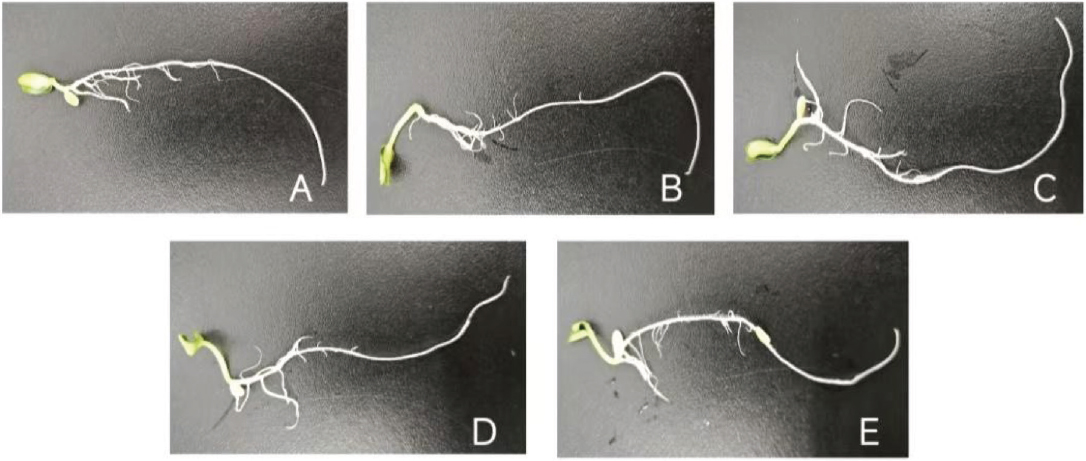
Figure 1.
Effects of different bioactive substances on the radicle length of melon seeds. (A) CK; (B) alginate, SW; (C) DA-6; (D) BR; (E) potassium humate, HA. BR, brassinosteroid; DA-6, diethyl aminoethyl hexanoate.
The effect of different bioactive substances on melon seeds under NaCl
According to Table 3, at appropriate concentration levels, alginate, DA-6, BR and potassium humate can significantly alleviate the negative effects of salt stress on melon seed germination. Among them, alginate has the most significant alleviating effect, followed by BR and potassium humate. Compared with the other three soaking treatments, alginate had the best promoting effect on the germination vigour, GI and vigour index of melon seeds, increasing by 50.2%, 18.9% and 35.1% respectively, compared to the blank control. DA-6 had the best promoting effect on the embryonic root length of melon seeds, increasing by 14.5% compared to the control.
Table 3.
Effects of different bioactive substances on the salt resistance of melon seeds.
| Treatment | Bioactive substance | Germination rate (%) | GI | Vigour index | Root length (mm) | Seedling height (mm) |
|---|---|---|---|---|---|---|
| CK | CK | 80.0 c | 12.7 c | 20.2 c | 15.9 b | 10.8 a |
| 1 | SW | 83.3 b | 15. 1 a | 27.3 a | 18.1 a | 11.1 a |
| 2 | DA-6 | 85.0 a | 13.9 b | 25.3 a | 18.2 a | 10.4 ab |
| 3 | BR | 86.7 a | 14.9 ab | 25.9 a | 17.5 ab | 10.9 a |
| 4 | HA | 86.7 a | 15.0 a | 23.7 b | 15.8 b | 11.0 a |
The effect of different bioactive substances on the germination of melon seeds under NaCl
According to Table 3, compared with the control, alginate (SW) had the best effect on increasing the germination potential of melon seeds under salt stress, followed by BR. DA-6 and potassium humate (HA) had no significant effect. Compared with the control, SW showed a 50.2% increase in germination potential, while BR showed a 20.1% increase in germination potential. Compared with the control, the growth active substances that have a better effect on improving the germination rate of melon seeds are BR and HA, followed by DA-6 and SW. Under salt stress, there was no significant difference in the germination rate of melon seeds between the BR, HA, and DA-6 treatment groups, but there were significant differences compared to the control group. Both BR and HA have increased by 8.4% compared to the control. DA-6 and SW increased by 6.3% and 4.1% respectively. The experimental results showed that there were no significant differences in some indicators among the four active treatment groups, but there were significant differences compared with the control group, indicating that these substances have a good effect on the salt stress resistance of melon.
The effect of different bioactive substances on the vigour of melon seeds under NaCl
According to Table 3, compared with the control, all four growth-active substances significantly increased the GI of melon seeds under salt stress. Among them, SW and HA had the most significant effects, followed by BA, while DA-6 had the least significant effect. SW and HA both increased by 18.9% compared to the control, BR increased by 17.3%, and DA-6 increased by 9% 4%. Among the four growth-active substances, all increased the vigour index of melon seeds, with SW showing the most significant effect, followed by BR and DA-6. HA showed the least significant effect, with SW increasing by 35.1%, BR and DA-6 increasing by 28.2%, 25.2%, and HA increasing by 17.3%, respectively.
The effect of different bioactive substances on melon seed embryos under NaCl
According to Table 3, compared with the control, under salt stress, different concentrations of alginate, DA-6, BR, and potassium humate all had significant regulatory effects on the growth of melon embryonic roots and hypocotyls. When the concentration of alginate is 1000 mg · L−1, the concentration of DA-6 is 10 mg · L−1, the concentration of BR is 0.2 mg · L−1 and the concentration of potassium humate is 50 mg · L−1, it is most conducive to the germination of melon seeds. Compared with the control, the soaking treatment of four bioactive substances, SW, DA-6, BR and HA, did not have a significant effect on the hypocotyl length of melon seeds.
According to the analysis in Figure 2, compared with CK, DA-6 had the most significant effect on promoting the embryonic root length of melon seeds, followed by SW and BR. HA had no significant difference, with DA-6 increasing by 14.6% (p< 0.05) compared to the control, and SW and BR increasing by 13.8% and 10.1% (p < 0.05), respectively. The increase in embryonic root length of SW and BR was not as significant as that of DA-6, indicating that soaking seeds with bioactive substances can alleviate the inhibitory effect of salt stress on embryonic root length during melon germination, and significantly promote the growth of melon seed root length.
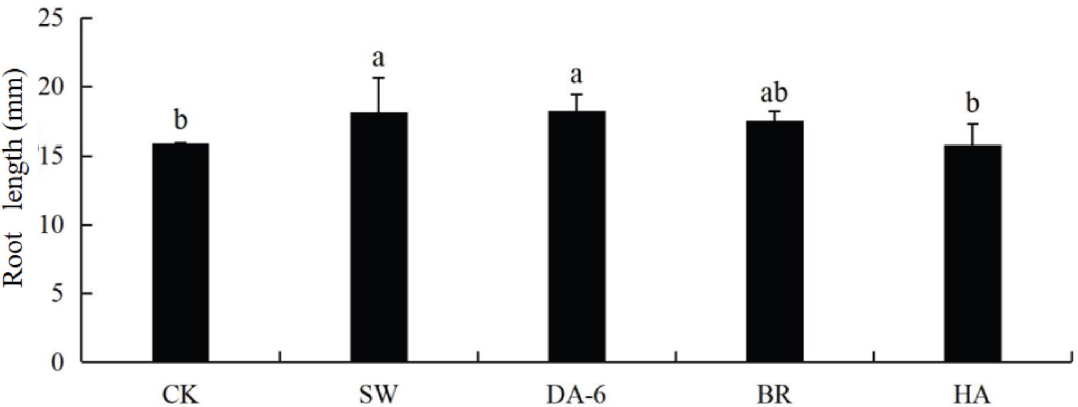
Figure 2.
Effects of different bioactive substances on the root length of melon seeds. Different lowercase letters marked on the column indicate significant differences between treatments (p < 0.05). BR, brassinolide; DA-6, diethyl aminoethyl hexanoate.
From Figure 3, it can be seen that under salt stress conditions, the germination of melon seeds is inhibited to varying degrees, but seeds treated with bioactive substances exhibit better growth status. Compared with the control group, the soaking treatment of bioactive substances significantly enhanced the growth of melon seed roots, increased the length of main roots and significantly increased the number of lateral roots. Among all the treatments, the most significant promotion effect on lateral root growth was achieved by DA-6, followed by alginate and potassium humate.
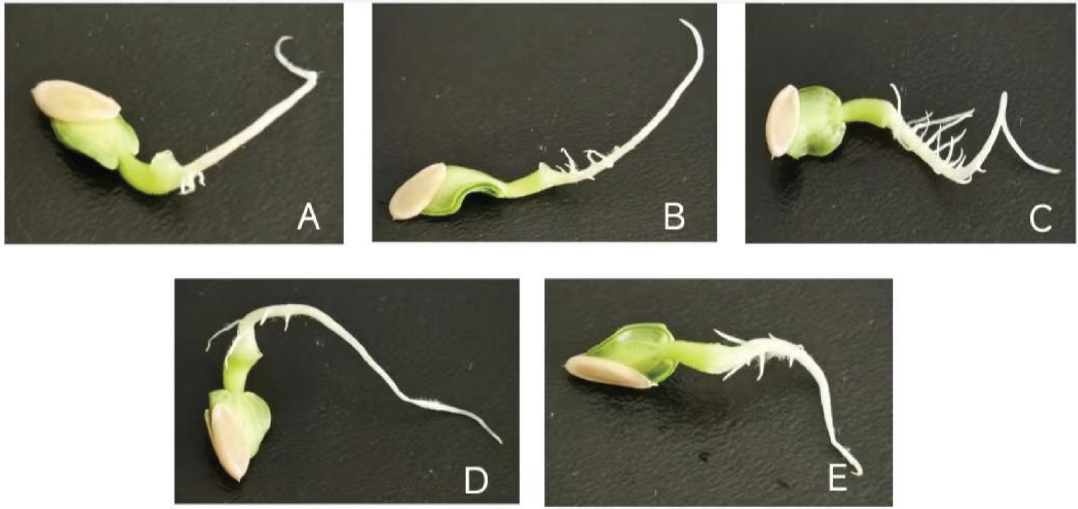
Figure 3.
Effects of different bioactive substances on the salt resistance of melon seeds. (A) CK; (B) 1000 mg · L−1 alginate, SW; (C) 10 mg · L−1 DA-6; (D) 0.2 mg · L−1 BR; (E) 50 mg · L−1 potassium humate, HA. BR, brassinosteroid; DA-6, diethyl aminoethyl hexanoate.
DISCUSSION
With the continuous deepening of research on the mechanism of action of bioactive substances, more and more bioactive substances are widely used in agricultural production. However, it should be noted that there are significant differences in the effects of bioactive substances at different dosages. The natural active ingredient alginate helps promote crop growth (Staden et al., 1994), increase yield and promote seed germination (Nilsun et al., 2006; Kumar and Sahoo, 2011). The study by Wen et al. (2012) found that when the application rate of alginate is 0.01 g/pot, it could significantly promote crop growth. However, if the application amount exceeds this level, it will have an inhibitory effect on the normal growth of crops. This conclusion is consistent with the phenomenon observed in this experiment, where low concentrations of alginate promote growth and high concentrations inhibit growth. This experiment further found that when the concentration of alginate is below 1000 mg · L−1, it has a positive effect on the germination and growth of melon seeds. Among them, 200 mg · L−1 is most conducive to the germination of melon seeds, while 1000 mg · L−1 is more suitable for the growth of melon roots and hypocotyls. In addition, the main function of potassium humate in melon production is to promote root growth and development, and enhance seed vitality. Liu et al. (2024b) conducted corn seed germination experiments using potassium humate from different concentrations of mineral sources. The results showed that soaking seeds with 300 mg · L−1 potassium humate significantly improved the germination effect of seeds, effectively enhanced the germination rate, germination vigour and GI of seeds, and promoted root system growth. This result is significantly higher than the optimal soaking concentration of 50 mg · L−1 for melon seed germination and growth determined in this experiment, which may be related to the different types of potassium humate and crops.
BR has a significant promoting effect on the root growth and seedling height of sweet melon, which can enhance seed vitality. Its main function is to promote root growth. Ji et al. (2014) soaked corn seeds with different concentrations of BR and found that low concentrations of BR could significantly improve the germination vigour and germination rate of corn seeds. Among them, the soaking concentration of 0.015 mg · L−1 had the most significant effect. However, this concentration was significantly lower than the optimal soaking concentration of 0.2 mg · L−1 determined in this experiment for the germination and growth of melon seeds. This difference may be related to differences in the response mechanisms of different crop species to BR. In a salt stress environment, DA-6 can promote seed germination, increase germination rate and vigour. Cui et al. (2025) conducted germination experiments on alfalfa seeds with different concentrations of aminobutyric acid. The results showed that soaking seeds with different concentrations of DA-6 could effectively improve the germination rate, germination vigour, GI, root length, stem length and other indicators of seeds, thereby promoting the overall germination process. This result is significantly lower than the optimal soaking concentration of 10 mg · L−1 for melon seed germination and growth determined in this experiment, and this difference may be closely related to the selected crop variety.
This experiment determined that under normal conditions, four bioactive substances treated with appropriate concentrations all had a significant effect on the germination of sweet melon seeds under salt stress conditions. In terms of promoting the germination of melon seeds, the best-performing agent is DA-6, followed by BR. Specifically, when the mass concentration of alginate reaches 1000 mg · L−1, the mass concentration of DA-6 is 10 mg · L−1, the mass concentration of BR is 0.2 mg · L−1, and the mass concentration of potassium humate reaches 50 mg · L−1, the promotion effect on melon root length and seedling height is most significant.
Under salt stress conditions, melon seeds were treated with 10 mg · L−1 DA-6, 0.2 mg · L−1 BR, 1000 mg · L−1 alginate and 50 mg · L−1 potassium humate, respectively. Compared with the control group, these treatments showed good seed salt tolerance. Among them, alginate has the most significant promoting effect on the germination potential, GI, vigour index and seedling height of melon seeds, while BR and potassium humate show the most outstanding performance in improving the germination rate of melon seeds. However, after treatment with a high concentration of 1500 mg · L−1 SW, it will to some extent inhibit the germination of melon seeds and the growth of seedlings. High concentrations of SW can inhibit seed germination and seedling growth through mechanisms such as osmotic stress and ion toxicity. Humic acid promotes growth by regulating root osmotic pressure and cell elongation, but high concentrations may damage root cell structure or inhibit root hair formation, leading to a decrease in water absorption and nutrient capacity of seedlings, thereby disrupting normal plant growth. As for DA-6, it performs well in promoting the growth of melon seed roots, not only significantly enhancing the growth of the main root and increasing its length, but also significantly increasing the number of lateral roots. The main reason why DA-6 promotes the elongation of melon seed embryonic roots is that it can increase the activity of peroxidase and nitrate reductase, accelerate the rate of photosynthesis, and promote root development and cell division.
The effect of promoting seed germination and root growth exhibited by these bioactive substances can significantly enhance the salt tolerance and stress resistance of crops, which is of great significance for improving the utilisation efficiency of fertilisers and pesticides, improving soil salinisation, and promoting the growth of plants in saline alkali land. This helps plants to survive better in salt-tolerant environments, improve crop germination and salt resistance, and effectively improve the growth status of crops in areas with secondary salinisation. In the actual production and application of cantaloupe, it is necessary to further screen the optimal solution concentration of these four bioactive substances in future production applications.
Due to the relatively small variety of sweet melons used in this experiment, further research is needed to verify whether the results obtained from the experiment apply to more varieties of sweet melons. In addition, since the experiment was conducted in an artificially set environment, it is necessary to continue exploring whether the same results will be obtained if the experiment is conducted in the field.
ACKNOWLEDGEMENTS
The authors thank Hu Li (Huaibei Normal University, Department of School of life), Jiyuan Wang (Huaibei Normal university, Department of School of Life)- Yupeng Fang (Huaibei Normal university, Department of School of Life) and Yanliang Guo (Huaibei Normal University, Department of School of Life), who were involved in the experiment.
Notes
[6] Contributed by AUTHOR CONTRIBUTIONS
Ch.L. was responsible for experimental design and manuscript writing. Y.W., J.L., J.L., H.Z. and X.Z. implemented the experimental content, and corrected and revised the paper. Ch.L. and Y.W. have contributed equally to this work.
[7] Conflicts of interest CONFLICT OF INTEREST
The authors declare that there is no conflict of interest.