
INTRODUCTION
Tomato (Solanum lycopersicum L.) is one of the most popular horticultural crops and an essential source of antioxidants such as lycopene and ascorbic acid (AsA) in the human diet (Collins et al., 2022). It originated in western South America and is believed to have been domesticated in Central America (Fuentes et al., 2022). The global yield was estimated at 35532.5 kg · ha −1 in 2023, with China and India as the major producers (FAOSTAT, 2023). The yield and quality of tomatoes are influenced by both genetic factors and environmental conditions (Marefatzadeh-Khameneh et al., 2021; Rasheed et al., 2023). Among the environmental factors, in addition to temperature, the humidity index has a significant impact on plant growth and tomato fruit quality (Brdar et al., 2021). Tomato is sensitive to humidity and wet conditions because fungal and bacterial infections typically develop rapidly in warm, humid environments (Singh et al., 2025). One of the most serious diseases is the late blight (Bahramisharif and Rose, 2019; Arafa et al., 2022), caused by Phytophthora infestans (Mont.) de Bary. The pathogen affects all stages of plant development. P. infestans causes disease symptoms such as foliar blight which are characterised by irregular water-soaked spots, and at advanced stages of disease development, green brown lesions are formed (Choga et al., 2021). In addition, late blight can also affect the leaves and stems, and cause dark oblivious spots on tomato fruits. The disease is severe in areas with high humidity and rainfall and spreads through wind, rain or contaminated plant material capable of causing entire crop failure if left uncontrolled (Adhikari and Bista, 2023).
In recent years, cover cropping techniques, such as cultivation within polyethylene (PE) rain shelters that protect plants from heavy rain while also lowering disease incidence and operational costs, have become popular in the cultivation of fruit trees (Claire et al., 2018; de Palma et al., 2019; Jat et al., 2020; Dema and Yangchen, 2021; Nakayama et al., 2021). These methods result in improved plant growth and yield (Du et al., 2015; Cao et al., 2016). Rain-sheltered cultivation is widely used in southern China, a region characterised by a subtropical monsoon climate, with hot and humid summers and dry, mild winters (Herman et al., 2017; Li and Zha, 2018; Zhang et al., 2021). For instance, in Guangxi, the annual average rainfall is approximately 1500 mm, with a highly uneven seasonal distribution. The rainy season (April to September) accounts for roughly 80% of the annual precipitation, accompanied by average high and low temperatures of 29–33°C and 22–25°C, respectively (China Meteorological Administration, http://www.cma.gov.cn/). This combination of high temperature and high humidity during the growing season poses significant challenges to tomato production.
Rain-shelter cultivation, distinct from greenhouse cultivation, functions as a protective barrier, shielding plants from rainfall (He et al., 2025). It is a simple and easy-to-operate cultivation mode that involves covering the top of crops with plastic film to block rainwater, with open sides for ventilation. It has advantages such as flower and fruit protection, reducing disease, improving fruit quality, reducing pesticide usage and saving costs (Chen et al., 2020). In comparison to the technically complex and costly greenhouse systems which require professional management, rain-shelter cultivation is more widely popular with farmers.
Tomatoes grown under rain shelters have significantly different growth durations and conditions than those grown in open fields or greenhouses (Tang et al., 2012; Gan et al., 2021; Getahun et al., 2022; Zhang et al., 2022). Therefore, we investigated the growth, yield and quality responses of tomatoes under rain-shelter and open-air cultivation during the rainy season of 2020. We conducted two pilot experiments to assess the effects of rain-shelter and open-air management strategies on tomato growth, yield, fruit quality and resistance to late blight disease in the subtropical climate of China.
MATERIALS AND METHODS
Plant material, experimental sites and cultivation conditions
The experimental trial was conducted with three treatment groups at two locations in southern China during the 2020 tomato-growing season. The first location is Yongfu County (YF) (24°94′41.8″N, 109°65′91.2″), Guangxi Province, China and the second is Wuming County (WM) (24°91′68.2″N, 109°78′28.0″E), Guangxi Province, China (Figures 1A–1C). YF is a multi-rainfall area, characterised by high eco-environmental sensitivity and a concentrated distribution of karst in the world (He et al., 2021; Huang et al., 2021). The annual precipitation in the two regions is shown in Figure 1E. We obtained permission from the farm owner to conduct the study. For this study, we selected the ‘Yingfen 1’ F1 tomato, a hybrid variety nationally registered in China under number GPD Tomato (2021) 450011. Seeds were sown in trays at a nursery on 15 March, transplanted to the field on 10 April at the six-leaf stage and harvests were recorded from 21 August to 30 September. The seedling trays employed were polypropylene tomato plug trays, each equipped with one or more drainage holes at the bottom of each cell. The plug trays had a specification of 50 cells, and tomato seedlings at the young seedling stage (approximately 3–4 true leaves, 25–30 days old) were raised before transplantation. The seedling substrate was a commercial product dominated by peat moss, blended with perlite and vermiculite. Before transplanting, the experimental site was ploughed and harrowed to a depth of 30 cm, with plant spacing of 30 cm. A compound fertiliser (N:P:K 15:15:15) was applied and incorporated into the soil at a rate of 1000 kg · ha−1.
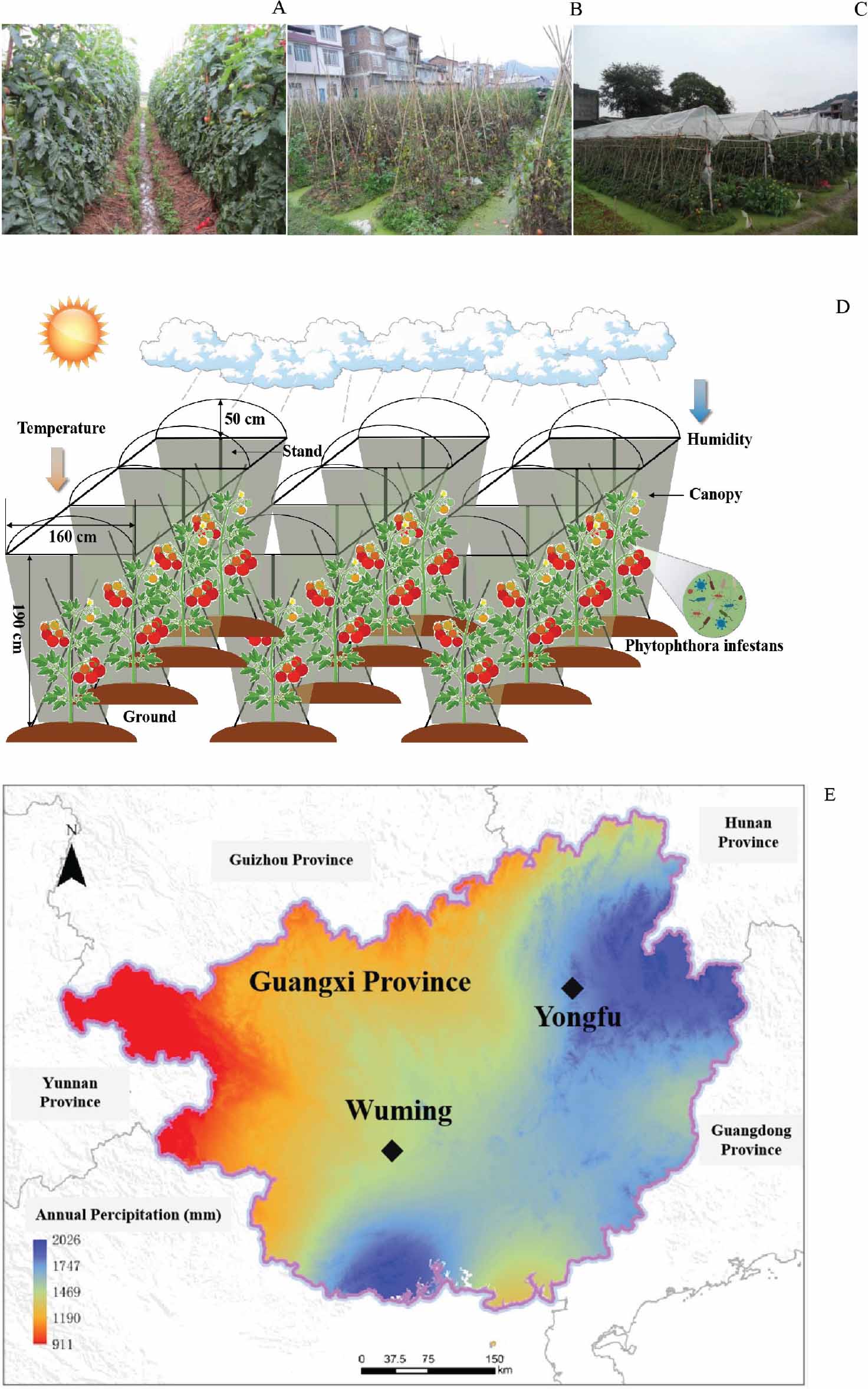
Figure 1.
View of the tomato open-air cultivation and rain-shelter cultivation: (A) Open-air cultivation in WM, (B) open-air cultivation in YF, (C) rain-shelter cultivation in YF, (D) schematic diagram of tomato cultivation under rain shelter, (E) annual precipitation in WM and YF. WM, Wuming County; YF, Yongfu County.
Treatment groups and experimental design
In order to explore the effect of rain-shelter cultivation in a rainy region (YF, Group 2; see below), open-air groups from YF (Group 1) and WM (Group 3) served as controls (Table 1). In both treatment groups, three sampling units were artificially divided to create three biological replicates, each consisting of 25 tomatoes. All experimental units were subjected to consistent cultural management practices, including pest and disease control and fertilisation. A rain shelter shed was built using a colourless PE film with a thickness of 0.10–0.12 mm and 80% light transmittance. For each row, the rain-shelter frame was 190 cm high from the ground and 160 cm wide. The shed was designed to exclude rain while allowing natural ventilation (Figure 1D). The rain shelter shed was built on 5 April 2020.
Meteorological conditions
The Weather Atlas website (https://www.weather-atlas.com) provided monthly raw statistics on the index number across two examined counties. Daily data for eight meteorological factors: highest temperature (°C), lowest temperature (°C), humidity (%), rainfall (mm), rainfall days (day), UV index, daylight (hours) and sunshine (hours) from March to September 2020 were manually extracted from the website.
Measurements of growth
Plant growth characteristics in all three groups were determined using six indicators: plant height (PH, cm), stem diameter (SD, cm), root length (RL, cm), root mass (RM, g · plant−1), shoot mass (SM, g · plant−1) and root-to-shoot ratio (RSR, g · g−1). At final harvest, plants were carefully uprooted, rinsed with tap water and divided into root, stem and leaf sections for further analysis. These indicators were measured at the tomato maturity stage, specifically when the second truss of fruits from the bottom was fully ripe, which was 41 days after transplantation.
PH was measured with a measuring tape having a minimum graduation of 1 mm. With the tomato plant in a natural, upright position, the zero end of the tape was carefully positioned at the base of the cotyledon node. The tape was then extended vertically to the highest growing point, and the value was recorded. SD was measured at the internode bearing the first mature fruit truss using a digital vernier caliper with an accuracy of 0.01 mm. RL was measured on the intact root systems. Following careful excavation, the roots were gently rinsed with tap water to remove adhering soil, then laid flat on a measuring board without straightening and measured from the root-shoot junction to the taproot tip to the nearest centimeter. For the measurement of RM, plants were first separated at the root collar into the underground part (root system) and the above ground part. After being cleaned, they were placed in separate paper bags and subjected to drying in a 105°C blast drying oven for 30 min. The dry weight was measured using an electronic analytical balance with a precision of 0.001 g, and the results were recorded in grams. The RSR is calculated as the root dry weight divided by the shoot dry weight.
Measurements of yield and quality
To prevent boundary effects, only the 10 plants in the middle of each plot were selected for further measurements. Approximately 45 days after transplanting, the fruits on the first and second trusses completed development and reached harvest maturity. Ripe tomatoes from the three treatments were sampled at harvest to evaluate the fruit quality characteristics. The collected tomatoes were washed with running tap water to remove dirt, thoroughly dried with absorbent tissue paper, and then analysed for mean single fruit weight (MSW) and mean single fruit volume (MSV). AsA content was determined by titrating tomato homogenates (diluted in a 3% metaphosphoric acid solution and an 8% acetic acid solution). The titration used a 2,6-dichlorophenol-indophenol solution standardised against an AsA solution of known concentration (Shao et al., 2014). Total soluble solids (TSS) of tomatoes were measured using a digital refractometer ATC-1E, ATAGO Master, Guangzhou ATAGO Scientific Instruments Co., Ltd., China at room temperature, as described by Clément et al. (2008). Hardness of the fruit tissues was measured by a GY-1 meter (Beijing Time Ricon Technology Co., Ltd, Beijing, China) in the mature green stage (hardness in mature green [HMG]) and fully ripened stage (HFR). The fruit samples were placed upside down on their calyx and cut to a central thickness of 1 cm. The Sarcocarp was measured to determine the hardness of the tomato fruit, and the deformed fruit rate (DFR) was calculated:
Assessment of tomato late blight disease
Experimental plots were inspected for late blight symptoms, beginning shortly after emergence in April and continuing at 15-days’ interval until the experiments ended in September. Tomato late blight severity was graded from 0 to 6 according to China’s Agricultural Industry Standard NY/T 1858.1-2010 (Rules for evaluation of tomato for resistance to diseases Part 1: Rule for evaluation of tomato for resistance to late blight), primarily based on the percentage of leaf area covered by lesions: 0 (no symptoms), 1 (<5%), 2 (5%–15%), 3 (15%–30%), 4 (30%–50%), 5 (50%–70%) and 6 (70%–100%). The disease incidence refers to the ratio of the number of tomato plants infected with late blight to the total number of plants. Three designated field workers assessed disease incidence as a percentage for each plot, and the severity scores were averaged across assessors. Total yield was calculated at the final harvest as follows:
Study of economic effectiveness
Given that the three treatments in this study received identical management, a partial budget analysis was conducted to compare their respective economic effectiveness in a rainy region (Claire et al., 2018). The cost items for tomato cultivation under rain shelters included both variable and fixed costs. In our study, variable costs included fertilisers, pesticides and labour for harvesting and maintenance related to the installation of transparent PE covers on the shelters. These costs were based on current input prices and labour costs. Fixed costs included interest on the total initial investment, such as rain shelters and stands. The study investigated the total value of production, gross return, net return, total cost of production, benefit to cost ratio and productivity in the economic analysis of tomato cultivation under rain shelters as follows:
Statistical analysis
One-way analysis of variance (ANOVA) was performed to assess the significance of differences between samples, with a significance level of p < 0.05. Data were analysed for variance using Microsoft Excel 2017 (Microsoft Corp., Redmond, WA, USA). Graphs were generated using Microsoft PowerPoint (Microsoft Corp.).
RESULTS
Monitoring of environmental variables
In order to understand the results obtained in the agronomic variables, the characteristics of the climatic behaviour of the experimentation at the sites are first listed. Three treatment groups were applied to evaluate typical rain-shelter cultivation in both rainy and drought regions. The major cultivation period for tomatoes in 2020 was from March to September. The highest and lowest temperature indices at WM tomato base were higher than those at YF (Figures 2A and 2B), which is consistent with WM at a lower latitude in southern China (Table 1).
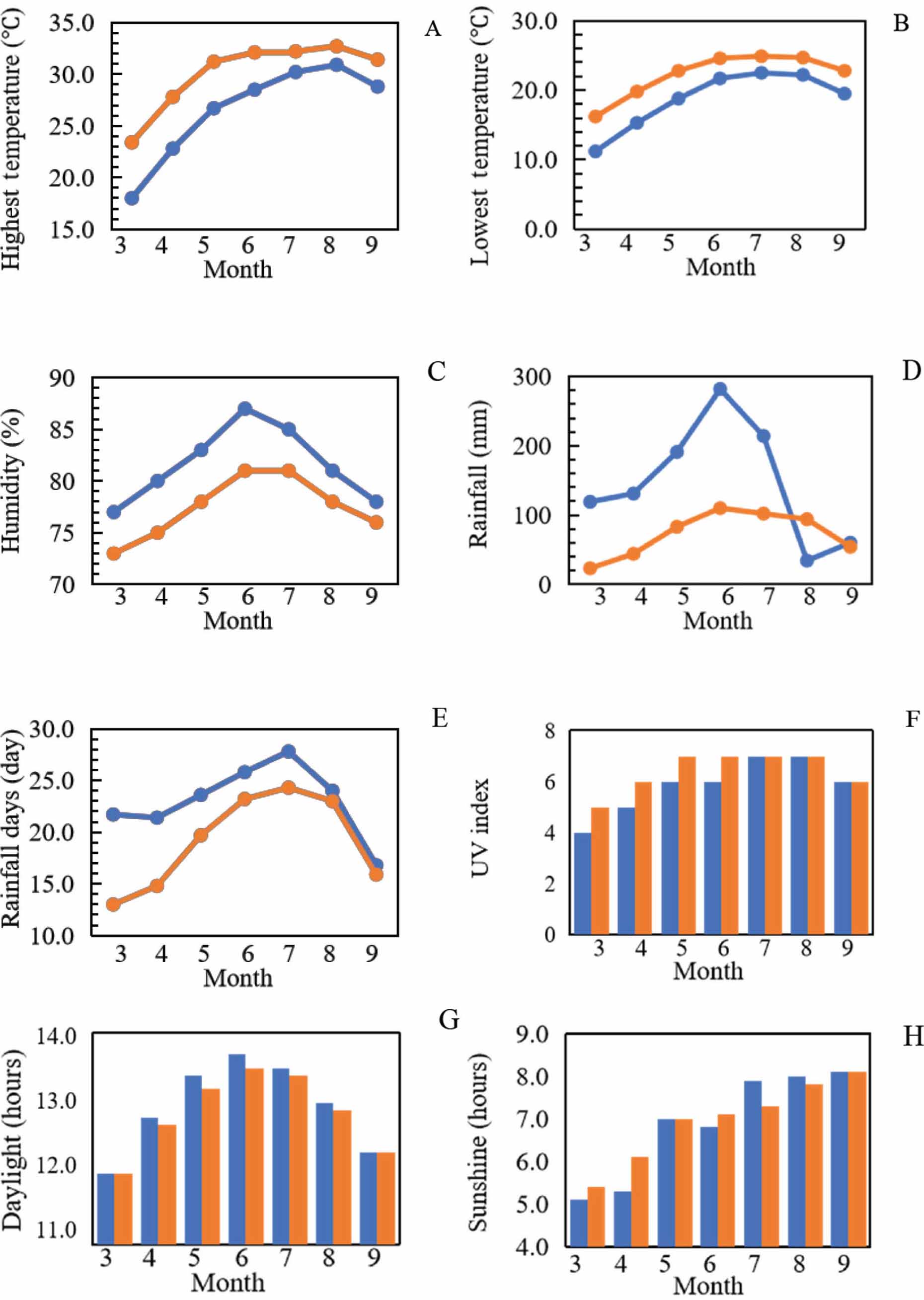
Figure 2.
Geographical and meteorological parameters associated with rain-shelter and open-air tomato cultivation in the southern China: (A) Highest temperature, (B) lowest temperature, (C) humidity, (D) rainfall, (E) rainfall days, (F) UV index, (G) daylight, (H) sunshine. Data are shown from March to September on YF and WM. Orange indicates WM’s parameters, while blue indicates YF’s parameters. The raw data were collected from Weather Atlas website (https://www.weather-atlas.com). UV, ultraviolet; WM, Wuming County; YF, Yongfu County.
According to the data for humidity, rainfall and rainy days, YF has the highest humidity at 87%, compared with 81% in WM. The highest rainfall recorded is 282 mm in YF, while WM receives 110 mm. YF receives high humidity and practically continuous rains, particularly in June and July, which correspond with the growing season (Figures 2C–2E). The similar UV index, daylight and sunshine levels indicate that YF and WM belong to a subtropical monsoon climate (Figures 2F–2H). Considering these climate parameters comprehensively, the higher frequency of rainfall events explains why rain-shelter cultivation is popular in YF.
Agronomic characteristics
Considering the effects of rainfall on PH, the plants in group 3 were the tallest, whereas groups 2 and 3 showed significant differences to group 3. The PH of groups 1 and 2 (139 cm and 154 cm, respectively) in the rainy area were generally lower than group 3 (169 cm) in the drought area (Figure 3A). Similarly, the SD above ground in the open-air field of YF (1.04 cm) is significantly smaller than that in the rain-shelter field of YF and the open-air field of WM (1.20 cm and 1.23 cm, respectively) (Figure 3B). Root morphological characteristics play an important role in the uptake of mineral nutrients from the soil (Vives-Peris et al., 2020; Balliu et al., 2021).
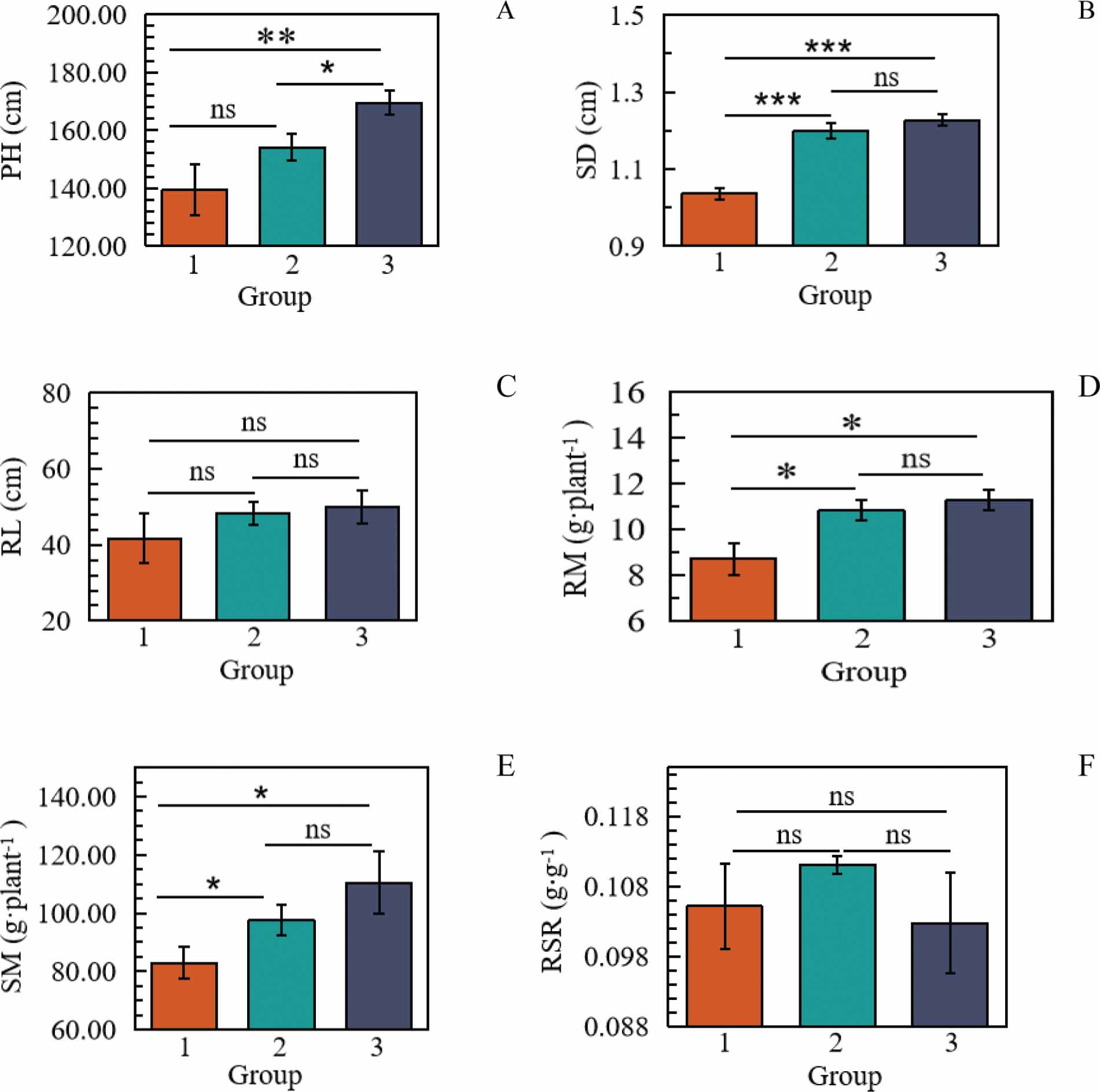
Figure 3.
Histogram of tomato growth parameters in three groups: (A) PH, (B) SD, (C) RL, (D) RM, (E) SM, (F) RSR. ns = not significant, *p < 0.05, **p < 0.01 and ***p < 0.001 of probability according to the ANOVA single factor test. Vertical error bars represent ± SD of the mean. The SD was calculated across three replicates for each group. ANOVA, analysis of variance; PH, plant height; RL, root length; RM, root mass; RSR, root-to-shoot ratio; SD, standard deviation; SD, stem diameter; SM, shoot mass.
A similar trend was observed in RL and RSR across the three groups (Figures 3C and 3F). However, RM and SM in groups 2 and 3 showed significant differences compared with group 1 (Figures 3D and 3E). The RM and SM (9.4 g and 88.9 g, respectively) in group 1 are significantly lower than those in group 2 (11.2 g and 102.2 g, respectively) and group 3 (11.8 g and 121.4 g, respectively). The inability of the roots in group 1 to acclimate to wet conditions during the rainy season may have resulted in reduced growth and function, leading to decreased matter accumulation in the shoots (Zhang, 2025).
Fruit quality
Fruit appearance is the primary quality trait for consumers and is determined by fruit size and shape (Pathare et al., 2021). Among the three groups, MSW (Figure 4A) was significantly higher in groups 2 and 3 (184.7 g and 199.5 g, respectively) compared with group 1 (118.13 g) (p < 0.05). Lower fruit weight was also recorded under high humidity, consistent with the findings of Barker, who found that under similar temperature conditions, tomato grown under high relative humidity had lower average fruit weight and yield (Barker, 1990; Ayenan et al., 2022). High humidity induces reduction in leaf area and kinked trusses restricting phloem sap flow into the fruits and subsequently lead to the reduction of fruit weight. The MSV of group 2 (170.56 g) and group 3 (185.98 g) was significantly higher than that of group 1 (147.4 g) (p < 0.05) in 2020 (Figure 4B), indicating that rainy events may affect fruit size. Yin found that the number of inflorescences, fruit size, single fruit weight and fruit weight per plant of all the six genotypes significantly decreased by waterlogging treatment, which could be partially explained by the low gas diffusion due to excessive rhizosphere water (Yin et al., 2023).
The flavour of tomatoes and their nutritional quality are largely determined by the levels of AsA and TSS (Li et al., 2021). Studies have found that rain-shelter cultivation not only enhances the internal quality of tomatoes by increasing soluble solids and vitamin C content but also improves their external appearance by significantly reducing the fruit cracking rate (Zhu et al., 2014; Gan et al., 2021). Figures 4C and 4D summarise the effects of rain-shelter cultivation and open-air cultivation on tomato flavour and nutritional quality. Group 2 had considerably higher AsA readings (15.56 mg · 100 g−1) than groups 1 and 3 (12.43 mg · 100 g−1 and 12.21 mg · 100 g−1, respectively). Group 1 had higher values than group 3, but the difference was not statistically significant. It is possible to speculate that YF is located in southern China’s acid rain zone (Zhong et al., 2018). TSS (Figure 4D) showed no significant difference among the three groups (p > 0.05).
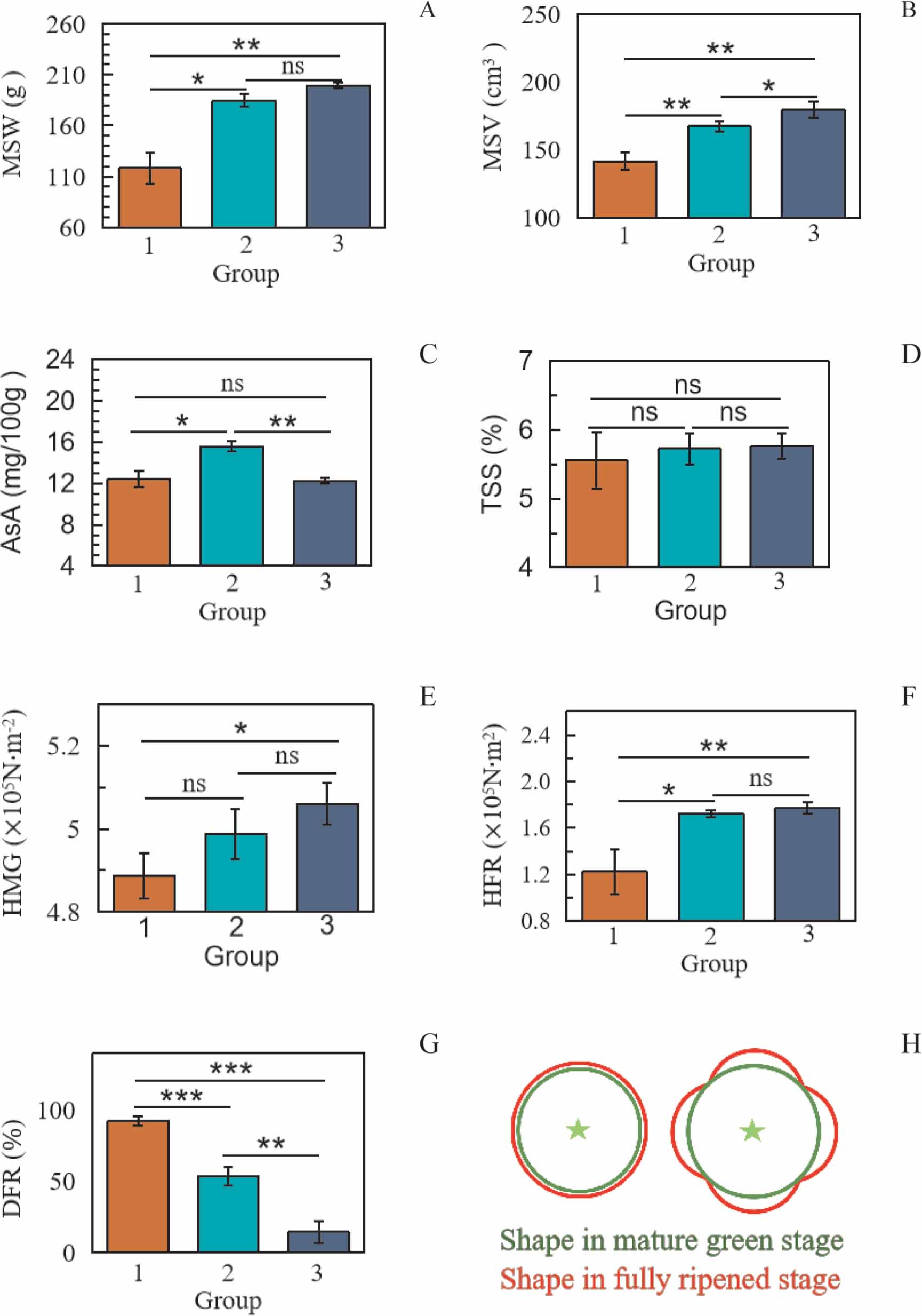
Figure 4.
Histogram of tomato yield and quality parameters in three groups: (A) MSW, (B) MSV, (C) AsA content, (D) TSS, (E) HMG, (F) HFR, (G) deformed productivity rate, (H) schematic diagram of normal shape (left) and deformed shape (right) of tomato in fully ripened stage. ns = not significant, *p < 0.05, **p < 0.01 and *** p < 0.001 of probability according to the ANOVA single factor test. Vertical error bars represent ±SD of the mean. The SD was calculated across three replicates for each group. ANOVA, analysis of variance; AsA, ascorbic acid; DFR, deformed fruit rate; HMG, hardness in mature green; HFR, hardness in fully ripened; MSV, mean single fruit volume; MSW, mean single fruit weight; SD, standard deviation; TSS, total soluble solids.
Hardness influences the extent of damage to tomato fruit during transportation (Cherono and Workneh, 2018). This study examined HMG and HFR in the three groups (Figures 4E and 4F). At the mature green stage, which typically occurs around 40 days after self-pollination, tomato fruits reach their cultivar-specific maximum size and appear plump. While the skin remains green, the fruit develops a slight softness and elasticity to the touch. Only group 3 had considerably higher hardness (5.06 × 10⁵ N · m−2) than group 1 (4.89 × 10⁵ N · m−2). No additional differences were noticed. The fruit hardness at the fully ripened stage (HFR) in group 1 (1.22 × 10⁵ N · m−2) is significantly lower than that in group 2 (1.72 × 10⁵ N · m−2) and group 3 (1.77 × 10⁵ N · m−2). DFR was measured at the final harvest (Figure 4G). The normal and deformed shapes of tomatoes are shown in Figure 4H. The results indicate that the deformed shape appeared most frequently in group 1 (92%) and group 2 (54%) from the rainy areas, compared with group 3 (14%) in the drought area. Additionally, rain-shelter cultivation reduced the rate of deformed shapes in the rainy area.
Tomato late blight infections
Among the three experimental groups, the final disease incidence was significantly higher (p < 0.05) in group 1 (100%), which was cultivated in open air, compared with group 2 (13.3%) under rain-shelter cultivation in the YF rainy area, and group 3 (5%) in WM, a drought-prone area. There was a marked increase in group 1 during June and July (Figure 5A). However, the final harvest yield in group 1 (661.2 kg · 0.0667 ha−1) was significantly lower than that of group 2 (7603.5 kg · 0.0667 ha−1) and group 3 (8641.9 kg · 0.0667 ha−1), as shown in Figure 5B. Based on tomato plant phenotypic and whole plant observations (Figures 5C–5F), the outbreak of late blight occurred in the rainy region of YF. Currently, rain-shelter cultivation is the most effective method to prevent late blight outbreaks in such rainy areas.
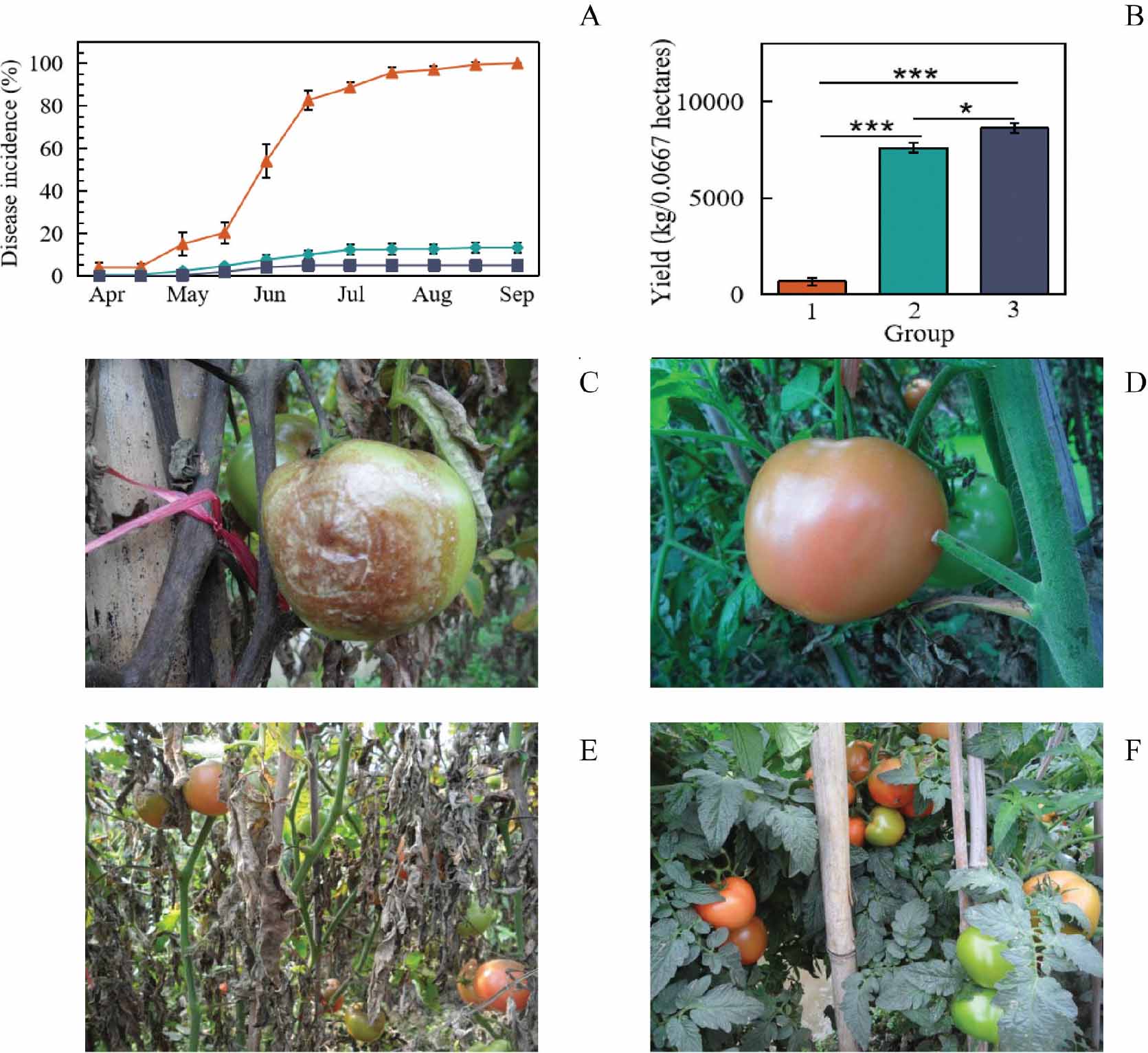
Figure 5.
Effects of the late blight resistance on tomato cultivation: (A) The disease incidence (%) collected from April to September, (B) histogram of final yield in three groups, (C) the typical phenotype of Group 1; (D) the typical phenotype of Group 2; (E) the whole plant phenotype of Group 1 affected by late blight disease; (F) the whole plant phenotype of Group 2 affected by late blight disease. ns = not significant, *p < 0.05, **p < 0.01 and ***p < 0.001 of probability according to the ANOVA single factor test. Vertical error bars represent ± SD of the mean. The SD was calculated across three replicates for each group. Scale bar: 5 cm. ANOVA, analysis of variance; SD, standard deviation.
Economic analysis
Table 2 summarises the difference in costs for the Yongfu test. Because there were considerable disparities in marketable yields between groups 1 and 2, labour expenses for harvesting and shelter maintenance were included in the analysis. Additionally, the pesticides used in group 1 resulted in higher costs, with a cost difference of 300.00 CNY · 0.0667 ha−1. In YF, the gross production value for open-air and rain-shelter cultivation is –4477.60 CNY · 0.0667 ha−1 and 8507.06 CNY · 0.0667 ha−1, respectively. The variable and fixed costs for tomato cultivation in the open-air cultivation were 5800.00 CNY · 0.0667 ha−1 and 0.00 CNY · 0.0667 ha−1, while for rain-shelter cultivation, they were 6700.00 CNY · 0.0667 ha−1 and 800.00 CNY · 0.0667 ha−1.
Table 2.
Economic indices of tomato production in open-air field and rain-shelter field in YF.
| Cost and return components | YF | |
|---|---|---|
| Open-air cultivation | Rain-shelter cultivation | |
| Fruit yield (kg · 0.0667 ha−1) | 661.20 | 7603.53 |
| Sale price (CNY · kg−1) | 2 | 2 |
| Total value of production (CNY · 0.0667 ha−1) | 1322.40 | 15207.06 |
| Variable cost of production (CNY · 0.0667 ha−1) | ||
| (1) Fertilisers | 5300.00 | 5300.00 |
| (2) Pesticides | 500.00 | 200.00 |
| (3) Labour for harvest and maintenance shelter | 0.00 | 1200.00 |
| Total | 5800.00 | 6700.00 |
| Fixed cost of production (CNY · 0.0667 ha−1) | ||
| (1) Rain-shelter | 0.00 | 600.00 |
| (2) Stands | 0.00 | 200.00 |
| Total | 0.00 | 800.00 |
| Total cost of production (CNY · 0.0667 ha−1) | 5800.00 | 7500.00 |
| Gross return (CNY · 0.0667 ha−1) | –4477.60 | 8507.06 |
| Net return (CNY · 0.0667 ha−1) | –4477.60 | 7707.06 |
| Benefit to cost ratio | 0.23 | 2.03 |
| Productivity(kg · CNY−1) | 0.11 | 1.01 |
The total cost of production in open-air cultivation (5800.00 CNY · 0.0667 ha−1) is lower than that of rain-shelter cultivation (7500.00 CNY · 0.0667 ha−1). However, the gross return and net return in open-air cultivation (–4477.60 CNY · 0.0667 ha−1) are much lower than those in rain-shelter cultivation (8507.61 CNY · 0.0667 ha−1 and 7707.06 CNY · 0.0667 ha−1, respectively). In fact, most farmers in YF incur losses when selling tomatoes without using rain-shelter cultivation.
In rain-shelter cultivation, the benefit-to-cost ratio is 2.03, which is much higher than the 0.23 observed in open-air cultivation. Productivity is expressed as output per CNY, indicating how much product can be produced with one yuan. In this study, the efficiency values are 0.11 kg · CNY−1 for open-air cultivation and 1.01 kg · CNY−1 for rain-shelter cultivation. Taken together, data from groups 1 and 2 suggest that rain-shelter cultivation represents both a technical and economic optimum.
Overall, economic analysis revealed that the implementation of rain shelter structures would be profitable due to its low initial cost and improved marketable yields in the rainy area compared with open-air cultivation.
DISCUSSION
Open-air and rain-shelter cultivation both coexisted in Southern China
Southern China is located in the subtropical monsoon climate region. Due to the alternating influence of winter and summer winds, seasonal rainfall is irregular, and the dry and wet seasons are distinct (Li et al., 2016). The rainy season lasts from April to September, and the dry season lasts from October to the following March. Generally speaking, although precipitation is abundant, its seasonal and spatial distribution significantly affects tomato breeding and cultivation. Considering the climatic parameters in two distinct tomato planting areas during the growing season from March to September, the tomato breeding regions in southern China were classified as rain-fed areas and rain-deficient areas.
Furthermore, according to the local meteorological survey report, there are simultaneously three significant rain-fed and rain-deficient areas distributed across Guangxi Province, which is the major tomato production base in southern China. The three rain-fed areas were the Shiwan Dashan mountain area, the Dayaoshan mountain area and the Yuechengling mountain area, with annual rainfall of 2010–2760 mm, 1700–2000 mm and 1800–2000 mm, respectively. In contrast, the three rain-deficient areas were the Youjiang River valley, the Mingjiang River valley and the Qianjiang River valley, where annual rainfall was 1080–1200 mm, 1200–1300 mm and 1200–1300 mm, respectively (Xie et al., 2019; Zhou et al., 2019).
In this study, WM, located near the Youjiang River valley, has warm, sunny weather with low rainfall, making open-air tomato cultivation an economical and practical choice. In contrast, YF, situated in the central Yuechengling mountain area, is characterised by high temperatures and humidity during the summer. Rain-shelter tomato cultivation is an effective method for protecting plants from excessive rainfall in this region. Given the irregular precipitation and its impact on tomato growth, southern China has both open-air and rain-shelter cultivation.
Rain-shelter cultivation could affect the growth and fruit quality in humidity and raininess
Many factors can influence plant growth and fruit quality, including environmental changes and varietal traits. Rain-shelter cultivation has been demonstrated to significantly reduce disease incidence in horticultural crops including pear (Chen et al., 2020), grape (He et al., 2025), mango (Xu et al., 2013), cherry (Tian et al., 2019) and tomato (Gan et al., 2021), while enhancing both yield and fruit quality. These studies have found that in tomato rain-shelter cultivation, the soil moisture content remains around 30% during and after continuous rainfall, with a small variation range. Meanwhile, the relative air humidity on rainy days is significantly lower than in open-air cultivation. This environment is more conducive to crop growth and development. Several studies have also indicated that rain-shelter cultivation results in higher total photosynthetic accumulation, promotes the accumulation of secondary metabolites during fruit development, and leads to increased contents of AsA and TSS (Zhu et al., 2014; Gan et al., 2021; Liu et al., 2022). In this study, similar results were obtained when comparing open-air cultivation in the rainy area. Notably, tomatoes cultivated in YF had a higher AsA content than those grown in WM, regardless of whether rain-shelter or open-air cultivation was used. It is hypothesised that YF, located in northern Guangxi Province, is a basin characterised by a typical Karst landform.
Hardness of fruit is an important indicator for transportation and storage (Al-Dairi et al., 2021). Tomato fruit hardness is determined by a variety of anatomical factors, including cell wall structure, cuticle properties and turgor pressure (Liu et al., 2023). In research on grapes (Considine and Kriedemann, 1972), it was found that high TSS content and low water potential led to increased water absorption by fruits, thereby elevating the risk of fruit cracking. Environmental factors also exert significant influence. Among these factors, humidity plays a crucial role in fruit development. When the fruit surface is exposed to liquid water or high-water vapour, it induces the formation of microcracks in the epidermal membrane, thereby increasing the risk of fruit cracking (Li et al., 2025). In our study, the hardness of fruit grown under rain shelters was greater than that of fruit cultivated in open fields in the rainy region. Rain-shelter cultivation significantly reduced DFR; however, DFR remained higher in YF than in WM, regardless of whether under rain-shelter or open-air cultivation. Collectively, rain shelters have been demonstrated to be a more desirable practice for maintaining plant health, as they protect fruit from excessive rainfall and humidity, thereby improving fruit appearance and quality.
Using rain-shelter cultivation to control late blight diseases and improve yields
As the causal agent of tomato late blight, P. infestans is one of the most destructive plant pathogens in agricultural history, significantly limiting global tomato production. In this study, among the three experimental groups, the final disease incidence was significantly higher (p < 0.05) in group 1 (100%), which was cultivated in open air, compared with group 2 (13.3%) under rain-shelter cultivation in the YF rainy area, and group 3 (5%) in WM, a drought-prone area. The final harvest yield in group 1 (661.2 kg · 0.0667 ha−1) was significantly lower than that of group 2 (7603.5 kg · 0.0667 ha−1) and group 3 (8641.9 kg · 0.0667 ha−1).
Based on tomato plant phenotypic and whole plant observations, group 2 showed positive resistance to late blight disease under rain-shelter conditions during the rainy season. Studies have evaluated the effectiveness of the Rain Shelter Method in comparison with traditional methods and found that both the tomato yield and farmers’ income achieved by the former were significantly higher than those by the latter (Pathak and Kakati, 2025). When tomatoes are continuously exposed to rainfall without any cover, the crop might be nearly destroyed. Rain-shelter cultivation can decrease foliar and soil-borne diseases by minimising the dispersion of air and water pollutants that are spread by wind or rainfall. Although greenhouse systems effectively mitigate pathogen transmission (Arinaitwe et al., 2023), their high construction and maintenance costs make them unsuitable for most farmers. Considering effectiveness, ease of construction and input costs, rain-shelter cultivation is the best choice for controlling late blight disease and improving yields in the rain-fed regions of southern China.
CONCLUSIONS
Guangxi Province is located in the subtropical monsoon climate zone, where the main tomato-growing areas are characterised by high temperature and abundant rainfall year-round. This climate is highly conducive to the outbreak of late blight, causing substantial economic losses to the local tomato industry. In this study, we compared plant growth, yield, fruit quality and economic benefits of tomatoes under open-air cultivation and rain-shelter cultivation. The results showed that rain-shelter cultivation avoided direct erosion of tomato plants and ridged beds by rainfall, thereby providing favourable growth conditions for tomatoes. Compared with open-air cultivation, the average single fruit weight and volume of tomatoes under rain-shelter cultivation increased by 50% and 40%, respectively, while the AsA content was 20% higher. Furthermore, rain-shelter cultivation blocked the disease transmission pathway, which not only reduced pesticide application but also mitigated late blight—with an incidence rate of merely 5% under rain-shelter cultivation, in contrast to 100% under open-air cultivation. In terms of yield and economics, the yield under rain-shelter cultivation reached 10000 kg · 0.0667 ha−1, whereas that under open-air cultivation was 661 kg. Both the total return and net return of rain-shelter cultivation were significantly higher.
In conclusion, rain-shelter cultivation exhibits the characteristics of low input and high output, improving tomato yield and quality with considerable application value. Thus, it is suitable for promotion in subtropical climate regions such as Guangxi. Additionally, rain-shelter cultivation should be combined with other strategies to further promote the high-quality development of the tomato industry, including: (1) breeding high-quality and disease-resistant varieties using molecular markers for target traits; (2) optimising tomato cultivation techniques by adjusting planting density, applying fertilisers reasonably and improving the photosynthetic use efficiency of the population per unit area.
Abbreviations
- AsA
ascorbic acid
- DFR
deformed fruit rate
- HFR
hardness in fully ripened
- HMG
hardness in mature green
- MSV
mean single fruit volume
- MSW
mean single fruit weight
- PH
plant height
- RL
root length
- RM
root mass
- RSR
root-to-shoot ratio
- SD
stem diameter
- SM
shoot mass
- TSS
total soluble solids
- WM
Wuming County
- YF
Yongfu County
Notes
[3] Contributed by AUTHOR CONTRIBUTIONS
J.Z. and C.Z. designed the experiments and collected the data. G.Y., G.G. and L.Z. performed statistical analysis and evaluation. H.T. and A. C. wrote the original draft of the manuscript. H.C. and W.X. equally contributed to manuscript writing. All authors reviewed and approved the final version of manuscript.
[4] Conflicts of interest CONFLICT OF INTEREST
The authors declare no conflicts of interest.