
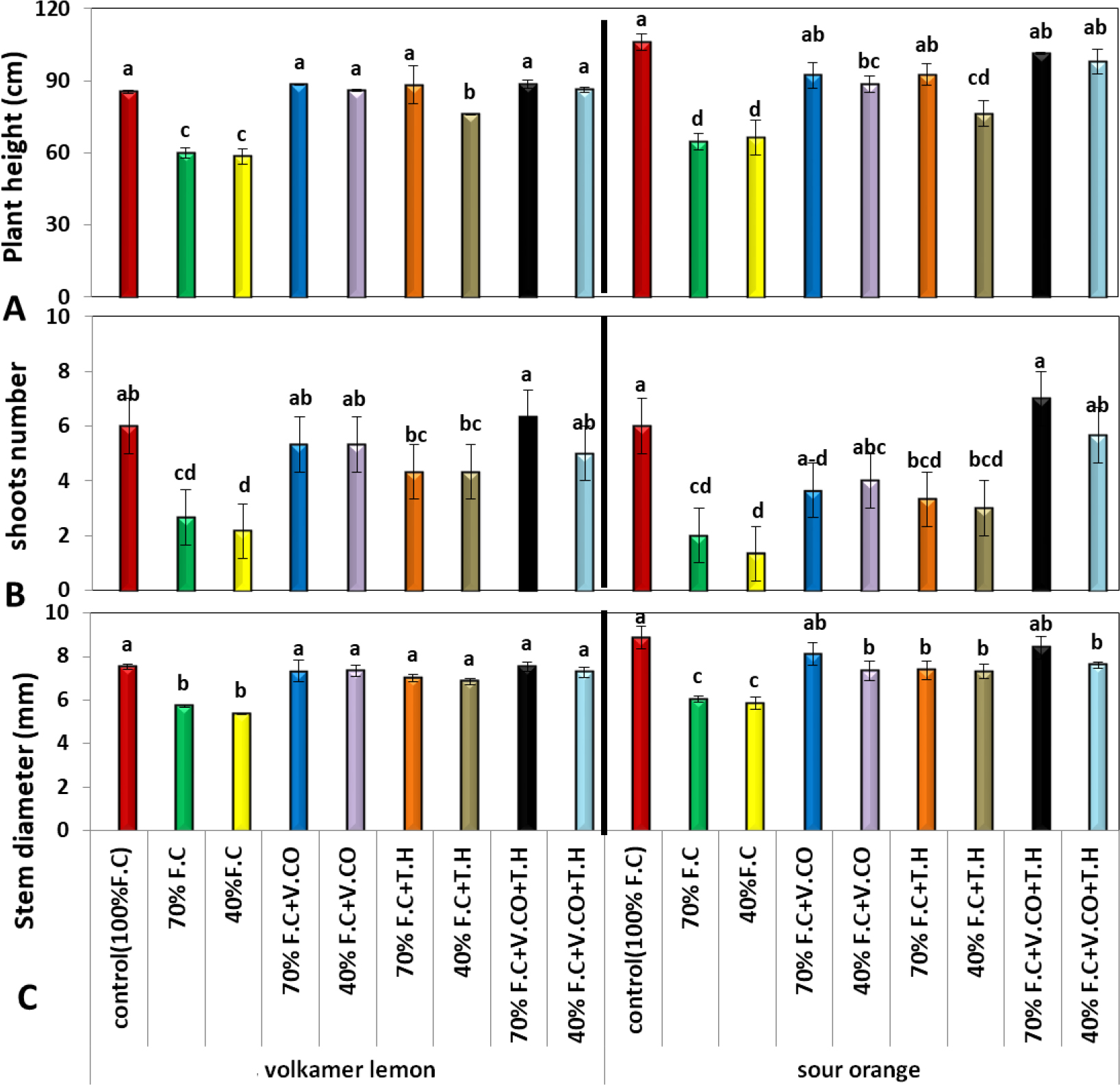
Figure 1.
The influence of diverse levels of drought (70% FC and 40% FC), V.CO and exogenous TH on CRH (cm) (A), Shoots number (B) and Stem diameter (mm) (C).Three replicates (n = 3) for each season and the means of two se asons (2023 and 2024) make up the data. Duncan’s multiple range test indicates a significant difference at p ≤ 0.05 between the mean values ± SE of each parameter followed by various alphabetical letters. CRH, citrus rootstock height; FC, field capacity; SE, standard error; TH, trehalose; V.CO, vermicompost.
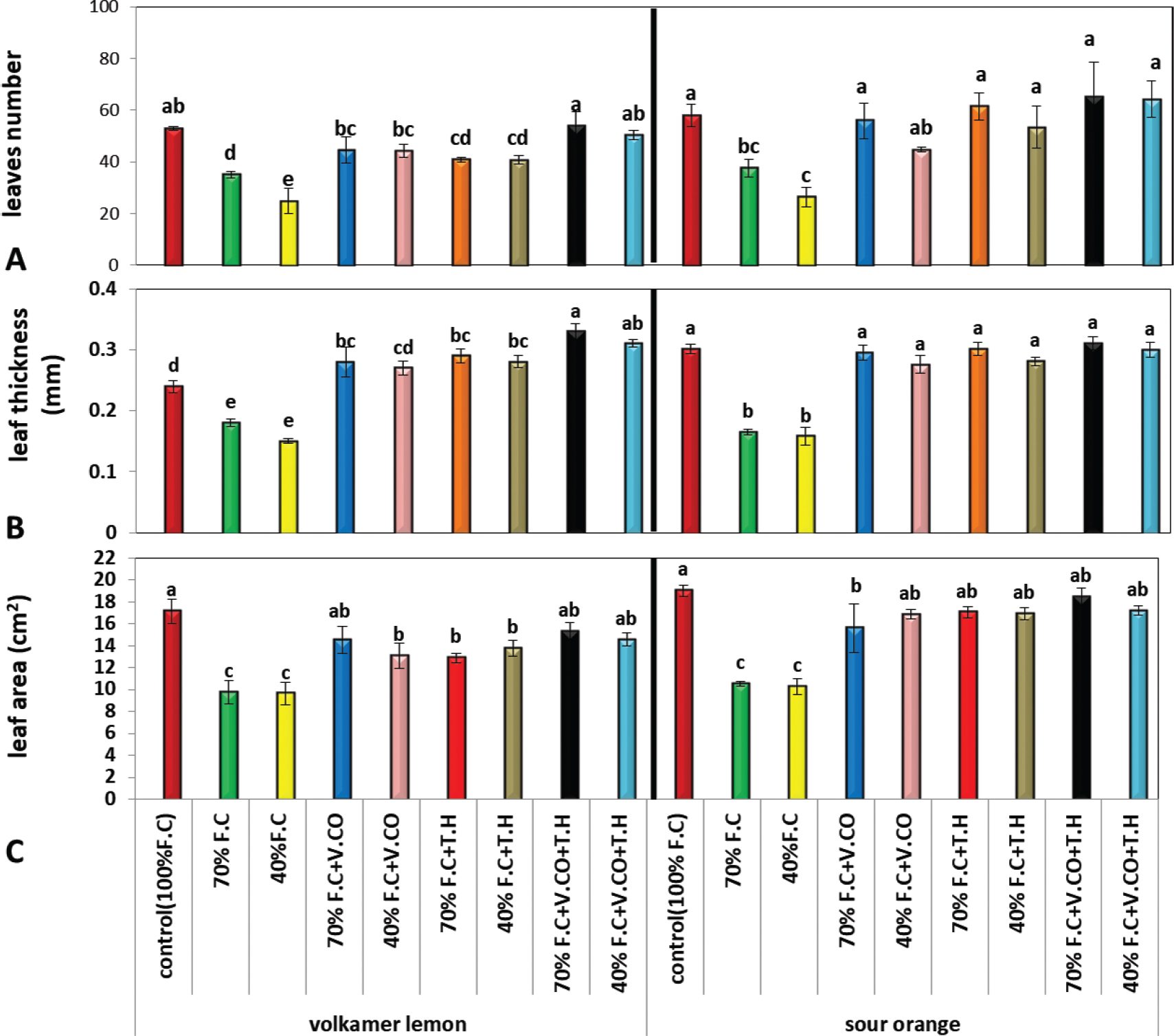
Figure 2.
The influence of diverse levels of drought (70% FC and 40% FC), V.CO and exogenous TH on citrus rootstock leaves number (A), LT (mm) (B) and LA (cm2) (C). Three replicates (n = 3) for each season and the means of two seasons (2023 and 2024) make up the data. Duncan’s multiple range test indicates a significant difference at p ≤ 0.05 between the mean values ± SE of each parameter followed by various alphabetical letters. FC, field capacity; LA, leaf area; LT, leaf thickness; SE, standard error; TH, trehalose; V.CO, vermicompost.
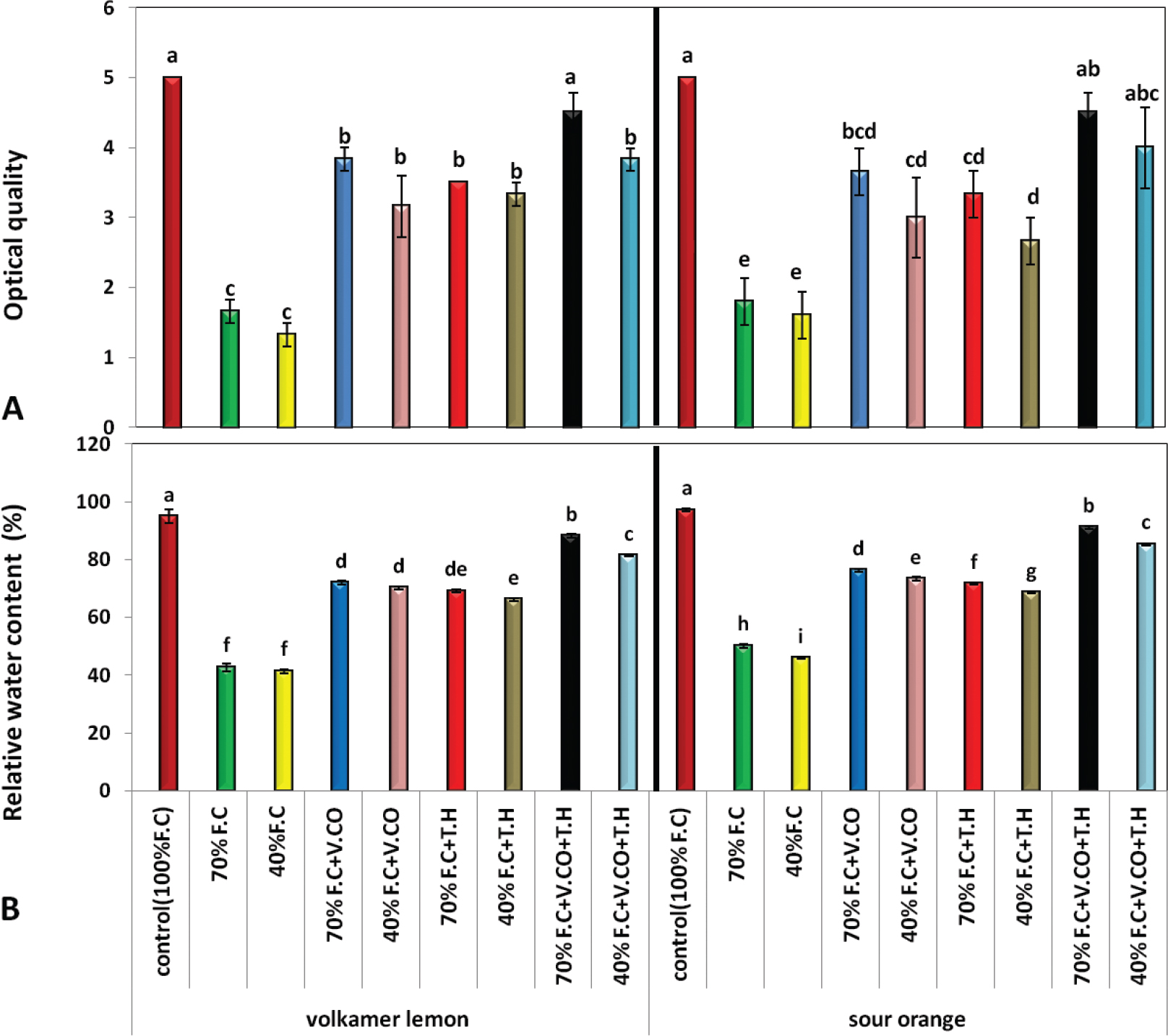
Figure 3.
The influence of diverse levels of drought (70% FC and 40% FC), V.CO and exogenous TH on optical quality (A) and RWC (%) (B). Three replicates (n = 3) for each season and the means of two seasons (2023 and 2024) make up the data. Duncan’s multiple range test indicates a significant difference at p ≤ 0.05 between the mean values ± SE of each parameter followed by various alphabetical letters. FC, field capacity; RWC, relative water content; SE, standard error; TH, trehalose; V.CO, vermicompost.
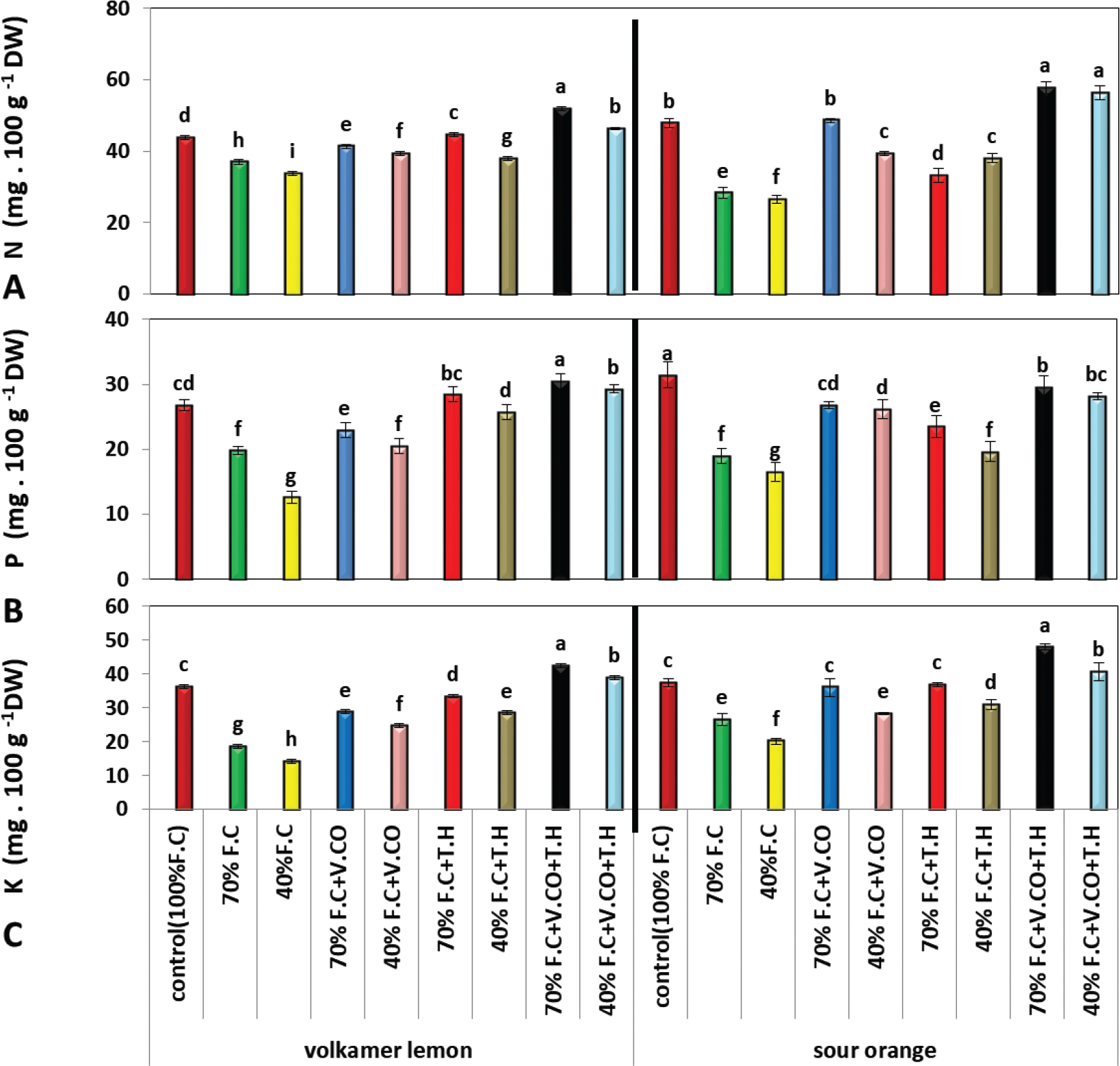
Figure 4.
The influence of diverse levels of drought (70% FC and 40% FC), V.CO and exogenous TH on nitrogen (N) (mg · 100 g−1 DW) (A), phosphorus (P) (mg · 100 g−1 DW) (B) and potassium (K) (mg · 100 g−1 DW) (C). Three replicates (n = 3) for each season and the means of two seasons (2023 and 2024) make up the data. Duncan’s multiple range test indicates a significant difference at p ≤ 0.05 between the mean values ± SE of each parameter followed by various alphabetical letters. DW, dry weight; FC, field capacity; SE, standard error; TH, trehalose; V.CO, vermicompost.
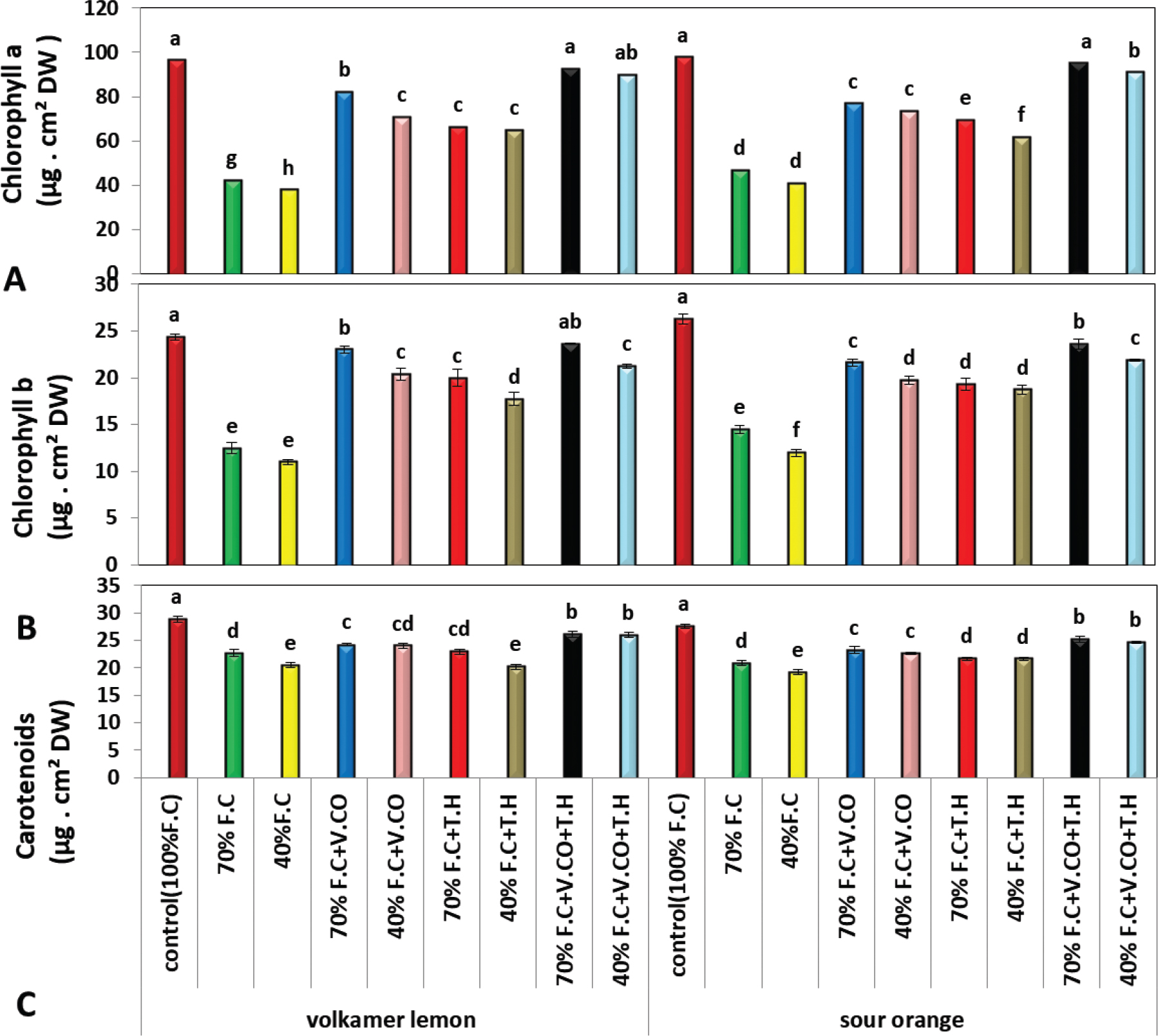
Figure 5.
The influence of diverse levels of drought (70% FC and 40% FC), V.CO and exogenous TH on chlorophyll a (μg · cm2 DW) (A), chlorophyll b (μg · cm2 DW) (B) and carotenoids (μg · cm2 DW) (C). Three replicates (n = 3) for each season and the means of two seasons (2023 and 2024) make up the data. Duncan’s multiple range test indicates a significant difference at p ≤ 0.05 between the mean values ± SE of each parameter followed by various alphabetical letters. FC, field capacity; SE, standard error; TH, trehalose; V.CO, vermicompost.
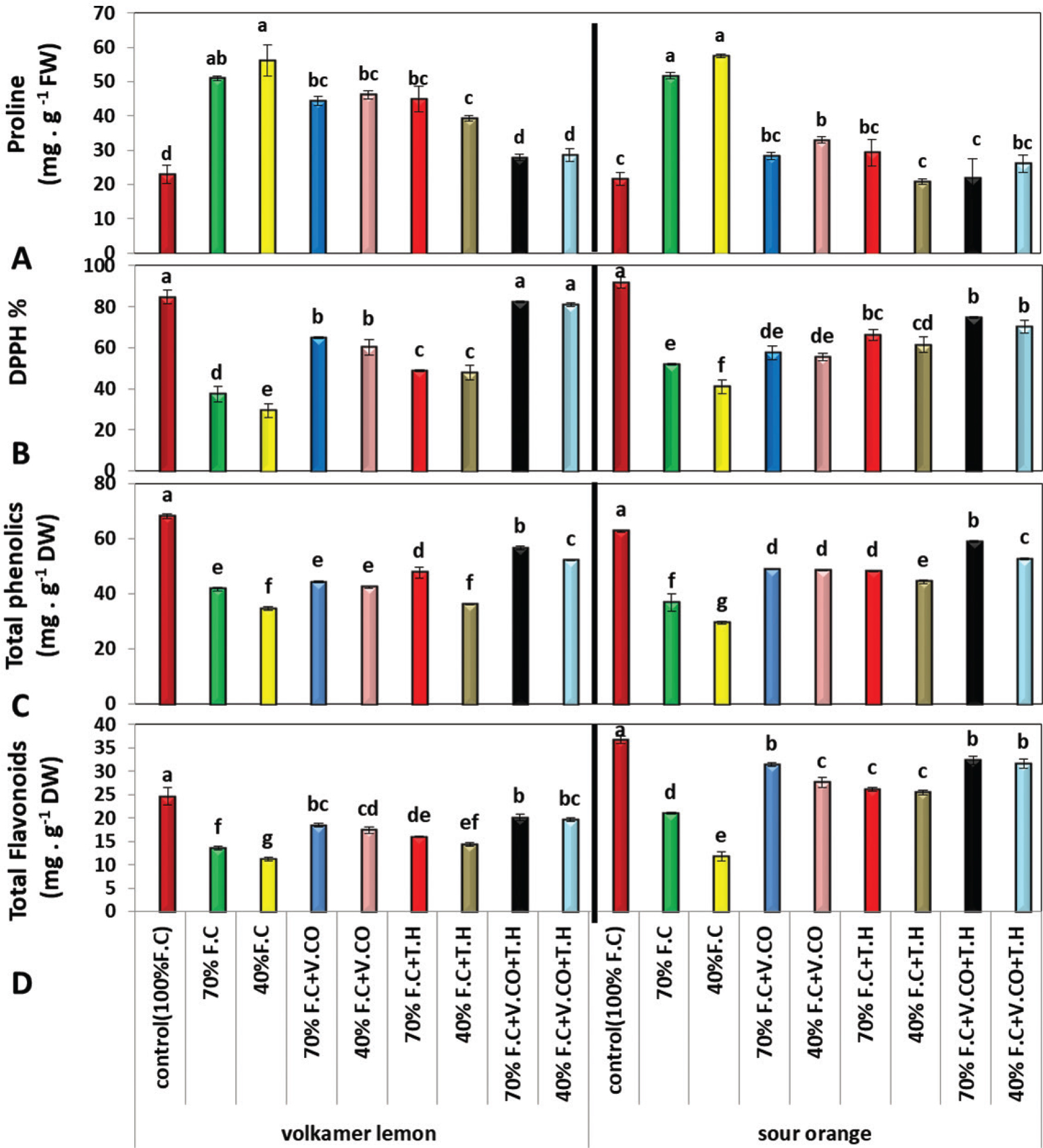
Figure 6.
The influence of diverse levels of drought (70% FC and 40% FC), V.CO and exogenous TH on Proline (mg · g−1 FW) (A), DPPH (%) (B), total phenolics (mg · g−1 DW) (C) and total flavonoids (mg · g−1 DW) (D). Three replicates (n = 3) for each season and the means of two seasons (2023 and 2024) make up the data. Duncan’s multiple range test indicates a significant difference at p ≤ 0.05 between the mean values ± SE of each parameter followed by various alphabetical letters. DPPH, 2,2-diphenyl-1-picrylhydrazyl; DW, dry weight; FC, field capacity; FW, fresh weight; SE, standard error; TH, trehalose; V.CO, vermicompost.
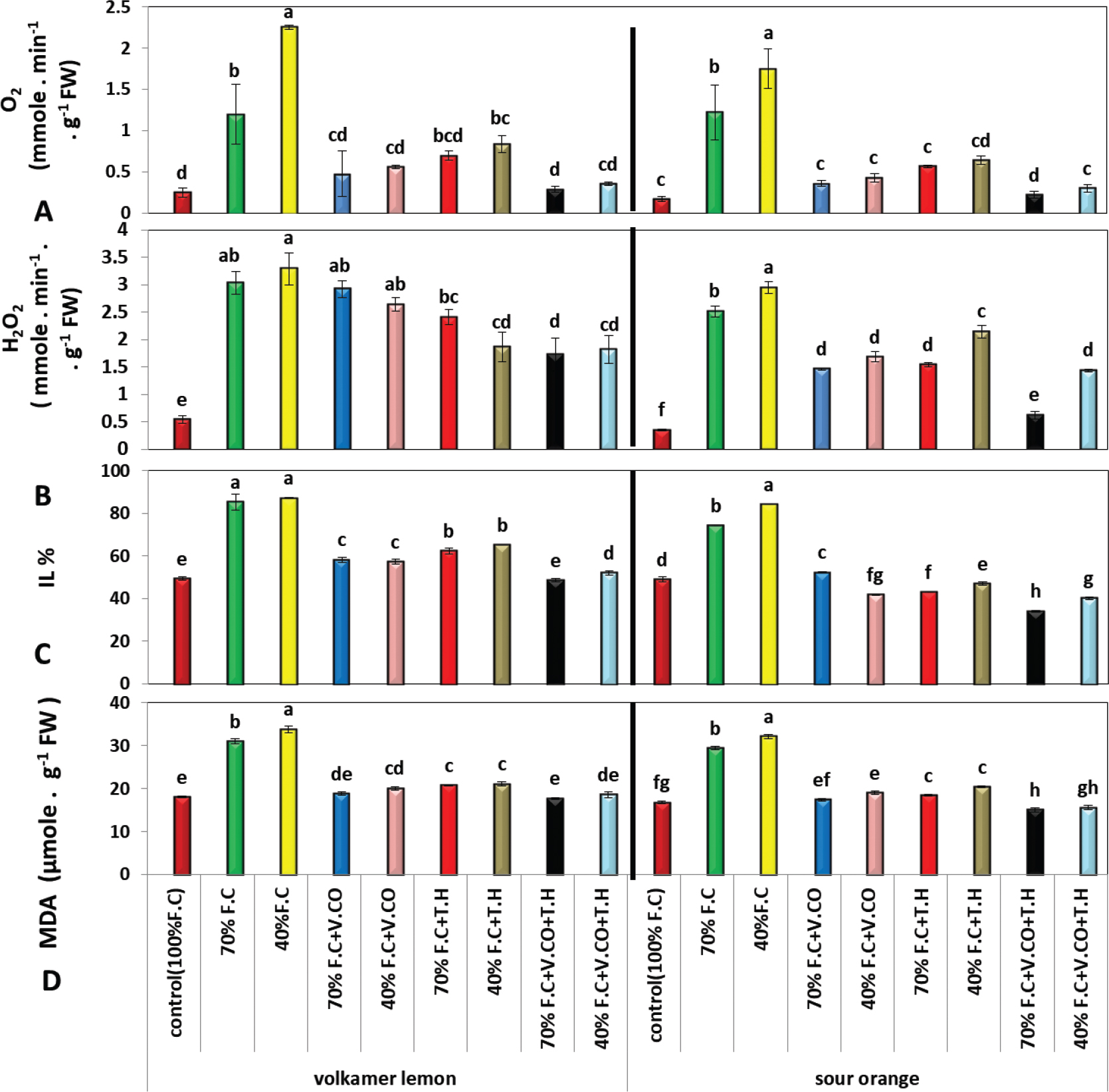
Figure 7.
The influence of diverse levels of drought (70% FC and 40% FC), V.CO and exogenous TH on superoxide anion (O2) (mmole · min−1 · g−1 FW), (A), hydrogen peroxide (H2O2) (mmole · min−1 · g−1 FW) (B), IL (%) (C) and MDA (μmole · g−1 FW) (D). Three replicates (n = 3) for each season and the means of two seasons (2023 and 2024) make up the data. Duncan’s multiple range test indicates a significant difference at p ≤ 0.05 between the mean values ± SE of each parameter followed by various alphabetical letters. FC, field capacity; FW, fresh weight; IL, ion leakage; MDA, malondialdehyde; SE, standard error; TH, trehalose; V.CO, vermicompost.
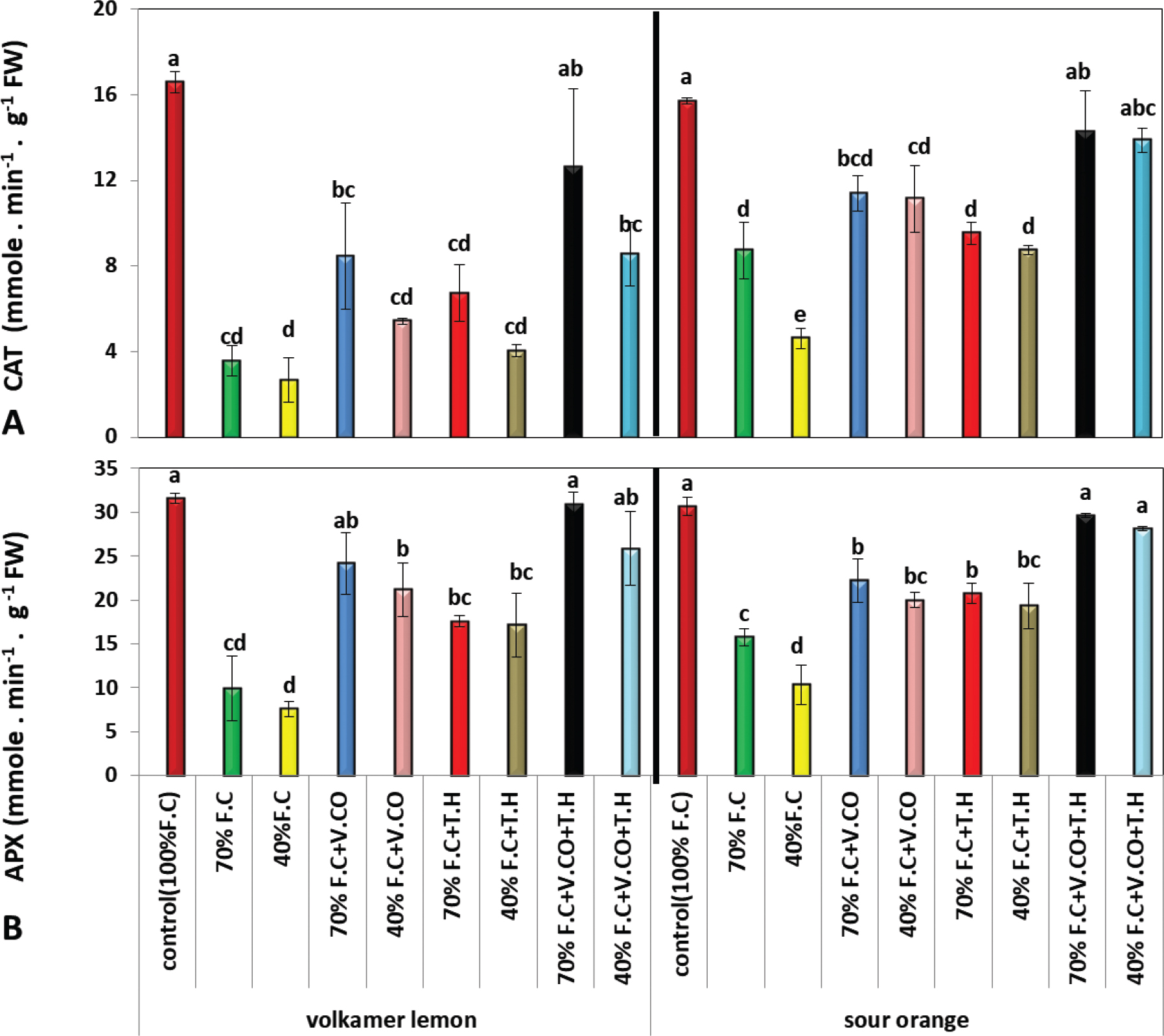
Figure 8.
The influence of diverse levels of drought (70% FC and 40% FC), V.CO and exogenous TH on CAT (mmole · min−1 · g−1 FW) (A) and APX (mmole · min−1 · g−1 FW) (B). Three replicates (n = 3) for each season and the means of two seasons (2023 and 2024) make up the data. Duncan’s multiple range test indicates a significant difference at p ≤ 0.05 between the mean values ± SE of each parameter followed by various alphabetical letters. APX, ascorbate peroxides; CAT, catalase; FC, field capacity; FW, fresh weight; SE, standard error; TH, trehalose; V.CO, vermicompost.
Table 1.
Lamina micro-morphological characters of citrus rootstock leaves as affected by drought stress and anti-stress (V.CO and TH).
| Dermal system | Mesophyll tissue | Mechanical tissue | Ground tissue | Vascular system | Secretory system | Crystals | |||||||||
|---|---|---|---|---|---|---|---|---|---|---|---|---|---|---|---|
| Trichomes | |||||||||||||||
| Rootstock type | Treatment no. | Outline in T.s | Eglandular | Glandular | Cuticle | Epidermal cells | Type | Palisade Rows No. | Palisade extended at mid rib region | Collenchyma | Parenchyma | Outline | No of bundles | Schizogenous duct | |
| Volkamer lemon | Tl | Raised adaxially & abaxially | - | - | Thick | Tangentially, radially | Dorsiventral | 2 | + | Annular | + | Continuous | 37 | + | - |
| T2 | // | - | - | Thin | // | // | // | + | // | + | // | 45 | + | - | |
| T3 | // | - | - | // | // | // | // | + | // | + | // | 34 | + | - | |
| T4 | // | - | - | // | // | // | // | + | // | + | // | 26 | + | - | |
| T5 | // | - | - | Thick | // | // | // | + | // | + | // | 25 | + | - | |
| T6 | // | - | - | // | // | // | // | + | // | + | // | 23 | + | - | |
| T7 | // | - | - | // | // | // | // | + | // | + | // | 23 | + | - | |
| T8 | // | - | - | // | // | // | // | + | // | + | // | 24 | + | - | |
| T9 | // | - | - | // | // | // | // | + | // | + | // | 36 | + | - | |
| Sour orange | Tl | // | - | - | Thick | // | // | // | + | // | + | // | 40 | + | - |
| T2 | // | - | - | Thin | // | // | // | + | // | + | // | 52 | + | - | |
| T3 | // | - | - | // | // | // | // | + | // | + | // | 46 | + | - | |
| T4 | // | - | - | Thick | // | // | // | + | // | + | // | 58 | + | - | |
| T5 | // | - | - | // | // | // | // | + | // | + | // | 37 | + | - | |
| T6 | // | - | - | // | // | // | // | + | // | + | // | 35 | + | - | |
| T7 | // | - | - | // | // | // | // | + | // | + | // | 37 | + | - | |
| T8 | // | - | - | // | // | // | // | + | // | + | // | 39 | + | - | |
| T9 | // | - | - | // | // | // | // | + | // | + | // | 38 | + | - | |
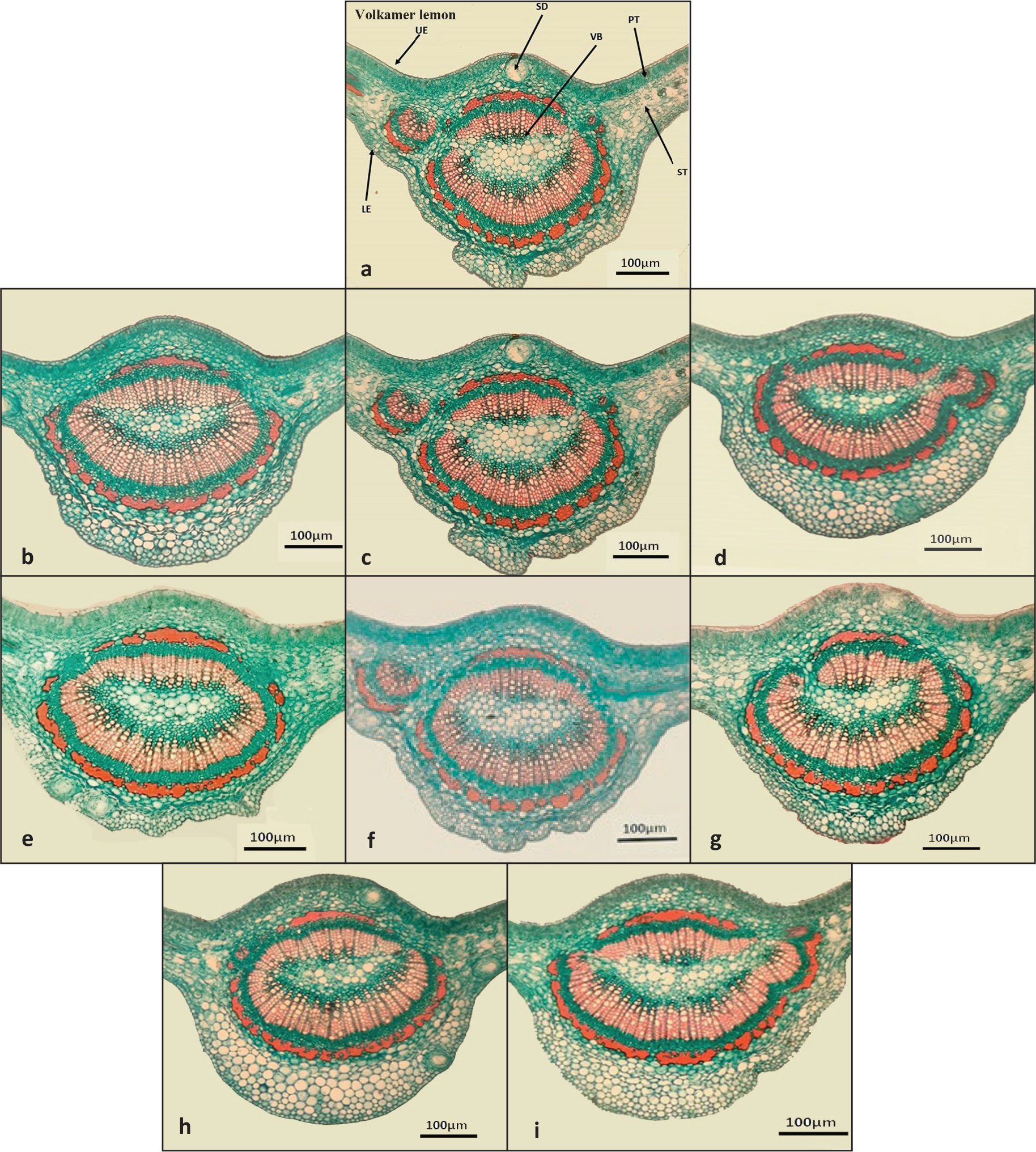
Figure 9.
The transverse section through the leaves blade on the median portion of Volkamer lemon rootstock as affected by drought stress and anti stress (V.CO and TH) shows asymmetric. (A) Control with 100% FC; (B) with 70% FC; (C) with 40% FC; (D) with 70% FC + V.CO; (E) 40% F C + V.CO; (F) 70% FC + TH; (G) 40% FC + TH; (H) 70% FC + V.CO + TH; (I) 40% FC + V.CO + TH. (Obj. 10×). FC, field capacity; LE, lower epidermis; PT, palisade tissue; SD, schizogenous duct; ST, spongy tissue; TH, trehalose; UE, upper epidermis; VB, vascular bundle; V.CO, vermicompost.
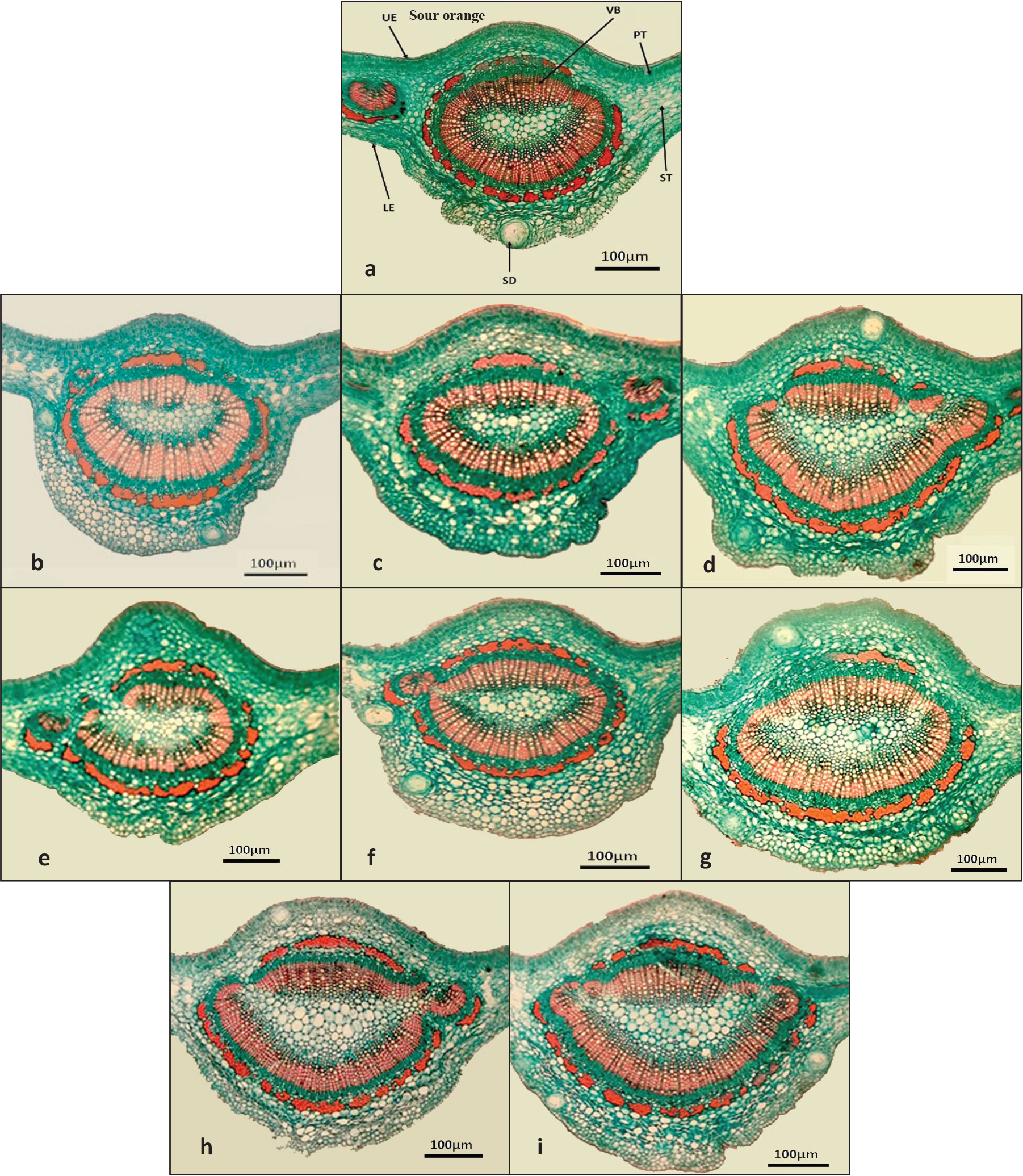
Figure 10.
The transverse section through the leaves blade on the median portion of Sour orange rootstock as affected by drought stress and anti stress (V.CO and TH) shows asymmetric. (A) Control with 100% FC; (B) with 70% FC; (C) with 40% FC; (D) with 70% FC + V.CO; (E) 40% FC + V.CO; (F) 70% FC + TH; (G) 40% FC + TH; (H) 70% FC + V. CO + TH; (I) 40% FC + V.CO + TH. (Obj. 10×). FC, field capacity; LE, lower epidermis; PT, palisade tissue; SD, schizogenous duct; ST, spongy tissue; TH, trehalose; UE, upper epidermis; V.CO, vermicompost; VB, vascular bundle.
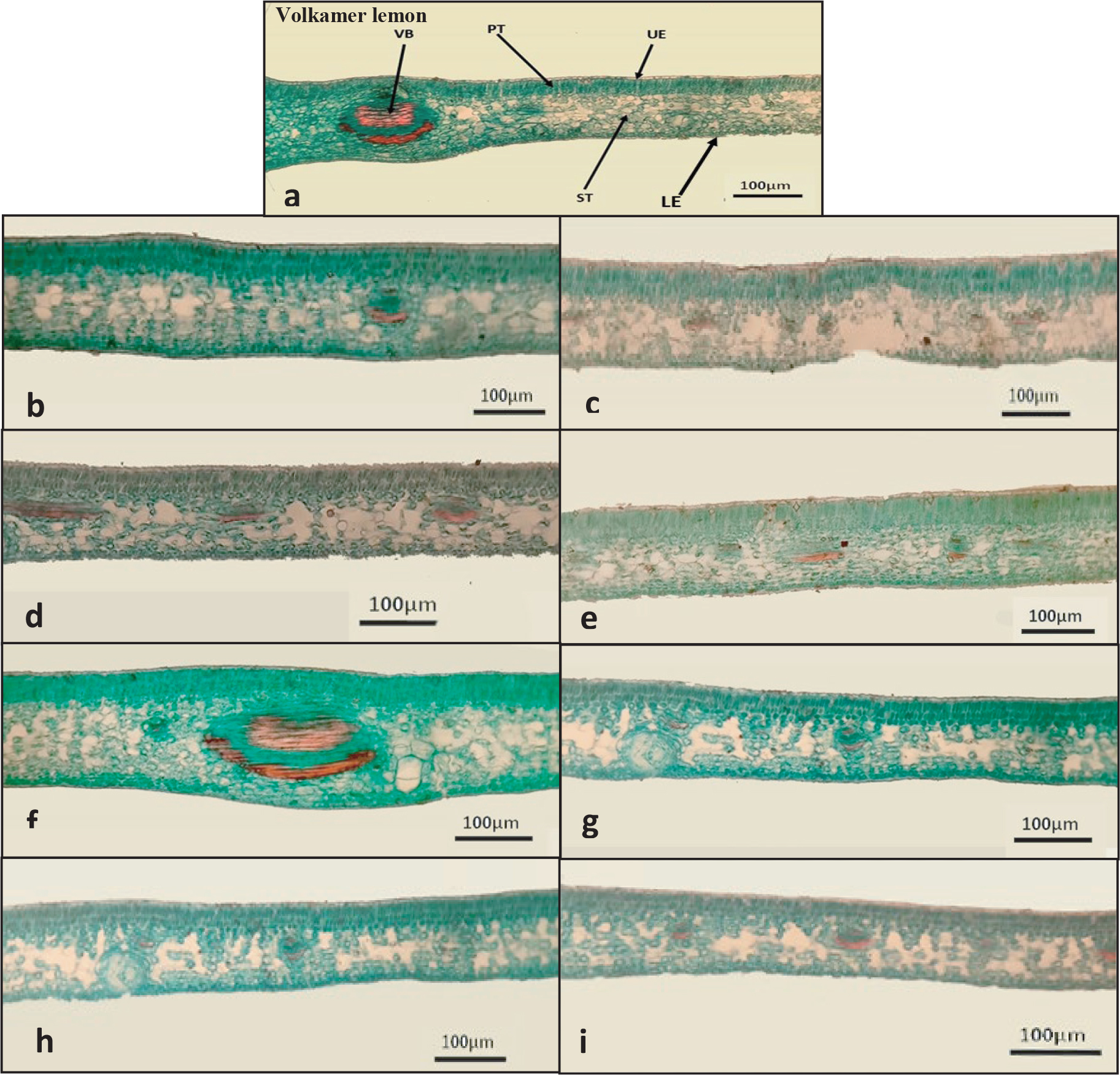
Figure 11.
Leaf transverse section of Volkamer lemon rootstock as affected by drought stress and anti-stress (V.CO and TH) showing two unequal palisade parenchyma. (A) Control with 100% FC; (B) with 70% FC; (C) with 40% FC; (D) with 70% FC + V.CO; (E) 40% FC + V.CO; (F) 70% FC + TH; (G) 40% FC + TH; (H) 70% FC + V.CO + TH; (I) 40% FC + V.CO + TH (Obj. 10× and 40×). FC, field capacity; LE, lower epidermis; PT, palisade tissue; ST, spongy tissue; TH, trehalose; UE, upper epidermis; VB, vascular bundle; V.CO, vermicompost.
Table 2.
Lamina anatomical traits of citrus rootstock leaves as affected by drought stress and anti-stress (V.CO and TH).
| Rootstock type | Treatment no. | Cuticle thickness (μm) | Lamina thickness (μm) | Midrib zone thickness (μm) | Cell size (μm) | VB of mid rib (μm) | ||
|---|---|---|---|---|---|---|---|---|
| Palisade mesophyll | Spongy mesophyll | Vertical length | Horizontal length | |||||
| Volkamer lemon | T1 | 97.39 ± 0.008 c | 15.44 ± 5.773 a | 61.17 ± 5.773 c | 3.41 ± 5.773 d | 10.97 ± 3.333 d | 39.79 ± 5.773 a | 45.57 ± 3.333 c |
| T2 | 67.02 ± 0.014 h | 12.84 ± 0.010 h | 54.86 ± 6.666 f | 2.36 ± 5.773 i | 9.62 ± 3.333 h | 34.32 ± 5.773 g | 46.31 ± 5.773 a | |
| T3 | 70.87 ± 0.014 g | 12.18 ± 0.003 i | 51.57 ± 5.773 h | 3.11 ± 5.773 g | 10.94 ± 6.666 e | 34.35 ± 8.819 f | 43.12 ± 8.819 g | |
| T4 | 66.37 ± 0.037 i | 13.03 ± 6.666 g | 56.82 ± 8.819 d | 2.54 ± 8.190 h | 9.57 ± 6.666 i | 34.02 ± 5.773 h | 39.11 ± 3.333 h | |
| T5 | 80.38 ± 0.008 f | 14.13 ± 3.333 f | 54.16 ± 0.002 g | 4.58 ± 5.773 a | 11.09 ±6.666 a | 36.06 ±0.001 e | 44.66 ± 44.66 d | |
| T6 | 84.09 ±0.011 e | 14.27 ± 5.773 e | 55.55 ± 6.666 e | 3.62 ± 5.773 b | 10.99 ± 6.666 b | 36.49 ± 5.773 d | 43.35 ± 43.35 f | |
| T7 | 88.81 ±0.017 d | 14.30 ± 8.819 d | 50.09 ± 6.666 i | 3.14 ± 8.819 f | 10.98 ± 3.333 c | 30.97 ± 5.773 i | 37.45 ± 5.773 i | |
| T8 | 100.00 ±0.021 b | 14.88 ±0.001 c | 61.98 ± 3.333 a | 3.46 ± 6.666 c | 10.66 ± 0.003 g | 37.20 ± 5.773 c | 45.88 ± 3.333 b | |
| T9 | 102.16 ±0.005 a | 15.01 ± 8.819 b | 61.71 ± 8.819 b | 3.32 ± 8.819 e | 10.66 ± 0.001 f | 38.61 ± 5.773 b | 44.38 ±0.001 e | |
| Sour orange | T1 | 90.12 ± 0.014 c | 18.02 ± 5.773 a | 57.29 ± 5.773 a | 3.77 ± 0.148 c | 13.88 ±5.773 a | 36.75 ± 0.001 c | 43.90 ± 8.819 e |
| T2 | 72.14 ± 0.012 h | 13.84 ± 8.819 h | 46.30 ± 5.773 h | 2.71 ± 3.333 e | 10.97 ± 8.819 h | 29.39 ± 5.773 g | 37.16 ± 3.333 g | |
| T3 | 69.58 ±0.011 i | 12.90 ± 8.819 i | 42.69 ± 0.003 i | 3.29 ± 5.773 d | 8.69 ± 5.773 i | 25.15 ± 5.773 h | 33.58 ± 3.333 h | |
| T4 | 75.25 ± 0.017 g | 16.69 ± 3.333 e | 55.70 ± 5.773 e | 3.82 ± 5.773 b | 11.41 ± 5.773 g | 35.68 ± 5.773 d | 46.23 ± 8.819 c | |
| T5 | 80.31 ± 0.008 f | 16.82 ± 5.773 d | 43.32 ± 0.003 g | 2.85 ± 8.819 e | 12.02 ±0.001 e | 24.13 ± 5.773 i | 32.41 ± 3.333 i | |
| T6 | 83.47 ± 0.014 e | 15.32 ± 5.773 g | 59.23 ± 8.819 c | 3.59 ±0.001 c | 11.90 ± 5.773 f | 35.45 ± 5.773 e | 41.82 ± 8.819 f | |
| T7 | 87.35 ± 0.014 e | 15.60 ± 8.819 f | 52.84 ± 8.189 f | 3.89 ± 3.333 b | 12.90 ±0.001 c | 33.46 ± 5.773 f | 44.07 ± 3.333 d | |
| T8 | 94.82 ± 0.014 b | 17.09 ± 6.666 c | 60.87 ± 5.773 b | 4.09 ± 5.773 a | 12.34 ± 5.773 d | 41.36 ±0.001 b | 51.23 ± 5.773 b | |
| T9 | 97.32 ±0.014 a | 17.77 ± 5.773 b | 72.42 ± 5.773 a | 3.74 ± 3.333 be | 13.27 ± 5.773 b | 45.36 ±0.001 a | 64.20 ± 3.333 a | |
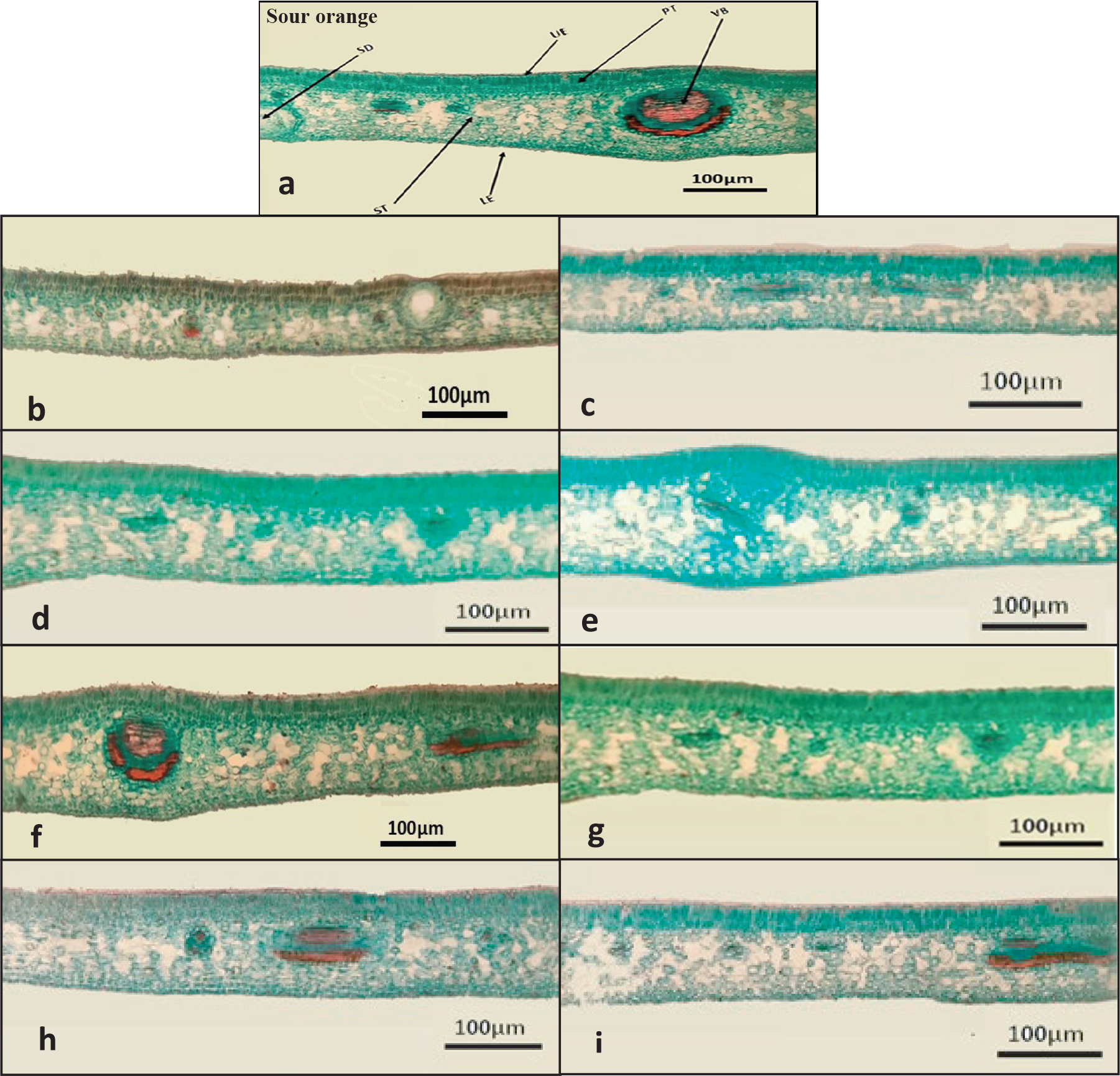
Figure 12.
Leaf transverse section of sour orange rootstock as affected by drought stress and anti-stress (V.CO and TH) showing two unequal palisade parenchyma. (A) Control with 100% FC; (B) with 70% FC; (C) with 40% FC; (D) with 70% FC + V.CO; (E) 40% FC + V.CO; (F) 70% FC + TH; (G) 40% FC + TH; (H) 70% FC + V.CO + TH; (I) 40% FC + V.CO + TH (Obj. 10× and 40×). FC, field capacity; LE, lower epidermis; PT, palisade tissue; SD, schizogenous duct; ST, spongy tissue; TH, trehalose; UE, upper epidermis; VB, vascular bundle; V.CO, vermicompost.