
Introduction
Saline water is a significant issue affecting agricultural areas worldwide, negatively impacting crop cultivation (Majeed and Muhammad, 2019). Salinity induces abiotic stress in plants, resulting in reduced growth, development and ultimately, decreased productivity. Complex mechanisms of gene expression regulate this stress response. Salt stress is particularly concerning for food crops, especially field-grown plants like rice (Kumar et al., 2013) and soybean (Phang et al., 2008), as well as well-studied model plants like Arabidopsis (Burssens et al., 2000; Kim et al., 2022), allowing for the selection or development of salt-tolerant lines (Ismail and Horie, 2017). Nonetheless, very few studies have been conducted on salt stress in non-food crops, particularly in potted plant species such as orchids.
Dendrobium is a large genus of orchids that has been widely utilised both as an ornamental plant and for traditional medicine (Kuehnle, 2007; Teixeira da Silva and Ng, 2017), making it economically important. Thailand, a leading global exporter of Dendrobium orchids (Yuan et al., 2021), mainly cultivates the orchids in the central region, where growers frequently face saline water intrusion into freshwater resources during the dry season, an issue that has become more severe in recent years due to Climate Change (Heydarizad et al., 2023). The use of saline water for irrigation has been shown to reduce flower production, leading to economic losses (Thairath Online, 2021). Orchids tend to be sensitive to salinity, but their responses vary by species, age and the level of salinity. A classic study on Phalaenopsis orchids in 1998 reported that the plants could maintain growth and flowering up to an electrical conductivity (EC) of 1.1 dS · m−1 (Wang, 1998). An earlier study on 12-month-old Dendrobium found that NaCl concentrations at or above an EC of 2 dS · m−1 reduced plant growth and flower size (Abdullakasim et al., 2018). Additionally, in 3-month-old Dendrobium plants, increasing the EC from 0 dS · m−1 to 8 dS · m−1 resulted in reduced leaf greenness and pseudobulb size (Sonsud et al., 2014). Irrigating 9- and 24-month-old Dendrobium with an EC of 1–2 dS · m−1 for 2 months decreased both the carbon dioxide exchange rate and stomatal conductance. These effects were observed even earlier when the Vanda orchid was irrigated with saline water for just 2 weeks (Chiewchookul, 2018). In vitro propagation, Dendrobium 'Sonia Jo Daeng' plantlets exhibited a median lethal concentration (LC50) of NaCl at 193.3 mM (Obsuwan et al., 2021). Supplementing the culture medium with calcium silicate (CaSiO3), paclobutrazol or proline significantly enhanced plantlet survival under salt stress (Obsuwan et al., 2019, 2021). Understanding the response to salt stress is crucial for developing salt-tolerant orchid varieties, which provides a promising solution to mitigate the effects of climate change on plant productivity.
Micropropagation, or tissue culture, is the most efficient method for producing a large number of identical plantlets using aseptic techniques (Rout et al., 2006). In orchids like Dendrobium, micropropagation commonly involves the induction of protocorm-like bodies (PLBs), structures that resemble somatic embryos morphologically but differ in developmental origin and are specific to orchids, from explants such as pseudobulbs, leaves and inflorescence stalks (Lee et al., 2013; Teixeira da Silva et al., 2015; Cardoso et al., 2020). The PLBs are then multiplied to sufficient numbers and subsequently regenerated with root and shoot induction, resulting in plantlets (Teixeira da Silva et al., 2015). Besides propagation, PLBs are employed in genetic research as a straightforward method for producing transgenic plants (Teixeira da Silva et al., 2016; Cardoso et al., 2020) and creating mutated plants through chemical induction (Sarathum et al., 2010), all of which can be conducted under easily controlled stress conditions (Bednarek and Orłowska, 2020). Thus, understanding the salt stress responses of PLBs is beneficial, as their origin and simple tissue structure make them an ideal starting point for further application.
During the multiplication of PLBs, genes involved in cell division and development play a crucial role. For instance, CDKA1 is essential for activating the cell cycle (Takayanagi et al., 2022), exhibiting the highest expression in PLBs compared to other tissues, such as roots and leaves, in D. candidum (Zhang et al., 2012). Microtubules are crucial for chromosome separation and cell wall formation during cell division (Hsiao and Huang, 2023), with beta-tubulin proteins (TUBB3) playing a significant role in salt stress adaptation and tolerance in Arabidopsis (Chun et al., 2021). Although TUBB3 is often considered a housekeeping gene, its expression in protocorms of Dendrobium officinale was found to be unstable under osmotic and temperature stress (An et al., 2016). Expansins (EXP) promote cell enlargement by facilitating the loosening and extension of the cell wall. Under drought stress, expansins have been shown to induce cell wall folding (Choi et al., 2006) and palisade mesophyll thickening (Yao et al., 2023). cytokinin oxidase-1 (CKX1) regulates cytokinin degradation, which directly influences shoot formation (Yang et al., 2003). In terms of photosynthesis, ribulose-1,5-bisphosphate carboxylase/oxygenase large subunit (rbcL) is a key component of the Rubisco enzyme, serving as an indicator of photosynthetic efficiency (Zhang et al., 2013). Moreover, late embryogenesis abundant (LEA) proteins play a crucial role in stress tolerance, particularly under salinity conditions, by protecting cellular structures from dehydration and oxidative damage (Ling et al., 2016). As shown in previous reports, the expression of these genes affects PLB multiplication, which may be influenced by salinity, making them appropriate targets for this study.
The effect of salinity on PLBs of Cymbidium orchid was evident at above 20 mM NaCl, where necrosis, reduced survival rates and lower weight were observed. However, PLBs cultured at lower NaCl levels showed tolerance to 40 mM NaCl over several subcultures (Teixeira da Silva, 2015). Multiplication of Dendrobium PLBs is negatively affected when cultured with NaCl concentrations higher than 50 mM (Khamtae et al., 2018). This negative response may result from the altered expression of genes related to cell division and development, although this is not well understood in Dendrobium orchids. Thus, this study aims to investigate how salinity affects the multiplication of PLBs in two Dendrobium cultivars. We evaluated the morphological, physiological and histological responses, as well as examined the early expression of genes related to cell division and development at the transcriptional level. This research may offer preliminary insights into the response of Dendrobium orchids to salinity at the stage of PLBs multiplication, which in vitro condition allows for the controlled assessment of physiological and molecular traits before transplanting to ex vitro environments. The finding could support the development of tissue culture-based propagation and screening to enhance salt stress tolerance in orchids.
MATERIALS AND METHODS
Tissue preparation and salt stress treatment
PLBs were induced from pseudobulb segments of Dendrobium Sonia 'Earsakul' and 'Jindasweet' in Vacin and Went (VW) (Vacin and Went, 1949) liquid medium supplemented with 20 g · L−1 sucrose and 150 mL · L−1 fresh coconut water. The medium was adjusted to a pH of 5.2 and autoclaved at 121°C for 25 min. The PLBs were sub-cultured at 20-day intervals. The cultures were placed at 25 ± 2°C under a 14-hr photoperiod of 40 μmol · m−2· s−1 from cool daylight fluorescent lamps on a rotary shaker at 120 rpm. PLBs, at the age of approximately 5 months after the induction started, ranging in size from 0.5 cm to 0.7 cm in diameter, were used in the experiment. At the beginning of the experiment, 'Jindasweet' PLBs had already initiated some small shoots, whereas 'Earsakul' PLBs had not (Figure 1). A piece of PLBs was transferred into a volumetric flask filled with 20 mL VW liquid medium supplemented with 20 g · L−1 sucrose and 2 mg · L−1 of 6-benzylaminopurine (BAP), as a control (EC ≈190 μS · cm−1). For salt stress treatment, the liquid medium of the control was supplemented with 150 mM NaCl (EC = 1400 μS · cm−1). The concentration of 150 mM NaCl was chosen based on previous studies showing that similar or higher levels induce salt stress in Dendrobium without causing tissue death. For example, Dendrobium 'Sonia Jo Daeng' had an LC50 of 193.3 mM (Obsuwan et al., 2021), while D. officinale was tested for salt tolerance at concentrations up to 250 mM. In addition, salt levels above 50 mM have been shown to reduce PLB multiplication (Khamtae et al., 2018). Thus, a concentration of 150 mM was considered suitable to trigger stress while preserving tissue viability. The cultures were maintained under the same conditions used for PLB preparation and were sub-cultured every 2 weeks.
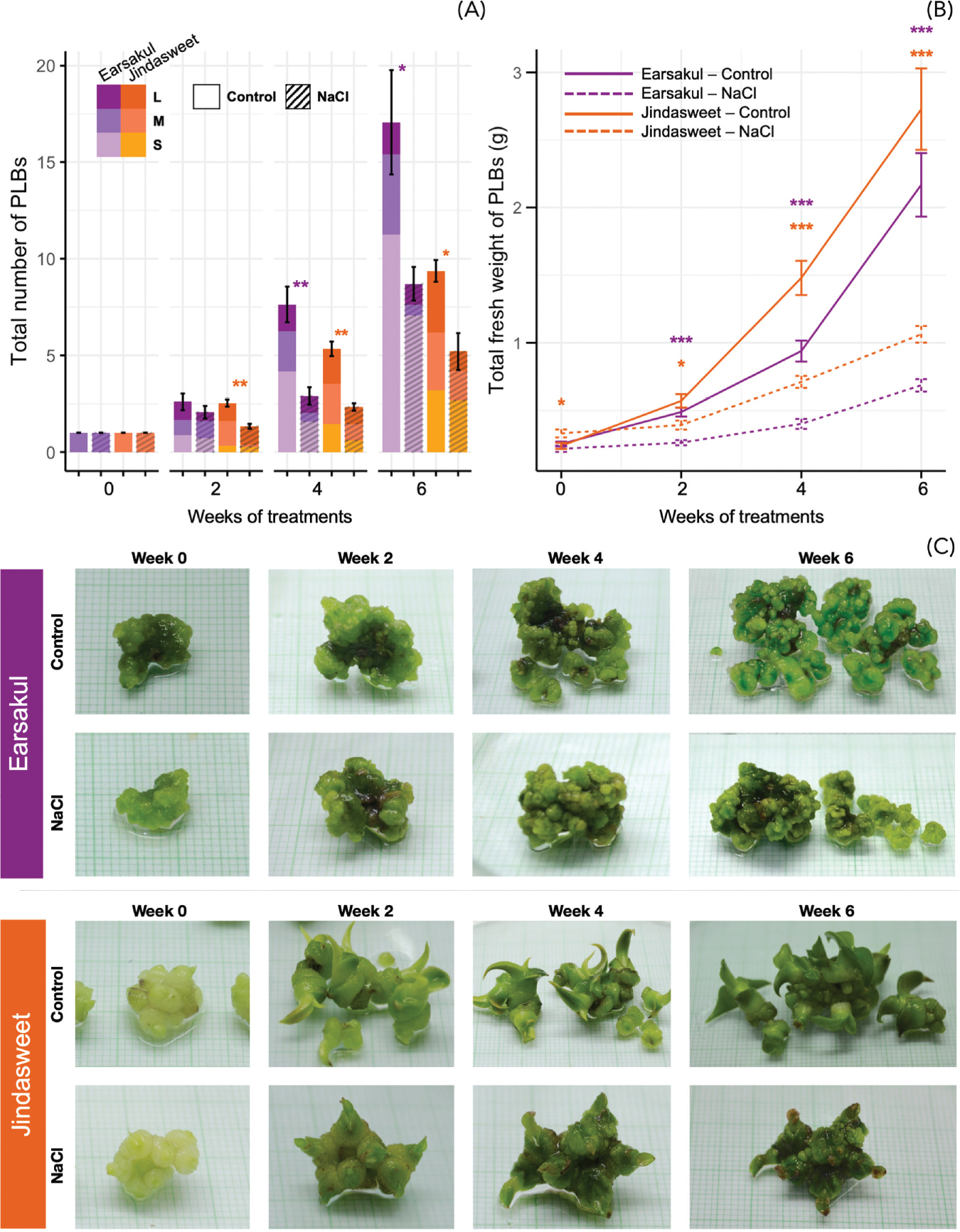
Figure 1.
Total number (A), total fresh weight (B) and photographs (C) of PLBs of Dendrobium Sonia 'Earsakul' and 'Jindasweet' cultured in liquid medium (control) or medium supplemented with 150 mM NaCl for 0, 2, 4 and 6 weeks. PLB numbers were categorised by size of diameter: S (<0.5 cm), M (0.5–1.0 cm) and L (>1.0 cm). All data are presented as the means of independent samples (n = 5). The error bars indicated ± standard error. A single asterisk (*) indicates significant difference at p < 0.05, and double asterisks (**) indicate p < 0.01, and triple asterisks (***) indicate p < 0.001 according to a t-test for each cultivar. PLBs, protocorm-like bodies.
Multiplication of PLBs
The number of PLBs and fresh weight were recorded after 2, 4 and 6 weeks of treatment under aseptic conditions. The number of PLBs according to the three different sizes of diameter was recorded, consisting of S (<0.5 cm), M (0.5–1.0 cm) and L (>1.0 cm). Photographs were taken periodically to observe the differentiation of PLBs.
Histological changes
The PLBs were sampled from each treatment after 6 weeks to investigate their histological changes using modified paraffin methods (Johansen, 1940; Nopun et al., 2025). Tissue samples were fixed in formalin-acetic-alcohol (FAA) solution for at least 48 hr. After fixation, the samples were dehydrated through a graded series of tertiary butyl alcohol and embedded in paraffin wax. Longitudinal sections, 12–15 μm thick, were cut using a rotary microtome (Slee, Nieder-Olm, Germany). The sections were stained with safranin and fast green to visualise cellular structures. Stained sections were examined under a light microscope, and images were captured using a Dino-eye microscope eyepiece camera (AnMo Electronics, New Taipei City, Taiwan) to investigate structural characteristics of PLB tissue.
Pigment contents
The PLBs were sampled from each treatment after 2, 4 and 6 weeks for pigment content analysis. Chlorophyll and carotenoids were determined using the method of Moran and Porath (1980). The Pigments were extracted from 0.2 g of fresh PLBs, which were sliced into small pieces and immersed in 3 mL of N,N’-dimethylformamide (DMF) solution. The samples were incubated in the dark at 4°C for 48 hr. A 1 mL aliquot of the extract was taken for measurement using a spectrophotometer (Biodrop, Cambridge, UK). Absorbance readings were taken at 480, 647 and 664 nm. Chlorophyll a (Chl a), chlorophyll b (Chl b) and total chlorophyll contents were calculated using the equations described by Porra et al. (1989): Chl a = 12 A664 – 3.11 A647, Chl b = 20.78 A647 – 4.88 A664 and total Chl = Chl a + Chl b. Carotenoid (Cx + c) contents were calculated following Wellburn (1994): Cx + c= (1000 A480 – 1.12 Chl a – 34.07 Chl b)/245.
Electrolyte leakage
For the determination of membrane permeability via electrolyte leakage (EL), the method of Lutts et al. (1995) was followed. PLBs were washed three times with deionised water and then incubated in closed tubes containing 10 mL of deionised water on a rotary shaker at 120 rpm and 25°C for 24 hr. The initial conductivity of the bathing solution (L1) was measured using an EC meter (Index, Noblesville, IN, USA). After incubation, all samples were autoclaved at 121°C for 20 min to kill the tissues and release all electrolytes. The final conductivity of the bathing solution (L2) was measured at room temperature. EL was calculated using the formula EL = (L1/L2) × 100%.
Gene expression
To quantify early gene expression responses to salt stress, the PLBs were collected 24 hr after treatments began, at the middle of the light period (7 hr after lights-on), then immediately flash-frozen in liquid nitrogen and stored at –°C. Total RNA was isolated from PLBs using GENEzol™ reagent (Geneaid Biotect, New Taipei City, Taiwan). Genomic DNA was removed with DNaseI enzyme (New England Biolabs, Ipswich, MA, USA). To synthesise complementary DNA (cDNA), reverse transcription of total RNA was performed using 1 μg of total RNA with an oligo-dT (15) primer and MMuLV Reverse Transcriptase (BiotechRabbit, Hennigsdorf, Germany). The quantitative reverse transcription polymerase chain reaction (qRT-PCR) analysis was performed in a fluorometric thermal cycler (Eppendorf, Hamburg, Germany) using corresponding primers (Table 1). The qRT-PCR reactions were set up to a total volume of 10 μL containing 5 μL 2x qPCR Green Master Mix (BiotechRabbit), 0.5 μL each primer (0.4 μM), 1 μL cDNA template and 3 μL nuclease-free water. The thermal conditions were 95°C for 30 s, followed by 40 cycles of 95°C for 15 s and 60°C for 1 min. To normalise gene expression, a parallel amplification of the elongation factor (EF1-a) gene was used as an internal reference gene. All reactions were determined with three biological replicates and three technical replicates for qRT-PCR analysis. The relative expression levels were calculated using the 2−△△Ct method.
Table 1.
Primers for gene expression analysis by qRT-PCR.
| Gene | Forward primer (5′-3′) | Reverse primer (5′-3′) | Accession No. | Reference |
|---|---|---|---|---|
| CDKA1 | TTCTCCGTGGCATTGCTTACTG | TCCAAGGAGGATTTCTGGTGCT | HQ904083.1 | Zhang et al. (2012) |
| TUBB3 | CCGTTGTGGAACCATACAATGC | GTAGCCGAGATGAGGTGATTGA | KX524085.1 | An et al. (2016) |
| EXP | AAAGGAGGGATTCGGTTCAC | ACGAGTTGCTTTGCCAATTC | KM408748.1 | - |
| CK1 | TCTCCCCTCACTCATTCACC | GCCCCAGCATCTACAAACAT | AJ294542 | - |
| rbcL | TGTCTACGGGGTGGACTTGA | AGCCAGGCTAGTATTTGCGG | AB519791.1 | - |
| LEA2 | ATGAGGAGAAGGGTGGCTTC | ACACAAGCTTCCTCCCATCA | KY626329.1 | - |
| EF1-a | TCAGGCTGACTGTGCTGTCCT | GTGGTGGCGTCCATCTTGTT | Zhang et al. (2012) |
Statistical analysis
The experiment was designed using a completely randomised design (CRD) with five independent replicates per treatment (n = 5), each consisting of three biological replicates (i.e., three individual PLB starters). For gene expression analysis only, the number of independent replicates was minimised to three per treatment (n = 3). To examine the effect of salinity, each cultivar was analysed separately using an independent sample t-test to compare the control and salinity. Differences between means were considered statistically significant at p <0.05. The normality of the residuals was examined using the Shapiro–Wilk test at p <0.05. The homogeneity of residuals was tested with Bartlett’s test at p <0.05. Both assumptions were met in all cases. All tests were using R version 4.2.3 (R Core Team, Vienna, Austria, 2023).
RESULTS AND DISCUSSION
Multiplication of PLBs decreased significantly under salinity conditions
PLBs of Dendrobium Sonia 'Earsakul' and 'Jindasweet' were cultured in liquid medium and compared to a salinity condition where the medium was supplemented with 150 mM NaCl. Salinity negatively affected PLB multiplication in both cultivars of Dendrobium (Figure 1). Similar in vitro responses to salinity have been reported in orchid protocorms, including those of Dendrobium (Khamtae et al., 2018) and Cymbidium (Teixeira da Silva, 2015), as well as in callus of other crops like durum wheat (Arzani and Mirodjagh, 1999), rice (Htwe et al., 2011) and sugarcane (Gandonou et al., 2006). Although PLBs in our study continued to multiply under salinity, the total number of PLBs was significantly lower, nearly half that observed under control conditions at 4–6 weeks of treatment (Figures 1A and 1C). Regardless of salinity, PLBs of Dendrobium 'Jindasweet' were evenly distributed across the three size categories, whereas in 'Earsakul', the majority of PLBs (>60%) were in the small size category. This may be explained by developmental differences between the cultivars: 'Earsakul' PLBs appeared to remain in an active multiplication phase, producing numerous small pieces, whereas 'Jindasweet' PLBs had progressed further toward shoot development. Reduction in total fresh weight due to salinity was observed along the treatment period with the largest was at the final observation (6 weeks), with decreases of 68% and 61% for 'Earsakul' and 'Jindasweet', respectively (Figure 1B). 'Earsakul' PLBs appeared more sensitive to salinity, as the difference between the control and salinity treatments was more pronounced and occurred earlier compared to 'Jindasweet' PLBs.
Salinity led to increased EL and denser PLBs, which potentially resulted in higher pigment content
EL results from the disruption of cell membrane integrity and is therefore a key indicator of salt stress (Hniličková et al., 2019). For instance, EL increased significantly with increasing salinity in durum wheat (Pastuszak et al., 2022). In Dendrobium plantlets cultured in vitro, EL in leaves was also shown to increase at NaCl concentrations above 50 mM, corresponding with higher proline accumulation (Khamtae et al., 2020). A similar result was shown in our study, where salinity increased EL in the PLBs over the 6-weeks treatment period. In the control, EL remained at 10%–20%, whereas under salinity, it increased 4–5 times in 'Earsakul' and 3–4 times in 'Jindasweet' (Figure 2). This suggests that 'Jindasweet' PLBs may exhibit better salt stress tolerance by maintaining lower EL.
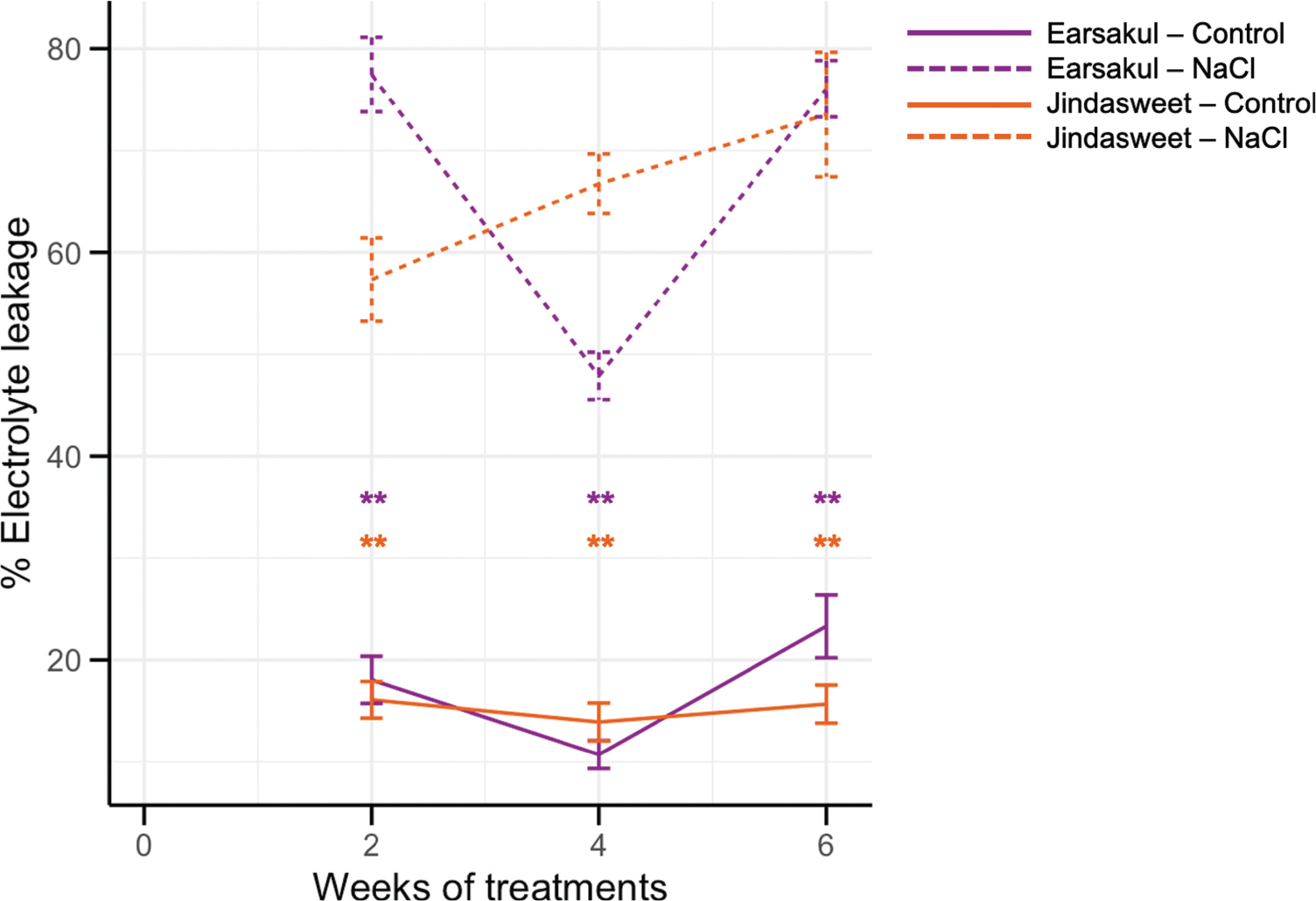
Figure 2.
EL of PLBs of Dendrobium Sonia 'Earsakul' and 'Jindasweet' cultured in liquid medium (control) or medium supplemented with 150 mM NaCl for 2, 4 and 6 weeks. All data are presented as the means of independent samples (n = 5). The error bars indicate ± standard error. A single asterisk (*) indicates a significant difference at p < 0.05, double asterisks (**) indicate p < 0.01 and triple asterisks (***) indicate p < 0.001 according to a t-test for each cultivar. PLBs, protocorm-like bodies. EL, electrolyte leakage.
Although the PLBs could multiply under salinity conditions, their numbers were reduced, and their characteristics were affected by the stress. The PLBs of 'Earsakul' cultured under normal conditions (control) grew and divided into several pieces, each increasing in size (Figures 1C and 3A). Histological analysis revealed active cell division, indicated by stained elements in the cells (black arrows, Figure 3C). In contrast, salinity-treated PLBs appeared rougher and had more folded surfaces on the outer explant (Figure 3B). These tissues tend to be less able to enlarge compared to the smooth, symmetrical pieces seen in the control (Figure 3A). The cells in salt-treated tissue were smaller and densely packed (black frame, Figure 3D), likely due to impaired osmotic regulation, exposure to toxic compounds and antioxidant imbalance, causing organelle movement disorders (Baranova and Gulevich, 2021).
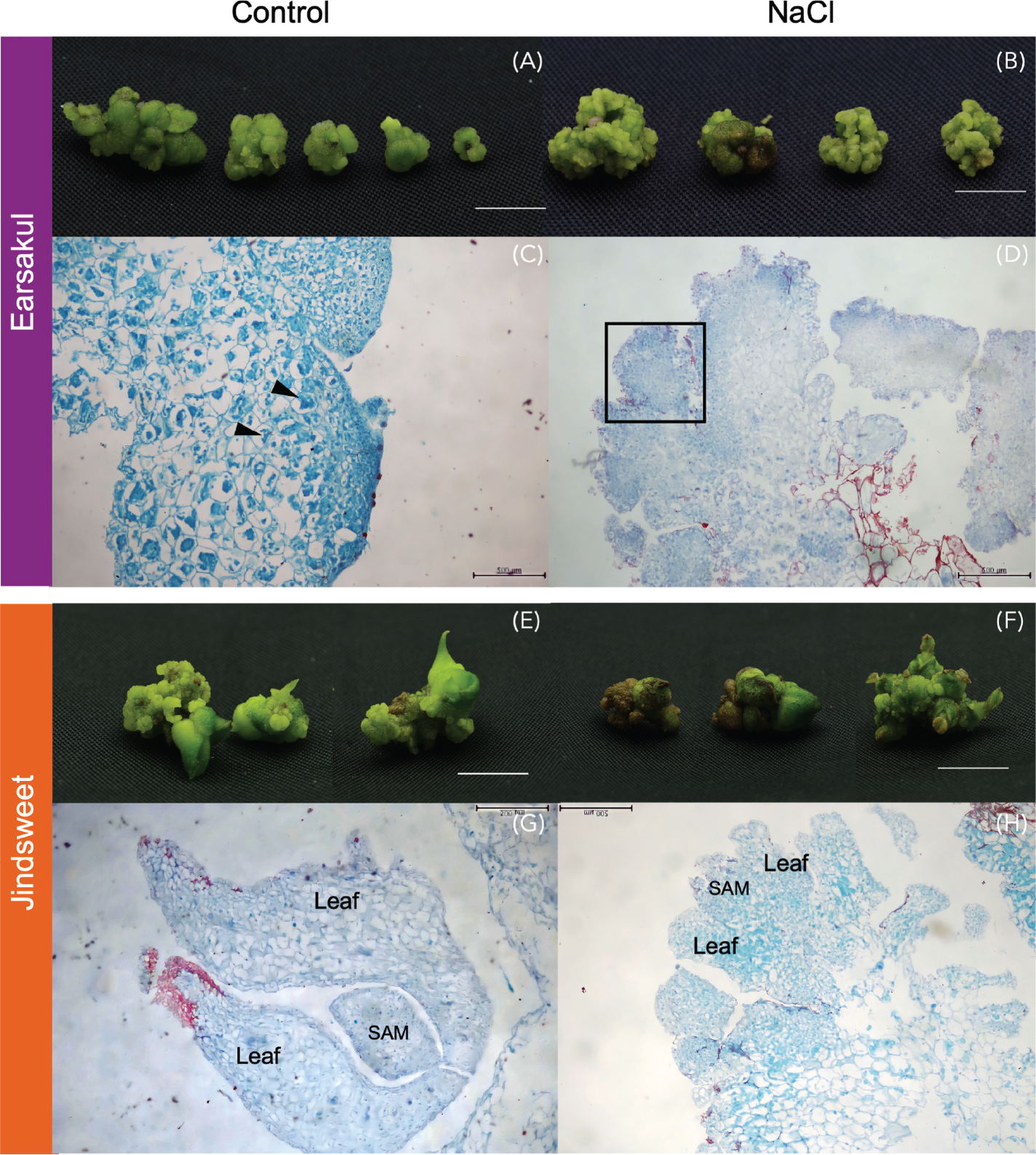
Figure 3.
Representative PLBs and their histology by a longitudinal section of PLBs of Dendrobium Sonia 'Earsakul' (A–D) and 'Jindasweet' (E–H), cultured in liquid medium (control, A, C, E, G) or medium supplemented with 150 mM NaCl (B, D, F, H) for 6 weeks. White and black scale bars represent 1 cm and 500 μm, respectively. PLBs, protocormlike bodies; SAM, shoot apical meristem.
In 'Jindasweet', shoot formation was visible on the PLBs under both control and salinity conditions, as the initial PLBs had already initiated shoots (Figures 3E,F). Therefore, it is important to note that the differences in developmental stages between 'Earsakul' and 'Jindasweet' may contribute to their varying responses to salinity. Under normal conditions, a well-defined shoot apical meristem (SAM) with enlarging leaf primordia was observed (Figure 3G). However, salinity hindered shoot development; resulting in smaller, more compact SAMs and leaf primordia (Figure 3H). Browning of the outer tissue was also evident under salinity stress in both cultivars. High concentrations of inorganic salts like NaCl can intensify browning in explants by accelerating the oxidation of phenolic compounds (Liu et al., 2024).
Salinity stress is widely known to disrupt chlorophyll biosynthesis and accelerate pigment degradation. Several studies have shown that increased salt levels often lead to a significant reduction in chlorophyll content in various plant species (Ashraf and Harris, 2013), such as leaves of Arabidopsis (Li et al., 2022) and cucumber (Yildirim et al., 2008). The degradation of pigments could be caused by the accumulation of reactive oxygen species (ROS)(Balasubramaniam et al., 2023). In contrast, we found that the chlorophyll content of PLBS increased under salinity conditions. A significant increase was observed at 2 weeks and 4 weeks but not at 6 weeks in 'Earsakul', and only at 2 weeks in 'Jindasweet' (Figures 4A–C). The increase in chlorophyll due to salt stress is reported in various crops, such as water dropwort (Kumar et al., 2021), barley (Boussora et al., 2024), sugar beet and cabbage (Jamil et al., 2007). This response may represent an adaptive mechanism to cope with salt-induced stress. In Dendrobium, no significant difference in leaf chlorophyll content was observed under irrigation with about 10-150 mM NaCl (Abdullakasim et al., 2018). In our study, the increased pigment content during the earlier phases may be attributed to the denser tissue structure of the salt-treated PLBs (Figure 3H), potentially caused by water loss in response to an osmotic imbalance (Hniličková et al., 2017). In the latest phase, the lack of difference in pigment content may suggest that, although the tissue remained compact, pigment degradation in the salt-treated PLBs compensated for the earlier increase, bringing pigment levels in line with those of the control PLBs. In addition, the less influence found in 'Jindasweet' PLBs may be due to differences in tissue types, as many of these PLBs had already initiated shoots. A significant increase in carotenoid content due to salinity was observed only at 4 weeks of treatment in both cultivars (Figure 4D). The observed responses in our experiment may be attributed to an osmotic potential gradient that causes cell dehydration. Prolonged exposure also results in ion toxicity due to nutrient imbalances (Acosta-Motos et al., 2017). In addition, salt stress induces oxidative stress by generating ROS, which damages cellular structures and membranes and consequently photosynthesis (Balasubramaniam et al., 2023). Although our study did not directly measure these factor, future research should assess Na+, K+ and Cl– levels, osmotic potential and ROS levels to gain a more understanding of responses to salinity.
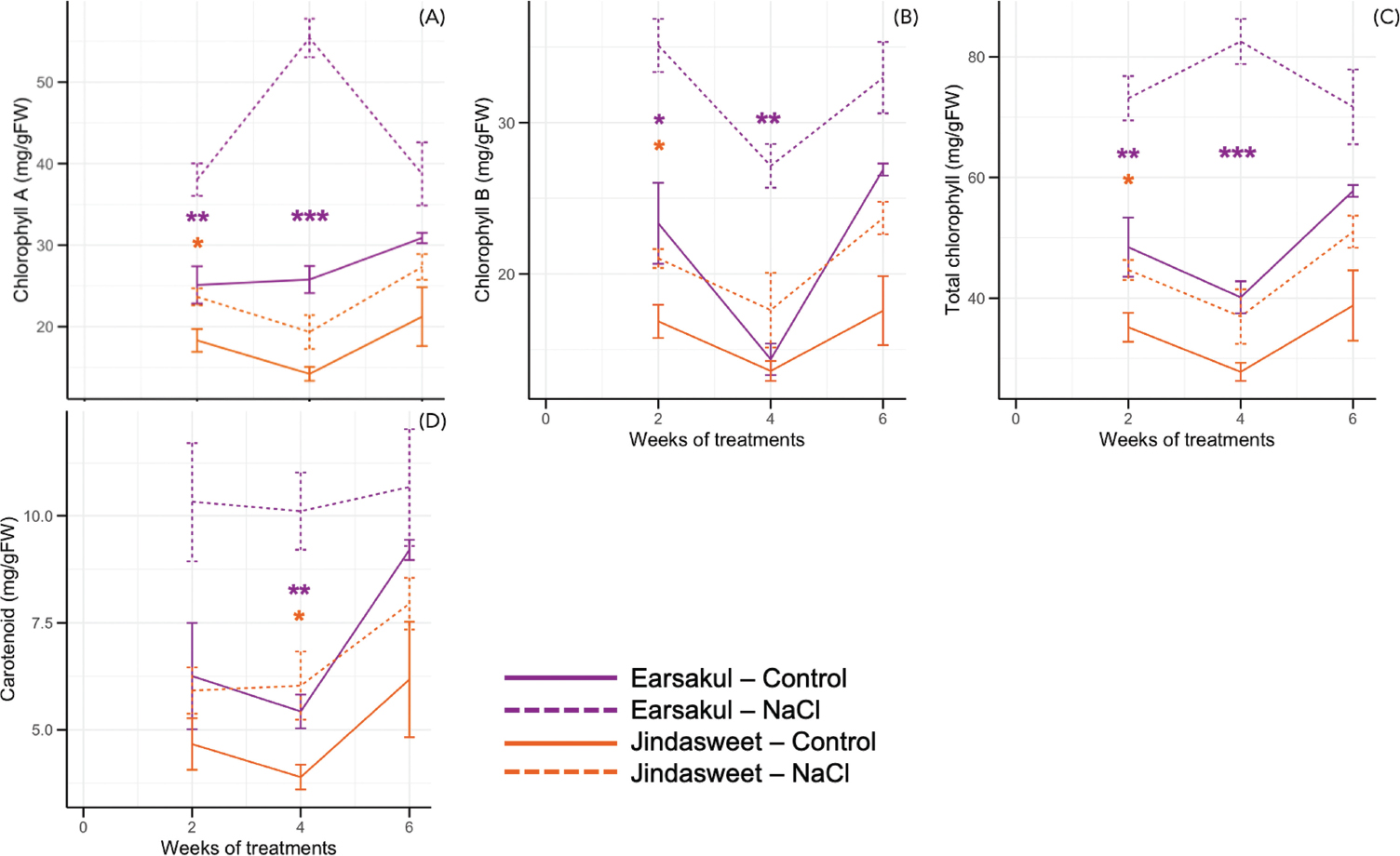
Figure 4.
Pigment contents including chlorophyll a (A), b (B), total chlorophyll (C) and carotenoid (D) in PLBs of Dendrobium Sonia 'Earsakul' and 'Jindasweet' cultured in liquid medium (control) or medium supplemented with 150 mM NaCl for 2, 4 and 6 weeks. The contents are fresh weight. All data are presented as the means of independent samples (n = 5). The error bars indicate ± standard error. A single asterisk (*) indicates a significant difference at p < 0.05, double asterisks (**) indicate p < 0.01 and triple asterisks (***) indicate p < 0.001 according to a t-test for each cultivar. PLBs, protocorm-like bodies.
Gene expression as an early response to salinity was slightly affected by salinity
The expression of genes at the transcription level was studied in salinity-treated PLBs after 24 hr to evaluate their early response to salt stress. Although PLB multiplication was visibly reduced under salt stress, no significant changes were observed in the expression of cell division and development-related genes, including cyclin-dependent kinase A-1 (CDKA1), beta-3-tubulin (TUBB3), expansin (EXP) and cytokinin oxidase-1 (CKX1) (Figure 5). This suggests that these genes may not play a key role in the early-phase response to salt stress in the studied plants. The expression of ribulose-1,5-bisphosphate carboxylase/oxygenase large subunit (rbcL) declined under salt stress in 'Earsakul', which may reflect a reduction in photosynthetic capacity, a common response observed in various species like rapeseed, sweet sorghum (El Sayed et al., 2019, 2022). Conversely, in 'Jindasweet', rbcL expression was upregulated under salt stress, which may be associated with a more stable or responsive photosynthetic apparatus under stress (Winicov and Seemann, 1990; El-Esawi et al., 2018). This higher expression may be an early adaptive mechanism in which salt-induced protein degradation could be compensated for by increased rbcL production. It is important to note that the PLBs of 'Jindasweet' had induced multiple shoots, and the higher rbcL expression could be attributed to the fact that leaf tissues typically have higher rbcL levels compared to PLBs (i.e., callus), as observed in tobacco (Horáková-Brazdilová et al., 2008). Moreover, the actual PLBs tissue might be more sensitive to stress than the differentiated PLBs with shoots, as the organs were assigned. Additionally, the expression of late embryogenesis abundant (LEA) was suppressed under salt stress in 'Earsakul' but remained relatively unchanged in 'Jindasweet'. Since LEA proteins play a crucial role in abiotic stress tolerance, including salt stress (Ling et al., 2016), the suppression of LEA in 'Earsakul' may indicate a higher sensitivity to salinity than the other. As this study examined on the 24-hr response in gene expression, future studies should include later time points, such as several days or weeks after treatment, to better understand long-term responses. Future research should also investigate the molecular mechanisms underlying these differences, focusing on ion homeostasis, antioxidant activity, osmotic adjustment and long-term responses at various developmental stages.
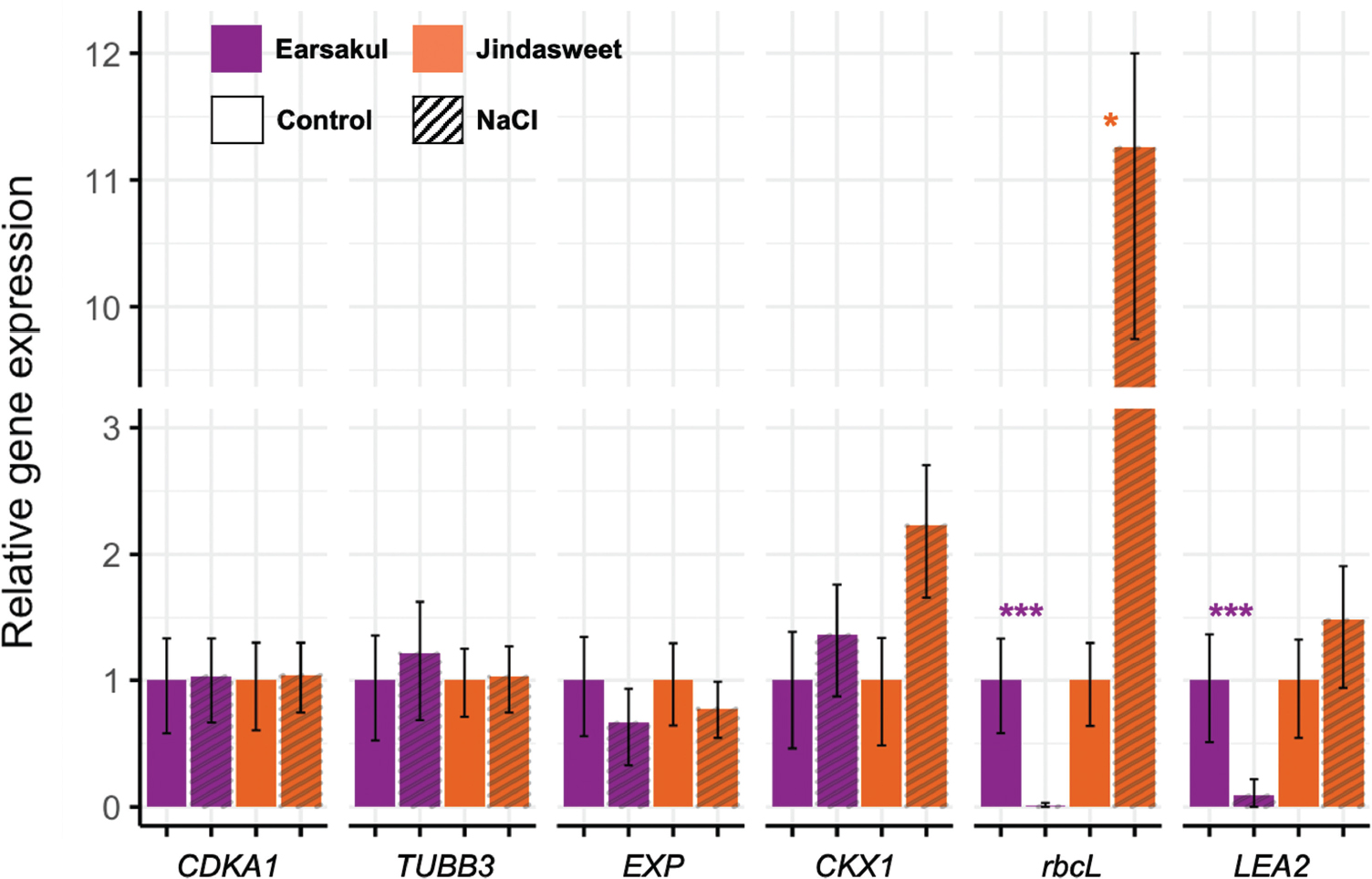
Figure 5.
Relative expressions of CDKA1, TUBB3, EXP, CKX1, rbcL and LEA2 in PLBs of Dendrobium Sonia 'Earsakul' and 'Jindasweet' cultured in liquid medium (control) or medium supplemented with 150 mM NaCl for 24 h. EF1-a was used as a reference gene. All data are presented as the means of independent samples (n = 3). The error bars indicate ± standard error. A single asterisk (*) indicates a significant difference at p < 0.05, double asterisks (**) indicate p < 0.01 and triple asterisks (***) indicate p < 0.001 according to a t-test for each cultivar. PLBs, protocorm-like bodies.
Overall, PLBs of 'Jindasweet' appeared to have better salt stress tolerance, as reflected by its greater maintained multiplication and physiological parameters. These differences could be attributed to cultivar-specific stress responses and developmental stage variations, with the initiated shoots in 'Jindasweet' PLBs potentially providing better stress adaptation compared to the undifferentiated PLBs in 'Earsakul' PLBs. Although this study was conducted in vitro, the responses observed in PLBs may partly reflect underlying physiological traits associated with salt tolerance at the whole-plant level. However, further validation under field or nursery conditions is needed to confirm these findings. Tissue culture technique could serve as a useful platform for developing salt-tolerant lines, with the parameters examined in this study potentially serving as indicators for salinity tolerance screening.
Conclusions
Salinity negatively affected the multiplication of PLBs in both Dendrobium Sonia 'Earsakul' and 'Jindasweet'. Salinity led to increased EL and pigment content, with salt-treated PLBs exhibiting a more compact tissue structure compared to the control. 'Jindasweet' PLBs likely showed greater salt tolerance, as indicated by higher multiplication rates, better-maintained EL and pigment concentration under salt stress. However, this response may be attributed to the developmental stage of 'Jindasweet', which had already initiated shoot formation, unlike 'Earsakul'. At the early phase, the enhanced expression of rbcL in 'Jindasweet' PLBs could be associated with higher salt tolerance, in which the lack of suppression of LEA genes may contribute to its salt tolerance. In addition to differences among cultivars, it is important to note that the differences in developmental stages that occurred since the beginning of this experiment may also contribute to their distinct responses to salt stress. These findings highlight the potential of PLBs as an in vitro model for screening salt stress responses. Further studies are needed to assess long-term effects for a better understanding of salt tolerance in Dendrobium PLBs.
Acknowledgements
The authors thank Pondpan Napaumpaipond, Petsupang Khamtae and Nattawut Chudecha for their practical support during the experiment.
Abbreviations
- BAP
6-benzylaminopurine
- CDKA1
cyclin-dependent kinase A-1
- CKX1
cytokinin oxidase-1
- DMFN,N’
-dimethylformamide
- EXP
expansin
- FAA
formalin-acetic-alcohol
- LEA
late embryogenesis abundant
- rbcL
ribulose-1,5-bisphosphate carboxylase/oxygenase large subunit
- TUBB3
beta-3-tubulin.
Notes
[1] Contributed by Author Contributions
P.B. and A.S. were involved in conceptualisation and supervision. P.B. was responsible for funding acquisition. W.S. and A.S. performed formal analysis and wrote the original manuscript. W.S., A.S., D.B. and H.J. developed the methodology. W.S. and H.J. conducted investigation. W.S., A.S., P.B. and D.B. revised the manuscript. All the authors approved the manuscript.
[2] Conflicts of interest Conflict of Interest
The authors declare no conflict of interest.