
INTRODUCTION
With the development of magnetism, bio-magnetism has been widely used in the research fields of Medicine, Agriculture, Horticulture, Forestry, Bioengineering, etc. The application of magnetism there, considering the operability, is commonly used in the way of direct seed/plant magnetic field (MF) treatment or running through all possible growth stages of plants in the form of magnetised water irrigation (Abobatta, 2019; Sarraf et al., 2020; Hozayn et al., 2021). Numerous studies and experiments have proved that, directly or indirectly, by applying MF to seeds or plants can effectively improve their seed germination and vigour, plant resistance to stress, plant growth traits, and increase crop yield and quality (Baghel et al., 2019; Alvarez et al., 2020; Souza-Torres et al., 2020; Harb et al., 2021; Samarrai et al., 2022).
Germination capacity is one of the most important parameters of seed quality. Seeds with low germination will result in poor field stand. It will lead to uneven emergence and make it hard to carry out effective plant management. It will also result in the following stages, in getting weak plants with low resistance to natural stresses and diseases. Furthermore, it will eventually result in low production yield. Recently, seed companies in the world, when competing with improving seed quality of commercial (expensive) seeds (e.g. sugar beet, green onion or tomato), are doing an additional test for seed vigour. Because the seed germination test is done in a lab in the optimal conditions, such conditions never happen during seed sowing time in the field in early spring. So, testing for seed vigour also plays an important role in seed quality evaluation. The radish seed production is difficult due to the crop’s low genetic stability. We need to use transplants and off-type transplant selection before starting a seed plantation. For radish roots commercial production, we need stable plants and seeds with high vigour (Hołuowicz, 2022). For these reasons, nowadays, in commercial seed production, increasing seed germination and vigour or maintaining its quality has been one of the most important aims in seed companies in the world (Hołuowicz, 2016, 2022; Singh and Asati, 2018). On the other hand, for commercial storage of seeds, only high-quality seeds stored at low costs are of interest (Padula et al., 2022). This includes also seeds difficult to store, e.g. of onion-like crops (Pagano et al., 2023). In commercial production, the inability to sell seeds due to low germination capacity and vigour or natural ageing that do not meet commercial standards will result in certain cost losses. While pursuing further improvement in the germination capacity of excellent seeds, it is also worth paying attention to enhancing the germination capacity and vigour of low-quality seeds to meet normal usage standards and reduce losses.
Seed priming has been widely used in commercial seed production to improve seed germination. It includes hydropriming, osmopriming, drum priming, solid matrix priming, biopriming, hormonal priming, nanopriming, physical priming, etc. (Farooq et al., 2019; Rhaman et al., 2020; Pagano et al., 2023). In commercial plant production, considering cost and operability, the most used priming methods are hydropriming and one of its derivatives - drum priming—which meets automation needs. Compared with osmopriming, solid matrix priming, biopriming, hormonal priming and nanopriming, their main advantage is that only water is used as a priming solution. This way, avoiding possible contamination, side effects and eliminating the need for subsequent cleaning manipulation of the seed surface is possible. The MF treatment, as a new method of physical priming, has the advantages of low cost, easy operation and it creates no pollution (Nyakane et al., 2019; Abdel Latef et al., 2020; Johnson and Puthur, 2021; Pagano et al., 2023). As the MF treatment can be done with dry seeds, when compared with hydro- and drum priming, the procedure of drying them after priming is not needed. As a result, the new method has been receiving more and more attention from the seed practice. However, many experiments have shown that for different species or even different cultivars of the same species, different optimal doses of MF had positive effects (Araújo et al., 2016; Farooq et al., 2019; Nyakane et al., 2019; Rifina et al., 2019; Sarraf et al., 2020). Under these circumstances, to achieve the aim of MF commercial use, more profound research and a larger number of screen experiments should be done for other species or cultivars.
Research indicates that magnetic field can significantly impact the growth and development of plants. These effects depend on the type of MF, its intensity, exposure duration, and the specific biological characteristics of the plants. MF can be used as a tool to improve plant vitality, shorten germination time, and increase yields; however, these effects can vary depending on experimental conditions and plant species (da Silva and Dobránszki, 2016). Currently, an increasing number of literature reports suggest that ultra-weak bio-photon emission originates from the generation of reactive oxygen species (ROS), produced in mitochondria as by-products of cellular respiration (Du et al., 2023). Oxidative processes occur in virtually every living cell, both animal and plant, which are exposed to the production of ROS under various factors and in different cells. MF can influence biological processes in plants by interacting with ROS and other chemical molecules involved in metabolism (Maffei, 2014; Du et al., 2023). Changes in the MF can modulate enzyme activity, oxidative stress levels, and other physiological processes (Vahalova and Cifra, 2023).
One aspect of the research focused on finding correlations between ultra-weak photon emission and MF. Ultra-weak photon emission (UPE) is a phenomenon occurring in every living organism. However, due to its low energy intensity below the sensitivity of our vision, the phenomenon can only be observed using a photomultiplier. The device allows the determination of the number of photons emitted by the tested sample over a unit of time. It is assumed that in plant cells, UPE is associated with ongoing metabolic processes. The phenomenon of ultra-weak photon emission represents a form of spontaneous and endogenous radiation naturally emitted by living organisms during routine metabolic processes (Borc et al., 2012). The emission intensity is low, ranging from 1 photons cm−2·s−1 to 1000 photons cm−2·s−1 within the light spectrum of approximately 200–800 nm (Sun et al., 2023). Increasing literature reports seem to confirm that ultra-weak photon emission is associated with metabolic processes, including cell division (Volodyaev and Beloussov, 2015), cell death (Mould et al., 2022), photosynthesis (Xi et al., 2014; Mackenzie et al., 2023), and signal transduction (Kobayashi et al., 2007; Footitt et al., 2016). Biochemical research in mitochondria increasingly suggests that the source of single photon emissions is luminescence from free radical reactions (ROS), DNA, or chemical reactions occurring during energy transfer (Khabiri et al., 2008). Some studies have shown that changes in the external MF can affect the intensity of UPE (da Silva and Dobránszki, 2016; Sarraf et al., 2020). For example, variable MF can increase or decrease photon emission depending on experimental conditions. Research also indicates that different plant types may respond differently to changes in the MF, suggesting a complex and species-specific response. One proposed mechanism suggests that the MF can influence the kinetics of chemical reactions by altering the spins of electrons in reactive molecules. This can lead to changes in ROS levels and thus affect UPE intensity.
Photon emission test could be used to control and monitor biological live tissue responses to various environmental factors. Using this test to evaluate seed vigour affected by MF treatment to confirm if there are any positive or adverse effects will have practical importance. Understanding the correlation between the MF and UPE can have practical applications in agriculture, such as optimizing plant growth conditions through MF manipulation. It can also contribute to a better understanding of oxidative stress mechanisms in plants and the development of new plant protection strategies.
This experiment was to investigate the potential of MF treatment for improving the quality of low germination/aged seeds and to explore the possibility of using MF treatment to improve the quality of aged seeds in commercial production and reduce cost losses. Through a photon emission test, physiological activities in seed germination were evaluated to explore the effects of MF treatment on seeds and to ensure that MF treatment had positive, not adverse effects on seeds.
The objective of this experiment was to find out, if the low frequency magnetic field (LFMF) treatment on the accelerated aging (AA) radish seeds could improve their quality evaluated by their germination, vigour and ultra-weak photon emission. The hypothesis was that LFMF could improve the AA radish seeds quality without any adverse effects.
MATERIALS and METHODS
Research materials
Two radish (Raphanus sativus L.) cultivars seeds were used in the experiment: 'Carmen' (C) and 'Szkarłatna z Białym Końcem' (SBK). They both came from a Polish plant breeding and seed production company W. Legutko and met all the standards for commercial production. Their seed lot numbers were C—PL702/05/16/HR15 and SBK—PL030/12/210/L569/A. Confirmed by the preliminary experiment, the germination capacity of the untreated fresh seeds were C - 98.5% and SBK - 96.5%.
Experimental procedure
The seeds of both cultivars were put through the routine AA procedure (Copeland and McDonald, 1985) with the following conditions: 45°C air temperature and 100% air relative humidity (RH) for 48 hr. The seeds were then removed from stress conditions and dried back, with 20°C air temperature and 45% RH for 48 hr, to standard moisture content level. Their germination for both cultivars lowered from above 95% to around 70%. Then the prepared seeds were subjected to the LFMF treatment. The LFMF was generated by a routine medical magnetic human therapy device Viofor JPS Delux (Med & Life, Komorów, Poland) (Figure 1, Hołuowicz et al., 2014) with the settings G1 output, P1 programme and M1 mode. The used generated magnetic induction was equal to the intensity of 10, 20 and 30 μT, respectively. The seeds were subjected to the LFMF treatment for exposing time 30, 60, 90 and 120 min for each induction, respectively. The control seeds (CK) were the same ones but without the LFMF treatment.
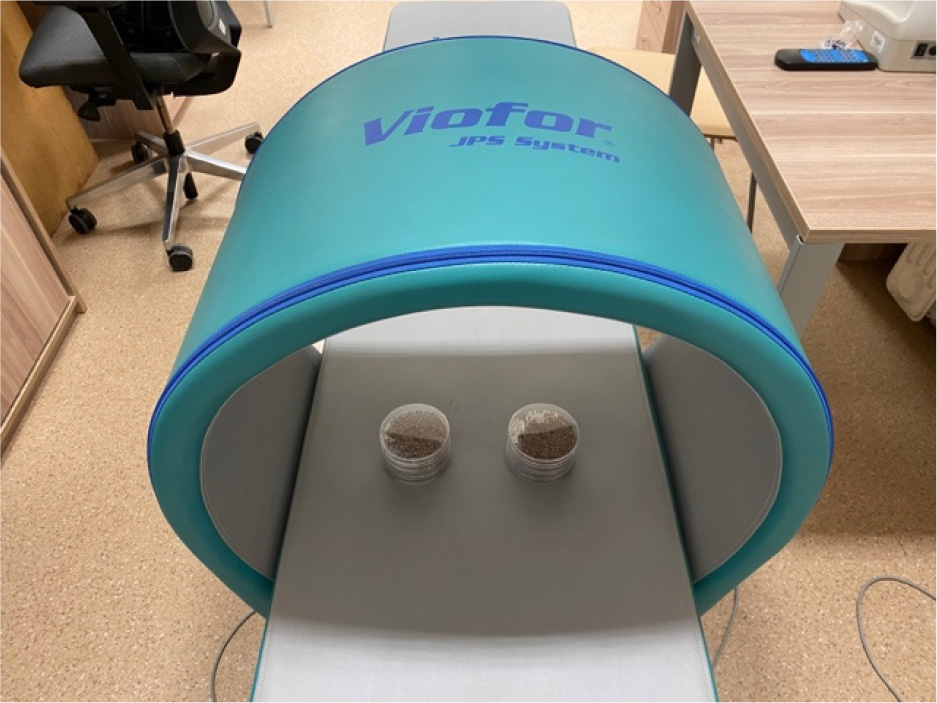
Figure 1.
The radish seeds in Petri dishes in the Viofor JPS Delux machine used in the experiment to generate LFMF.
The carried-out seed germination test conditions followed the rules regulated by the International Seed Testing Association (ISTA): seeds on blotter paper, 50 seeds replicating 4 times for each treatment, the air temperature was 20°C, the first count was done after 4 days and the final one after 10 days (Anonymous, 2012). The first count (germination energy) was done for the normal seedlings after 4 days, and the final count (germination capacity) was done for the percentage of normal seedlings after 10 days. The abnormal seedlings, fresh seeds, dead seeds and hard seeds were also counted in percentage after 10 days.
The seed vigour test was carried out separately at 20°C, with seeds on blotter paper, 50 seeds replicating 4 times for each treatment and counting the number of germinated seeds every day for 10 days. To process the original data, the following parameters: mean germination time (MGT), T10 (time taken for 10% seeds to germinate), T25 (time taken for 25% seeds to germinate), T50 (time taken for 50% seeds to germinate), T75 (time taken for 75% seeds to germinate), T90 (time taken for 90% seeds to germinate), U75-25 (time taken from 25% germinated seeds to 75% germinated seeds), U90-10 (time taken from 10% germinated seeds to 90% germinated seeds) were calculated using the Seed Calculator version 2.1 software (Jalink and Van der Schör, 1999).
After completing the germination and vigour tests, ultra-weak glow analyses were carried out for three types of prepared seed samples: original, AA and AA with LFMF (AA MF). They were prepared by placing them in 10 cm diameter Petri dishes on blotting paper. Each sample had 25 seeds. There were two dishes for each kind of the seeds. Then, they were stored in the dark at 20°C for the entire test cycle of 10 days.
Ultra-weak photon emissions from the germinating radish seed were measured by using photon counting units (PCUs) - model H7360-01, Hamamatsu Photonics K.K., Shizuoka, Japan. It integrates a high-voltage power supply and a photon-multiplier tube (PMT) sensitive to the visible range (300–650 nm), selected units for low dark noise (mean value 15.6 ± 4.5 photons · s−1). No optical filters were used in the study, which assumes analysis of photon counts over the entire visible and near ultraviolet (near-UV) spectral range in which the PMT photocathode responds. Photon counts were obtained using control software (C8855-01, Hamamatsu KK). The entire test cycle was carried out over 10 days (0d–10d). Measurements were taken immediately after sample preparation (0d) and then, at the same time, after 1d, 2d, 3d, 4d 7d and 10d. Photon counts were taken every 1 s for a period of 480 s. Measurement results were recorded continuously, directly on a computer, and then stored on a hard drive. The radish seeds to be analyzed were placed in Petri dishes, as close as possible, between the front window of the sensor and the lid of the dish. This positioning of the test sample was implemented to maximize the number of photons captured by the photocathode, which was fully exposed to the area, where the seeds were germinating and seedlings were growing, inside the dish.
Statistical analysis
For the received data, variance was calculated. For the mean values, the Duncan’s test was used for α = 0.05. Significant mean values were marked with different letters. For the photon emission values, standard deviations were calculated.
RESULTS
The used LFMF of the intensity 20 μT, when the AA C seeds were exposed to it for 90 min and 120 min, it increased their germination capacity by 7.5% (percentage points), respectively. In both cases, it was due to receiving a lower number of abnormal seedlings. All the other LFMF treatments showed no differences compared with the control seeds (Table 1).
Table 1.
Effect of LFMF on seed germination (%) of the artificially aged (CK) radish seed cultivar Carmen (C).
| LFMF treatment | Germination energy (%) | Germination capacity (%) | Abnormal seedling (%) | Fresh seed (%) | Dead seed (%) | Hard seed (%) |
|---|---|---|---|---|---|---|
| CK | 34.0 a* | 71.5 bc | 24.0 a | 2.5 ab | 2.0 abc | 0.0 |
| 10 μT 30 min | 38.0 a | 75.0 abc | 24.0 a | 0.5 b | 0.5 c | 0.0 |
| 10 μT 60 min | 36.0 a | 74.0 abc | 24.0 a | 1.5 ab | 0.5 c | 0.0 |
| 10 μT 90 min | 40.5 a | 75.0 abc | 24.5 a | 0.0 b | 0.5 c | 0.0 |
| 10 μT 120 min | 41.5 a | 78.0 ab | 22.0 ab | 0.0 b | 0.0 c | 0.0 |
| 20 μT 30 min | 35.0 a | 74.5 abc | 21.0 abc | 1.0 b | 3.5 ab | 0.0 |
| 20 μT 60 min | 41.5 a | 76.0 abc | 21.0 abc | 2.5 ab | 0.5 c | 0.0 |
| 20 μT 90 min | 40.0 a | 79.0 a | 17.5 bc | 2.5 ab | 1.0 c | 0.0 |
| 20 μT 120 min | 39.5 a | 79.0 a | 16.0 c | 3.5 a | 1.5 bc | 0.0 |
| 30 μT 30 min | 39.0 a | 77.5 ab | 21.5 abc | 1.0 b | 0.0 c | 0.0 |
| 30 μT 60 min | 35.0 a | 77.0 ab | 23.0 ab | 0.0 b | 0.0 c | 0.0 |
| 30 μT 90 min | 33.0 a | 72.5 abc | 26.5 a | 0.5 b | 0.5 c | 0.0 |
| 30 μT 120 min | 36.0 a | 70.5 c | 23.5 a | 2.0 ab | 4.0 a | 0.0 |
The used LFMF of the intensity 20 μT, when the AA SBK seeds were exposed to it for 60, 90 and 120 min, increased their germination energy by 9.0%, 13.0% and 8.5% (percentage points), respectively (Table 2). In all three cases, the differences were not shown in the recorded results of the final counting (germination capacity). All the other LFMF treatments showed no differences compared with the control seeds (Table 2).
Table 2.
Effect of LFMF on seed germination (%) of the artificially aged (CK) radish seed cultivar Szkarłatna z Białym Końcem (‘SBK’).
| LFMF treatment | Germination energy (%) | Germination capacity (%) | Abnormal seedling (%) | Fresh seed (%) | Dead seed (%) | Hard seed (%) |
|---|---|---|---|---|---|---|
| CK | 22.0 de* | 71.5 a | 21.5 a | 4.0 a | 3.0 a | 0.0 |
| 10 μT 30 min | 21.0 e | 70.5 a | 20.5 a | 5.0 a | 4.0 a | 0.0 |
| 10 μT 60 min | 22.0 de | 74.0 a | 18.5 a | 5.5 a | 2.0 a | 0.0 |
| 10 μT 90 min | 23.5 cde | 74.0 a | 16.5 a | 8.0 a | 1.5 a | 0.0 |
| 10 μT 120 min | 27.0 b–e | 73.5 a | 19.0 a | 5.0 a | 2.5 a | 0.0 |
| 20 μT 30 min | 27.5 b–e | 72.5 a | 18.5 a | 6.5 a | 2.5 a | 0.0 |
| 20 μT 60 min | 31.0 ab | 77.5 a | 16.0 a | 3.0 a | 3.5 a | 0.0 |
| 20 μT 90 min | 35.0 a | 75.5 a | 16.5 a | 4.5 a | 3.5 a | 0.0 |
| 20 μT 120 min | 30.5 abc | 72.5 a | 21.5 a | 4.5 a | 1.5 a | 0.0 |
| 30 μT 30 min | 24.0 b–e | 75.5 a | 16.5 a | 6.0 a | 2.0 a | 0.0 |
| 30 μT 60 min | 23.0 de | 72.5 a | 17.5 a | 7.5 a | 2.5 a | 0.0 |
| 30 μT 90 min | 29.0 a–d | 75.0 a | 19.5 a | 4.5 a | 1.0 a | 0.0 |
| 30 μT 120 min | 28.0 b–e | 75.0 a | 13.5 a | 7.0 a | 4.5 a | 0.0 |
The used LFMF of the intensity 20 μT, when the AA C seeds were exposed to it for 120 min, increased their vigour expressed in their germination speed (T50, T75, U75-25, U90-10) but did not shorten their MGT in comparison with the check seeds (Table 3). The seeds treatment 30 μT for 30 min showed only one shortened time of T10. No significant difference was found on other elements (Table 3).
Table 3.
Effect of LFMF on seed vigour expressed as germination speed (days) and MGT (days) of the artificially aged (CK) radish seed cultivar Carmen (‘C’).
| LFMF treatment | T10 | T25 | T50 | T75 | T90 | U75-25 | U90-10 | MGT |
|---|---|---|---|---|---|---|---|---|
| CK | 1.78 ab* | 2.07 a–d | 2.47 abc | 3.02 abc | 3.80 ab | 0.95 abc | 2.01 ab | 2.69 ab |
| 10 μT 30 min | 1.84 ab | 2.13 abc | 2.51 abc | 3.00 abc | 3.62 b | 0.87 abc | 1.79 bc | 2.66 ab |
| 10 μT 60 min | 1.74 abc | 2.03 bcd | 2.40 bcd | 2.86 bc | 3.40 b | 0.83 abc | 1.66 bc | 2.52 b |
| 10 μT 90 min | 1.80 abc | 2.05 bcd | 2.39 bcd | 2.81 cd | 3.34 b | 0.76 cd | 1.55 bc | 2.52 b |
| 10 μT 120 min | 1.81 ab | 2.03 bcd | 2.35 cd | 2.82 cd | 3.58 b | 0.78 bcd | 1.77 bc | 2.59 b |
| 20 μT 30 min | 1.73 abc | 2.00 d | 2.38 bcd | 2.87 bc | 3.53 b | 0.86 abc | 1.80 abc | 2.55 b |
| 20 μT 60 min | 1.73 abc | 1.98 d | 2.33 cd | 2.78 cd | 3.41 b | 0.80 abc | 1.69 bc | 2.50 b |
| 20 μT 90 min | 1.80 abc | 2.05 bcd | 2.38 bcd | 2.84 bc | 3.52 b | 0.80 abc | 1.71 bc | 2.58 b |
| 20 μT 120 min | 1.85 ab | 2.01 cd | 2.24 d | 2.61 d | 3.35 b | 0.60 d | 1.50 c | 2.50 b |
| 30 μT 30 min | 1.64 c | 1.97 d | 2.40 bcd | 2.94 abc | 3.61 b | 0.98 a | 1.97 abc | 2.55 b |
| 30 μT 60 min | 1.85 a | 2.19 a | 2.60 a | 3.05 ab | 3.50 b | 0.86 abc | 1.65 bc | 2.65 ab |
| 30 μT 90 min | 1.84 ab | 2.13 ab | 2.54 ab | 3.14 a | 4.09 a | 1.01 a | 2.24 a | 2.83 a |
| 30 μT 120 min | 1.68 bc | 1.99 cd | 2.41 bcd | 2.96 abc | 3.69 ab | 0.97 ab | 2.01 ab | 2.60 b |
1* Means for a given trait followed by the same letters are not significantly different according to Duncan’s test α = 0.05.
1 LFMF, low frequency magnetic field; MGT, mean germination time; T10, time taken for 10% seeds to germinate; T25, time taken for 25% seeds to germinate; T50, time taken for 50% seeds to germinate; T75, time taken for 75% seeds to germinate; T90, time taken for 90% seeds to germinate; U75-25, time taken from 25% germinated seeds to 75% germinated seeds; U90-10, time taken from 10% germinated seeds to 90% germinated seeds.
The used LFMF of the intensity 20 μT, when the AA SBK seeds were exposed to it for 30, 60 and 120 min, increased their vigour expressed in their germination speed and shortened their MGT in comparison with the check seeds (Table 4). The treatment of 20 μT for 30 min showed shortened time of T50, T75, T90, U75-25, U90-10 and MGT. The same intensity for 60 min showed the shortened time of T75, T90, U75-25, U90-10 and MGT. The treatment of 20 μT for 120 min showed the shortened time of T25, T50, T75 and MGT. No significant difference was found on other elements (Table 4).
Table 4.
Effect of LFMF on seed vigour expressed as germination speed (days) and MGT (days) of the artificially aged (CK) radish seed cultivar Szkarłatna z Białym Końcem (‘SBK’).
| LFMF treatment | T10 | T25 | T50 | T75 | T90 | U75-25 | U90-10 | MGT |
|---|---|---|---|---|---|---|---|---|
| CK | 1.88 ab* | 2.22 ab | 2.71 ab | 3.39 ab | 4.38 abc | 1.16 a–d | 2.50 ab | 2.99 ab |
| 10 μT 30 min | 1.87 a | 2.22 ab | 2.73 ab | 3.50 a | 4.77 a | 1.28 a | 2.90 a | 3.12 a |
| 10 μT 60 min | 1.88 a | 2.28 a | 2.82 a | 3.53 a | 4.44 abc | 1.25 abc | 2.56 ab | 3.05 ab |
| 10 μT 90 min | 1.83 ab | 2.23 ab | 2.77 ab | 3.47 a | 4.38 ab | 1.25 ab | 2.55 ab | 2.99 ab |
| 10 μT 120 min | 1.84 ab | 2.20 ab | 2.68 ab | 3.28 a–d | 4.05 b–e | 1.08 a–e | 2.20 bcd | 2.86 a–e |
| 20 μT 30 min | 1.90 a | 2.13 bc | 2.45 cd | 2.88 e | 3.52 e | 0.75 f | 1.62 d | 2.64 de |
| 20 μT 60 min | 1.91 a | 2.19 ab | 2.55 bcd | 3.03 cde | 3.67 de | 0.85 ef | 1.76 cd | 2.72 cde |
| 20 μT 90 min | 1.87 ab | 2.20 ab | 2.65 abc | 3.31 a–d | 4.28 a–d | 1.11 a–e | 2.41 abc | 2.94 abc |
| 20 μT 120 min | 1.74 b | 2.03 c | 2.42 d | 2.94 de | 3.64 cde | 0.91 def | 1.90 bcd | 2.61 e |
| 30 μT 30 min | 1.85 ab | 2.21 ab | 2.70 ab | 3.34 abc | 4.15 b–e | 1.13 a–d | 2.30 bcd | 2.90 a–d |
| 30 μT 60 min | 1.87 ab | 2.18 ab | 2.60 a–d | 3.18 a–e | 3.99 b–e | 1.00 a–e | 2.12 bcd | 2.83 b–e |
| 30 μT 90 min | 1.90 ab | 2.20 ab | 2.61 a–d | 3.15 b–e | 3.90 b–e | 0.95 c–f | 2.00 bcd | 2.81 b–e |
| 30 μT 120 min | 1.85 ab | 2.16 ab | 2.57 bcd | 3.14 b–e | 3.96 b–e | 0.99 b–f | 2.11 bcd | 2.81 b–e |
1* Means for a given trait followed by the same letters are not significantly different according to the Duncan’s test α = 0.05.
1 LFMF, low frequency magnetic field; MGT, mean germination time; T10, time taken for 10% seeds to germinate; T25, time taken for 25% seeds to germinate; T50, time taken for 50% seeds to germinate; T75, time taken for 75% seeds to germinate; T90, time taken for 90% seeds to germinate; U75-25, time taken from 25% germinated seeds to 75% germinated seeds; U90-10, time taken from 10% germinated seeds to 90% germinated seeds.
During the first 7 days of the seed germination, the original seed sample of cultivar C (C original - no AA or LFMF treatment) showed the highest values of photon emission count (Figure 2). The AA C and AA C MF samples had similar photon emission values during the first 2 days of their germination. Compared with C original, the value differences between AA C and AA C MF ranged between 2.0% and 6.2%. For the first 2 days of seed germination, both AA C and AA C MF samples showed lower photon emission count values compared with the ones of C original. Compared with the values of C original, the values of AA C were 21.8%, 16.7% and 20.8% less for the starting day (0d), the first day (1d) and the second day (2d), respectively. For the same period, the values of AA C MF were 20.2%, 20.7% and 25.7% less for 0d, 1d and 2d, respectively. As the germination of the seeds continued, the photon emission counts of all samples showed an upward trend, but the magnitude of the increase was different (Figure 2). The largest difference of AA C and AA C MF, compared with C original, occurred on the third day (3d) - 37.7% and 26.3%, respectively. As the germination continued, the differences between the 2 samples and the C original showed a decreasing trend. On the 10th day (10d) of germination, even though the photon emission count of AA C exceeded that of C original by 11.2%, still there was no significant difference between them. For the whole germination process (0d–10d), compared with C original, AA C and AA C MF had a delay of photon emission count increase, but generally they maintained the same pattern as C original (Figure 2).
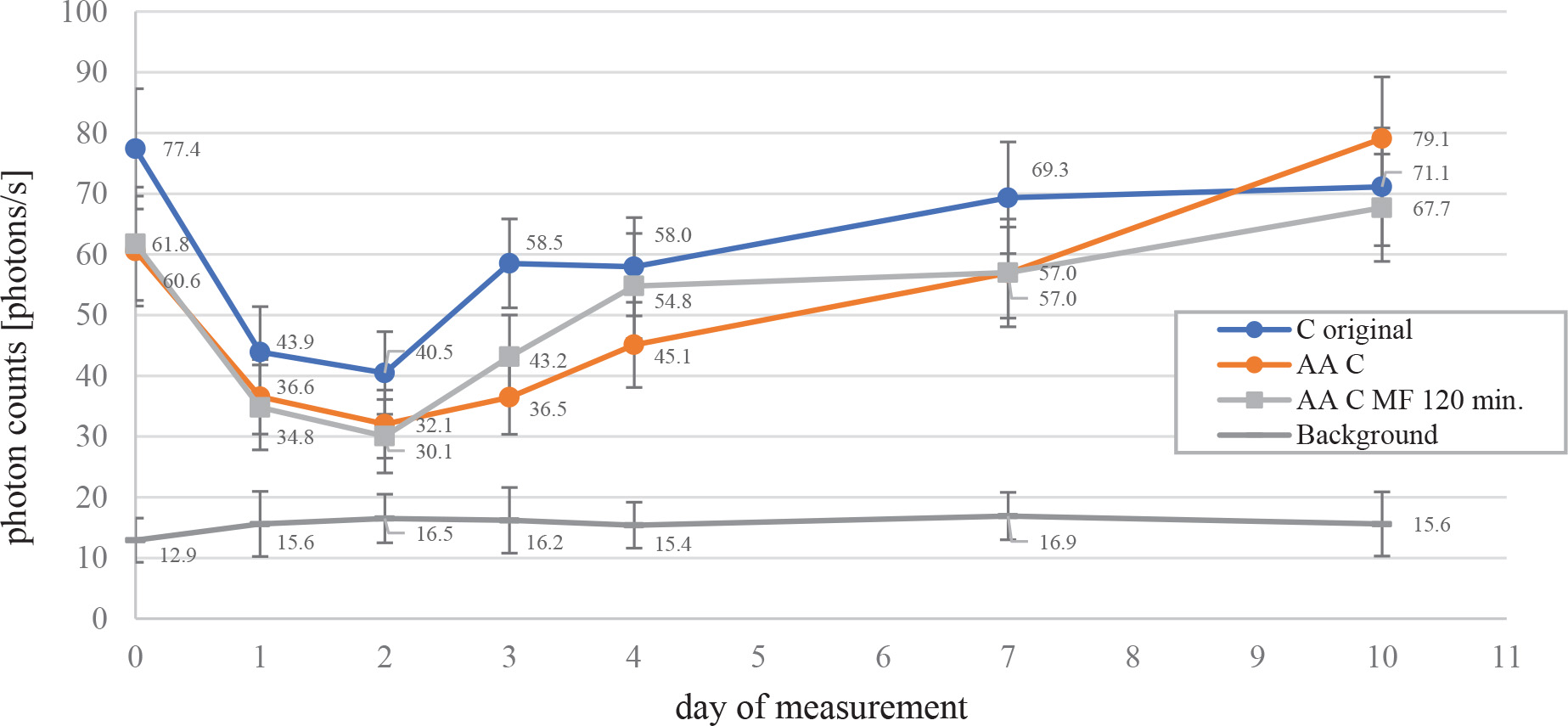
Figure 2.
Effect of the AA and LFMF treatments of radish cultivar C seeds on their photon emission during germination at 20°C in dark. AA, accelerated aging; LFMF, low frequency magnetic field.
Both dynamics of photon emissions and the biggest differences in them were the same for the second tested cultivar SBK (the data not shown). Here again, the biggest differences were recorded for the seed emission after 3 days (3d) of their germination.
DISCUSSION
Radish is an important vegetable produced through gradually sown seeds. For this purpose, it needs high quality seeds for precision sowing providing the grower with even seedlings and full field stand (Nonnecke, 1989).
The carried out experiments showed that although the responses of AA seeds of radish cultivars C and SBK to the LFMF treatment were different, still some of them showed better germination and vigour. Such positive effects for seeds quality have also been reported on numerous agricultural and horticultural crops, such as: maize, rice, wheat, sunflower, radish, common bean, soybean, mung bean, passion fruit, cotton, etc. (Baghel et al., 2019; Farooq et al., 2019; Menegatti et al., 2019; Radhakrishnan, 2019; Xia et al., 2020; Bukhari et al., 2021). They all are proofs that MF treatment was indeed effective in improving the quality of seeds. Although previous experiments of the MF treatment on seed germination were mostly on the seeds without AA treatment or on the seeds subjected to other stress conditions (usually salinity stress or heavy metal stress), still we have some experiments on the aged seeds. In the experiment of AA pepper seeds, the seeds treated with MF (5 times at 100 mT, 2 min each time) showed the biggest promotion in germination capacity (17% points higher than the control) after 8 days of the ageing treatment (Liu et al., 2003). Han and co-workers carried out experiment on AA seeds of multiple cultivars of Chinese cabbage in 2008. Their result showed the MF treatment’s positive effect on seed germination rate, and it was bigger than its effect on the germination capacity (Han et al., 2008). Not only the MF effects on normal seeds but also on stressed seeds, the obtained results were similar to this experiment, both showing improvements in the parameters of germination or vigour. They confirmed that MF treatment did have the positive effect on seed germination or vigour. The mechanism of MF improving seed quality is reportedly related to increasing enzyme activity (polyphenol oxidase [PPO], superoxide dismutase [SOD], catalase [CAT], etc.), accelerating seed water absorption process, stimulating seed protein synthesis, and promoting respiration (Araújo et al., 2016; Radhakrishnan, 2019; Sarraf et al., 2020).
The AA seeds of the two radish cultivars used in this experiment responded differently to LFMF treatment. Moreover, their optimal MF doses were also different. In the germination test, LFMF treatment did not effectively increase the seed energy of the cultivar C but increased the final germination capacity. On the contrary, the positive impact of LFMF treatment on the cultivar SBK was reflected in the seed energy, but did not effectively increase its germination capacity. There has been a vast literature data to prove that there were different optimal doses of MF treatment in different plant species or different cultivars of the same species (Farooq et al., 2019; Nyakane et al., 2019; Rifina et al., 2019; Sarraf et al., 2020). The results by us support this observation. In addition, the results of germination capacity of the cultivar C seeds under 30 μT LFMF intensity, with the prolongation of exposing time, the influence of LFMF treatment showed a trend of first strengthening and then weakening. This observation is in agreement with the results of many other experiments, in which if the MF seed treatment exceeded the optimal dose, the subsequent effects were attenuated or even negative (Abdel Latef et al., 2020; Sarraf et al., 2020; Bukhari et al., 2021; Harb et al., 2021). Therefore, it can be concluded that if MF treatment is to be put into practical application, a large number of screening experiments for different species or even different cultivars of the same species are still required to determine the optimal MF intensity and exposing time.
According to the comprehensive results of germination and vigour test in this experiment, we could conclude that LFMF treatment effectively improved the quality of the AA radish seeds. Using the MF treatment, precious radish seed lots with low germination and vigour can improve its quality and still be used in horticultural practice. The improved germination and vigour and AA radish seeds could be a proof that LFMF treatment, as an easy operation and no pollution method, has high potential to be used to enhance the germination and vigour of low quality seeds to meet normal usage standards and reduce commercial losses. Although the developed new method has great potential, but for wide commercial use, a bigger number of screen experiments on other species and cultivars is still needed.
The quality of radish seeds and seedlings was also tested by a new method based on their ultra-weak photon emission during their germination and seedling growth. Although, this method has been well-known in routine biophysics (Ma et al., 2002; Jócsák et al., 2022), still it has never been used on radish seeds and seedlings. It has been reported that ultra-weak photon emission test could be used as a non-invasive method to evaluate seed quality (Footitt et al., 2016; Ebner, 2020).
Both dynamics of photon emissions and the biggest differences in them were the same for both tested cultivars. In each of the samples tested, the same pattern of photon emission was recorded: firstly decreasing in 0d–2d and then increasing in the following days. The photon emission increase trend of the AA and AA MF seeds after 2d had a delay in comparison with the original ones. Although fewer photons were emitted from the AA and AA MF seeds on 3d, they maintained the same photon emission trend as the original seeds for the tested 10 days. One of possible explanation of that phenomenon observed in our experiment is that LFMF treatment on AA seeds could have changed their metabolic processes responsible for germination and growth rate, but it had no harmful effect on the nature of their growth process.
The limitation of this experiment was that the low germination capacity and vigour seeds used in the experiment were artificially simulated by using AA treatment. If seeds that have been naturally aged for one or more years could be used as experimental materials, it would be more practical. However, it should be considered that it is difficult to obtain naturally aged seeds on the market that are below the standards for cultivation, as these seeds are usually already disposed as waste.
CONCLUSIONS
The used low frequency magnetic field (LFMF) treatment has increased in artificially aged radish seeds their germination and vigour. It showed the potential to use LFMF to enhance the germination and vigour of low-quality seeds to meet normal usage standards and reduce commercial losses.
The most recommended LFMF treatment dose to increase germination and vigour of the seeds are: for the cultivar Carmen (C) - 20 μT, 120 min and for the cultivar Szkarłatna z Białym Końcem (SBK) - 20 μT, 60 min.
According to the results of photon emission, it can be assumed the LFMF treatment on AA seeds could have changed their metabolic processes responsible for germination and growth rate, but it had no harmful effect on the nature of their growth process.
Due to the non-invasive nature of the method and the ability to monitor ongoing processes in vivo and in vitro, ultra-weak photon emission appears to be an intriguing research alternative that could be used to observe stress progression in real-time within plant tissues. The use of this phenomenon is the subject of heated discussions, as proper assessment and accurate interpretation of results require equipment with very high sensitivity, possessing high quantum efficiency and simultaneously very low noise levels.
The naturally aged seeds are recommended to be used in future experiments to get more practical results.
Using the MF treatment, precious radish seed lots with low germination and vigour can improve their quality and still be used in horticultural practice. The MF treatment has a high potential in commercial seed processing. To achieve it on all kinds of crops, further research and a high number of screen experiments on other crops and their cultivars are still needed.
Notes
[11] Contributed by AUTHOR’S CONTRIBUTIONS
Conceptualization: X.X., L.K.; Data curation: X.X., A.Z.; Formal analysis: X.X., A.Z.; Funding acquisition: R.H., G.P.; Investigation: X.X.; Methodology: X.X.; Project administration: X.X.; Resources: X.X.; Software: X.X., A.Z.; Supervision: R.H., L.K.; Visualization: X.X., A.Z.; Writing - original draft: X.X.; Writing - review and editing: X.X., R.H.
[12] Conflicts of interest CONFLICT OF INTEREST
The authors declare that there are no conflicts of interest related to this article.