
Table 1
Results of the analysis of variance on growth and development of taro plant as affected by the planting materials used and morphological alteration treatments.
| 12 WAP | 20 WAP | 28 WAP | 12 WAP | 20 WAP | 28 WAP | |
|---|---|---|---|---|---|---|
| Leaf blade | ||||||
| MP number of leaves | ns | ns | ns | ** | ** | ** |
| MP leaf blade: fresh weight | ns | ns | ns | ** | ** | ** |
| MP leaf blade: dry weight | ns | ns | ns | ** | ** | ** |
| LL midrib: length | ns | ns | ns | ** | ** | ** |
| LL midrib: width | ns | ns | ns | ** | ** | * |
| Petiole | ||||||
| MP petiole: fresh weight | * | ns | ns | ** | ** | ** |
| MP petiole: dry weight | ns | * | ns | ** | ** | ** |
| LL petiole: length | ns | ns | ns | ** | * | ns |
| LL petiole: diameter | ns | ns | ns | ** | ** | * |
| Sucker | ||||||
| Number of suckers | ns | ns | ns | ns | ns | ns |
| SK number of leaves | ns | ns | ns | ns | ns | ns |
| SK leaf: fresh weight | ns | ns | ns | ns | * | ns |
| SK leaf: dry weight | ns | ns | ns | ns | ns | ns |
| SK petiole: fresh weight | ns | ns | ns | ns | * | ns |
| SK petiole: dry weight | ns | ns | ns | ns | ns | ns |
| Roots | ||||||
| Root length | ns | ns | ns | * | ns | ns |
| MP roots: fresh weight | ns | ns | ns | ** | ** | ** |
| MP roots: dry weight | ns | ns | ns | ** | ** | ** |
| SK roots: fresh weight | ns | ns | ns | ns | ns | ns |
| SK roots: dry weight | ns | ns | ns | ns | ns | ns |
| Corm and cormels | ||||||
| Main corm: diameter | ** | ns | ns | ** | ns | ns |
| Main corm: length | ** | ns | ns | ** | ns | ** |
| Main corm: fresh weight | * | ns | ns | ** | ** | ** |
| Main corm: dry weight | * | ns | ns | ** | ** | ** |
| Cormel: fresh weight | - | ns | ns | - | ** | ** |
| Cormel: dry weight | - | ns | ns | - | ** | ** |
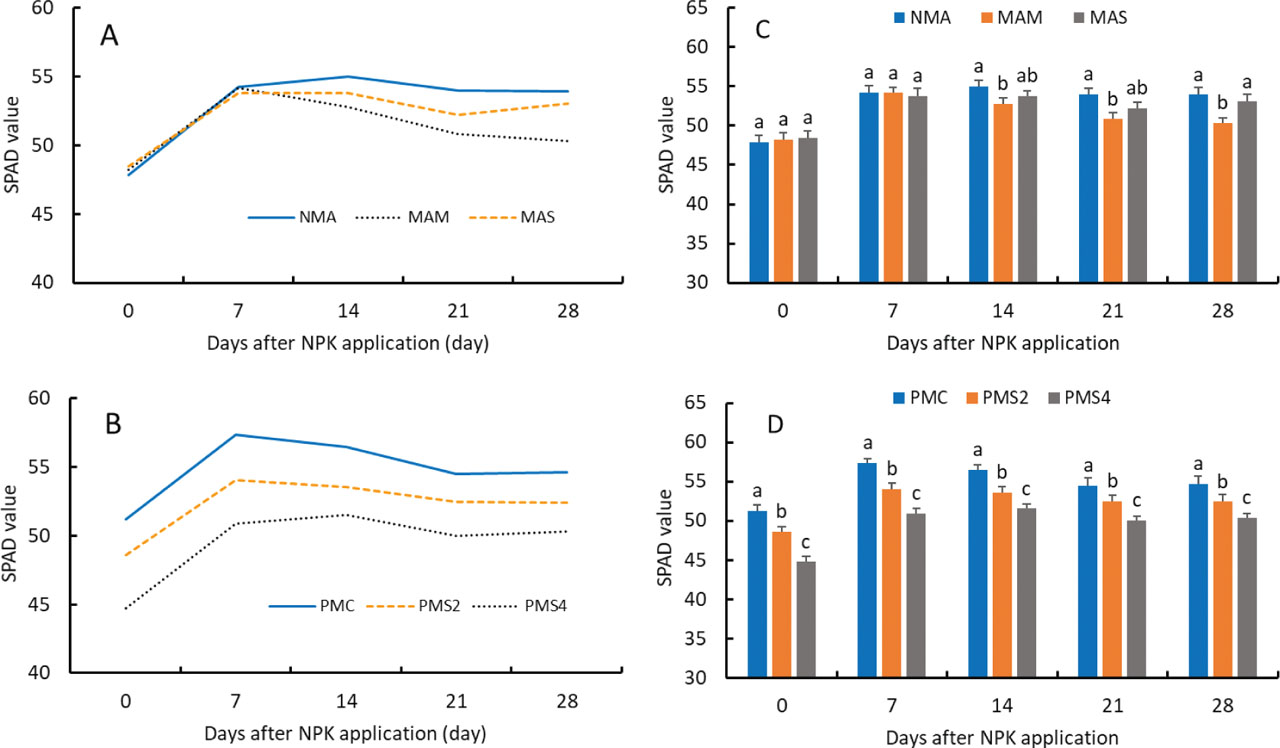
Figure 1
Responses of taro plants to NPK fertilizer application in morphologically altered plants (A and C) and with different planting materials (B and D). The standard errors are represented by the length of the error bars. MAM, morphological alteration involving excision of the mother plant; MAS, morphological alteration involving removal of all suckers; NMA, non-treated control; PMC, planting material cormel; PMS2, planting material suckers with two leaves; PMS4, planting material suckers with four leaves; SPAD, unit-less indicator for leaf chlorophyll content. Small letters a, b, and c on tops of the SPAD value bars were used to indicate differences amongst the morphological alteration treatments.
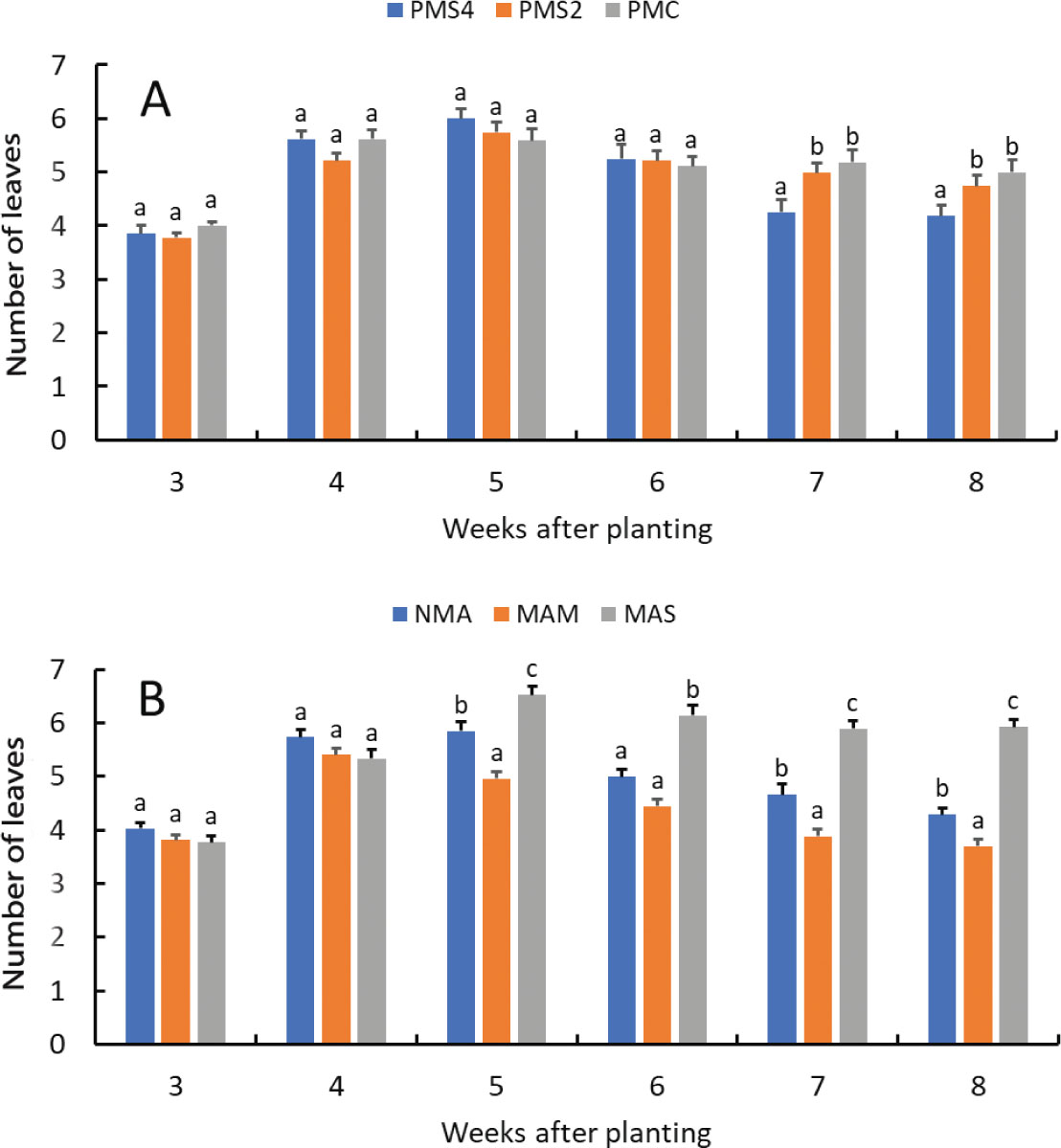
Figure 2
The influence of planting material (A) and morphological alterations (B) on the number of leaves in the mother plant of taro. The standard errors are represented by the length of the error bars. MAM, morphological alteration involving excision of the mother plant; MAS, morphological alteration involving removal of all suckers; NMA, non-treated control; PMC, planting material cormel; PMS2, planting material suckers with two leaves; PMS4, planting material suckers with four leaves.
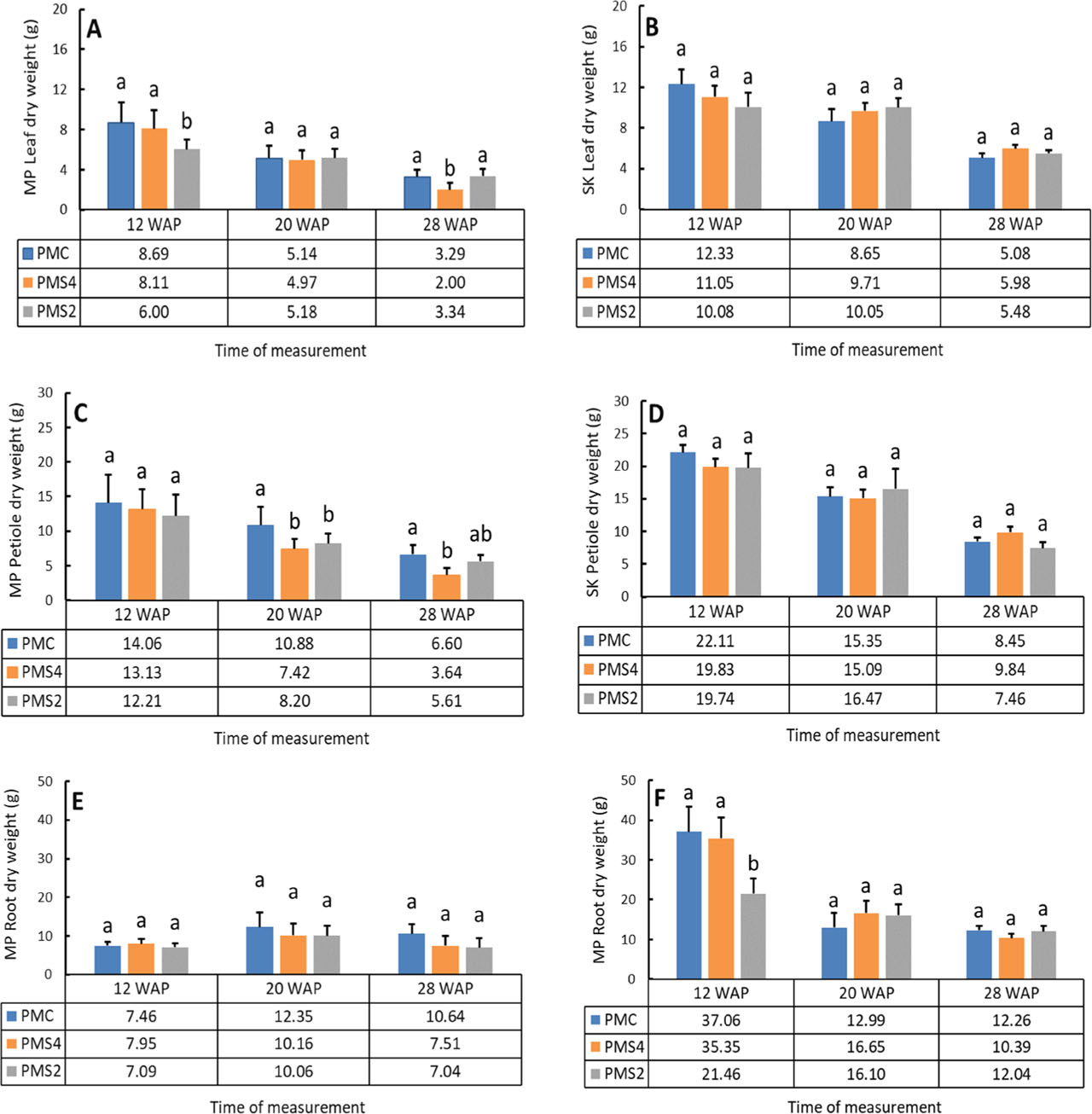
Figure 3
Dry weights of leaf blade, petiole and fibrous roots of the individual mother plant (A, C and E) and suckers (B, D and F) cultivated using cormel (PMC) or seedling with two (PMS2) or four (PMS4) leaves observed at 12 WAP, 20 WAP and 28 WAP in taro plants. The standard errors are represented by the length of the error bars. MP, mother plant; SK, sucker; WAP, weeks after planting.
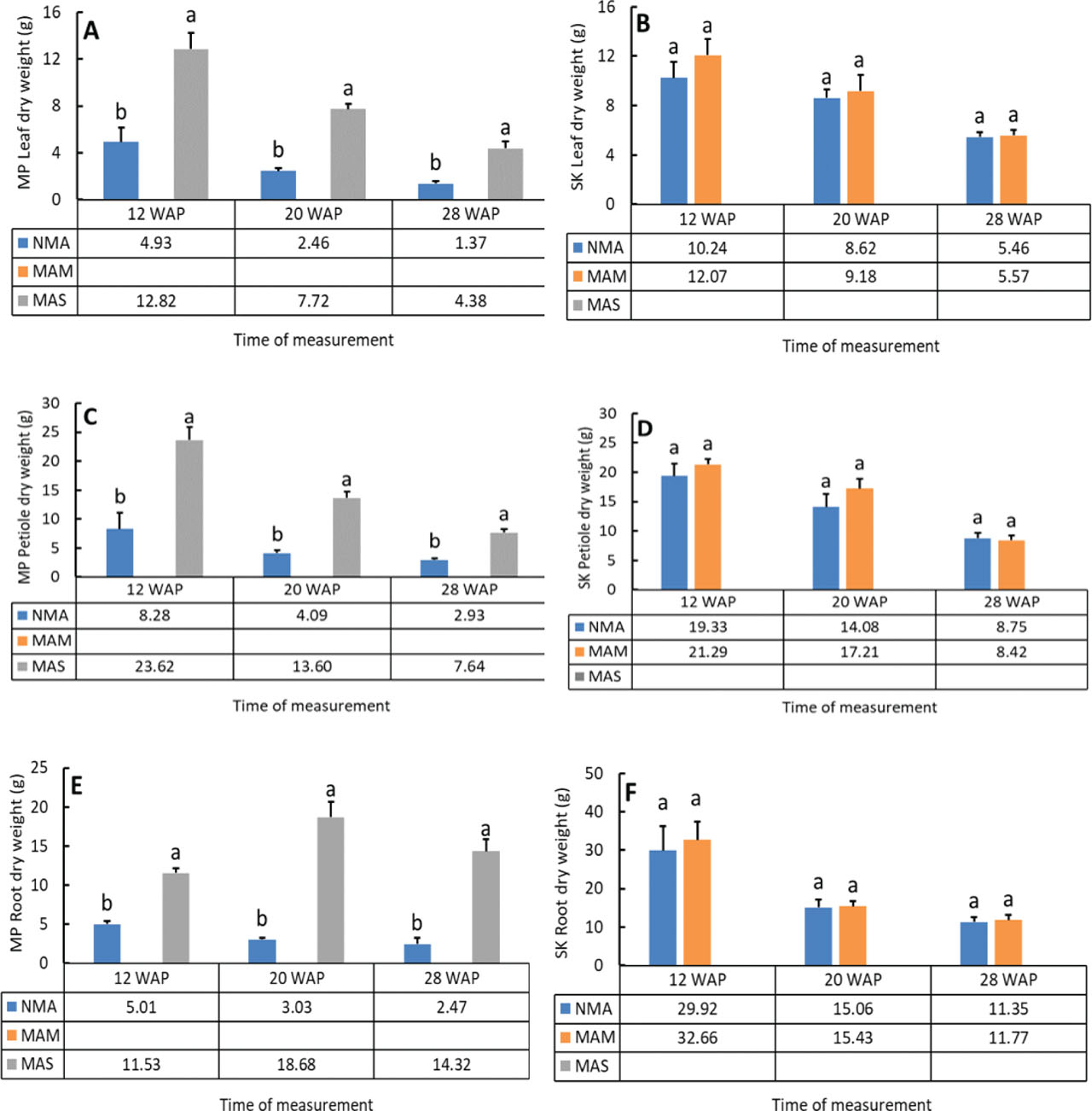
Figure 4
Different responses of the plants to the morphological alteration treatments involving excision of mother plant (MAM) and removal of suckers (MAS) in comparison to non-treated plants (NMA) in terms of the dry weights of leaf (A, B), petiole (C, D) and fibrous roots (E, F), observed at 12 WAP, 20 WAP and 28 WAP in taro plants.
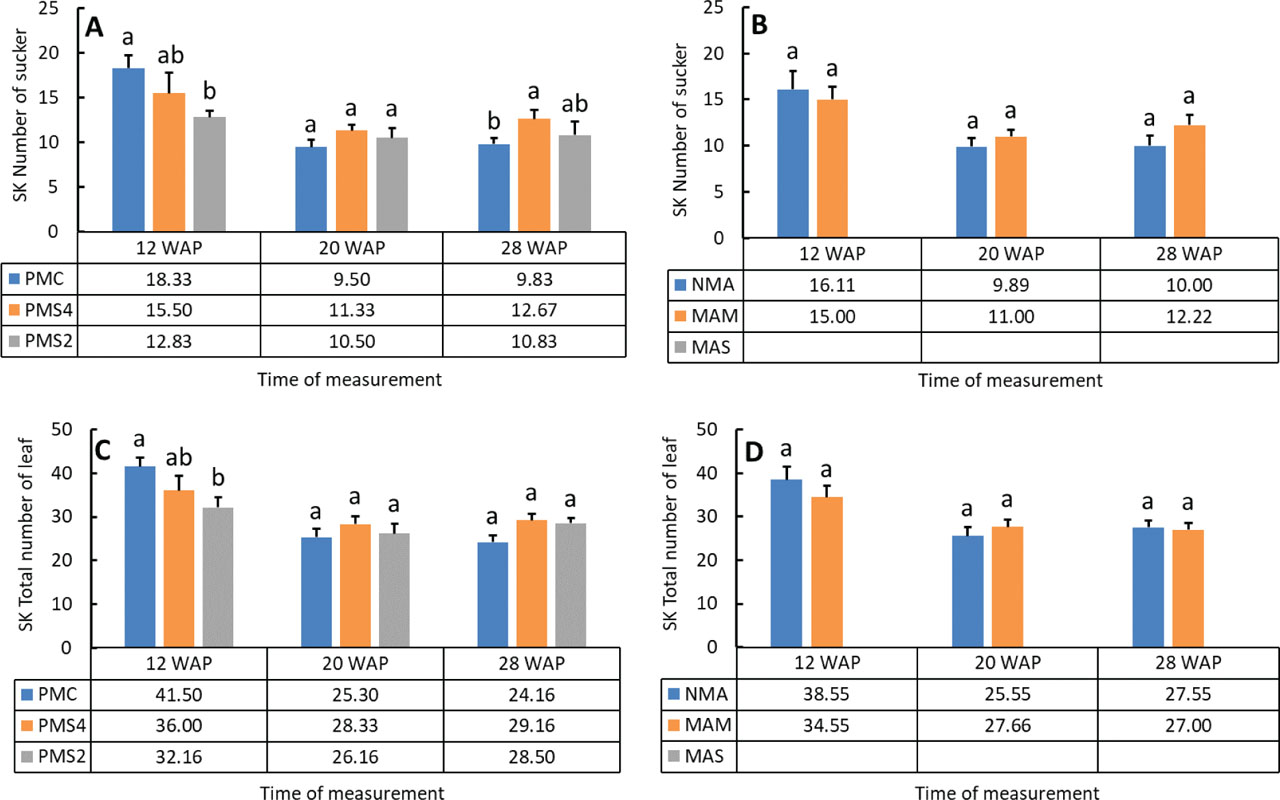
Figure 5
Number of suckers and total number of leaves per plant were higher in plants grown using cormel as the planting material (A, C) and the number of suckers and leaves were not different between the mother plant excision treatment and the non-treated plant (B, D), when observed at 12 WAP, 20 WAP and 28 WAP in taro plants. The standard errors are represented by the length of the error bars. MAM, morphological alteration involving excision of the mother plant; MAS, morphological alteration involving removal of all suckers; MP, mother plant; NMA, non-treated control; PMC, planting material cormel; PMS2, planting material suckers with two leaves; PMS4, planting material suckers with four leaves; SK, sucker; WAP, weeks after planting.
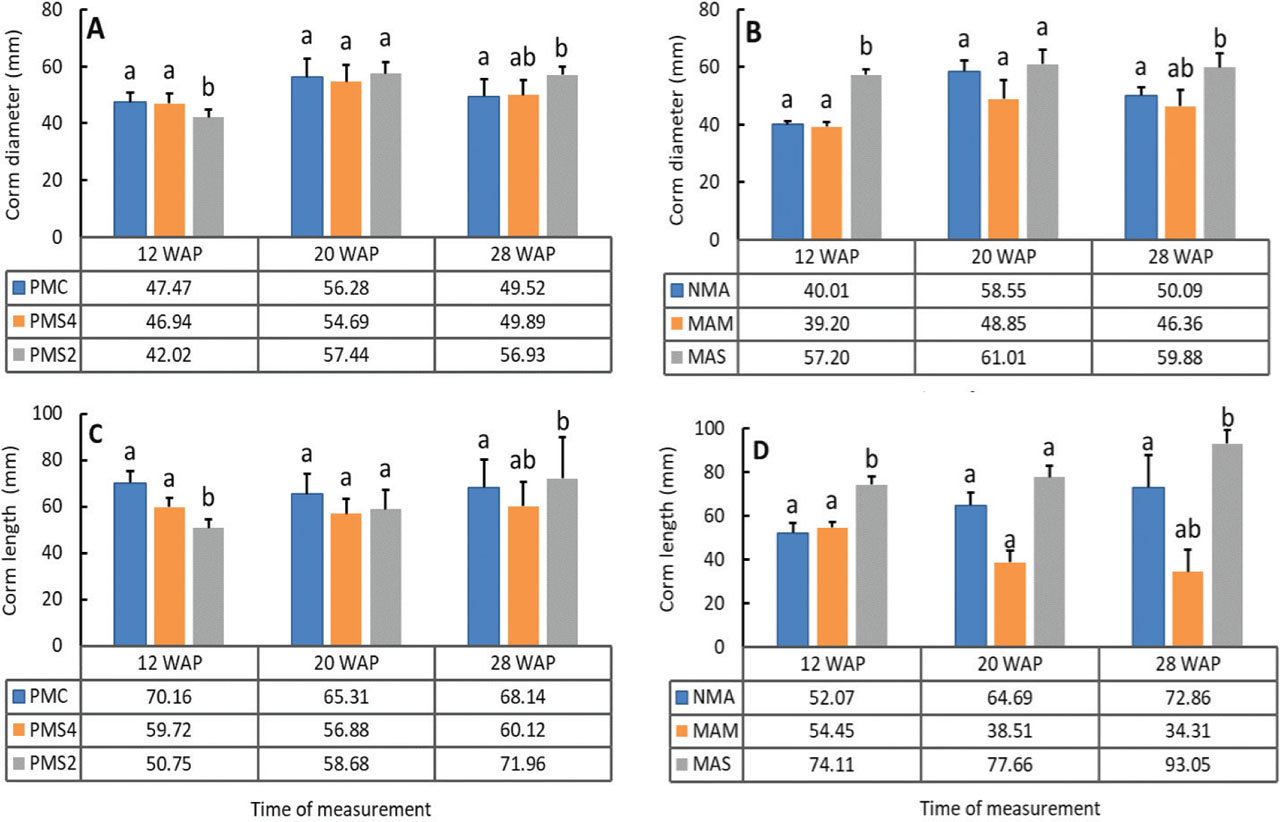
Figure 6
The diameter and length of the corm were compared based on the type of planting material (A, C) and differences in morphological alteration treatment (B, D) in taro plants aged 12 WAP, 20 WAP and 28 WAP. The standard errors are represented by the length of the error bars. MAM, morphological alteration involving excision of the mother plant; MAS, morphological alteration involving removal of all suckers; NMA, non-treated control; PMC, planting material cormel; PMS2, planting material suckers with two leaves; PMS4, planting material suckers with four leaves; WAP, weeks after planting.
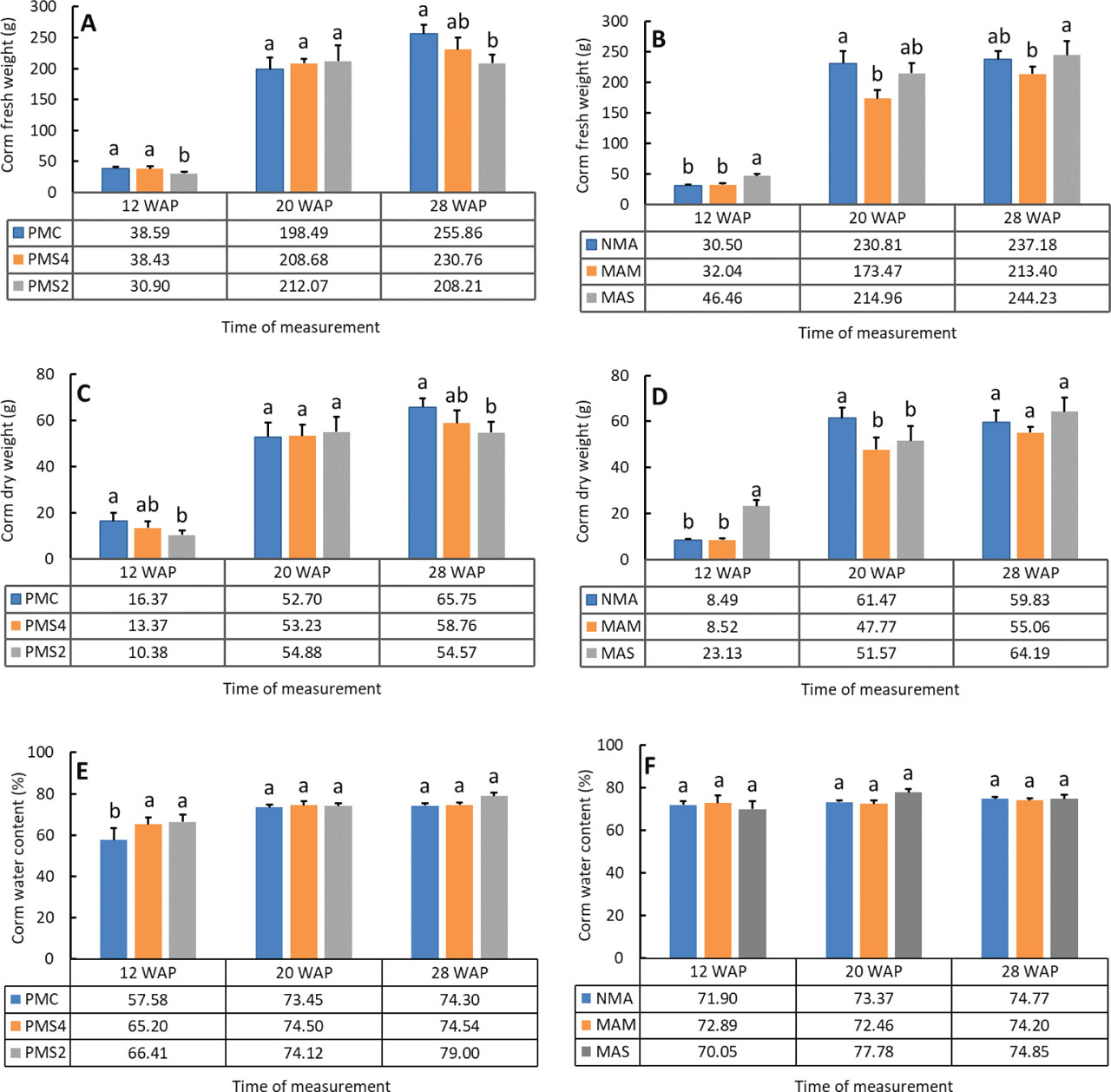
Figure 7
The fresh weight, dry weight and water content of the corm were compared based on the type of planting material (A, C and E) and differences in morphological alteration treatment (B, D and F) in taro plants aged 12 WAP, 20 WAP and 28 WAP. The standard errors are represented by the length of the error bars. MAM, morphological alteration involving excision of the mother plant; MAS, morphological alteration involving removal of all suckers; NMA, non-treated control; PMC, planting material cormel; PMS2, planting material suckers with two leaves; PMS4, planting material suckers with four leaves; WAP, weeks after planting.
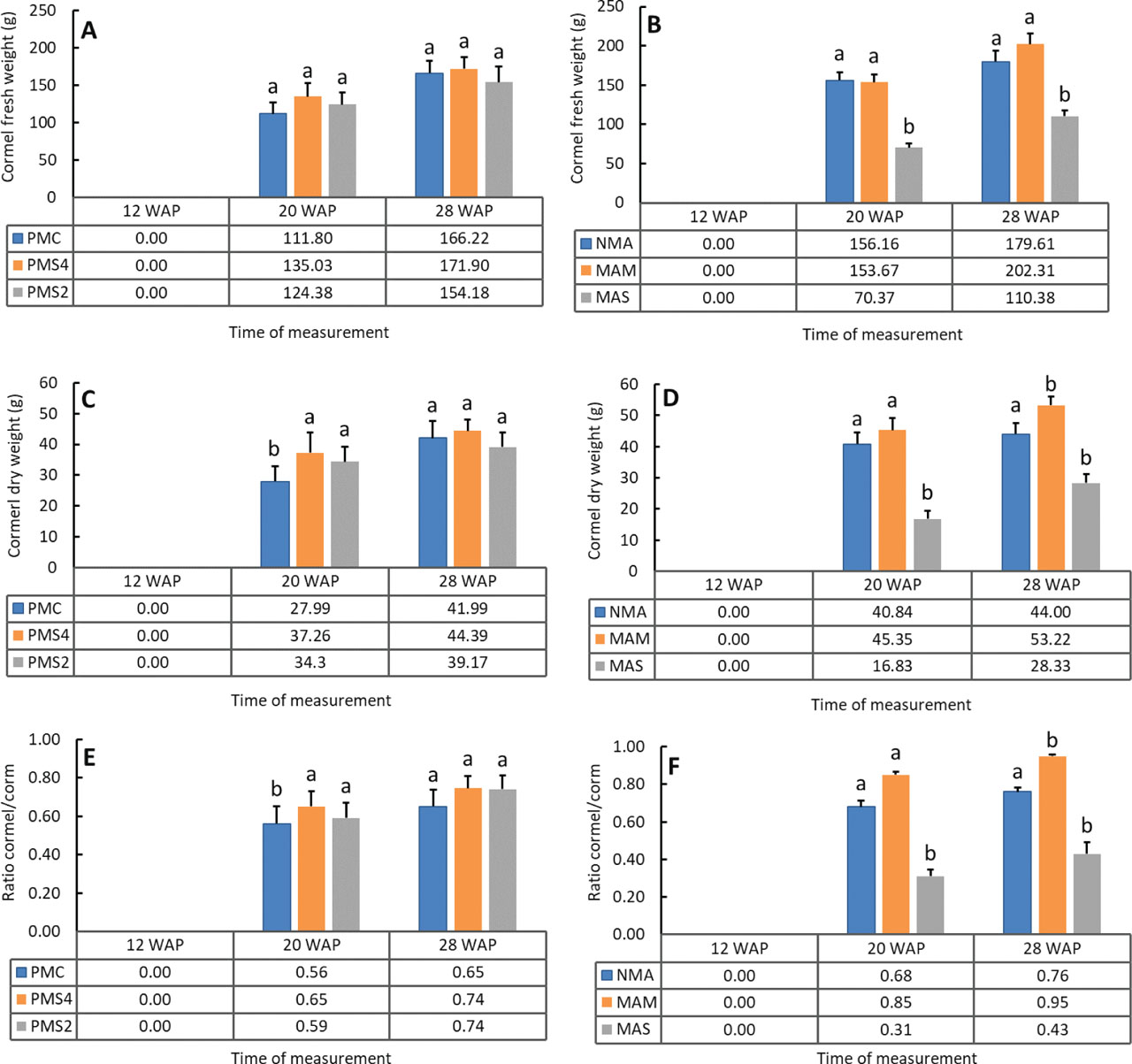
Figure 8
The fresh and dry weights of the cormel and the ratio of cormel/corm were compared based on the type of planting material (A, C and E) and differences in morphological alteration treatment (B, D and F) in taro plants aged 12 WAP, 20 WAP and 28 WAP. The standard errors are represented by the length of the error bars. MAM, morphological alteration involving excision of the mother plant; MAS, morphological alteration involving removal of all suckers; NMA, non-treated control; PMC, planting material cormel; PMS2, planting material suckers with two leaves; PMS4, planting material suckers with four leaves; WAP, weeks after planting.