
Introduction
Soil is an important component of the forest ecosystem (Prusinkiewicz 1970; Gatica-Saavedra et al. 2023), and chemical indices describing its condition provide information on the relationships between vegetation and soil. In the study of soil indices, Kowalkowski (2002), Pavlů et al. (2021) and Gatica-Saavedra et al. (2023) showed that the most frequently assessed soil parameters are pH and the content of total organic carbon (TOC) and total nitrogen (TN). According to Greinert and Greinert (1999), an approximate assessment of the soil’s resistance to chemical degradation can be made based on the soil’s sorption capacity for cations. The chemical quality of forest soils is related to the ratio of acids to bases, which is represented by the acidity of the soil (pH), cation saturation and their ratio to aluminium (Ca : Al or SBC : Al) (Cronan and Grigal 1995). The content of cations in forest soils is an important determinant for the interactions in the soil-soil-solution system (Matschonat and Vogt 1998) and the possible susceptibility of the soil to degradation processes (Siuta 1987). Sorption capacity (CEC) and base saturation (BS) determine the availability of nutrients for plants (Augusto et al. 2002; Ampong et al. 2022; Gmitrowicz-Iwan et al. 2023) and the toxicity of aluminium and heavy metals (Medyńska-Juraszek and Ćwielag-Piasecka 2020). One of the most important factors determining soil fertility is its pH value. Excessive acidification of the soil can contribute to an increase in the hydrogen ion content (H+) and the toxicity of aluminium ions (Al3+) for plants. Knowledge of soil quality is an important criterion for rational forest management and the protection of forest ecosystems from harmful processes caused by global climate change. Excessive soil acidification leads to the loss of base cations (K+, Na+, Ca2+, Mg2+), which are essential for the proper functioning of forest ecosystems. The risks associated with aluminium toxicity in soil can be predicted by assessing the ratio of the sum of base cations (SBC) to the aluminium content, that is, SBC : Al. The molar ratio of the sum of base cations, that is, Ca2+, Mg2+, K+ and Al3+ in the soil solution, is a critical chemical parameter, and the assumption of SBC : Al >1.0 can protect forest ecosystems from damage by aluminium ions (Brunner and Sperisen 2013). Excess aluminium in soil poses a serious threat to forest health and can accelerate its decline (Eggenberger and Kurz 2000; Rout et al. 2001). The assessment of soil quality is complicated due to the complexity and variability of its properties and composition (Greinert and Greinert 1999; Kowalik 2001) and the influence of different tree species (Galka et al. 2014; Gruba and Mulder 2015; Mulder and Stein 1994). Knowledge of soil quality is an important criterion for rational forest management and the protection of forest ecosystems from harmful processes caused by global climate change.
The aim of the study was to assess the condition of forest soils in central and northern Poland using selected chemical indicators.
Material and methods
Study area
The study used soil samples from eight permanent forest plots that are part of the network of intensive forest monitoring coordinated by the Forest Research Institute in Sękocin Stary, Poland, during 2007–2017. These plots are included in the national and European (ICP Forests) monitoring system and represent mature forest stands across the main forest habitat types in central and northern Poland. The classification of forest habitat types (FHS, in polish TSL) was based on data from forest districts and soil habitat surveys. The Institute verified the permanence of the listed FHSs and found that deciduous species occur in the understorey layer in two areas, Chojnów and Strzałowo, but the dominant species layer remains unchanged. Although Table 1 lists only the dominant tree species, stands usually include admixtures consistent with site conditions, especially in BMśw sites, where secondary species often regenerate beneath pine crowns. The study plots were located in eight forest districts in central and northern Poland, that is, Białowieża, Chojnów, Łąck, Gdańsk, Krotoszyn, Krucz, Strzałowo and Suwałki (Fig. 1). The soils of these forest areas consist of Quaternary sands (Białowieża, Chojnów), fluvioglacial sands (Chojnów, Łąck, Strzałowo), aeolian sands overlain by boulder sands (Krucz) and boulder clay (Krotoszyn, Suwałki). A detailed description of the study areas can be found in Table 1.
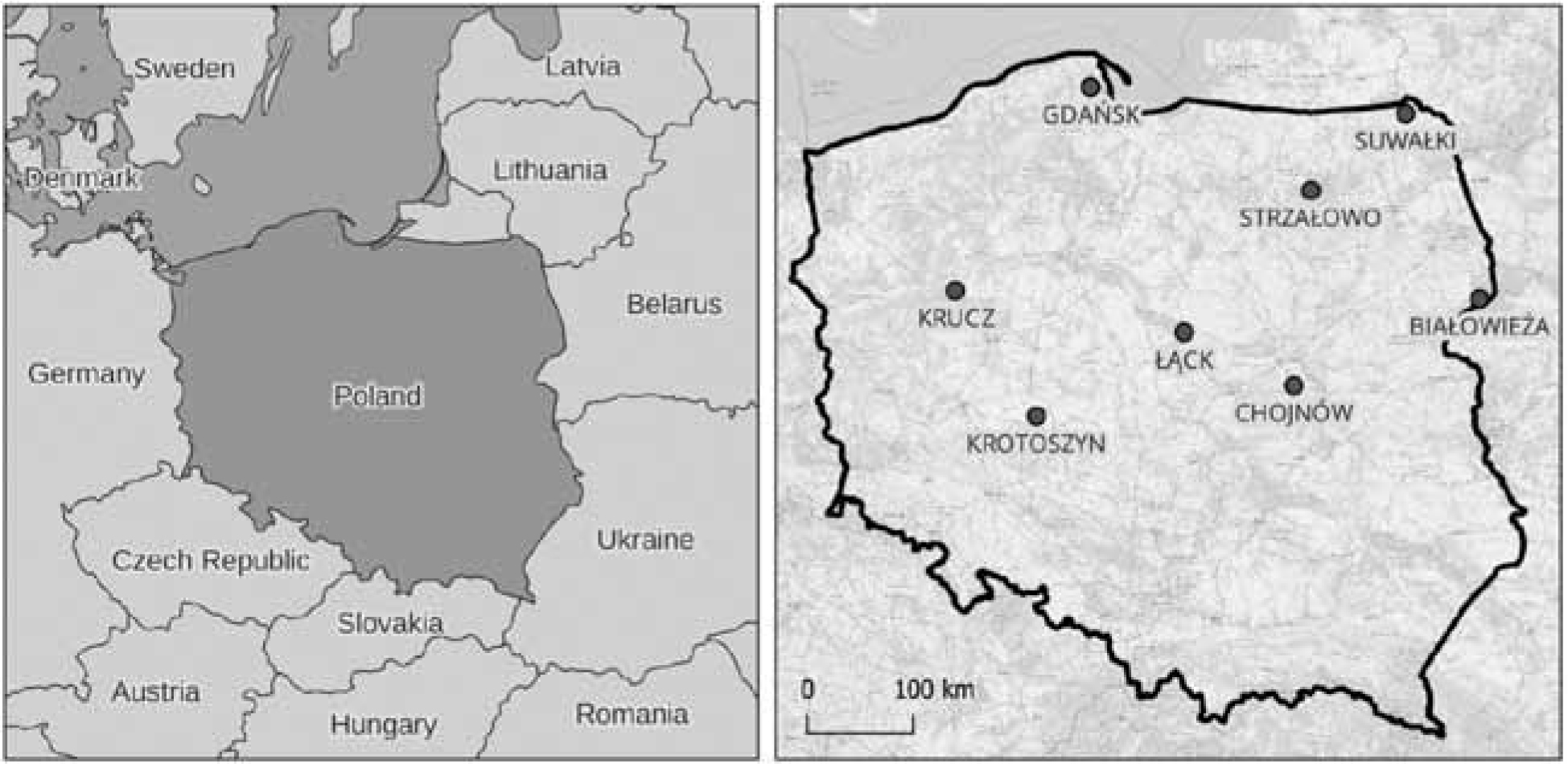
Figure 1.
Location of the study plots
Table 1.
Characteristics of habitat conditions in the central and northern Poland (in 2007–2017)
| Forest District | Average annual temperature [°C] | Annual sum of precipitation [mm] | Soil type | Parent material origin | Type of forest habitat | Dominant tree species |
|---|---|---|---|---|---|---|
| Białowieża | 7.0 | 550 | BRt | Qp | BMśw | So |
| Chojnów | 8.0 | <550 | RDb | QZp | BMśw | So |
| Gdańsk | 7.5 | 650 | BRKt | Qp | Lśw | Bk |
| Krotoszyn | 8.0 | <550 | OGw | Qg | Lśw | Db |
| Krucz | 8.0 | <550 | B | QEp/QZp | Bśw | So |
| Łąck | 8.0 | <550 | RDbr | QFp | LMśw | Db |
| Strzałowo | 7.5 | 650 | Pbr | QFp | BMśw | So |
| Suwałki | 6.5 | 550 | BRg | Qg | Lśw | Św |
1 Soil type: BRt – Eutric Cambisol, RDb – Brunic Arenosol (Protospodic), BRKt – Dystric Cambisol, OGw – Stagnosol, B – Haplic Podzol, RDbr – Brunic Arenosol, Pbr – Haplic Luvisol, BRg – Gleyic Cambisol; Parent material origin: Qp – glacial sand, QZp – fluvioglacial sand (sandr), Qg – glacial till, QEp/QZp – aeolian sand over fluvioglacial sand (sandr), QFp – fluvioglacial sand; Habitat type of the forest: BMśw – mixed fresh coniferous forest, Lśw – fresh broadleaved forest, Bśw – fresh coniferous forest, LMśw – fresh mixed broadleaved forest; Dominant tree species: So – Scots pine, Bk – European beech, Db – Oak, Św – Norway spruce.
A description of weather conditions, that is, average annual temperature (°C) and average annual precipitation (mm) in central and northern Poland in the period 1991–2020, is given in Table 1 (https//:Klimat.imgw.pl/en/climate-normals).
Soil sampling and physico-chemical analysis
Soil samples were collected in 2007 and 2017 from the organic layer (O) and five mineral layers (M) at depths of 0–5, 5–10, 10–20, 20–40 and 40–80 cm. The samples were composite, consisting of nine subsamples collected in a cross-pattern in each study area; this applied to both mineral and organic samples. Mineral samples were collected using an auger, and organic samples were collected using a trowel. Organic layers were collected together, without division into sub-levels (Ol, Ofh/Of, Oh). After collection from individual points, each core was placed in a plastic bucket. Once samples from nine points had been collected, the contents of the buckets were thoroughly homogenised and then placed in canvas bags. The weight of the mineral samples was 1 kg, while the volume of the organic samples was 1 litre. The soil samples were prepared according to Manual on Methodologies (1994). The collected samples were dried at 40°C, then sieved through a 2-mm mesh sieve and thoroughly mixed in a FRISCH Pulverisette 2 agate mill (according to ISO 11464:1994). The samples thus prepared were subjected to physicochemical tests, in which the following measurements were taken:
– particle size distribution according to PN-EN 11277:2005,
– dry matter according to PN-ISO 11465:1999,
– pHCaCl2 in 0.01 mol CaCl2·dm-3 according to ISO 10390:1997,
– TOC and TN by the high-temperature combustion method with TCD detection (according to PN-ISO 10694:2002 for TOC and according to PN-ISO 13878:2002 for TN),
– content of basic cations – Ca2+, Mg2+, K+, Na+, Fe2+ and Mn2+ – and acidic cations – H+, Al3+ – in a 0.1 M barium chloride solution at pH 8.1 according to PN-EN ISO 11260:2011 and determined by ICP-OES method (PN-EN 11885:2007),
– exchangeable acidity (Hw) in BaCl2 extracts according to PN-EN ISO 14254:2011.
Based on the results of the study, the following indicators for the chemical status of forest soils were calculated:
– Sum of the base cations (SBC),
where:
SBC = (K+ + Na+ + Mg2+ + Ca2+),
– Base and acid cation exchange capacity (CEC),
where:
CEC = (K+ + Na+ + Mg2+ + Ca2+) + (H+ + Al3+),
– Degree of saturation of the soil with bases (BS%),
where :
SB = SBC : CEC x 100%,
– Index of aluminium toxicity: SBC : Al, Ca : Al.
Statistical analysis
The normality of the distribution of the results for the investigated parameters in forest soils was tested using the Shapiro–Wilk test. To evaluate the influence of forest tree species on selected physico-chemical soil properties, a one-way analysis of variance was performed. The significance of the differences between the mean values of the parameters was tested using Tukey’s test at significance levels of P<0.05, 0.01 and 0.001. The following parameters: pHCaCl, TOC, TN, CEC, SBC, BS and SBC: Al were analysed in the organic (O) and mineral soil layers 0–80 cm (M).
A cluster analysis was performed for the studied chemical indicators in the forest soils of the northern part of the country, and the dendrogram was created using the Ward method. This method is used to estimate the distances between clusters and uses the analysis of variance approach.
Linear correlation analysis was performed between forest habitat type and selected soil parameters, that is, pHCaCl2, Hw, TOC and TN, and selected indicators, that is, SBC, CEC, BS, SBC : Al and Ca : Al. The linear correlation coefficients were tested at three levels of significance: p < 0.05, 0.01 and 0.001. All analyses were performed using Statistica version 13.3 (TIBCO Software Inc. 2017).
Results
Physico-chemical properties of the soil
The soils on the plots were of varying composition. The majority of materials consisted of loamy sands (45% of cases, depending on depth), followed by a high proportion of sand (37.5%), sandy loam (15%) and sandy clay (2.5%). The vertical texture distribution of all plots is shown in Figure 2.
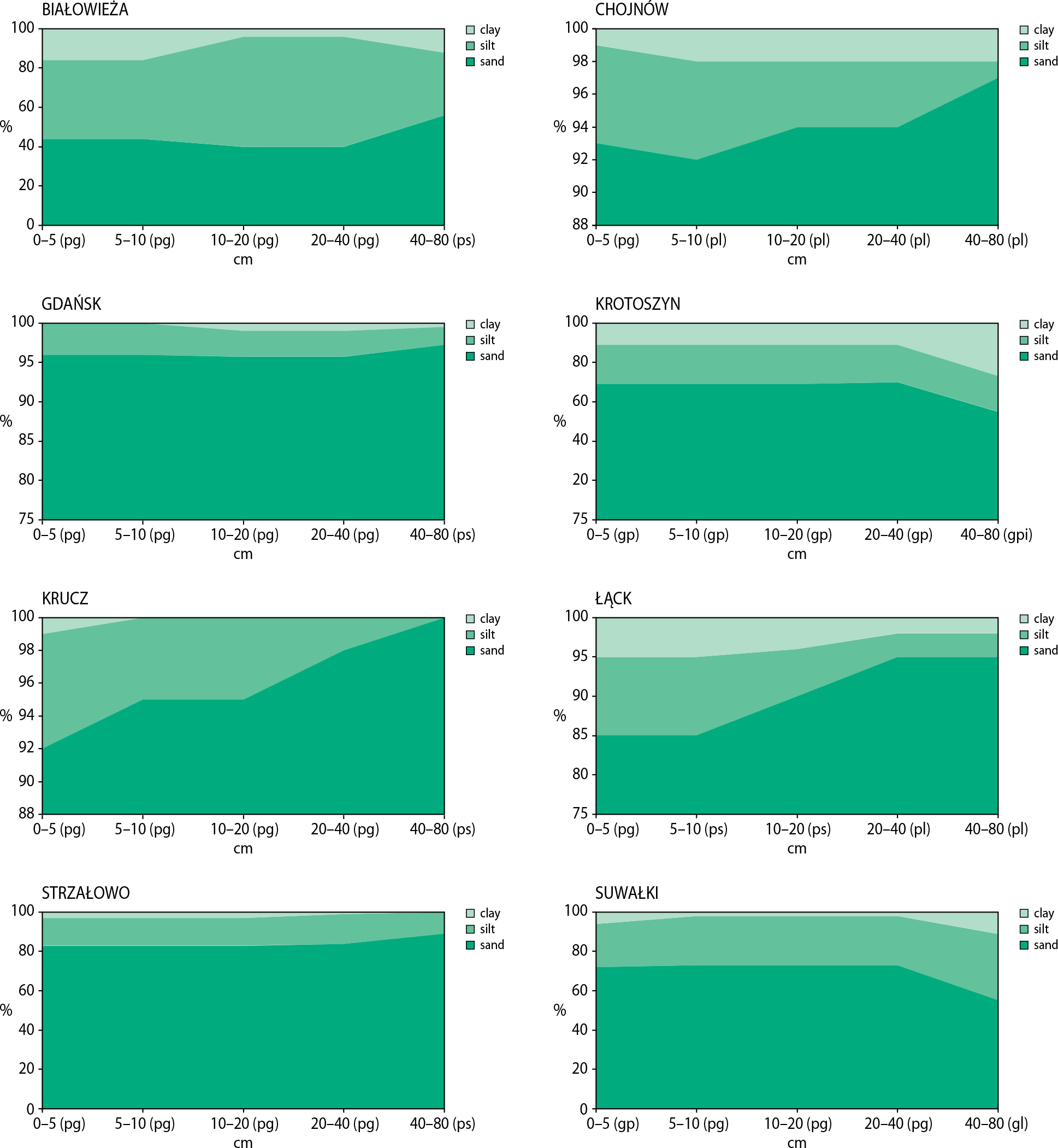
Figure 2.
Particle size distribution on the study plots
The investigated forest soils were characterised by an acidic reaction independent of site and soil layer (Tab. 2). In 2007, the organic layer of the Haplic Podzol under Pinus sylvestris (L.) stands in the Krucz Forest District was the most acidic (pHCaCl2 2.70), and the least acidic soil was the brunic arenosol under Quercus L. in the Łąck Forest District (pHCaCl2 4.50). After a decade, no significant changes in the acidity of the investigated forest soils were observed. No significant changes in the acidity of the forest soils in the mineral layer were detected in 2007 and 2017 either. The most acidic (pHCaCl2 3.20) was the Brunic Arenosol type soil under Pinus sylvestris L. in the Chojnów Forest District, and the least acidic was the Haplic Luvisol type soil under the same stands in the Strzałowo Forest District (pHCaCl2 4.60). The analysis of variance revealed no significant changes in pH during the decade 2007–2017 in soils of the central-northern Poland (Tab. 2).
Table 2.
Average of pH values and TOC and TN contents in forest soils in central and northern Poland (2007–2017)
| Forest District | Layer (cm) | Year | pHCaCl2 | TOC [g·kg-1] | TN [g·kg-1] | C :N |
|---|---|---|---|---|---|---|
| 1 | 2 | 3 | 4 | 5 | 6 | 7 |
| Chojnów | O | 2007 | 3.20 | 313.90 | 13.75 | 22.83 |
| 2017 | 3.19 | 390.38 | 17.16 | 22.75 | ||
| mean±SD | 3.19±0.10 | 325.48±48.67 | 15.45±2.41 | 22.79±1.14 | ||
| M | 2007 | 3.84a’ | 7.53a’ | 0.42a’ | 16.97a’ | |
| 2017 | 3.71a’ | 9.04a’ | 0.46a’ | 18.54a’ | ||
| mean±SD | 3.78±0.40 | 8.53±4.94 | 0,44±0.18 | 17.74±3.52 | ||
| Łąck | O | 2007 | 4.50 | 218.50 | 11.19 | 19.53 |
| 2017 | 4.50 | 268.87 | 12.68 | 21.19 | ||
| mean±SD | 4.50±0.33 | 239.48±26.21 | 11.93±1.05 | 20.36±0.83 | ||
| M | 2007 | 3.88a’ | 6.10a’ | 0.38a’ | 12.34a’ | |
| 2017 | 4.04a’ | 12.51a’ | 0.64a’ | 17.60a’ | ||
| mean±SD | 3.99±0.28 | 9.84±9.82 | 0.51±0.49 | 16.66±4.40 | ||
| Krotoszyn | O | 2007 | 3.20 | 305.80 | 16.19 | 18.89 |
| 2017 | 3.20 | 369.48 | 20.91 | 17.67 | ||
| mean±SD | 3.20±0.01 | 353.73±34.55 | 18.55±1.05 | 17.70±6.40 | ||
| M | 2007 | 3.52a’ | 23.38a’ | 1.32a’ | 15.97a’ | |
| 2017 | 3.46a’ | 19.71a’ | 1.00a’ | 17.04a’ | ||
| mean±SD | 3.49±0.36 | 20.08±8.73 | 1.16±0.96 | 17.00±0.98 | ||
| Krucz | O | 2007 | 2.70 | 357.60 | 11.84 | 30.20 |
| 2017 | 2.71 | 399.61 | 13.66 | 29.24 | ||
| mean±SD | 2.70±0.07 | 315.90±90.32 | 12.70±1.29 | 29.54±0.47 | ||
| M | 2007 | 3.81a’ | 7.18a’ | 0.39a’ | 16.82a’ | |
| 2017 | 4.19a’ | 7.09a’ | 0.36a.’ | 16.65a’ | ||
| mean±SD | 3.92±0.43 | 7.11±0.70 | 0.38±0.20 | 16.51a’0.07 | ||
| Suwałki | O | 2007 | 4.10 | 154.00 | 8.07 | 19.08 |
| 2017 | 4.11 | 166.17 | 8.81 | 18.86 | ||
| mean±SD | 4.00±0.14 | 162.99±9.72 | 8.40±0.52 | 18.69±0.83 | ||
| M | 2007 | 3.73a’ | 12.79a’ | 1.02a’ | 11.24a’ | |
| 2017 | 3.94a’ | 14.31a’ | 0.99a’ | 14.59a’ | ||
| mean±SD | 3.80±0.29 | 13.90±9.32 | 1.08±0.62 | 13.55±3.04 | ||
| Białowieża | O | 2007 | 3.60 | 289.20 | 16.98 | 22.81 |
| 2017 | 3.59 | 323.39 | 13.92 | 23.22 | ||
| mean±SD | 3.60±0.21 | 326.53±31.83 | 15.45±2.16 | 22.63±0.56 | ||
| M | 2007 | 3.99a’ | 12.51a’ | 0.42a’ | 15.47a’ | |
| 2017 | 4.10a’ | 17.01a’ | 0.46a’ | 16.34a’ | ||
| mean±SD | 4.07±0.47 | 14.67±12.02 | 0.46±0.20 | 16.19±1.82 | ||
| Strzałowo | O | 2007 | 4.30 | 56.92 | 3.10 | 18.36 |
| 2017 | 4.31 | 162.87 | 6.80 | 23.95 | ||
| mean±SD | 4.30±0.01 | 114.28±57.30 | 4.95±2.61 | 21.04±2.29 | ||
| M | 2007 | 4.51a’ | 8.25a’ | 0,61a’ | 12.38a’ | |
| 2017 | 4.60a’ | 9.74a’ | 0.65a’ | 14.40a’ | ||
| mean±SD | 4.58±0.22 | 9.18±5.82 | 0,63±0,40 | 13.02±1.83 | ||
| Gdańsk | O | 2007 | 4.50 | 303.30 | 16.07 | 18.87 |
| 2017 | 4.51 | 358.88 | 14.54 | 24.68 | ||
| mean±SD | 4.50±0.01 | 326.48±28.91 | 15,30±1.08 | 21.78±2.90 | ||
| M | 2007 | 3.79a’ | 8.51a’ | 0,58a’ | 13.91a’ | |
| 2017 | 3.94a’ | 8.20a’ | 0.51a’ | 14.86a’ | ||
| mean±SD | 3.84±0.30 | 8.36±4.50 | 0,55±0,26 | 14.23±3.10 |
The TOC content of the forest soils varied depending on the soil layer, habitat and soil conditions in the study area (Tab. 2, Fig. 3A–F). In both 2007 and 2017, the organic soil layer in the Krucz Forest District, developed on Haplic Podzol under stands of Pinus sylvestris L., had the highest TOC content (357.60 and 399.61 g TOC kg-1, respectively), while the lowest values were recorded in the Strzałowo Forest District (56.92 and 162.87 g TOC kg-1, respectively) on Haplic Luvisol under Pinus sylvestris L. In addition, the TOC content of the organic soil layer increased after a decade in all forest plots included in the study. The TOC content of the mineral soil layers was low (less 25.0 g TOC kg-1) and did not change significantly over the decade (years: 2007–2017) (Tab. 2).
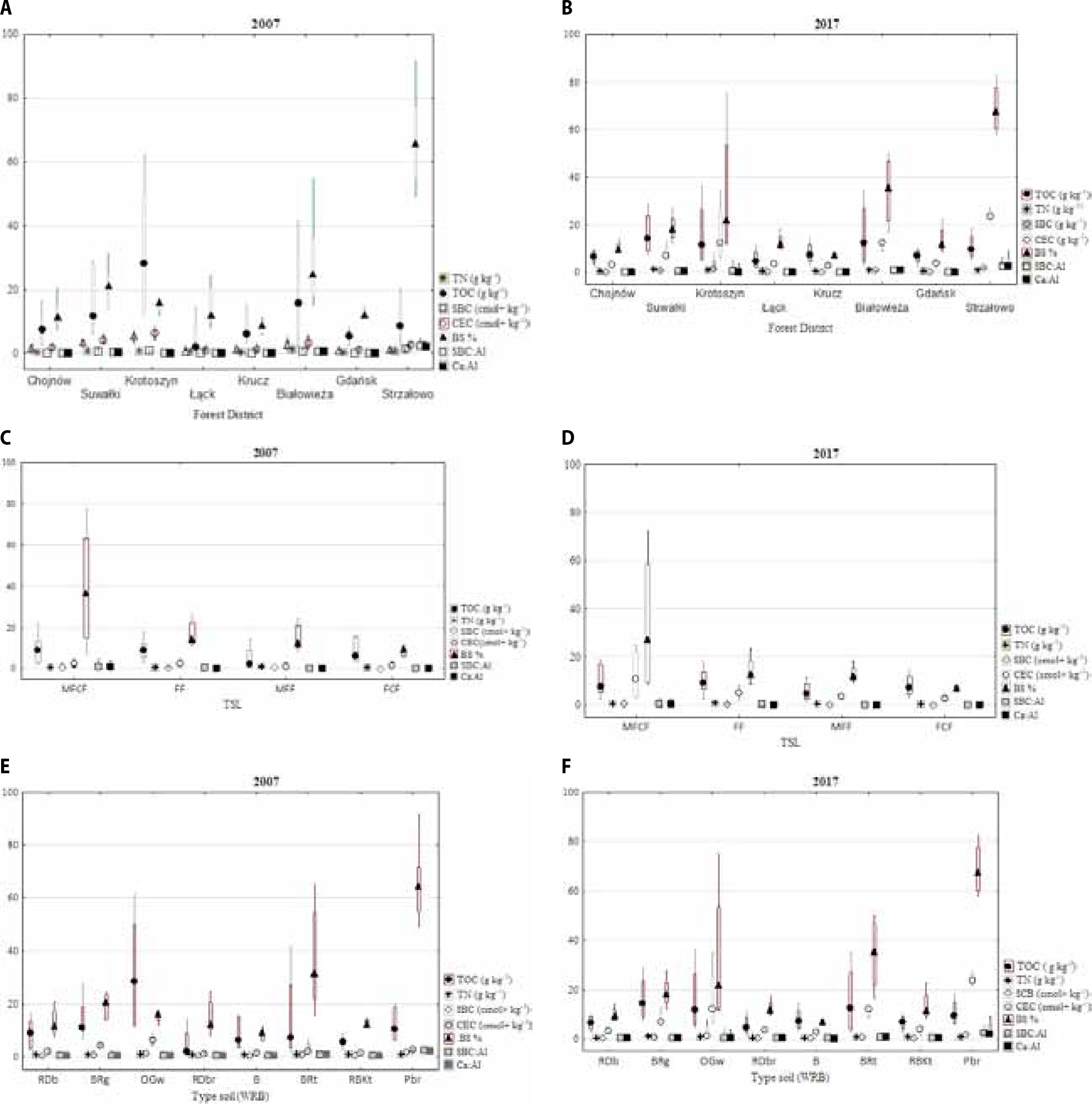
Figure 3.
Selected chemical parameters of forest soils in central and northern Poland in 2007 and 2017 against the background of: A-B) – location of the study areas, C-D) – forest habitat type; E-F) – soil type (WRB)
The TN content in the forest soils also depended on the depth of sampling. In 2007, the nitrogen content in the organic layer of the studied sites ranged from 3.10 to 16.98 g TN kg-1 in Strzałowo and Białowieża. In 2017, it was slightly higher in most of the assessed soils, ranging from 6.80 to 20.91 g TN kg-1 in the Strzałowo Forest District on Haplic Luvisol soil and in the Krotoszyn Forest District on Stagnosol soil, both under Pinus sylvestris (L.). The exceptions were the organic layers of soil in Białowieża and Gdańsk, where the TN content decreased after a decade. The content of this component in the mineral layer of the soil was low in all years, ranging from 0.38 to 1.32 g TN kg (Tab. 2).
The C : N ratio in the forest soils depended on the habitat conditions in the forest plots. Regardless of the time of soil sampling, the organic soil layers showed a wider range than the mineral layers. In 2007, the lowest C : N value was measured in the organic soil layer of the Strzałowo Forest District (18.36) on Haplic Luvisol soil under Pinus sylvestris (L.) stands, whereas the highest value was observed in the Krucz Forest District (30.20) on Haplic Podzol soil, also under Pinus sylvestris (L.). After a decade, the lowest C : N value was measured in 2017 in the soil of the Krotoszyn Forest District (16.67) and the highest value again in the Krucz Forest District (29.24). The C : N ratio in the mineral layer of the soil changed only slightly in 2007 and 2017. The lowest value was measured in 2007 in the soils of the Suwalki Forest District (11.24) and the highest in the Chojnów Forest District (16.97). In 2017, after a decade, the lowest C : N value was measured in the soil of the Strzałowo Forest District (14.40) and the highest in the soil of the Chojnów Forest District (18.54). Despite a decade having passed since 2007, there were no statistically significant differences in the C : N ratio values in the forest soils of central-northern Poland (Tab. 2).
Indicators of soil chemical status
Sum of base cations (SBC)
The average content of base cations (SBC) in the forest soils studied in 2007 and 2017 varied between sites and soil layers (Fig. 3A–F). In the organic layer in 2007, this parameter was 6.04 cmol(+)/kg-1 in Krucz and 28.95 cmol(+)/kg-1 in Łąck. After a decade, it increased to 14.57 cmol(+)/kg-1. Despite the ten-year interval since 2007, there were no statistically significant differences in the C : N ratio values in the forest soils of centralnorthern Poland (Tab. 2). Despite the period of a decade since 2007, there were no statistically significant differences in the values of the C : N ratio in the forest soils of central-northern Poland (Tab. 2).
Despite the period of a decade since 2007, there were no statistically significant differences in the values of the C : N ratio in the forest soils of central-northern Poland (Tab. 2).
The SBC value increased significantly after this time in Krotoszyn (20.64 cmol(+)/kg-1), Strzałowo (+8.98 cmol(+)/kg-1), Krucz (+8.53 cmol(+)/kg-1) and Gdańsk (+6.78 cmol(+)/kg-1) and decreased in Bialowieża (–9.95 cmol(+)/kg-1). Regardless of the sampling time, the organic layer in the Cambisol area of the Gdańsk Forest District exhibited the highest average concentration of base cations (23.93 cmol(+)/kg-1) in the FBF (fresh broadleaved forest) habitat type, dominated by Fagus sylvatica L. and the least rich was the Haplic Podzol soil in Krucz (10.30 cmol(+)/kg-1) of the FCF (fresh coniferous forest) habitat type under Pinus sylvestris L. (Tab. 3).
Table 3.
Selected chemical indicators of the fertility status of forest soils of the central and northern Poland (2007–2017)
| Forest District | Layer | Year | SBC (cmol·kg-1) | CEC (cmol·kg-1) | BS (%) | SBC : Al | Ca : Al |
|---|---|---|---|---|---|---|---|
| 1 | 2 | 3 | 4 | 5 | 6 | 7 | 8 |
| Chojnów | O | 2007 | 16.11a | 21.58a | 74.65a | 11.21b | 8.52a |
| 2017 | 16.54a | 20.82a | 79.42a | 9.13b | 6.71a | ||
| mean±SD | 16.32±0.30 | 21.20±0.53 | 77.04±3.37 | 10.1±1.47 | 7.62±1.28 | ||
| M | 2007 | 0.18a’ | 1.34a’ | 13.07a’ | 0.18a’ | 0.11a’ | |
| 2017 | 0.22a’ | 2.09a’ | 12.08a’ | 0.14a’ | 0.08a’ | ||
| mean±SD | 0.20±0.11 | 1.70±0.96 | 12.58±3.87 | 0.16±0.06 | 0.10±0.05 | ||
| Łąck | O | 2007 | 28.95a | 31.03a | 93.30a | 298.90a | 27.60a |
| 2017 | 23.30a | 26.40a | 88.25a | 44.65b | 33.67a | ||
| mean±SD | 26.98±4.00 | 29.63±3.27 | 90.77±3.56 | 116.77±172.71 | 30.63±4.29 | ||
| M | 2007 | 0.28a’ | 1.09a’ | 21.16a’ | 0.30a’ | 0.20’ | |
| 2017 | 0.27a’ | 2.20a’ | 13.68a’ | 0.16a’ | 0.09’ | ||
| mean±SD | 0.27±0.27 | 1.64±1.21 | 17.42±9.01 | 0.23±0.22 | 0.14±0.15 | ||
| Krotoszyn | O | 2007 | 9.18a | 18.68b | 50.80b | 1.92a | 1.24a |
| 2017 | 29.82b | 38.08a | 78.32a | 6.30a | 1.00a | ||
| mean±SD | 19.50±14.6 | 28.07±14.15 | 64.56±19.46 | 4.10±3.09 | 1.22±0.17 | ||
| M | 2007 | 1.58a’ | 5.46a’ | 27.30a’ | 0.57a’ | 0.34a’ | |
| 2017 | 2.67a’ | 7.09a’ | 29.03a’ | 1.33a’ | 0.86a’ | ||
| mean±SD | 2.13±2.83 | 6.27±2.49 | 28.17±23.76 | 0.95±1.75 | 0.60±1.18 | ||
| Krucz | O | 2007 | 6.04a | 15.95a | 37.87b | 2.18a | 1.64a |
| 2017 | 14.57b | 22.15a | 65.76a | 9.10b | 6.77b | ||
| mean±SD | 10.30±6.03 | 19.05±4.38 | 51.81±19.72 | 5.64±4.90 | 4.21±3.62 | ||
| M | 2007 | 0.11a’ | 1.24a’ | 10.67a’ | 0.12a’ | 0.07a’ | |
| 2017 | 0.15a’ | 1.59a’ | 12.73a’ | 0.21a’ | 0.12a’ | ||
| mean±SD | 0.13±0.07 | 1.42±0.94 | 11.70±8.32 | 0.16±0.17 | 0.10±0.11 | ||
| Suwałki | O | 2007 | 12.45a | 14.92a | 83.45a | 25.79a | 21.87a |
| 2017 | 17.17a | 19.38a | 88.59a | 18.75a | 14.39a | ||
| mean±SD | 14.81±3.33 | 17.15±3.15 | 86.02±3.64 | 22.27±5.00 | 18.11±5.32 | ||
| M | 2007 | 0.82a’ | 3.77a’ | 23.36a’ | 0.66a’ | 0.52a’ | |
| 2017 | 4.72a’ | 7.80a” | 36.00a’ | 5.22b’ | 4.22b’ | ||
| mean±SD | 2.10±2.75 | 4.89±3.59 | 26.15±17.14 | 1.79±3.22 | 2.37±3.11 | ||
| Białowieża | O | 2007 | 17.14a | 21.58a | 79.42a | 24.37a | 21.07a |
| 2017 | 7.20b | 11.50b | 62.60a | 4.08b | 3.38b | ||
| mean±SD | 12.17±7.03 | 16.54±7.13 | 71.01±11.90 | 14.24±14.34 | 12.23±12.50 | ||
| M | 2007 | 0.57a’ | 2.61a’ | 28.30a’ | 0.75a’ | 0.64a’ | |
| 2017 | 1.68a’ | 3.66a’ | 51.71b’ | 10.05b’ | 9.62b’ | ||
| mean±SD | 1.02±0.54 | 3.09±2.37 | 37.18±2.37 | 1.11±0.89 | 5.13±1.09 | ||
| Strzałowo | O | 2007 | 7.85a | 8.75a | 89.71a | 22.94b’ | 18.82a |
| 2017 | 16.83b | 21.05b | 79.95a | 7.95a’ | 6.25a | ||
| mean±SD | 12.34±6.35 | 14.90±8.70 | 84.83±6.90 | 15.44±10.60 | 12.54±8.89 | ||
| M | 2007 | 1.74a’ | 2.18a’ | 84.18a’ | 11.21a’ | 10.01a’ | |
| 2017 | 1.67a’ | 2.71a’ | 63.29a’ | 2.49b’ | 2.02b’ | ||
| mean±SD | 1.70±0.55 | 2.44±0.95 | 73.73±18.10 | 6.85±9.45 | 6.02±8.53 | ||
| Gdańsk | O | 2007 | 20.54a | 23.02a | 89.23a | 25.12a | 18.94a |
| 2017 | 27.32a | 32.18a | 84.90a | 20.23a | 15.30a | ||
| mean±SD | 23.93±4.79 | 27.60±6.48 | 87.06±3.06 | 23.51±3.52 | 17.12±2.57 | ||
| M | 2007 | 0.21a’ | 1.34a’ | 15.12a’ | 0.24a’ | 0.14a’ | |
| 2017 | 0.34a’ | 1.71a’ | 21.49a’ | 0.29a’ | 0.14a’ | ||
| mean±SD | 0.23±0.16 | 1.52±0.45 | 18.30±8.75 | 0.26±0.14 | 0.14±0.11 |
1 Layer: O – organic, M – mineral (0–80 cm deph) – arithmetic mean value; SBC – sum of basic cations; CEC – cation exchange capacity; BS% – alkaline saturation; CBC : Al ratio; BS – base saturation, CEC – cation exchange capacity, SBC – sum of base cations, SBC : Al ratio (the ratio of the sum of alkali cations to aluminum).
The range of SBC content in the mineral layers of forest soils in north-central Poland was low in 2007 and ranged from 0.11 to 1.58 cmol(+)/kg-1 in Krucz and Krotoszyn, respectively. In 2017, the SBC was similar and ranged from 0.15 in Krucz to 4.72 cmol(+)/kg-1 in Suwałki. After a decade, the low content of basic cations has not changed in all forest districts in north-central Poland (Tab. 3). Regardless of the time of sampling, the analysed mineral soils showed a very low content of basic cations, especially in the forest districts: Krucz, Chojnów, Łąck and Gdańsk. The SBC content in the mineral layer at half of the sites (Chojnów, Łąck, Gdańsk, Krusz) was very low, below 0.30 SBC cmol(+)/kg-1, indicating poor forest habitats on sandy and acidic soils. SBC content in the range of 1.0–5.0 SBC cmol(+)/kg-1 in deeper mineral horizons is typical for soils of mesotrophic habitats (Lasota, Błońska 2013). This was observed at the other half of the sites (Krotoszyn, Suwałki, Strzałowo, Białystok).
Cation exchange capacity (CEC)
Like the SBC, the value of the CEC was significantly higher in the organic layer than in the mineral layer. In 2007, the range of this parameter in the organic soil layer was between 8.75 and 31.03 cmol(+)/kg-1 in the forest districts of Strzałowo and Łąck. After a decade, the value increased slightly, reaching a range of 11.50–38.08 cmol(+)/kg-1, with the lowest values recorded in the soil of the Białowieża forest area and the highest in the soil of the Krotoszyn Forest District. After a decade (2007–2017), the CEC value increased in the soils of the Krotoszyn (+19.40), Krucz (+6.2), Suwałki (+4.46), Strzałowo (+12.3) and Gdańsk (+9.16) forest areas and decreased in the Chojnów (–0.76), Łąck (–4.63) and Białowieża (–10.08) Forest Districts. In the other cases, there were no significant statistical differences between the average values of this parameter (Tab. 3).
In 2007, the CEC content in the mineral layers of the investigated forest soils ranged from 1.09 in the Łąck Forest District to 5.46 cmol(+)/kg-1 in the Krotoszyn Forest District. After a decade, it increased slightly from 1.59 to 7.09 cmol(+)/kg-1 in the Krucz and Krotoszyn Forest Districts. In 2007 and 2017, there were no statistically significant differences between the average CEC content in the soil layers of the investigated sites. The lowest average CEC value from both years of investigation was recorded in the Podzol soil in the Krucz Forest District under Pinus sylvestris L. (1.42 cmol(+)/kg-1), whereas the highest value was observed in the Krotoszyn Forest District (6.27 cmol(+)/kg-1) on the Stagnosol soil under Quercus L. (Tab. 3).
Base saturation (BS)
The average value of the BS parameter in the organic soil layer in 2007 in the Krucz and Łąck Forest Districts was 37.87–93.30, while after a decade, it increased significantly to the lower range and amounted to 62.60%–88.59% in the Białowieża and Suwałki Forest Districts. In this period, the value of the BS index increased significantly in the soils of the Krotoszyn (+28) and Krucz (+27.89) Forest Districts, while no significant statistical differences were found in the other cases.
The average BS value in the mineral layers of the soil in 2007 was significantly lower than that in the organic layer and ranged from 10.67% to 84.18% in the Krucz and Strzałowo Forest Districts. In 2017, it was slightly lower in the Chojnów and Strzałowo Forest Districts, ranging from 12.08 to 63.29. After a decade, the BS value increased significantly only in the soil of the Białowieża Forest District (+23.31); in the other cases, no significant statistical differences in this parameter were found in the period 2007–2017 (Tab. 3). The degree of saturation of the sorption complex of the investigated soils (BS%) was low (average < 30%) for most sites, except for the Białowieża and Strzałowo Forest Districts (average > 50%).
SBC : Al and Ca : Al ratio
The SBC : Al ratio (the ratio of the sum of alkali cations to aluminium) in the mineral layers of the investigated soils ranged from 0.12 to 11.21 in the Krucz and Strzałowo Forest Districts in 2007, and in 2017, the trends were similar in the Chojnów and Białowieża Forest Districts (0.14–10.05). After a decade (2007–2017), a significant decrease in the threat of Al3+ ions to forest ecosystems was observed in the Suwalki and Białowieża Forest Districts, while the opposite trend was observed in the Strzałowo forest district. In the Strzałowo Forest District, a significant decrease in SBC : Al values from 11.21 to 2.49 was observed.
It was found that the value of the Ca : Al ratio in the organic layer was significantly higher than that in the mineral layer of the soil, with the exception of the Krotoszyn forest area. The highest value was measured in the soils of the Łąck (27.60) and Suwałki (21.87) Forest Districts. After a decade since 2007, the Ca : Al value in the soil of the Białowieża forest area decreased significantly (–3.38), while it increased in the Krucz Forest District (+5.13). In the other cases, there were no significant statistical differences in the content of this parameter. In the mineral strata, with the exception of the Strzałowo, Białowieża and Suwałki Forest Districts, the average content of this parameter was low (Ca : Al < 1.0), which may indicate a threat to forest ecosystems in the central and northern part of the country from the toxicity of Al3+ ions. After a decade, the value of Ca : Al in the mineral layers increased significantly in the soils of the Białowieża (+8.98) and Suwałki (+3.70) Forest Districts and decreased in the soil of the Strzałowo Forest District (–7.99).
Relationships between soil chemical indicators
Based on non-parametric Spearman rank correlations, the influence of selected soil characteristics (r = 0.539***) on habitat conditions and the forest stand occupying them was demonstrated. Soil physical properties, particularly the sand fraction, favoured low stratum TOC (r = –0.333*), TN (r = –0.396*), significantly reduced soil base cation content (SBC) (r = –0.702***), and low sorption capacity (CEC) (r = –0.853***). A different trend was observed for fine silt and clay fractions, as they improved soil base cation content and promoted better soil sorption capacity (Tab. 4). The research showed that selected soil properties, that is, acidity (r = 0.743***), TOC content (r = –0.618***), TN (r = –0.637***) and C : N (r = –0.668***) decreased with depth, and a weak reverse tendency was observed for SBC : Al (r = 0.338*).
Table 4.
Non-parametric Spearman correlation between the properties of forest soils in Poland
| Soil type | Layer | Sand | Silt | Clay | Texture | pH | TOC | TN | C :N | SBC | SBC : Al. | CEC | BS | Ca : Al. | |
|---|---|---|---|---|---|---|---|---|---|---|---|---|---|---|---|
| TSL | – | – | –0.361 (*) | – | 0.343 (*) | – | – | – | – | – | – | – | – | – | – |
| Tree species | 0.539 (***) | – | – | – | – | –0.367 (*) | – | – | – | – | – | – | – | –0.466(**) | – |
| Layer | – | – | – | – | – | – | 0.743 (***) | –0.618 (***) | –0.637 (***) | –0.668 | – | 0.338 (*) | – | – | – |
| Sand | – | – | – | –0.913 | –0.775 (***) | –0.557 (***) | – | –0.333 (*) | –0.396 (*) | – | –0.702 (***) | – | –0.853 (***) | – | – |
| Silt | – | – | –0.913 | – | 0.449(**) | 0.576 (***) | – | – | 0.374 (*) | – | 0.523 (***) | – | 0.679 (***) | – | – |
| Clay | – | – | –0.775 | 0.449(**) | – | 0.326 (*) | – | – | – | – | 0.727 (***) | – | 0.816 (***) | – | – |
| Texture | – | – | –0.557 | 0.576 (***) | 0.326 (*) | – | – | – | – | – | 0.362 (*) | – | 0.358 (*) | 0.396 (*) | – |
| pH | – | 0.743 (***) | – | – | – | – | – | –0.609 (***) | –0.599 (***) | –0.620 (***) | – | 0.570 (***) | –0.424(**) | 0.602 (***) | 0.506 (***) |
| TOC | – | –0.618 | –0.333 (*) | – | – | – | –0.609 | – | 0.982 (***) | 0.416(**) | – | – | 0.618 (***) | – | – |
| TN | – | –0.637 | –0.396 (*) | 0.374 (*) | – | – | –0.599 | 0.982 (***) | – | 0.316 (*) | – | – | 0.656 (***) | – | – |
| C :N | – | –0.668 | – | – | – | – | –0.620 | 0.416(**) | 0.316 (*) | – | –0.455 | –0.436(**) | – | –0.608 (***) | – |
| SBC | – | – | –0.702 | 0.523 (***) | 0.727 (***) | 0.362 (*) | – | – | – | –0.455(**) | – | 0.531 (***) | 0.720 (***) | 0.661 (***) | – |
| CEC | – | – | – | – | – | 0.396 (*) | 0.602 (***) | – | – | –0.608 | 0.661 (***) | 0.767 (***) | – | – | – |
| BS | – | – | – | – | – | – | 0.506 (***) | – | – | – | – | 0.905 (***) | – | 0.528 (***) | 0.528 (***) |
| Ca :Al | – | 0.338 (*) | – | – | – | – | 0.570 (***) | – | – | –0.436(**) | 0.531 (***) | – | – | 0.767 (***) | – |
| SBC : Al | – | – | –0.853 | 0.679 (***) | 0.816 (***) | 0.358 (*) | –0.424(**) | 0.618 (***) | 0.656 (***) | – | 0.720 (***) | – | – | – | 0.905 (***) |
It has been shown that soil pH is an important parameter that determines the carbon and mineral content of the forest soils investigated. This is evidenced by positive or negative value of Spearman correlation coefficients. An increase in acidity was associated with a decrease in TOC, TN and C : N (r = –0.599*** to r = –0.620***) and CEC (r = –0.424**). The decrease was associated with higher base saturation of BS (r = 0.602***). In addition, the increase in pH was favoured by a weak reduction in the risk of aluminium toxicity, as shown by the non-parametric Spearman correlations between pH and parameters such as SBC : Al (r = 0.570***) and Ca : Al (r = 0.506***).
The cation exchange capacity of the sorption complex (CEC) was positively correlated with the content of SBC (r=0.661***), SBC : Al (r = 0.767***) and Ca : Al (r = 0.528***). In contrast, an increase in C : N ratio was accompanied by a decrease in CEC values, as evidenced by negative Spearman rank correlation coefficients (r = –0.436**). In addition, a close relationship between SCB and CEC was demonstrated (r = 0.720***).
Cluster analysis
A cluster analysis was carried out in which all soil quality indicators of the eight forest districts in central and northern Poland were taken into account (Fig. 4). According to the dendrogram, three groups were formed, namely, (1) the first group: soils of Haplic Luvisol (Strzałowo), Eutric Cambisol (Białowieża) and Gleyic Luvisol (Suwałki); (2) the second group: Stagnosol (Krotoszyn), Dystric Cambisol (Gdańsk) and Brunic Arenosol (Łąck) soils; and (3) the last group: Haplic Podzol (Krucz) and Brunic Arenosol (Chojnów) soils. It was found that the analysed soil groups differ mainly in the TOC content and the degree of base saturation (BS) of the soil. The first group included soils with the highest saturation of the sorption complex with cations, which indicates higher fertility and their resistance to degradation. The third group included the poorest habitats with low saturation of base cations and greater susceptibility to degradation and aluminium toxicity. The observed climate change could exacerbate the degradation of soils and forest habitats in the country. Due to the health risks to forest ecosystems caused by excessive soil acidification and aluminium ion toxicity, it is necessary to monitor forest soils to prevent their degradation.
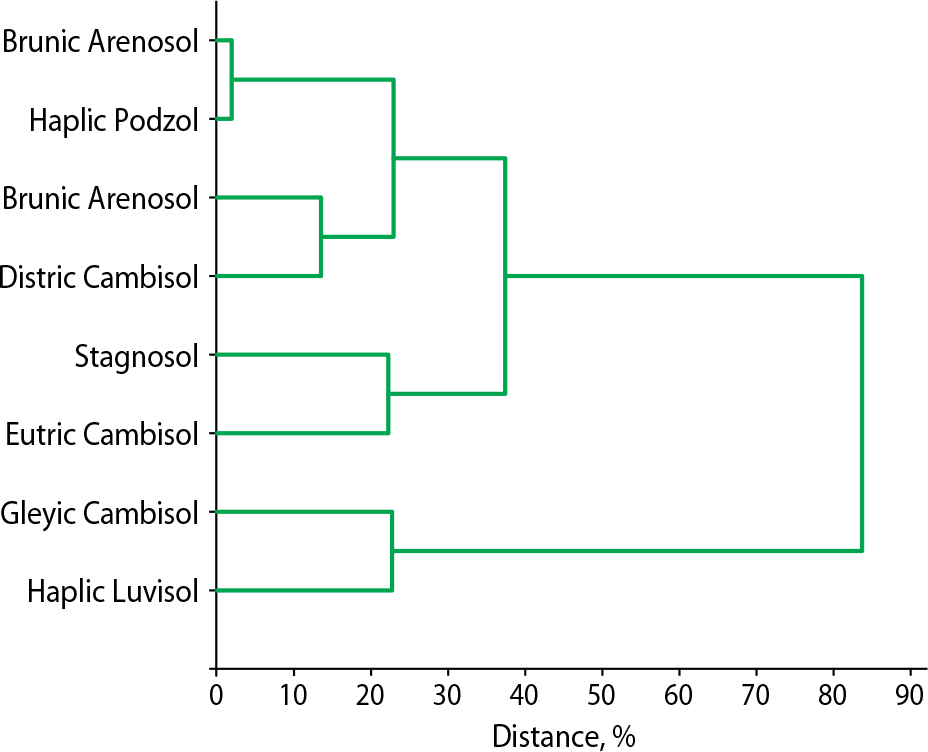
Figure 4.
Dendrogram of selected physicochemical parameters in different soil types in central and northern Poland (2017)
Discussion
Selected chemical parameters of forest soils in central and northern Poland were assessed in 2007 and 2017. The forest districts were located on different soils and forest sites, which affected their physical and chemical properties and the relationship between selected chemical indicators (Fig. 3A–F).
It was found that soil acidity, TOC, TN and C : N ratio did not change significantly after a decade, while the other parameters related to soil cation richness, that is, SBC, CEC, BS and aluminium toxicity indices (SBC : Al and Ca : Al), were subject to changes depending on the location of the studied forest districts.
The study hypothesised that high acidification and low organic carbon content could be the cause of soil chemical degradation and the deterioration of living conditions for forest ecosystems.
Soil acidity is one of the most important indicators of soil health, as it influences the development of soil microflora and the availability of nutrients for vegetation and determines soil-forming processes (Bednarek 1991; Christ and David 1996; Badora 2002; Yano et al. 2002; Wang et al. 2006). The reaction values in the forest soils of central and northern Poland ranged from extremely acidic (pHCaCl2 2.75) under Pinus sylvestris L. conifer stands in the Krucz Forest District to strongly acidic in the Gdańsk, Łąck and Strzałowo Forest Districts (pHCaCl2 4.50–4.60) under Fagus sylvatica L, Quercus L. and Pinus sylvestris L., The obtained pH values are confirmed in the works of many authors (Brożek and Zwydak 2010; Gruba 2009; Janowska 2001; Jonczak 2012, 2015; Degórski et al 2013; Jonczak et al. 2013). Some studies (Augusto et al. 1998; Błońska et al. 2016) indicate that coniferous species have a stronger acidifying effect than deciduous species. Augusto et al. (2002) ranked tree species according to their effect on soil acidification: lime, ash, hornbeam and maple ≤ birch, oak, beech ≤ conifers. The results obtained in the study show the acidifying effect of Pinus sylvestris L. stands on forest soils, which was also confirmed in the work of Schulze (2000).
The acidified state of the soils is due to the properties of the sedimentary rocks deposited by the Scandinavian glaciers (Filipek 2001). The observed lack of pH differences in the study area between 2007 and 2017 could be an indication of the stability of the physical properties of the studied forest soils (Kabala et al. 2021) and the lack of impact of anthropogenic activities on the soils.
The pH of the investigated forest soils influenced the content of selected chemical parameters in the soils. The correlations between the 2007 and 2017 results show that the increase in soil acidity is accompanied by a decrease in TOC (r = –609***), TN (r = –0.599***) and CEC (r = –0.424**) content. On the other hand, an increase in pH was positively influenced by the percentage increase in BS base saturation of the sorption complex in the soil, as evidenced by the addition of the values of the non-parametric Spearman coefficient (r = –0.602***). In addition, the reduction in soil acidity had a positive effect on the risk of aluminium toxicity, as evidenced by the positive values of the correlation coefficients between pH and the content of SBC : Al (r = 0.570***) and Ca : Al (r = 0.506***).
Studies by Borowiec (2005) and Uziak et al. (2005) confirm the existence of a relationship between the sorption capacity of the soil and the organic matter content. Soils with a higher sorption capacity (CEC) tend to have a higher content of organic matter, clay and clay fractions (McCauley et al. 2009). The results obtained agree with those of numerous researchers (Chojnicki et al. 2010; Jonczak and Parzych 2015; Jonczak et al. 2022; Isa et al. 2023). The fractions of the granulometric composition of the soil influence various parameters of the investigated forest soils. It was found that the content of the sand fraction reduced the accumulation in the soil: TOC (r = –0.333*), nitrogen (r = –0.396*) and SBC (r = –0.702***). It was shown that soils rich in fine fractions (clay and silt) have a greater capacity to retain alkaline cations. This trend is illustrated by the positive values of the non-parametric Spearman correlation coefficients for SBC (silt: r = 0.523***; clay: r = 0.727***).
Soil organic carbon content is an important qualitative parameter that determines the content of forest soils in the basic cations required for forest ecosystems. The study showed that the top litter layer (114.3–353.73 g TOC kg-1) contained significantly more organic carbon than the mineral layer (<25.0 g TOC kg-1). The stratified distribution of TOC and TN is due to the fact that both components are supplied to the soil mainly with the precipitation of the assimilation apparatus (Kuznicki et al. 1978; Jankowska 2001; Błońska and Januszek 2010; Brożek and Zwydak 2010; Osman 2013). The differences between the TOC and TN content on the plots in the Strzałowo and Krotoszyn Forest Districts are due to the different habitat conditions and species of the predominant stand. The indicated trend is confirmed by studies of Dziadowiec et al. (2007), Jonczak (2011, 2013), Woś et al. (2022) and Hu et al. (2024). Pinus sylvestris L. dominated in the Strzałowo Forest District, while Quercus L. was found in the Krotoszyn Forest District.
The C : N ratio is considered one of the most important indicators of the biological activity of soils and the quality of the forest habitat (Wawrzoniak et al. 2004; Brożek and Zwydak, 2010). The C : N value in the organic soil layer was higher under coniferous stands than under deciduous stands in almost all forest districts, with the exception of the Suwałki Forest District. The indicated trend is most likely due to the content of wood and cones in the plant exudates (Jonczak 2011). The C : N values determined in this study were typical for Polish soils (Dziadowiec 1990; GetinoÁlvarez et al. 2023). The lack of differences in the C : N ratio between 2007 and 2017 can be explained by the too short observation period (Berg and Matzner 1997; Chao et al. 2023) and the low anthropogenic load (Sien-kiewicz et al. 2018). Positive Spearman rank correlation coefficients were found between C : N and soil TOC (r = 0.416**) and TN (r = 0.316*) and negative ones with pH (r = –0.620***) and SBC (r = –0.455***) and CEC (r = –0.608***). The observed trends could indicate that soil acidification is associated with a slowdown in the decomposition of plant residues (increase in the C : N ratio) and thus with a decrease in the saturation of the sorption complex with nutrients important for forest ecosystems.
The sum of base cations (SBC) and the sorption capacity (CEC) are among the key properties of soils, as they have a significant influence on the functioning of terrestrial ecosystems. The results obtained in this work for SBC and CEC show a large variation depending on soil depth, which is also confirmed by the studies of other authors (Kuznicki et al. 1974; Janowska 2001; Hendershot et al. 2008; Chojnicki et al. 2010; Jonczak 2015). According to the studies by Glinski (1985) and Olszowska (2018), the abundance of SBC and CEC in the soil is significantly influenced by the type of vegetation on a given area.
The degree of saturation of the sorption complex with bases (BS) in the organic layer was 37.87–93.30% in 2007, and in 2017, the lower range increased to 62.60–88.59%. In contrast, mineral soils had lower values of 10.67–84.18% (2007) and 12.08–63.29% (2017), respectively. Similar ranges of this indicator in forest soils were also shown by other authors (Kuznicki et al. 1974; Blaszczyk 1998; Konecka-Betley et al. 1999; Brożek and Zwydak 2010; Wanic and Błońska 2011). An increase in the proportion of BS in organic horizons may indicate improved soil properties, that is, water retention, better nutrient availability and less damage (Roussos et al. 2017; Paradelo et al. 2024). According to studies by Bennett et al. (2021) and Pérez-Harguindeguy et al. (2013), increasing BS values in mineral horizons may be due to agroecological practices, and a decrease in this parameter below 50% may indicate soil degradation.
The ratio of SBC : Al and Ca : Al in forest soils is an important chemical indicator of the potential toxicity of aluminium ions to forest ecosystems. It is assumed that a value of both ratios below <1.0 may indicate the toxicity of this element in the environment. The study shows that the value of this ratio is significantly higher than the limit value for the organic soil layer. A positive Spearman rank coefficient was found between the TOC content and the SBC : Al ratio (r = 0.618***). This relationship shows the important role of organic matter in protecting forest ecosystems from the toxic effects of aluminium. The described trend is also confirmed by the studies of other authors (Brümmer and Hermus 1983; Neagoe et al. 2012; Stefanowicz et al. 2020). The large values of the ratios of SBC : Al and Ca : Al in the organic layers indicate that they are dominated by basic cations. Similar results were obtained by Kopáček et al. (2001). On the other hand, a significant decrease in SBC : Al values was found in the soils of the Strzelowo Forest District, which could indicate changes in the mineralogical composition of forest soils. If the downward trend of these indices continues in the long term, this could lead to increased aluminium toxicity in the soil and poor health of the forest stands. This risk was present in most of the soils examined and remained at a similar level after a decade 2007 and 2017 (Tab. 5).
Table 5.
Valuation of critical acid deposition loads of SBC : Al (A) and Ca : Al (B) of forest soils of centralnorthern Poland in 2007–2017
| A | |||
|---|---|---|---|
| Risk assessment | SBC : Al | Percentage of samples (%) | |
| 2007 | 2017 | ||
| Very High | <0.40 | 50.0 | 50.00 |
| High | 0.40–0.80 | 14.58 | 12.50 |
| Medium | 0.81–2.00 | 8.33 | 4.17 |
| Low | >2.01 | 27.09 | 33.33 |
| B | |||
|---|---|---|---|
| Risk assessment | Ca : Al | Percentage of samples (%) | |
| 2007 | 2017 | ||
| Very high | <0.20 | 45.83 | 47.90 |
| High | 0.21–0.50 | 14.60 | 10.40 |
| Medium | 0.51–1.00 | 6.24 | 10.45 |
| Low | 25.00 | 28.45 | |
1 Soil type (WRB): BRt – Eutric Cambisol, RDb – Brunic Arenosol (Protospodic), BRKt – Dystric Cambisol, OGw – Stagnosol, B – Haplic Podzol, RDbr – Brunic Arenosol, Pbr – Haplic Luvisol, BRg – Gleyic Cambisol; Parent material origin: Qp – glacial sand, QZp – fluvioglacial sand (sandr), Qg – glacial till, QEp/QZp – aeolian sand over fluvioglacial sand (sandr), QFp – fluvioglacial sand; Dominant tree species: So – Scots pine, Bk – European beech, Db – Oak, Św – Norway spruce]; Forest Site Types (TSL): MFCF – mixed fresh coniferous forest; FF – fresh forest; MFF – mixed forest fresh; FCF – fresh coniferous forest
To reduce the risk of forest soil degradation due to the loss of basic cations and the increase in the proportion of acidic cations in the soil sorption complex, as well as the increase in toxic aluminium in the area under study, regular forest soil testing should be carried out.
Conclusions
The forest soils in central and northern Poland were characterised by a highly acidic pHCaCl2 value of 2.75–4.60, with the lowest value measured under Pinus sylvestris L. stands in the Krucz forest area. The influence of soil pH on some properties of forest soils was demonstrated, which was confirmed by negative correlation coefficients between pH and TOC (r = –609***), TN (r = –0.599***) and CEC (r = –0.424**). Positive correlations were also found between pH and parameters such as SBC : Al (r = 0.570***), Ca : Al (r = 0.506***) and BS (r = 0.602***). The positive Spearman rank coefficient between TOC content and the SBC : Al ratio (r = 0.618***) may indicate the important role of organic matter in protecting forest ecosystems from the toxic effects of aluminium on forest habitats and stands. To maintain appropriate soil chemical indicators, soil organic matter should be monitored at least once per decade.
Acknowledgements
This paper was financed by the Ministry of Environment Protection, Natural Resources, Forestry, Chief Inspectorate for Environmental Protection and State Forests (Poland) and a granted Scholarship Fund of the Forest Research Institute in Sękocin Stary, Poland, to Krzysztof Sztabkowski (based on an Agreement concluded on 31 July 2023 and annex on 22 July 2024).
Special thanks to the entire team at the Center for International Forestry Research and World Agroforestry (CIFOR-ICRAF) in Vietnam for the opportunity to complete a research internship financed by the Forest Research Institute’s scholarship fund (based on an Agreement concluded on 31 July 2023).