
Introduction
The contemporary labor market increasingly places demands on university graduates that extend beyond the scope of their formal study programs. Employers often expect practical skills, experience, and interpersonal competencies that are not fully developed within traditional academic curricula (Żeber-Dzikowska et al. 2014). In this context, students’ organizations – particularly scientific associations – play a significant role by providing opportunities to expand knowledge, develop practical skills, and foster personal growth (Kurzyk 2015; Śnieżek 2017; Obidziński 2020).
In modern teaching methodology, growing emphasis is placed on the need for education through action – learning by doing (Dewey 1938) – recognized as one of the most effective methods of learning (Żylińska 2019). Experiential learning, especially through direct involvement in research projects, community initiatives, or organizational activities, enables students not only to acquire knowledge but also to analyze problems, engage in critical reflection, make informed decisions, and develop a sense of responsibility (Kolb 1984). As Dewey (1938) mentions, education reaches its fullest potential when learners have opportunities to act in real-world contexts and critically evaluate the outcomes of their actions. From this perspective, students’ scientific associations provide a unique educational environment that integrates formal academic learning with the acquisition of practical and social experience (Śnieżek 2017; Szaban 2019; Obidziński 2020).
Students’ scientific associations are voluntary organizations operating within universities, primarily aimed at deepening specialized knowledge, developing research skills, and promoting both scientific and social engagement among students (Czapiewska 2021; Olszewski 2022). Their activities usually include conducting research projects; organizing scientific events, workshops, and conferences; and collaborating with external stakeholders such as public institutions or private enterprises (Korpetta et al. 2017). Participation in students’ scientific associations not only broadens theoretical knowledge and facilitates its practical application but also enhances so-called soft skills, including teamwork, public presentation of research findings, and project management (Bęczkowska 2019; Kwiatkowska 2023). The experience and competencies gained, along with the networks established, can significantly improve students’ prospects of employment in their chosen field and facilitate the start of a career, for example, in science or starting own business (Olszewski 2022). Many employers now also recognize extracurricular achievements as indicators of a candidate’s activity and professional potential.
Within the field of forestry education, the close integration of learning with field-based practice creates particularly favorable conditions for leveraging the potential of students’ scientific associations. Engagement in research projects, field measurements, volunteer work, and educational or outreach activities enables students to gain experience that goes beyond the framework of standard coursework (Obidziński 2018, 2020; Różański et al. 2018; Szaban 2019).
The Forestry Students’ Scientific Association (FSSA) at the Warsaw University of Life Sciences (WULS) serves as a good example of a dynamic academic organization in the field of natural and technical sciences. It brings together students organized into several specialized sections that carry out research, educational, and outreach projects in collaboration with the university, the State Forests National Forest Holding, national parks, and various other institutions. Participation in FSSA activities allows students to develop research, organizational, and communication skills, as well as interdisciplinary collaboration competencies. Engagement in scientific expeditions, field projects, and conferences prepares them to navigate a complex and evolving professional environment (Klimaszewski 2020; Tomusiak 2020).
However, while emphasizing the educational value of students’ scientific associations, most of the publications cited above are based primarily on general observations and reflections rather than empirical data with statistical analysis. Although Korpetta et al. (2017) employed surveys in their study, the questions focused only on the nature of the association activities and its members’ preferences. Similarly, Olender-Jermacz (2024) investigated the influence of such an association on students’ attitudes but without applying causal explanations or statistical analyses of the findings.
In light of these gaps, the present study aims to empirically assess the impact of participation in students’ scientific associations on the development of students’ theoretical knowledge, practical skills, social competencies, and career trajectories. An equally important objective is to examine how such engagement influences personal growth, particularly in areas such as self-awareness, motivation for self-improvement, time management, self-confidence, and teamwork abilities. Although these elements are challenging to assess, they constitute an essential component of both professional and general development.
The analysis was carried out on an example of the Forestry Students’ Scientific Association at the Warsaw University of Life Sciences. To achieve this, the following research questions were formulated: (1) What professional and personal competencies are developed through participation in FSSA, and to what extent? (2) Which forms of FSSA activity most effectively contribute to the development of these competencies? (3) How does involvement in FSSA influence students career development? (4) How does the level of engagement in FSSA activities affect the overall professional and personal growth of its members?
Material and methods
Characteristics of the Forestry Students’ Scientific Association at WULS
The Forestry Students’ Scientific Association (Koło Naukowe Leśników) at the Warsaw University of Life Sciences (Szkoła Główna Gospodarstwa Wiejskiego) is among the oldest students’ scientific organizations in Poland, with a history spanning more than 100 years. Its origins are closely linked to the establishment of the Royal-Polish Main School of Rural Economy on October 17, 1918, which was renamed the Warsaw University of Life Sciences in 1919. Although the founding meeting of the Association took place on the very day of the university’s establishment (October 17, 1918), it did not commence its activities immediately due to the mass conscription of students into the army starting on November 11 of that year. The organization, initially known as the Forestry Association (Koło Leśników), was officially founded on November 21, 1919, when its statute was approved and regular activities began (Anonim 1923; J.K. 1930; Niedziałkowski 1930).
The objectives of FSSA have remained essentially unchanged since its inception. From the beginning, they included: organizing and representing students of the Faculty of Forestry, providing supplementary education, offering academic and professional mutual support, and organizing social life within the students community (Anonim 1923). Today, the Association’s activities focus primarily on conducting scientific research (Klimaszewski 2020; Tomusiak 2020).
FSSA pursues its objectives through a variety of initiatives. A key form of activity involves field-based scientific research, conducted during research expeditions or shorter field trips, primarily within Poland but also abroad. Members of the Association prepare scientific reports and presentations, participate in conferences and symposia, and engage in educational and outreach activities (Obidziński 2020; Tomusiak 2020; Grzywacz and Szczepkowski 2023; Karbownik-Jasion and Grzębkowski 2024).
Over the years, FSSA has grown to become one of the largest students’ organizations at WULS. At its peak, around 2020, it had more than 150 members. Currently, due to an overall decline in student numbers at the Faculty and the University, it has about 100 active members. These students are organized into 11 thematic sections: Forest Botany, Forest Biometry, Entomology, Forest Phytopathology, Geomatics, Silviculture, Game Management, Ornithology, Theriology, Forest Management Planning, and Forest Utilization.
The Association also affiliates youth sections of some professional organizations: the Association of Forest Engineers and Technicians (Stowarzyszenie Inżynierów i Techników Leśnictwa i Drzewnictwa, SiTLiD), the Polish Forestry Society (Polskie Towarzystwo Leśne, PTL), and the International Forestry Students’ Association (IFSA). Historically, other sections have operated periodically within FSSA, including: Education and Social Communication, Educational Exchange, Forest Economics, Forest Productivity, Forest Tourism, History and Military Training of Foresters, and the Hunting Signallers Team Akteon. Since the post-war period, at least 1,000 students have participated in the activities of FSSA. Currently, more than 20 scientific employees from the Faculty of Forestry at WULS supervise the work of the sections, with many others providing expert consultations.
Research tool
Empirical data were collected using an anonymous online survey hosted on the Microsoft Forms platform. The questionnaire consisted of 28 questions grouped into five thematic categories: (1) personal characteristics of respondents, (2) scope of respondents’ involvement in FSSA activities, (3) competencies developed as a result of participation in FSSA, (4) impact of participation in FSSA on professional careers, and (5) reflections and emotions associated with past activities in FSSA.
For this paper, the last category was omitted in the analysis. The questionnaire included both closed-ended questions (single- and multiple-choice) and open-ended questions, allowing respondents to provide unrestricted comments. The survey was available online for three months, from April 15 to July 15, 2025. Information about the study and the survey link were distributed among current and former FSSA members via social media platforms (Facebook, Instagram), as well as through email, phone calls, and direct personal contacts.
Data analysis
Of the 344 surveys collected, 263 were deemed valid and included in the analysis. Excluded surveys included those in which respondents: (a) declared that they were neither current nor former members of FSSA (34 surveys), (b) were current students with no professional experience (39 surveys), (c) had only participated in non-research sections such as SiTLiD, IFSA, or PTL (5 surveys), and (d) provided internally contradictory or nonsensical responses (2 surveys).
The collected data were compiled and preliminarily organized in a Microsoft Excel spreadsheet. The choice of statistical tests was guided by the characteristics of the data, particularly the absence of normal distribution among the studied variables. A chi-squared test was applied to determine the statistical significance of differences in the frequency of particular response choices. The Mann–Whitney U test was used to assess differences in self-reported development of knowledge, competencies, and career trajectories based on respondents’ level of engagement in FSSA activities. Calculations were performed using Microsoft Excel, PAST software (Hammer et al. 2001), and Python 3.10 (Python Software Foundation 2021) in a Jupyter Notebook environment (Kluyver et al. 2016).
Results
Respondents’ characteristics
The survey was completed by 105 women and 155 men, while 3 respondents did not specify their gender. In terms of age distribution, 31 respondents were under 25 years old, 148 were between 26 and 40, 63 were between 41 and 65, and 21 were over 65. Regarding education level, 3 respondents reported having completed secondary education, 45 had a first-cycle degree (engineering or bachelor’s), and 163 held a master’s degree. Another 42 respondents reported earning a PhD, while 10 had achieved habilitation or professorship. A total of 208 respondents declared that their work was forestry-related, 29 worked in non-forestry sectors, and 26 did not answer this question. Among those who specified their occupation: 111 identified themselves as practicing foresters (not exclusively within the The State Forests Company), 60 as researchers, 36 as employees of nature or environmental protection institutions, 26 as employees in educational institutions, 17 as employees in forest management planning offices or surveying companies, 17 as employees in institutions or organizations unrelated to natural resource management, and 5 as self-employed, but without specifying the nature of their business. Among the respondents, 243 identified as former members of FSSA and 20 as current members. Participation over time was distributed as follows: up to 1970, 6 respondents; 1971–1990, 38 respondents; 1991–2010, 80 respondents; after 2011, 123 respondents; and 16 did not specify a timeframe. The level of involvement was reported as high by 126 respondents, moderate by 120, and low by 17. Participation in the number of sections was as follows: one section, 178 respondents; two sections, 52 respondents; three sections, 25 respondents; and four or more sections, 8 respondents. Each section was indicated by the following number of times: Forest Botany, 106; Ornithology, 74; Entomology, 67; Forest Utilization, 30; Game Management, 24; Theriology, 19; Biometry, 18; Silviculture, 17; Forest Phytopathology, 15; and Forest Management Planning, 15. Other sections were mentioned a total of 11 times.
Impact on knowledge and competence development
According to respondents, participation in FSSA contributed to developing numerous competencies. On average, 4.5 competencies were listed per survey. The most frequently indicated were fieldwork skills (86%), teamwork (78%), specialized forestry knowledge (66%), public presentation of research results (62%), and project and event organization (52%). The least frequently cited were collaboration with external partners (20%) and fundraising skills (19%). Four respondents (2%) declared no impact of FSSA activities on their competence development (Fig. 1A).
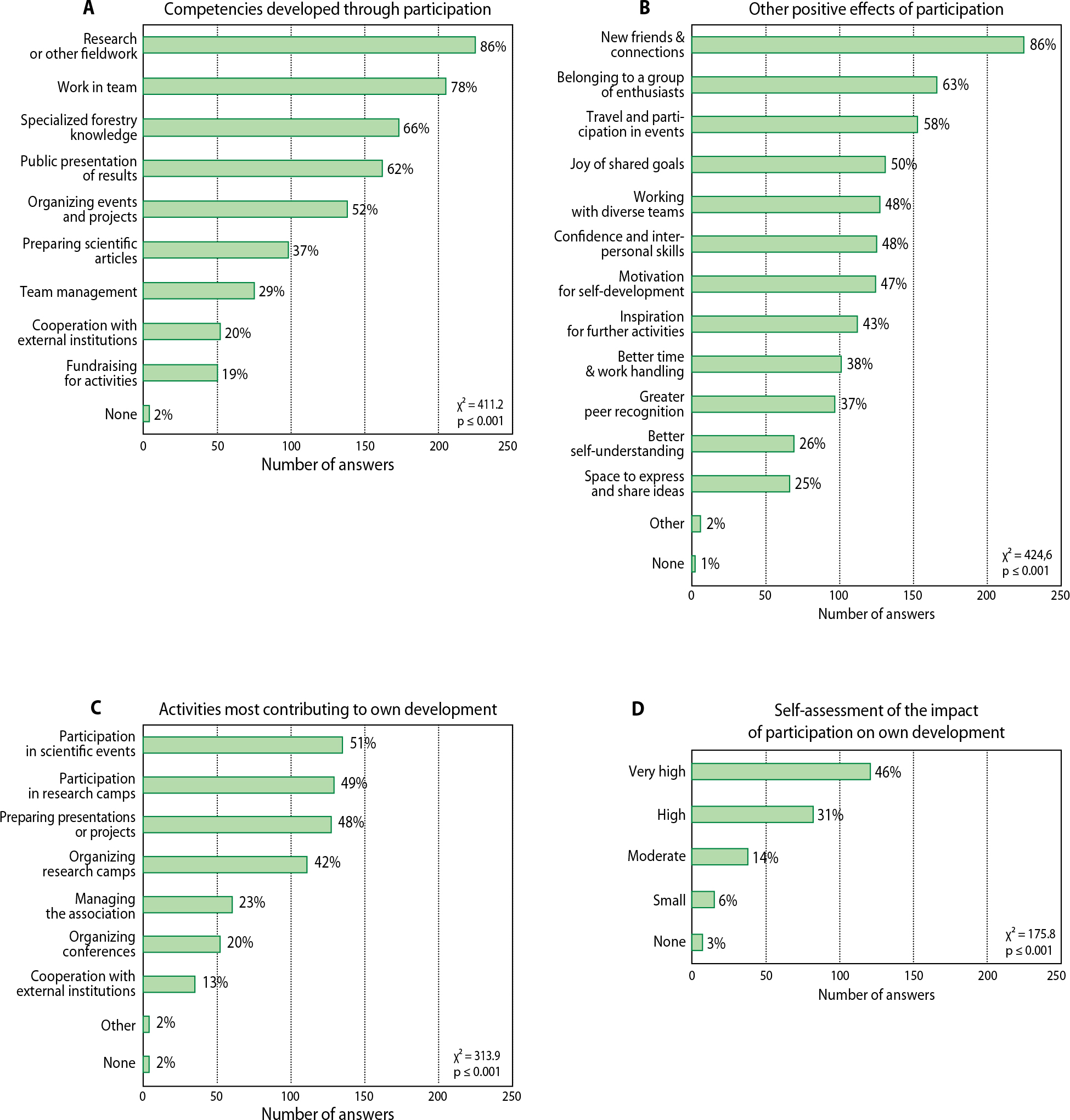
Figure 1.
The impact of participation in Forestry Students’ Scientific Association at Warsaw University of Life Sciences on the development of knowledge and competencies among its members
Respondents listed an average of 5.7 categories per survey regarding personal growth and intangible benefits. The most common were new acquaintances and friendships (86%), a sense of belonging to a community of enthusiasts (63%), opportunities for travel and participation in industry events (58%), and satisfaction from working toward a shared goal (50%). The least frequent were better understanding of own predispositions (26%) and self-expression and idea sharing (25%). Two respondents (1%) reported no positive personal effects from the participation (Fig. 1B).
The most stimulating activities for personal development were identified as participation in conferences and workshops (51%), participation in research expeditions (49%), and preparation of reports or research projects (48%). The least influential were considered: collaboration with forestry industry institutions and companies (13%) and organization of conferences and scientific seminars (20%). Four respondents (2%) stated that none of the activities contributed to their development (Fig. 1C).
The overall perceived impact of FSSA on personal and professional development was rated as very high, 46%; high, 31%; moderate, 14%; low, 6%; and no impact, 3% (Fig. 1D).
All response distribution differences across the four question groups were statistically significant at p ≤ 0.001.
Impact on career choice and development
The influence of their activities at FSSA on their choice of career path was indicated by 24% of respondents; partial influence was indicated by 41%, and no influence was indicated by 25% of respondents (Fig. 2A).
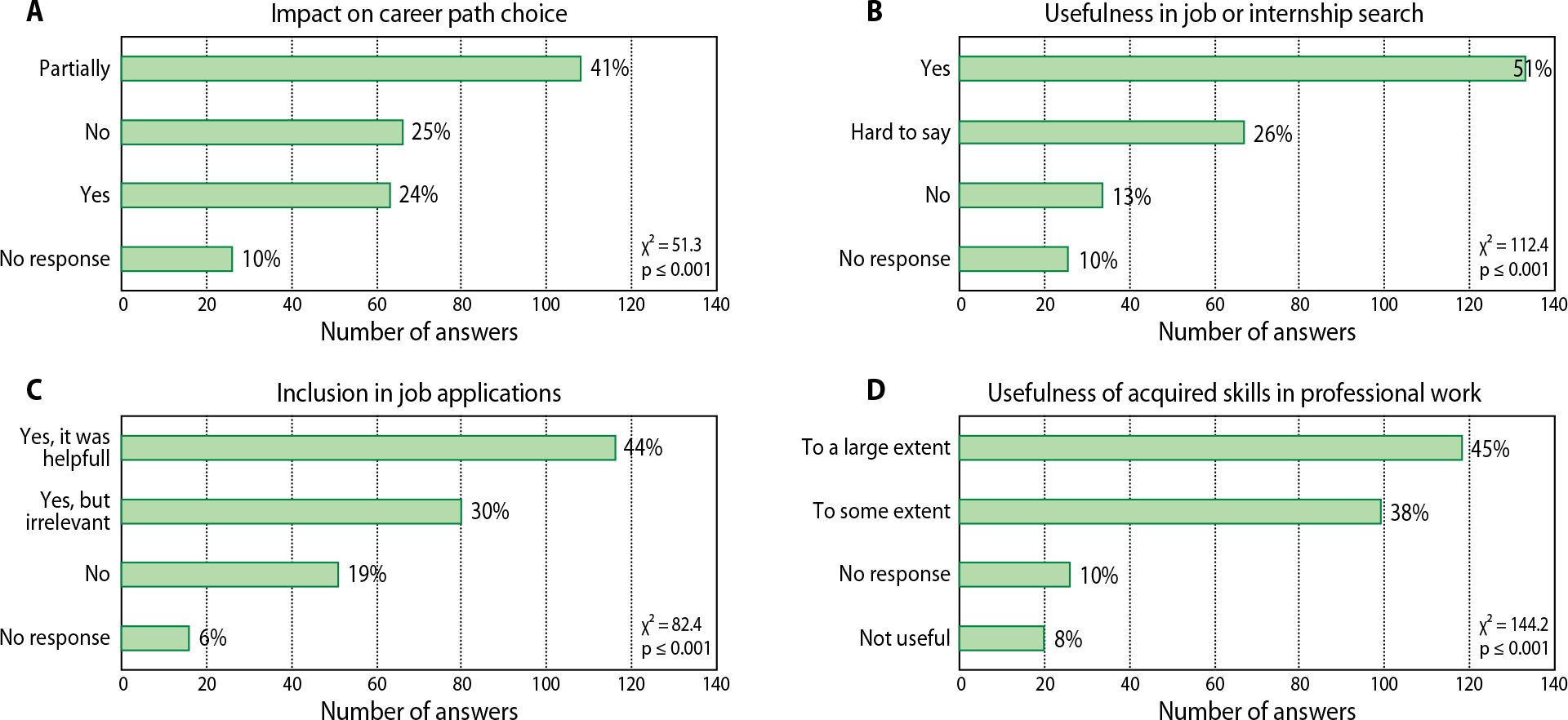
Figure 2.
The impact of participation in Forestry Students’ Scientific Association at Warsaw University of Life Sciences on career choice and development
More than half of respondents (51%) stated that the FSSA experience helped them to find a job or internship. More than a quarter of respondents (26%) were uncertain and 13% considered it not useful (Fig. 2B).
When applying for jobs, 74.5% of respondents included information about their FSSA activities, including 44.1% stated it was perceived as an asset during recruitment and 19.4% did not mention it (Fig. 2C).
Skills acquired through FSSA were considered valid for professional work by 82.5% of respondents, with 44.9% indicating that they were highly useful and 7.6% considering these skills as not useful (Fig. 2D).
All the differences in response distribution were statistically significant at p ≤ 0.001.
Knowledge, competence, and career development by engagement level
The degree of involvement in FSSA activities found a directly proportional expression in the declared number of competences acquired by participants (Fig. 3A), the number of additional positive effects resulting from participation in FSSA activities (Fig. 3B), the perceived degree of influence of this activity on the professional development of respondents (Fig. 3C), the degree of influence on the choice of career path (Fig. 3D), the degree of impact on obtaining a job or internship (Fig. 3E), and the degree of usefulness in professional work of the skills acquired in FSSA (Fig. 3F).
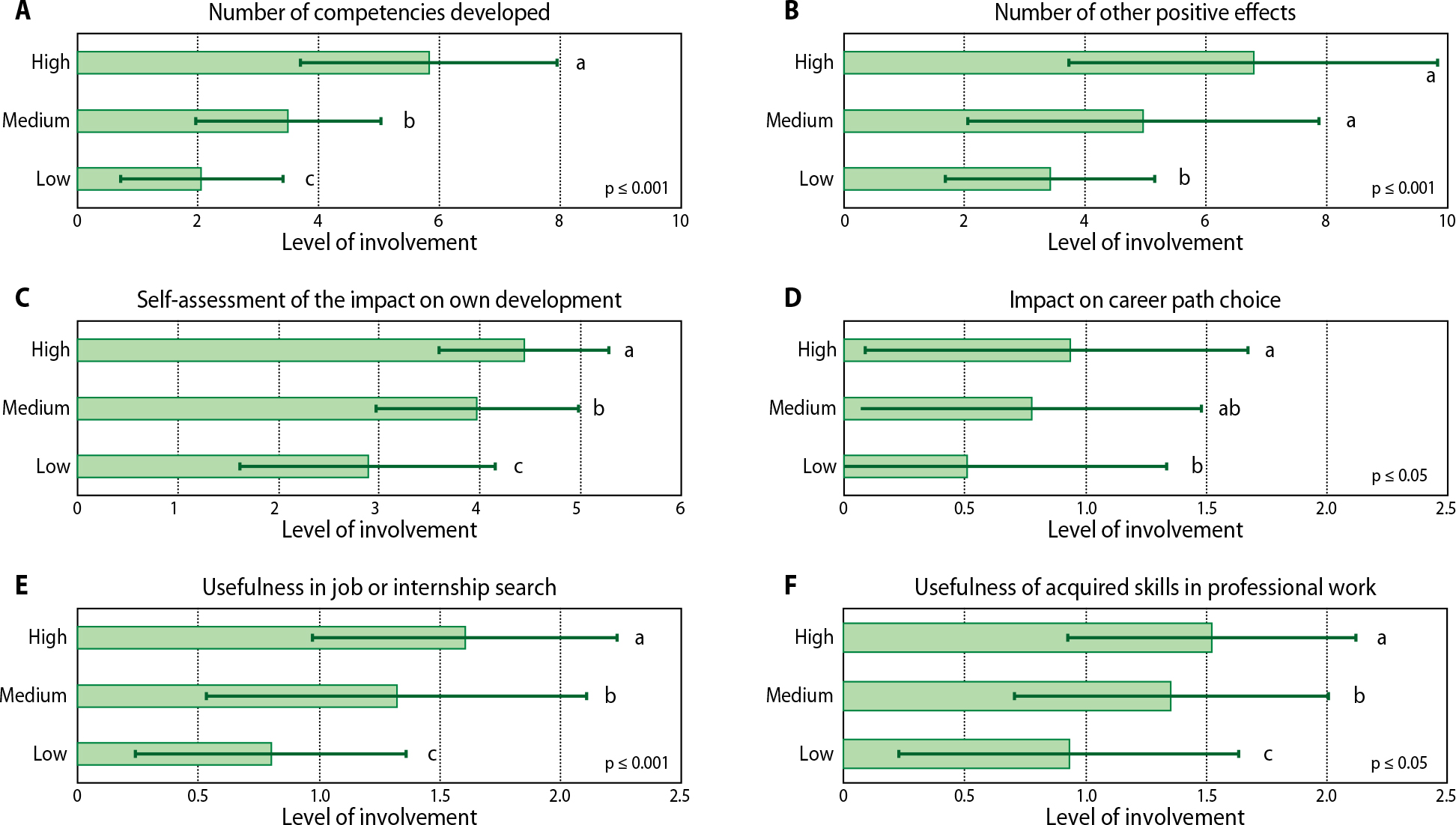
Figure 3.
The impact of the level of involvement in activities of Forestry Students’ Scientific Association at Warsaw University of Life Sciences on knowledge, competencies, and career development. The graphs show means +/- SD and the lowercase letters indicate differences at the given significance level
Discussion
Representativeness of results
The obtained results may be influenced by the fact that the survey mainly reached people maintaining social or professional contact – directly or online – within forestry or environmental fields. Underrepresented groups may include those who pursued entirely different career paths or retired former members. In particular, individuals who graduated before 1970 were likely underrepresented due to a lack of digital communication and natural demographic factors.
With 263 valid surveys and an estimated population of 1,000 former and current members, the data are representative at a confidence level of 0.94 (p ≤ 0.06). The representativeness of the obtained results is also enhanced by the fact that their distribution is approximately proportional to the number of members of the individual sections and to the number of members of the association in the subsequent decades of its activity.
It is also worth noting that during survey distribution, the authors exhausted all known to them methods of reaching potential respondents, including several dozen social media advertisements, dozens of mass mailings, and dozens of telephone and face-to-face conversations. This is also reflected in the asymptotic shape of the curve representing the cumulative number of incoming surveys.
General interpretation of findings
The results of the research indicate that the activities of the Forestry Students’ Scientific Association catalyze the multifaceted professional and personal development of students. The relationships between the various areas of competence development for FSSA members can be summarized as follows: the foundation of the activities is the acquisition of specialist knowledge and hard skills, such as field measurement techniques and computational or editorial skills. These activities also foster soft skills, such as teamwork, public speaking, time management, and organizing research or conferences. The following aspect of these activities is participants’ personal and social development, which includes self-awareness, responsibility, self-esteem, motivation, and building relationships with others. The tangible result of these three aspects of competence development is multidimensional professional and personal development, increasing employability, and a potential successful career.
Students who engage deeply and consistently with FSSA derive the most significant benefits. Moreover, the relationships formed within FSSA based on shared responsible work often extend beyond graduation, fostering collaboration in professional organizations, NGOs, and informal interest groups, often formed by the former students, thus contributing to civil society building.
The findings strongly support Dewey’s (1938) learning by doing concept, according to which active participation in real-life conditions (field, project, science camp), followed by data processing and interpretation of results (research report, paper, thesis, scientific publication), better prepares students for professional challenges than traditional teaching methods. Thus, through the diversity of issues, research methods, and research objects, the Forestry Students’ Scientific Association creates an educational environment in which theory meets practice, and the knowledge acquired stems from real needs. All this means that working at FSSA, and most probably also in other such associations, releases the potential in young people that is dormant and often even suppressed at earlier stages of education.
Practical applications
The study provides evidence to support the development and promotion of students’ scientific organizations by both universities and external institutions. For this to happen, it is worth disseminating knowledge about their positive impact on students education, seeking financing for their activities and organizational support, strengthening cooperation with external institutions, adapting the topics of undertaken projects and research to the societal and economic needs, and encouraging other university employees to undertake such mentorship.
The educational model implemented in students’ scientific associations is worth popularizing as a good example for education, not just academic. Its forms of operation embody the user-friendly teaching methods advocated for decades by critics and reformers of the traditional Herbartian methodology, such as John Dewey, Maria Montessori, Janusz Korczak, Celestyn Freinet, John T. Gatto, Deborah Meier, Vicky Colbert, and more recently, Gerald Hüther or Marzena Żylińska. The new educational solutions they implement prioritize learner motivation, voluntary participation, a sense of security and trust, cooperation, shared responsibility, and instead of grading, they set ambitious goals with real meaning. These assumptions, as experts unanimously note, are being implemented in students’ research associations.
Furthermore, it is worth noting that both sides of the teaching process increasingly perceive university courses as merely a formal obligation. Against this backdrop, students’ research associations serve as an example of an authentic, engaged form of education. A positive, albeit small, step toward popularizing such solutions is the introduction of mentoring programs at universities, which, to some extent, emulate the model of students’ research organizations.
Potential Directions for Further Research
The obtained results encourage further research into the effects student’s scientific associations’ activities, encompassing various aspects of their operation and impact.
First, it seems worth examining the contribution of FSSA graduates to the development of the forestry and nature conservation industries, and, more broadly, the contribution of graduates of other research associations to the development of the economic sectors with which they are associated. Another valuable research direction would be to analyze the areas and scale of alumni’s social involvement in activities not directly related to their industry.
Another important issue seems to be comparing, on a single scale, the importance of the benefits gained by FSSA graduates from their association in terms of (a) knowledge, (b) hard skills, (c) soft skills, and (d) personal development. It would also be interesting to compare the growth of student competencies during their studies between groups that did and did not participate in students’ research associations.
It would also be worthwhile to conduct comparative analyses between students’ research groups in other fields of study and at other universities. It would also be interesting to examine how the activities of students’ research groups have evolved over decades and how their effects have changed.
In order to improve research methodology, it would be advisable to (a) use more measurable indicators of professional success, for example, positions held or degrees obtained; (b) more precisely determine the degree of involvement in the association's activities, for example, based on the number of expeditions attended, papers presented, awards won, or projects completed; (c) calculate the correlation between these new measures of involvement and indicators of professional success; and (d) reach the oldest graduates with the survey to obtain a more comprehensive historical perspective.
Conclusions
The results obtained allow us to conclude that student involvement in the Forestry Students’ Scientific Association at the Warsaw University of Life Sciences exerts a significant, multidimensional influence on their development. Participation in the Association promotes not only the acquisition of specialized knowledge but also competencies, the development of which goes beyond the framework of the formal study program. The results also indicate a positive correlation between the level of involvement in the activities and the educational benefits achieved in professional, personal, and social terms. The most important conclusions from the study include the following:
The Forestry Students’ Scientific Association provides a unique space for acquiring specialized knowledge and practical skills, essential in forestry or nature conservation related professions.
Activities in the Association foster the improvement of soft skills, including interpersonal communication, public speaking, and time and team management.
Participation in FSSA enhances personality development, including self-awareness, confidence, motivation, and building deep peer relationships.
Experience gained in FSSA positively affects career decisions and job or internship search outcomes.
Higher involvement in FSSA activities implies larger competence acquisition and their greater usefulness in professional careers.
The Forestry Students’ Scientific Association embodies the concept of learning by doing, offering more effective than traditional learning, better preparing students for a dynamically changing reality.
Given the crisis of Herbartian teaching methodology, the methods developed in students’ scientific associations can serve as a model for reform not only in higher education.
Acknowledgements
The authors convey their thanks to the current and former supervisors of the Forestry Students’ Scientific Association at Warsaw University of Life Sciences for their contribution to the development of this organisation. They also thank the respondents and everyone who helped disseminate the survey, as well as Dr. Katarzyna Marciszewska and an anonymous reviewer for their valuable comments on the first version of the manuscript.