
Introduction
Climate change is expected to lead to a reduction in natural rainfall and an uneven distribution of rainfall. The ability of plants to manage the water regime will be the criterion for their selection for landscaping and urban forestry. It is, therefore, important to focus on research into species that are able to survive and grow under conditions of different types of environmental stress, especially stress caused by lack of water. Changes in growth, content of assimilatory pigments and other physiological indicators are known as plants’ reactions to water shortage.
Chlorophyll content in leaves and its changes are not considered to be a direct marker of stress but may indicate a significant dysfunction in nutritional deficiency caused by lack of water. In many cases, a significant decrease in the chlorophyll content due to drought has been observed.
According to Ashraf and Harris (2013), the decrease in the chlorophyll content is a commonly observed phenomenon under drought stress, but some different responses of plant species in accumulating the chlorophyll content due to drought are known. Chlorophyll is one of the main chloroplast components for photosynthesis, and the relative chlorophyll content has a positive relationship with the photosynthetic rate. The decrease in chlorophyll content under drought stress is a typical symptom of oxidative stress and may be the result of pigment photooxidation and chlorophyll degradation (Anjum et al. 2011). Previously, chlorophyll content was found to be reduced under conditions of water deficit due to slow synthesis or rapid degradation (Ashraf 2003). Although it is known that chlorophyll a and chlorophyll b are sensitive to soil dehydration (Farooq et al. 2009), the specifics of plant species in adaptive responses to water deficit are so variable that it is impossible to clearly define a general model of changes in chlorophyll content due to water deficit. Where changes in chlorophyll content are reported in response to drought stress, the most reported type of change is in the ratio of chlorophyll a to chlorophyll b or in the ratio of total chlorophyll to carotenoids (Ditmarová 2007).
The chlorophyll content of the leaves influences the growth and visual characteristics of the plant. Changes in nutrient transport conditions alter the amount of nutrients involved in the formation of chlorophyll. Nitrogen is an essential element in the structure of chlorophyll, and its content is directly related to leaf colour (Pagola 2009). Therefore, a plant’s response to water shortage may also be a change in leaf colour and a reduction in the aesthetic functions of the plant.
An important indicator of the water balance of the plant is the relative water content (RWC), which represents the total amount of water required by the plant at full saturation. RWC expresses the percentage of water content at a given time in relation to the water content at full turgor (González et al 2001). In regularly hydrated plants, RWC is usually around 90% (Brestič and Olšovská 2001). Decreases in RWC below speciesspecific levels cause changes in metabolic activities. Reduced metabolic activities cause changes in growth, and leaves become smaller.
In contrast to the leaves, which inhibit growth when the soil is dry, the roots elongate. Current knowledge suggests that root growth is stimulated by the need to increase the absorptive surface, a response which is particularly active under low-water conditions (Kuhns 1985). The products of assimilation are used for growth, respiration and carbon accumulation under conditions of water stress (Hartmann and Trumbore 2016; Schiestel-Aalto et al. 2019; Collalti et al. 2020). The transport of assimilates to the root system results in the formation of compensatory roots. They penetrate the deeper layers of the soil to obtain sufficient water (Masarovičová 2002).
Plant responses to water scarcity are specific and conditioned by species characteristics. The search for species that can survive and grow in conditions of changing water availability is fundamental to landscaping, especially in urban areas. For this reason, research often focuses on tree species that originate from sites where water is scarce. One of the species that we expect to show good tolerance to water scarcity is Ginkgo biloba L. Ginkgo originates from Southeastern Asia and is one of the most phylogenetically ancient species. Its natural habitat is the Sichuan province in China. Because of its ecological and other values, it has been introduced to Europe (Del Tredici 1991) and many other countries of the world since 1730 (Li et al. 2018; Wang et al. 2011). Ginkgo is extremely similar to cycads in terms of embryology, but more similar to conifers in macromorphology and vegetative anatomy, suggesting that the Ginkgo lineage may have an intermediate phylogenetic position between cycads and conifers (Wang et al. 2011), but unlike conifers, the gymnosperm Ginkgo biloba is dependent on light for chlorophyll synthesis and initiation of chloroplast development (Chinn and Silverthorne 1993). The mesophyll anatomy of Ginkgo leaves varies with growth irradiance (Pandey et al. 2020), and SLA values are influenced by canopy structure (Christianson et al. 2011). During generative reproduction, it uses adaptive strategies that allow it to respond effectively to environmental conditions (Del Tredici 2007). It prefers sunny and semi-shady sites, grows slowly and is relatively resistant to pollutants and de-icing salts. Ginkgo biloba L. is generally considered to be one of the most adaptable species with a high level of environmental adaptability and therefore has a very long lifespan (Wang et al. 2020). Due to its resistance to urban conditions, Ginkgo biloba is recommended for urban and street planting in many countries in Asia (Li et al. 2014; Handa 2020), Europe (Saebø 2005; Borowski and Latocha 2006) and North America (Bassuk 2003), but it is not recommended for planting in low temperature areas (Guo 2019). It is best known to the public as a component of various pharmaceutical products. Researchers are focusing on the study of production technologies (Chen et al. 1996; Raček and Gaži 2014), new chemical entities (Uvackova 2014), the influence of soil and climatic conditions on the metabolite response (Lin et al. 2019; Chang et al. 2020), the antioxidant system, secondary metabolites and phytohormones under drought stress (He et al. 2016), the rewatering response after drought stress (Yu et al. 2021; Ming et al 2024), the salt stress mitigation strategy (Dmuchowski et al. 2019; Xu et al. 2020), the prediction of suitable habitats for the establishment of orchards (Feng et al. 2021) or production management (Schmid and Balz 2005). At present, there is a lack of knowledge on the qualitative and quantitative changes and growth patterns of Ginkgo biloba under water shortage, as this species is often used in urban forestry. This study provides new information on the responses of Ginkgo biloba to water stress and quantifies the processes of selected traits. The aim of the present research was to define changes in chlorophyll content, relative water content, specific leaf area, leaf area and selected growth characteristics of Ginkgo biloba plants under conditions of water scarcity. We assumed that Ginkgo would respond to water stress by decreasing chlorophyll content, decreasing leaf area, decreasing relative water content in leaves, increasing specific leaf area and altering growth in favour of the root system. Due to the expected tolerance to drought, we assumed that the dynamics of changes in chlorophyll content and relative water content would be low.
The results can be used as a comparative model for other tree species with limited water availability and are applicable to the cultivation and maintenance of Ginkgo biloba in urban forestry.
Material and methods
Two-year-old plants were produced from seeds of parent plants grown in the south of Slovakia. They were grown in 2-litre containers in a peat substrate with corrected pH 5.5 to 6.0 + fertiliser 1 kg/m3. The substrate was enriched with clay fraction (0–25 mm/m clay 20 kg/m3). The plants were 40–50 cm high. Different irrigation regimes were introduced at the phenological stage of rapid shoot growth. Soil substratum saturation was 40% of field water capacity (FWC) for stressed plants and 70% for the control. The substrate was irrigated three times per week. The differentiated irrigation regime was maintained for 12 weeks from early June to early September. Samples were taken at 2-week intervals. The first sampling took place immediately after the introduction of the differentiated irrigation regime at the beginning of June. The last sampling took place at the beginning of September after 85 days of differentiated irrigation. Ten plants were analysed (five for each variant) per analysis, carried out at 2-week intervals. Thirty plants were used for the control and 30 for the stressed variant during one season. The experiments were carried out over 3 years. The initial analysis was the same for both variants. Spectrophotometric analysis of the chlorophyll (a + b) content in leaves was performed according to Šesták and Čatský (1996). Ten leaves of each plant were used for spectrophotometric analysis.
Other indicators measured in the experiments were leaf area (LA) size (cm2), relative water content (RWC, %) and specific leaf area (SLA, cm2·g-1). Leaf area size was calculated from leaf scans using ImageJ software (URL 1. ImageJ 2023). Relative water content (RWC) and specific leaf area of turgescent leaves were calculated according to Larcher (2003).
Finally, root volume, shoot length, stem and root dry mass, LA of the top five leaves and SLA of the top five leaves of 20 plants (10 stressed and 10 control) were measured. The dry mass of roots and stems was determined gravimetrically, and the volume of roots was determined by immersing the root system in a measuring cylinder. The basic experimental design is described in Figure 1.
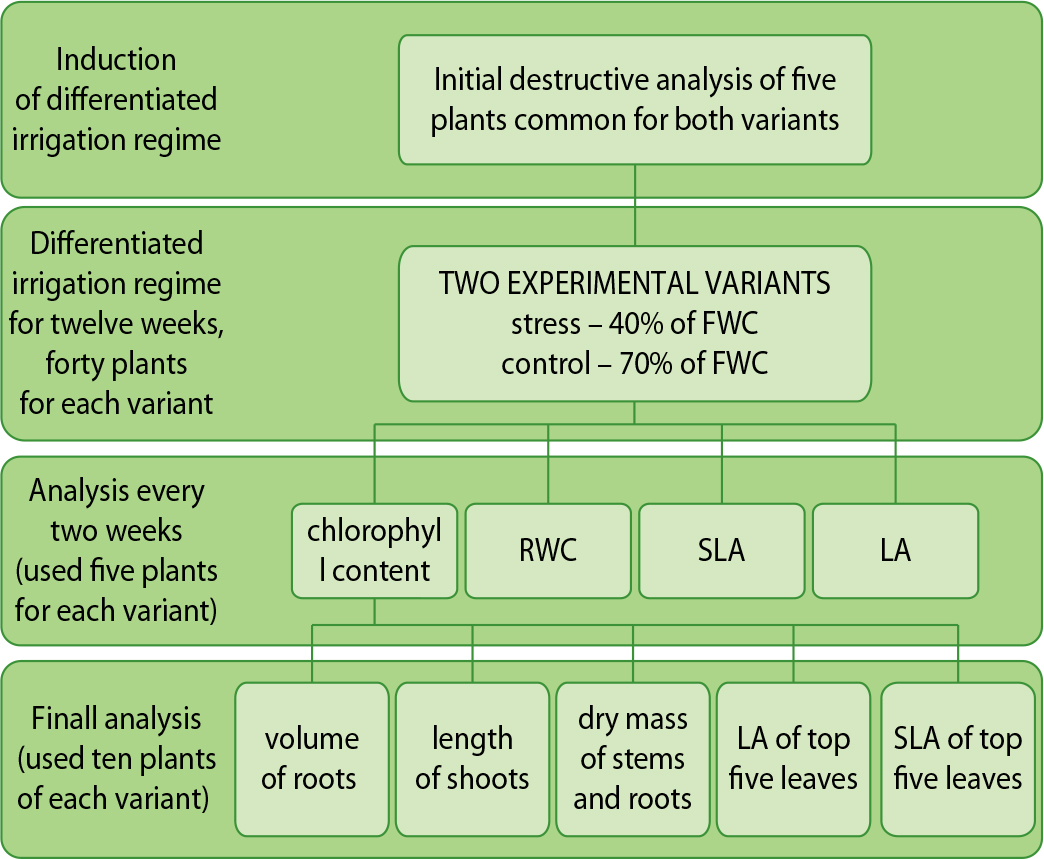
Figure 1.
The experimental design. FWC – field water capacity, chlorophyll content (mg·cm−2), RWC – relative water content (%), SLA – specific leaf area (cm2·g−1), LA – leaf area (cm2), root volume (cm3), shoot length (cm), stem and root dry mass (%)
The results were evaluated for three growing seasons. Statgraphics Centurion XVI software was used for statistical evaluation. Analysis of variance and multiple range tests were used for evaluation.
Results
In Ginkgo biloba plants exposed to drought, we observed a different development of the chlorophyll content in the leaves (Fig. 2). The changes concerned not only the chlorophyll content but also the dynamics of its development during the growing season. The chlorophyll content in the leaves of the control irrigated plants increased gradually over the next two weeks. After reaching a peak in mid-June, the chlorophyll content in the leaves of the control plants gradually began to decrease. The chlorophyll content in the leaves of the control plants probably copies the curve of natural leaf ontogeny during the year. A decrease in the chlorophyll content after the first measurement is evident in the response of plants induced to water shortage. The chlorophyll content in the leaves of stressed plants was 62.1 mg·cm2 lower after the first measurement. At the next measurement, the difference was only 28.1 mg·cm2 in favour of the control. At the end of August and beginning of September, the chlorophyll content of the control leaves decreased even more than that of the stressed plants.
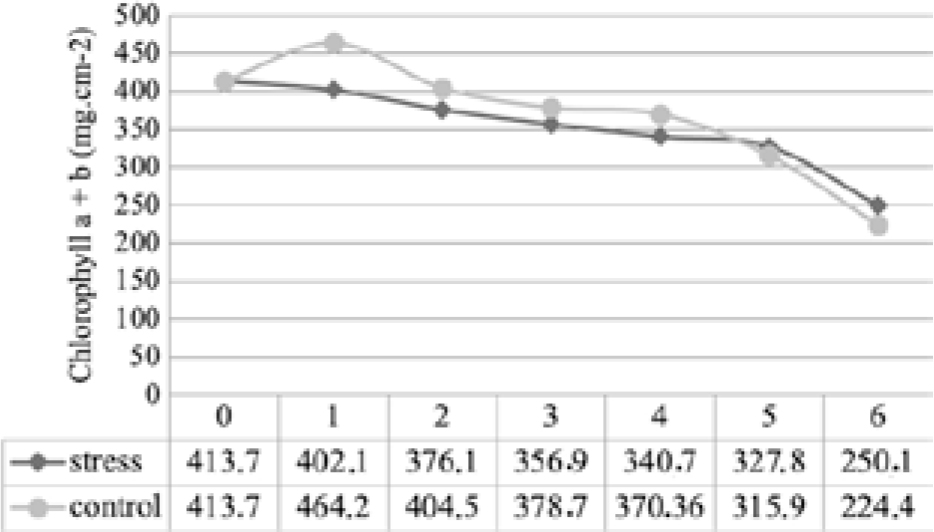
Figure 2.
Evolution of the chlorophyll content in the leaves of stressed and control Ginkgo biloba L. plants under different irrigation regimes, expressed in milligrams per square meter. The numbers 0–6 represent data collected at 2-week intervals (from the first of June to the seventh of September)
Chlorophyll content in the leaves of stressed plants gradually decreased immediately after the introduction of water shortage. After 9 weeks (in the second half of August), the chlorophyll content in stressed and control plants reached similar levels.
When evaluating the results of relative water content (RWC) in leaves, statistically significant differences were found due to the irrigation regime. The RWC of the leaves of plants with 40% field water capacity (FWC) of the soil substrate was approximately three percent lower than the RWC of plants with 70% FWC (Tab. 1). Changes in RWC during the experiments are shown in Figure 3. We found that the most significant changes in RWC occurred during the first six weeks. After two weeks of water regime induction in mid-June, RWC of stressed plants decreased by 2.64% compared to the control. In July, RWC of stressed plants decreased further by 3.51% and 3.45%, respectively. After six weeks, at the end of July, the RWC of stressed plants started to increase despite the water shortage. It is noteworthy that at the end of August, the RWC of the leaves was identical regardless of the water supply. It is noteworthy that the basic dynamics of RWC development of stressed plants during the observed period were very similar to the dynamics of RWC development of fully irrigated plants.
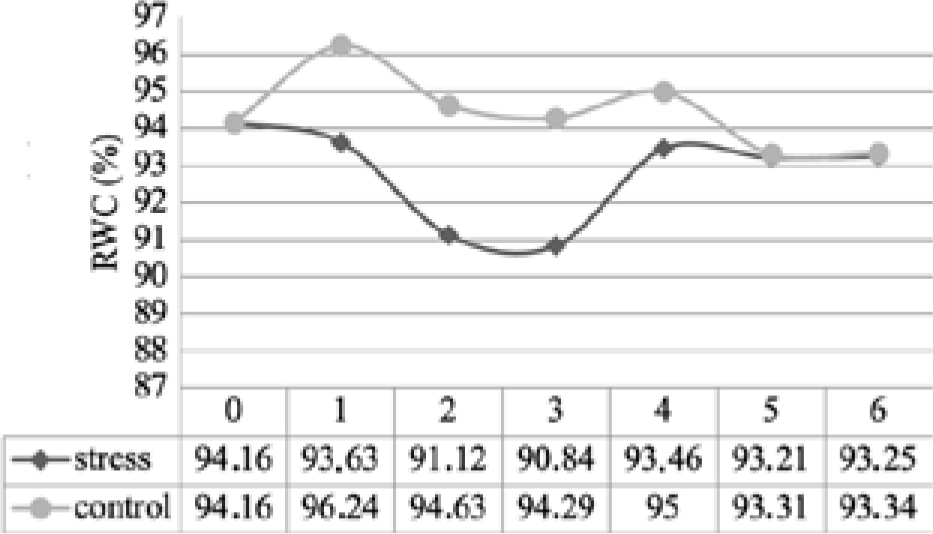
Figure 3.
Relative water content (RWC) in the leaves of stressed and control Ginkgo biloba plants under conditions of water stress. Numbers 0–6 represent data collected at 2-week intervals (from the first of June to the seventh of September)
Table 1.
LSD test for statistical significance of differences in the magnitude of mean values of leaf area (LA in cm2), specific leaf area (SLA in cm2·g−1) and relative leaf water content (RWC in %) of Ginkgo biloba L. plants under water stress
| Measured parameters | Variant | Count | P-value | Mean | Homogeneous groups group differences | |
|---|---|---|---|---|---|---|
| A (cm2) LA | S | 30 90 | 0.67 | 243,96 349.5 | A a | |
| C | 30 90 | 267,73 345.4 | B a | |||
| SLAt (cm2 · g−1) SLA | S | 30 90 | 0.0000 | 44,6167 45.6 | B a | |
| C | 30 90 | 40,9133 42.5 | A b | |||
| RWC (%) RWC | S | 309390 90 | 0.0104 | 91,23 91.6 | A b | |
| C | 309090 90 | 93,3933 94.5 | B a | |||
Leaf area (LA) and specific leaf area (SLA) of Ginkgo biloba changed under water stress conditions. The LA of stressed plants increased insignificantly, and we observed a statistically significant increase in the SLA of stressed plants (on average by 3.1 mg·cm2) (Tab. 1).
Ginkgo plants did not differ in the percentage of dry mass of the stem (Tab. 2), but the length of the shoots was significantly different. The shoots of the control plants were one third longer than those of the stressed plants. Similar results were obtained when evaluating the root system. Dry mass and root volume of stressed and control plants were highly significantly different (Tab. 2). Water content and root mass were higher in roots under regular irrigation.
Table 2.
LSD test for statistical significance of differences in the magnitude of mean values of stem dry mass (%), root dry mass (%), root volume (cm3) and shoot length (cm) of Ginkgo biloba plants under water stress
| Measured parameters | Variant | Count | P-value | Mean | Homogeneous groups group differences |
|---|---|---|---|---|---|
| A cm2) Dry mass of stem | S | 30 30 | 0.0501 | 43.5 | a |
| C | 30 30 | 42.7 | a | ||
| Dry mass of rootsSLAt (cm2 × g−1) water contentw | S | 30 30 | 0.0000 | 32.5 | a |
| C | 30 30 | 27.2 | b | ||
| RWC (%) root amountRoot volume | S | 309390 30 | 0.0000 | 10 | b |
| C | 3030909030230 | 16.6 | a | ||
| Length of shoots | S | 30 | 0.0014 | 13.6 | b |
| C | 30303 | 21.1 | a |
One of the visually observed changes was the morphological response of the uppermost leaves of the shoot. We found that the top five leaves of stressed plants were almost twice as small as the leaves of control plants (Fig. 4), but as we noted, the SLA of these leaves (Tab. 3) was not significantly different. The annual differences were not statistically significant.
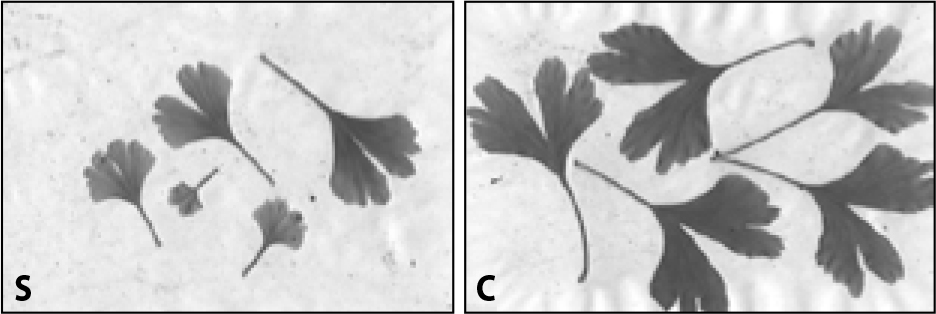
Figure 4.
Leaf area (LA) of the top five ginkgo leaves from the stressed plant (S) and from the controlled plant (C) (software image J used)
Table 3.
LSD test for statistical significance of the differences in the magnitude of the mean values of leaf area (LA in cm2) and specific leaf area (SLA in cm2·g−1) of the top five leaves of Ginkgo biloba influenced by water stress
| Measured parameters | Variant | Count | P-value | Mean | Homogeneous groups group differences |
|---|---|---|---|---|---|
| LA | S | 30 30 | 0.0003 | 54.4 | b |
| C | 30 30 | 100 | a | ||
| SLASLAt (cm2 · g−1) water contentw | S | 30 30 | 0.2616 | 54 | a |
| C | 30 30 | 51 | a |
Discussion
The results of changes in chlorophyll content in Ginkgo biloba leaves are consistent with our hypothesis and with previously published results (Raček et al. 2010; Yu et al. 2022). Ginkgo biloba exposed to water shortage changed the course of development of chlorophyll content in the leaves (Fig. 1). The reason for such a response could be the sensitivity of chlorophyll a and chlorophyll b to soil dehydration (Farooq et al. 2009) and changes in plant and leaf ontogeny influenced by water scarcity, which are related to the photosynthetic activity of Ginkgo biloba L. leaves (Yang and Chen 2014; Jing et al. 2005). We suggest that the decrease in chlorophyll content in the leaves of plants exposed to water scarcity caused a slowdown in plant growth. Adaptive changes and the ability to regulate leaf water content in relation to chlorophyll content were reflected at the end of the summer, when chlorophyll content in the leaves of stressed plants showed a similar persistence to the chlorophyll content in the control. Despite a significant reduction in irrigation, the dynamics of the development of chlorophyll content in the leaves of Ginkgo biloba from the beginning of August to the beginning of September was practically identical to that of the fully irrigated plants. Based on the above results, we believe that the reduction in irrigation led to changes in chlorophyll formation, but these changes did not have a determining effect on the changes in chlorophyll content during the mentioned growth phase.
The ability of Ginkgo to tolerate water deficiency must have been reflected in its growth. Ginkgo biloba plants exposed to different irrigation regimes did not differ in the percentage of stem dry mass, but shoot length and root volume were significantly different. The shoots of the control plants were one third longer than the shoots of the stressed plants, and the roots of the control plants were almost one third more voluminous than the roots of the water-stressed plants. The results showed that Ginkgo biloba L. plants limited their growth after the introduction of a differentiated irrigation regime but did not support the growth of the roots, which is not in accordance with our assumption. It is known that plant growth is stunted by drought and plants tend to invest more in root growth (Pace et al. 1999; Kuhns et al. 1985; Susiluoto and Berninger 2007). Ginkgo biloba under water shortage did not use this strategy. The species response was simpler. Plants also reduced shoot and root growth proportionally. Although we cannot say with certainty whether ginkgo seedlings would change their biomass storage strategy in favour of roots under even greater water stress, one thing is certain: This experience can be an important indicator for the use of Ginkgo in urban forestry and means that although Ginkgo can survive in very dry conditions, its growth will be fundamentally limited. In view of the above, we agree with the opinion that the possibilities of using ginkgo in urban streets are limited (Swoczyna et al. 2015). We express our belief that ginkgo in an arid environment will need irrigation to fully ensure its ecological functions.
Despite the decrease in RWC and the statistically proven effect of a significantly reduced water supply on its reduction, RWC was not lower than 90% during the experiment. Therefore, we believe that Ginkgo has a significant ability to control and manage the water content in the leaves during the transpiration process. The results are in agreement with the results of research on Ginkgo biloba aimed at investigating the stomatal conductance of the species (Raček et al. 2018).
Evaluation of other physiological responses showed that ginkgo plants significantly changed the leaf area (LA) of leaves developed after the introduction of different irrigation regimes (Tab. 3). The leaves of the uppermost shoots of the plants under regular irrigation developed almost twice as much LA compared to the plants under conditions of water shortage. The above finding is in accordance with our assumption and with the known statement (Chaves et al. 2003), which considers the reduction of LA as one of the plant responses to water stress. It should be stressed that the difference in LA of Ginkgo was found only in the ontogenetically youngest leaves.
Very valuable results were obtained by comparing the SLA of leaves of whole plants and top shoot leaves. In agreement with the previous study (Raček et al. 2011), the SLA of leaves of whole plants increased under water stress conditions, but the SLA of top shoot leaves did not change even though their LA decreased significantly.
Conclusions
Water shortage in Ginkgo biloba caused a decrease in the chlorophyll content in the leaves and consequently changes in growth. In general, we can conclude that Ginkgo biloba has an extraordinary ability to protect the water content of the leaves in conditions of water shortage, which probably allows it to survive a prolonged period of drought. However, the survival strategy of the lack of water leads to a limitation of the growth of the whole plant, including the root system. Although this strategy allows Ginkgo biloba to survive water shortages, it is likely to be a limiting factor when grown in nurseries and later when used in an urbanised environment. Successful cultivation of this unique species in arid conditions is unlikely to be possible without additional irrigation. Future research should focus on supporting cultivation techniques that ensure optimal growth of the species under natural drought conditions.
Acknowledgement
This research was funded by the Ministry of Education, Science, Research and Sport of the Slovak Republic within the Cultural and Educational Grant Agency (KEGA) number 004SPU-4/2023 KR:EK:IN – Landscape Economy for Innovative and Sustainable Interdisciplinary University Education in Slovakia.