
Introduction
An effective restoration of forest stands destroyed by fires caused by Russians during their military actions in the years 2014–2025 is an important problem for the future forest management in Ukraine (Irland et al. 2023; Myroniuk et al. 2023; Shumilo et al. 2023; Myroniuk et al. 2024). At the end of June 2022, forests with an area of 1,849,046 ha and timber volume of 414,397,000 m3 were affected by the war (Zibtsev et al. 2022c). The area and volume of destroyed forests are constantly increasing. Ukraine is now one of the countries whose forests contain the largest number of explosive objects (Goldammer 2013; Musa et al. 2017; Zibtsev et al. 2022c). Direct impacts of military actions on forests include pollution of the environment, destruction of natural resources such as timber and drinking water, deforestation (Mendez and Valánszki 2021), habitat change (Dudley et al. 2002; Kauppi et al. 2022), and negative impacts on biological diversity (Dudley et al. 2002; Machlis and Hanson 2008). All these actions may be classified as an ecocide (Kozak 2023).
The restoration of ruined forests may be hampered by future climate change in the steppe zone (steppe occupies 40% of the area of Ukraine) (Buksha et al. 2011a; Buksha et al. 2011b; Buksha et al. 2017). From the north, the steppe borders the forest-steppe zone (this zone occupies 33% of the area of Ukraine), though the area of the steppe zone may soon increase to include the forest-steppe zone due to climate change. Now, already the climate change is manifesting itself in the reduction of the area of Scots pine (Pinus sylvestris L.) forests in Ukraine (Migration 2020; Shvidenko et al. 2017). Under climate change and increased war impacts, forest stands became more vulnerable and less resistant to damages caused by biotic agents (Ziesche 2017); their productivity decreased and they started to die (Buksha et al. 2017; Vacek et al. 2016; Shvidenko et al. 2018; Meshkova 2021). Another major threat to forests is wildfires (Zibtsev et al. 2022c). Improper forest management in the past and the increased negative influence of military operations also accelerate forest deterioration (Prihodko et al. 2022).
In eastern Ukraine, that is, in Luhansk and Donetsk regions, destruction of forests started already in 2014, since the beginning of the Russian occupation. In July 2024, 205,146 ha of forests were devastated in this region, and the loss of timber resources reached 32,302,000 m3 (Zibtsev et al. 2022c). Restoration of these forests may take 15–20 years and will require considerable effort and money. Taking into account the above facts, there is an urgent need for developing tools which can be used to predict the effects of climate change and war-caused damages on future regeneration of forests destroyed during the Russian invasion. Predictive models that are based on process analysis (Miehle et al. 2009) and take into account the cause-and-effect relationships controlling tree growth (Korzukhin et al. 1996) explicitly simulate key physiological processes that are influenced by underlying environmental variables (Battaglia and Sands 1998). The largest family of process-based models is the so-called gap models (Botkin et al. 1972a; Botkin et al. 1972b). In gap models, the basic simulation unit is a group of trees developing in the stand gap. Gap models explicitly consider competition among individual trees and account for the key environmental factors (Botkin et al. 1972b; Shugart and West 1980; Brzeziecki 1991; Botkin 1993; Bugmann 2001). In this study, the gap-type Urban Forest Biomass (UFB) model (Kozak et al. 2023) was used. It was parameterized and validated for the steppe zone occurring in the Luhansk region. The aim of the study was to validate the UFB model and to apply it to predict the dynamics of tree seedlings in burned forests. In simulations, sites with high and low initial density of Scots pine seedlings were taken into account. In addition, the hypothesis assuming the negative impact of high initial density on Scots pine growth in warm-dry scenario was evaluated.
Material and methods
Study area and sampling design
The empirical part of the study was performed in 2021 in the Luhansk region (oblast), occupying an area of 1046 km2 (Fig. 1). The average annual precipitation in the region is 450 mm, and the average annual temperature is 7.8°C. Elevation ranges from 150 to 151 m a.s.l. Soil is an ordinary medium-humus chernozem developed on loess-like rocks.
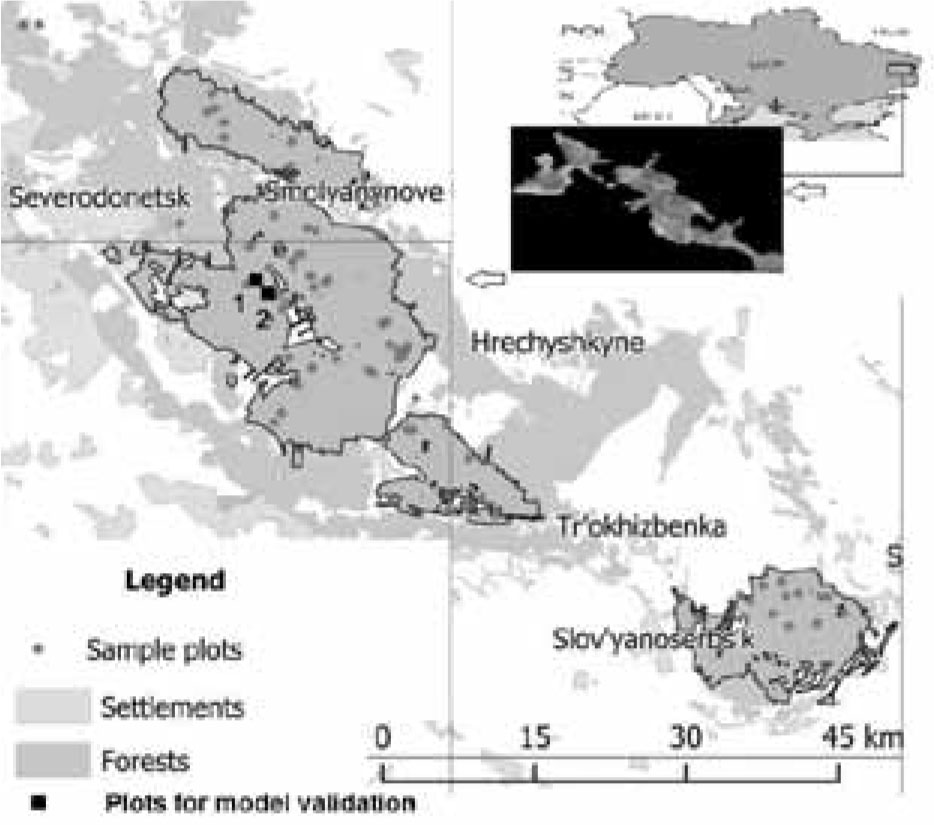
Figure 1.
The location of the research area in eastern Ukraine and the spatial distribution of sample plots
The Luhansk region has been periodically in the center of active military operations since 2014. As a result, the fires destroyed in total 10,240 ha of forest here. Sanitary logging after these fires began immediately after the withdrawal of troops (in 2016). Field studies conducted 7 years after the military actions were started showed that in many areas affected by fires, there was a massive recovery of artificial regeneration of Scots pine.
A supervised classification of Sentinel-2 remote-sensing images of the region was performed in Quantum GIS [QGIS] using the Semi-automatic Classification Plugin (SCP). An appropriate code was developed in the R package. The code allowed the transformation of the normalized difference vegetation index (NDVI) values calculated from the Sentinel-2 images to csv files and the graphical (chart) presentation of the obtained classification units.
In total, 60 1-ha sample plots (SPs) were established in the Luhansk region (Fig. 1). For model validation conducted in this paper, two SPs were selected (Fig. 2). The plots were square in shape and had a size of 1 ha. Both SPs were artificially regenerated with pine trees in 2014. SP 1 was planted with 10,000 trees, while SP 2 was planted with 3,333 trees.

Figure 2.
Representative fragments of two SPs selected for model validation (left: SP 1; right: SP 2); photographs were taken in 2021. SPs: sample plots
The measurements conducted on SPs in 2021 included data on species composition, as well as number and height (H) of all trees. SPs selected for model validation were distinguished by the same ecological conditions and had a flat aspect. The area of each SP was divided into 16 parts of 625 m2 that were used in the UFB model predictions.
The forest model
To simulate the future forest growth in the Luhansk region, the UFB model (Kozak et al. 2023) was used. As a descendant of the FORestKOzakMEnshutkin [FORKOME] model (Kozak et al. 2003, 2012, 2014a, 2014b; Kozak and Parpan 2019; Parpan et al. 2019), the UFB model also predicts tree growth, competition, and mortality in small patches of 1/16 ha (625 m2) (Fig. 3). There are no interactions between patches in the UFB model. This means that forest succession taking place in particular patches is independent of their neighborhood (Bugmann 2001). The model was initially calibrated with an independent data set that was not used for its validation. The standard calibration procedure was adopted: repeating runs, with the manual adjustment of parameters to find the best possible fit to the observed tree heights. The parameters of growth rate (G) as well as the upper and lower limits of growing degree-day sums (DDMAX, DDMIN) were modified for Scots pine in the Luhansk region.
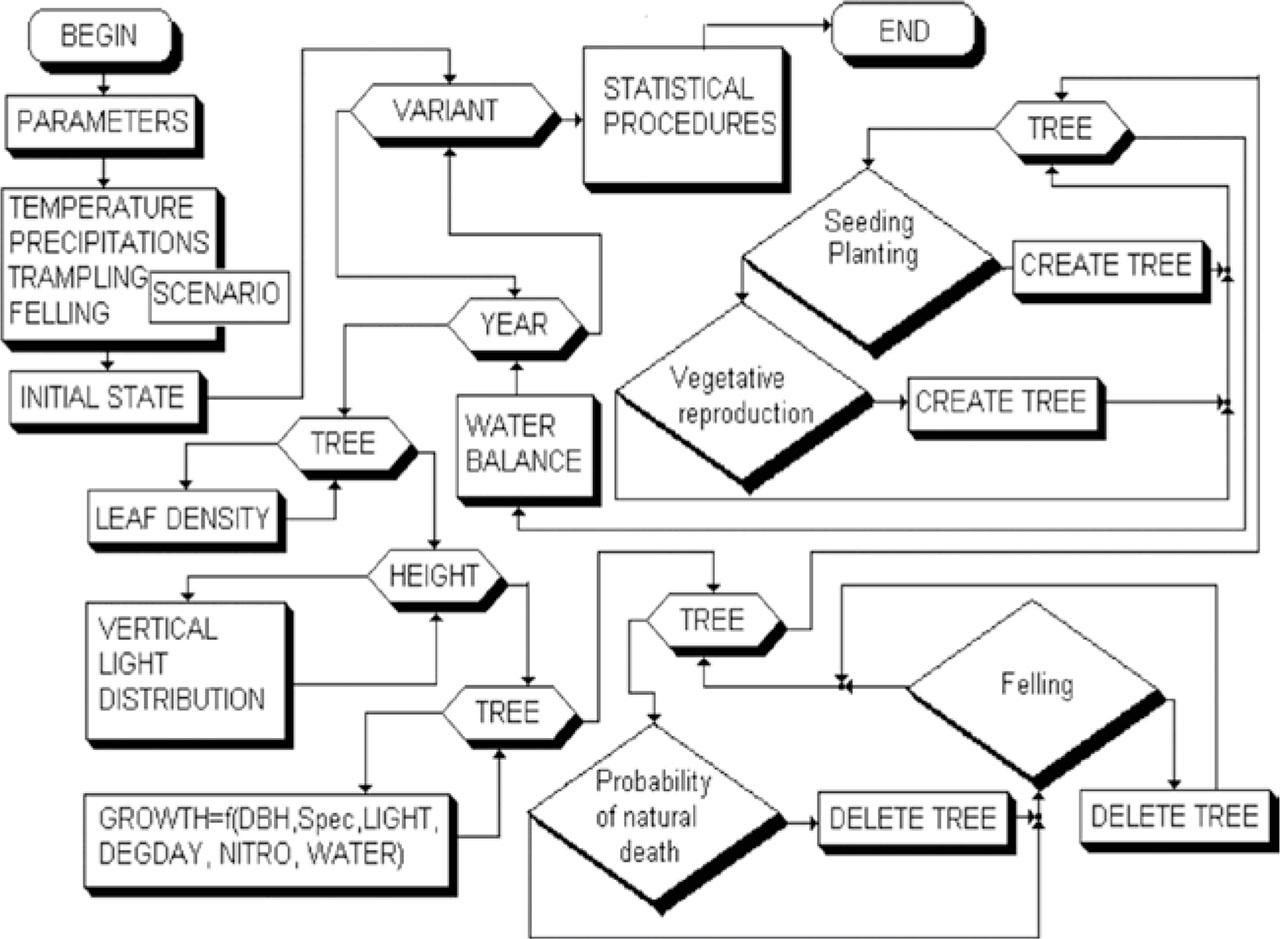
Figure 3.
Block diagram of the UFB model (Kozak et al. 2023), the full term of DBH given in the figure: diameter at breast height
The UFB model was presented in greater detail and evaluated in a recent publication (Kozak et al. 2023). Thus, here we only briefly describe the model. In the UFB model, tree growth is defined by the growth equation described in Botkin (1993). The model considers the influence of the most important environmental factors, such as temperature, precipitation, light, and nutrient content in the soil, on the main processes taking place in forest stands (regeneration, growth, and dieback of individual trees). The UFB model resembles the Forest Ecosystem [FORET] model (Shugart and West 1980) the most, and in calculating the amount of light, it resembles the JAnak-BOtkinWAllis [JABOWA] 3 model (Botkin 1993). The UFB model considers fluctuations in temperature, water balance, and tree transpiration.
The die-off block of the UFB model takes into account three basic stages of the tree status: healthy, dying, and fallen (dead). The dying tree is described by the parameter dry, which determines the percentage of dry branches and needles in the crown: 25%, 50%, 75%, and 100%. A healthy tree with a dryness parameter of 0% does not reveal any signs of dryness, as shown in Figure 4A for an exemplary Scots pine tree. The drying block is part of the stochastic mortality process. This process is random, depending on the tree’s age, growth, and climatic conditions in the previous year. The textures of dying trees are shown in 3D visualization presenting the stages of shrinkage and decay of tree branches and needles (Fig. 4).
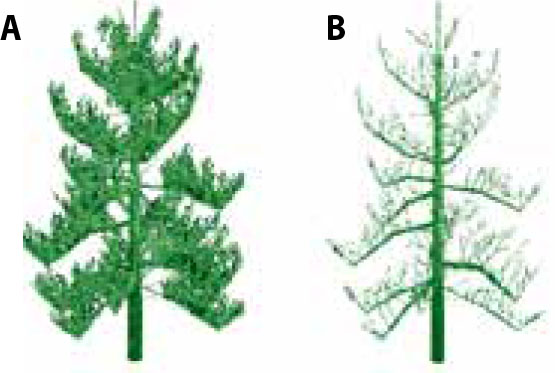
Figure 4.
Percentage of drying of assimilation apparatus of Scots pine as depicted in the UFB model: a) 0%, b) 100%
The UFB model takes into account data on climate trends, which are reported on the website ClimateCharts.net (Zepner et al. 2020). The data from this site were used to determine temperature and precipitation parameters in simulations corresponding to the control and the warm-dry scenarios. To account for future climatic conditions, the scenario A1B was assumed. This scenario reflects the moderate climate change (Nakicenovic and Swart 2000; Shvidenko et al. 2018; IPCC 2022), including an increase in growing degree-day sum by 225°C and a decrease in precipitation by 100 mm. To check the usefulness of the UFB model in creating reliable forecasts for forests occurring in the research area, the average tree height was used. A statistical evaluation of the model was performed by means of linear regression analysis of the modeled and observed values (Yang et al. 2004). To determine the predictive ability of the model, coefficient of determination R2, as well as the intersection and slope of the fitted regression lines were used (Vanclay and Skovsgaard 1997). Model efficiency (ME), root mean square error (RMSE) and BIAS were also estimated. The Monte Carlo realizations (random simulations including 200 runs) were analyzed in the model. The autocorrelation function of number of trees in the model prediction was calculated. Results of simulations have been processed in statistical R and STATISTICA 13 software.
The autocorrelation functions were analyzed in the statistical procedures block. The percentage similarity coefficient (Bugmann 1997) was used to compare number of trees across 10 years of predictions.
The following simulations were conducted: one with the number of seedlings amounting to 10,000 ind./ha (SP 1) and the second one with the number of seedlings amounting to 3,333 ind./ha (SP 2), according to the recent Forest Recommendations (Zibtsev 2022b). In the model, the method of planting in rows in various combinations was used (Zibtsev et al. 2022b).
Results
NDVI classification
The classification results for NDVI obtained for the area under investigation are shown in Fig. 5. The polygon representing the research area was cut out from the T37UDQ square of Sentinel-2 data obtained for two dates: 06.27.2020 and 07.06.2024. The comparison of Sentinel-2 data for 2020–2024 showed a strong decrease of NDVI index values above 0.6 (e.g., 0.7 NDVI value decreased from 23% in 2020 to 1.3% in 2024), which confirms the catastrophic decrease in forest area.
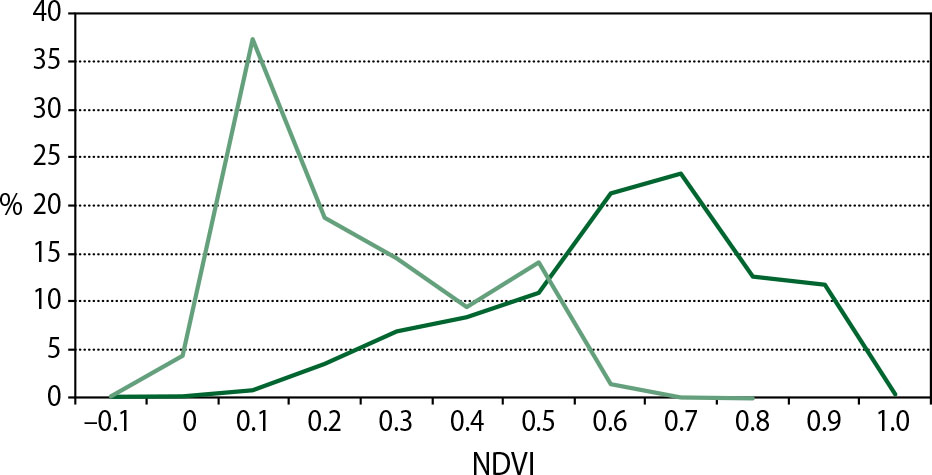
Figure 5.
Percentage distribution of the NDVI index in the Luhansk region, as obtained for two dates: 06.27.2020 (dark green) and 07.06.2024 (light green)
On 06.27.2020, the NDVI values above 0.54 clearly dominated (Fig. 5). However, on 07.06.2024, that is, in the active phase of the war, there were practically no indices above 0.7. This indicates that mature forests with the highest NDVI indices (above 0.6) were practically destroyed during ongoing war. Such an analysis indicates an urgent need to renew the destroyed forests in the studied region.
Model validation
To validate the model, the height of individual trees, measured on representative 25 × 25 m sample subplots 7 years after planting of Scots pine seedlings, was compared with the modeled height. The results shown in Table 1 and Figure 6A, Figure 6C indicate generally a high agreement of the model with field data. Taking into account the value of R2 and RMSE, the estimation accuracy of the variable tree height in SP 1 was slightly lower compared to SP 2. Similarly, the residuals for tree height in SP 1 revealed a higher variation and ranged from −0.145 to 0.202 (Fig. 6B), while for SP 2 they ranged from −0.072 to 0.053 (Fig. 6D).
Table 1.
Statistical results of model validation
| SP No. | R2 | RMSE, m | ME, m | BIAS |
|---|---|---|---|---|
| 1 | 0.9579 | 0.0264 | 0.9580 | 0.0013 |
| 2 | 0.9601 | 0.0305 | 0.9392 | 0.0164 |
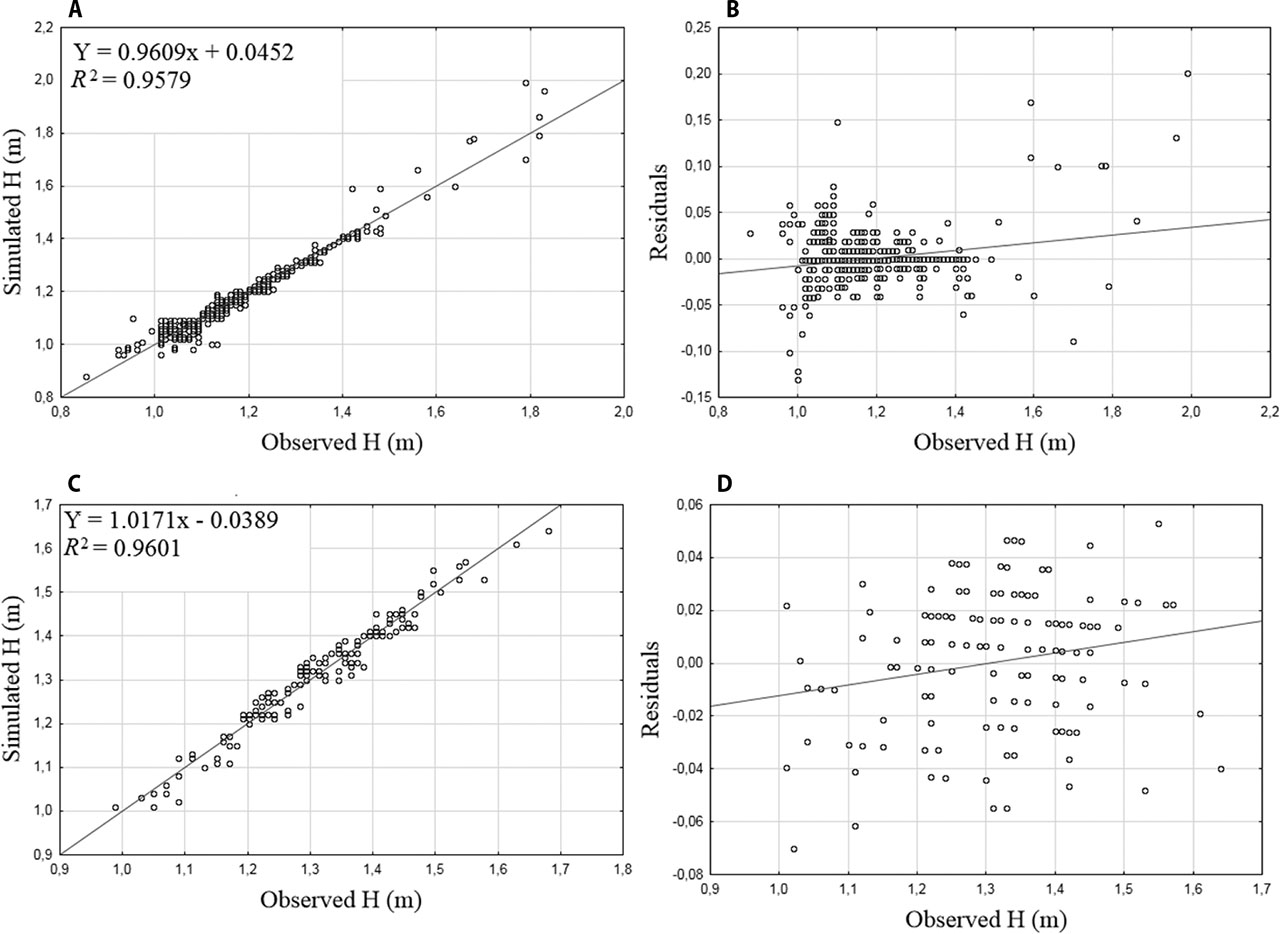
Figure 6.
Graphical visualization of statistical calculations: linear regressions for modeled versus observed tree height: A – for SP 1, C – for SP 2; residual plots for tree height associated with the linear models in the preceding graph: B – for SP 1, D – for SP 2
Simulation of future forest development
The simulation results of the Scots pine stands growing in SP 1 and SP 2, differing in the initial density of trees, and taking into account two climate scenarios (control variant and warm-dry variant), are presented in Table 2 and Figure 7. The simulation was carried out starting from 2014 until 2030. Autocorrelation of number of trees in all variants varied from 0.95 at τ = 1 to 0.80 at τ = 10 (τ – Kendall coefficient). In all cases, there was a reduction in the number of trees during the simulation period; however, the rate of the reduction depended on the experimental variant. By far, the greatest reduction of trees (almost 80%) occurred on SP 1 (distinguished by a high initial seedling density) in the warm-dry variant. In all other variants, the seedling density reduction rate was markedly lower and ranged between c. 22% and 32%. For both plots, the mortality rate was higher in the warm-dry variant compared to the control variant. This effect was much more pronounced in case of high initial seedling density (SP 1), which confirms the hypothesis that the high density has a negative impact on the development of planted trees and increases their die-off under less-favorable (a scarcity of water) climatic conditions.
Table 2.
Climatic scenarios and major simulation results for two sample plots (SP 1 and SP2) differing in terms of the initial seedling density
| Sample plot | Initial (in 2014) number of planted trees, ind./ha | Climatic scenario | Annual degree-day, °C | Precipitation, mm | Modeled No. of trees, ind./ha | No. of dead trees | ||
|---|---|---|---|---|---|---|---|---|
| 2014 | 2030 | ind./ha | % | |||||
| SP 1 | 10,000 | Control | 1750 | 450 | 10,000 | 6756 | 3244 | 32.4 |
| Warm-dry | 1975 | 350 | 10,000 | 2161 | 7839 | 78.4 | ||
| SP 2 | 3,333 | Control | 1750 | 450 | 3,333 | 2597 | 736 | 22.1 |
| Warm-dry | 1975 | 350 | 3,333 | 2342 | 991 | 29.7 | ||
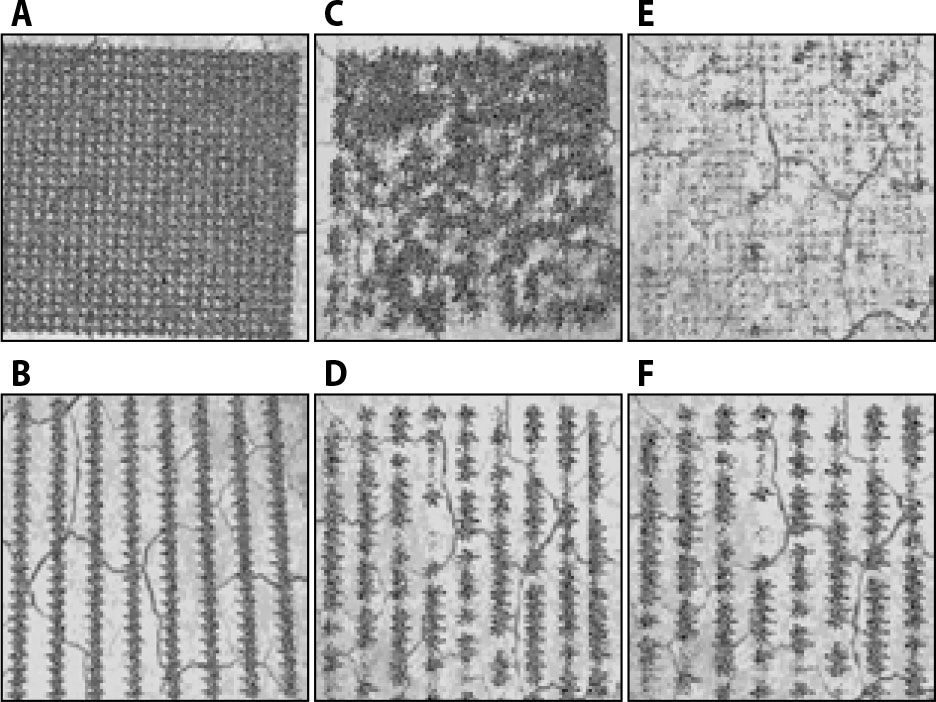
Figure 7.
Visualization of Scots pine seedlings in simulations performed by the UFB model: A – SP 1 in 1 year; B – SP 2 in 1 year; C – SP 1 in the year 2030 (control variant); D – SP 2 in the year 2030 (control variant); E – SP 1 in the year 2030 (warm-dry variant); F – SP 2 in the year 2030 (warm-dry variant); size of the plots 25 × 25 m
Discussion
The present study included calibration and validation of the forest growth model and using it to forecast the dynamics of the number of trees in pure Scots pine plantings. The correlation between observed and predicted tree height was very high (R2 = 0.9579 on SP 1 and 0.9601 on SP 2) and was far superior than in the validation of the gap model of the JABOWA type in eastern Australia, where R2 = 0.59 (Ngugi and Botkin 2011). The main limitation of the present research was that a forecast was made only up to 2030. In principle, the model could be used to predict the dynamics of Scots pine plantings in the following years. However, the Luhansk region is currently still occupied by the Russians. For this reason, it was not possible to find SPs with older forest stands for model validation. In older plantings, diverse types of maintenance cuts should be added. It could not be conducted in the field and accordingly in long-term forecasts in the model. Nonetheless, we hope that the model validation and tree number forecasts conducted until 2030 will be useful for future similar analysis. It is worth noting, for example, that the tree mortality analyzed in the model is a process that can be caused by many factors (Taylor and MacLean 2007). As in other gap-type models, the UFB model simulates the probability of mortality as a function of tree age and competition between particular individuals for space, light, water, and nutrients. The UFB model simulates the probability of mortality. Similarly, the best solution to consider reproduction and ingrowth is to adopt a probabilistic approach. The use of the model for further forecasting of so-called catastrophic mortality, such as that caused by warfare fires, also seems to be very prospective. The previous version of the current UFB model, called FORKOME (Kozak et al. 2014b), was used to predict the effects of fire. In addition, the development of geometrical shape parameters of trees that are expressed in 3D visualization as functions of forest tree variables called form model is very promising. We used these 3D elements in stand growth visualization and enhanced demonstration of prediction effects.
Our predictions showed a much greater number of dead Scotch pines when planted with high density (SP 1, 10,000 individuals per ha) in warm-dry scenario. This was also confirmed by published data (Zibtsev et al. 2022b) for Luhansk region. The factors limiting tree growth used in the UFB model included tree density, transpiration rate, water evaporation, and soil water availability. The results obtained from the model are consistent with the conclusions of academician Vysotsky (1927) and other authors (Buksha et al. 2017; Shvidenko et al. 2018; Zibtsev et al. 2022a). The density of planted trees set in the model is confirmed by the current Forest Recommendations (Zibtsev et al. 2022b) adopted for forest management in Ukraine.
The current war further exacerbated the reforestation problem in steppe conditions. Russia’s military operations in Ukraine since 2014 and the full-scale Russian invasion of Ukraine since 2022 have had a dramatic impact on Ukrainian forest ecosystems, including the steppe zone. Considering the current Russian occupation of the southeastern part of Ukraine and presence of mines, it becomes impossible to conduct research and measurements in these areas. In such a situation, when a large area is inaccessible for collecting forest data, the possibility of updating forest information is limited. For this reason, the relevance of the use of satellite data, including Sentinel-2, and the forecasting forest growth models such as UFB presented in this paper, has increased significantly. For the assessment of forest damages caused by the war, monitoring (it was revealed that 18% of the protective plantations have been damaged as of 2023; Matsala et al. 2025) and forecasting changes (Matsala et al. 2024) are becoming very important issues. There is a clear indication in the literature about the need to reduce forest fire risk by creating low-density stands that are not conducive to spread of crown fires (Zibtsev et al. 2021). The results obtained and presented in the article can be used by forest management in the conditions of dynamic climate change and war damage in the steppe zone of Ukraine and for planning post-war forest regeneration.
Summary and conclusions
The forest growth UFB model was calibrated and validated for steppe zone in Ukraine in conditions of war and climate change. The values of tree height as predicted by the model showed high similarity to the observation data collected in Scots pine plantings, differing in terms of initial seedling density. Comparison of modeled and observed tree heights produced R2 values of 0.9579 and 0.9601 for two representative SPs. In the present study, tests based on R2, BIAS, ME, and RMSE demonstrated the suitability of the UFB model for prediction of tree height change over time. For the warm-dry scenario, the predictions showed an increase in the percentage of dead Scots pine individuals growing in high density (10,000 ind./ha) up to 78.4%. This result confirmed the hypothesis about the negative impact of high density on the development of planted trees and their increased mortality in warm-dry scenario under steppe conditions. In addition, forecasting obtained by means of the UFB model showed a high autocorrelation of the analyzed number of Scots pine trees. The high correlation of the number of Scots pine trees proves their high growth potential in the Luhansk region. To conclude, we propose to plant a smaller number of Scots pine individuals (3,333 ind./ha) for greater survival in steppe conditions under the influence of warfare in warm-dry climate change scenario. We also recommend further exploration of the UFB model.