
Introduction
The wide-scale increasing tree mortality observed in many European countries, including Poland, is a consequence of unequivocal and unprecedented climate change that significantly exceeds the natural adaptive capacity of forest trees (Allen et al. 2010; Anderegg et al. 2013; Schuldt et al. 2020; Leifsson et al. 2023). In the face of these changes, extreme weather events such as heat waves and more frequent and intense droughts are the main abiotic factors leading to increased levels of chronic and severe stress, which often translates into reduced tree vigour and growth (Babst et al. 2019; Capecki et al. 2020). During drought, trees can suffer from reduced stomatal conductance and photosynthesis, as well as hydraulic insufficiency and carbon deficiency (Bréda et al. 2006; McDowell et al. 2008, 2022; Song et al. 2022). Droughts are predicted to have increasingly negative impacts on forest ecosystems as a result of global warming, leading to increased mortality in all climatic regions where forests occur, transforming them from a carbon sink to a carbon source (Spinoni et al. 2018; McDowell et al. 2020). In the long term, most forests will inevitably adapt to changing environmental conditions, changing the distribution of tree species (Dyderski et al. 2018; Puchałka et al. 2023) and the organisms dependent on them, and thus the properties of entire ecosystems. However, these changes may disturb the ecological and hydrological balance, which plays a key role in regulating climate and landscape (Ciais et al. 2005; Hanewinkel et al. 2013).
As a result of intensive forest management conducted in many parts of Europe since the 19th century, due to the high productivity and economic value of its wood, Norway spruce has been planted in various, often inappropriate habitats and outside its natural range (Spiecker et al. 2004; Modrzyński 2007). However, since the beginning of the 21st century, an increasing mortality of spruce monocultures has been observed in many areas of Central Europe, mainly due to drought stress and subsequent susceptibility to bark beetle outbreaks (Coleoptera: Scolytidae) (Seidl et al. 2015; Netherer et al. 2021). In the Polish Sudetes, where Norway spruce occupies about 67% of the forest area and has a high average age (76 years) and volume (364 m3/ha), its stands are currently among the most endangered by forest dieback in the country (Bruchwald et al. 2019; Bałazy 2020; Dmyterko et al. 2020). Strong winds and droughts, which are becoming more frequent due to global climate change, have already caused significant damage to these forests (Korzybski et al. 2013; Bruchwald et al. 2019). In 2015, much of Europe, including Poland, experienced extreme soil drought, one of the most severe and long-lasting summer drought anomalies, combined with heat waves (Somorowska 2022). In the Eastern Sudetes (the Opawskie Mts), the climatic water balance determined for the 2015 vegetation season was the lowest in several decades (Durło 2019). According to the studies by Bruchwald et al. (2019) and Dmyterko et al. (2020), the harvest of deadwood (mainly spruce) associated with this extreme drought amounted to 3.2 million m3 in 2015–2019, while the record harvest of deadwood of 723,000 m3 was achieved in 2016. Climate change is predicted to intensify hot droughts and increase their frequency. Therefore, there is a justified concern that the ongoing degradation of spruce forests in the Sudetes region will continue, mirroring the observed and ongoing decay of spruce stands in the Western Beskids (Dmyterko and Bruchwald 2018).
Climate change now forces the setting of new economic goals for the forests of Polish mountains, including the Sudetes. However, first, it is necessary to recognise the changes taking place in these forests, develop new principles of forest management and implement them in forestry management practice.
The aim of the study is to characterise the process of tree dieback and the breakdown of tree stands in the Sudetes Mts. The characteristics will be applied to both the main and admixture tree species found in the study area, including Scot pine, oak and European beech. The scale of the tree mortality dieback process and the reasons for its initiation and course will be presented. The physiological aspects of tree death caused by drought and high atmospheric air temperature will be discussed.
Material and Methods
One of the oldest mountain ranges in Europe, the Sudetes, are located in southwest Poland, in the basin of the upper and middle Odra river. They are formed crustal-block mountains, with a crystalline or folded structure, characterised by a varied relief. The highest peaks of the Polish Sudetes are Śnieżka (1602 m above sea level) located in the Karkonosze mountain range, Śnieżnik (1425 m) located in the Śnieżnik Massif, Wysoka Kopa (1126 m) in the Jizera Mountains, Postawna (1117 m) in the Golden Mountains, Orlica (1084 m) in the Orlickie Mountains and Wielka Sowa (1015 m) in the Sowie Mountains. The mountain ranges are separated by wide valleys: the Kłodzko Valley with the main Nysa Kłodzka River, the Jeleniogórska Valley with the Bóbr River and the Kamienna Góra Valley with the Bóbr River. The Sudetes are among the oldest mountains in Europe. For many years, the Sudetes were forested with Norway spruce, European beech and larch to a much lesser extent, while oak and Scots pine were planted in the lower parts of the mountains.
The study uses data from two sources: the database of the State Forests Information System (SILP) and the database of the Institute of Meteorology and Water Management (IMGW–PIB). From the SILP database, the taxation descriptions of individual stands of selected forest districts and the volume of harvested deadwood, broken down by individual tree species, were used. Data for seven meteorological stations located in the Sudetes, representing various physiographic conditions (Tab. 1), were retained from the IMGW repository. The data set was created for 1971–2022 and included monthly precipitation totals, average monthly air temperature values and variables for calculating evapotranspiration: relative humidity, wind speed, day length and sunshine duration. The data were used to determine the variability of air temperature and precipitation in the study period and calculate climate water balance (CWB). CWB was determined as the difference between atmospheric precipitation and potential evapotranspiration using the methodology proposed by Doroszewski et al. (2012). The CWB values were calculated for individual months, vegetation periods (April–October), and years in the multi-year period 1971–2022. The determined characteristics were tested for the presence of trends using the Mann–Kendall test using the MAKESENS 1.0 application (Salmi et al. 2002), assuming α ≤ 0.05 for significant trends.
Table 1.
Geographical localisations and altitude above see level of the meteorological stations applied in the study
| Meteorological station | Zgorzelec/Görlitz | Jelenia Góra | Karpacz | Szczawno Zdrój | Kłodzko | Duszniki/Słoszów | Lądek-Zdrój |
|---|---|---|---|---|---|---|---|
| Altitude m a.s.l. | 203 m | 342 m | 605 m | 430 m | 360 m | 555 m | 461 m |
|
|
|
|
|
|
|
|
| Western Sudetes | Central Sudetes | Eastern Sudetes | |||||
The Sudetes Mts forests are supervised by 12 forest districts that are part of the Regional Directorate of State Forests in Wrocław. The area of these forest districts covers both mountain and foothill areas, and its size varies from 9 to 16 thousand ha, in total amounts to 155 thousand ha (Tab. 2). Calculations made with the stand growth model (Bruchwald 1986) showed that the total growing stock of stands in the study area is about 56 million m3, of which 65% are Norway spruce forests. Per 1 ha, the growing stock of stands of the characterised forest districts ranges from 302 to 414 m3/ha, and the average value of 362 m3/ha is higher than the national average of 273 m3/ha. The increase in the growing stock of stands in these forest districts ranges from 8.5 to 12.1 m3, and the size of this increase is related to the share of Norway spruce, which, for individual forest districts, ranges from 27.4% to 84.6%. The average age of stands is high, 76 years old, and ranges from 62 to 83 years.
Table 2.
Characteristics of growth features of forests districts located in the Sudetes Mts in 2022
| Forest district | Area (ha) | Average age of stands | Merchantable volume (thousand m3) | The average stand volume (m3/ha) | The average of volume increment (m3/ha/year) | The share area of spruce (%) |
|---|---|---|---|---|---|---|
| Bardo Śląskie | 12,158 | 77 | 3,676 | 302 | 8.6 | 28.6 |
| Bystrzyca Kłodzka | 12,260 | 81 | 4,913 | 401 | 10.6 | 79.8 |
| Zdroje | 9,604 | 83 | 4,974 | 414 | 10.8 | 74.0 |
| Jugów | 9,096 | 69 | 2,973 | 327 | 10.0 | 56.0 |
| Kamienna Góra | 15,364 | 72 | 6,040 | 393 | 10.9 | 80.5 |
| Międzylesie | 9,788 | 81 | 3,675 | 375 | 10.0 | 77.2 |
| Lądek Zdrój | 15,767 | 83 | 6,100 | 387 | 9.8 | 82.4 |
| Szklarska Poręba | 13,506 | 72 | 5,118 | 379 | 12.1 | 84.6 |
| Śnieżka | 12,372 | 75 | 4,667 | 377 | 10.6 | 69.6 |
| Świdnica | 15,541 | 82 | 5,275 | 339 | 8.5 | 27.7 |
| Świeradów | 14,528 | 62 | 4,585 | 316 | 11.8 | 59.8 |
| Wałbrzych | 14,878 | 79 | 5,219 | 351 | 9.2 | 60.2 |
| Average/total | 154,862 | 76 | 57,215 | 363 | 10.2 | 65.0 |
Two measures characterising the tree dieback process were used in the studies:
– Tree dieback index – deadwood volume of a specific tree species harvested in three 4-year periods of 2011–2014, 2015–2018 and 2019–2022,
– Coefficient of intensity of tree dieback – the quotient of deadwood volume harvested after the occurrence of the main cause of tree dieback and the volume of deadwood harvested before this cause occurred.
Due to the main reason for the increased thinning of trees occurring in 2015, this study assumes that these indicators are calculated as the ratio of the volume of deadwood harvested in the periods 2015–2018 and 2019–2022 to the volume of deadwood harvested in the period 2011–2014. The quotient value of 1 means no acceleration of tree dieback process, a value below 1 slows down this process and a value above 1 means the acceleration is greater. The higher the value of the tree dieback intensity coefficient, the higher the acceleration is.
Climatic conditions of the Sudetes
The Sudetes are characterised by a large spatial diversity of climatic conditions, determined mainly by topoclimatic factors: height above sea level, varied landforms, as well as the type of land cover. These factors imply changes in the values of individual meteorological elements in a small area and numerous, locally occurring meteorological phenomena. With increasing altitude above sea level (from 200 m in Pogórze Izerskie to 1603 m in top of the Śnieżka mountain), there is a decrease in air temperature, an increase in precipitation and its diversification depending on the exposure of the slopes.
The average annual air temperature in the Sudetes in 1971–2022 ranged from 1.0°C on Śnieżka to 8.8°C in Pogórze Izerskie. On average, the growing season lasted from about 230 days in Pogórzeze Izerskie to 220 days in the eastern part of the Kłodzko Basin. The length of the growing season is shortened with increasing elevation and at an altitude 1000 m above sea level it lasts less than 5 months. Annual precipitation ranges from about 600 mm in the Kłodzko Valley to 1200 mm in the Karkonosze Mountains, where the snow cover lasts the longest (190 days).
The foehn wind occurs most often at the foot of the Karkonosze and the Śnieżnik Massif and in the Jelenia Góra and Kłodzko Basin. It is strongest in autumn and spring and often causes great damage to tree stands. Once in several years, there are strong hurricane winds related to cyclonic circulation in the cold season, causing catastrophic destruction in forests, for example, hurricane Kyrill in 2007 (Pawlik 2012).
The contemporary climatic conditions of the Sudetes, similar to other European mountains, are characterised by progressive warming, with a markedly increased growth rate of the average annual air temperature since the end of the 1980s (Fig. 1a). In the last three decades, its rate of increase was about 0.6ºC/10 years. In the vegetation season, the rate of change was higher; the highest rate of increase in air temperature occurred in April (0.7–1.3ºC/10 years), June and July (0.6–1.1ºC/10 years), with mere significant trends of changes occurring in the Central Sudetes. In the case of precipitation, there are no statistically significant changes in annual totals. However, a decreasing trend in total precipitation in the summer period was noted, which was observed especially in the Central Sudetes. At the same time, there was a clear change in the structure of precipitation; the number of days with precipitation decreased, the frequency of heavy precipitation increased and periods without precipitation lengthened (Marosz et al. 2011).
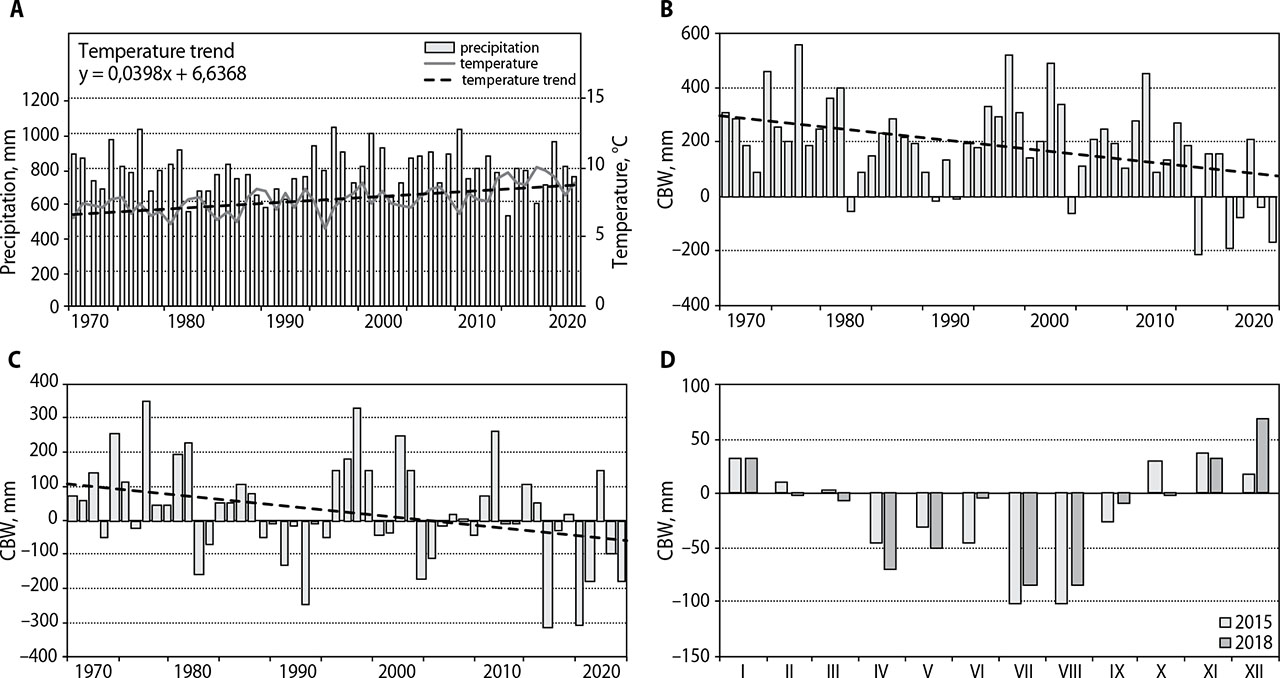
Figure 1.
Climatic conditions in the Polish part of the Sudetes in 1971–2022: A – average annual air temperature and annual precipitation; B – annual climatic water balance; C – climatic water balance in the growing season; D – monthly values of the climatic water balance in 2015 and 2018
Since the beginning of the 1990s, the summer months have been characterised by a strong increasing trend in air temperature and increased sunshine duration, on the one hand, and a negative precipitation trend on the other, which resulted in an increase in potential evapotranspiration. This was reflected in changes in CWB, especially during the vegetation period. Long-term changes in annual and seasonal CWB values were characterised by a negative, statistically significant trend (on average, −25 mm per decade for annual CWB values). A particularly pronounced decrease in CWB values was recorded in the last two decades (2001–2020) when CWB values in the summer decreased by almost 80 mm per decade. The lowest CWB values in 1971–2022 occurred in the last decade, in 2015 and 2018 (Fig. 1B–D). In the lower mountain zones (up to 600 m above sea level), an extreme water deficit occurred; the annual CWB values were −215.6 and −186.4 mm, respectively. The most significant water deficit occurred in summer (Fig. 1D). The CWB deficit continued in the following years: 2019, 2021 and 2022. However, it should be emphasised that the values of the CWB deficit were spatially diversified, with the highest water deficit occurring in 2015 and 2018 in the Central Sudetes, which can be associated with the low susceptibility of this area to the advection of humid air masses from the west.
Results
In the years 2011–2022, in the stands within the study area, thinning of deadwood of 2755 thousand m3 was distinguished. The greatest amount of thinning of deadwood was found in the Bardo Śląskie 521,000 m3) and Świdnica (498,000 m3) forest districts (Fig. 2), but the process was observed in every forest district of Sudetes Mts region. In three forest districts, the amount of deadwood ranged from 200 to 300 thousand m3, in five districts from 100 to 200 thousand m3, and in two forest districts, it was lower then 100 thousand m3.
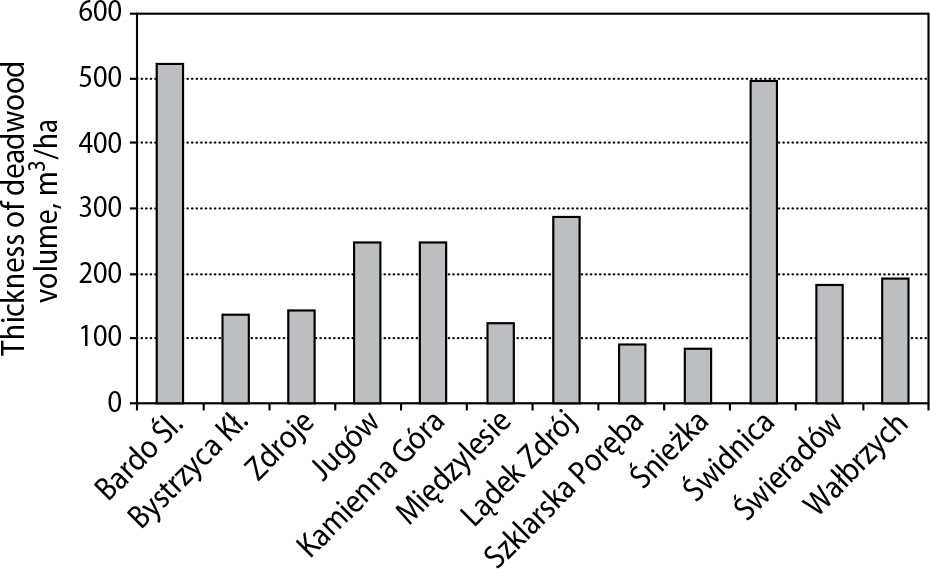
Figure 2.
Volume of deadwood harvested in individual forest districts of the Sudetes in the period 2011–2022
Forest districts with the greatest thickness of deadwood were located in the northeastern part of the Sudetes and are adjacent to each other: Forest Districts of Lądek Zdrój, Bardo Śląskie, Świdnica, Jugów and Kamienna Góra. The least deadwood was observed in the Szklarska Poręba and Śnieżka forest districts located in the western part of the Sudetes.
Deadwood was found in both monoculture and multispecies stands. The largest thickness of the deadwood was found in Norway spruce; its size was 2,592,000 m3, which is 94.0% of deadwood volume. The largest thickness of deadwood of Norway spruce was observed in the Bardo Śląskie and Świdnica forest districts, and the lowest one in the Szklarska Poręba and Śnieżka forest districts (Fig. 3). In the period 2015–2022, many Norway spruce stands were completely disintegrated.
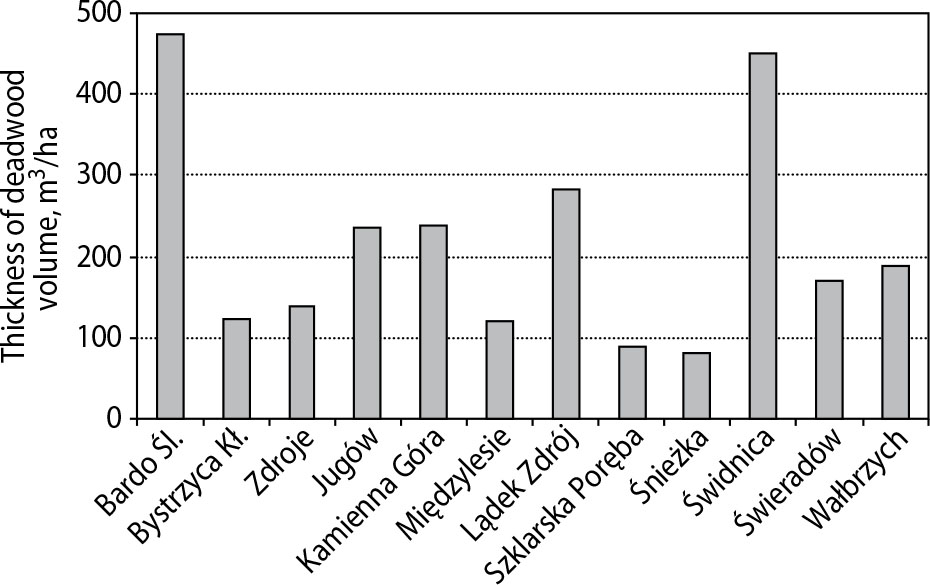
Figure 3.
Volume of dead spruce wood obtained in the Sudetes forest districts in the period 2011–2022
Less deadwood was found in stands that included other tree species because their total thickness in 2015–2022 was 163,000 m3. Apart from Norway spruce, the most harvested deadwood was that of Scots pine and larch (approximately 1% each), and the relatively high share of fir and sycamore deadwood was surprising, considering the low share of these tree species in the forests of the Sudetes (Tab. 3).
Table 3.
Area, share and volume of deadwood of major tree species in the Sudetes forests in the period 2011–2022
| Tree species | Area (ha) | Areal share (%) | Volume of deadwood (thousand m3) | Share (%) of deadwood |
|---|---|---|---|---|
| Norway spruce | 100,392 | 66.0 | 2591.2 | 94.03 |
| Scots pine | 4,680 | 3.1 | 28.3 | 1.03 |
| Larch sp. | 6,300 | 4.1 | 27.0 | 0.98 |
| Fir | 776 | 0.5 | 15.5 | 0.56 |
| Oak sp. | 8,554 | 5.6 | 14.1 | 0.51 |
| European beech | 21,634 | 14.2 | 1.6 | 0.06 |
| Alder | 4,114 | 2.7 | 2.1 | 0.08 |
| Sycamore | 1,913 | 1.3 | 17.2 | 0.62 |
| Other species | 6,499 | 2.5 | 58.8 | 2.13 |
| Total | 154,862 | 100 | 2755.8 | 100. |
The analysed period of 2011–2022 of deadwood thinning in the Sudetes was divided into three 4-year periods, and then the share of deadwood was determined for them (Fig. 4). The first period of 2011–2014 was characterised by a very low share of deadwood in the Sudetes, reaching up to 10% in some forest districts. In the second period of 2015–2018, there was a jump in the share of deadwood and it was maintained in the next period 2019–2022. This large share of deadwood in the last two periods occurred in all forest districts of the Sudety Mts.
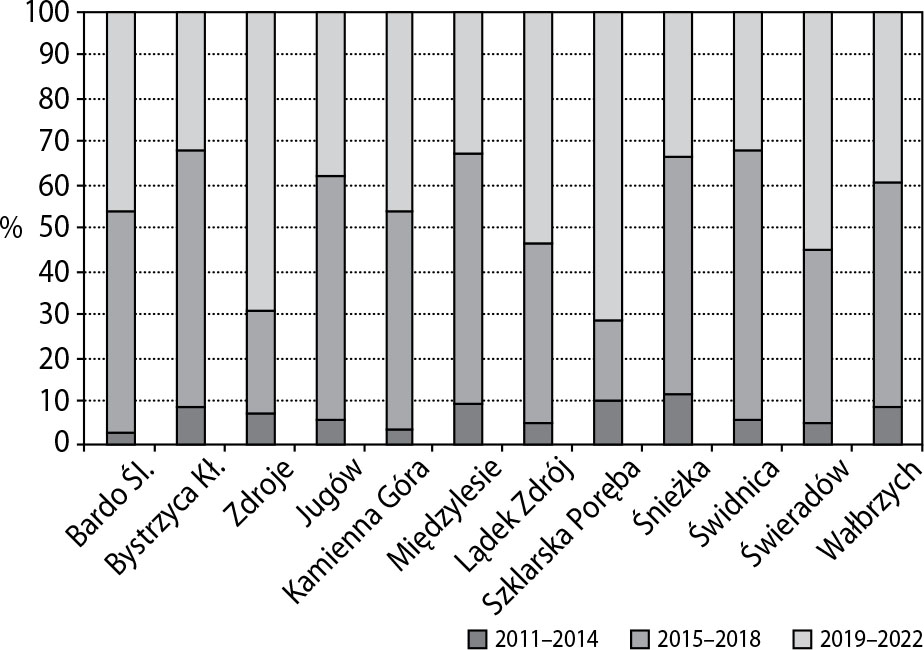
Figure 4.
Share of deadwood volume in the Sudetes forest districts in the periods 2011–2014, 2015–2018 and 2019–2022
Starting from 2015, the process of tree mortality was accelerated, which was indicated by the value of the quotient of deadwood thickness from the periods 2015–2018 and 2019–2022 in relation to the value from the period 2011–2014, called the coefficient of the intensity of the tree dieback process (Fig. 5). For the period 2015–2018, the value of this coefficient ranged from 1.9 for the Szklarska Poręba Forest District to 20.2 for the Bardo Śląskie Forest District (Fig. 5). High values of this coefficient were also obtained in the period 2019–2022, and its highest value of 18.3 was found in the Bardo Śląskie Forest District.
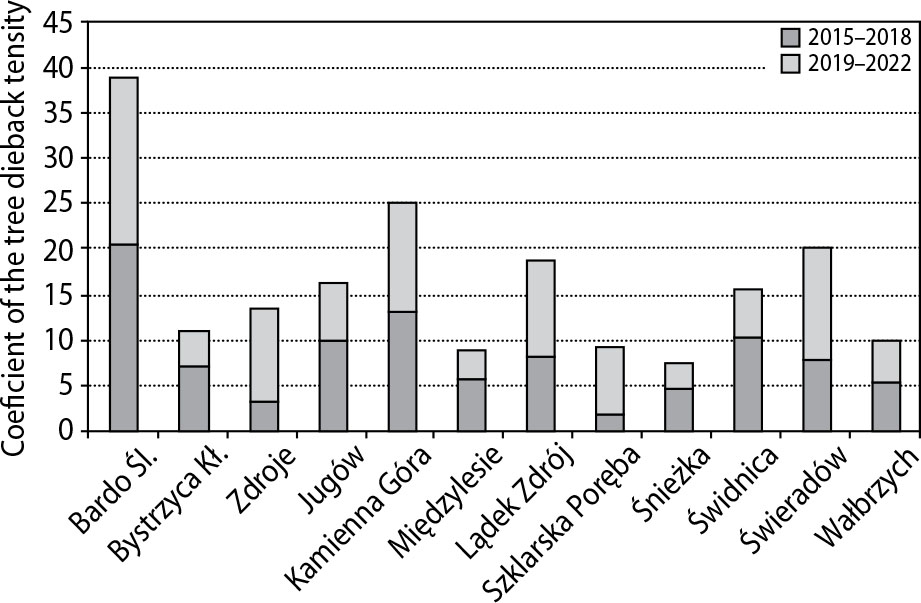
Figure 5.
Ratio of deadwood volume in the periods 2015–2018 and 2019–2022 to deadwood volume in the period 2011–2014
The coefficient of intensity of dieback of individual tree species was highly variable. For Norway spruce, its value for the Sudetes treestands for the period 2015–2018 was 8.5, and for the period 2019–2022, it was 7.6. The highest value of 45.1 was estimated for the first period and 39.6 for the second period accordingly for Norway spruce stands in the Bardo Śląskie Forest District. In five forest districts, this coefficient exceeded the value of 10, and also in five forest districts, values in the range of 5–10 were observed.
Acceleration of the dieback process is also applied to other tree species for the periods 2015–2018 and 2019–2022. A high value of the tree dieback intensity coefficient of 6.8 for the first period and 9.6 for the second period was estimated for Scots pine also. The highest values of the tree dieback intensity coefficient, 20.7 and 21.4, respectively, were estimated for the Bardo Śląskie Forest District, and the lowest ones, 2.4 and 0.4, respectively, for the Szklarska Poręba Forest District. The intensive process of tree thinning was also applied to larch, for which the coefficients were 6.8 and 8.4, silver fir (3.2; 5.6), oak (2.1; 2.6), and alder (2.5; 2.6), accordingly. A low value of the coefficient was estimated for European beech (1.2 and 1.3) and sycamore, and its value of 0.2 and 0.2, respectively, means that an intensive process of dying of this tree species occurred in the period 2011–2014.
In total, for all forest districts, the impact of the basic characteristics of the relief on the process of tree dieback was assessed. In the altitude zones above sea level, the deadwood thickness observed implied that its highest value occurred in the 600–800 m class, that is, in the lower subalpine forest (Fig. 6). On analysing the treestand exposition in relation to the cardinal directions, the smallest share of deadwood was found in the northern expositions (Fig. 7). It was also concluded that the highest share of deadwood occured in the class of land slope 15°–21°, and the lowest share occured in extreme classes (Fig. 8).
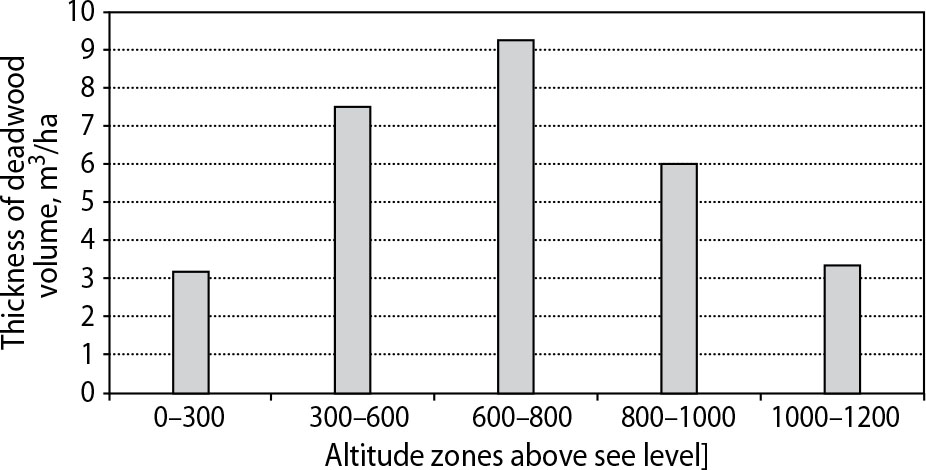
Figure 6.
Thickness of deadwood in altitude zones above sea level
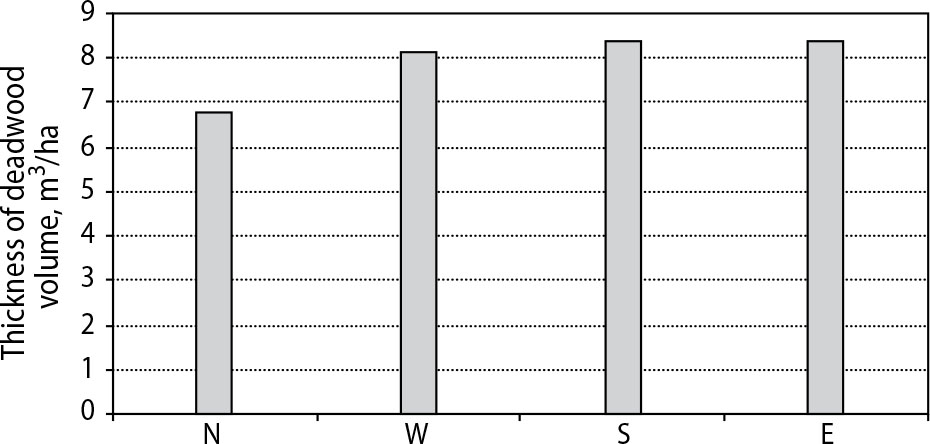
Figure 7.
Thickness of deadwood at different exposures
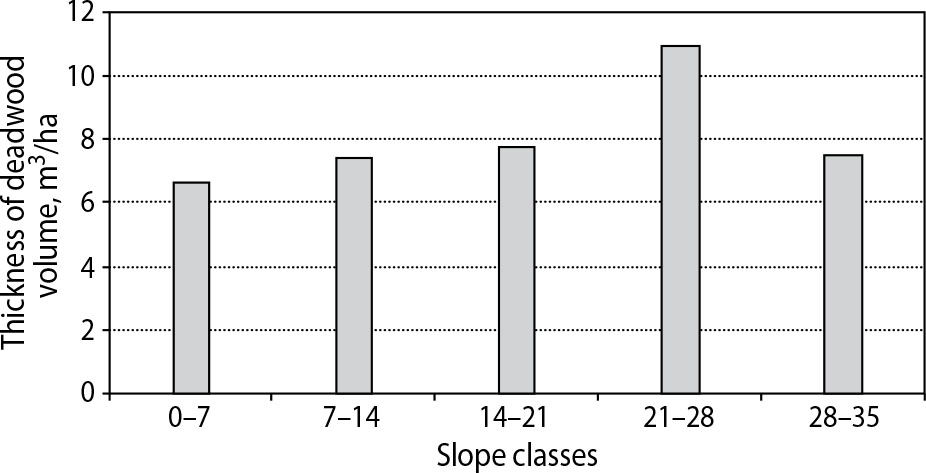
Figure 8.
Thickness of deadwood in slope classes
With an increase in the age class of treestands from II to VI, the share of harvested deadwood increases (Fig. 9). The lower share of deadwood in class VII compared to class VI can be explained by the fact that in the oldest class, there is a large share of converted treestands of relatively low volume.
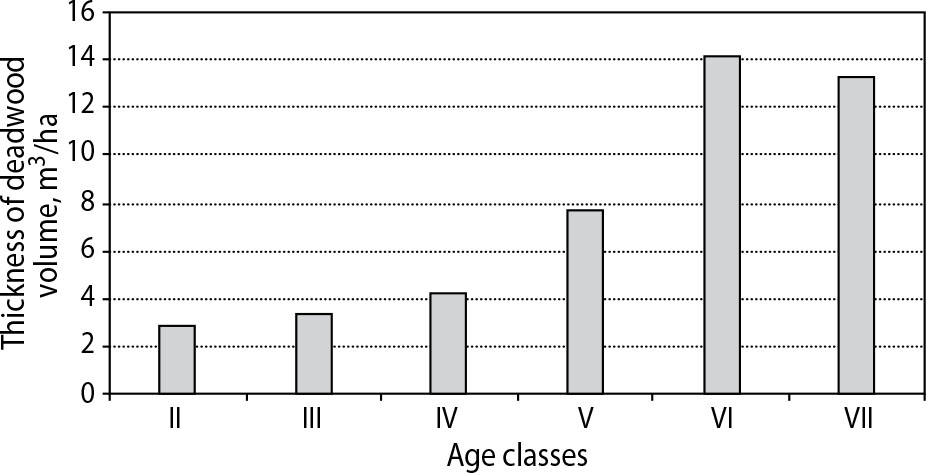
Figure 9.
Deadwood volume in age classes
In the Sudetes, mountain habitats are the most common, followed by upland habitats, among them fresh and moist habitats. The largest amount of deadwood was found in mountain fresh mixed broadleaved forest (LMGśw) habitats and it was over 9 m3 per 1 ha (Fig. 10). In the moist mountain forest (LGw) habitat, deadwood thinning was much lower, amounting to 5.9 m3/ha. In addition, in fresh habitats, that is, upland fresh mixed broadleaved forest, upland frech mixed broadleaved forest and mountain fresh mixed coniferous forest (LMwyżśw, Lwyżśw and BMGśw, respectively), deadwood thinning was much higher than that observed in habitats of the same type, but moist upland moist mixed broadleaved forest, upland moist broadleaved forest and montane moist coniferous forest (LMwyżw, Lwyżw, BMGw). This regularity has not been found in the montane fresh broadleaved forest and montane moist broadleaved forest habitats (LGśw and LGw, respectively).
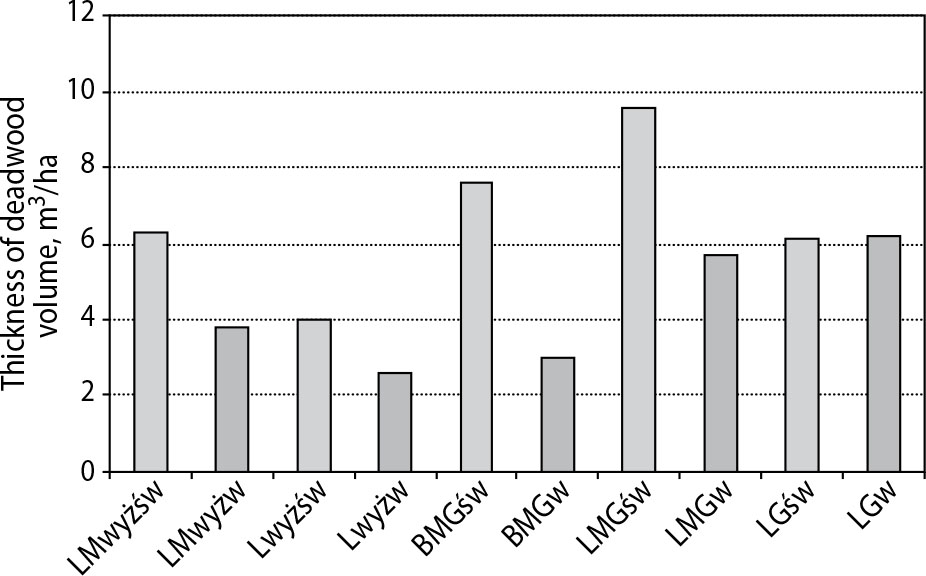
Figure 10.
Thickness of deadwood in fresh and moist sites
Legend: Bb – bog (pine) forest, BG – montane coniferous forest, BMb – bog mixed coniferous forest, BMG – montane mixed coniferous forest, BMśw – fresh mixed coniferous forest, BMw – moist mixed coniferous forest, BMwyż – upland mixed coniferous forest, Bs – dry coniferous forest, Bśw – fresh coniferous forest, Bw – moist coniferous forest, BWG – high-mountain coniferous forest, LG – montane broadleaved forest, Lł – riparian forest, LMb – bog mixed broadleaved forest, LMG – montane mixed broadleaved forest, LMśw – fresh mixed broadleaved forest, LMw – moist mixed broadleaved forest, LMwyż – upland mixed broadleaved forest, Lśw – fresh broadleaved forest, Lw – moist broadleaved forest, Lwyż – upland broadleaved forest, Ol – alder forest, OlJ – alder-ash forest; https://www.lasy.gov.pl/pl/publikacje/in-english/forests-in-poland-2013/@@download/file/Forests%20in%20Poland%202013.pdf
Discussion
Poland’s forests, estimated to cover 10 million ha area, corresponding to 30% of the country’s forest cover, have been threatened for many years by abiotic, biotic and anthropogenic factors, occurring with varying intensity and duration of impact. In the years 1960–1990, industrial pollution was the greatest threat to forests in Poland, as well as in Europe. Not only silver fir and Norway spruce, but also Scots pine were the most endangered treestands at that time. In the south of Poland, the decline in forests was most severe, where industry developed rapidly, which was not accompanied by appropriate expenditures to reduce industrial emissions. It is estimated that acid rains and insect gradations (larch tortrix and bark beetles) were the biggest cause of the dying of spruce treestands in the Sudetes, especially in the Izera Mountains (Capecki et al. 1991).
In the 21st century, more frequent occurrence of strong winds was noted in Poland, causing great damage to forests, including in the Sudetes Mts. They were:
– hurricane ‘Kyrill’ (2007), after which 4.8 million m3 of broken and fallen tree materials were extracted from the forests of the Regional Directorate of State Forests in Wrocław, Katowice and Zielona Góra,
– foehn wind in 2015, after which 247 thousand m3 of broken and fallen tree materials were extracted from the Międzylesie Forest District (Ciesielski et al. 2016).
The winds forced a correction of forest management plans regarding the conversion of the Sudetes forest treestands. The location of the forest treestands for final cuttings and their conversions is imposed, which is usually not the optimal way of breeding and economic management in forests.
In the present century, the growth and development of the forest has been increasingly influenced by the increasing temperature of the air and low precipitation, especially during the vegetation season. Already at the beginning of the 21st century, years with a negative CWB were observed (Miszczuk 2023). In this respect, record was broken in 2006, with a high negative water balance, after which in the Western Beskids Mts, the decay of Norway spruce treestands was intensified (Szabla 2009; Bruchwald and Dmyterko 2010). In recent years, periods of intense drought have also been found in the Sudetes, and 2015 can be considered a record year when the annual CWB was −215.6 mm. Similar results for the Eastern Sudetes were reported by Durło (2019). In 2018, the Sudetes experienced another extreme water deficit (−186.4 mm). Climate change in the Sudetes is also evidenced by the increasing air temperature in April and June, as well as change in the structure of precipitation: the extension of periods without precipitation and the increase in the frequency of very heavy precipitation.
Under the influence of increasing air temperature and drought, the process of creating air embolism symptoms in leaves or shoots occurs in trees (Zimmermann and Brown 1981). This process is also called embolism (Roloff 2010) or cavitation (Boisvenue and Running 2006; Adam et al. 2017), and it leads to breaking the water column in the plant, which usually causes the death of the tree. Cavitation occurs when the pressure resulting from root pressure drops below a threshold value, that is, below the saturated vapour pressure of a given liquid at a certain temperature. As a result of cavitation, gas bubbles are formed that cannot be eliminated in the water column of vessel elements. Thus, the transport of water to the leaves and assimilates to the organs of the plant is blocked.
Trees with wider vessel elements and low wood density are susceptible to cavitation (Hentschel et al. 2014), which is also related to the temperature of the atmospheric air (Rosner et al. 2016). Cavitation is most likely to occur when there is little water in the soil, that is, in the case of drought during the vegetation season and at high atmospheric air temperatures, which happened in Europe in 1976 and 2003 (Ciais et al. 2005; Vitali et al. 2017). According to the same authors, Norway spruce is the most susceptible to cavitation from the studied tree species, while silver fir and Douglas fir are susceptible to a much lesser extent.
In the Sudetes, 2015 was characterised by climatic conditions that were similar to those of Western Europe in 2003, that is, a large deficiency of precipitation and high air temperature (Wrzesiński et al. 2024). Mainly, Norway spruce has been dying and is still dying, with smaller amounts of Scots pine, European larch, European beech and birch. In silver fir and Douglas fir, the process of tree dieback was not found, which may be related to the very small share of these tree species in the study object. An interesting problem that requires further research is to explain the reasons for the more intensive thinning of sycamore in the period 2011–2014, that is, before the period of mass thinning of other tree species, especially Norway spruce.
The process of dying trees in the Sudetes occurs especially in fresh forest habitats and to a much lesser extent in moist ones. This confirms the main reason for the dying of trees, which is insufficient water in the forest environment. Water deficiency occurs mainly in the altitude zone of 600–800 m above sea level. The higher elevations of the mountains are to a lesser extent affected by the process of tree dieback, which may be related to thermal and precipitation inversion in the Sudetes Mts.
Intensive drought in Poland, occurring more often in the current century, forces a different point of view on the role of the forest, emphasising its environmental function. The forest significantly affects the carbon cycle on the globe, and thus is the main supplier of oxygen to the atmosphere. Maintaining a highly productive forest, resistant to drought as far as possible, which is also related to the resistance of plants to cavitation, therefore becomes the primary goal of forest management.
Conclusions
In many parts of our globe, the process of forest dieback is taking place, the main causes of which are, for example, intense winds and severe droughts, especially during the vegetation season. Such drought periods have occurred in Poland, as well, for example, in the Western Beskids Mts, especially since 2006. Nowadays, in the Sudetes Mts, starting from 2015, decline of mainly Norway spruce and, to a lesser extent, Scots pine and European larch is observed.
Forest decline in the Sudetes Mts is observed especially in the lower subalpine forest (600–800 m above sea level), mainly in stands of older age classes and to a lesser extent on the northern expositions. Tree dieback occurs to the greatest extent in fresh forest habitats and to a lesser extent in moist ones. This supports the hypothesis regarding the relationship between the intensification of the process of tree dieback and the water deficiency phenomenon in the forest.
One of the main functions of forests is their environmental role: absorption of carbon dioxide and production of oxygen. The maximisation of these processes occurs in forests with high wood production, that is, in forests with a high volume increment, and such a goal should be one of the important principles of forest management.
The forests of individual mountain regions are advanced in their conversion process to varying degrees. The most favourable changes occurred in the Bieszczady and Beskid Niski Mts, where the dominant tree species are silver fir and European beech. The advanced conversion process of forests is also observed in the Western Beskids, including the Beskid Mały and Śląski Mts. The process of forest conversion in the Sudetes Mts is at the initial stage. It will be, among others, the main task of Polish forest management in the upcoming years.
There is an urgent need to change the concept of forest management in Poland. In the field of silviculture, it should include in particular:
a) planning the species composition of treestands, adapted to the changing of their growth conditions;
b) a critical approach to the methods of forest management, including the harvesting system;
c) a critical verification of the methods used to determine the action level of cutting management, especially harvesting systems, and the order of selection of tree stands for the implementation of these treatments.