
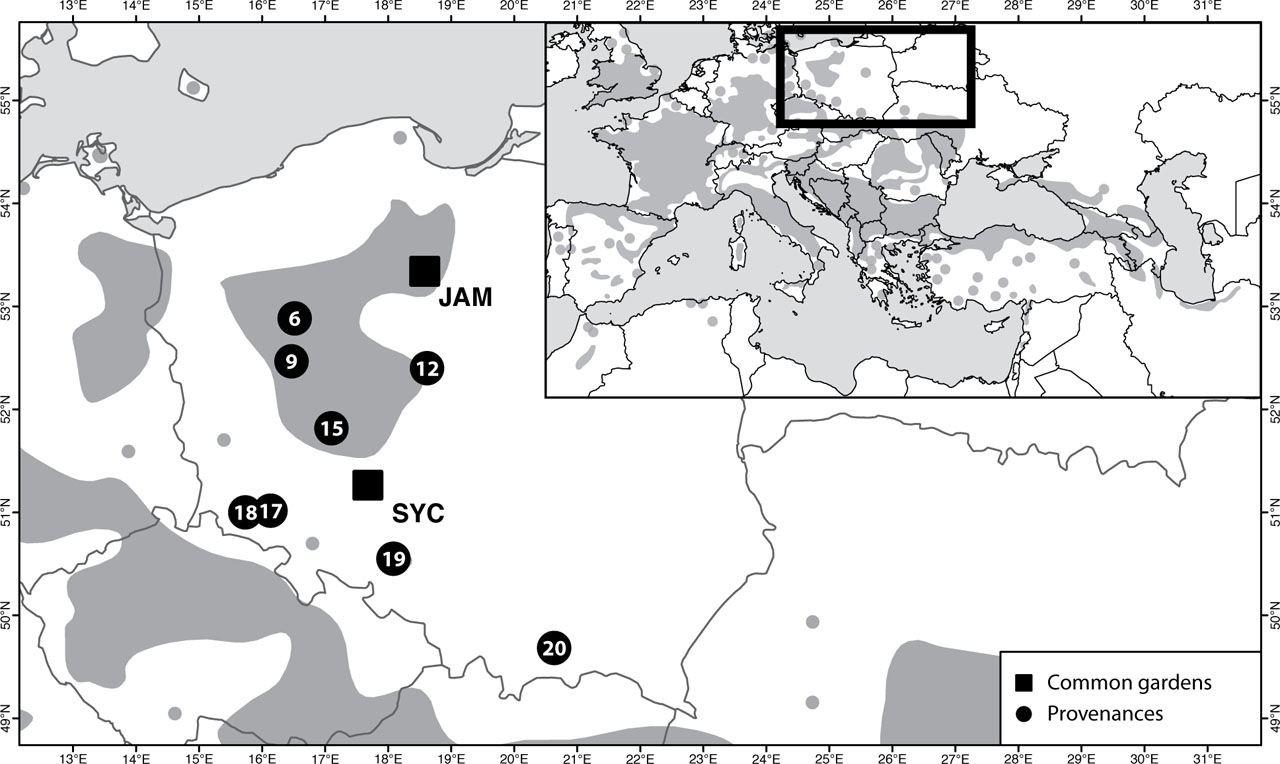
Figure 1.
Locations of wild service tree common gardens (squares) and tested provenances (circles). The ID of provenances according to Table 1. The dark grey polygons and dots on both maps show the distribution range of the species according to Caudullo et al. (2017)
Table 1.
Characteristics of the tested wild service tree (Sorbus torminalis (L.) Crantz) provenances
| IDa | Provenance | Latitude N | Longitude E | Altitude m a.s.l. | Forest site conditions | Soil typeb |
|---|---|---|---|---|---|---|
| 6 | Goraj | 52°53′ | 16°31′ | 50–80 | Fresh broadleaved forests | Brown soils |
| 9 | Bytyń | 52°28′ | 16°28′ | 100 | Fresh broadleaved forests | Leached brown soils |
| 12 | Kawęczyńskie Brzęki Reserve | 52°24′ | 18°37′ | 120–130 |
| Brown soils |
| 15 | Piaski | 51°49′ | 17°12′ | 130 | Fresh broadleaved forests | Stagnosols, brown soils |
| 17 | Jawor | 51°01′ | 16°08′ | 300–395 | Upland forests, mixed upland forests | Raw siliceous rocky soils (litho-sols), rankers, acid brown soils |
| 18 | Lubiechowa | 51°00′ | 15°50′ | 360 | upland forests | Brown soils |
| 19 | Kamień Śląski Reserve | 50°33′ | 18°05′ | 180–190 | Fresh broadleaved forests, fresh mixed broadleaved forests | Rusty soils, brown soils |
| 20 | Białowodzka Góra Reserve | 49°41′ | 20°38′ | 500–550 | Mountain forests | Brown soils, leached brown soils |
a – ID of provenances is identical to Fig. 1 and the study of Bednorz (2006);
b – classification on the basis of Kabała et al. (2019).
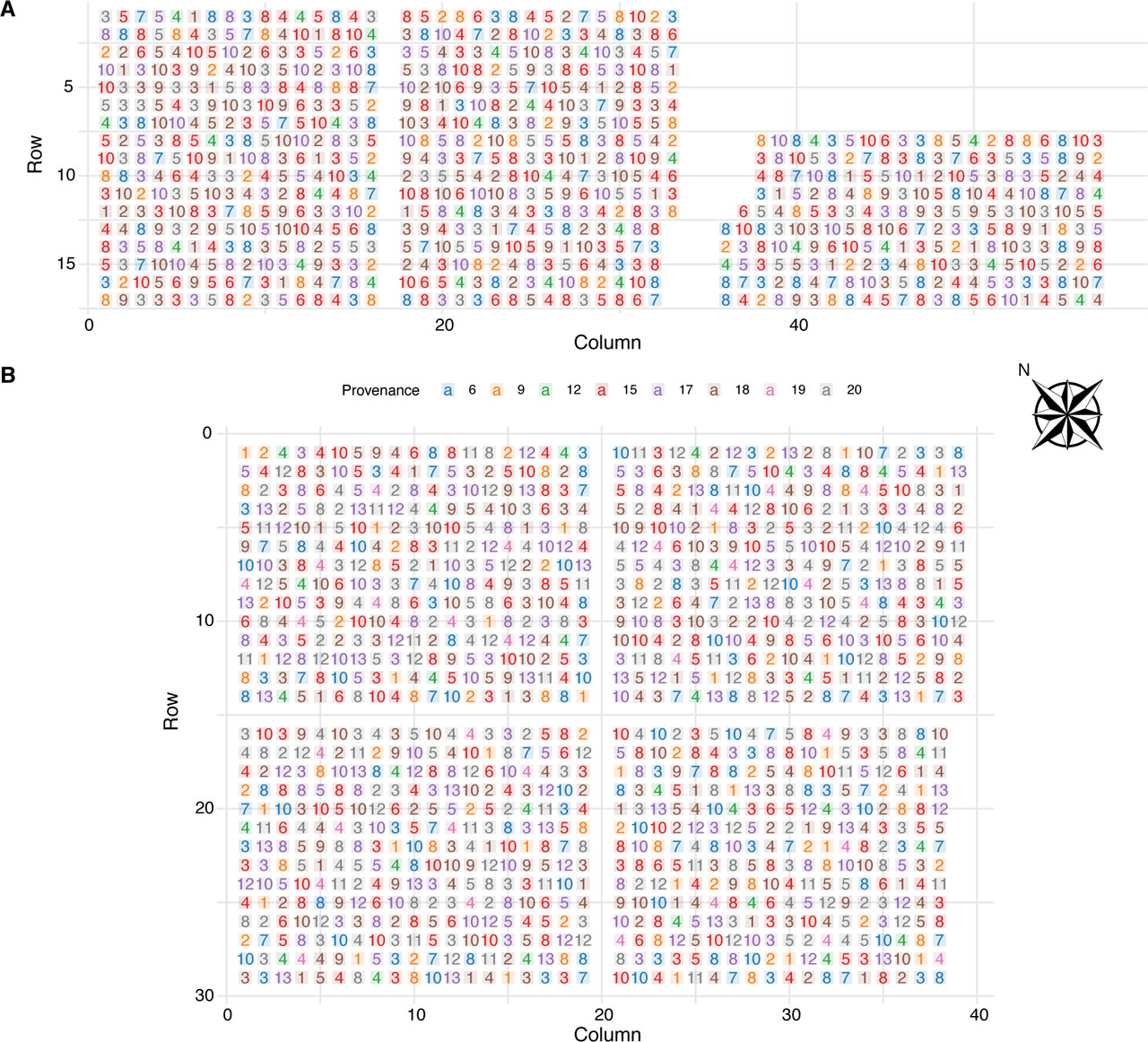
Figure 2.
The original layout of the JAM (A) and SYC (B) common garden trials. Different colours denote provenances, and the numbers (labels) on the layout represent OP families within those provenances. The labels of the OP families correspond to those in Table 2; for example, the red 10 stands for OP family 15/10. The experiments are divided into sub-blocks: at the JAM site, sub-blocks 1, 2, and 3 are left, middle, and right, respectively; at the SYC site, sub-blocks 1, 2, 3, and 4 are top left, bottom left, top right, and bottom right, respectively. The north direction is the same for both sites
Table 2.
Number of seedling planted at the JAM and SYC common gardens according to provenances and open pollinated (OP) familiesa
| Provenance | JAM | SYC | No. | OP family | JAM | SYC |
|---|---|---|---|---|---|---|
| 1 | 2 | 3 | 4 | 5 | 6 | 7 |
| 6 | 93 | 115 | 1 | 6/3 | 25 | 25 |
| 2 | 6/7 | 30 | 30 | |||
| 3 | 6/8 | 38 | 30 | |||
| 4 | 6/10 | - | 30 | |||
| 9 | 55 | 85 | 1 | 9/1 | - | 30 |
| 2 | 9/2 | 30 | 30 | |||
| 3 | 9/8 | 25 | 25 | |||
| 12 | 30 | 30 | 1 | 12/4 | 30 | 30 |
| 15 | 188 | 193 | 1 | 15/3 | 30 | 30 |
| 2 | 15/4 | 30 | 35 | |||
| 3 | 15/5 | 30 | 30 | |||
| 4 | 15/6 | 30 | 30 | |||
| 5 | 15/8 | 38 | 38 | |||
| 6 | 15/10 | 30 | 30 | |||
| 17 | 120 | 180 | 1 | 17/3 | 30 | 30 |
| 2 | 17/5 | 30 | 30 | |||
| 3 | 17/8 | 30 | 30 | |||
| 4 | 17/10 | 30 | 30 | |||
| 5 | 17/12 | - | 30 | |||
| 6 | 17/13 | - | 30 | |||
| 18 | 200 | 206 | 1 | 18/1 | 25 | 25 |
| 2 | 18/2 | 30 | 36 | |||
| 3 | 18/3 | 30 | 30 | |||
| 4 | 18/4 | 30 | 30 | |||
| 5 | 18/5 | 25 | 25 | |||
| 6 | 18/9 | 30 | 30 | |||
| 7 | 18/10 | 30 | 30 | |||
| 19 | - | 30 | 1 | 19/4 | - | 30 |
| 20 | 64 | 211 | 1 | 20/2 | - | 30 |
| 2 | 20/3 | 39 | 36 | |||
| 3 | 20/4 | - | 30 | |||
| 4 | 20/5 | 25 | 25 | |||
| 5 | 20/8 | - | 30 | |||
| 6 | 20/11 | - | 30 | |||
| 7 | 20/12 | - | 30 | |||
| Total | 750 | 1050 | 750 | 1050 | ||
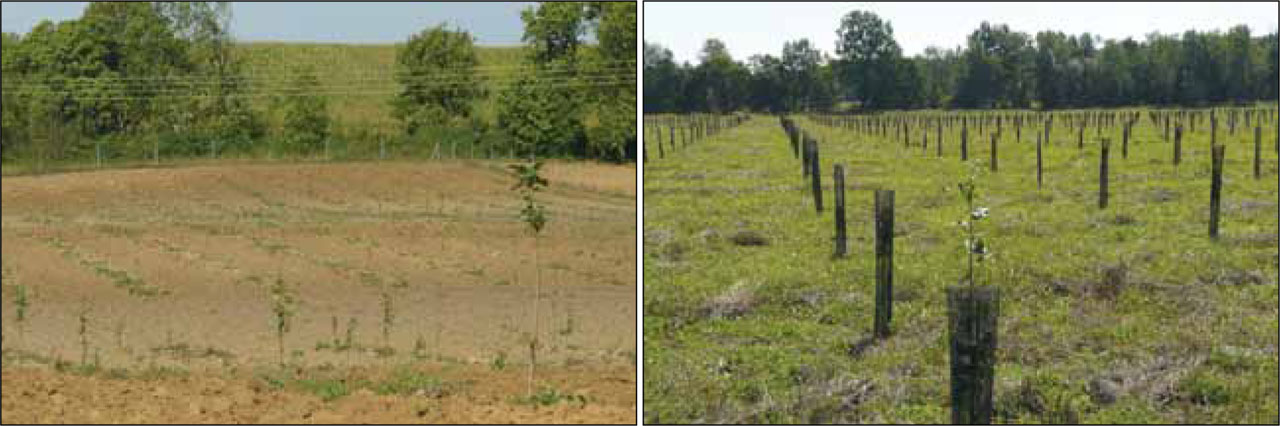
Figure 3.
A view of the JAM (left) and SYC (right) wild service tree common gardens (Photo: Tomasz Wojda, 28–30 August 2012)
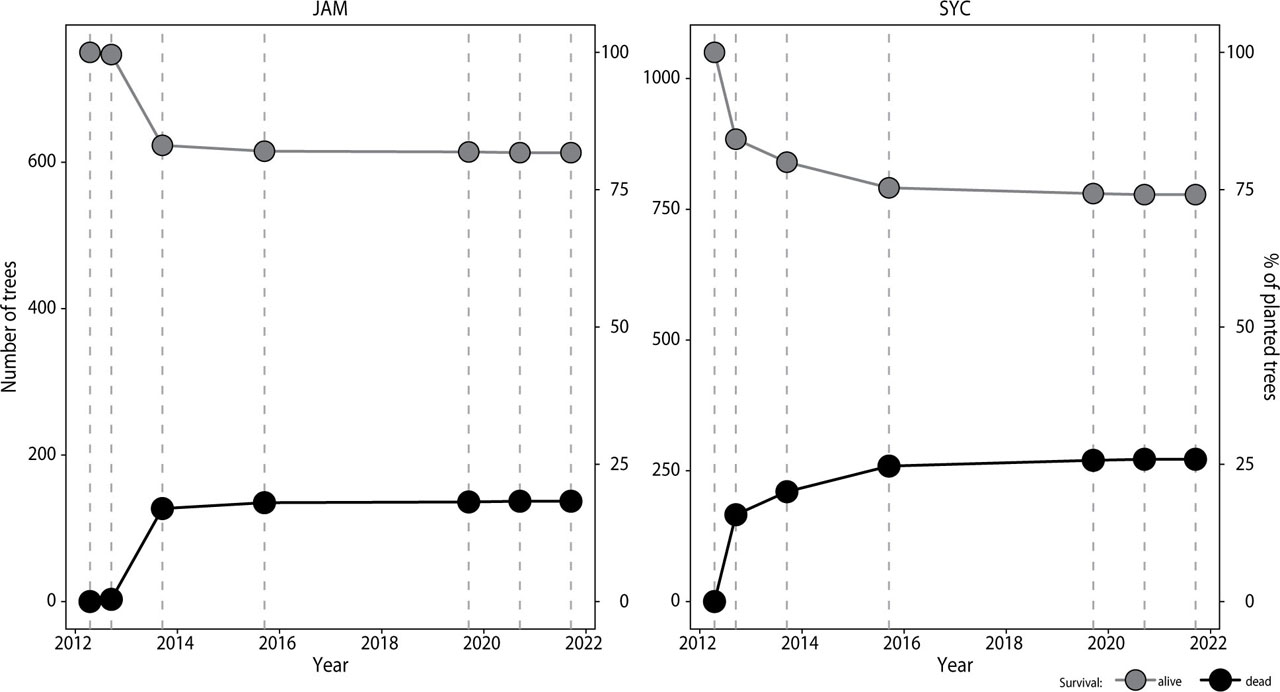
Figure 4.
Survival of trees at the JAM and SYC sites in the first ten years after planting. The grey line represents the surviving trees, while the black line represents the non-surviving trees. Vertical dashed lines indicate the time points at which survival assessments were conducted
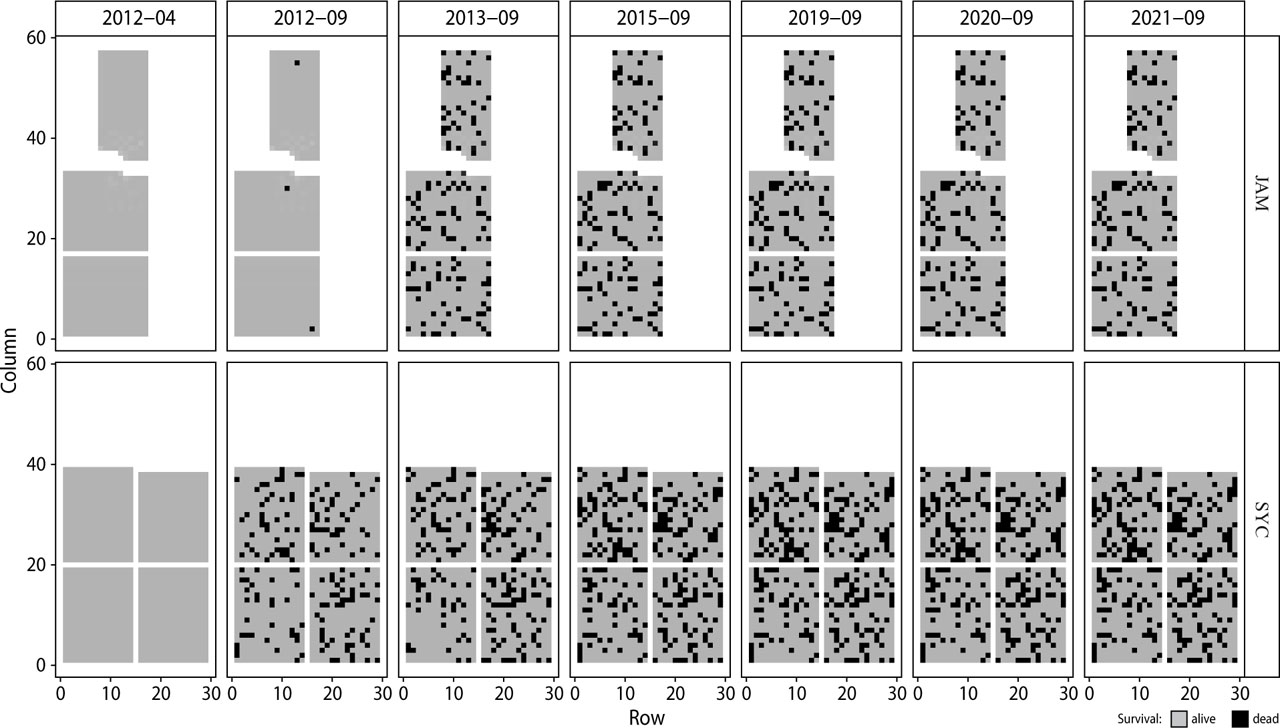
Figure 5.
Spatial visualisation of tree survival in common garden experiments for wild service tree at the JAM and SYC sites during the first ten years after planting. Grey indicates surviving trees, while black represents non-surviving trees
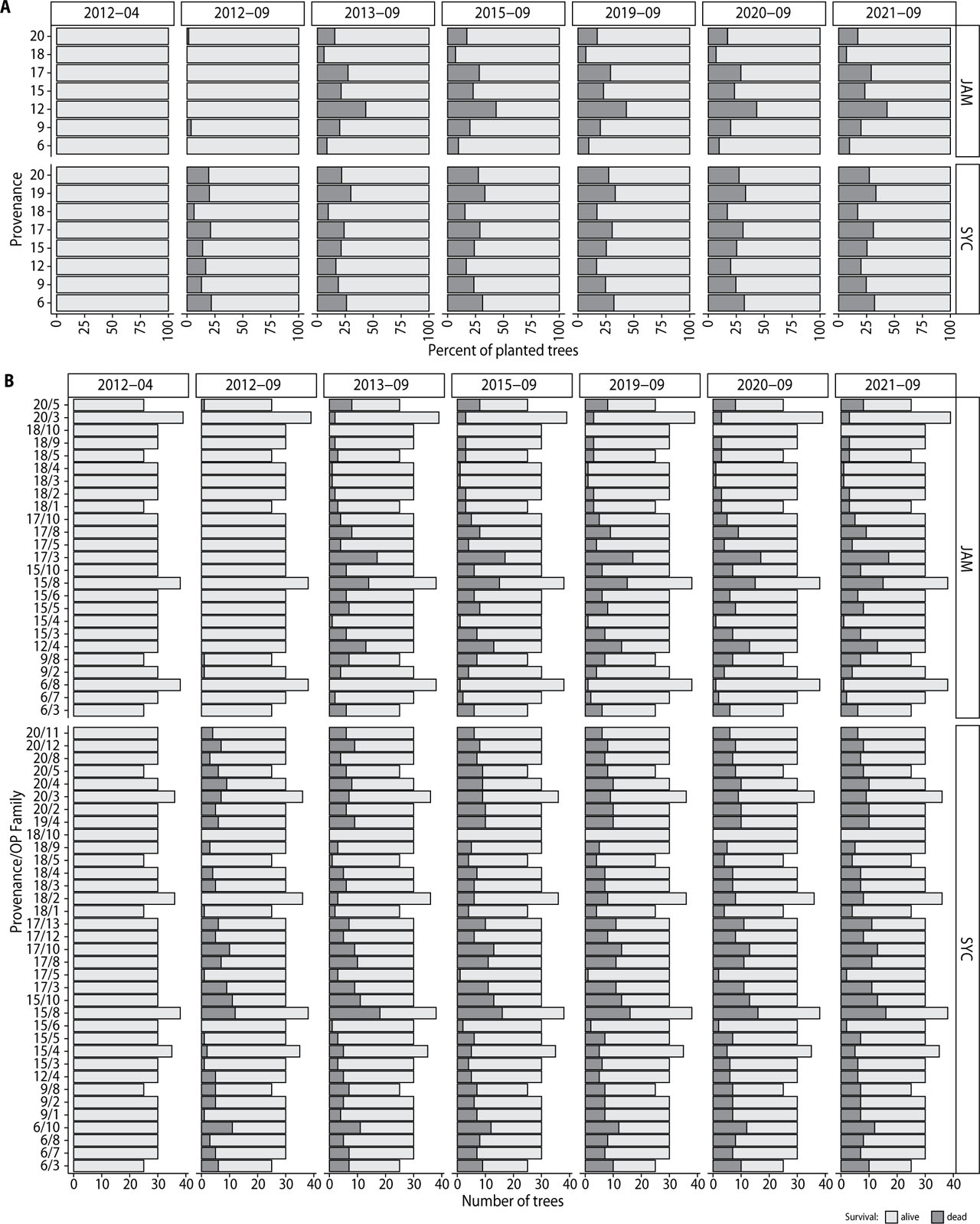
Figure 6.
Survival of provenances (A) and OP families (B) at JAM and SYC sites during the first ten years after planting. Grey indicates surviving trees, while black represents non-surviving trees.
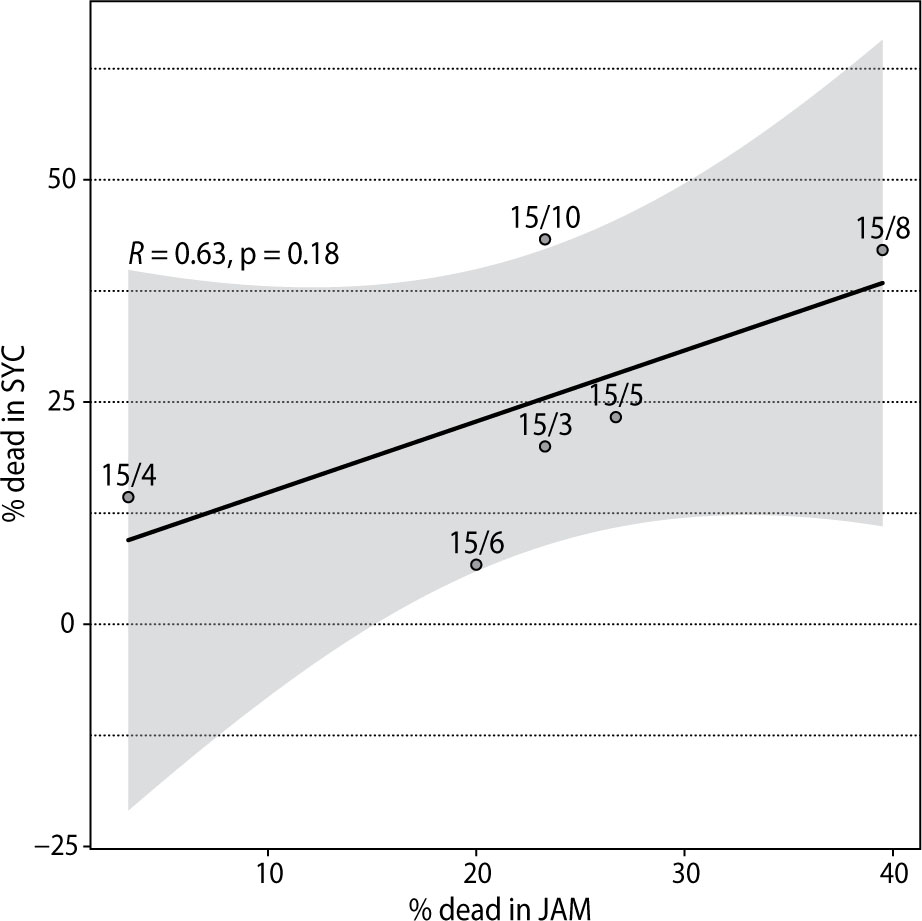
Figure 7.
Percentage of non-surviving trees in OP families within provenance 15. The labelled dots represent the values for OP families at the JAM and SYC sites ten years after planting.
Table 3.
Pearson correlation coefficients for the survival of OP families between the JAM and SYC sites in different years (highlighted diagonal values) and between different years at the same site (JAM – above the diagonal and SYC – below the diagonal)
| 2012-09 | 2013-09 | 2015-09 | 2019-09 | 2020-09 | 2021-09 | |
|---|---|---|---|---|---|---|
| 2012-09 | 0.19 | 0.21 | 0.18 | 0.18 | 0.17 | 0.17 |
| 2013-09 | 0.92 | 0.50 | 0.99 | 0.99 | 0.99 | 0.99 |
| 2015-09 | 0.87 | 0.89 | 0.46 | 0.98 | 0.98 | 0.98 |
| 2019-09 | 0.85 | 0.87 | 0.98 | 0.50 | 1.00 | 1.00 |
| 2020-09 | 0.86 | 0.87 | 0.98 | 1.00 | 0.50 | 1.00 |
| 2021-09 | 0.86 | 0.87 | 0.98 | 1.00 | 1.00 | 0.50 |