
INTRODUCTION
Damage tolerance analysis (DTA) is the foundation of modern aircraft structural integrity assessment. By allowing predictions of fatigue crack propagation rates and residual strength under cyclic loading, DTA represents a significant improvement over earlier safe life and failsafe methodologies. DTA allows engineers to quantify fatigue crack lengths as a function of load cycles and establish critical crack lengths at failure. This information enables the selection of inspection methods tailored to detectable crack sizes and the formulation of inspection intervals with a high probability of detecting fatigue cracks before structural failure occurs.
As commonly implemented, DTA frequently adopts a generic assumption for the initial crack length, and this generalized guidance typically does not explicitly account for the inherent variability in detection capability among various nondestructive inspection (NDI) methods. Integrating method specific probability of detection (POD) data, derived from inspection sensitivity studies, into crack growth models offers a promising pathway to enhance the predictive accuracy of the DTA methodology. This synergistic approach has the potential to refine estimates of crack length with respect to flight cycles while facilitating the design of flexible inspection programs. Within such programs, multiple NDI methods may be employed, including lower sensitivity techniques applied at higher inspection frequencies, to achieve cumulative POD levels equivalent to, or exceeding, those obtained using high sensitivity, high-cost inspection methods commonly adopted in conventional practice.
PROBABILITY OF DETECTION DATA
POD data quantify the likelihood that a crack of a given size will be detected using a specific NDI method. This probability data is amassed from controlled experimental studies in which known cracks are inspected under defined conditions, allowing detection performance to be characterized as a function of crack size and inspection method.
As a statistically derived measure of inspection performance based on controlled testing, POD data provide a quantitative foundation for evaluating projected NDI detection capability. Because the data is generated under specific experimental conditions, the resulting detection probabilities reflect not only the inspection method itself, but also the material being examined, the structural configuration, the inspection environment, and the proficiency of the personnel performing the examination. For example, inspections conducted under controlled production settings on subassemblies prior to fastener installation may demonstrate different detection capability than inspections performed on in-service aircraft under line-maintenance conditions. Similarly, inspectors who are routinely assigned to a particular component may achieve different detection performance than generalist inspectors who encounter that component infrequently. For this reason, many POD studies organize results by inspection environment (e.g., production versus field), inspector classification, and in some cases by individual inspector, thereby preserving traceability to the conditions under which the data was obtained and enabling meaningful application to comparable inspection scenarios. Accordingly, many aircraft manufacturers, commercial operators, and military organizations establish internal proprietary POD guidance or qualification standards to ensure that selected datasets appropriately reflect their specific inspection methods, environments, and personnel training practices.
Publicly available POD data can be obtained from a variety of sources; among the most comprehensive publicly accessible references is the Nondestructive Testing Information and Analysis Center (NTIAC) Probability of Detection for Nondestructive Evaluation report (Nondestructive Testing Information Analysis Center, 2000). This document compiles results from numerous double-blind studies covering a range of NDI methods, materials, and structural configurations. An example POD curve extracted from this database is shown in Figure 1.
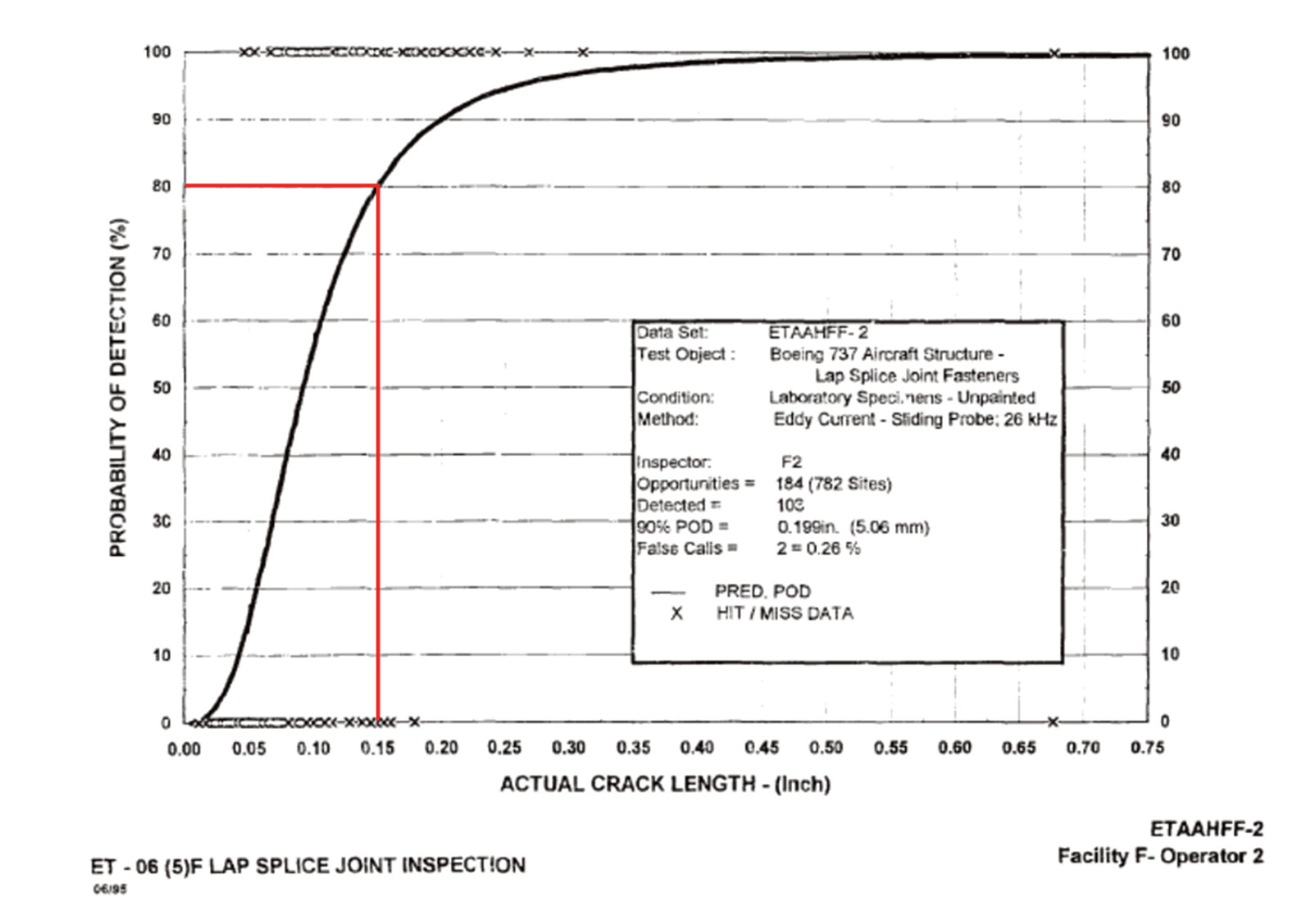
Figure 1.
Sample POD curve for a high-frequency eddy current inspection. (Best available copy, Nondestructive Testing Information Analysis Center, 2000).
As illustrated in Figure 1, the NTIAC data plot the probability of detecting a flaw as a function of crack length for a specific inspection method and configuration. By way of example, the curve indicates that a crack approximately 0.15 in. in length has an estimated single inspection detection probability of about 80% under the test conditions represented.
POD data of this type are not limited to assessing detection likelihood for a single inspection event. When multiple inspections are conducted over the service life of a component, POD information may be combined to estimate the cumulative probability of detection across the inspection program. If each inspection is treated as an independent event with two possible outcomes, detection or non-detection, the probability that a flaw remains undetected is obtained by multiplying the nondetection probabilities for each inspection. This nondetection probability is commonly referred to as the null hypothesis (Treloar, 1939). For the example shown in Figure 1, a flaw with an 80% probability of detection per inspection has a 20% probability of going undetected. For three independent inspection opportunities, the probability that the flaw remains undetected is therefore;
corresponding to a 0.8% chance of nondetection and, equivalently, a 99.2% cumulative probability of detection.A detection capability of this order would, by conventional understanding, be regarded as a “high probability of detection.” This characterization is consistent with language employed in Federal Aviation Administration (FAA) transport category regulations and reflected in corresponding European Union Aviation Safety Agency (EASA) guidance addressing crack detection during aircraft inspections. Although the term “high probability” appears in regulatory language, it is not explicitly defined within the FAA guidance. In practice, a demonstrated probability of detection of 90% with 95% statistical confidence—the so-called 90/95 criterion—has emerged as the de facto industry benchmark (Miedlar et al., 2002). The probability value represents the expected frequency of flaw detection at a given size, whereas the confidence level reflects the statistical certainty associated with that estimate based on the supporting experimental data.
It is important note that many sources of POD data meet the 90/95 criteria, it is also important to recognize that the POD values reported in the NTIAC database represent detection probabilities derived from individual experimental trials. Consequently, curves such as those shown in Figure 1 do not represent specified confidence bound POD (e.g., 90/95), but rather reflect detection performance under specific test conditions. 90% POD values often exceed 90/95 standard (Berens, 2000), accordingly, some degree of engineering judgment is required when applying data of this type. Despite these limitations, the NTIAC database and similar sources provide a valuable qualitative basis for comparing the relative detection capabilities of different NDI methods, particularly when trends are evaluated across comparable configurations. In this study, cited POD data are therefore used to illustrate how inspection capability may be incorporated into the analytical framework, rather than to assert universally applicable quantitative inspection performance.
OVERVIEW OF DAMAGE TOLERANCE ANALYSIS
DTA is the prevailing framework for ensuring the structural integrity of aircraft components subject to cyclic fatigue. While a comprehensive treatment of the DTA methodology exceeds the scope of this paper, a high-level overview is essential to contextualize the integration of POD data and its potential to refine current practices.
DTA is founded on the assumption that structural members under evaluation contain an undetected initial crack. This assumption, colloquially referred to as the “rogue flaw,” does not imply that components are necessarily cracked in service; rather, it reflects the finite detection capability of NDI methods used in aircraft production and maintenance. Crack growth is modeled using fracture mechanics-based approaches that account for component geometry, material properties (including fracture toughness), and residual strength requirements under limit loads (Federal Aviation Administration, 2015; Berens, 2000). The analysis simulates the propagation of an assumed initial crack from a postulated starting length to a critical length, at which the component can no longer sustain the required limit flight loads. Crack growth predictions are typically based on established formulations, such as the Paris law, integrated with representative loading spectrums and material crack growth data.
The predicted crack growth, from the assumed initial crack length (a0) to the critical crack length (aCRIT), forms the basis for establishing inspection intervals (Federal Aviation Administration, 2015). To ensure structural safety, inspections must have a high probability of detecting a crack before it reaches aCRIT. Regulatory guidance recommends repetitive intervals corresponding to a fraction (commonly 1/2 to 1/3) of the detectable growth life (Federal Aviation Administration, 2015). An appropriate NDI method is then selected, capable of reliably detecting cracks at or before the sizes predicted during the interval.
The aCRIT is largely deterministic, and subject to minimal variability in calculation methods as it is a function of the material’s fracture toughness and applied stresses. In contrast, the selection of a0 introduces greater subjectivity. While regulatory and industry guidance provides recommendations for a0 based on manufacturing quality, service experience, and NDI capabilities, a 0.05-inch initial flaw has become a prevailing industry benchmark in many civil aviation certifications by the FAA and EASA (Federal Aviation Administration, 1978; Federal Aviation Administration, 1995; Aeronautical Sciences, 2017). The assumed a0 significantly influences the total predicted life and derived inspection intervals, underscoring the need for its careful justification.
BASELINE EXAMPLE
To illustrate how the incorporation of POD can enhance the fidelity of a damage tolerance analysis and its associated inspection program, a baseline case consistent with current regulatory guidance and industry practice is presented. To isolate the effects of POD integration and avoid unnecessary geometric or load path complexity, a simple center cracked panel configuration is selected for this demonstration.
The baseline configuration consists of a 2024-T3 aluminum panel 4 in. wide and 0.040 in. thick, assumed to be infinitely long in the direction of applied load. An initial crack length of 0.05 in. is assumed, consistent with commonly adopted guidance. (Configuration is illustrated in Figure 2.) The panel is subjected to constant-amplitude cyclic loading at a maximum stress of 25 ksi with a minimum stress of zero. The software input defines stress ratio (R) as minimum stress divided by maximum stress, which equates to zero in this example.
For the purpose of establishing inspection criteria, the component is assumed to be installed on a large transport category aircraft (i.e., regulated under FAA 14 CFR Part 25) and classified as a single load path structurally significant item, such that failure could result in a safety of flight concern. Inspections in this example are assumed to be performed using a high frequency eddy current (HFEC) NDI method.
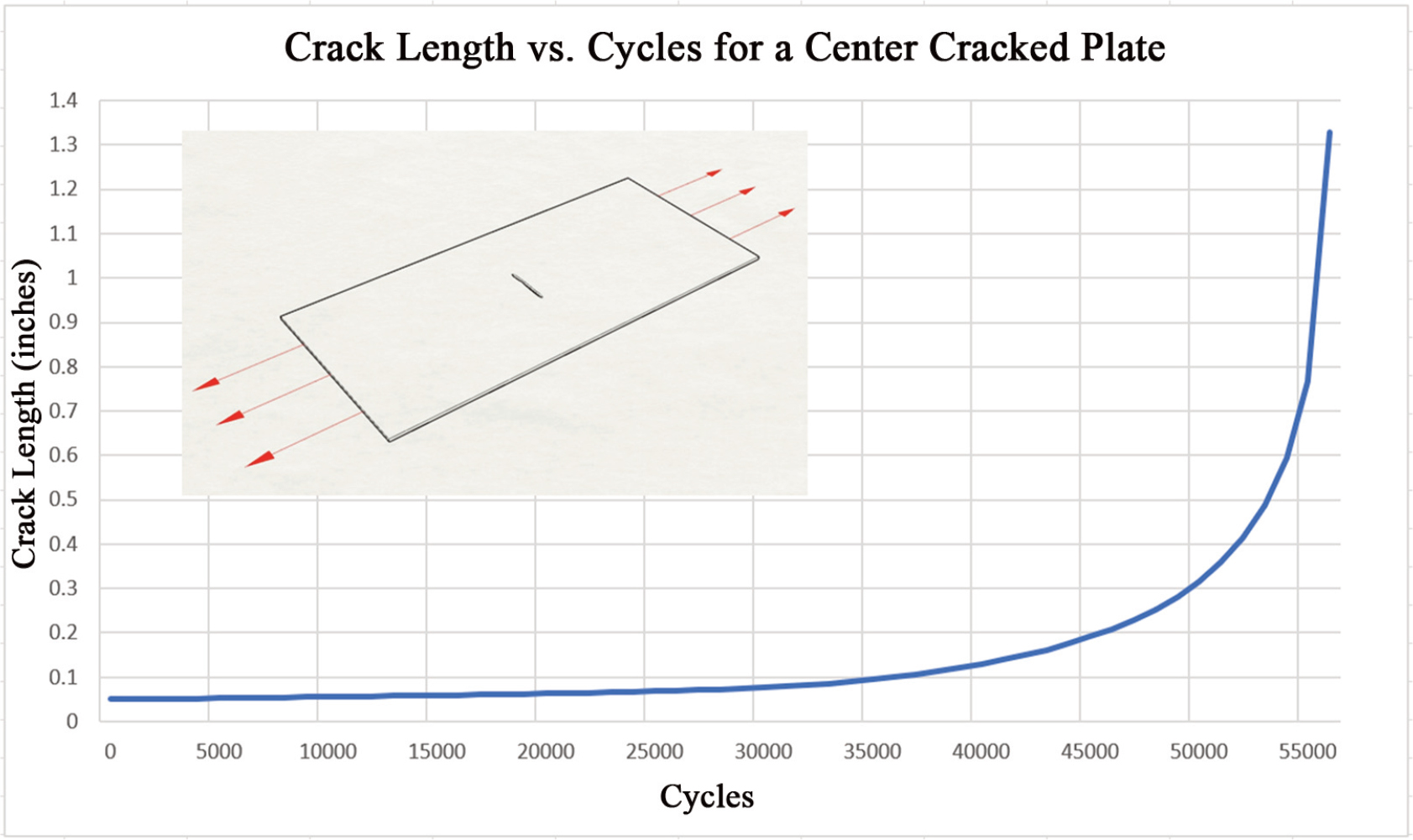
Figure 2.
Cycles vs crack length for a center cracked 2024 T3 Aluminum panel. Data generated by AFGROW Version 4.008.
Crack growth as a function of applied load cycles is simulated using AFGROW software and is shown in Figure 2. For clarity, the results are presented in terms of total crack length; AFGROW natively reports half crack length for this configuration necessitating this adjustment. For the selected loading and geometry, the aCRIT length of 1.33 inches is reached at 55,783 cycles.
Inspection planning for this scenario follows established damage tolerance analysis (DTA) methodology consistent with 14 CFR §25.571. The relationship between detectable crack length (aDET), critical crack length (aCRIT), and inspection intervals is illustrated in FAA AC 91-82A and provides a useful framework for interpreting the inspection process. This approach introduces the concept of a detectable crack length, denoted aDET, which corresponds to the minimum crack size that can be reliably detected by the selected NDI method. The number of cycles required for a crack to grow from aDET to aCRIT defines the allowable inspection interval, denoted L. In practical terms, L represents the interval within which a crack must be detected to preclude structural failure. FAA guidance recommends that a minimum of two inspection opportunities be provided within this interval.
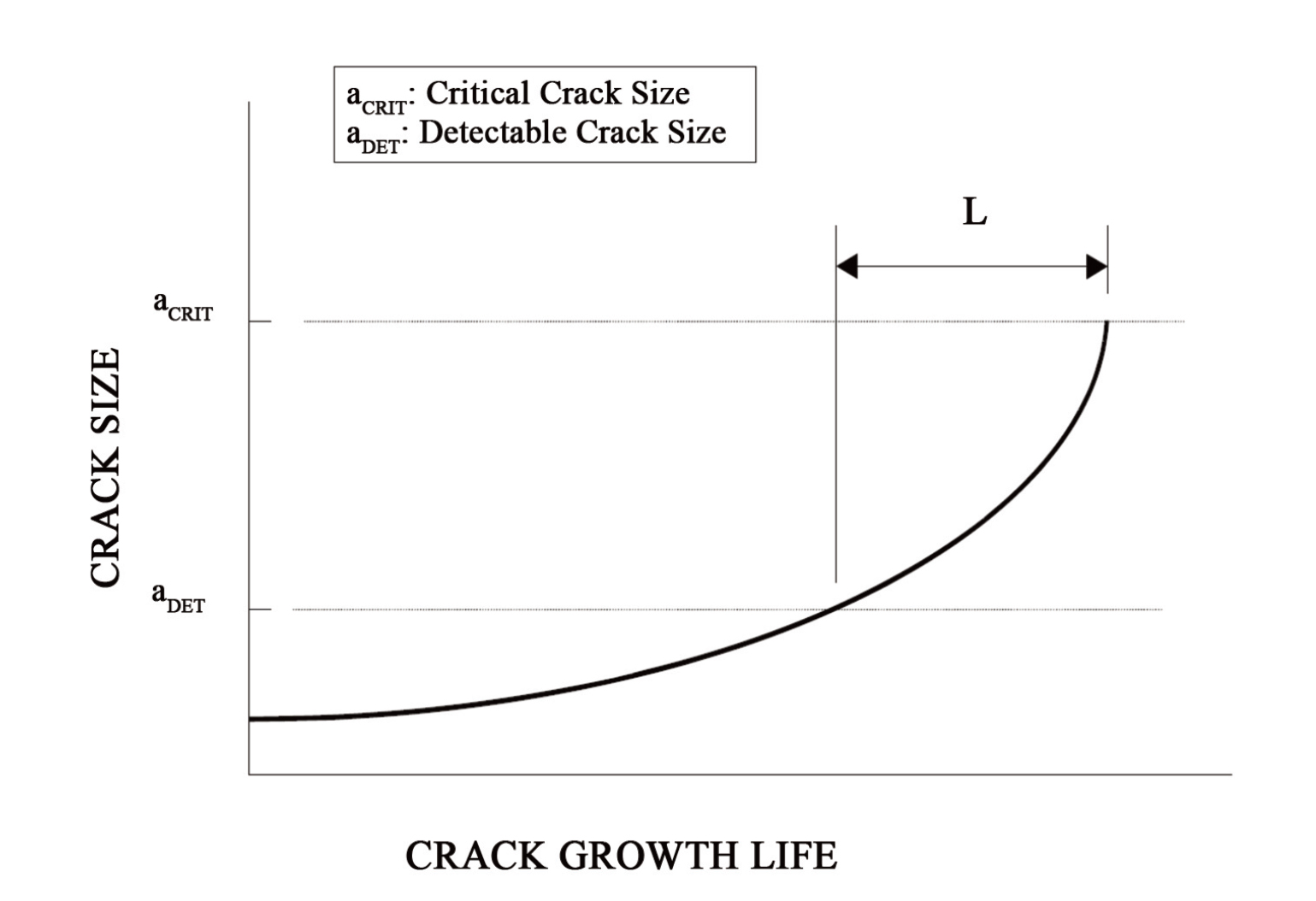
Figure 3.
Crack Growth in a single load path structure and inspection terminology for FAA AC 91-82A (Federal Aviation Administration, 2015).
Regulatory guidance provides limited quantitative guidance regarding the POD level required to define aDET. While FAA documents generally imply a “high probability of detection” at aDET (Federal Aviation Administration, 2015), “high probability” is not explicitly defined as described earlier. For general surface inspections using HFEC methods, Boeing Design for durability and damage tolerance (D6-24958) recommends an aDET value of 0.2 for a general surface inspection. This aligns with the 90% POD threshold of 0.199 in. reported in Figure 1. Accordingly, for the purposes of this scenario, “high probability” and aDET will be as defined 0.2 in.
As shown in Figure 2, a crack length of 0.2 in. is reached at approximately 45,000 cycles. With aCRIT occurring at approximately 55,800 cycles. Thus, the resulting inspection interval (L) is 10,800 cycles.
Consistent with FAA guidance requiring two inspection opportunities within this interval (Federal Aviation Administration, 2015) a repetitive inspection interval of approximately 3,600 cycles is obtained. Under this baseline scenario, inspections would therefore commence at 45,000 cycles and be repeated at 3,600-cycle intervals thereafter. The baseline case parameters and resulting inspection cycle are summarized in Table 1.
Table 1.
Baseline case parameters and resulting inspection cycle.
| Baseline Example Summary | |||||
|---|---|---|---|---|---|
| Initial Crack Length0.05 (2,3) | Critical Crack Length1.32 (4) | Total Life 55783 cycles (4) | Threshold Inspection 45000 cycles (5) | Allowable Inspection Interval 10783 cycles (6) | Recurring Inspections 3600 cycles (7) |
[iv] 3. FAA Transport Airplane and Engine Issue Area General Structures Harmonization Working Group Task 5
[v] 4. From AFGROW simulation Figure 2
Incorporating POD into a DTA analysis and Inspection Program
The DTA framework and associated inspection procedures have guided fatigue management for U.S. transport category aircraft since the late 1970s (Federal Aviation Administration, 1978). By requiring the assumption of initial damage, explicit crack growth evaluation, and recurring inspections, DTA shifted structural design and certification from crack avoidance to crack management. The sustained application of this regulatory methodology has markedly improved aviation safety: structural fatigue related fatal accidents, once a recurring hazard, have become comparatively rare (Aeronautical Sciences, 2017).
However, as with any mature and successful engineering framework, opportunities remain for technical refinement. The incorporation of POD data offers a means to enhance DTA by more directly accounting for the demonstrated performance of contemporary nondestructive inspection methods while remaining fully consistent with existing regulatory requirements. In this context, POD is not proposed as a replacement for established damage tolerance procedures, but as a complementary source of quantitative information that can be integrated within the current analytical framework. By directly linking crack-growth predictions to the measured detection capability of specific inspection methods, POD provides a defensible basis for estimating initial flaw size, refining inspection intervals, and informing inspection method selection. To illustrate this approach, the baseline DTA example introduced previously is extended to incorporate POD data, allowing the resulting effects on crack-growth prediction, inspection frequency, and inspection method selection to be contrasted with the baseline case.
Incorporating POD into a0 determination
The selection of a0 represents a critical parameter in DTA and is an area in which the use of POD data may provide a quantitative basis for its determination. Consistent with conservative engineering judgment, the assumed “rogue flaw” (i.e., a0) should correspond to the largest crack that could reasonably remain undetected during aircraft manufacturing, repair, or alteration when evaluated using the POD data specific to the inspection method employed. This principle is reflected in regulatory requirements for transport-category aircraft. For example, FAA 14 CFR 25.571 requires:
“assuming the structure contains an initial flaw of the maximum probable size that could exist as a result of manufacturing or service-induced damage”
Similarly, EASA CS 25.571 requires:
“assuming the structure contains an initial flaw representative of a defect or damage of the maximum probable size that could exist as a result of manufacturing processes or manufacturing or service-induced damage”
Determination of the maximum probable flaw size is inherently dependent upon the inspection method employed during an aircraft’s manufacture, repair, or alteration. Existing reference and guidance material addressing the selection of a0 reflect two generally accepted approaches: some recommend or imply the use of probability of detection data to justify the assumed initial flaw size (Miedlar et al., 2002; Federal Aviation Administration, 1995), while others support the adoption of 0.05 inches as a standardized default value applicable across configurations and inspection methods (European Union Aviation Safety Agency, n.d.; Federal Aviation Administration, 1978). Additional guidance permits use of the 0.05-inch generic assumption while noting limitations on its applicability (European Union Aviation Safety Agency, n.d.). For purposes of demonstrating compliance with the referenced regulations, either approach is currently acceptable; in practice, particularly for transport category aircraft repairs and alterations, the 0.05-inch assumption is widely utilized.
It should also be noted that current EASA guidance requires that when a0 = 0.05 inches is assumed, the allowable life (L) be reduced by a factor of two (European Union Aviation Safety Agency, n.d.). This requirement represents an additional conservatism applied when adopting the generic initial crack length and reflects regulatory caution regarding the use of a standardized default value.
The baseline example adopted a0 = 0.05 inches in accordance with established convention and assumed high-frequency eddy current (HFEC) inspection for both manufacturing and subsequent in-service inspections. Using this assumption, Table 1 summarizes the resulting inspection schedule, with HFEC inspections commencing at 45,000 cycles time in service and repeating every 3,600 cycles thereafter.
The value of incorporating POD data becomes evident when inspection capability is explicitly incorporated into the determination of a0. If an inspection method were employed at the time of aircraft manufacture whose 90/95 detection capability corresponded to a crack length of 0.05 inches or smaller, selection of a0 = 0.05 inches would be directly supported by demonstrated inspection performance, and the inspection intervals summarized in Table 1 would remain analytically consistent with regulatory intent.
However, for purposes of the baseline example, it was assumed that the HFEC NDI method employed during component manufacture had a 90/95 detection threshold of approximately 0.2 inches based on Figure 1 and The Boeing Company D6-24958. Under these assumptions, and consistent with the regulatory requirement to assume the maximum probable undetected flaw, a crack of 0.2 inches would be assumed to be present at the time of manufacture, resulting in a revised a0 of 0.2 inches. Reference to Figure 1 indicates that such a crack would reach critical size in approximately 10,800 cycles. Because the assumed initial flaw size is equal to the detectable crack length for the selected inspection method, detection capability is effectively satisfied at entry into service. Accordingly, HFEC inspections would commence at 3,600 flight cycles and repeat at 3,600-cycle intervals thereafter.
While the DTA analytical procedure remains unchanged and regulatorily compliant in both cases, incorporation of POD data demonstrates that the assumed initial flaw size directly governs the timing of inspection initiation and therefore the residual risk carried into service. As summarized in Table 2, the difference in assumed a0 produces a substantial shift in inspection commencement, from 45,000 cycles in the baseline case to 3,600 cycles when manufacturing inspection capability is explicitly considered. When the 90/95 detection threshold of the manufacturing HFEC inspection is incorporated, analysis indicates that a detectable flaw could reach critical size well before the first scheduled inspection under the generic assumption. The comparison presented in Table 2 therefore illustrates that the initial flaw assumption is not merely a modeling parameter, but a controlling factor in inspection timing and structural risk exposure.
Table 2.
Comparison of baseline example inspection program to POD based a0 inspection program.
| Comparsion of Baseline Example Inspection to POD based a0 | ||||||
|---|---|---|---|---|---|---|
| Assumed a0 | Initial Crack Length | Critical Crack Length | Total Life | Threshold Inspection | Allowable Inspection Interval | Recurring Inspections |
| Baseline | 0.05 | 1.32 | 55783 cycles | 45000 cycles | 10783 cycles | 3600 cycles |
| With POD | 0.2 | 1.32 | 10783 cycles | 3600 cycles | 10783 cycles | 3600 cycles |
Although both approaches satisfy regulatory requirements, the POD-based method provides a traceable and technically consistent linkage between manufacturing inspection capability, assumed initial flaw size, and inspection interval determination. By explicitly aligning analytical assumptions with measurable inspection performance, the resulting inspection schedule more directly reflects the demonstrated capability of the inspection system rather than a generalized convention. As evidenced by the divergence in inspection initiation shown in Table 2, incorporation of POD data reduces reliance on default assumptions and strengthens the technical defensibility of the resulting maintenance and inspection program.
Incorporating POD to facilitate flexible inspection types and frequency
An additional benefit of incorporating probability of detection (POD) data into damage tolerance analysis (DTA) is the ability to evaluate inspection equivalency based on cumulative detection probability rather than strict adherence to a single prescribed inspection method. Mandated inspections for transport-category aircraft typically specify both the nondestructive inspection (NDI) technique to be used and the maximum allowable interval between inspections. This prescriptive approach provides regulatory clarity and ensures compliance with established assumptions regarding inspection capability.
However, the underlying safety objective of such requirements is not method-specific; rather, it is the achievement of a sufficiently high probability that a crack will be detected before reaching aCRIT. Under conventional practice, inspection opportunities are commonly structured around the 90/95 detection criterion described previously. Using the null-hypothesis formulation introduced earlier, a 90% probability of detection at a given crack size corresponds to a 10% probability of non-detection for that inspection event. If three independent inspection opportunities are provided prior to reaching aCRIT, the cumulative probability of non-detection is:
Accordingly, the cumulative probability of detecting the crack before it reaches aCRIT is 99.9%. This result illustrates that the safety objective is fundamentally expressed as a cumulative probability requirement. Provided that independence between inspections can reasonably be assumed, cumulative detection reliability depends on the individual inspection POD values and the number of inspection opportunities, rather than solely on the specific inspection method prescribed.
This probabilistic framework permits evaluation of alternative inspection strategies that achieve equivalent or greater cumulative probability of detection. Consider again the baseline example, in which three inspection opportunities are provided at 3,600-cycle intervals using high-frequency eddy current (HFEC) inspection, each meeting the 90/95 criterion. HFEC inspection provides high sensitivity but typically requires specialized instrumentation, qualified personnel, and controlled inspection conditions. These requirements may limit availability in certain operational environments or impose additional logistical and resource burdens on operators. By contrast, fluorescent dye penetrant inspection, while generally exhibiting lower sensitivity for small crack detection, requires minimal specialized equipment and comparatively less extensive operator training, and may be performed using widely available line-maintenance resources. This distinction in implementation complexity motivates examination of whether equivalent cumulative detection probability can be achieved through adjusted inspection frequency.
Suppose that at the second inspection interval (approximately 50,000 flight cycles), the crack length is predicted to be approximately 0.30 inches, as shown in Figure 2. As indicated in Figure 4, the corresponding POD for fluorescent dye penetrant inspection at this crack length is approximately 85%. Although this single-inspection POD is lower than the nominal 90% associated with HFEC, cumulative detection probability can be increased through multiple inspection opportunities within the same 3,600-cycle interval.
For a single dye penetrant inspection with an 85% POD, the probability of non-detection is 15%. If two independent dye penetrant inspections are conducted within the interval, the cumulative probability of non-detection becomes:
The resulting cumulative probability of detection is therefore 97.75%, exceeding the 90% single-inspection criterion and, at this crack length, slightly exceeding the detection probability associated with a single HFEC inspection as shown in Figure 1.
The foregoing example is illustrative and does not imply that fluorescent dye penetrant inspection is uniquely suited as a substitute for HFEC. The probabilistic framework is method-agnostic and may be applied to any inspection technique for which reliable POD data are available. Ultrasonic inspection, phased-array methods, radiographic techniques, or other surface or visual inspection modalities may be evaluated in a similar manner, provided that detection performance at the relevant crack length can be quantified. The governing requirement is not the specific inspection method, but demonstration that the cumulative probability of detection prior to reaching aCRIT meets or exceeds the intended reliability objective.
Cumulative detection probability may therefore be increased through additional inspection opportunities, even when the individual inspection method has lower single-event sensitivity. Provided that independence between inspection events can reasonably be assumed, the combined probability of detection may equal or exceed that achieved using a higher-sensitivity method at lower frequency.
While more difficult to quantify explicitly, additional intrinsic advantages may be associated with permitting flexibility in inspection type and frequency. When a single inspection method is prescribed and repeatedly performed over successive intervals, there exists the potential for reduced sensitivity due to operator familiarity effects. Although not intentional, repetitive execution of an identical inspection task by the same individual may introduce elements of complacency or diminished vigilance, phenomena documented in human-factors literature.
In contrast, permitting variation in inspection method may increase the likelihood that different qualified personnel perform successive inspections. Such variation can enhance statistical independence between inspection events and may improve overall detection reliability by introducing multiple evaluators and distinct inspection modalities to the same structural feature. Independent assessment by different inspectors, or through different physical detection mechanisms, can reduce the probability of systematic oversight associated with a single technique or observer.
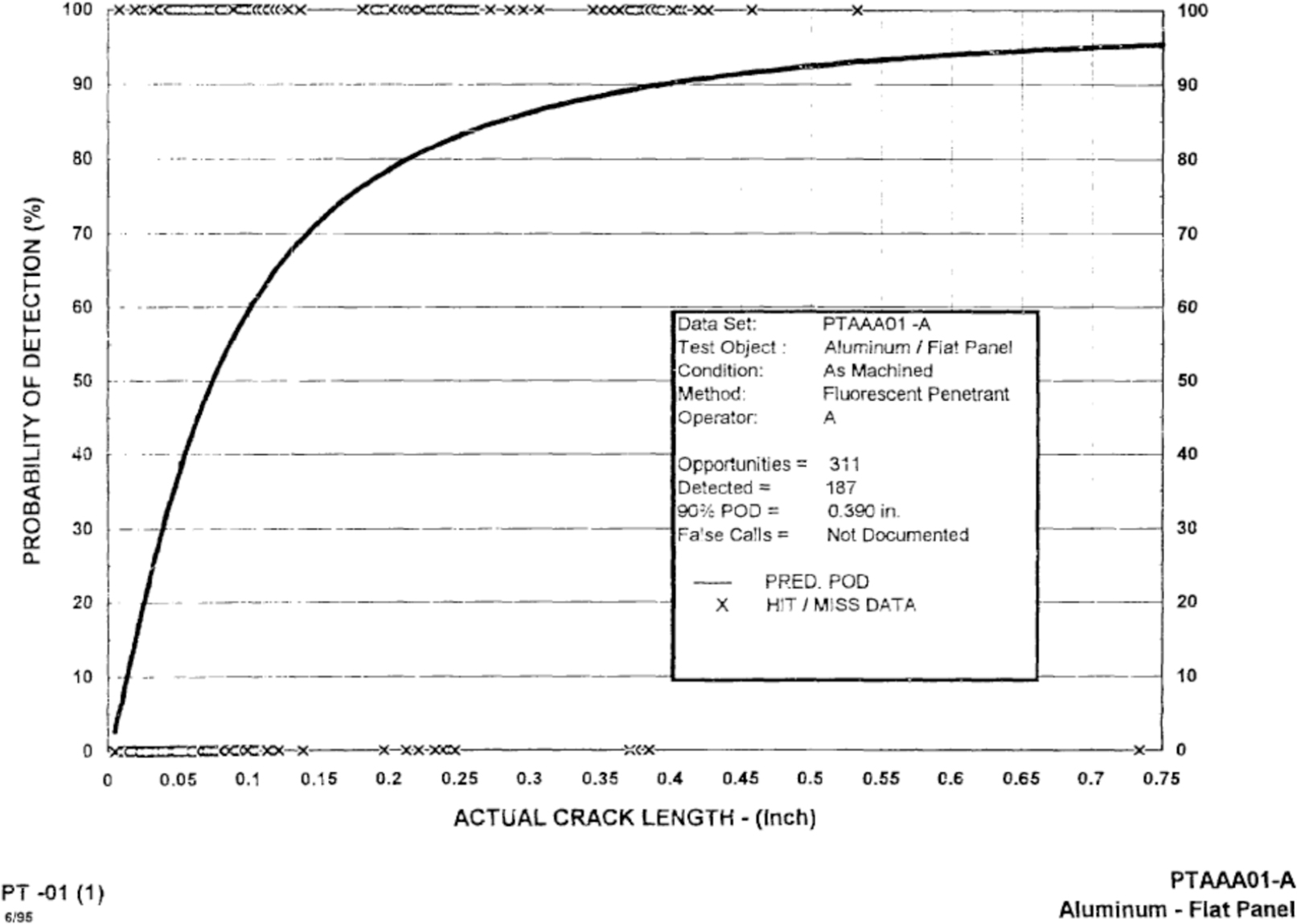
Figure 4.
Sample POD curve for a Fluorescent Penetrant Inspection (Best available copy, Nondestructive Testing Information Analysis Center, 2000).
Similarly, increasing inspection frequency, when supported by POD-based equivalency, introduces additional opportunities for flaw detection. More frequent examination of a structural location not only increases the cumulative probability of crack detection prior to reaching aCRIT, but also enhances the likelihood of identifying unrelated in-service damage mechanisms. Corrosion, impact damage, fastener loosening, or other forms of structural degradation may be discovered incidentally during these inspection events. Inspection strategies that incorporate greater frequency, when analytically justified through cumulative POD evaluation, may therefore contribute to broader structural risk mitigation beyond the specific damage tolerance scenario under consideration.
Taken together, these considerations illustrate that when POD data are explicitly incorporated into damage tolerance analysis, inspection requirements can be expressed in terms of cumulative detection reliability rather than strict adherence to a single inspection method or interval. By evaluating inspection sensitivity and frequency within a probabilistic framework, alternative strategies may be demonstrated to meet or exceed the intended likelihood of crack detection prior to reaching aCRIT. Such an approach preserves the underlying safety objective while introducing analytical transparency and structured flexibility into inspection planning. When supported by documented POD performance and reasonable assumptions regarding independence, this methodology provides a technically defensible basis for tailoring inspection programs to operational constraints without reducing structural reliability.
CONCLUSION
This study aims to demonstrate that method-specific probability of detection data can enhance the established damage tolerance analysis framework by offering a quantitative complement to parameters that have traditionally been addressed through generic assumptions or established inspection practices. By explicitly linking measured inspection performance to the assumed initial flaw size, detectable crack length, and inspection interval structure, the analytical connection between crack-growth prediction and inspection planning may be refined.
Application of POD data to the baseline example illustrates that the assumed initial flaw size is not merely a default analytical assumption, but a key input that directly influences inspection initiation and residual structural risk exposure. When inspection capability at manufacture is explicitly considered, significant differences in inspection scheduling may result while remaining fully consistent with existing FAA and EASA requirements. In this context, POD integration enhances traceability between analytical assumptions and demonstrated inspection performance.
Further, evaluation of cumulative detection probability demonstrates that inspection effectiveness may be expressed in probabilistic terms independent of strict method prescription. When supported by reliable POD datasets and reasonable assumptions regarding independence, alternative combinations of inspection sensitivity and frequency may be shown to achieve equivalent or greater likelihood of crack detection prior to reaching critical size. This probabilistic formulation enables structured flexibility in inspection planning while preserving the underlying safety objective of crack management before structural failure.
Importantly, the incorporation of POD data does not replace established damage tolerance procedures; rather, it refines them by introducing quantitative inspection-performance information into parameters that have historically relied on generalized assumptions. As nondestructive inspection technologies continue to evolve and inspection environments diversify across production and operational contexts, integration of method-specific detection capability into DTA may offer a rational and technically defensible pathway for enhancing inspection program fidelity.
Accordingly, the framework presented herein encourages consideration of a more explicit alignment between fracture-mechanics-based crack growth prediction and empirically demonstrated inspection performance. Such alignment strengthens analytical transparency, supports regulatory compliance, and contributes to the continued evolution of fatigue management practices for transport-category aircraft.
List of Symbols
- DTA
Damage Tolerance Analysis
- NDI
Nondestructive Inspection
- POD
Probability of Detection
- PNDtotal
Total Probability of Non-detection
- FAA
United States Federal Aviation Administration
- EASA
European Union Aviation Safety Agency
- HFEC
High Frequency Eddy Current
- a0
Assumed initial crack length
- aCRIT
Critical crack length (length of crack where the part can no longer support flight loads)
- aDET
The minimum detectable crack length for an NDI method
- AC
United States Federal Aviation Administration Advisory Circular
- L
Inspection Interval