
1. Introduction
Digital technologies have increasingly transformed the tourism sector, influencing how destinations are promoted, experienced, and communicated. Immersive technologies such as virtual reality (VR) and augmented reality (AR) have expanded tourism beyond physical travel by enabling interactive and accessible virtual experiences (Guttentag, 2010; Buhalis et al., 2022; Buhalis et al., 2023). The metaverse, in turn, represents a broader digital environment that may incorporate these technologies as access interfaces. Conceptually, the metaverse, is more accurately understood as a persistent and interconnected digital environment that may incorporate VR, AR, and other immersive interfaces rather than constituting a single technology itself (Dwivedi et al., 2022).
Virtual tourism has been particularly relevant for cultural and heritage contexts, where immersive and digitally reconstructed experiences enhance visitor engagement while supporting sustainability and accessibility objectives (Bec et al., 2019; Rauschnabel et al., 2022; Baker et al., 2023). At the same time, tourism organisations increasingly adopt these technologies as part of their marketing strategies to attract new audiences and remain competitive (Dwivedi et al., 2022).
Despite the growing visibility of immersive technologies in tourism, their adoption is strongly influenced by societal understanding as mediated by news coverage and media representation. Mass media play a key role in shaping how emerging technologies are understood and legitimised by framing them as innovative, beneficial, or disruptive (Happer & Philo, 2013). However, cross-national analyses of media discourse on immersive technologies in tourism remain limited (Loureiro et al., 2020).
This study examines how mainstream news media frame the metaverse and immersive technologies (VR/AR/XR) within the tourism domain across major European markets. To address this objective, a qualitative content analysis was conducted on 126 open-access news articles published between 2024 and 2025 in leading digital newspapers from six European countries. The analysis adopts a media framing perspective, examining not only the frequency of themes but also how journalistic narratives construct meanings around immersive technologies in tourism. Rather than measuring public attitudes, the study interprets patterns of representation, emphasis, and association through which the metaverse and related technologies are discursively positioned across major European markets.
2. Literature Review
The considerable expansion of digital technologies has been drastically transforming how people plan, organise and perform tourism (Buhalis et al, 2022). Many products and services have changed to meet this new paradigm, including destinations, hotels and airlines (Buhalis et al., 2022; Buhalis et al., 2023). Due to the exponential growth of information and communication technology (ICT), users now primarily obtain travel information and itineraries via digital channels, creating the ‘eTourism’ sector within the tourist business (Buhalis et al, 2023).
Immersive technologies, such as VR and augmented reality (AR), are among the digital innovations that have significantly influenced the tourism sector (Guttentag, 2010; Dwivedi et al., 2022). Rather than constituting the metaverse itself, these technologies function as enabling interfaces through which users can access virtual environments. The metaverse is therefore better understood as a persistent digital ecosystem that may incorporate immersive technologies to recreate tourism experiences in virtual settings (Dwivedi et al., 2022; Buhalis et al., 2023). Such environments allow users to engage with simulated destinations, including cultural heritage sites and remote landscapes, through mediated digital interaction.
The immersion provided by these technologies offers a viable alternative for touristic activities, preserving the essence of the experience while overcoming geographical constraints (Rauschnabel et al, 2022).
Also, the metaverse has significantly transformed the market, prompting agencies to adopt strategies to keep up with customers’ growing adoption of this technology (Dwivedi et al., 2022; Dwivedi et al., 2023; Ud Din & Almogren, 2023). Beyond revolutionising management and marketing, travel agencies have noted remarkable progress in virtual tourism regarding sustainability - a benefit that adds value to their services while reducing costs for both businesses and consumers (Go & Kang, 2023).
According to Ud Din and Almogren (2023), the metaverse - particularly through virtual tourism - demonstrates significant potential to foster social integration, entertainment and education while promoting inclusivity, thereby enhancing physical and mental well-being.
Despite increasing media coverage, understanding of how this innovation is actually perceived by different stakeholders in the sector remains limited (Loureiro et al, 2020).
Previous tourism research has primarily examined the applications, user experience, and potential impacts of immersive technologies, with particular attention to VR adoption and digital heritage experiences (Guttentag, 2010; Bec et al., 2019; Bogicevic et al., 2019; Dwivedi et al., 2022; Baker et al., 2023). However, considerably less attention has been paid to how mainstream news media represent these innovations, which narratives dominate their portrayal, and whether such representations vary across national contexts. Examining journalistic discourse is therefore relevant not to infer public attitudes but to understand how technologies acquire discursive legitimacy through media framing (Happer & Philo, 2013). A cross-country perspective is particularly pertinent, as European tourism markets differ in media systems, digitalisation strategies, and technological positioning, which may shape distinct narrative constructions of immersive tourism innovation in national news contexts (Happer & Philo, 2013).
This article therefore examines how journalistic media frame the metaverse within tourism, providing a critical analysis of the narratives through which technology is represented across major European markets.
Building on the identified research gap, this study addresses the following research questions:
RQ1: How do national news media frame the metaverse and immersive technologies (VR/AR/XR) within the tourism domain?
RQ2: Which tourism sectors and applications are most frequently associated with these technologies in journalistic narratives?
RQ3: What similarities and differences emerge across countries in the media representation of immersive tourism technologies?
RQ4: How is the metaverse positioned in relation to other immersive technologies in tourism media discourse?
3. Methodology
This study adopts a qualitative research design based on a systematic content analysis of digital newspaper articles to examine media discourse on immersive technologies in tourism.
3.1. Newspapers source
For this research, we selected digital newspapers from the six European countries with the highest tourism revenue (Spain, UK, France, Italy, Germany, and Portugal; (Statista, 2024)), choosing the respective newspapers based on their role as national agenda-setting media rather than solely on reputation. For each country, widely circulated generalist newspapers with nationwide readership and regular digital publication were included to capture mainstream journalistic discourse. The selected newspapers included: El País, El Mundo and La Vanguardia (Spain); The Guardian, The Telegraph and The Independent (UK); Le Monde, Le Figaro, Les Echos and La Tribune (France); La Stampa, Avvenire, Ansa and AGI (Italy); Süddeutsche Zeitung, Frankfurter Allgemeine Zeitung, Die Welt, Deutsche Welle, Der Tagesspiegel and Die Zeit (Germany); and Público, Diário de Notícias, Expresso, Jornal de Negócios, Económico, Observador and Jornal de Notícias (Portugal).
Searches were conducted individually in each newspaper’s digital archive using country-language keyword strings combining immersive technology terms (e.g., ‘metaverse’, ‘virtual reality’, ‘augmented reality’, ‘XR’, ‘virtual tourism’) with tourism-related terms (e.g., ‘tourism’, ‘travel’, ‘destination’, ‘heritage’). Retrieved articles were manually screened to ensure relevance to tourism contexts involving immersive technologies. Equivalent search terms were translated and adapted to each national language to ensure conceptual equivalence across countries. The research team verified semantic consistency of translated keywords before data collection – e.g., in cases where direct translation could produce ambiguity, synonymous terms commonly used in national media were also included (e.g., ‘digitale Realität’ in German coverage; ‘experiencia inmersiva’ in Spanish; ‘expérience immersive’ in French), ensuring broader capture of relevant articles. The inclusion criteria focused on news published in 2024 and 2025 that directly address tourism and its related domains—such as tourism practices and communication contexts, destination marketing, or cultural experiences, within the context of the metaverse or any form of immersive or augmented reality. News was excluded if it did not align with the scope of tourism or immersive digital environments, was published before 2024, or was entirely inaccessible due to paywall restrictions, thereby ensuring the inclusion of only the most current and relevant open-access sources.
3.2. Newspapers’ qualitative analysis
The development of the research database involved a series of methodological discussions among the research team, culminating in the systematic organisation of selected news within an Excel spreadsheet for subsequent analysis and characterisation. The analysis does not attempt to infer public attitudes or behavioural responses. Instead, it examines how news media represent and frame immersive technologies within tourismrelated narratives. The unit of analysis was the full news article, with coding based on explicit references appearing in the article text and headline. Through an iterative consensus-building process, three primary analytical dimensions were established: technological components (identifying specific technologies referenced in each news item), marketing-related narratives (examining promotional strategies for featured products or services), and tourism-related elements (categorising the nature of described offerings). These categories were subsequently refined through additional meetings to develop precise subcategories for more nuanced classification.
To ensure methodological rigour, the research team implemented a dual-coding verification process. Two researchers independently applied the classification framework to the dataset, after which their assessments were compared and reconciled to evaluate inter-coder reliability. Inter-coder reliability was assessed using Cohen’s kappa coefficient (=0.82). This validation procedure was conducted in strict adherence to the qualitative research standards outlined in the COREQ guidelines, thereby maintaining transparency and academic rigor throughout the analytical process while strengthening the study’s overall validity (Tong et al., 2007). The systematic approach to both categorisation and validation provided a robust foundation for subsequent analysis of the media representations under investigation.
The selected articles were systematically analysed within three overarching thematic categories: Technology, marketing, and tourism. These categories refer to themes mentioned in journalistic discourse and not to measured sectoral practices. The subcategories employed are presented in Table 1.
Table 1:
Main topics are categorised into subtopics
| Immersive Technology | Marketing-related narratives | Tourism-related elements |
|---|---|---|
| Artificial Intelligence (AI) | Fairs | Cultural Heritage |
| Virtual Reality (VR) | Virtual Tours | Hotels |
| Augmented Reality (AR) | Sustainability | Museums |
| Metaverse | Digital Exhibition | Theme Parks |
| Digital Reality | Promotion | Cathedrals |
| Chatbot | Historical Reconstruction | Arts |
| Digital Tools | Virtual Exhibition | Festivals |
| Extended Reality (XR) | Accessibility | Resorts |
| Digitisation | Immersive Exhibition | Historical Monuments |
| Immersive Realities | Virtual Experiences | Holidays and Observances |
| Custom Itineraries | Cities | |
| Countries | ||
| Villages | ||
| Regions | ||
| Mountains | ||
| Islands | ||
| Destination |
4. Results
A total of 141 articles were identified, revealing an uneven distribution across countries (Figure 1). Spain (n=48), Germany (n=32) and Portugal (n=30) accounted for the largest share of coverage, suggesting stronger media attention to immersive tourism narratives in these contexts, while the United Kingdom showed comparatively limited coverage (n=5).
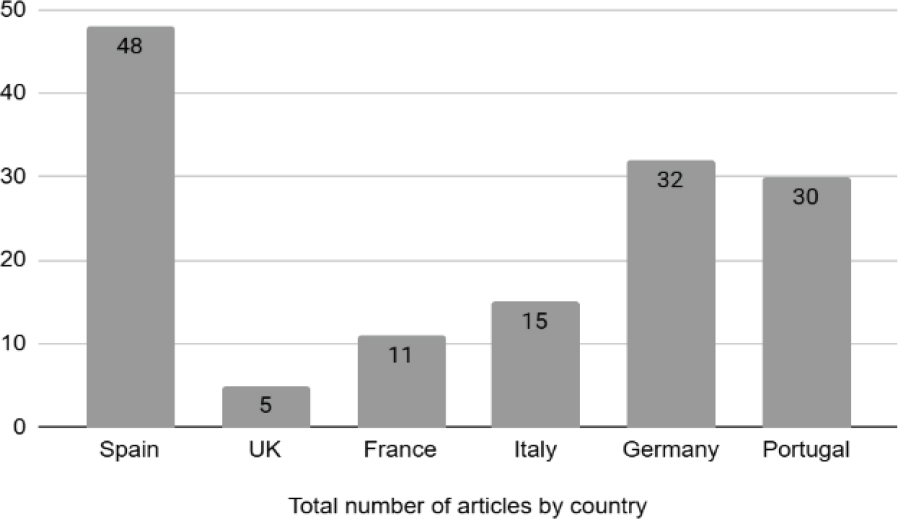
Figure 1:
National distribution of media coverage in the analysed sample
The keyword distribution shown in Figure 2 reveals a clear hierarchy of terms. Virtual tourism appears most frequently (n=54 articles), followed by immersive reality (n=36) and virtual reality (n=33), whereas metaverse is mentioned considerably less often (n=11 articles), and digital tourism and VR in tourism appear only marginally. This pattern indicates that journalistic coverage emphasises experience-oriented terminology over platform-specific technological concepts, framing immersive technologies primarily as tourism practices rather than as a distinct technological ecosystem.
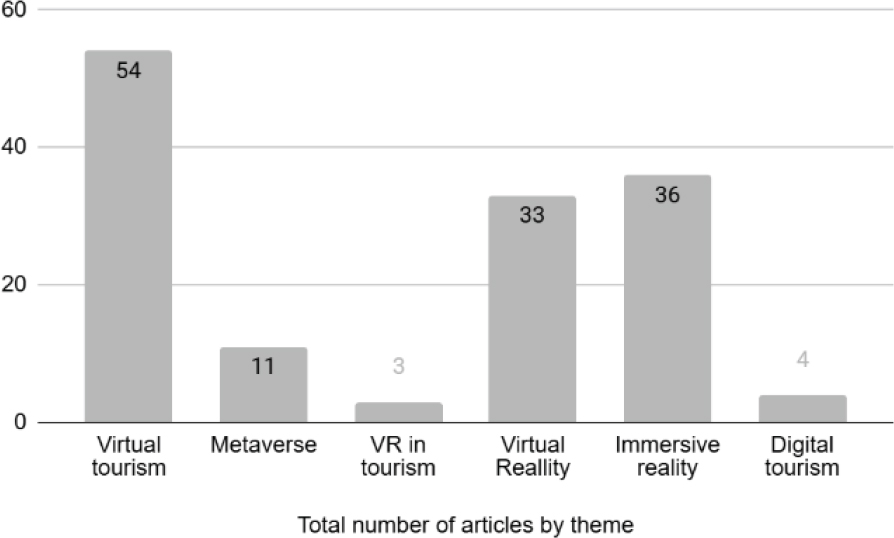
Figure 2:
Keyword distribution in news coverage of immersive tourism
4.1. Article selection
Following the application of the predefined inclusion and exclusion criteria, an initial set of potentially relevant articles was identified. However, nine articles were excluded for not directly addressing the intersection of tourism and immersive or augmented reality technologies. An additional five articles were removed due to being entirely behind paywalls, which prevented full access to their content. One article was excluded for presenting completely duplicated content, offering no new or relevant insights. As a result, the final selection for contextual analysis included 126 publications, all of which met the eligibility criteria and provided meaningful contributions to understanding the role of VR, AR or the metaverse in the tourism sector.
Tables 2, 3 and 4 present the most prevalent subgroups (N>10) within each major topic among the selected articles, along with the journals in which they were published and their countries of origin.
Table 2:
Most prominent technological references in tourism news coverage (N > 10)
| Sub-topic if n>10 | N | Key headings | Newspapers | Countries |
|---|---|---|---|---|
| VR | 72 | Valencia will open around 20 museums and unique buildings to the public virtually; Visit the museum with virtual reality glasses; From sunflowers to wheat fields: an immersive journey through the works of Van Gogh; Her Name Was Gisberta: an “immersive journey” through the life of a “national landmark”; | El País La Vanguardia The Guardian The Telegraph Le Monde Le Figaro ANSA SZ FAZ DW Der Tagesspiegel Die Zeit Público Diário de Notícias Jornal de Negócios Econó- mico Observador JN | Spain UK France Italy Germany Portugal |
| Metaverse | 14 | The magical world of Tomorrow land comes to life: Europe’s largest metaverse to celebrate 20 years of the world’s most famous electronic music festival; Portugal takes timid steps into the metaverse; | El mundo The Telegraph Les Echos ANSA SZ DW Die Zeit Público Expresso Jornal de Negócios | Spain UK France Italy Germany Portugal |
| XR | 13 | Villa Antiopa receives award for best digitized experience using immersive technology; Virtual journey through the history of the Jewish quarter of Frankfurt; | La Vanguarda Le Monde La Stampa Avvenire ANSA DW Die Zeit Público | France Italy Germany Portugal |
Table 3:
Predominant marketing-related narratives in tourism media coverage (N > 10)
| Sub-topic if n>10 | N | Key headings | Newspapers | Countries |
|---|---|---|---|---|
| Immersive Experience | 41 | New tourists: explorers of a virtual ocean; With virtual reality glasses on the “Titanic”; I (virtually) conquered Everest – this is what it was like; Dante’s House Museum, with virtual reality walking with the poet; | El País El Mundo La Vanguardia The Guardian The Telegraph Le Monde Le Figaro Les Echos La Stampa Avvenire ANSA SZ Der Tagesspiegel Die Zeit Público Jornal de Negócios JN | Spain UK France Italy Germany Portugal |
| Historical reconstruction | 29 | Carmona hosts the ‘VR Heritage’ project recreating the Turdetani world through virtual reality; Frederick II, 800 years told with virtual reality; | La Vanguardia Le Figaro ANSA SZ DW Der Tagesspiegel Die zeit Público Expresso | Spain France Italy Germany Portugal |
| Virtual Tour | 15 | Tourism - Cathedral adds virtual tours allowing visitors to ‘fly over’ the temple and discover 18th-century Málag; Virtual holiday trips on Unity Day in Schwerin; | El País La Vanguardia Le Monde Les Echos SZ DW Público Expresso Jornal de Negócios Económico | Spain France Germany Portugal |
| Virtual Experience | 10 | Wagner opera partially virtual; Papal Basilicas, a place to help tourists discover themselves as pilgrims; | La Vanguardia Le Monde Avvenire SZ DW Der Tagesspiegel Observador | Spain France Italy Germany Portugal |
Table 4:
Tourism-related narrative contexts in media coverage (N > 10)
| Sub-topic if n>10 | N | Key Titles | Editors | Countries | |
|---|---|---|---|---|---|
| Cultural Heritage | 33 | A Pacific island starts packing for the metaverse Carcassonne as in the 14th century through an immersive experience in Paris, Lyon, and Bordeaux The World of Tutankhamun floods Bombas Gens in an immersive journey through ancient Egypt. | El País La Vanguardia Le Monde Le Figaro Les Echos Avvenire ANSA SZ DW Der Tagesspiegel Die Zeit Público Expresso JN | Spain France Italy Germany Portugal | |
| Museum | 24 | Go to the museum or take a vacation with virtual reality glasses Museums and monuments addicted to the immersive experience Feel the vertigo of an ‘enxaneta’ at the Casteller Museum of Catalonia | El País El Mundo La Vanguardia Le Monde Les Echos ANSA SZ DW Der Tagesspiegel Die Zeit Expresso | Spain France Italy Germany Portugal | |
| Art | 18 | Experience immersive art in Munich – an overview of what’s on offer A face-to-face with Goya A new immersive experience to dive into the life and work of Salvador Dalí | El Mundo La Vanguardia Le Figaro ANSA SZ DW Der Tagesspiegel Die Zeit Público Diário de notícias Observador JN | Spain France Italy Germany Portugal | |
| Cities | 11 | Medinaceli (Soria) will have a virtual reality app to promote its tourism and commercial activities City introduces app for digital tours around the city | El País La Vanguardia ANSA SZ Die Zeit Jornal de Negócios Económico | Spain Italy Germany Portugal |
4.2. . Media framing of immersive-technologies subtopics in tourism
The analysis reveals differentiated media framings of immersive technologies within tourism coverage. VR appears most frequently (72 articles) and is typically described through experiential language, often linked to museums, exhibitions, and cultural immersion. Headlines referring to ‘immersive journeys’, ‘virtual visits’, or the possibility of ‘discovering’ places indicate that VR is framed as a practical and already operational extension of tourism experiences.
By contrast, the metaverse is mentioned less often (14 articles) and tends to appear in connection with largescale events, experimental initiatives, or future-oriented projects. Expressions referring to ‘entering’ or ‘taking steps into’ the metaverse position it as an emerging environment rather than a routine tourism tool, suggesting a speculative and anticipatory framing rather than an established practice.
XR (13 articles) is predominantly associated with institutional, heritage, or digitisation contexts. Coverage often emphasises technical integration and educational or interpretative functions, indicating a more infrastructural and professional framing compared to the experiential narratives attached to VR (Table 2).
4.3. Media framing of marketing-related narratives in tourism
Within the marketing-related coverage, media narratives predominantly frame immersive technologies through experiential storytelling rather than commercial promotion. Four recurring narrative patterns emerge: immersive experience, historical reconstruction, virtual tour, and virtual experience.
The most prominent framing is the immersive experience (41 articles), in which journalistic discourse emphasises sensory engagement and personal participation. Headlines frequently highlight actions such as “ exploring”, “ walking through”, or “ experiencing”, presenting technology as a means of extending presence rather than as a technical tool.
The historical reconstruction narrative (29 articles) situates immersive technologies within educational and cultural contexts. Here, virtual environments are portrayed as mechanisms for accessing past eras, suggesting a legitimising function in which innovation is associated with heritage preservation and knowledge dissemination.
The virtual tour framing (15 articles) emphasises mediated access to distant or restricted places, presenting technology as a substitute for physical accessibility rather than a replacement for travel. Finally, the virtual experience category (10 articles) encompasses cultural performances and hybrid events, where immersive technologies are depicted as enhancing traditional activities rather than transforming them (Table 3). Beyond thematic frequency, the analysis identified recurring rhetorical patterns in the headlines and article framing. Consistent with Entman’s (1993) framing model, immersive technologies are primarily defined through experiential metaphors (‘immersive journey,’ ‘virtual visit,’ ‘entering the metaverse’), which emphasise presence and exploration. The tone of coverage is predominantly optimistic, often associating innovation with accessibility, enhancement, or cultural enrichment. Negative or risk-oriented language appears marginally. This pattern reflects an agenda-setting effect (McCombs, 2005), whereby repeated emphasis on experiential benefits contributes to normalising immersive technologies within tourism discourse.
4.4. Media framing of tourism-related elements
Within tourism-related references, media coverage consistently associates immersive technologies with culturally legitimised contexts (Table 4). Cultural heritage emerges as the most prominent element (33 occurrences), indicating that journalistic discourse frequently frames innovation through historical and educational narratives. Rather than presenting immersive technologies as disruptive, coverage situates them as tools for preservation and interpretation of the past.
Museums (24 occurrences) reinforce this institutional framing. Articles commonly depict immersive technologies as extensions of existing cultural infrastructures, emphasising accessibility and mediation rather than replacement of physical visits.
Art-related coverage (18 occurrences) further contributes to experiential framing, presenting immersive environments as aesthetic encounters. Expressions such as ‘immersive journey’ or ‘dive into the work’ suggest an interpretative and sensory approach rather than a technical one.
Finally, cities (11 occurrences) appear primarily in promotional and orientation contexts, where digital tools are framed as complementary aids for exploration. This positioning emphasises augmentation of place-based tourism rather than substitution, maintaining the centrality of physical destinations.
5. Discussion
This article critically examines how media discourse constructs narratives about the role of immersive technologies and the metaverse in tourism. Rather than assessing public perception or technological adoption, the study focuses on how journalistic framing contributes to shaping the visibility and legitimacy of these innovations within tourism communication. From a media theory perspective, the findings can be interpreted through framing, agenda-setting, and priming mechanisms, which explain how repeated thematic emphasis contributes not only to issue salience but also to the criteria through which technologies are evaluated in public discourse (Entman, 1993; McCombs, 2005).
Cross-national differences in article frequency indicate uneven media visibility of immersive tourism narratives across the analysed countries. Spain generated the highest number of publications, followed by Germany and Portugal, whereas the United Kingdom showed comparatively limited coverage. These variations should be interpreted as differences in journalistic emphasis and media agenda-setting rather than as indicators of technological adoption or tourism performance. The findings highlight how national media systems may attribute varying levels of attention to immersive innovation within tourism discourse. As comparative media research has demonstrated, structural differences in media systems—including editorial traditions, market orientation, and political parallelism—can shape issue salience and framing patterns across countries (Hallin & Mancini, 2004).
The article selection process employed targeted keywords and phrases to identify relevant news items meeting the study’s criteria. The ‘virtual tourism’ yielded the highest number of results (54), demonstrating optimal alignment with the research objectives. Subsequent search terms – ‘immersive reality’ and ‘virtual reality’ - generated the second (36) and third (33) highest result volumes, respectively. Notably, these primary terms showed a significantly greater yield compared to the tertiary terms (‘metaverse’ (11), ‘digital tourism’ (4), and ‘VR in tourism’ (3), with a marked decline in result frequency. The distribution of keywords highlights a discursive hierarchy in which ‘virtual tourism’ and ‘immersive reality’ receive greater prominence than ‘metaverse’ or ‘digital tourism.’ Rather than indicating levels of technological adoption, this pattern suggests differential visibility within journalistic discourse. In line with media framing theory (Happer & Philo, 2013), repeated emphasis on certain terms contributes to constructing specific technological narratives as more established or operational within tourism communication. The prominence of experience-oriented terminology also resonates with broader discussions of immersive innovation in tourism (Dwivedi et al., 2023), though the findings reflect media representation rather than sectoral diffusion.
Most news articles examined in this study portray immersive technologies, such as VR and the metaverse, as groundbreaking innovations in the tourism sector. Phrases like “ this is the first time such technology has been introduced” or “ technological innovation” are commonly employed to market tourism-related products and services. This perspective aligns with Dwivedi et al.’s (2022) argument, which emphasises how organisations and businesses have recognised the potential of immersive realities, gradually adopting them as a growth strategy.
The technological distribution observed in the study highlights clear trends in the adoption and perceived value of immersive technologies within virtual tourism. VR emerges as the most frequently referenced technology in the analysed corpus. Its prominence within news coverage suggests that it occupies a central position in the discursive construction of immersive tourism. Rather than demonstrating technological superiority, this visibility reflects the way VR is framed as a tangible and operational interface for experiential tourism practices. This aligns with previous literature emphasising VR’s capacity to mediate sensory engagement and pre-visit experience (Bogicevic et al., 2019), although the present findings concern media representation rather than technological performance.
Metaverse, though less frequently cited (14 articles), is framed in more anticipatory and speculative terms. Media narratives often associate it with largescale events or future-oriented projects, positioning it as an evolving digital environment rather than a routine tourism tool. This framing reflects broader academic discussions of the metaverse as a persistent and interconnected digital ecosystem (Dwivedi et al., 2022), but its representation in news discourse suggests a stage of symbolic emergence rather than normalised integration within tourism practices. Unlike conventional VR applications, the metaverse is described in the literature as enabling persistent and shared digital environments (Dwivedi et al., 2022). Within academic discussions, such environments are often associated with interactive and participatory potential, particularly in heritage and cultural contexts (Bec et al., 2019). However, in the analysed news coverage, these possibilities are largely presented at a conceptual level, reinforcing a futureoriented framing rather than evidencing widespread implementation.
Extended reality (XR) technologies, featured in 13 articles, are presented in the analysed coverage as integrative configurations combining VR, AR, and mixed-reality applications. Compared to VR, XR receives more limited visibility and is primarily framed within institutional or educational contexts. Academic literature describes XR as blending physical and digital environments to support hybrid forms of engagement (Dwivedi et al., 2022), yet in news discourse its representation remains comparatively restrained. Rather than indicating levels of implementation, this lower frequency suggests that XR occupies a more specialised or technical position within media narratives, particularly in relation to museums, urban interpretation and heritage initiatives. The findings therefore reflect patterns of discursive prominence rather than measurable adoption stages (Guttentag, 2010).
The data suggest a discursive alignment between marketing-related narratives and tourism-related contexts in media coverage, rather than demonstrating measurable tourism preferences. The predominance of immersive experiences (41 articles) indicates the visibility of experiential framing in journalistic discourse, particularly in relation to VR and metaverse references. Notably, the parallel between historical reconstruction (29 articles) in marketing and cultural heritage (33 occurrences) in tourism reflects a narrative convergence that situates immersive technologies within culturally legitimised domains. The museum subtopic’s prominence (24 occurrences) reinforces the institutional framing of immersive innovation, while art’s representation (18 occurrences) further embeds these technologies within established cultural circuits. The urban focus (Cities, 10 occurrences) appears within promotional and orientation narratives, though with relatively less emphasis than heritage-related contexts. These frequency distributions should be interpreted as patterns of media emphasis rather than indicators of technological adoption or consumer demand. In line with digital tourism frameworks (Kieanwatana & Vongvit, 2024), immersive technologies are discursively positioned as extensions of established cultural and experiential tourism practices. The lower counts for virtual tours and experiences may reflect reduced narrative prominence in news discourse rather than limited sectoral relevance (Baker et al., 2023).
According to Vourdoubas (2025), the implementation of immersive technologies in tourism is influenced by political, economic, social and cultural factors, as well as sustainability and accessibility considerations. While such factors may shape technological development, the present findings relate specifically to their representation in media discourse rather than to empirical implementation outcomes.
6. Limitations and future recommendations
This study presents several limitations that should be acknowledged. The sample consists exclusively of mainstream national newspapers with open-access content, which may reflect editorial priorities, political orientations and agenda-setting tendencies that influence the visibility and framing of immersive technologies. Although efforts were made to ensure semantic equivalence across languages, minor variations in journalistic terminology may have affected article retrieval. Furthermore, the temporal scope captures a specific period of media attention and may reflect short-term trends rather than long-term discursive patterns. As with all qualitative research, despite intercoder reliability procedures, interpretative judgement remains inherent in thematic categorisation.
The analysis also focuses solely on mainstream digital press and does not include social media platforms, reader comments, or alternative media ecosystems, where different narratives may emerge. While coverage predominantly frames immersive technologies in positive and experiential terms, broader ethical and structural concerns, such as data privacy, platform governance (Dwivedi et al., 2022), accessibility, and the digital divide (Buhalis et al., 2023), receive comparatively limited attention. Future research could adopt longitudinal designs, integrate comparative media system approaches, or triangulate media discourse with audience reception studies to further explore how technological innovation is represented and interpreted within tourism contexts.
7. Conclusion
This study examines how immersive technologies and the metaverse are constructed within European tourism news discourse. The findings show that media coverage establishes a discursive hierarchy in which VR appears normalised and operational, while the metaverse is framed in more anticipatory and future-oriented terms. Immersive technologies are predominantly embedded within culturally legitimised contexts (particularly heritage and museums) suggesting that media narratives position innovation as an extension of established tourism practices rather than as disruptive transformation.
The study contributes to research at the intersection of media theory and digital tourism by integrating framing and agenda-setting perspectives into the analysis of technological representation. By highlighting cross-national variation in media visibility and rhetorical emphasis, the findings demonstrate how issue salience and narrative construction shape the symbolic positioning of immersive innovation in tourism communication.
These results underscore the importance of critically examining media discourse alongside technological development. Future research may extend this work through longitudinal, comparative media systems, or audience-based approaches to further explore the relationship between representation and technological integration in tourism contexts.
Acknowledgements
The authors acknowledge the institutional support provided by the Polytechnic Institute of Leiria during the development of this research.
Notes
[1] Disclosure statement
The authors declare no financial interest or benefit arising from the direct applications of this research.
[2] Data availability statement
The data supporting the findings of this study are not publicly available due to copyright restrictions associated with the original news sources but are available from the corresponding author upon reasonable request (marlene.rosa@ipleiria.pt).
[3] Conflicts of interest Conflicts of Interest
The authors of the article ‘The Narrative Surrounding the Metaverse in Tourism – Shaping the Media Discourse and Public Opinion’ declare no conflict of interest.