
INTRODUCTION
The physiological structure of articular cartilage limits its intrinsic regenerative capacity [1]. This constraint underscores a clinical need for effective and safe treatment methods. Consequently, it drives the ongoing development of therapies aimed at cartilage regeneration and repair. However, two-stage surgical procedures pose significant challenges. One notable issue is the potential dedifferentiation of chondrocytes cultured ex vivo. These drawbacks have heightened the demand for alternative strategies, with a primary emphasis on novel, predominantly one-stage procedures [2].
For many years, researchers have aimed to identify a substantial population of suitable cells for repairing damaged or diseased hyaline cartilage. Several promising cell-based strategies for cartilage therapy have been investigated. These include the use of autologous mature chondrocytes, bone marrow-derived stem cells, and adipose tissue-derived cells. Despite advances, these sources face limitations, such as variable chondrogenic potential in bone marrow (mesenchymal stem cells) MSCs, scalability issues with chondrocytes, and lower regenerative capacity in subcutaneous adipose-derived cells compared to intra-articular sources. Nevertheless, many current methods – along with those not yet fully implemented in clinical practice – encounter evident or anticipated limitations. Such constraints may hinder their effectiveness in cellular cartilage repair. The application of chondroprogenitors in cell therapy offers a potentially innovative and more effective solution. This approach addresses at least some of the existing challenges [3].
Over the past decade, numerous studies have evaluated the immunophenotype and differentiation potential of adipose-derived stromal cells from the infrapatellar fat pad (IPFP) [4,5,6]. A study by SONG Saisai et al. (2020) found no significant differences in the expression of stem cell surface protein markers between human subcutaneous adipose tissue stem cells (SC-ASC) and infrapatellar fat pad stem cells (IPFP-ASC). However, the proliferation and chondrogenic potential of human IPFP-ASC were superior to those of SC-ASC in vitro. Their therapeutic effect on rat osteoarthritis in vivo also outperformed SC-ASC [7]. IPFP-ASC demonstrate a clear advantage in chondrogenic differentiation, whereas SC-ASC exhibit greater osteogenic differentiation. This finding is supported by the detection of SOX-9, a chondrogenic transcription factor, during differentiation assays [8]. Stem cells expressing this marker are present in the IPFP. Due to its anatomical location, the IPFP may positively contribute to cartilage regenerative processes. However, several questions remain unresolved. These include the quantitative characteristics of these cells, their comparison with other common adipose tissue sources, and their potential for clinical application.
MATERIALS AND METHODS
The study was conducted in accordance with the Declaration of Helsinki. The protocol was approved by the Ethics Committee of Zaporizhzhia State Medical and Pharmaceutical University (Protocol No. 8, December 26, 2024). All patients participating in the study were informed about the surgical intervention plan and the use of their biopsy samples for scientific research. They provided signed informed consent.
For this study, data analysis was performed on 25 patients. This group included both male and female participants who underwent surgical or combined treatment for knee osteoarthritis. Patients were selected based on the following inclusion criteria: confirmed diagnosis of knee osteoarthritis (Kellgren-Lawrence grade 2–3), age 40–70 years, and absence of systemic inflammatory diseases or malignancies. Exclusion criteria included prior knee joint replacement, severe comorbidities, or use of immunosuppressive therapy within six months prior to surgery. Histological examination was conducted on biopsy samples from Hoffa’s fat pad and abdominal subcutaneous tissue. Macroscopic evaluation and standard tissue processing were performed, including hematoxylin-eosin staining. Microscopy was carried out using a Carl Zeiss Scope.A1 microscope (Germany). The microscope was equipped with a Progres Gryphax Jenoptik 60N-C1″ 1.0x426114 camera (Germany), connected to a computer. The Progres Gryphax 1.1.4.2 digital analysis software (Jenoptik Optical System, Germany) was used to capture microphotographs and perform subsequent image analysis.
Morphological study
Immunohistochemical analysis was performed on serial paraffin sections of biopsy samples from Hoffa’s fat pad (n = 15) and abdominal subcutaneous tissue (n = 10). Monoclonal antibodies used included CD44 (clone SP37, Vitro, Spain), CD166 (clone F48292, BIOZOL, Germany), and SOX9 (clone EP317, Vitro, Spain). For the analysis, paraffin blocks containing tissue fragments were sectioned into 4 μm slices. These slices were deparaffinized and rehydrated. High-temperature antigen retrieval was conducted by heating the sections in Tris-EDTA buffer (pH 9.0) in a water bath to unmask the antigens. Endogenous peroxidase activity was blocked with a 3% hydrogen peroxide solution. This was followed by the application of a blocking serum. Incubation with primary antibodies was carried out according to the manufacturers’ instructions. The DAKO EnVision+ System with diaminobenzidine (DAB) (DAKO, USA) was used to visualize the immunohistochemical reaction. The sections were then counterstained with Mayer’s hematoxylin, dehydrated, and mounted with Canadian balsam.
Mesenchymal stem cell populations were identified by the parallel detection of multiple positive and negative markers. This identification was based on the minimal criteria established by the International Society for Cellular Therapy. Evaluation was conducted in five standardized fields of view. A Carl Zeiss Scope.A1 microscope (Germany) with a Progres Gryphax Jenoptik 60N-C1″ 1.0×426114 camera (Germany) was used at ×200 magnification for each case. Digital images of microscopic specimens were obtained. The relative quantity (%) of cells expressing CD44, CD166, and SOX9 was calculated for each standardized field of view at ×200 magnification.
Statistical processing of research results
Statistical processing of the obtained results was performed using a personal computer. The statistical package Statistica® for Windows 13.0 (StatSoft Inc., license No. JPZ804I382130ARCN10-J) was employed. Non-parametric statistical methods were used for the analysis.
To assess the hypothesis of normality for the distribution of the studied variables, the Shapiro–Wilk test was applied. The results showed that the data in the comparison groups were not normally distributed. Therefore, the median and interquartile range (Me [Q1; Q3]) were reported. The non-parametric Mann–Whitney U-test was used to compare independent samples. In all analyses, differences were considered statistically significant at p < 0.05.
Results
According to the results of immunohistochemical and statistical analyses (Table 1, Fig. 1), biopsy samples from the infrapatellar fat pad (IPFP) and subcutaneous adipose tissue (SCAT) showed notable differences. The relative number of cells expressing CD44, CD166, and SOX9 markers in a standard field of view (×200) was 30.92% in IPFP and 3.4% in SCAT. This suggests that the relative abundance of these cells in IPFP was 9.09 times higher than in SCAT. The observed difference was statistically significant (p < 0.05) across the entire marker profile. Statistically significant differences were also identified for individual markers (Fig. 1).
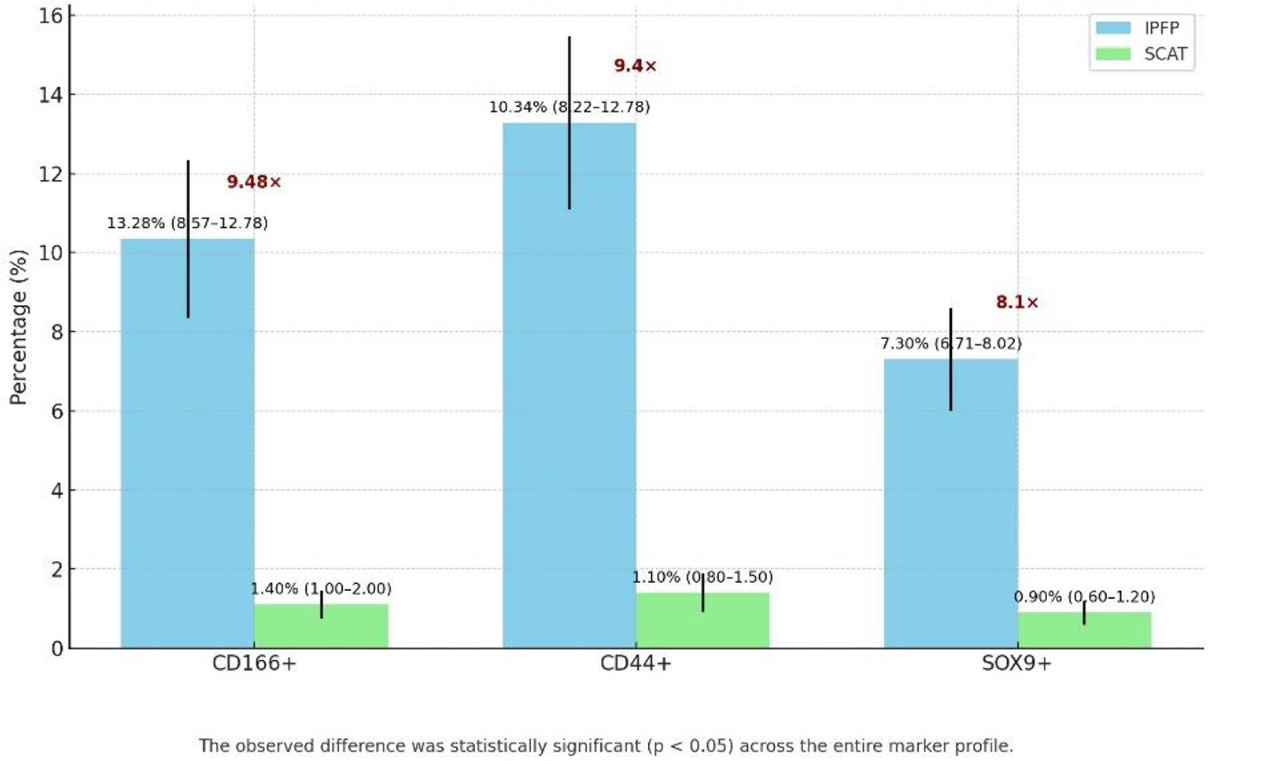
Figure 1.
Comprasion of Marker-Positive Cells in the infrapatellar fat pad (IPFP) and abdominal subcutaneous adipose tissue (SCAT)
Table 1.
The relative number of cells expressing CD44+, CD166+, SOX9+ in the biopsy material of infrapatellar fat pad (IPFP) and abdominal subcutaneous adipose tissue (SCAT)
| GROUP | MARKER | ME (%) | Q1 (%) | Q3 (%) | IQR (%) | CV (%) |
|---|---|---|---|---|---|---|
| SCAT | CD166+ | 1.10 | 0.80 | 1.50 | 0.70 | 63.64 |
| CD44+ | 1.40 | 1.00 | 2.00 | 1.00 | 71.43 | |
| Sox9+ | 0.90 | 0.60 | 1.20 | 0.60 | 66.67 | |
| IPFP | CD166+ | 10.34 | 8.22 | 12.78 | 4.56 | 44.10 |
| CD44+ | 13.28 | 8.57 | 15.11 | 6.54 | 49.25 | |
| Sox9+ | 7.30 | 6.71 | 8.02 | 1.31 | 17.95 |
The study results revealed a significant difference in the relative number of CD44-positive cells between the IPFP and subcutaneous adipose tissue SCAT. In the IPFP biopsy, the relative number of CD44-positive cells was 13.28% (8.57; 12.78). In the SCAT biopsy, it was 1.40% (1.00; 2.00) (Table 1, Figs. 1, 2). This represents a 9.48-fold increase. The difference was statistically significant (p < 0.05).
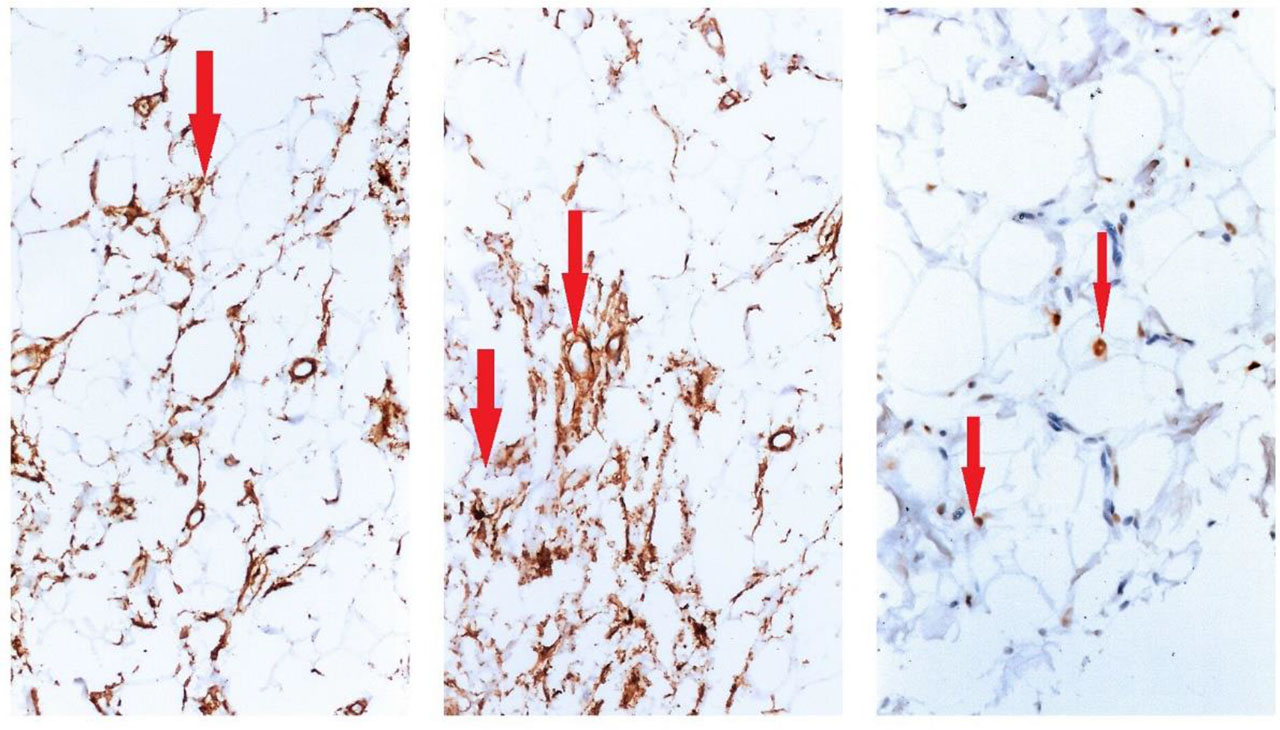
Figure 2.
Immunohistochemical staining of biopsy samples from infrapatellar fat pad showing expression of CD44, CD166, and SOX9 markers (brown staining). Arrows
Similarly, the relative number of CD166-positive cells was 10.34% (8.22; 12.78) in the IPFP biopsy. In the SCAT biopsy, it was 1.10% (0.80; 1.50) (Table 1, Figs. 1, 2). This indicates a 9.4-fold increase. This difference was also statistically significant (p < 0.05).
For SOX9-positive cells, the relative number in the IPFP biopsy was 7.30% (6.71; 8.02). In the SCAT biopsy, it was 0.90% (0.60; 1.20) (Table 1, Fig. 2). This reflects an 8.1-fold increase. The difference was statistically significant (p < 0.05).
The obtained data highlight several findings. In subcutaneous adipose tissue, the coefficients of variation (CV) range from 63.64% to 71.43%. This reflects a significant spread of values within this group. The greatest variation occurs for CD44-positive cells. In the infrapatellar fat pad, the CV is lower than in SCAT. This is particularly evident for SOX9-positive cells (17.95%), suggesting greater data stability in IPFP. The greatest spread in IPFP is observed for CD44-positive cells (49.25%).
The obtained data confirm the presence of adipose-derived mesenchymal stem cells (MSCs) with an immunohistochemical profile of CD44, CD166, and SOX9. These cells were identified in biopsies from both Hoffa’s fat pad and subcutaneous adipose tissue. The difference in the number of these cells between the two tissues was statistically significant.
Analysis of the results based on individual marker expression revealed distinct patterns. The relative number of SOX9-positive cells was significantly higher in the infrapatellar fat pad (IPFP) than in subcutaneous adipose tissue. Similarly, the expression of CD44 and CD166 was statistically significantly greater in the IPFP. This difference may be due to the greater diversity of cellular composition in the IPFP. It could also reflect a higher number of inflammatory cells, possibly resulting from traumatic or non-traumatic changes in the knee joints of the donors.
The anatomical location of the tissue likely plays a crucial role. MSCs from subcutaneous adipose tissue show moderate SOX9 expression, consistent with basal levels. In contrast, the infrapatellar fat pad is a specialized tissue located intracapsularly in the knee joint. It serves unique functions, including load cushioning, maintenance of cellular homeostasis in the joint, and participation in reparative processes. A key difference between the two adipose tissues lies in functional adaptation. MSCs in Hoffa’s fat pad are specialized for maintaining and restoring articular tissues, such as cartilage, which requires elevated SOX9 activity. Conversely, subcutaneous adipose tissue primarily functions in energy storage and insulation, reducing the need for SOX9-mediated processes
The microenvironment also contributes significantly. The proximity of cartilage tissue and other joint structures influences the receptor profile and growth factors in the IPFP. These factors stimulate chondrogenic differentiation pathways. Mechanical signals during joint loading further enhance this effect.
However, the study has limitations that must be acknowledged. The sample size was limited, with 15 tissue samples from the infrapatellar fat pad and 10 from subcutaneous adipose tissue. Additionally, the use of the non-parametric Mann–Whitney test has drawbacks. While it does not require normality of distribution or equality of variance, it is less rigorous than the parametric Student’s t-test for independent samples.
Discussion. The infrapatellar fat pad was, until recently, viewed primarily as a large vascular structure. It is innervated by intracapsular and extrasynovial tissue and plays a biomechanical role in the anterior compartment, protecting the knee joint. Over time, researchers recognized that the IPFP and the synovial membrane function as a single unit. Their close molecular interactions have become evident. This discovery has highlighted new roles for the IPFP in the pathophysiology of joint diseases, including osteoarthritis. It has also revealed characteristics of resident cells associated with the immune system, which exhibit diverse phenotypes.
This structural complex is increasingly recognized as a potential therapeutic target for patients with various knee joint pathologies. The presence of mesenchymal stem cells (MSCs) as perivascular cells in the IPFP is notable. These cells demonstrate immunomodulatory, antifibrotic, and neutralizing activities. Such properties align with those of key mediators in the mesentery. As a result, the IPFP emerges as an alternative source of MSCs for clinical cell-therapy protocols [9]. The molecular basis for these therapeutic effects involves the secretion of bioactive molecules, such as interleukin-10 (IL-10) and transforming growth factor-beta (TGF-β), which modulate inflammation and promote tissue repair. Studies have shown that IPFP-derived MSCs suppress pro-inflammatory cytokines like IL-1β and TNF-α, contributing to an anti-inflammatory microenvironment conducive to cartilage regeneration [10].
The intraarticular location of the IPFP and its anatomical proximity to cartilage are significant. It is not surprising that IPFP-derived adipose stem cells show a strong affinity for chondrogenic differentiation in vitro. Specifically, IPFP-ASC exhibit a greater capacity for chondrogenic differentiation compared to adipose-derived stem cells from other anatomical locations. This capacity also surpasses that of MSCs from bone marrow and umbilical cord. However, some studies suggest that the chondrogenic potential of IPFP-ASC is at least comparable to that of bone marrow-derived MSCs. Still, it remains lower than that of native chondrocytes and perivascular IPFP-ASC. The enhanced chondrogenic potential of IPFP-ASCs is likely driven by the upregulation of key transcription factors, such as SOX9, and the production of extracellular matrix (ECM) components, including type II collagen and aggrecan, under the influence of TGF-β signaling pathways. TGF-β activates the SMAD2/3 signaling cascade, which directly regulates SOX9 expression, a master regulator of chondrogenesis [11].
Research based on these findings indicates that selective isolation of specific IPFP-ASC subpopulations can enhance their chondrogenic differentiation capacity. Additionally, perivascular IPFP-ASC produce significantly more extracellular matrix than heterogeneous, untreated IPFP-ASC cultures. This difference may be attributed to the enriched expression of perivascular markers, such as CD146, which correlate with higher proliferative and differentiation potential. Recent studies further confirm that CD146+ IPFP-ASC sub-populations demonstrate superior chondrogenic potential due to their enhanced expression of cartilage-specific genes, such as Col-2A1 and ACAN, highlighting their promise for targeted regenerative therapies [12].
In vivo studies show promising results. Freshly isolated, uncultured CD44+ IPFP-ASC were seeded in a TGF-β3-derived extracellular matrix (ECM). When subcutaneously implanted into nude mice, these cells generated cartilage-like tissue. This tissue was rich in sulfated glycosaminoglycans (sGAG) and type II collagen. Chondroprogenitor cells, a sub-population of multipotent progenitor cells, are primed for chondrogenesis. These cells differ from articular chondrocytes. They exhibit a high affinity for fibronectin, high colony formation efficiency, and expression of the Notch1 gene. Notch1 signaling has been implicated in maintaining stemness and promoting early chondrogenic commitment, further supporting the therapeutic promise of these cells [13].
Several markers are commonly linked to the chondrogenic potential of mesenchymal stem cells and chondroprogenitor cells in current scientific literature. These include CD44, CD49c, CD166, SOX9, and Col-2 [14,15,16]. Due to their strong proliferative and chondrogenic differentiation capacities, these cells can play a significant role. They contribute to the regeneration and repair of cartilage in osteoarthritis. CD44, a hyaluronic acid receptor, facilitates cell-matrix interactions critical for chondrogenesis, while SOX9 orchestrates the expression of cartilage-specific genes. The molecular interplay between these markers and signaling pathways, such as Wnt/β-catenin and Hedgehog, further modulates chondrogenic differentiation and ECM production [14].
CD44 is a common marker for both chondrocytes and chondroprogenitor cells in normal cartilage, while CD90, CD105, and CD166 are common markers for chondroprogenitor cells in both normal and damaged cartilage [17].
In the current literature, there are very few reports on the quantitative characterization of chondroprogenitor cells in adipose tissue, which could potentially be used in one-step procedures for treating musculoskeletal diseases. This gap underscores the need for standardized protocols to quantify chondroprogenitor subpopulations in IPFP, which could streamline their clinical translation for single-stage cartilage repair procedures.
In healthy cartilage tissue, CD166+ cells are present at a level of 15.3 ± 2.3%, according to FACS analysis [18]. This value closely aligns with the results of our study on IPFP biopsy material. It supports the theory of their similarity to surrounding cells in regenerative restoration.
In our study, SOX9+ cells were identified in freshly isolated tissue samples from Hoffa’s fat pad. We used immunohistochemical analysis with digital image processing. The relative number of SOX9+ cells was 7.30% (6.71; 8.02). Literature data, based on PCR analysis of SOX9 gene expression in intra-articular structures like Hoffa’s fat pad, indicate higher levels of chondrogenic gene expression compared to extra-articular structures, such as subcutaneous tissue. These findings are consistent with our results. They emphasize the need for further studies on the therapeutic potential of these cells [19]. The elevated SOX9 expression in IPFP may be influenced by the local microenvironment, including synovial fluid-derived growth factors like TGF-β and BMP-2, which enhance chondrogenic gene expression [20]. Recent quantitative proteomic analyses have identified BMP-2 as a critical regulator of SOX9 expression in IPFP-ASCs, suggesting that targeted modulation of BMP signaling could enhance their chondrogenic potential in clinical applications [21].
Stem cell therapy using cartilage progenitor stem cells shows promise as an important approach for treating osteoarthritis. These cells are a subset of stem cells with enhanced proliferation, chemotaxis, and significant potential to differentiate into chondrocytes. Stem cells isolated from the infrapatellar fat pad benefit from their anatomical location. This location influences the characteristics of adipose stem cells and enhances the chondrogenic differentiation potential of IPFP-derived ASCs. The close proximity of IPFPs to the synovial membrane and fluid likely contributes to this higher potential by exposing cells to a milieu rich in chondrogenic inducers. For instance, synovial fluid contains high levels of hyaluronic acid and TGF-β, which synergistically promote MSC differentiation into chondrocytes. As a result, IPFPs can be considered a valuable resource for regenerative cartilage therapy. The therapeutic potential of mesenchymal stem cells from Hoffa’s fat pad makes it an important source of adipose-derived stem cells. These cells can be utilized for regenerative engineering treatments, especially for cartilage tissue.
To maximize the clinical impact of these findings, key takeaways include the superior chondrogenic potential of IPFP-ASCs compared to other MSC sources, driven by their unique molecular profile and anatomical advantages. The identification of specific subpopulations, such as CD146+ and SOX9+ cells, offers a pathway for developing targeted cell-based therapies for osteoarthritis. However, challenges remain, including the need for standardized isolation techniques and larger-scale clinical trials to validate efficacy and safety.
Future research should focus on several critical directions. First, optimizing the isolation and expansion of chondroprogenitor subpopulations from IPFP could enhance their therapeutic efficacy. Second, longitudinal studies are needed to assess the durability of IPFP-ASC-derived cartilage repair in vivo, particularly in human osteoarthritis models. Third, integrating advanced biomaterials with IPFP-ASCs could improve cell delivery and retention at the defect site, addressing current limitations in cartilage regeneration. Finally, exploring the role of novel signaling pathways, such as Hedgehog and BMP, in regulating IPFP-ASC chondrogenesis could un-cover new therapeutic targets to enhance cartilage repair outcomes.
In conclusion, the molecular mechanisms underlying the therapeutic effects of IPFP-derived MSCs and their chondrogenic potential involve a complex interplay of signaling pathways (e.g., TGF-β/SMAD, Notch, Wnt) and the expression of cartilage-specific genes (e.g., SOX9, Col-2). These mechanisms are supported by the immunomodulatory properties of MSCs and their ability to produce a cartilage-like ECM. Further exploration of these pathways and their regulation could optimize the use of IPFP-ASCs in clinical settings, offering a promising avenue for OA treatment.