
INTRODUCTION
Frequency of infections that are caused by multidrug resistant bacteria is escalating at an extraordinary rate. These infections pose a great clinical danger due to the difficulties encountered during their treatment. This issue is especially related to infectious caused by hospital strains of Gram-negative and Gram-positive bacteria [1,2]. One of the most significant mechanisms of resistance are efflux pumps mainly located in the outer membrane of Gram-negative pathogens. The overproduction of these pumps leads to reduced - sublethal intracellular concentrations of antibiotics due to the processes of transporting these substances outside the bacterial cell [3]. Efflux pumps can transport antibiotics of one or more structural classes, thereby providing multidrug resistance (MDR) [2,4]. Since efflux pumps have been found in three kingdoms of living organisms, they are considered ancient [5]. That means antimicrobial resistance is not their only function. Some of pumps have a role in biofilm formation [6], others present an indispensable factor of virulence, which is why these pumps can be considered as fundamental to the bacterial physiology [7,8,9].
EFFLUX PUMP FAMILIES
Efflux pumps in Gram-negative bacteria, based on their protein structure can be classified in two major groups: primary and secondary transporters. First group of transporters includes ATP-binding cassette (ABC) family. These transporters as a source of energy use energy generated during the processes of ATP binding and hydrolysis. Secondary transporters are further divided in four groups: major facilitator superfamily (MFS), resistance nodulation division family (RND), small multidrug resistance (SMR) and multidrug and toxic compound extrusion family (MATE). Secondary transporters as a source of energy use the electrochemical potential of the bacterial cell membrane (Figure 1). Efflux pumps that can be found in Gram-positive bacteria belong either to the ABC, MFS or SMR families [4,10,11].
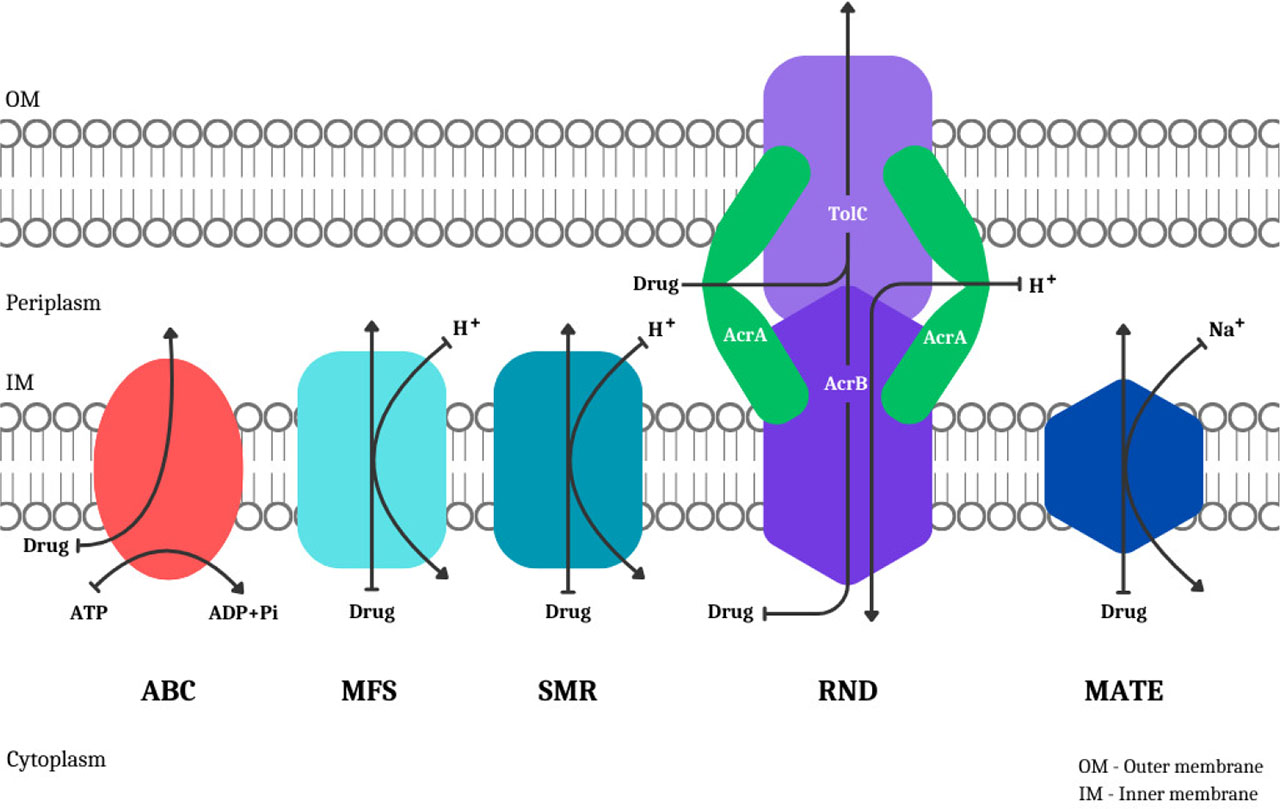
Figure 1.
Schematic representation of five families of efflux pumps
ABC – ATP-binding cassette superfamily; MFS – major facilitator superfamily; SMR – small multidrug resistance superfamily; RND – resistance nodulation division family; MATE – multidrug and toxic compound extrusion family; IM – inner membrane; OM – outer membrane.
PRIMARY TRANSPORTERS – ABC family
Transporters of the ABC family are built of two subunits. First one is an intracellular nucleotide-binding domain dimer (NBD dimer) that has the function of binding and hydrolysis of ATP and second one is a cognate membrane-domain dimer (MD dimer), part of transporter that is integrated in the plasma membrane and presents the trans-membrane protein channel for substrates [4,12,13,14]. Members of the ABC family can be found in both Gram-negative and Gram-positive bacteria. Some of them who are clinically important pathogens are: Salmonella typhimurium, Streptococcus pneumoniae, Staphylococcus aureus, Neisseria spp., Escherichia coli [13]. As a consequence of having this group of pumps, among these bacteria there are often strains resistant to lincomycin, bacitracin, erythromycin and kanamycin [15].
SECONDARY TRANSPORTERS
RND family
Clinically, the most significant for the resistant Gram-negative bacteria are the pumps of RND family. These pumps are built in form of tripartite system that permeates both, inner and outer membranes. This system contains three components:
1) inner membrane transporter – AcrB
2) periplasmic adaptor protein – AcrA
3) outer membrane transporter – TolC [16]
RND pumps are in many cases highly conserved, but also the number of different pumps found in certain bacterial species can vary and it looks like it can be related to the lifestile. Bacteria that possess this sistem are: Escherichia coli, Pseudomonas aeruginosa, Acinetobacter baumannii, Campylobacter jejuni, Neisseria gonorrhoeae, Klebsiella pneumoniae [17,18]. Just like other efflux pumps, the RND pumps can be substrate specific, but can also recognize and transport a broad range of substances and lead to multidrug resistance [19]. Some of the antibiotics whose concentrations can be significantly reduced by the action of RND pumps are β-lactams, aminoglycosides, tetracyclines, trimethoprim-sulfamethoxazole, chloramphenicol [20]. Given the high degree of expression of this type of pump among clinically resistant strains of bacteria, finding their effective inhibitor would significantly increase the success of the treatment of severe (mostly nosocomial) infections[11,17].
MFS family
Major facilitator superfamily presents the largest group of bacterial efflux pumps. These proteins are made up of 400 amino acids that form 12 transmembrane helices[2]. In both Gram-positive and Gram-negative bacteria these pumps are usually present as multicomponent transporters that are responsible for sugar uptake, biofilm formation, protection from osmotic stress and drug resistance [21,22,23,24]. Some of the most common pumps of this family are NorA, NorB, LmrB, MefE, MefA, which are most important for resistance among Gram-positive bacteria[2]. Clinically significant pathogens that have developed antimicrobial resistance due to the presence of these pumps are: Staphylococcus aureus, Mycobacterium tuberculosis, Mycobacterium bovis, Shigella flexneri, Vibrio cholerae, Helicobacter pylori, Acinetobacter baumannii, Escherichia coli, Neisseria gonorrhoeae [24,25,26,27]. Overexpression of MFS pumps leads to frequent resistance to the following antibiotics: tetracycline, chloramphenicol, norfloxacin, erythromycin, azithromycin, rifampin, spectinomycin, daunorubicin, linezolid, fluoroquinolones [11,28,29].
SMR family
Members of small multidrug resistance family are small, hydrophobic efflux transporters whose polypeptide chains permeate bacterial membrane four times [30]. Since these peptides are composed of an average of 110 amino acids, they are thought to function as oligomeric complexes[2]. Most of these pumps are substrate specific which means they lead to the resistance to one individual or a small group of antibiotics with similar structure [31]. SMR pumps are found in Staphylococcus aureus, Escherichia coli, Proteus vulgaris, Klebsiella aerogenes, Acinetobacter baumannii [30,32]. Specific situation is seen in Acinetobacter baumannii where SMR pump AbeS is able to export a broad range of antibiotics including aminoglycosides, quinolones, erythromycin, tetracycline along with some detergents, disinfectants and dyes [32].
MATE FAMILY
MATE family is the most recently discovered group of secondary transporters [33]. These transporters are unique in that instead of proton gradient they use the potential created as a result of the arrangement of sodium ions on both sides of the cell membrane as a source of energy [34]. In addition, their characteristic is that the number of amino acids in their composition varies between 400 and 700, while the required number of transmembrane helices is 12. Such a variation in the number of amino acids is made possible by the different number of repetitions of the expression of the same gene that is common to all members of this protein family. This rule was originally established by examining MepA pump expression in S. aureus [2,23]. Among of MATE family, almost all pumps are able to recognize fluoroquinolones and aminoglycosides (especially streptomycin and kanamycin). Intracellular concentration of some dyes as ethidium-bromide and acriflavine can also be reduced by the activity of these pumps. Bacteria species who gained multidrug resistance thanks to the possession of MATE transporters are Acinetobacter baumannii, Escherichia coli, Clostridium difficile, Haemophilus influenzae, Pseudomonas aeruginosa, Neisseria meningitidis[11,12,33,34].
OVEREXPRESSION OF EFFLUX PUMPS AS A SIGNIFICANT CAUSE OF ANTIBIOTIC RESISTANCE
Main causes of efflux pumps overexpression
Increased expression of efflux pumps which leads to the clinically significant antibiotic resistance may be due to the action of various factors that lead to changes in both, intracellular and extracellular environment [11]. As mentioned earlier, genes that determine resistance mechanisms have been present in bacterial cells since ancient times. However, over the last few decades, excessive and misuse of antibiotics has led to the development of severe antimicrobial resistance. Natural selection also plays a significant role in the development of this resistance, since weakly resistant bacterial strains are easily removed by the action of antibiotics [35]. All this leads to the conclusion that one of, if not the main cause of widespread antibiotic resistance is the excessive use of antibiotics in clinical medicine combined with self-medication [36]. Increased expression of the efflux pumps usually occurs as a result of changes in the bacterial cell environment. Different changes lead to the initiation of different signaling pathways and the activation of appropriate adaptation mechanisms. Most common signal triggers are substrates of the bacterial efflux pumps, for example, antibiotics and biocides, but also some of the natural substrates like bile and indole. These last two substrates led to enhanced expression of acrAB in Salmonella spp. and Escherichia coli [37]. However, pump expression inducers do not always have to be their substrates. Namely, the inductive effect of some substances, such as ethidium bromide, crystal violet, berberine and rhodamine 6G on the crystal structure of RamR, a modulator of acrAB expression in Salmonella spp., has been proven [38].
Regulatory system of efflux pump expression
Since antibiotics resistance isn’t the only function these pumps provide, bacterial cells have developed a complex regulatory system. Some of the most important regulation factors are:
Transcription factors whose regulons contain efflux pump and other plasma membrane protein genes [39]
This mechanism is most common for the regulation of RND pumps expression, but can also be important for other pump families. Genes encoding pumps of the RND family and gene that codes repressor protein of TetR family are normally located next to each other [11,40]. Mutations in repressor gene lead to the disinhibition of the promotor gene, its increased expression and subsequently to the efflux pump overexpression and multidrug-resistance phenotype [41,42]. It is important to know that both the number and activity of regulatory molecules are also controlled by proteases. For example, in both Salmonella and Escherichia coli AraC/XylS transcription factors are degraded due to Lon protease activity, as one of the most important protease system in multidrug resistant bacterial strains [11,43].
Two-component systems (TCS) for regulation of RND pumps expression
As the name suggests, this regulatory system is made up of two components: histidine protein kinase domain and cognate receiver domain with its C terminal kinase as main part. Histidine protein kinase domain registers corresponding extracellular changes which induces phosphorylation of the receiver domain and initiates further signal transduction via the transmembrane helicase system to the C-terminal kinase domain. This phosphorylation sequence leads to a conformational change in the C-terminal kinase domain in cytosol and thus allows it to affect the expression of genes encoding protein subunits of efflux pumps [44]. Protein classes of TCS connectors are present in both Gram-negative and Gram-positive bacteria and represent one of the most important factors for antibiotic resistance, growth, osmoregulation sporulation and many others [45,46].
Mutations as a cause of transcriptional changes that lead to efflux pump overexpression
Mutations of regulatory genes, other than TetR, and genes that code transcription factors often lead to the overexpression of the efflux pumps and multidrug resistance as a consequence. Increased pump expression often occurs as a consequence of loss of repressor mechanisms [41,47,48]. In addition to the mentioned genes, mutations can also occur in their promoter regions and thus affect the binding and action of regulatory proteins on DNA [49]. Many studies showed that even single, point mutations can lead to the dramatically increased pump expression and MDR.
Bacterial efflux pumps overexpression consequences
The most significant consequence of efflux pump over-expression is reflected in the appearance of highly resistant clinically important pathogens. The last few decades have seen a significant increase in the incidence of infections caused by multidrug-resistant bacterial strains. Some of clinically important pathogens that owe their antibiotic resistance to efflux pumps are shown in Table 1. In addition to pathogenic strains, this table shows types of efflux pumps that bacteria possess, as well as antibiotics and other substrates that are expelled from cell by this mechanism. The main problem with these infections is the difficulty of treatment because of the significantly reduced choice of antibiotics that are effective. For this reason the choice of antibiotic should be based on the results of the antibiogram [35].
Table 1.
Clinically most significant efflux pumps in Gram-negative and Gram-positive bacteria
| Bacteria | Efflux pumps families | Antibiotics and other substrates | Ref. |
|---|---|---|---|
| Acinetobacter baumannii | RND | Fluoroquinolones, carbapenems, aminoglycosides, tetracyclines | [1,57,58] |
| MFS | Chloramphenicol, daunorubicin, linezolid, macrolides | [11,29] | |
| SMR | Detergents, dyes, disinfectants | [32] | |
| MATE | Ethidium bromide | [12,33] | |
| Escherichia coli | ABC | Lincomycin, bacitracin, erythromycin, tigecycline | [13,15] |
| RND | β-lactams, aminoglycosides, tetracyclines, chloramphenicole, trimethoprim-sulfamethoxazole | [17] | |
| MFS | Rifampin, daunorubicin | [28] | |
| MATE | Aminoglycosides | [33,34] | |
| Pseudomonas aeruginosa | RND | Novobiocin, penicillins, erythromycin, β-lactams, macrolides, tetracyclines, chloramphenicol | [18] |
| MATE | Chloramphenicol, linezolid | [12,33,34] | |
| Neisseria gonorrhoeae | ABC | Kanamycin, bacitracin | [13,15] |
| RND | Erythromycin, crystal violet, cholic acid | [59] | |
| MFS | Norfloxacin, azithromycin, rifampin, spectinomycin | [29] | |
| Salmonella spp. | ABC | Erythromycin, kakamycin | [9,13] |
| RND | Fluoroquinolones, chloramphenicol, rifampin, β-lactams, bile saslts, indole, crystal violet | [9,37,60] | |
| Staphylococcus aureus | ABC | Macrolides | [14] |
| MFS | β-lactams, tetracyclines, fluoroquinolones | [29] | |
| SMR | Aminoglycosides, quinolones, erythromycin, detergents, disinfectants | [32] |
CONCLUSION AND FUTURE PERSPECTIVE
As a consequence of frequent use of antibiotics, there is a significant increase in the expression of efflux pumps. Because of that, human pathogens have become increasingly resistant to the most commonly used antibiotics, causing very severe infections with significantly reduced therapeutic options, and potentially serious consequences for patient health[1]. As the role of these pumps is not only in antibiotic resistance but also in biofilm formation and virulence, inhibition of these pumps would significantly weaken the pathogenicity of the microorganisms that possess them. Understanding the structure of efflux pumps and knowing their distribution among bacterial strains is necessary for the development of effective inhibitors. Therefore, an adequate inhibitor would facilitate the use of already existing antibiotics in clinical practice. For now, several different types of inhibitors are being investigated, which differ in their mechanism and place of action [11]. The main groups are competitive inhibitors, then substances that lead to reduced or completely interrupted transcription of genes encoding protein components of pumps as well as inhibitors of various components of the tripartite system of RND pumps [50,51,52,53,54,55,56]. Clinically, the most important would be inhibitors of the RND family of pumps given their prevalence among resistant strains. A fact that should facilitate the synthesis of an effective inhibitor is the absence of a structural protein homologue of these proteins in mammals [11,61,62]. A clinically applicable inhibitor should, in addition to blocking dominant efflux pump types, be non-toxic to eukaryotic cells. The importance of these application conditions is reflected in the inability to clinically use some of the most potent inhibitors such as PAßN and ABI-PP [62,63].
AKNOWLEDGEMENT
The study was financially supported by the Faculty of Medical Sciences, University of Kragujevac, Serbia, JP 03/10.