
Table 1
Ideological positions
| Ideological dimension | Positions 1 and 2 | Position 3 | Positions 4 and 5 |
|---|---|---|---|
| Economic | Strong/moderate preference for state intervention and equality | Balancing economic freedom with distributional concerns and state intervention | Moderate/strong preference for economic freedom |
| Social | Strong/moderate preference for the rights and freedoms of individuals and minority social groups | Balancing individual and minority freedoms with majoritarian values and collective interest | Moderate/strong preference for majoritarian social values and collective interest |
| Authoritarian | Strong/moderate preference for individual human rights | Balancing individual rights with social order and authority of the state | Moderate/strong preference for authority of the state and social order |
Table 2
Example of scoring of judges’ positions based on their votes
| Position 1 | Position 2 | Position 3 | Position 4 | Position 5 | |
|---|---|---|---|---|---|
| DECISION 1 | Decision | Counter-decision | |||
| Judges voting in favour | 1 | 1 | 1 | ||
| Judges voting against | 1 | 1 | |||
| DECISION 2 | Decision | Counter-decision | |||
| Judges voting in favour | 1 | 1 | 0.5 | ||
| Judges voting against | 0,5 | 1 | 1 |
Table 3
Example of scoring of judges’ positions based on votes and separate opinions
| Position 1 | Position 2 | Position 3 | Position 4 | Position 5 | |
|---|---|---|---|---|---|
| DECISION 1 | Concurring separate opinion | Decision | Counter-decision and dissenting separate opinion | ||
| Judges subscribing to concurring opinion | 2 | ||||
| Judges subscribing to dissenting opinion | 2 | ||||
| Judges voting in favour | 0.5 | 1 | 1 | ||
| Judges voting against | 1 | 1 |
Table 4
Structure of the sample with respect to the subject matter of decisions
| Ideological dimension | Subject matter according to content descriptors | Number in total | Share in total | Number in sample | Share in sample | Sample/Total |
|---|---|---|---|---|---|---|
| Economic | Free economic initiative | 17 | 2.8 | 10 | 10.0 | 58.8 |
| Property rights, restitution | 59 | 9.6 | 10 | 10.0 | 16.9 | |
| Public good, environment | 31 | 5.1 | 4 | 4.0 | 12.9 | |
| Taxation, public finance | 49 | 8.0 | 4 | 4.0 | 8.2 | |
| Social and workers’ rights | 41 | 6.7 | 7 | 7.0 | 17.1 | |
| Social | Freedom of speech | 5 | 0.8 | 2 | 2.0 | 40.0 |
| Right to privacy | 12 | 2.0 | 8 | 8.0 | 66.7 | |
| Children’s and parents’ rights | 5 | 0.8 | 1 | 1.0 | 20.0 | |
| Discrimination, minority rights | 12 | 2.0 | 9 | 9.0 | 75.0 | |
| Cultural and religious rights | 4 | 0.7 | 2 | 2.0 | 50.0 | |
| Authoritarian | Political rights, referenda | 55 | 9.0 | 13 | 13.0 | 23.6 |
| Legality, political system | 100 | 16.3 | 10 | 10.0 | 10.0 | |
| Law enforcement, human rights | 222 | 36.3 | 20 | 20.0 | 9.0 | |
| Economic | All | 197 | 32.2 | 35 | 35.0 | 17.8 |
| Social | All | 38 | 6.2 | 22 | 22.0 | 57.9 |
| Authoritarian | All | 377 | 61.6 | 43 | 43.0 | 11.4 |
| Total | All | 612 | 100 | 16.3 | ||
Table 5
Structure of the sample with respect to disagreement among judges
| Number in total | Share in total | Number in sample | Share in sample | |
|---|---|---|---|---|
| Unanimous decisions | 446 | 76.1 | 59 | 59.0 |
| Decisions with at least one judge voting against at least a part of the decision | 146 | 23.9 | 41 | 41.0 |
| Decisions with a separate opinion | 80 | 13.1 | 39 | 39.0 |
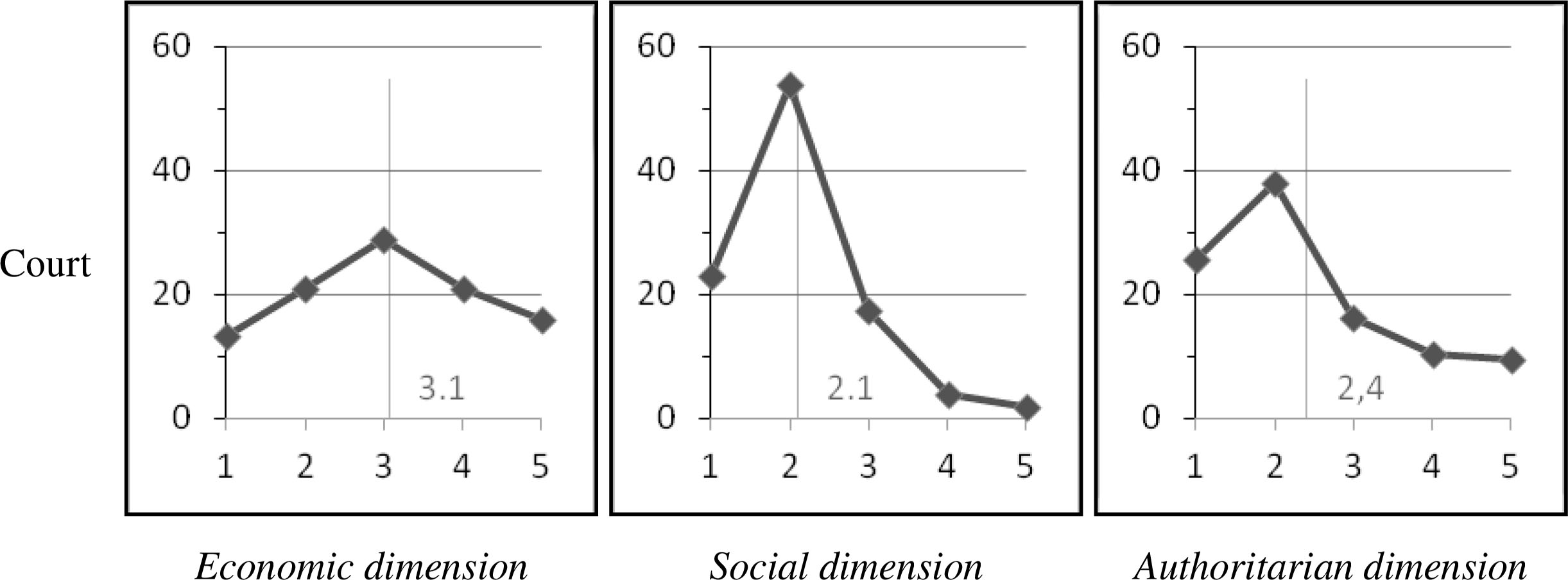
Figure 1
Ideological profile and ideal points of the Constitutional Court
Note: The horizontal axis plots ideological positions along the dimension, the vertical axis measures the intensity of preference (relative frequencies) for each position. The red vertical line and the number present the ideological ideal points.
Number of observations – economic dimension: 38 decisions, social: 52, authoritarian: 105.
Table 6
Judges’ ideal points
| Judge | Economic dimension | Social dimension | Authoritarian dimension | |||
|---|---|---|---|---|---|---|
| IP | SD | IP | SD | IP | SD | |
| Čebulj | 2.9 | 1.2 | 2.3 | 1.0 | 2.5 | 1.2 |
| Fišer | 2.9 | 1.1 | 2.2 | 0.8 | 2.4 | 1.1 |
| Janko | 3.0 | 1.1 | 2.2 | 0.8 | 2.6 | 1.1 |
| Krisper-K. | 2.9 | 1.2 | 2.2 | 0.8 | 2.6 | 1.2 |
| Modrijan | 3.0 | 1.1 | 2.3 | 1.0 | 2.6 | 1.2 |
| Ribičič | 3.0 | 1.1 | 2.1 | 0.8 | 2.3 | 1.0 |
| Škrk | 2.9 | 1.1 | 2.0 | 0.7 | 2.5 | 1.1 |
| Tratnik | 2.8 | 1.1 | 2.2 | 0.9 | 2.5 | 1.1 |
| Wedam-L. | 3.1 | 1.1 | 2.1 | 0.8 | 2.3 | 1.0 |
| The Court | 3.1 | 1.3 | 2.1 | 0.9 | 2.4 | 1.2 |
| Median of judges | 2.9 | 2.2 | 2.5 | |||
[i] Note: IP = ideal point; SD = standard deviation of scores for all decisions.
[ii] Number of observations – for the Court as in Figure 1; for individual judges, there are 32–38 observations for the economic dimension, 41–51 for the social dimension, and 92–104 for the authoritarian one. For two judges who were appointed later, there are 27 and 31 observations for the economic dimension, 37 and 45 for the social one, and 80 and 83 for the authoritarian dimension.
Table 7
Ideal points in contested and unanimous decision
| Social dimension | Authoritarian dimension | |||||
|---|---|---|---|---|---|---|
| Judge | All decisions | Unanimous decision | Contested decisions | All decisions | Unanimous decision | Contested decisions |
| Čebulj | 2.3 | 1.9 | 2.9 | 2.5 | 2.2 | 2.9 |
| Fišer | 2.2 | 1.9 | 2.7 | 2.4 | 2.2 | 2.7 |
| Janko | 2.2 | 1.9 | 2.6 | 2.6 | 2.2 | 3.0 |
| Krisper-K. | 2.2 | 2.0 | 2.6 | 2.6 | 2.3 | 3.1 |
| Modrijan | 2.3 | 1.9 | 2.9 | 2.6 | 2.2 | 3.1 |
| Ribičič | 2.1 | 1.8 | 2.5 | 2.3 | 2.2 | 2.4 |
| Škrk | 2.0 | 1.8 | 2.4 | 2.5 | 2.3 | 2.9 |
| Tratnik | 2.2 | 1.9 | 2.8 | 2.5 | 2.3 | 2.8 |
| Wedam-L. | 2.1 | 1.9 | 2.4 | 2.3 | 2.1 | 2.6 |
| The Court | 2.1 | 1.5 | 3.0 | 2.4 | 1.9 | 2.6 |
| Median of judges | 2.2 | 1.9 | 2.6 | 2.5 | 2.2 | 2.9 |
[i] Note: Number of observations for all decision is as reported in Table 1. For unanimous decisions, it ranges from 29 to 33 on the social dimension and from 55 to 59 on the authoritarian. For contested decisions, the number of observations is between 12 and 19 on the social dimension and between 37 and 46 on the authoritarian. For the 2 judges that joined the Court later (Krisper-Kramberger and Tratnik), there are 25 and 29 observations for unanimous decisions on the social dimension, and 48 and 51 on the authoritarian. For contested decisions there are 14 and 16 observations for these two judges on the social dimension and 32 on the authoritarian.