
Table 1.
Proinflammatory changes in smokers' lungs.
| Alteration compared with nonsmoker | Reference |
|---|---|
| Increase in alveolar inflammatory cells | Niewoehner et al., 1974 (34) |
| Generation of chemotactic factor C5a | |
| Inactivation of chemotactic factor inhibitor | Robbins et al., 1990 (16) |
| Activation of macrophages | Hunninghake and Crystal, 1983 (17) |
| Activation of epithelial cells | |
| Four- to five-fold increase in BAL neutrophils | Hunninghake and Crystal, 1983 (17) |
| Increase in BAL neutrophil elastase levels | Fujita et al., 1990 (20) |
| Decrease in anti-elastase activity | |
| Four- to five-fold increase in BAL macrophages | Shapiro, 1994 (23) |
| Increase in macrophage metalloelastase | Shapiro, 1994 (23) |
| Recruitment of inflammatory cells via macrophage generated matrix fragments | |
| Increase in cathepsins B, D, and L |
Table 2.
Subclinical manifestations of pulmonary inflammation in smokers.
| Alteration compared with nonsmoker | Reference |
|---|---|
| Increased respiratory symptoms on SGRSQ; especially morning cough | |
| Decreased FEF25–75% | |
| Increased clearance of 99m-DTPA | |
| Abbreviations: | |
| SGRSQ: |
|
| FEF25–75%: | |
| 99m-DTPA: |
Table 3.
Proinflammatory changes in smokers' systemic circulation.
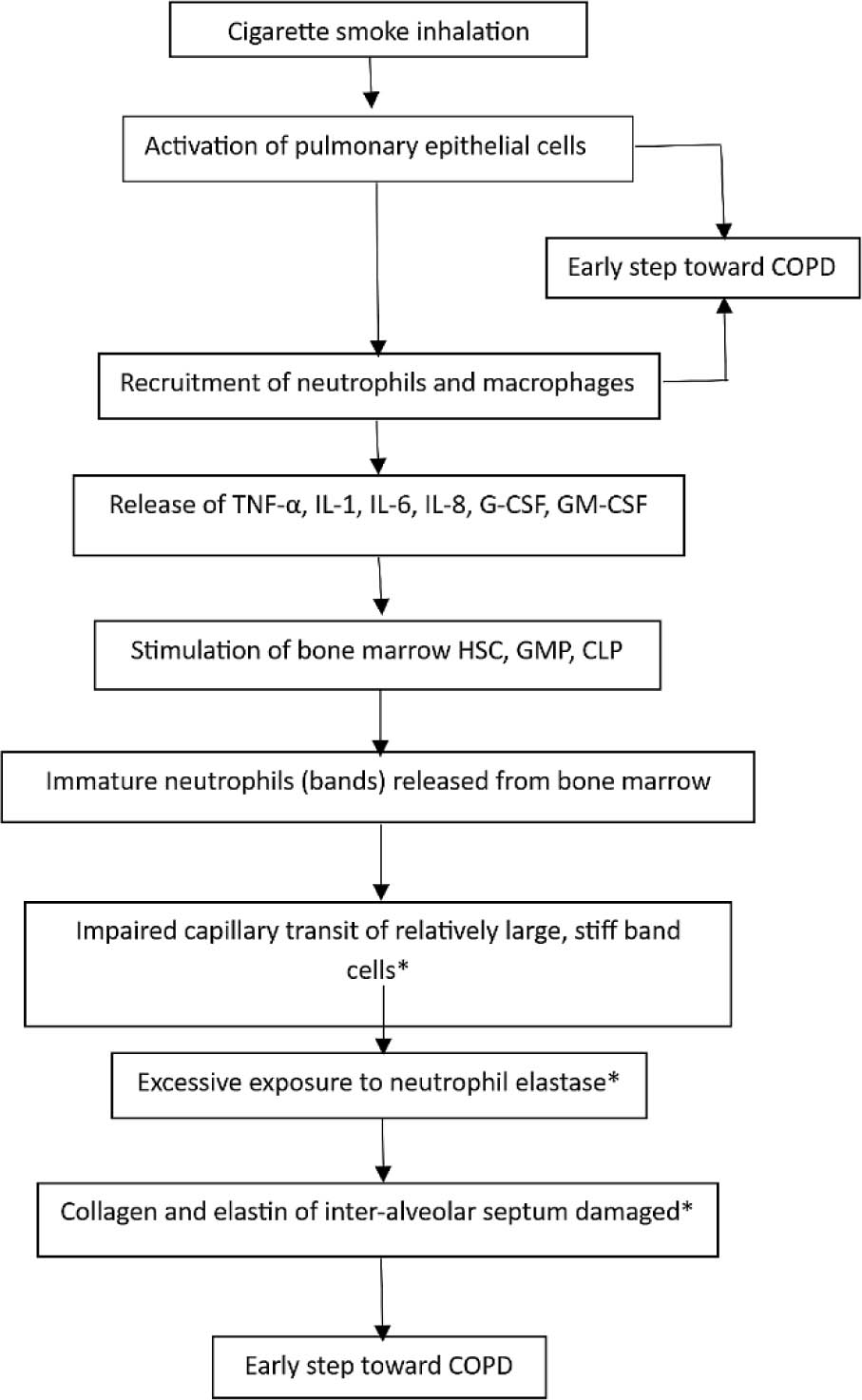
Figure 1.
Interaction of pulmonary and systemic inflammation.
Table 4.
Tmax and Cmax data for nicotine intake from various nicotine sources.
| Nicotine source | Absorption site | Absorption speed (peak time (Tmax) to maximum blood concentration) | Peak blood level (Cmax peak plasma concentration) | References |
|---|---|---|---|---|
| Cigarettes | Pulmonary vasculature (alveoli to pulmonary veins) | 5 min affected by puff intensity and duration. [Nicotine in smoking tobacco is delivered mainly in the form of mixed nicotine salts.] | 15 ng/mL | |
| Heat-not-burn device (IQOS) | Oral mucosal vasculature | 5 min | 13 ng/mL | |
| Small cigars | Oral mucosal vasculature | There were no significant differences in Tmax based on cigar type (~60 min) | 6 ng/mL | Claus et al., 2018 (91) |
| Cigarillos | Oral mucosal vasculature | There were no significant differences in Tmax based on cigarillo type (~60 min) | 8 ng/mL | Claus et al., 2018 (91) |
| Large cigars | Oral mucosal vasculature | There were no significant differences in Tmax based on cigar type (~60 min) | 13 ng/mL | Claus et al., 2018 (91) |
| Moist snuff 18 mg nicotine | Nasal mucosal vasculature | 65 min | 17 ng/mL | Lunell et al., 2020 (92) |
| Loose snus 10.8 mg | Oral mucosal vasculature | 45 min | 8 ng/mL | Renard et al., 2025 (93) |
| Loose snus 10.8 mg | Oral mucosal vasculature | 60 min | 11 ng/mL | Digard et al., 2013 (94) |
| Loose snus 27.1 mg | Oral mucosal vasculature | 60 min | 18 ng/mL | Digard et al., 2013 (94) |
| Pouched snus 10.7 mg | Oral mucosal vasculature | 60 min | 11 ng/mL | Digard et al., 2013 (94) |
| Pouched snus 14.7 mg | Oral mucosal vasculature | 60 min | 13 ng/mL | Digard et al., 2013 (94) |
| Nicotine pouches 6 mg | Oral mucosal vasculature | 20 min | 3 ng/mL | Mallock-Ohnesorg et al., 2024 (95) |
| Nicotine pouches 6 mg | Oral mucosal vasculature | 30 min | 11 ng/mL | Renard et al., 2025 (93) |
| Nicotine pouches 9 mg | Oral mucosal vasculature | 38 min | 14 ng/mL | Renard et al., 2025 (93) |
| Nicotine pouches 11 mg | Oral mucosal vasculature | 30 min | 17–20 ng/mL | Renard et al., 2025 (93) |
| Azzopardi et al., 2026 (96) | ||||
| Nicotine pouches 20 mg | Oral mucosal vasculature | 15 min | 7 ng/mL | Mallock-Ohnesorg et al., 2024 (95) |
| Nicotine pouches 30 mg | Oral mucosal vasculature | 15 min | 29 ng/mL | Mallock-Ohnesorg et al., 2024 (95) |
| Nicotine pouches 11 mg | Oral mucosal vasculature | 20 min | 21 ng/mL | Pickworth et.al. 2014 (97) |
| Azzopardi et al., 2026 (96) | ||||
| Nicotine pouches 20 mg | Oral mucosal vasculature | 20 min | 30 ng/mL | Azzopardi et al., 2026 (96) |
| Tobacco-free nicotine pouches (ZYN) 3 mg | Oral mucosal vasculature | 61 min | 8 ng/mL | Azzopardi et al., 2026 (96) |
| Lunell et al., 2020 (92) | ||||
| Tobacco-free nicotine pouches (ZYN) 6 mg | Oral mucosal vasculature | 66 min | 15 ng/mL | Lunell et al., 2020 (92) |
| Tobacco-free nicotine pouches (ZYN) 8 mg | Oral mucosal vasculature | 59 min | 19 ng/mL | Lunell et al., 2020 (92) |
| Nasal spray 1 mg | Nasal mucosal vasculature | 11–18 min | 5–8 ng/mL | |
| Inhaler 4 mg released (one 10 mg cartridge, 20 min) | Nasal mucosal vasculature | 30 min | 8 ng/mL | |
| Oral capsule 3–4 mg | Oral mucosal vasculature | 90 min | 6–8 ng/mL | |
| Oral slow-release capsule (colonic absorption) 6 mg | Oral mucosal vasculature | 7.5 h | 2 ng/mL | |
| Oral solution 2 mg | Oral mucosal vasculature | 51 min | 5 ng/mL | |
| Oral solution ~3 mg | Oral mucosal vasculature | 66 min | 3 ng/mL | |
| Enema ~3.5 mg | Anal mucosal vasculature | 20–80 min | 2–3 ng/mL | |
| Enema 6 mg | Anal mucosal vasculature | 45 min | 6–9 ng/mL | |
| Gum 2 mg | Oral mucosal vasculature | 30 min | 6–9 ng/mL | |
| Gum 4 mg | Oral mucosal vasculature | 30 min | 10–17 ng/mL | |
| Gum 4.2 mg | Oral mucosal vasculature | 45 min | 9 ng/mL | |
| Lozenge 2 mg | Oral mucosal vasculature | 60 min | 4 ng/mL | |
| Lozenge 4 mg | Oral mucosal vasculature | 66 min | 11 ng/mL | |
| Sublingual tablet 2 mg | Oral mucosal vasculature | ~60 min | 4 ng/mL | |
| Subcutaneous injection 2.4 mg | Venous capillaries and small veins | 25 min | 15 ng/mL | |
| Intravenous injection 5 mg | Venous capillaries and small veins | 30 min | 30 ng/mL**** | |
| Tooth patch 2 mg | Oral mucosal vasculature | ~120 min | 3 ng/mL | |
| Dermal patch 14 mg (Nicoderm) | Venous capillaries and small veins | 6–9 h | 11–14 ng/mL | |
| Dermal patch 15 mg (Nicotrol) | Venous capillaries and small veins | 4–7 h | 11–16 ng/mL | |
| Dermal patch 21 mg (Nicoderm) | Venous capillaries and small veins | 3–7 h | 18–23 ng/mL | |
| Dermal patch 21 mg (Habitrol) | Venous capillaries and small veins | 9–12 h | 12–21 ng/mL | |
| Disposable vapes (Cig-a-likes) – 1st gen. variable nicotine level | Pulmonary, oral, pharyngeal circulation | 6–13 min | 4–9 ng/mL | |
| Disposable vapes – 2nd gen. variable nicotine level | Pulmonary, oral, pharyngeal circulation | 6–10 min | 4–12 ng/mL | |
| Juul-type e-cigs 59 mg | Pulmonary, oral, pharyngeal circulation | 6 min | 11 ng/mL | Goldenson et al., 2021 (101) |
| Juul-type e-cigs 18 mg | Pulmonary, oral, pharyngeal circulation | 6 min | 4 ng/mL | Goldenson et al., 2021 (101) |
| Juul-type e-cigs 9 mg | Pulmonary, oral, pharyngeal circulation | 7 min | 2 ng/mL | Goldenson et al., 2021 (101) |
| Vape pen (myblu) nicotine salt 25 mg nicotine | Pulmonary, oral, pharyngeal circulation | 6 min | 8 ng/mL | Anonymous 2019 (102) |
| Vape pen (myblu) 25 mg free base nicotine | Pulmonary, oral, pharyngeal circulation | 8 min | 5 ng/mL | Anonymous 2019 (102) |
| Box mods | Pulmonary, oral, pharyngeal circulation | 10 min | 7 ng/mL | Voos et al., 2019 (98) |
| Sub-ohm devices | Pulmonary, oral, pharyngeal circulation | 72 min | 13 ng/mL | St Helen et al., 2016 (103) |
| Sub-ohm devices | Pulmonary, oral, pharyngeal circulation | 65 min | 23 ng/mL | Farsalinos et al., 2014 (104) |
| E-pipe | Pulmonary, oral, pharyngeal circulation | 10 min | 5 ng/mL | Voos et al., 2019 (98) |
| E-cigar | Pulmonary, oral, pharyngeal circulation | 10 min | 3 ng/mL | Voos et al., 2019 (98) |
Table 5.
Inflammation-associated effects of nicotine in human disease.
| Disease | Association with smoking or e-cigarettes | Role of nicotine | References |
|---|---|---|---|
| Ulcerative colitis (UC) |
| Ameliorates pathology and symptoms | |
| Crohn's disease (CD) | Probably ameliorates pathology and symptoms (limited data) | ||
| Multiple sclerosis (MS) | Smoking increases the risk and exacerbates symptoms | Nicotine use is not harmful and probably protective. | |
| Pulmonary sarcoidosis | Current smoking reduces risk | Nicotine normalizes immune responses and improves FVC. | |
| Rheumatoid arthritis (RA) | Smoking increases the risk, exacerbates the clinical course, and reduces therapeutic efficacy |
| |
| Sepsis | Smoking increases the risk | Nicotine is anti-inflammatory in animal models of sepsis. |
Table 6.
E-cigarettes and important physical characteristics.
| Disposable e-cigarette | Cig-a-like e-cigarette (1st generation) | Vape pens (2nd generation) | Pod mods (2nd/3rd generation) | Box mods and tanks (3rd/4th generation) | References | |
|---|---|---|---|---|---|---|
| Description | Single-use, not rechargeable or refillable, convenient, puff-activated | — | Larger than cig-a-like, cylindrical in shape, rechargeable, usually refillable, better battery life, better vapor production vs. cig-a-like | Compact, rechargeable, uses pre-filled or fillable pods (instead of tanks), often uses nicotine salts | Large, highly customizable, users can change voltage, wattage and temperature, often use sub-ohm tanks for increased vapor production | USDHHS, 2019 (205) |
| Power (wattage) | 7–15 W | 7–15 W | 10–50 W | 10–50 W | 10–200 W | |
| Temperature range (°C) | 160–250 °C | 160– 250 °C | 195–255 °C | 157–266 °C | 157–266 °C | |
| Aerosol mass | 7–8 mg/puff | 7–8 mg/puff | 10–12 mg/puff | 10–12 mg/puff | 7–22 mg/puff | |
| Metal risk assessment | These e-cigarettes usually contain high levels of lead and anti-mony from leaching non-heated (like leaded bronze alloys) | Models with heating coils of Nichrome have risks of nickel and chromium | Models with heating coils of Nichrome have risks of nickel and chromium | Generally, show high concentrations of cobalt and nickel compared to other models | Generally, show high concentrations of cobalt and nickel compared to other models |