
INTRODUCTION
Cigarette smoking is causally associated with a number of different diseases and pathologies including pulmonary carcinoma and other cancers, chronic bronchitis, emphysema, atherosclerosis, thrombosis, myocardial infarction, ischemic stroke, and peripheral vascular disease (1). In addition, cigarette use can also exacerbate Crohn's disease (2–3) and rheumatoid arthritis (4). Inflammation plays a contributory role in the pathogenesis of each of these smoking-related conditions.
In contrast with the consistently proinflammatory effect of cigarette smoking, a voluminous literature reports that nicotine can ameliorate numerous inflammatory clinical conditions in humans, or experimental models of inflammatory disease in mice and rats, via activation of α7-nicotinic cholinergic receptors (α7-nAChRs) and other mechanistic pathways (5,6,7,8). ZHANG et al. (6) reviewed the literature published from 2000 to 2022. These authors reported that nicotine affected immune regulation in over 20 diseases or clinical conditions, with most of the effects being anti-inflammatory.
It is difficult to disentangle a potential proinflammatory effect of nicotine from the proinflammatory constituents co-delivered in mainstream cigarette smoke. In this review and analysis, studies on nicotine replacement therapies or consumer products delivering nicotine in chemically-simplified aerosols are examined for reported changes in any inflammatory marker or clinical test indicative of inflammation including those noted in Tables 1–3. The potential contribution of nicotine to the induction of the inflammation denoted or suggested by the reported biomarker or clinical test is evaluated given interpretative limitations arising from co-delivered chemicals, potential confounders, and study design parameters.
Table 1.
Proinflammatory changes in smokers' lungs.
| Alteration compared with nonsmoker | Reference |
|---|---|
| Increase in alveolar inflammatory cells | Niewoehner et al., 1974 (34) |
| Generation of chemotactic factor C5a | |
| Inactivation of chemotactic factor inhibitor | Robbins et al., 1990 (16) |
| Activation of macrophages | Hunninghake and Crystal, 1983 (17) |
| Activation of epithelial cells | |
| Four- to five-fold increase in BAL neutrophils | Hunninghake and Crystal, 1983 (17) |
| Increase in BAL neutrophil elastase levels | Fujita et al., 1990 (20) |
| Decrease in anti-elastase activity | |
| Four- to five-fold increase in BAL macrophages | Shapiro, 1994 (23) |
| Increase in macrophage metalloelastase | Shapiro, 1994 (23) |
| Recruitment of inflammatory cells via macrophage generated matrix fragments | |
| Increase in cathepsins B, D, and L |
Table 2.
Subclinical manifestations of pulmonary inflammation in smokers.
| Alteration compared with nonsmoker | Reference |
|---|---|
| Increased respiratory symptoms on SGRSQ; especially morning cough | |
| Decreased FEF25–75% | |
| Increased clearance of 99m-DTPA | |
| Abbreviations: | |
| SGRSQ: |
|
| FEF25–75%: | |
| 99m-DTPA: |
Table 3.
Proinflammatory changes in smokers' systemic circulation.
| Alteration compared with nonsmoker | Reference |
|---|---|
| Increase in C-reactive protein | Madsen et al., 2007 (60) |
| Increase in glycoprotein acetylation | Kianoush et al., 2017 (61) |
| Increase in fibrinogen | Tuut and Hense, 2001 (62) |
| Increase in peripheral white blood cell count |
Disentangling the potential pathogenic contribution of nicotine is complicated by the relatively short time period during which nicotine replacement therapies and consumer products have been widely available (9). In addition, many current users of products like electronic cigarettes (e-cigarettes) are either former cigarette smokers or currently use both cigarettes and e-cigarettes. Also, nicotine is not the sole constituent of e-cigarette aerosols thereby further complicating the analysis (9). Given the absence of high-quality epidemiology studies correlating exclusive e-cigarette or similar product usage with the risk of developing smoking-related chronic diseases, this review focuses on the established mechanistic pathway common to the diverse pathologies caused by or exacerbated by cigarette smoking, i.e., inflammation.
I. LITERATURE SEARCH STRATEGY
Initially, Google and PubMed were searched using the terms cigarettes/cigarette, smoke/cigarette, smokers/tobacco, smoke/tobacco, smoking/electronic, cigarettes/e-cigarettes/vaping/nicotine crossmatched against each of the following disease-related search terms: inflammatory bowel disease, ulcerative colitis, Crohn's disease, chronic obstructive pulmonary disease (COPD), chronic bronchitis, emphysema, pulmonary inflammation, systemic inflammation, rheumatoid arthritis, osteoarthritis, pulmonary sarcoidosis, multiple sclerosis, sepsis, infection, and pneumonia.
The terms related to cigarette or tobacco smoking and human diseases turned up thousands of hits. When feasible, preference for inclusion for analysis was given to large human studies, publication in major journals at established institutions, heavily cited articles, and recent years of publication. The nicotine and e-cigarette literature was less dense so those initial searches were subjected to manual title and abstract review for relevance. Each publication deemed relevant was located in PubMed (National Library of Medicine) to retrieve the list of “Similar Articles.” The list of Similar Articles was reviewed for potential inclusion. A representative sample of the literature related to each reported disease association was reviewed to determine the consensus opinion regarding the relationship between tobacco smoking and the disease entity, and between nicotine exposure especially via inhalation and the disease entity.
Construction of the “Conflicting evidence and limitations” section related to the human disease sections required a manual title search in PubMed of the terms nicotine or e-cigarette crossmatched against each of the disease-related terms noted previously. Each title suggesting a contrarian opinion was subjected to abstract review. Similar articles listed in PubMed for any contrarian article were then reviewed for consideration of inclusion.
II. INHALING TOBACCO SMOKE INDUCES PULMONARY INFLAMMATION
Smoke from a burning cigar, cigarillo, cigarette, or burning pipe tobacco (i.e., tobacco-burning products) is generated via a puffing action of the user (10). Smoke generated in a tobacco-burning product is a highly complex mixture of chemicals found in particulate, vapor, and semi-volatile phases (11). Thousands of chemicals have been identified in mainstream tobacco smoke (11, 12). Cigarette smoke contains particulate and vapor phase nicotine, and proinflammatory constituents in both the vapor and particulate phases. Symptomatic smokers with a significant pack-year history can display a wide range of markers of pulmonary inflammation.
Bronchoscopic visualization of smokers' lungs displays redness, swelling, and mucus secretion (13). Bronchoalveolar Lavage (BAL) pellets from healthy smokers contain approximately 90% pulmonary macrophages and 10% neutrophils (13). As compared with nonsmokers, smokers can display four- to five-fold increases in BAL neutrophil and macrophage counts (13). In addition to increases in inflammatory cell counts, BAL studies in smokers have reported proinflammatory changes including the following: generation of chemotactic factor C5a (14, 15), inactivation of chemotactic factor inhibitor (16), macrophage activation (17), epithelial cell activation (17,18,19), increased neutrophil elastase levels (20), decreased anti-elastase activity (21–22), increased macrophage metalloelastase (23), recruitment of inflammatory cells via macrophage generated matrix fragments (24, 25), and increased levels of cathepsins B (26,27,28), D (29), and L (30). There have also been many demonstrations of increases in proinflammatory cytokines in BAL fluid from smokers including the interleukins IL-17A (31), IL-8 (32), and IL-26 (33). Table 1 summarizes some of the many lines of evidence demonstrating pulmonary inflammation in smokers.
In addition to direct measures of pulmonary inflammation, there are at least three subclinical manifestations of relatively low-level pulmonary inflammation commonly observed in young, asymptomatic otherwise healthy cigarette smokers. The first subclinical manifestation is a mild productive cough usually presenting during the morning shower and reported via the St. George's Respiratory Symptom Questionnaire (SGRSQ) (36,37,38). In our experience, young smokers are frequently not aware of the presence of morning cough until queried by the SGRSQ.
The second subclinical manifestation is a lower than ideal age-adjusted value for the spirometry measurement Forced Expiratory Flow (FEF) between 25% and 75% of forced vital capacity (FEF25–75%) (39–40). A reduced FEF25–75%value is an indicator of airway obstruction in peripheral bronchioles (39). Small decrements in FEF25–75% are detectable prior to adverse changes in the large airway measurements of Forced Expiratory Volume at 1st second (FEV1) or Forced Vital Capacity (FVC) (41).
The third subclinical manifestation of pulmonary inflammation is increased lung clearance of 99m-technicium-diethylenetriaminepentaacetic acid (Tc-DTPA) (42). Lung clearance of Tc-DTPA measures pulmonary epithelial permeability and integrity. Tc-DTPA is inhaled as an aerosol with a normal clearance time from the lungs with a half-life of approximately 80 minutes. Faster clearance times are indicative of increased epithelial permeability suggesting lung damage. Increased epithelial permeability is seen in a variety of clinical conditions including cigarette smoking, interstitial lung disease, and adult respiratory distress syndrome (ARDS) (43).
In summary, young smokers with relatively few pack-years of smoking history can be asymptomatic regarding respiratory symptoms or express only mild symptoms of which they may or may not be consciously aware. Adverse changes of potential future clinical significance can be detected in these young asymptomatic or mildly symptomatic smokers via the SGRSQ, FEF25–75%, or Tc-DTPA lung scans (Table 2).
While inflammatory mediators originating in the lungs can enter the systemic circulation, smoking-induced pathological changes originating outside the lungs can influence the pathogenicity of the pulmonary inflammatory response. Toward achieving a better understanding of the mechanistic significance of this aspect of smoking-associated inflammation, at this point it is necessary to briefly review some features of white blood cell biology. Alveolar capillaries have an average diameter of 4.47 μm (44). Neutrophils are considerably larger than alveolar capillaries with an average diameter of 12–15 μm (45). Neutrophils must deform their shape to traverse capillary beds (46). Neutrophils store a powerful serine protease called elastase in their primary granules (47). Adjacent alveoli are separated by the inter-alveolar septum. This septum is comprised of connective tissue that can be digested by neutrophil elastase (48).
Budde and Schaefer (49) conducted trephine biopsies on 32 smokers. [A trephine biopsy removes a small piece of bone with the marrow inside (50).] In all 32 cases, Budde and Schaefer (49) found a moderate increase in granulopoietic cells (neutrophils, eosinophils, basophils) with a shift to the right, i.e., toward mature cells. The bone marrow of these smokers also displayed increased phagocytic activity of macrophages, most notably toward neutrophils. They interpreted these findings as a smoking-induced inhibition of the locomotion of mature segmented neutrophils, thereby leading to their prolonged residence in the bone marrow followed by phagocytosis by macrophages.
The observations made by Budde and Schaefer (49) are consistent with studies conducted by Stephan van Eeden and James C. Hogg at the University of British Columbia. Van Eeden and Hogg (51) studied the response of human bone marrow to chronic cigarette smoking. This study employed three characteristics of peripheral blood polymorphonuclear leukocytes indicative of active bone marrow release, i.e., band cell counts (young immature neutrophils), surface L-selectin expression (L-selectin mediates the initial “capture” and “rolling” of leukocytes along the vascular endothelium), and myeloperoxidase (MPO) content (MPO is strictly synthesized during the early stages of development in the bone marrow). These three measurements were conducted in 38 healthy chronic smokers. The results indicated that the bone marrow in these smokers was being chronically stimulated, and that the polymorphonuclear leukocytes in their peripheral circulation were relatively immature developmentally as compared with leukocytes from nonsmokers.
The immature neutrophils found in the peripheral circulation of smokers pass through the vasculature of the lungs as part of the normal circulatory process. The characteristics of immature neutrophils are relevant to the potential pathogenicity of smoking-associated pulmonary inflammation. Immature neutrophils (band cells) possess less deformable cytoskeletons as compared with mature, segmented neutrophils. In addition to increased rigidity, band cells are larger than mature cells, this combination renders immature cells less capable of traversing alveolar capillary beds (52). The increased transit time through the alveolar capillary circulation facilitates an increased exposure of the collagen and elastin connective tissue comprising the inter-alveolar septum to neutrophil elastase (48). This mechanism is hypothesized to contribute to the pathogenesis of chronic obstructive pulmonary disease (53).
In summary, inhaling cigarette smoke constituents induces pulmonary inflammation. Mechanistic data garnered from animal experiments and observations in human patients suggest that the following processes can potentially contribute to the development of COPD. Inflammatory mediators and growth factors released during the pulmonary inflammatory process enter the systemic circulation and travel to the bone marrow. The bone marrow is stimulated to proliferate, but does so abnormally and releases neutrophils at an inappropriate relatively early developmental stage. The immature neutrophils travel back to the capillary beds of the inter-alveolar septum. These immature neutrophils display an increased transit time through the capillary beds as compared to morphologically normal leukocytes. The connective tissue matrix of the alveoli is exposed to excessive neutrophil elastase proteolysis thereby contributing to alveolar damage and eventually to COPD. This hypothesized pathogenic pathway is shown in Figure 1. It should be noted that other mechanisms could be acting concomitantly, e.g., pulmonary macrophages also contain elastase (54).
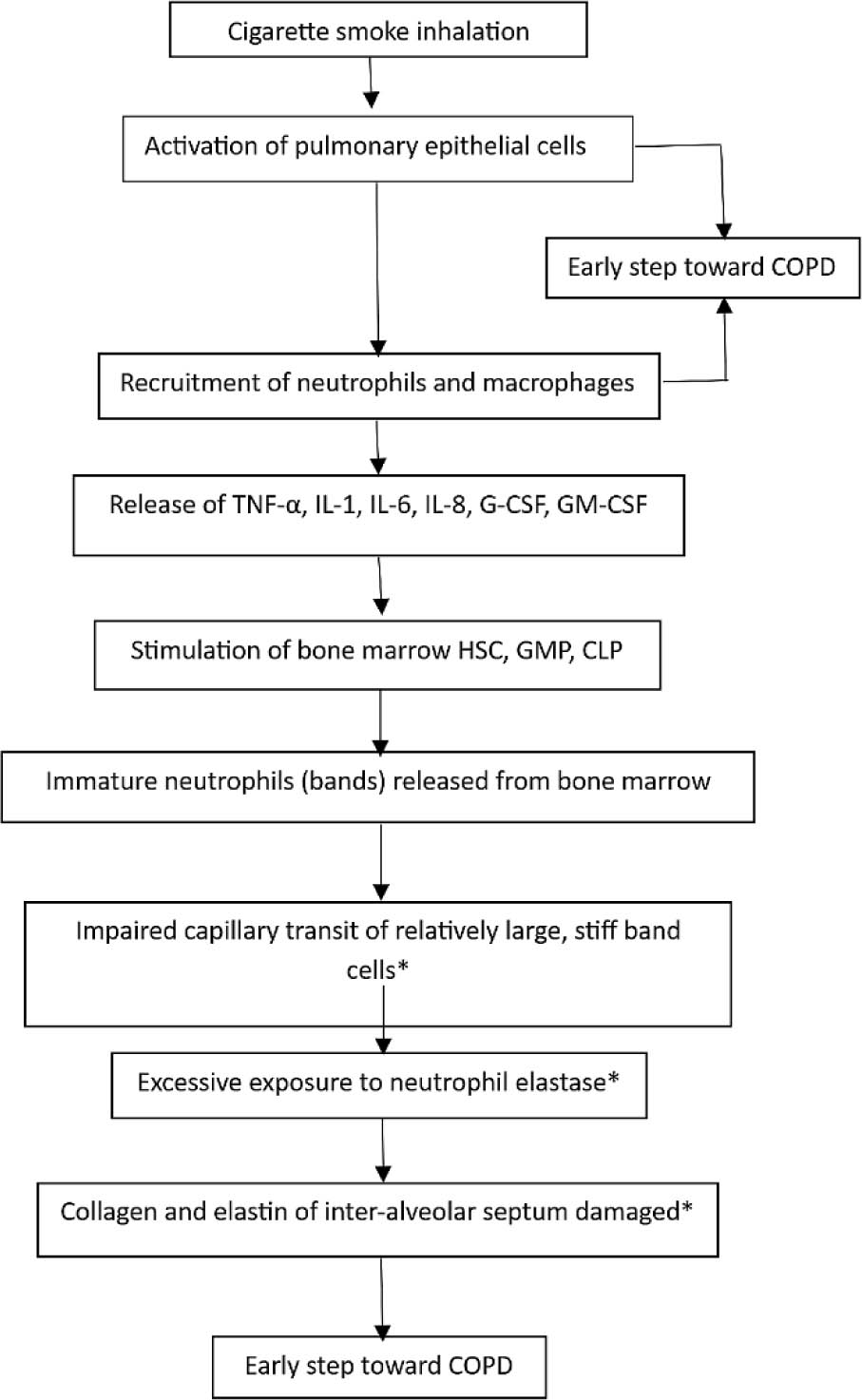
Figure 1.
Interaction of pulmonary and systemic inflammation.
III. PULMONARY INFLAMMATION INDUCES SYSTEMIC INFLAMMATION
The source of systemic inflammation in smokers is presumably primarily pulmonary inflammation induced by inhalation of the proinflammatory (55,56,57) and cytotoxic (58–59) particulate and vapor phase constituents of mainstream cigarette smoke. The caveat “primarily” is necessary due to a possible contribution from inflammation independently induced in tissues outside the lungs. Serum biomarkers of systemic inflammation including C-reactive protein (CRP) (60), GlycA (glycoprotein acetylation) (61), and fibrinogen (62) are higher in current cigarette smokers and to a lesser extent in former smokers than in never smokers (Table 3).
A large number of studies have reported that cigarette smoking increases the peripheral white blood cell count (63,64,65,66,67,68,69,70,71,72,73). Smoking-related elevations in white blood cell counts are seen in a variety of cell types including neutrophils, lymphocytes, monocytes, eosinophils, and basophils (73). Neutrophils, monocytes, eosinophils, and basophils originate from the granulocyte monocyte progenitor (GMP) in bone marrow (74). Lymphocytes originate from the common lymphoid progenitor (CLP) (75) in bone marrow. The Hematopoietic Stem Cell (HSC) is the common ancestor of both the GMP and the CLP (76). A number of different cytokines and growth factors released during pulmonary inflammation can stimulate the proliferation of bone marrow progenitor cells including Tumor Necrosis Factor α (TNF-α) secreted by pulmonary macrophages (77), Granulocyte Colony-Stimulating Factor (G-CSF) (78), IL-1 (79), IL-6 (80), IL-8 (81), and Granulocyte-Macrophage Colony-Stimulating Factor (GM-CSF) (82).
The pattern of atherosclerosis seen in the Pathological Determinants of Atherosclerosis in Youth (PDAY) studies suggests the presence of what the lead investigator, the late-great pathologist and atherosclerosis researcher HENRY C. MCGILL JR., M.D., referred to as a “chronic arteritis” in young otherwise healthy cigarette smokers (83). In the PDAY study, the degree of abdominal aorta atherosclerosis in young cigarette smokers at autopsy following traumatic death was approximately equivalent to that seen in nonsmokers who were five years older (84). This result was adjusted for blood lipid levels thereby implying that the increased atherosclerosis was related to endothelial injury, i.e., the basis for Dr. MCGILL'S supposition that smoking was inducing a chronic inflammation of the arteries in these young smokers (85).
IV. NICOTINE LEVELS IN CONSUMER PRODUCTS AND THERAPEUTICS
A large and diverse array of consumer products and therapeutics deliver nicotine either by inhalation, dermal absorption, or orally. Table 4 lists the nicotine source, absorption site, absorption speed, the peak time to maximum blood concentration (Tmax), and peak blood level/peak plasma concentration (Cmax). The list of nicotine sources illustrates the diversity of available products including the following: cigarettes, Heat-not-Burn devices (IQOS), small cigars, cigarillos, large cigars, moist snuff 18 mg nicotine, loose snus (10.8 mg, 27.1 mg), pouched snus (10.7 mg, 14.7 mg), nicotine pouches (6 mg, 9 mg, 11 mg, 20 mg, 30 mg), tobacco-free nicotine pouches (ZYN) (3 mg, 6 mg, 8 mg), nasal spray 1 mg, inhaler 4 mg released (one 10 mg cartridge, 20 min), oral capsule 4 mg, oral slow-release capsule (colonic absorption) 6 mg, oral solution (2 mg, ~3 mg), enema (~3.5 mg, 6 mg), gum (2 mg, 4 mg, 4.2 mg), lozenge (2 mg, 4 mg), sublingual tablet 2 mg, subcutaneous injection 2.4 mg, intravenous injection 5 mg, tooth patch 2 mg, dermal patch (Nicoderm) (14 mg, 21 mg), dermal patch (Nicotrol) (15 mg), dermal patch (Habitrol) 21 mg, disposable vapes: (Cig-a-likes) – 1st generation variable nicotine level, disposable vapes – 2nd generation variable nicotine level, Juul-type E-cigs (9 mg, 18 mg, 59 mg), vape pen (myblu) nicotine salt 25 mg nicotine, vape pen (myblu) 25 mg free base nicotine, box mods, sub-ohm devices, e-pipe, and e-cigar.
Table 4.
Tmax and Cmax data for nicotine intake from various nicotine sources.
| Nicotine source | Absorption site | Absorption speed (peak time (Tmax) to maximum blood concentration) | Peak blood level (Cmax peak plasma concentration) | References |
|---|---|---|---|---|
| Cigarettes | Pulmonary vasculature (alveoli to pulmonary veins) | 5 min affected by puff intensity and duration. [Nicotine in smoking tobacco is delivered mainly in the form of mixed nicotine salts.] | 15 ng/mL | |
| Heat-not-burn device (IQOS) | Oral mucosal vasculature | 5 min | 13 ng/mL | |
| Small cigars | Oral mucosal vasculature | There were no significant differences in Tmax based on cigar type (~60 min) | 6 ng/mL | Claus et al., 2018 (91) |
| Cigarillos | Oral mucosal vasculature | There were no significant differences in Tmax based on cigarillo type (~60 min) | 8 ng/mL | Claus et al., 2018 (91) |
| Large cigars | Oral mucosal vasculature | There were no significant differences in Tmax based on cigar type (~60 min) | 13 ng/mL | Claus et al., 2018 (91) |
| Moist snuff 18 mg nicotine | Nasal mucosal vasculature | 65 min | 17 ng/mL | Lunell et al., 2020 (92) |
| Loose snus 10.8 mg | Oral mucosal vasculature | 45 min | 8 ng/mL | Renard et al., 2025 (93) |
| Loose snus 10.8 mg | Oral mucosal vasculature | 60 min | 11 ng/mL | Digard et al., 2013 (94) |
| Loose snus 27.1 mg | Oral mucosal vasculature | 60 min | 18 ng/mL | Digard et al., 2013 (94) |
| Pouched snus 10.7 mg | Oral mucosal vasculature | 60 min | 11 ng/mL | Digard et al., 2013 (94) |
| Pouched snus 14.7 mg | Oral mucosal vasculature | 60 min | 13 ng/mL | Digard et al., 2013 (94) |
| Nicotine pouches 6 mg | Oral mucosal vasculature | 20 min | 3 ng/mL | Mallock-Ohnesorg et al., 2024 (95) |
| Nicotine pouches 6 mg | Oral mucosal vasculature | 30 min | 11 ng/mL | Renard et al., 2025 (93) |
| Nicotine pouches 9 mg | Oral mucosal vasculature | 38 min | 14 ng/mL | Renard et al., 2025 (93) |
| Nicotine pouches 11 mg | Oral mucosal vasculature | 30 min | 17–20 ng/mL | Renard et al., 2025 (93) |
| Azzopardi et al., 2026 (96) | ||||
| Nicotine pouches 20 mg | Oral mucosal vasculature | 15 min | 7 ng/mL | Mallock-Ohnesorg et al., 2024 (95) |
| Nicotine pouches 30 mg | Oral mucosal vasculature | 15 min | 29 ng/mL | Mallock-Ohnesorg et al., 2024 (95) |
| Nicotine pouches 11 mg | Oral mucosal vasculature | 20 min | 21 ng/mL | Pickworth et.al. 2014 (97) |
| Azzopardi et al., 2026 (96) | ||||
| Nicotine pouches 20 mg | Oral mucosal vasculature | 20 min | 30 ng/mL | Azzopardi et al., 2026 (96) |
| Tobacco-free nicotine pouches (ZYN) 3 mg | Oral mucosal vasculature | 61 min | 8 ng/mL | Azzopardi et al., 2026 (96) |
| Lunell et al., 2020 (92) | ||||
| Tobacco-free nicotine pouches (ZYN) 6 mg | Oral mucosal vasculature | 66 min | 15 ng/mL | Lunell et al., 2020 (92) |
| Tobacco-free nicotine pouches (ZYN) 8 mg | Oral mucosal vasculature | 59 min | 19 ng/mL | Lunell et al., 2020 (92) |
| Nasal spray 1 mg | Nasal mucosal vasculature | 11–18 min | 5–8 ng/mL | |
| Inhaler 4 mg released (one 10 mg cartridge, 20 min) | Nasal mucosal vasculature | 30 min | 8 ng/mL | |
| Oral capsule 3–4 mg | Oral mucosal vasculature | 90 min | 6–8 ng/mL | |
| Oral slow-release capsule (colonic absorption) 6 mg | Oral mucosal vasculature | 7.5 h | 2 ng/mL | |
| Oral solution 2 mg | Oral mucosal vasculature | 51 min | 5 ng/mL | |
| Oral solution ~3 mg | Oral mucosal vasculature | 66 min | 3 ng/mL | |
| Enema ~3.5 mg | Anal mucosal vasculature | 20–80 min | 2–3 ng/mL | |
| Enema 6 mg | Anal mucosal vasculature | 45 min | 6–9 ng/mL | |
| Gum 2 mg | Oral mucosal vasculature | 30 min | 6–9 ng/mL | |
| Gum 4 mg | Oral mucosal vasculature | 30 min | 10–17 ng/mL | |
| Gum 4.2 mg | Oral mucosal vasculature | 45 min | 9 ng/mL | |
| Lozenge 2 mg | Oral mucosal vasculature | 60 min | 4 ng/mL | |
| Lozenge 4 mg | Oral mucosal vasculature | 66 min | 11 ng/mL | |
| Sublingual tablet 2 mg | Oral mucosal vasculature | ~60 min | 4 ng/mL | |
| Subcutaneous injection 2.4 mg | Venous capillaries and small veins | 25 min | 15 ng/mL | |
| Intravenous injection 5 mg | Venous capillaries and small veins | 30 min | 30 ng/mL**** | |
| Tooth patch 2 mg | Oral mucosal vasculature | ~120 min | 3 ng/mL | |
| Dermal patch 14 mg (Nicoderm) | Venous capillaries and small veins | 6–9 h | 11–14 ng/mL | |
| Dermal patch 15 mg (Nicotrol) | Venous capillaries and small veins | 4–7 h | 11–16 ng/mL | |
| Dermal patch 21 mg (Nicoderm) | Venous capillaries and small veins | 3–7 h | 18–23 ng/mL | |
| Dermal patch 21 mg (Habitrol) | Venous capillaries and small veins | 9–12 h | 12–21 ng/mL | |
| Disposable vapes (Cig-a-likes) – 1st gen. variable nicotine level | Pulmonary, oral, pharyngeal circulation | 6–13 min | 4–9 ng/mL | |
| Disposable vapes – 2nd gen. variable nicotine level | Pulmonary, oral, pharyngeal circulation | 6–10 min | 4–12 ng/mL | |
| Juul-type e-cigs 59 mg | Pulmonary, oral, pharyngeal circulation | 6 min | 11 ng/mL | Goldenson et al., 2021 (101) |
| Juul-type e-cigs 18 mg | Pulmonary, oral, pharyngeal circulation | 6 min | 4 ng/mL | Goldenson et al., 2021 (101) |
| Juul-type e-cigs 9 mg | Pulmonary, oral, pharyngeal circulation | 7 min | 2 ng/mL | Goldenson et al., 2021 (101) |
| Vape pen (myblu) nicotine salt 25 mg nicotine | Pulmonary, oral, pharyngeal circulation | 6 min | 8 ng/mL | Anonymous 2019 (102) |
| Vape pen (myblu) 25 mg free base nicotine | Pulmonary, oral, pharyngeal circulation | 8 min | 5 ng/mL | Anonymous 2019 (102) |
| Box mods | Pulmonary, oral, pharyngeal circulation | 10 min | 7 ng/mL | Voos et al., 2019 (98) |
| Sub-ohm devices | Pulmonary, oral, pharyngeal circulation | 72 min | 13 ng/mL | St Helen et al., 2016 (103) |
| Sub-ohm devices | Pulmonary, oral, pharyngeal circulation | 65 min | 23 ng/mL | Farsalinos et al., 2014 (104) |
| E-pipe | Pulmonary, oral, pharyngeal circulation | 10 min | 5 ng/mL | Voos et al., 2019 (98) |
| E-cigar | Pulmonary, oral, pharyngeal circulation | 10 min | 3 ng/mL | Voos et al., 2019 (98) |
E-cigarettes have become increasingly popular as a lower-risk alternative to cigarette smoking. Vaping and smoking generate their respective aerosols in different ways (105). As compared to tobacco-burning products, the chemical compositional complexity of the vapor generated by e-cigarettes and other aerosol delivery devices is much less complex (106–107). The temperature where vapor is generated from tobacco is directly related to the mutagenicity of the condensate collected (108). Compared to tobacco-burning cigarettes, e-cigarettes generate their vapors at much lower temperatures with a typical operating range where the aerosol generating agent vaporizes at between 160 °C and 250 °C (109,110,111). This temperature range is 3–4 times lower than that seen in a burning cigarette (112,113,114,115). In contrast with the thousands of chemicals in mainstream cigarette smoke (116), the vapor produced from an e-cigarette contains fewer than 200 identifiable chemicals (117,118,119). The levels of vapor components in e-cigarettes is also generally lower compared to the smoke of tobacco-burning cigarettes, with the notable exceptions of glycerol and propylene glycol (117).
V. ROLE OF NICOTINE IN INFLAMMATORY DISEASES
Inflammatory bowel disease
Cigarette smoking decreases the risk of ulcerative colitis (120). Several studies have reported that nicotine ameliorates ulcerative colitis. Pullan et al. (121) examined the effect of nicotine as a supplemental treatment for ulcerative colitis. Seventy-two patients with active ulcerative colitis were enrolled. All patients had been taking the anti-inflammatory drug mesalamine (5-aminosalicylic acid). Twelve of the 72 patients were also receiving low doses of glucocorticoids. These medications were continued during the study. Using a randomized, double-blind study design, patients were given either transdermal nicotine patches or placebo patches for six weeks. Nicotine use led to 17/35 patients experiencing complete remissions as compared with 9/37 patients receiving placebo (p = 0.03). A number of clinical parameters improved in the nicotine arm as compared to placebo including global clinical grade of colitis (p < 0.001), histologic grade (p = 0.03), lower stool frequency (a difference of 1.6 stools daily; p = 0.008), less abdominal pain (p = 0.05), and less fecal urgency (p = 0.009).
Sandborn et al. (122) conducted a randomized, double-blind, placebo-controlled trial for mildly to moderately active ulcerative colitis. Sixty-four patients on standard medications were enrolled and stratified on the basis of smoking history, extent of disease, and concomitant medical therapy. Stratified patients were randomly assigned to daily treatment with transdermal nicotine (n = 31) at 11 mg for one week (highest tolerated dose) and then < 22 mg for 3 weeks or to placebo (n = 33). After four weeks, 12/31 patients (39%) who received transdermal nicotine showed clinical improvement as compared with 3/33 (9%) who received placebo. The improvement in the nicotine group was statistically significant (p = 0.007).
In contrast with the negative association between smoking and ulcerative colitis, most studies report a positive association between smoking and Crohn's disease (3). Based on the considerable overlap in treatment for Crohn's disease and ulcerative colitis, Ingram et al. (125) conducted an open pilot study where they administered nicotine enemas for active Crohn's colitis. The pilot study enrolled 13 patients with active rectosigmoid Crohn's disease. The patients were administered 6 mg-nicotine enemas each day for four weeks. Study measurements conducted at the beginning and end of the four-week trial included a Crohn's disease activity index (CDAI) score, sigmoidoscopy, and hematological inflammatory markers.
The mean CDAI score decreased from 202 to 153 with reductions seen in six patients, three patients were unchanged, and one patient experienced an increase. In eight patients, the frequency of bowel movements decreased, and the sigmoidoscopy grade improved in seven patients. In addition, the mean C-reactive protein decreased from 22.0 to 12.3 mg/L. In this small study, 6 mg-nicotine enemas were of clinical benefit to most patients and were well tolerated without adverse events. This result suggests that the factor in cigarette smoke that increases the risk of developing and exacerbating Crohn's disease is probably not nicotine.
In 2023, Sheehan et al. (123) published a case-control study on e-cigarette use and disease outcomes in inflammatory bowel disease. The study design was retrospective, with each Crohn's disease or ulcerative colitis patient who was a current user of e-cigarettes (N = 127) matched to two controls who did not vape (N = 251). Over two years, the study outcome measurements were initiation of a new biologic therapeutic, switching to another biologic therapy (necessary for inadequate efficacy), hospitalization for a flare-up, or intestinal surgery. Among the vaping Crohn's patients, current e-cigarette use was not associated with a higher risk of study outcomes (odds ratio (OR) 0.82, 95% Confidence Interval (CI) 0.36–1.87). This lack of an association was not impacted by current or former cigarette smoking. Among the vaping ulcerative colitis patients, current e-cigarette use was also not associated with the primary outcomes (OR 1.05, 95% CI 0.33–3.39). In this study, current e-cigarette use was not associated with worse outcomes among patients with ulcerative colitis or Crohn's disease. The results from this study support the findings from the nicotine enema trial of Ingram et al. (125) and suggest that nicotine itself is not the factor in cigarette smoke ex-acerbating Crohn's disease.
Parigi et al. (124) conducted a multicenter international study on the impact of e-cigarettes and Heat-Not-Burn Tobacco (HNBT) on postoperative recurrence of Crohn's disease.
The retrospective study design enrolled consecutive Crohn's disease patients who underwent ileocolic resection and endoscopic evaluation within one year at nine medical centers in Italy, Spain, and France. It was relatively difficult to find e-cigarette users among this patient population as 932 patients were enrolled, i.e., 691 (74%) nonsmokers, 176 (19%) cigarette smokers, 37 (4%) HNBT users, and only 33 (4%) e-cigarette users. The primary outcome measure was recurrence validated by endoscopy (Rutgeerts score ≥ 2) at one year after surgery. As compared with the nonsmoker recurrence rate of 40.8%, the recurrence rates in cigarette smokers (69.4%), HNBT users (63.9%), and e-cigarette users (60.6%) were all higher (p < 0.05). When multivariable regression analysis was applied to the results, HNBT use remained significantly associated with recurrence (OR 2.76), but the association for e-cigarette use was not statistically significant (OR 2.02, p = 0.067).
Conflicting evidence and limitations
Thomas et al. (145) conducted a randomized, double-blind study in 80 patients with ulcerative colitis in remission. Transdermal nicotine was not superior to placebo toward maintaining remission in ulcerative colitis. In a follow-up study on 43 ulcerative colitis patients, Thomas et al. (146) found transdermal nicotine alone to only be of modest benefit and was not as efficacious as 15 mg of prednisolone daily.
McGrath et al. (147) reviewed the results from five randomized trials published between 1970 and December 2003. The anti-inflammatory effect of transdermal nicotine against ulcerative colitis was superior to placebo for inducing remission in ulcerative colitis. Transdermal nicotine was not more efficacious toward inducing remissions than the standard therapies of that era, i.e., mesalamine and corticosteroids. In addition, there were more adverse events in patients administered transdermal nicotine which limited its tolerance in some patients. It should also be noted that current therapies for ulcerative colitis including tumor necrosis factor alpha antibody drugs, Janus kinase (JAK) inhibitors, and sphingosine 1-phosphate (S1P) receptor modulators are far more efficacious than mesalamine and corticosteroids (148).
Multiple sclerosis
Cigarette smoking increases the risk for developing multiple sclerosis (MS), increases disease activity, and is associated with faster rates of brain atrophy (126). Evidence suggests that nicotine is not involved in the positive association between smoking and MS. Hedström et al. (127) reported that nicotine might have a protective effect in the etiology of multiple sclerosis. They analyzed two Swedish population-based, case-control studies with 7,883 cases and 9,437 controls. Snuff users had a decreased risk of developing MS compared with never users of moist snuff (odds ratio 0.83, 95% CI 0.75–0.92).
In addition, there was an inverse dose-response correlation between cumulative dose of snuff use and the risk of developing MS.
Based on the clinical observations that nicotine does not exacerbate MS symptoms or progression, MS patients who smoke are encouraged to use smoking cessation therapies including nicotine gum, inhalers, lozenges, nasal spray, and transdermal patches (128). Experimental autoimmune encephalomyelitis (EAE) is the most commonly used animal model for Multiple Sclerosis. Rothbard et al. (5) showed that activation of α7-nAChRs leads to the reduction of the proinflammatory cytokines TNF-α, IL-1β, IL-6, and IL-18 and the reduction of paralysis in a mouse model of EAE. A therapeutic effect of nicotine on EAE has also been reported in other studies (129,130,131). The weight-of-the-evidence supports the contention that nicotine probably does not adversely impact the risk or progression of MS.
Conflicting evidence and limitations
In the EAE animal model of MS, nicotine exerts its protective effects through interactions with α7- and α9-nicotinic acetylcholine receptors. Based on this animal data, Briggs (149) applied a multi-stage gene-environment framework to analyze a dataset including 286 human MS cases and 176 controls for which genetic information on α7- and α9-nicotinic acetylcholine receptors was available. The results of the analysis showed that variants of the genes coding for α7- and α9-receptors were associated with different levels of MS risk in smokers (149). A number of different hypothetical mechanisms have been proposed as potentially contributing to a protective effect of nicotine toward MS as the basis of the association has not been clarified. In a rat model of EAE, nicotine was shown to augment the beneficial effects of mesenchymal stem cell-based therapy. As compared with either monotherapy, the combination of mesenchymal stem cells and nicotine increased the levels of the anti-inflammatory cytokine IL-10, and significantly reduced the splenocyte production of pro-inflammatory IL-17 and tumor necrosis factor alpha (150). In a mouse model, Rothbard et al. (151) demonstrated that shock proteins, amyloid fibrils, and nicotine bind to α7-nicotinic receptors on peritoneal macrophages. Receptor binding stimulated a common immunosuppressive pathway wherein peritoneal macrophages converted from an inflammatory to an anti-inflammatory type and both peritoneal macrophages and B lymphocytes migrated from the peritoneum to the lymph tissues. Jiang et al. (131) also employed a mouse model of EAE to study the infiltration of pro-inflammatory monocytes and neutrophils into the central nervous system. Myeloid cell counts were determined within the bone marrow, spleen, blood, and CNS of EAE mice. At pathogenically important time points, nicotine significantly inhibited the infiltration of proinflammatory monocytes and neutrophils into the CNS. This inhibitory effect was modulated by interactions at α7- and α9-acetylcholine receptors.
Xiao et al. (152) have proposed a mechanistic relationship between exposure to the nicotine-derived nitrosamine ketone (NNK) and MS. This group employed the statistical method Mendelian Randomization (MR) analysis to predict enzymatic activities associated with MS (153). In an EAE mouse model, MR analysis predicted that dipeptidyl peptidase-4 (DPP4) activity is associated with susceptibility to MS. DPP4 functions as a co-stimulatory molecule for T-cell activation (154). Systemic exposure to NNK increased DPP4 expression in inflamed tissue in EAE mice. NNK also accelerated disease onset, worsened neurological symptoms, and increased immune cell infiltration and CNS demyelination (152).
Pulmonary sarcoidosis
Sarcoidosis is a disease that can involve multiple organs but has a predilection for the lung. Non-necrotizing granulomas composed of macrophages accumulate in the absence of infectious pathogens. A number of proinflammatory cytokines are found at elevated levels in sarcoid lungs including IL-1, IL-6, IL-12, IL-17, IL-18, and TNF-α (155). Dehara et al. (132) conducted a systematic review of 30 studies, and a meta-analysis of 27 of the 30 studies and reported that current smoking was associated with a statistically significant 39% lower risk of developing pulmonary sarcoidosis (relative risk (RR) 0.61, 95% CI 0.45–0.83).
In 2013, Julian et al. (133) studied 13 patients with symptomatic sarcoidosis. Treatment with transdermal nicotine patches was well tolerated and restored peripheral immune responsiveness to toll-like receptor 2 (TLR2) and toll-like receptor 9 (TLR9) agonists. Treatment also expanded the population of FoxP3 1 Tregs, including a CD25 2 phenotype. [Regulatory T cells (Tregs), characterized by the expression of Forkhead Box P3 (FOXP3), constitute a distinct subset of T cells crucial for immune regulation.] The immunological profile in patients with symptomatic sarcoidosis treated with nicotine was very similar to that seen in asymptomatic patients. The authors interpreted these results as a beneficial effect in this patient population.
In 2021, the same research group published the results of a randomized pilot trial of transdermal nicotine for pulmonary sarcoidosis (134). The study design was a randomized, double-blind, controlled pilot trial administering either a daily 21 mg nicotine transdermal patch or a daily placebo patch for 24 weeks. Following a diagnosis of active pulmonary sarcoidosis based on the presentation of dyspnea and cough, and objective radiographic evidence of infiltrates consistent with nonfibrotic lung disease, 50 consecutive subjects > 18 years of age were enrolled. Repeated measurements of FVC, FEV1, quantitative lung texture score based on CT texture analysis, Fatigue Assessment Score (FAS), St. George's Respiratory Questionnaire (SGRSQ), and the Sarcoidosis Assessment Tool were conducted at baseline and at intervals with data analysis at 26 weeks. Nicotine treated patients experienced a statistically and clinically significant, approximately 2.1% (70 mL) improvement in FVC from baseline to 26 weeks. In contrast, the placebo patch patients experienced a decrease in FVC of 2.2% thereby resulting in a net differential of 140 mL (95% CI, 10–260). The authors concluded that nicotine treatment might reduce disease progression in active sarcoidosis as measured by FVC.
Conflicting evidence and limitations
Epidemiology studies on pulmonary sarcoidosis and environmental exposures are impacted by the large variation in incidence based on geography. Pulmonary sarcoidosis is relatively rare in South Korea, Taiwan, and Japan with an estimated incidence rate of 0.51 per 100,000. The prevalence rate in these countries is 1–5 per 100,000 population. In contrast, the incidence rate in Scandinavia is 11–15 per 100,000 population and the prevalence rate is 140–160 per 100,000 (156). Race and ethnicity also need to be properly considered in epidemiology studies as pulmonary sarcoidosis rates in African-Americans are higher than in other ethnic groups (157).
Rheumatoid arthritis
Cigarette smoking is an established risk factor for development of rheumatoid arthritis (RA), especially in genetically susceptible individuals. In addition to increasing risk, smoking exacerbates disease activity (135–136). Carlens et al. (137) conducted a cohort study of 277,777 male Swedish construction workers who had provided information about tobacco use in 1978–1993. This study reported the expected increase in smoking-associated RA with a relative risk (RR) for ever-smoking of 2.1 (95% CI 1.7–2.5). In contrast, there was no increase in the relative risk for RA in workers who were ever-users of moist snuff, i.e., RR = 1.0 (95% CI 0.9–1.2). This result suggests that nicotine is probably not the causative factor in the positive association between smoking and RA.
Bruchfeld et al. (138) demonstrated attenuation in endoxin-stimulated whole blood of TNF-α release by nicotine in 13 RA patients with vagus nerve activity depression. RA patients experience significantly depressed vagus nerve activity, a finding commonly seen in patients with autoimmune diseases. Part of central nervous system regulation of innate immunity is dependent on vagus nerve suppression of proinflammatory cytokine production and release via activation of cholinergic agonists at α7-nicotinic acetylcholine receptors (α7-nAChR) (138). These authors suggested that α7-nAChR agonists including nicotine should be studied for clinical efficacy in RA patients. The results from the epidemiology study on moist snuff users conducted by CARLENS et al. (137), and the mechanistic data from Bruchfeld et al. (138), are consistent with the use of nicotine replacement therapy in encouraging smoking cessation in RA patients (139). Isaji and Yamada (158) conducted a survey on the use of heated tobacco products (HTPs) by RA patients in Japan. These authors administered a web survey to 170,000 panelists who completed a questionnaire regarding smoking and disease status. A subgroup of 198 smokers with RA completed a secondary questionnaire regarding reasons for using HTPs and perceptions about the potential harmfulness of HTPs. Smokers with RA were highly significantly more likely to use HTPs than smokers without RA (adjusted odds ratio 2.34, 95% CI 1.92–2.85, p < 0.001). In HTP smokers with RA, 43.7% had considered using HTPs because of their RA, with 42.0% self-reporting symptomatic relief after switching to HTPs from traditional cigarettes.
Conflicting evidence and limitations
While the evidence for an anti-inflammatory effect of nicotine in RA is consistent, nicotine can exacerbate other forms of experimental arthritis. In a mouse model, nicotine accelerated collagen-induced arthritis (159). In contrast, in a different mouse model van Maanen et al. (160) showed that stimulating nicotinic acetylcholine receptors attenuated collagen-induced arthritis. In the Lewis rat model of Mycobacterium tuberculosis-induced arthritis, nicotine pretreatment prior to arthritis induction exacerbated the arthritis while nicotine posttreatment ameliorated the arthritis (161). Wasén et al. (162) immunized female ovariectomized BALB/c mice with chicken collagen II. Nicotine at 0.03% in drinking water putatively released “survivin” protein from the bone marrow. [Survivin is an anti-apoptosis protein (163)]. The release of survivin was thought to support the proinflammatory activity of PD-1-IL-7R+CD8+ T cells (a persistent stem cell-like self-renewing population) (162, 164).
Lourido et al. (165) conducted secretome analysis on human articular chondrocytes from osteoarthritis patients. [The secretome is the repertoire of proteins released by specific cell types (166)]. Nicotine was introduced into the cell culture at 10−8 to 10−7 molar. Biomarkers of joint inflammation and degradation including fibronectin and chitinase 3-like protein 1 (167) were increased by nicotine administration (165).
Sepsis
Sepsis is a life-threatening immunological reaction to an infection that harms healthy tissues and organs (140). Cigarette smokers have an elevated risk for developing sepsis. Lee et al. (141) conducted a longitudinal cohort study that retrospectively assessed adults (ages > 20 years). The study cohort underwent national health checkups under the Korean National Health Insurance Service between January and December 2009 (N = 4,234,415). Over a ten-year follow-up period, sepsis was identified based on the International Classification of Diseases, 10th Revision codes (168). Smoking status and pack-years were determined via a self-administered questionnaire. Cases with sepsis that occurred before follow-up or during the first year of follow-up were excluded from the analysis. The final cohort was extremely large comprising 3,881,958 total subjects, including 2,342,841 nonsmokers, 538,850 former smokers, and 999,267 active smokers. Compared to nonsmokers, both active smokers (adjusted hazard ratio: 1.41, 95% CI 1.38–1.44) and former smokers (1.10, 95% CI 1.07–1.14) with ≥ 20 pack-years were more likely to develop sepsis (p < 0.001). Higher exposures to smoking as indicated by ≥ 30 pack-years elevated the risk in former smokers resulting in a combined risk for former and active smokers of adjusted hazard ratio: 1.35 (95% CI 1.31–1.38, p < 0.001).
Experimental evidence suggests that nicotine is probably not the smoke component related to increased risk for sepsis. Özdemir-Kumral et al. (142) tested the effect of nicotine administration on male Wistar albino rats in which sepsis was induced. Microscopic examination of the lungs, liver, ileum, heart, and kidneys showed reductions in the inflammatory response following different nicotine pretreatment regimens. The reduction in sepsis-induced oxidative damage appeared to involve inhibition of neutrophil activity in the inflamed tissues. Similar findings have been reported by Wang et al. (143), who demonstrated that cholinergic agonists improve survival in experimental sepsis, and more recently by Keever et al. (144) who demonstrated increased mortality from experimental endotoxemia in α7-nAChR-deficient mice (compared with wild-type controls). [Experimental endotoxemia shares important characteristics with sepsis.] The increased mortality was concomitant with a significant reduction in the number of monocyte-derived macrophages in the lungs suggesting a reduction in the innate host-defense response (144).
Conflicting evidence and limitations
A significant literature reporting an increased incidence of post-operative sepsis in users of non-tobacco nicotine (NTN), i.e. primarily e-cigarette users, has been published. The results of these studies cannot be directly extrapolated to interpret the effects of nicotine only administration due to the frequency of NTN users either recently smoking cigarettes or switching back and forth between cigarettes. In addition, the many other chemical constituents of e-cigarette vapor also confound a potential positive association between nicotine exposure and sepsis. The results of these studies are briefly summarized below in chronological order.
Lawand et al. (169) studied 5,332 matched pairs of NTN users and non-users who experienced an anterior cervical discectomy and fusion. The NTN patients had higher risks for sepsis (1.40% vs. 0.80%, p = 0.01). Fuller et al. (170) studied 10,503 matched pairs of NTN users and non-users at 90 days post total hip arthroplasty. NTN users had higher rates of sepsis (1.0% versus 0.8%, p = 0.047) and pneumonia (1.8% versus 1.1%, p < 0.001). In a large study on 8,452 NTN users who underwent total hip arthroplasty, an increased risk of sepsis was seen at 90 days postoperatively (171). Within 90 days following anterior lumbar interbody fusion, 2,296 NTN users displayed elevated rates of pneumonia (p = 0.007), ventilator support (p = 0.019), and sepsis (p = 0.015) (172). Lawand et al. (173) examined the rate of joint infection following shoulder arthroplasty. During the 90-day postoperative period, 6,756 matched pairs of NTN users and non-users were studied. NTN users exhibited higher rates of sepsis (1.80% vs. 1.20%, p = 0.012), surgical site infection (1.20% vs. 0.70%, p = 0.007), and wound disruptions (0.70% vs. 0.40%, p = 0.048). In a cohort of 39,195 NTN users and 39,195 matched non-user controls analyzed 90 days after lumbar spine decompression and fusion, Spitzer et al. (174) reported elevated risks for pneumonia and sepsis (p < 0.05). After rotator cuff repair, total shoulder arthroplasty, and reverse total shoulder arthroplasty, Glenn et al. (175) reported elevated rates of pneumonia and sepsis in NTN users. Within 90 days post-surgery for lumbar fusion, elevated rates of pneumonia and sepsis in NTN users were observed by Lawand et al. (176). McCahon et al. (177) detected an increased risk of sepsis following total ankle arthroplasty (2.4% in NTN users versus 1.1% in non-users, OR 2.3). Wang et al. (178) examined post-operative complications in e-cigarette users following hammertoe correction and found the same elevated rates of sepsis compared to nonsmokers in both e-cigarette users and cigarette smokers, i.e., 0.4%.
Corriden et al. (179) attempted to explain the increased postoperative infection rates seen in e-cigarette users. Human neutrophils exposed to e-cigarette vapor demonstrated reduced chemotaxis toward bacterial cell components, impaired F-actin polarization and membrane fluidity, and a 48% reduction in the production of reactive oxygen species (p < 0.001). Human neutrophil exposure to e-cigarette vapor lowered the rate of phagocytosis of bacterial bioparticles by 47% (p < 0.05). These in vitro results suggested that exposure to e-cigarette vapor might increase the risk of postoperative invasive bacterial infections (179).
VI. CIGARETTES THAT PRIMARILY HEAT TOBACCO ARE LESS PROINFLAMMATORY
Heat-not-burn (HNB) products fall in a continuum between conventional tobacco-burning products and aerosol delivery products. HNB products including IQOS, Revo, Eclipse, and glo contain tobacco and aerosol generating materials (i.e., glycerol, propylene glycol) and use actual tobacco leaf rather than tobacco derived nicotine, synthetic nicotine, or nicotine-infused e-liquids (180, 181). HNB products operate at lower temperatures than tobacco-burning products but at much higher temperatures than aerosol delivery devices. The smoke composition from HNBs is much simpler than tobacco smoke but is more complex than the vapor from aerosol delivery devices (106, 182). Reducing both per product tobacco weight and operating temperatures, as employed in new-generation products, are apparently important in reducing the compositional chemical complexity of generated smoke and aerosol (183, 184).
Rennard et al. (185) conducted an evaluation of an HNB test marketed by RJ Reynolds as Eclipse. The study was designed to determine whether asymptomatic heavy smokers who did not wish to quit had improvement in lower respiratory tract inflammation after switching to Eclipse. Twelve asymptomatic, healthy smokers who smoked at least 40 cigarettes per day were enrolled. Eight normal healthy nonsmokers served as the control group. Each of the 12 smokers underwent bronchoscopy, bron-choalveolar lavages, and endobronchial biopsies before and after two months of smoking Eclipse exclusively. The eight nonsmoking control subjects were similarly evaluated on one occasion. At study initiation while smoking their traditional brand cigarette, the 12 smokers displayed higher than normal visible inflammation, increased recovery of inflammatory cells, and an increased percentage of goblet cells. [Goblet cells produce and secrete mucus to protect the airways.] After two months of using Eclipse, each of these three indicators of pulmonary inflammation were reduced, although the reductions did not achieve nonsmoking levels. There were no changes in peripheral blood measures, nicotine levels were maintained as compared with study initiation levels, and carbon monoxide levels increased.
In current smokers, Stewart et al. (43) tested the effect of switching to Eclipse on relative normalization of pulmonary epithelial permeability, airway inflammation, and blood leukocyte activation. Ten healthy smokers (aged 21–50 years, 19 ± 8 pack-years) were evaluated at baseline and after two and four weeks of switching to Eclipse. The ten subjects were evaluated for symptoms, pulmonary function, airway inflammation, lung clearance of Tc-DTPA, blood leukocyte activation, and production of reactive oxygen species. The comparison control group was comprised of healthy, lifetime non-smokers (aged 18–53 years). Switching to Eclipse reduced alveolar epithelial injury. Compared with baseline values, lung permeability half-time increased from 33 ± 3 to 43 ± 6 min (p = 0.017) after two weeks. Slight further improvement was seen at four weeks as lung permeability half-time increased to 44 ± 7 min (p = 0.10). Several improvements in inflammatory markers were observed including favorable alterations in the percent-age of natural killer cells, the expression of intercellular adhesion molecule-1 on monocytes, and the expression of CD45RO on T cells.
VII. CURRENT ELECTRONIC CIGARETTE CONFIGURATIONS AND POSSIBLE FUTURE TRENDS
An electronic cigarette (e-cigarette) is a handheld battery-powered vaporizer that simulates smoking in the absence of tobacco combustion (105–106, 186–187). The components of an e-cigarette include a mouthpiece, an atomizer, a power source such as a battery to provide energy and heat, and a container such as a cartridge or tank, i.e., a storage area for liquid. The atomizer is a heating element that vaporizes a liquid solution called e-liquid (188–189), composed of glycerol, propylene glycol, nicotine, and flavor constituents (189). Recently, some e-cigarette manufacturers have been replacing propylene glycol with distilled water and glycerin to produce vapor and minimize potential toxicity associated with exposure to formaldehyde, acetaldehyde, propanal, and glyoxal, which can be generated during the pyrolysis of propylene glycol (190,191,192,193).
Using a ceramic wick-based technology, Pinto et al. (194) chemically characterized the vapor emitted by two e-cigarettes. The water content under stress conditions was 0.46 ± 0.01 and 0.44 ± 0.02 mg/puff. A total of 50 puffs were completed with the resultant measured water at 23 mg and 22 mg per e-cigarette. For comparison, a University of Kentucky reference cigarette (K1R6F) delivered 19 mg of water for 9 puffs smoked under similar stress conditions.
When the e-liquid is heated, it aerosolizes. On rapid cooling that aerosol turns into an aerosol of fine droplets, vapor, and air (195). In contrast with chemically complex tobacco smoke aerosol, e-cigarette vapor is a relatively simplified vapor (196). E-cigarette vapor contains the following constituents: aerosolizing agents, i.e., glycerin and/or propylene glycol; water; nicotine; acids (from nicotine salts); flavors; metals; and nitroso compounds and decomposition products from the aerosolizing agents, i.e., formaldehyde, acetaldehyde, acrolein, etc.
While less harmful than tobacco smoking (197), vaping retains health risks (198) and is regulated by the United States Food and Drug Administration (FDA). Under a federal court order, manufacturers of deemed new tobacco products on the market as of the deeming rule's effective date of August 8, 2016, were required to submit premarket review applications by September 9, 2020. Because many manufacturers failed to comply, the FDA responded by issuing refuse to accept (RTA) letters, refuse to file letters, and/or marketing denial orders for millions of products. This FDA action included the following: determinations on applications for nearly 6.7 million products received by the Sept. 9, 2020, dead-line; more than 18 million products received after the Sept. 9 deadline; and applications for nearly one million non-tobacco nicotine products (mostly e-cigarettes) submitted by May 14, 2022, in accordance with the new Federal Law passed in April 2022 (199). As of March 2026, the US FDA has issued only 45 marketing orders for various e-cigarettes. These are the only e-cigarette products that currently may be lawfully sold in the U.S. (200).
The FDA Center for Tobacco Products (CTP) oversees and has authority over all tobacco deeming products (201). These include tobacco cigarettes, cigarillos, cigars, little cigars, heat-not-burn cigarettes, e-cigarettes, vapes, e-liquids, vape pens, atomizers, hookah (shisha or waterpipe tobacco), pipe tobacco, chewing tobacco, nicotine pouches, nicotine gels, and dissolvable tobacco products. It should be noted that the FDA CTP does not have authority over nicotine replacement therapies (NRTs). Over-the-counter (OTC) NRTs include transdermal nicotine patches, nicotine gum, and nicotine lozenges. Prescription NRTs include nicotine spray and nicotine inhaler. There are also prescription smoking cessation products that do not contain nicotine. Two FDA-approved smoking cessation products do not contain nicotine, i.e., Varenicline tartrate and Bupropion hydrochloride. The FDA's Center for Drug Evaluation and Research (CDER) evaluates NRTs to ensure they are safe and effective before they can be sold (202).
The clinical studies evaluated in this paper examined several types of e-cigarettes. Table 6 provides a description of the various types of e-cigarettes tested, as well as properties associated with each e-cigarette type including power, temperature ranges, aerosol mass, and metal risk profiles. As shown in Table 6, the ranges for performance parameters are quite broad. Power ranges from 7–200 watts. Temperature ranges from 160 °C–266 °C with some models capable of exceeding 1,000 °C (111). Aerosol mass ranges from 7–22 mg/puff. Risk assessments from metal exposures range from low to very high. The present set of 45 e-cigarettes with marketing orders represents an extremely broad diversity of product designs with a wide range of vapor deliveries, associated with variable toxicological outcomes. The limited number of FDA-authorized e-cigarette designs raises the possibility of employing current and previously established tobacco cigarette technologies to optimize vapor metal reductions, aldehyde scrubbing, temperature control, and other parameters related to the production of toxic vapor constituents. However, an unintended consequence of FDA regulation is the stifling of the natural research and development process of continuous product improvement (198, 203).
The phenomenon of inhibitory safety regulation is longstanding and well-characterized. For example, rigid safety standards imposed on private aircraft design infamously inhibited technological improvements in safety for decades with the US federal government only making significant reforms recently (204). In the case of e-cigarettes, it is unlikely that any engineering or stewardship recommendations can be readily enacted currently as this would entail resubmission of the product application to FDA scrutiny, likely expending thousands of man-hours of R&D effort, and significant budgetary expenditure. It would be advisable to proffer regulatory reforms regarding e-cigarette registration within the next 2.5 years while a deregulatory Administration is in office in the US.
VIII. PULMONARY AND SYSTEMIC INFLAMMATION IN E-CIGARETTE USERS
As described above, most e-cigarettes use batteries while others use a burnable gas like butane to heat the e-juice mixture to form either a nicotine-containing aerosol, or a nicotine-containing flavored aerosol (106). E-cigarettes generate heat and form aerosol at between 150–400 °C (189). The temperature range required to generate sufficient aerosol is of toxicological importance as minor but unwanted vapor components are also formed at these temperatures. Although the chemical composition of e-cigarette aerosols is greatly simplified as compared with cigarette mainstream smoke, heating glycerol and propylene glycol at high temperatures can produce pyrolysis products (214) with proinflammatory potential including acrolein (215), formaldehyde (216), and acetaldehyde (217,218,219).
Simovic et al. (220) examined the immune cell profile in young adults who regularly used e-cigarettes. Twenty-five young (ages 23 ± 3 years), healthy, regular users of e-cigarettes and 22 non-users (ages 23 ± 4 years) were enrolled. At study initiation, counts of white blood cells, neutrophils, monocytes, and lymphocytes were conducted. Next, the 25 e-cigarette users were randomized to either nicotine or nicotine-free products for 14 days. Compared to the 22 non-users, regular users of e-cigarettes had a significantly higher eosinophil count (absolute, p = 0.008, percentage, p = 0.042) and platelet count (p = 0.018). However, the alterations in eosinophils and platelets were not related to nicotine as counts for white blood cells, neutrophils, monocytes, and lymphocytes counts were similar between the nicotine-containing e-cigarette arm and the nicotine-free e-cigarette arm.
Chatterjee et al. (221) also studied nicotine-free e-cigarettes. Ten young healthy nonsmokers (23–33 years, mean 28.7 ± 5.5 years) with body mass indices between 18.5 and 30 were enrolled. The 10 nonsmokers inhaled the aerosol from E-Puffer (New York, NY, USA) nicotine-free e-cigarettes. Following acute inhalation, blood serum was analyzed for markers of inflammation including C-reactive protein (CRP), soluble intercellular adhesion molecule (sICAM), nitric oxide metabolites (NOx, i.e., the sum of nitrite and nitrate), and reactive oxygen species (ROS). Endothelial activation was measured via production and induction of ICAM-1 expression on human pulmonary microvascular endothelial cells (HPMVEC). As compared to the pre-exposure baseline, serum indices of oxidative stress and inflammation increased significantly (p < 0.05). These measurements peaked at approximately one to two hours post-e-cigarette aerosol inhalation and did not return to baseline levels for six hours. Circulating serum ICAM-1 and ROS also increased significantly at two hours and returned to baseline values six hours post-e-cigarette inhalation.
In 2021, Chatterjee et al. (222) published a larger study on nicotine-free e-cigarettes. Thirty-one healthy non-smokers were enrolled. Prior to vaping a nicotine-free cigarette, a blood sample was taken to analyze for inflammatory markers including serum levels of CRP, sICAM, high-mobility group box 1 (HMGB1) which alerts the immune system to tissue injury or infection, the down-stream effector of HMGB1, and the neutrophil to lymphocyte ratio (NLR) family pyrin domain containing inflammasome NLRP3 (nucleotide-binding oligomerization domain-like receptors with pyrin domain-containing protein 3). Several MRI (magnetic resonance imaging) parameters quantifying peripheral vascular reactivity, cerebrovascular reactivity, and aortic stiffness were also evaluated. Each of these measurements were taken again following vaping with the nicotine-free e-cigarette. Serum levels of CRP, sICAM, HMGB1, and NLRP3 increased significantly. Advantageous vasodilatory nitric oxide metabolites decreased, while reactive oxygen species increased. Concomitant with the proinflammatory blood biomarker increases, MRI indicated impaired vascular reactivity characterized by reduced flow-mediated dilation and attenuated hyperemic response after a cuff-occlusion test and decreased venous oxygen saturation. In addition to the limited number of evaluations conducted in subjects inhaling the aerosol from nicotine-free e-cigarettes, the literature on the potential adverse health effects of nicotine-containing e-cigarettes is extensive and growing rapidly. While not an exhaustive compilation, the following publications illustrate the diversity of adverse health effects in association with e-cigarette use that are currently under study. It should be noted that the co-delivery of other chemical constituents renders the results of these studies as inadequate toward directly addressing the toxicological effects of inhaled nicotine.
Pulmonary effects have been reported by Andreozzi et al. (223), Coppeta et al. (224), Ghosh et al. (225, 226), Hernandez et al. (227), Kim and Kang (228), Kim et al. (228), Kotoulas et al.(229), Lappas et al. (230), McConnell et al. (231), Meo et al. (232), Reidel et al. (233), Shields et al. (234), Singh et al. (235), Song et al. (236, 237), and Xie et al. (223,224,225,226,227,228,229,230,231,232,233,234,235,236,237,238,239).
Cardiovascular impacts have been examined by Amraotkar et al. (240), Benowitz et al. (241), Boakye et al. (242), Chaumont et al. (243), Haptonstall et al. (244), Kim et al. (245), Moheimani et al. (246–247), Oliveri et al. (248), and Stokes et al. (240,241,242,243,244,245,246,247,248,249).
Exposure to carcinogens has been measured by Goniewicz et al. (117), Hecht et al. (250), Kim and Shin (251), Lizhnyak et al. (252), Pulvers et al. (253), and Shahab et al. (117, 250,251,252,253,254).
Adverse effects on mitochondria have been reported by Chitteti et al. (255), Kanithi et al. (256), and Tommasi et al. (255,256,257).
Systemic inflammation has been detected by Kim et al. (238, 258), Mainous et al. (259), Moon et al. (260), Perez et al. (261), and Yao et al. (262).
IX. PROINFLAMMATORY E CIGARETTE VAPOR CONSTITUENTS
Cigarette smoking is proinflammatory in both the lungs and systemic circulation (Tables 1–3). Nicotine generally displays anti-inflammatory rather than pro-inflammatory activity (Table 5). Adverse health effects have been reported in nicotine-free e-cigarettes (220,221,222). In addition, although confounded by the possibility of concomitant use of tobacco-burning cigarettes and e-cigarettes (9), a large number of studies report adverse effects of e-cigarettes on the pulmonary and cardiovascular systems. Heavy metals and reactive aldehydes including acrolein, acetaldehyde, and formaldehyde are candidates for producing the adverse health effects associated with e-cigarette use.
Table 5.
Inflammation-associated effects of nicotine in human disease.
| Disease | Association with smoking or e-cigarettes | Role of nicotine | References |
|---|---|---|---|
| Ulcerative colitis (UC) |
| Ameliorates pathology and symptoms | |
| Crohn's disease (CD) | Probably ameliorates pathology and symptoms (limited data) | ||
| Multiple sclerosis (MS) | Smoking increases the risk and exacerbates symptoms | Nicotine use is not harmful and probably protective. | |
| Pulmonary sarcoidosis | Current smoking reduces risk | Nicotine normalizes immune responses and improves FVC. | |
| Rheumatoid arthritis (RA) | Smoking increases the risk, exacerbates the clinical course, and reduces therapeutic efficacy |
| |
| Sepsis | Smoking increases the risk | Nicotine is anti-inflammatory in animal models of sepsis. |
Table 6.
E-cigarettes and important physical characteristics.
| Disposable e-cigarette | Cig-a-like e-cigarette (1st generation) | Vape pens (2nd generation) | Pod mods (2nd/3rd generation) | Box mods and tanks (3rd/4th generation) | References | |
|---|---|---|---|---|---|---|
| Description | Single-use, not rechargeable or refillable, convenient, puff-activated | — | Larger than cig-a-like, cylindrical in shape, rechargeable, usually refillable, better battery life, better vapor production vs. cig-a-like | Compact, rechargeable, uses pre-filled or fillable pods (instead of tanks), often uses nicotine salts | Large, highly customizable, users can change voltage, wattage and temperature, often use sub-ohm tanks for increased vapor production | USDHHS, 2019 (205) |
| Power (wattage) | 7–15 W | 7–15 W | 10–50 W | 10–50 W | 10–200 W | |
| Temperature range (°C) | 160–250 °C | 160– 250 °C | 195–255 °C | 157–266 °C | 157–266 °C | |
| Aerosol mass | 7–8 mg/puff | 7–8 mg/puff | 10–12 mg/puff | 10–12 mg/puff | 7–22 mg/puff | |
| Metal risk assessment | These e-cigarettes usually contain high levels of lead and anti-mony from leaching non-heated (like leaded bronze alloys) | Models with heating coils of Nichrome have risks of nickel and chromium | Models with heating coils of Nichrome have risks of nickel and chromium | Generally, show high concentrations of cobalt and nickel compared to other models | Generally, show high concentrations of cobalt and nickel compared to other models |
Metals in e-cigarette vapor condensate
Different e-cigarette types vary by type of construction materials, power source and functionality, and flavor package. These factors lead to a wide variability in aerosol metal and metalloid concentrations (212) including aluminum (Al), antimony (Sb), arsenic (As), cobalt (Co), chromium (Cr), copper (Cu), iron (Fe), manganese (Mn), nickel (Ni), lead (Pb), tin (Sn), and zinc (Zn) (213). Coils and internal metallic components can leach metals that transfer to vapor or smoke via entrainment (212, 263). Salazar et al. (212) conducted a comprehensive analysis of several popular disposable e-cigarettes (Esco Bar, Flum Pebble, and ELF Bar) and found that users were exposed to levels of chromium, nickel, and antimony that were orders of magnitude higher in concentration than in traditional tobacco-burning cigarettes and other e-cigarettes. Similarly, Williams et al. (263) analyzed e-cigarette aerosol and reported that the concentrations of 9 out of 11 elements were higher than or equal to the corresponding concentrations in conventional tobacco-burning cigarette smoke.
Toxic metals in smoke aerosols of disposable e-cigarettes can exceed acceptable non-cancer and cancer risk thresholds. Metals in e-cigarette aerosol have been associated with oxidative DNA damage (264) and induction of damage to the DNA template (265). Navas-Acien et al. (266) have correlated metal exposures in e-cigarette aerosols with cardiovascular risk. This observation is consistent with a “Scientific Statement on Contaminant Metals as Cardiovascular Risk Factors” by the American Heart Association (267). Besaratinia (268) reviewed the potential adverse pulmonary effects of metals in e-cigarette aerosol. The conclusions of Besaratinia (268) are consistent with the results of many air pollution and occupational studies (269,270,271,272).
Inhalation of heavy metals is also of concern regarding carcinogenic potential. The International Agency for Research on Cancer (IARC) classifies arsenic (As), beryllium (Be), cadmium (Cd), chromium (Cr), and nickel (Ni) as Group 1 “known human” carcinogens (273). In addition, IARC classifies cobalt metal (with or without tungsten carbide), inorganic lead compounds, trivalent antimony compounds, and soluble cobalt (II) salts as Group 2A “probable human” carcinogens (274).
Reducing reactive aldehydes in e-cigarette vapor
Activated charcoal or carbon incorporated into filter mouthpieces can reduce acrolein, acetaldehyde, and formaldehyde in mainstream tobacco smoke. Filtration efficiency is heavily dependent on the amount of carbon, flow rate, and surface modifications. Raw charcoal acts through physical adsorption (i.e., physisorption) and is less effective against smaller aldehydes like form-aldehyde as compared to heavier volatile organic compounds (VOCs). To maximize removal, charcoal is often modified with amines or other chemicals to improve chemisorption (275–276). Diaion®CR20A, a macroporous, polystyrene based ion-exchange resin with surface amine group functionality, has been investigated for its ability to react with aldehydes and hydrogen cyanide (HCN) in an aerosol stream. This resin selectively reduced the yields of aldehydes and HCN in mainstream cigarette smoke (277).
Activated charcoal has limitations as it is less effective in filtering vapors with high levels of glycerol and propylene glycol as the charcoal can become less active and ineffective. Some research has addressed the problem of reducing aldehydes and ketones on e-cigarette vapor. De Falco et al. (278) have employed polyphenols including gallic acid, hydroxytyrosol, and epigallocatechin gallate added to e-liquid formulations to form dicarbonyls from aldehydes produced from the breakdown of aerosolizing agents. De Falco et al. (278) were able to reduce 72 out of 100 aldehydes using this method.
Apart from the work of de Falco et al. (278), little additional work on technologies to reduce aldehyde emissions in e-cigarette vapor has been described in the literature. Current nonproprietary strategies to reduce aldehyde emissions in e-cigarette vapor focus on lowering device power (279–280), lowering propylene glycol (117, 190–191), design innovations including bottom-coil atomizers (281–282), and increasing airflow to cool the coil (283–284).
X. EXPERIMENTAL DESIGN CONSIDERATIONS FOR TESTING FUTURE NICOTINE RODUCTS
Several of the design considerations discussed in the following section were developed for the human clinical evaluations of the Heat-not-burn (HNB) product Eclipse (182, 285). The recommendations in Smith and Martin (285) have been modified to incorporate new technologies that have arisen since the early 2000s.
From serving on Institutional Review Boards (IRBs) for the Protection of Human Subjects, the most difficult part of conducting clinical evaluations on human research subject volunteers is usually recruiting subjects that match the study inclusion criteria. To address the issues of whether nicotine exposure to the lungs induces pulmonary inflammation, or whether nicotine exposure via absorption from the buccal cavity induces systemic inflammation, enrolling nicotine-naïve subjects would probably be inappropriate due to the addictive potential of nicotine. Also, enrolling subjects who are either former smokers, current daily smokers, or dual smokers and e-cigarette users, would confound the results. Therefore, only exclusive e-cigarette users would be enrolled. The next issue that presents itself is the selection of the most relevant pathological endpoints. The gold standard in studying pulmonary inflammation is the bronchoalveolar lavage (BAL) procedure. Conducting research BAL procedures requires an experienced board-certified academic pulmonologist working in a specialized research facility, and is invasive and very expensive. As a surrogate for the BAL procedure, we have found that expired-breath condensate can be collected in smokers via a brief procedure that can be conducted by a technician in an office setting. The cold temperature of the condensate facilitates the collection and preservation of cytokines and other inflammatory markers that can be further analyzed and quantitated (286,287,288).
The measurement of systemic inflammation is less technically challenging than the determination of pulmonary inflammation as the tests are usually conducted on a blood sample. Frequently employed inflammatory markers include the acute phase proteins C-reactive protein, serum amyloid A, fibrinogen, and procalcitonin; cytokines including TNF-α, interleukins 1β, 6, 8, 10, and 12, and the receptors for these cytokines; and interferon-γ(289). Immune-related disease states are also being studied using multi-omics signatures of chronic inflammation (290).
It is important to select a test product that delivers nicotine while minimizing the confounding potentially inflammatory exposures of other reactive species (e.g., reactive aldehydes and heavy metals). For many years, the major tobacco companies have employed highly sophisticated analytical analysis of the smoke constituents produced by their products and have extended considerable effort toward minimizing exposures to extraneous potentially toxic chemical constituents or heavy metals (11, 182). Based on these historical practices, the FDA (specifically the FDA Center for Tobacco Products (CTP)) has granted marketing orders on several e-cigarettes marketed by the major tobacco companies based on data generated by FDA-approved third-party analytical chemistry support companies. Those products can be assumed to represent the closest approximation of a nicotine-only exposure.
The final design consideration is complicated by the inability to use a design wherein each subject would serve as his or her own control. If nicotine-naïve subjects could be employed, a baseline value for each inflammation-related parameter would be taken, with the same measurements taken at preselected timepoints. Statistical analysis would evaluate the degree of change from base-line as a function of time. Given that nicotine possesses addictive potential, only regular e-cigarette users can be enrolled. To determine a potential effect of nicotine inhalation on inflammatory parameters, the e-cigarette users would be compared to values taken on matched-control subjects.
The number of control subjects is limited by the per subject cost of the tests. Larger numbers of control subjects improve the quality of the comparisons. Relevant factors to control can include the following:
blood draws should be conducted in the morning after fasting since midnight;
abstention of NSAIDs (nonsteroidal anti-inflammatory drugs) and dietary supplements for at least one-week prior to blood draw;
subjects should be allowed to relax for at least 20 minutes prior to blood draw;
subjects and controls should be young and healthy as inflammation can occur as part of the aging process;
common inflammatory conditions including asthma, allergic rhinitis and atopic dermatitis are exclusionary;
the day of the menstrual cycle should be noted for female subjects;
current or recent illnesses are exclusionary, e.g., colds, flu, sinus infections, etc.; and
a nicotine or cotinine level equivalent to a one-half pack per day smoker should be required for study entry.
Many IRB applications for new study review request a power calculation to determine the appropriate subject number. Since the expected effect size would not be known in this type of human evaluation, the proposed study is best presented as a pilot study. Ten e-cigarette smokers and as many control subjects that can be afforded would represent a typical pilot study design. If one or more inflammatory markers stand out as differing between e-cigarette users and controls, then focused studies using higher subject numbers could be designed. Although this experimental design for testing future nicotine products focuses on e-cigarettes, other nicotine replacement therapies that contain nicotine could be similarly evaluated.
CONCLUSIONS
In 1976, Michael Russell(291) wrote, “People smoke for nicotine but they die from the tar.” This statement is an oversimplification as the vapor phase of tobacco smoke also contains harmful compounds (11), however the contention that nicotine is significantly less harmful than “tar,” i.e., the particulate phase of mainstream cigarette smoke, is correct. While the vapor from e-cigarettes contains less harmful chemicals than are found in main-stream cigarette smoke, the presence of heavy metals and reactive aldehydes has been associated with a number of serious adverse health effects.
A product stewardship program for e-cigarette design and manufacturing should consider the following:
Use metals in construction that are less toxic.
Clean all metal surfaces after construction.
Minimize the transfer of heavy metals into the aerosol.
Use only nicotine or nicotine salts that have not been in contact with metal surfaces.
Quality control test the composition of the aerosol to ensure minimal levels of heavy metals.
Minimize the operational temperature at which the aerosol is formed.
Minimize the production of reactive aldehydes in the aerosol.
Scrub via filtration or reactively convert aldehydes in the aerosol to dicarbonyls.
In all cases, smoking cessation is superior to switching from tobacco-burning cigarettes to e-cigarettes. For tobacco-burning cigarette smokers who either cannot quit, or do not choose to quit, switching to e-cigarettes can represent a reduction in risk. However, despite the relative simplicity of e-cigarette aerosols as compared to tobacco-burning cigarettes, until marketplace products achieve reductions in proinflammatory constituents like heavy metals and reactive aldehydes among others, switching to e-cigarettes might not represent an acceptable level of risk reduction in susceptible individuals with comorbidities and conditions characterized by elevated levels of inflammation. For these individuals, nicotine replacement strategies that avoid exposure to e-cigarette aerosols might represent a more advantageous pathway.