
1. INTRODUCTION
A large body of research is available describing the smoke constituents, including HPHCs, of combustible cigarettes (CCs). These studies are often grouped by geographical region since cigarette design and construction can vary depending on consumer preferences in a regional market. Several publications include “market map” style comparisons illustrative of the expected yield of certain smoke constituents in CCs of interest contrasted with an estimate of the respective CC market “mean” smoke constituent yield (1,2,3,4,5,6,7,8,9,10,11,12,13). There are many benefits of CC market map studies. Most notably, they aid regulators and manufacturers in the comparison of smoke constituent exposure between products based on statistical criterion that considers assay, inter-laboratory, and temporal variability (14). While the development of CC market maps has benefited greatly from decades of available literature on smoke constituent yield, limited design variability, and the ready availability of reference CC products with well characterized yields (15,16,17), similar attempts at the creation of a market map of electronic nicotine delivery systems (ENDS) aerosol select constituent yields have been hindered by several complicating factors, including rapid advancement in ENDS design, lack of standardized ENDS-specific analytical methods, and the absence of relevant ENDS reference products (18,19,20,21). To date, few published market map style studies have been conducted on ENDS that include multiple classes of HPHCs (e.g., carbonyls, metals, volatiles, etc.) in the same study. Most notably, Belushkin et al. (22) investigated 34 commercial ENDS and 57 e-liquids, including closed (non-refillable) and open (refillable) systems, for products purchased (via point of sale and internet) between 2015 and 2018 available in U.K., Poland, France, South Africa, and Canada. Chemical characterization of aerosol generated using standardized puffing conditions was focused on carbonyls, however, additional data was provided on tobacco-specific nitrosamines (TSNAs), benzo[a]pyrene (BaP), volatiles, and metals. In general, the authors found that carbonyls were quantifiable and highly variable in almost all of the tested products while TSNAs, BaP, volatiles, and metals were typically below method limits of detection. A number of studies using ENDS have been conducted on particular classes of HPHCs in aerosol, most commonly carbonyls (23,24,25,26,27,28) or metals (29,30,31,32,33,34). These earlier works help guide and aid future studies that can narrow the focus of aerosol constituents that are measurable while leveraging the advances in standardized laboratory procedures supported by the International Organization of Standardization (ISO) and Cooperation Centre for Scientific Research Relative to Tobacco (CORESTA).
Recently, regulatory agencies around the world, including United States Food and Drug Administration (U.S. FDA), European Union (EU) and United Kingdom Medicines and Healthcare products Regulatory Agency (UK MHRA), have addressed some ambiguity regarding minimum aerosol analyte data required for marketing and sale of ENDS, greatly incentivizing the development of ENDS-specific analytical methods. ENDS manufactures can now provide focused analyte lists with accurate aerosol yields, but comparison to CC is complicated since the products are different, especially the ENDS consumable size and nicotine concentration, not to mention that on a per puff basis for ENDS a higher aerosol mass per puff is inversely related to the number of puffs per consumable. To tackle the challenge, ENDS product aerosol constituent yields are now routinely benchmarked against reference cigarettes (such as the University of Kentucky Reference Cigarettes 3R4F or 1R6F), usually on a per-mg nicotine basis (21, 22, 35,36,37,38,39). For example, Cunningham et al. (21) investigated two commercial ENDS and five e-liquids, evaluating their aerosol constituent yields against each other and 1R6F, and found that 16 of the 19 HPHCs and other chemical compounds were not detected in the ENDS, and that levels of the nine WHO Tobacco Product Regulation (TobReg) priority cigarette smoke toxicants were more than 99% lower in the aerosols of the tested ENDS as compared with 1R6F on a per-mg of nicotine basis. Chen et al. (35) investigated the JUUL System with Virginia Tobacco and Menthol flavored pods at two nicotine concentrations with two different puffing regimes and found that all four JUUL system aerosols tested had constituent reductions greater than 98% compared to 3R4F mainstream smoke levels when normalized to mg of nicotine. Margham et al. (36) investigated one commercial ENDS product using three e-liquids and found that select aerosol constituent yields in e-cigarette aerosols were significantly lower than those in 3R4F cigarette smoke (on per-mg of nicotine basis), with 68.5% to >99% reductions and 88.4% to >99% reductions using the non-intense and intense smoke regimes (ISO 3308 and 20778), respectively. These publications support the overall conclusion of researchers that aerosol constituent yields, including those of regulatory and toxicological relevance, for ENDS are significantly decreased for most compounds when compared to combustible cigarettes, i.e., commonly tested 3R4F and 1R6F.
Therefore, the objective of this study was to create a North American ENDS market map measuring relevant HPHCs (i.e., those found in previous studies to be consistently above instrument detection limits) from a wide range of closed and open system ENDS representative of the 2021 and 2022 commercial market. The study was designed to report a head-to-head comparison in the same laboratory setting utilizing ISO standards and CORESTA recommended methods (CRMs) to provide analytical ranges for select aerosol constituents representative of the ENDS category. The use of the same laboratory is a critical aspect of the study design as comparison of literature data is difficult due to inter- and intra-laboratory variability, a concept well documented in other tobacco product testing (4, 8, 14). To this end, aerosol was generated from 14 brands using at least one tobacco-type and one menthol-type e-liquid giving rise to an analytical data set comprised of primary constituents, carbonyls, metals, and glycidol for 35 unique combinations of ENDS and e-liquid formulations. Lastly, aerosol constituent yields of carbonyls, metals, and glycidol for the represented North American market ENDS were compared to constituent yield values of 1R6F CC smoke.
2. MATERIALS AND METHODS
2.1. ENDS selection criteria
ENDS were selected to represent a range of products available in the North American market (United States (US) and Canada (CAN)). Represented product design characteristics included devices intended for freebase and nicotine salt formulation e-liquids and devices of low and high coil power. For select devices, additional flavors were tested to assess whether flavors could impact HPHC yields. Products considered for analysis were favored for selection based on 2020 Nielsen data for the CAN or US ENDS market. ENDS from Mexico were not considered due to the regulatory environment at the time of the study; an Executive Order was issued by the President of Mexico in 2020 regarding the import of vaping products followed by a formal ban in 2021 (40).
2.2. Selected ENDS
A total of 14 brands/devices of ENDS tested in this study are summarized in Table 1. A selection of seven closed pod-based systems were chosen for aerosol constituent yield analysis: Glas (Glas Inc., Los Angeles, CA, USA), Blu MyBlu (Fontem US LLC, Charlotte, NC, USA; a subsidiary of Imperial Brands PLC, England), NJOY ACE (NJOY LLC, Scottsdale, AZ, USA), PHIX (PhixVapor, Brea, CA, USA), RELX Classic (RELX II HK LIMITED, Hong Kong, China), JUUL (JUUL Labs, San Francisco, CA, USA), and Vuse Alto (R.J. Reynolds Vapor Company, Winston Salem, NC, USA). In addition, two rechargeable cigalike style devices with prefilled cartridges, Vuse Solo (R.J. Reynolds Vapor Company, Winston Salem, NC, USA) and South Beach Smoke (South Beach Smoke, Louisville, KY, USA), and one disposable device, BIDI Stick (Kaival Brands Innovations Group Inc, Grant, FL, USA), were also analyzed.
Table 1.
Brands/devices and e-liquid test products.
| Brands/devices | Product source | Category | E-liquid | Labelled nicotine strength (%) & form3 |
|---|---|---|---|---|
| Glas | US | Closed pod | Signature Tobacco | 5% Salt |
| Glas | US | Closed pod | Fresh Menthol | 5% Salt |
| myBlu | US | Closed pod | Rich Tobacco | 2.4% Freebase |
| myBlu | US | Closed pod | Menthol | 2.4% Freebase |
| ACE | US | Closed pod | Classic Tobacco | 5% Salt |
| ACE | US | Closed pod | Menthol | 5% Salt |
| PHIX | US | Closed pod | Original Blend (Tobacco) | 5% Salt |
| PHIX | US | Closed pod | Tobacco Menthol | 5% Salt |
| RELX Classic | CAN | Closed pod | Classic Tobacco | 5% Salt |
| RELX Classic | CAN | Closed pod | Mint | 5% Salt |
| RELX Classic | CAN | Closed pod | Tangy Purple | 3% Salt |
| RELX Classic | CAN | Closed pod | Peach Oolong | 3% Salt |
| JUUL | CAN | Closed pod | Mint | 5% Salt |
| JUUL | CAN | Closed pod | Golden Tobacco | 5% Salt |
| Alto | US | Closed pod | Rich Tobacco | 5% Salt |
| Alto | US | Closed pod | Menthol | 5% Salt |
| Alto | US | Closed pod | Rich Tobacco | 2.4% Salt |
| Alto | US | Closed pod | Menthol | 2.4% Salt |
| Alto | US | Closed pod | Rich Tobacco | 1.8% Salt |
| Alto | US | Closed pod | Menthol | 1.8% Salt |
| Solo | US | Closed cigalike | Original (Tobacco) | 4.8% Salt |
| Solo | US | Closed cigalike | Menthol | 4.8% Salt |
| BIDI Stick | US | Closed disposable | Classic (Tobacco) | 6% Salt |
| BIDI Stick | US | Closed disposable | Artic (Menthol) | 6% Salt |
| BIDI Stick | US | Closed disposable | Gold | 6% Salt |
| South Beach Smoke | US | Closed cigalike | Tobacco | 2.4% Freebase |
| South Beach Smoke | US | Closed cigalike | Menthol | 2.4% Freebase |
| iWũ1 (15W Max; 1.3Ω) | US | Open refillable pod | Mr. Salt-E Tobacco | 4.5% Salt |
| iWũ1 (15W Max; 1.3Ω) | US | Open refillable pod | Mr. Salt-E Menthol | 4.5% Salt |
| Nord 42 (12W; 0.4Ω) | US | Open refillable pod | Mr. Salt-E Tobacco | 4.5% Salt |
| Nord 42 (12W; 0.4Ω) | US | Open refillable pod | Mr. Salt-E Menthol | 4.5% Salt |
| Zumwalt1 (13W Max; 1.2Ω) | US | Open refillable pod | Mr. Salt-E Tobacco | 4.5% Salt |
| Zumwalt1 (13W Max; 1.2Ω) | US | Open refillable pod | Mr. Salt-E Menthol | 4.5% Salt |
| Renova ZERO2 (10.5W; 1.3Ω) | US | Open refillable pod | Mr. Salt-E Tobacco | 4.5% Salt |
| Renova ZERO2 (10.5W; 1.3Ω) | US | Open refillable pod | Mr. Salt-E Menthol | 4.5% Salt |
The following open system devices (four refillable pod-based) were chosen for aerosol constituent yield analysis: the Eleaf iWũ (ELeaf Group, Shenzhen, China) equipped with stock refillable pod containing 1.3 coil, Smok Nord 4 (Shenzhen IVPS Technology Co. Ltd., Shenzhen, China) equipped with Mouth to Lung RPM Mesh 0.4 coil, Uwell Zumwalt (Shenzhen Uwell Technology Co. Ltd., Shenzhen, China) equipped with stock refillable pod containing 1.2 coil, and Vaporesso Renova ZERO (Shenzhen Vaporesso Technology Ltd., Shenzhen, China) with stock refillable pod containing 1.3 coil. For the Eleaf iWũ and Uwell Zumwalt devices, power output was not adjustable. For the Smok Nord 4 and Vaporesso Renova Zero devices, power output was set to the medium, or middle, setting based on manufacturer range or coil maximum (Table 1).
The study was conducted post U.S. FDA 2020 enforcement policy on unauthorized flavored cartridge-based e-cigarettes (41), and therefore, tobacco-type and menthol-type e-liquid formulations were selected for each brand. Some devices (BIDI Stick and RELX) had sweet flavor e-liquid formulations available for sale, and thus, were included in the study. All tested ENDS contained tobacco-derived nicotine except one manufacturer (Glas Inc.) which contained synthetic nicotine. All ENDS, except for JUUL products sourced internally from CAN, were purchased online, and shipped directly to the test facility or purchased directly by the test facility between March 2021 and July 2022. Sample analysis for each test method was completed within 2 months upon test facility product receival. The test facility was responsible for ENDS product storage at room temperature in the commercial packaging until time of aerosol collection.
Consistent with test product selection criteria and the rationale for the use of tobacco-type and menthol-type e-liquid discussed above, two nicotine salt e-liquid formulations, one tobacco flavor, and one menthol flavor (Mr. Salt-E Tobacco and Mr. Salt-E Menthol 4.5% nicotine e-liquids, Chrystal Distribution, Lexington, KY, USA) were chosen for aerosol constituent yield analysis in open system devices. Manufacturers stated propylene glycol (PG):glycerol ratio of these e-liquids was 60:40. Information about purity and ingredients, including the type of organic acid used to produce the salt formulation of Mr. Salt-E Tobacco and Menthol Ice 4.5% nicotine e-liquids, were not readily available from the manufacturer or third-party retailers. In addition, Mr. Salt-E e-liquid has been used by other researchers and provided a nicotine strength and form similar to the majority of the closed system products, i.e., approximately 5% nicotine salt formulation (42). Note: information was gathered directly from consumer-facing media, including manufacturer website, retailer website, and/or any included product literature. For most products, the accuracy of specifications published on consumer-facing media was not verifiable by other means.
2.3. Cigarette comparator
For comparison of aerosol constituent values to combustible cigarette, CC smoke yields (normalized to nicotine) are provided for the University of Kentucky 1R6F reference cigarette (1R6F), a standard reference cigarette. The 1R6F is a traditional-style cellulose-acetate filtered king size cigarette with an American tobacco blend (flue-cured tobacco, Burley, and Oriental tobacco types, reconstituted tobacco, expanded flue-cured, expanded Burley, glycerol, Isosweet (sugar), PG) (43). Values used for comparisons were obtained: first, from the University of Kentucky 1R6F reference cigarette certificate of analysis (43); second, published literature (44, 45); and third, if no literature values were available, internal study data generated by third party contract research organizations were used. Details regarding the specific values and references used for comparison between market ENDS and 1R6F CC smoke are provided in section 3.6 and supplemental material.
2.4. Aerosol collection and characterization of HPHCs
Aerosol collection and constituent analyses (Table 2) were performed by Enthalpy Analytical LLC (Durham, NC, USA). Enthalpy Analytical LLC was accredited to the International Organization for Standardization (ISO) 17025 standard (46) at the time of the study. All test methods for chemical constituent analytical measurements were validated for the analysis of ENDS aerosol according to ICH guidance Q2 (R1) (47). Primary constituents, select carbonyls, select metals, and glycidol analysis in ENDS aerosol was conducted according to previously published methods (48). Additional method specifics (i.e., extract concentrations, internal standard concentrations, etc.) can be addressed by Enthalpy Analytical LLC upon request.
Briefly, ENDS aerosol was collected in a dedicated laboratory room in accordance with the ISO 20768 standard (49). Samples were stored under ambient conditions until analysis. Sample collection and puffing was carried out on a linear smoking machine (device orientation at −45 degrees from horizontal) with automated activation using a non-intense regime following ISO 20768 standard consisting of a 55-mL puff volume, a three-second puff duration, and two puffs per minute, and a custom intense regime consisting of a 110-mL puff volume, a six-second puff duration, and two puffs per minute. Both regimes used a square wave puff profile. Devices with adjustable airflow were configured to the maximum possible airflow. Devices with adjustable wattage were set to the medium level as discussed in Section 2.2. Under the intense puffing regime, some brands reached the end of their allowed coil activation duration before completing the six-second puff. Linear smoking machine settings were not adjusted since the maximum puff duration was taken from these devices.
Table 2.
HPHCs and chemicals analyzed in ENDS aerosol.
| Classification of HPHCs and chemicals | Main text | Supplemental only |
|---|---|---|
| Primary constituents | Nicotine, propylene glycol (PG), glycerol, menthol | Water |
| Carbonyls | Acetaldehyde, acetyl propionyl, acrolein, n-butyraldehyde, crotonaldehyde, diacetyl, formaldehyde | NA |
| Metals | Chomium (Cr), copper (Cu), iron (Fe), lead (Pb), nickel (Ni), zinc (Zn) | Arsenic (As), beryllium (Be), cadmium (Cd), cobalt (Co), selenium (Se), silver (Ag), Tin (Sn) |
| Glycidol | Glycidol | NA |
To determine the useful life of the product and to minimize the contribution of dry puffs to the analytical results, an end of life (EOL) study was performed according to Jameson et. al (48) to determine the number of machine puffs needed to completely deplete each tested product. Puffing EOL was determined under both ISO 20768 and intense puffing regimes with five replicates. Based on the EOL analysis, the number of puffs required to consume 85% of the entire e-liquid was calculated and used for all aerosol collections for all aerosol constituents analyses to minimize contributions from dry puffing and characterize constituents that may change over the life of the entire pod. Separate aerosol samples were collected for primary constituents, carbonyls, metals, and glycidol. Each of the 35 unique test products, as shown in Table 1, were collected in five replicates and each replicate analyzed for primary constituents, carbonyls, metals, and glycidol. For glycidol analysis, select products required additional procurement at a later date in the study, and therefore, EOL was reconducted and values shown in tables may differ when compared to primary constituents, carbonyls, and metals.
2.5. Data analysis
Data were reported from the test facility on a per-puff basis. All presented data in tables provide the mean and standard deviation of all five replicates. A wide range of analyte yields were reported across the study by device and puffing conditions. No outliers were removed, and no single device repeats were performed for any products used in the study. For carbonyls and metals, several brands displayed much greater variability than other tested devices. The poor reproducibility observed in some devices may be related to specific design features of that device. When reported analyte measurements consisted of a mixture of replicate measurements both greater than the limit of quantitation (LOQ) and below the LOQ (BLOQ), the numerical mean analyte yield was computed and reported only if that mean yield exceeded LOQ. For constituent measurements BLOQ, the average of the LOQ and limit of detection (LOD) was used as the numerical value in the aforementioned computation. For constituent measurements below the limit of detection (BLOD), the numerical LOD divided by 2 was used as the numerical value. The aforementioned approach for imputation of values BLOD and BLOQ was conducted in a similar manner as described in Margham et. al (38). Since values are reported on a per-puff basis and the number of puffs differ between ENDS, LODs and LOQs may differ slightly as shown in parentheses in the results section. See supplemental material for additional information regarding data analysis and ENDS specific LODs and LOQs.
For comparison to 1R6F CC smoke, ENDS analyte values were normalized on a per-mg of nicotine basis using Equation 1. See supplemental material Tables S1 and S2 for specific values used for comparisons.
Values used for 1R6F CC smoke yields were converted to mg per mg nicotine in a similar fashion as shown in Equation 1 in which literature analyte values were converted to mg per stick then divided by mg of nicotine per stick. See supplemental material Tables S3 and S4 for specific values used for comparisons. All data analysis was performed using basic statistical functions in Microsoft Excel.
3. RESULTS AND DISCUSSION
The following results and discussion are focused on providing a general discussion pertaining to the North American ENDS market at the time of testing and will not include comparisons of individual products to previously reported data in the vast ENDS literature that exist today. A complete review of the ENDS HPHC aerosol literature is out of the scope of this publication, but several literature reviews cover this area in detail (50,51,52,53,54).
3.1. Number of puffs and device mass loss (DML)
Number of puffs and DML per-puff values for market ENDS are presented at the top of each table. Puff count values shown in Tables 3 through 6 (and all tables shown in supplemental material) were based on EOL measurements and represent the number of puffs required to consume 85% of the available e-liquid in each tested product. For market ENDS, the number of puffs ranged from approximately 150 to 450 for ISO 20768 puff regime and 80 to 230 puffs for the intense puff regime. The aerosol delivery ranged from approximately 1.0 mg DML per puff to 15.0 mg DML per puff for ISO 20768 puff regime with a marked increase in aerosol mass per puff for the intense puff regime due to the larger puff volume and longer puff duration. As expected, DML per collection, shown in supplemental material, was proportional to the pod fill volume, while number of puffs (based on 85% of EOL) and DML per puff were brand specific. In general, closed system ENDS had lower DML per puff values than open system ENDS.
Table 3.
Market ENDS HPHCs and chemicals in aerosol – primary constituents (per puff).
| Parameter/constituent | Rich Tobacco | Classic Tobacco | Tobacco | Golden Tobacco | Rich Tobacco | Rich Tobacco | Rich Tobacco | Classic Tobacco | |
|---|---|---|---|---|---|---|---|---|---|
| 2.40% | 5.00% | 4.80% | 5.00% | 5.00% | 2.40% | 1.80% | 5.00% | ||
| MyBlu | ACE | Solo | JUUL | Alto | Alto | Alto | RELX | ||
| Primary constituents | |||||||||
| ISO 20768 puff count | 262 | 360 | 156 | 371 | 363 | 339 | 355 | 297 | |
| Intense puff count | 104 | 213 | 114 | 229 | 140 | 167 | 190 | 140 | |
| Device mass loss (mg) | |||||||||
| ISO 20768 | 6.08 ± 0.18 | 4.62 ± 0.38 | 2.46 ± 0.19 | 1.30 ± 0.12 | 4.07 ± 0.58 | 3.75 ± 0.76 | 3.51 ± 0.89 | 6.58 ± 0.29 | |
| Intense | 14.01 ± 1.39 | 7.97 ± 0.33 | 3.73 ± 0.12 | 2.21 ± 0.38 | 9.88 ± 0.96 | 9.07 ± 0.94 | 9.44 ± 0.95 | 12.78 ± 1.19 | |
| Nicotine (mg) | |||||||||
| ISO 20768 | 0.114 ± 0.005 | 0.196 ± 0.017 | 0.097 ± 0.011 | 0.061 ± 0.006 | 0.178 ± 0.024 | 0.079 ± 0.02 | 0.055 ± 0.021 | 0.276 ± 0.011 | |
| Intense | 0.244 ± 0.019 | 0.333 ± 0.035 | 0.147 ± 0.006 | 0.100 ± 0.019 | 0.440 ± 0.026 | 0.206 ± 0.027 | 0.150 ± 0.018 | 0.532 ± 0.054 | |
| Propylene glycol (mg) | |||||||||
| ISO 20768 | 1.99 ± 0.19 | 1.31 ± 0.12 | 0.345 ± 0.042 | 0.301 ± 0.027 | 1.31 ± 0.20 | 1.34 ± 0.32 | 1.27 ± 0.47 | 1.21 ± 0.06 | |
| Intense | 4.37 ± 0.39 | 2.15 ± 0.23 | 0.53 ± 0.02 | 0.53 ± 0.10 | 3.22 ± 0.20 | 3.58 ± 0.44 | 3.38 ± 0.34 | 2.40 ± 0.25 | |
| Glycerol (mg) | |||||||||
| ISO 20768 | 2.89 ± 0.13 | 1.92 ± 0.17 | 1.39 ± 0.16 | 0.79 ± 0.07 | 1.73 ± 0.20 | 1.71 ± 0.33 | 1.62 ± 0.46 | 3.32 ± 0.13 | |
| Intense | 6.14 ± 0.58 | 3.32 ± 0.34 | 2.05 ± 0.08 | 1.33 ± 0.25 | 4.38 ± 0.28 | 4.27 ± 0.42 | 4.27 ± 0.42 | 6.55 ± 0.51 | |
| Parameter/constituent | Original Blend | Signature Tobacco | Classic | Tobacco | Mr. Salt-E Tobacco | ||||
|---|---|---|---|---|---|---|---|---|---|
| 5.00% | 5.00% | 6.00% | 2.40% | 45mg/mL | 45mg/mL | 45mg/mL | 45mg/mL | ||
| PHIX | Glas | BIDI Stick | SBS | iWũ | Nord 4 | Zumwalt | Renova Zero | ||
| Primary constituents | |||||||||
| ISO 20768 puff count | 195 | 191 | 201 | 207 | 448 | 338 | 163 | 163 | |
| Intense puff count | 89 | 84 | 100 | 128 | 193 | 139 | 87 | 89 | |
| Device mass loss (mg) | |||||||||
| ISO 20768 | 6.90 ± 0.55 | 5.72 ± 1.12 | 4.56 ± 0.21 | 3.13 ± 0.26 | 4.10 ± 0.43 | 11.41 ± 0.37 | 8.26 ± 0.22 | 13.17 ± 0.92 | |
| Intense | 16.28 ± 0.97 | 13.81 ± 1.95 | 9.93 ± 0.76 | 6.80 ± 0.17 | 10.75 ± 1.39 | 27.70 ± 2.52 | 20.77 ± 0.76 | 23.90 ± 1.43 | |
| Nicotine (mg) | |||||||||
| ISO 20768 | 0.256 ± 0.022 | 0.250 ± 0.042 | 0.204 ± 0.030 | 0.061 ± 0.006 | 0.144 ± 0.013 | 0.384 ± 0.021 | 0.325 ± 0.009 | 0.407 ± 0.030 | |
| Intense | 0.559 ± 0.036 | 0.586 ± 0.072 | 0.439 ± 0.032 | 0.115 ± 0.001 | 0.360 ± 0.048 | 0.952 ± 0.082 | 0.704 ± 0.021 | 0.782 ± 0.098 | |
| Propylene glycol (mg) | |||||||||
| ISO 20768 | 1.66 ± 0.15 | 2.33 ± 0.46 | 2.00 ± 0.28 | 1.89 ± 0.17 | 0.944 ± 0.085 | 2.66 ± 0.12 | 2.04 ± 0.07 | 2.55 ± 0.25 | |
| Intense | 3.71 ± 0.28 | 5.57 ± 0.78 | 4.17 ± 0.30 | 3.56 ± 0.04 | 2.33 ± 0.31 | 6.49 ± 0.62 | 4.42 ± 0.18 | 4.93 ± 0.64 | |
| Glycerol (mg) | |||||||||
| ISO 20768 | 3.53 ± 0.29 | 1.93 ± 0.36 | 1.11 ± 0.17 | 0.92 ± 0.09 | 2.03 ± 0.31 | 5.86 ± 0.16 | 4.52 ± 0.12 | 6.54 ± 0.39 | |
| Intense | 7.88 ± 0.47 | 4.64 ± 0.54 | 2.39 ± 0.18 | 1.77 ± 0.04 | 4.53 ± 0.58 | 12.88 ± 1.31 | 10.03 ± 0.26 | 11.16 ± 1.25 | |
| Parameter/constituent | Menthol | Menthol | Menthol | Cool Mint | Menthol | Menthol | Menthol | |
|---|---|---|---|---|---|---|---|---|
| 2.40% | 5.00% | 4.80% | 5.00% | 5.00% | 2.40% | 1.80% | ||
| MyBlu | ACE | Solo | JUUL | Alto | Alto | Alto | ||
| Primary constituents | ||||||||
| ISO 20768 puff count | 323 | 405 | 149 | 455 | 260 | 272 | 271 | |
| Intense puff count | 127 | 149 | 111 | 223 | 123 | 126 | 135 | |
| Device mass loss (mg) | ||||||||
| ISO 20768 | 5.08 ± 0.08 | 4.55 ± 0.10 | 2.64 ± 0.14 | 1.16 ± 0.16 | 5.64 ± 0.17 | 6.47 ± 0.43 | 5.74 ± 0.64 | |
| Intense | 12.88 ± 0.09 | 11.16 ± 1.10 | 3.91 ± 0.13 | 2.01 ± 0.16 | 14.30 ± 0.78 | 13.74 ± 0.41 | 13.08 ± 1.18 | |
| Nicotine (mg) | ||||||||
| ISO 20768 | 0.101 ± 0.001 | 0.186 ± 0.002 | 0.104 ± 0.006 | 0.054 ± 0.006 | 0.247 ± 0.005 | 0.149 ± 0.010 | 0.091 ± 0.010 | |
| Intense | 0.252 ± 0.013 | 0.467 ± 0.068 | 0.156 ± 0.007 | 0.09 ± 0.01 | 0.586 ± 0.061 | 0.329 ± 0.008 | 0.210 ± 0.022 | |
| Propylene glycol (mg) | ||||||||
| ISO 20768 | 1.29 ± 0.01 | 1.30 ± 0.03 | 0.53 ± 0.03 | 0.27 ± 0.03 | 1.74 ± 0.07 | 2.40 ± 0.18 | 2.04 ± 0.20 | |
| Intense | 3.25 ± 0.18 | 3.14 ± 0.44 | 0.81 ± 0.03 | 0.46 ± 0.03 | 4.25 ± 0.52 | 5.35 ± 0.20 | 4.72 ± 0.49 | |
| Glycerol (mg) | ||||||||
| ISO 20768 | 2.89 ± 0.04 | 1.85 ± 0.04 | 1.29 ± 0.08 | 0.67 ± 0.07 | 2.40 ± 0.05 | 2.95 ± 0.19 | 2.50 ± 0.26 | |
| Intense | 7.23 ± 0.32 | 4.70 ± 0.62 | 1.91 ± 0.09 | 1.10 ± 0.05 | 5.87 ± 0.55 | 6.63 ± 0.13 | 5.72 ± 0.53 | |
| Menthol (mg) | ||||||||
| ISO 20768 | 0.0289 ± 0.0005 | 0.0096 ± 0.0004 | 0.011 ± 0.001 | 0.009 ± 0.001 | 0.047 ± 0.001 | 0.052 ± 0.004 | 0.041 ± 0.005 | |
| Intense | 0.073 ± 0.003 | 0.023 ± 0.003 | 0.014 ± 0.001 | 0.013 ± 0.001 | 0.121 ± 0.016 | 0.137 ± 0.004 | 0.105 ± 0.017 | |
| Parameter/constituent | Mint | Fruit Tea | Tangy Purple | Tobacco Menthol | Menthol | Arctic | Gold | Menthol | |
|---|---|---|---|---|---|---|---|---|---|
| 5.00% | 3.00% | 3.00% | 5.00% | 5.00% | 6.00% | 6.00% | 2.40% | ||
| RELX | RELX | RELX | PHIX | Glas | BIDI Stick | BIDI Stick | SBS | ||
| Primary constituents | |||||||||
| ISO 20768 puff count | 294 | 332 | 330 | 192 | 206 | 181 | 213 | 325 | |
| Intense puff count | 139 | 220 | 177 | 93 | 110 | 87 | 89 | 106 | |
| Device mass loss (mg) | |||||||||
| ISO 20768 | 6.48 ± 0.23 | 5.50 ± 0.31 | 5.33 ± 0.34 | 6.62 ± 1.14 | 5.77 ± 0.45 | 4.84 ± 0.09 | 4.70 ± 0.10 | 2.48 ± 0.12 | |
| Intense | 12.78 ± 0.85 | 9.44 ± 0.05 | 9.19 ± 2.60 | 15.08 ± 1.21 | 11.47 ± 0.11 | 11.09 ± 0.34 | 11.07 ± 0.46 | 6.96 ± 0.29 | |
| Nicotine (mg) | |||||||||
| ISO 20768 | 0.277 ± 0.013 | 0.143 ± 0.008 | 0.146 ± 0.009 | 0.253 ± 0.042 | 0.238 ± 0.023 | 0.242 ± 0.007 | 0.266 ± 0.008 | 0.045 ± 0.003 | |
| Intense | 0.538 ± 0.045 | 0.243 ± 0.008 | 0.252 ± 0.086 | 0.555 ± 0.063 | 0.486 ± 0.022 | 0.564 ± 0.031 | 0.528 ± 0.019 | 0.122 ± 0.005 | |
| Propylene glycol (mg) | |||||||||
| ISO 20768 | 0.94 ± 0.05 | 1.42 ± 0.10 | 1.75 ± 0.15 | 1.45 ± 0.25 | 2.33 ± 0.22 | 1.67 ± 0.07 | 2.37 ± 0.07 | 1.34 ± 0.07 | |
| Intense | 1.92 ± 0.16 | 2.57 ± 0.10 | 3.13 ± 1.09 | 3.24 ± 0.45 | 4.80 ± 0.20 | 3.80 ± 0.23 | 4.55 ± 0.19 | 3.66 ± 0.15 | |
| Glycerol (mg) | |||||||||
| ISO 20768 | 3.23 ± 0.13 | 2.38 ± 0.12 | 2.10 ± 0.12 | 3.63 ± 0.62 | 1.95 ± 0.22 | 1.55 ± 0.06 | 1.19 ± 0.06 | 0.72 ± 0.05 | |
| Intense | 6.51 ± 0.52 | 4.08 ± 0.11 | 3.78 ± 1.03 | 8.19 ± 0.71 | 4.01 ± 0.19 | 3.58 ± 0.24 | 2.41 ± 0.07 | 2.07 ± 0.08 | |
| Menthol (mg) | |||||||||
| ISO 20768 | 0.124 ± 0.006 | 0.043 ± 0.003 | 0.027 ± 0.002 | 0.043 ± 0.008 | 0.026 ± 0.002 | 0.084 ± 0.003 | BLOD (0.0009) | 0.027 ± 0.001 | |
| Intense | 0.275 ± 0.021 | 0.077 ± 0.003 | 0.049 ± 0.017 | 0.089 ± 0.014 | 0.053 ± 0.002 | 0.202 ± 0.012 | BLOD (0.002) | 0.077 ± 0.006 | |
| Parameter/constituent | Mr. Salt-E Menthol Ice | ||||
|---|---|---|---|---|---|
| 45 mg/mL | 45 mg/mL | 45 mg/mL | 45 mg/mL | ||
| iWũ | Nord 4 | Zumwalt | Renova Zero | ||
| Primary constituents | |||||
| ISO 20768 puff count | 369 | 294 | 168 | 142 | |
| Intense puff count | 126 | 132 | 80 | 77 | |
| Device mass loss (mg) | |||||
| ISO 20768 | 5.62 ± 0.31 | 13.24 ± 0.66 | 7.91 ± 0.24 | 14.88 ± 1.07 | |
| Intense | 15.30 ± 1.59 | 34.16 ± 2.43 | 22.94 ± 0.90 | 28.80 ± 1.43 | |
| Nicotine (mg) | |||||
| ISO 20768 | 0.213 ± 0.008 | 0.517 ± 0.091 | 0.294 ± 0.008 | 0.449 ± 0.036 | |
| Intense | 0.529 ± 0.054 | 1.109 ± 0.093 | 0.787 ± 0.064 | 0.884 ± 0.040 | |
| Propylene glycol (mg) | |||||
| ISO 20768 | 1.55 ± 0.06 | 3.68 ± 0.65 | 2.05 ± 0.07 | 3.24 ± 0.41 | |
| Intense | 3.73 ± 0.37 | 8.42 ± 0.71 | 5.53 ± 0.37 | 6.18 ± 0.28 | |
| Glycerol (mg) | |||||
| ISO 20768 | 2.78 ± 0.18 | 7.18 ± 1.31 | 4.08 ± 0.09 | 6.51 ± 0.41 | |
| Intense | 6.74 ± 0.66 | 15.31 ± 1.13 | 10.44 ± 0.61 | 11.78 ± 0.45 | |
| Menthol (mg) | |||||
| ISO 20768 | 0.061 ± 0.003 | 0.168 ± 0.034 | 0.087 ± 0.003 | 0.143 ± 0.016 | |
| Intense | 0.147 ± 0.014 | 0.337 ± 0.027 | 0.192 ± 0.013 | 0.282 ± 0.009 | |
Table 4.
Market ENDS HPHCs and chemicals in aerosol – carbonyls (per puff).
| Parameter/constituent | Rich Tobacco | Classic Tobacco | Tobacco | Golden Tobacco | Rich Tobacco | Rich Tobacco | Rich Tobacco | Classic Tobacco | |
|---|---|---|---|---|---|---|---|---|---|
| 2.40% | 5.00% | 4.80% | 5.00% | 5.00% | 2.40% | 1.80% | 5.00% | ||
| MyBlu | ACE | Solo | JUUL | Alto | Alto | Alto | RELX | ||
| Carbonyls | |||||||||
| ISO 20768 puff count | 262 | 360 | 156 | 371 | 363 | 339 | 355 | 297 | |
| Intense puff count | 104 | 213 | 114 | 229 | 140 | 167 | 190 | 140 | |
| Device mass loss (mg) | |||||||||
| ISO 20768 | 5.92 ± 0.44 | 4.57 ± 0.79 | 2.21 ± 0.09 | 1.26 ± 0.12 | 3.91 ± 0.45 | 4.27 ± 0.36 | 4.56 ± 0.45 | 6.27 ± 0.06 | |
| Intense | 14.79 ± 1.33 | 8.63 ± 0.64 | 3.31 ± 0.10 | 2.28 ± 0.29 | 10.81 ± 1.07 | 9.01 ± 1.55 | 9.70 ± 1.49 | 10.52 ± 1.42 | |
| Acetaldehyde (µg) | |||||||||
| ISO 20768 | 2.08 ± 0.97 | 0.45 ± 0.22 | 0.065 ± 0.022 | 0.017 ± 0.008 | 0.23 ± 0.15 | 0.38 ± 0.27 | 0.26 ± 0.09 | 0.056 ± 0.009 | |
| Intense | 38.99 ± 22.30 | 1.11 ± 1.00 | 0.14 ± 0.04 | 0.045 ± 0.045 | 0.42 ± 0.12 | 1.86 ± 1.07 | 1.30 ± 0.98 | 0.49 ± 0.47 | |
| Acetyl propionyl (µg) | |||||||||
| ISO 20768 | 0.010 ± 0.002 | 0.013 ± 0.005 | BLOQ (0.007) | BLOD (0.0003) | 0.017 ± 0.012 | 0.025 ± 0.012 | 0.019 ± 0.008 | BLOQ (0.004) | |
| Intense | 0.090 ± 0.039 | 0.009 ± 0.002 | BLOD (0.001) | BLOD (0.0006) | 0.021 ± 0.012 | 0.055 ± 0.022 | 0.049 ± 0.018 | 0.017 ± 0.015 | |
| Acrolein (µg) | |||||||||
| ISO 20768 | 0.61 ± 0.26 | 0.20 ± 0.12 | 0.022 ± 0.008 | 0.0092 ± 0.0032 | 0.14 ± 0.10 | 0.21 ± 0.10 | 0.17 ± 0.06 | 0.035 ± 0.012 | |
| Intense | 12.25 ± 4.91 | 0.59 ± 0.68 | 0.048 ± 0.014 | 0.026 ± 0.026 | 0.23 ± 0.10 | 1.02 ± 0.57 | 0.21 ± 0.10 | 0.43 ± 0.36 | |
| n-Butyraldehyde (µg) | |||||||||
| ISO 20768 | 0.009 ± 0.007 | BLOQ (0.003) | BLOD (0.0007) | BLOD (0.0003) | 0.005 ± 0.001 | 0.007 ± 0.002 | 0.006 ± 0.001 | BLOQ (0.004) | |
| Intense | 0.197 ± 0.112 | BLOD (0.0007) | BLOD (0.001) | BLOD (0.0006) | BLOD (0.001) | 0.0209 ± 0.005 | 0.0170 ± 0.004 | BLOQ (0.009) | |
| Crotonaldehyde (µg) | |||||||||
| ISO 20768 | 0.0074 ± 0.0044 | BLOQ (0.003) | BLOD (0.001) | BLOD (0.0003) | BLOQ (0.003) | BLOQ (0.003) | BLOQ (0.003) | BLOD (0.0004) | |
| Intense | 0.049 ± 0.019 | BLOQ (0.006) | BLOD (0.002) | BLOD (0.0006) | BLOD (0.0009) | BLOQ (0.007) | BLOQ (0.008) | BLOQ (0.009) | |
| Diacetyl (µg) | |||||||||
| ISO 20768 | 0.074 ± 0.013 | 0.048 ± 0.02 | BLOQ (0.007) | BLOQ (0.003) | 0.052 ± 0.044 | 0.086 ± 0.046 | 0.058 ± 0.028 | 0.007 ± 0.003 | |
| Intense | 0.488 ± 0.194 | 0.034 ± 0.011 | BLOQ (0.01) | BLOQ (0.006) | 0.076 ± 0.040 | 0.270 ± 0.101 | 0.1597 ± 0.067 | 0.080 ± 0.066 | |
| Formaldehyde (µg) | |||||||||
| ISO 20768 | 4.69 ± 2.60 | 0.29 ± 0.30 | 0.081 ± 0.042 | 0.084 ± 0.042 | 0.13 ± 0.11 | 0.40 ± 0.45 | 0.21 ± 0.15 | 0.12 ± 0.01 | |
| Intense | 82.1 ± 40.3 | 1.56 ± 2.06 | 0.24 ± 0.10 | 0.27 ± 0.31 | 0.26 ± 0.07 | 3.57 ± 2.39 | 1.77 ± 2.12 | 1.12 ± 1.14 | |
| Parameter/constituent | Original Blend | Signature Tobacco | Classic | Tobacco | Mr. Salt-E Tobacco | ||||
|---|---|---|---|---|---|---|---|---|---|
| 5.00% | 5.00% | 6.00% | 2.40% | 45 mg/mL | 45 mg/mL | 45 mg/mL | 45 mg/mL | ||
| PHIX | Glas | BIDI Stick | SBS | iWũ | Nord 4 | Zumwalt | Renova Zero | ||
| Carbonyls | |||||||||
| ISO 20768 puff count | 195 | 191 | 201 | 207 | 448 | 338 | 163 | 163 | |
| Intense puff count | 89 | 84 | 100 | 128 | 193 | 139 | 87 | 89 | |
| Device mass loss (mg) | |||||||||
| ISO 20768 | 6.54 ± 0.41 | 5.77 ± 0.74 | 4.5 ± 0.16 | 2.99 ± 0.33 | 4.22 ± 0.48 | 13.53 ± 0.86 | 7.82 ± 2.21 | 11.35 ± 0.53 | |
| Intense | 16.76 ± 0.30 | 13.90 ± 1.08 | 10.24 ± 0.67 | 6.58 ± 0.11 | 11.26 ± 0.39 | 33.39 ± 2.64 | 13.12 ± 5.50 | 25.12 ± 0.82 | |
| Acetaldehyde (µg) | |||||||||
| ISO 20768 | 0.22 ± 0.06 | 0.88 ± 1.67 | 0.035 ± 0.005 | 1.58 ± 1.86 | 1.35 ± 1.33 | 0.44 ± 0.08 | 18.92 ± 34.26 | 0.22 ± 0.05 | |
| Intense | 4.14 ± 3.91 | 1.78 ± 3.37 | 0.13 ± 0.08 | 15.56 ± 7.32 | 17.62 ± 13.71 | 2.04 ± 0.66 | 6.38 ± 4.98 | 15.49 ± 1.08 | |
| Acetyl propionyl (µg) | |||||||||
| ISO 20768 | BLOQ (0.006) | 0.007 ± 0.004 | BLOQ (0.006) | BLOQ (0.001) | 0.015 ± 0.008 | 0.009 ± 0.003 | 0.047 ± 0.044 | BLOQ (0.007) | |
| Intense | 0.026 ± 0.005 | 0.017 ± 0.012 | BLOQ (0.01) | 0.013 ± 0.002 | 0.053 ± 0.032 | 0.039 ± 0.015 | 0.037 ± 0.026 | 0.036 ± 0.003 | |
| Acrolein (µg) | |||||||||
| ISO 20768 | 0.50 ± 0.17 | 0.32 ± 0.51 | 0.021 ± 0.006 | 0.070 ± 0.050 | 1.20 ± 0.35 | 0.72 ± 0.11 | 2.45 ± 2.29 | 0.17 ± 0.05 | |
| Intense | 3.89 ± 2.36 | 0.66 ± 1.15 | 0.077 ± 0.050 | 4.59 ± 1.67 | 8.76 ± 4.26 | 2.49 ± 0.68 | 4.43 ± 1.96 | 8.44 ± 0.82 | |
| n-Butyraldehyde (µg) | |||||||||
| ISO 20768 | BLOD (0.002) | BLOD (0.002) | BLOD (0.001) | BLOD (0.002) | 0.025 ± 0.019 | 0.016 ± 0.001 | 0.204 ± 0.36 | 0.0141 ± 0.0003 | |
| Intense | BLOQ (0.01) | BLOD (0.02) | BLOD (0.01) | 0.019 ± 0.011 | 0.197 ± 0.130 | 0.056 ± 0.014 | 0.081 ± 0.038 | 0.207 ± 0.049 | |
| Crotonaldehyde (µg) | |||||||||
| ISO 20768 | BLOD (0.001) | BLOQ (0.006) | BLOD (0.001) | BLOD (0.001) | 0.015 ± 0.012 | BLOQ (0.003) | 0.021 ± 0.024 | BLOD (0.002) | |
| Intense | 0.017 ± 0.019 | BLOQ (0.02) | BLOD (0.01) | 0.0145 ± 0.006 | 0.069 ± 0.026 | 0.011 ± 0.006 | 0.084 ± 0.097 | 0.150 ± 0.017 | |
| Diacetyl (µg) | |||||||||
| ISO 20768 | 0.015 ± 0.008 | 0.023 ± 0.017 | 0.008 ± 0.003 | BLOQ (0.001) | 0.059 ± 0.019 | 0.031 ± 0.007 | 0.157 ± 0.153 | BLOQ (0.007) | |
| Intense | 0.085 ± 0.030 | 0.056 ± 0.053 | 0.028 ± 0.014 | 0.103 ± 0.026 | 0.225 ± 0.120 | 0.140 ± 0.054 | 0.160 ± 0.077 | 0.198 ± 0.021 | |
| Formaldehyde (µg) | |||||||||
| ISO 20768 | 0.085 ± 0.013 | 0.93 ± 1.95 | 0.24 ± 0.03 | 1.50 ± 1.52 | 1.54 ± 1.70 | 0.11 ± 0.03 | 30.4 ± 50.77 | 0.066 ± 0.006 | |
| Intense | 5.71 ± 6.20 | 2.31 ± 4.74 | 0.60 ± 0.11 | 19.98 ± 10.31 | 36.34 ± 28.96 | 0.75 ± 0.48 | 8.59 ± 9.40 | 28.44 ± 2.59 | |
| Parameter/constituent | Menthol | Menthol | Menthol | Cool Mint | Menthol | Menthol | Menthol | |
|---|---|---|---|---|---|---|---|---|
| 2.40% | 5.00% | 4.80% | 5.00% | 5.00% | 2.40% | 1.80% | ||
| MyBlu | ACE | Solo | JUUL | Alto | Alto | Alto | ||
| Carbonyls | ||||||||
| ISO 20768 puff count | 323 | 405 | 149 | 455 | 260 | 272 | 271 | |
| Intense puff count | 127 | 149 | 111 | 223 | 123 | 126 | 135 | |
| Device mass loss (mg) | ||||||||
| ISO 20768 | 5.14 ± 0.02 | 3.98 ± 0.19 | 2.25 ± 0.10 | 1.15 ± 0.13 | 5.5 ± 0.25 | 6.1 ± 0.32 | 5.49 ± 0.39 | |
| Intense | 13.08 ± 0.22 | 9.56 ± 0.47 | 3.24 ± 0.09 | 2.11 ± 0.24 | 11.69 ± 0.94 | 12.97 ± 0.60 | 12.57 ± 0.76 | |
| Acetaldehyde (µg) | ||||||||
| ISO 20768 | 2.05 ± 0.32 | 0.37 ± 0.09 | 0.048 ± 0.010 | 0.013 ± 0.003 | 0.096 ± 0.016 | 0.055 ± 0.006 | 0.062 ± 0.011 | |
| Intense | 4.56 ± 3.79 | 1.07 ± 0.70 | 0.20 ± 0.09 | 0.023 ± 0.005 | 0.21 ± 0.03 | 0.15 ± 0.06 | 0.17 ± 0.04 | |
| Acetyl propionyl (µg) | ||||||||
| ISO 20768 | BLOQ (0.004) | 0.018 ± 0.008 | BLOQ (0.008) | BLOD (0.0004) | 0.006 ± 0.002 | BLOQ (0.004) | BLOQ (0.004) | |
| Intense | 0.010 ± 0.003 | 0.040 ± 0.033 | BLOQ (0.01) | BLOD (0.0006) | BLOQ (0.01) | BLOQ (0.01) | BLOQ (0.01) | |
| Acrolein (µg) | ||||||||
| ISO 20768 | 1.27 ± 0.14 | 0.19 ± 0.08 | 0.022 ± 0.002 | 0.007 ± 0.001 | 0.030 ± 0.011 | 0.022 ± 0.008 | 0.035 ± 0.018 | |
| Intense | 3.43 ± 2.71 | 0.62 ± 0.44 | 0.084 ± 0.065 | 0.012 ± 0.004 | 0.071 ± 0.011 | 0.084 ± 0.070 | 0.093 ± 0.026 | |
| n-Butyraldehyde (µg) | ||||||||
| ISO 20768 | 0.014 ± 0.003 | BLOQ (0.003) | BLOD (0.0008) | BLOQ (0.002) | BLOQ (0.004) | BLOD (0.0004) | BLOQ (0.004) | |
| Intense | 0.022 ± 0.021 | BLOD (0.001) | BLOQ (0.01) | BLOQ (0.01) | BLOD (0.001) | BLOQ (0.01) | BLOQ (0.01) | |
| Crotonaldehyde (µg) | ||||||||
| ISO 20768 | 0.015 ± 0.002 | BLOQ (0.003) | BLOD (0.001) | BLOD (0.0002) | BLOD (0.0006) | BLOD (0.0007) | BLOD (0.0007) | |
| Intense | 0.029 ± 0.020 | BLOQ (0.009) | BLOD (0.002) | BLOD (0.0006) | BLOD (0.001) | BLOD (0.001) | BLOD (0.001) | |
| Diacetyl (µg) | ||||||||
| ISO 20768 | 0.020 ± 0.003 | 0.074 ± 0.029 | BLOQ (0.008) | BLOQ (0.003) | 0.006 ± 0.003 | 0.006 ± 0.003 | 0.012 ± 0.005 | |
| Intense | 0.047 ± 0.024 | 0.219 ± 0.167 | BLOQ (0.01) | BLOQ (0.01) | 0.015 ± 0.002 | 0.018 ± 0.019 | 0.023 ± 0.008 | |
| Formaldehyde (µg) | ||||||||
| ISO 20768 | 2.72 ± 0.51 | 0.26 ± 0.06 | 0.063 ± 0.016 | 0.054 ± 0.019 | 0.055 ± 0.019 | 0.057 ± 0.020 | 0.057 ± 0.012 | |
| Intense | 9.34 ± 9.83 | 1.21 ± 1.03 | 0.49 ± 0.39 | 0.11 ± 0.05 | 0.13 ± 0.05 | 0.13 ± 0.07 | 0.22 ± 0.26 | |
| Parameter/constituent | Mint | Fruit Tea | Tangy Purple | Tobacco Menthol | Menthol | Arctic | Gold | Menthol | |
|---|---|---|---|---|---|---|---|---|---|
| 5.00% | 3.00% | 3.00% | 5.00% | 5.00% | 6.00% | 6.00% | 2.40% | ||
| RELX | RELX | RELX | PHIX | Glas | BIDI Stick | BIDI Stick | SBS | ||
| Carbonyls | |||||||||
| ISO 20768 puff count | 294 | 332 | 330 | 192 | 206 | 181 | 213 | 325 | |
| Intense puff count | 139 | 220 | 177 | 93 | 110 | 87 | 89 | 106 | |
| Device mass loss (mg) | |||||||||
| ISO 20768 | 5.87 ± 0.84 | 5.00 ± 0.39 | 4.96 ± 1.22 | 5.79 ± 0.74 | 5.57 ± 0.39 | 4.66 ± 0.19 | 4.56 ± 0.39 | 2.45 ± 0.23 | |
| Intense | 11.98 ± 1.08 | 8.70 ± 0.95 | 9.97 ± 1.31 | 15.81 ± 0.54 | 11.60 ± 0.15 | 10.83 ± 0.42 | 10.37 ± 0.56 | 6.46 ± 0.28 | |
| Acetaldehyde (µg) | |||||||||
| ISO 20768 | 0.22 ± 0.05 | 0.062 ± 0.017 | 0.051 ± 0.006 | 0.19 ± 0.12 | 0.60 ± 1.18 | 0.020 ± 0.007 | 0.041 ± 0.016 | 0.62 ± 0.88 | |
| Intense | 0.72 ± 0.38 | 1.79 ± 1.47 | 0.47 ± 0.22 | 3.27 ± 3.35 | 6.85 ± 0.91 | 0.69 ± 0.99 | 0.088 ± 0.038 | 4.36 ± 2.19 | |
| Acetyl propionyl (µg) | |||||||||
| ISO 20768 | BLOQ (0.004) | BLOQ (0.003) | BLOQ (0.003) | BLOQ (0.006) | BLOQ (0.005) | BLOD (0.0006) | BLOQ (0.005) | BLOQ (0.003) | |
| Intense | 0.020 ± 0.013 | 0.010 ± 0.005 | BLOQ (0.007) | 0.030 ± 0.025 | 0.030 ± 0.006 | BLOQ (0.02) | BLOQ (0.01) | BLOQ (0.01) | |
| Acrolein (µg) | |||||||||
| ISO 20768 | 0.090 ± 0.052 | 0.084 ± 0.015 | 0.081 ± 0.026 | 0.47 ± 0.33 | 0.110 ± 0.201 | 0.022 ± 0.012 | 0.023 ± 0.010 | 0.19 ± 0.26 | |
| Intense | 0.42 ± 0.30 | 1.47 ± 1.32 | 0.60 ± 0.09 | 4.13 ± 3.40 | 2.19 ± 0.56 | 0.43 ± 0.50 | 0.085 ± 0.038 | 0.58 ± 0.53 | |
| n-Butyraldehyde (µg) | |||||||||
| ISO 20768 | BLOQ (0.004) | BLOQ (0.003) | BLOQ (0.003) | BLOD (0.002) | BLOD (0.002) | BLOQ (0.006) | BLOD (0.002) | BLOD (0.001) | |
| Intense | BLOQ (0.01) | 0.0066 ± 0.004 | BLOQ (0.01) | BLOQ (0.01) | BLOQ (0.01) | BLOD (0.002) | BLOD (0.001) | BLOD (0.001) | |
| Crotonaldehyde (µg) | |||||||||
| ISO 20768 | BLOD (0.0004) | BLOD (0.0003) | BLOD (0.0003) | BLOD (0.001) | BLOQ (0.005) | BLOD (0.0006) | BLOD (0.0009) | BLOQ (0.003) | |
| Intense | BLOQ (0.01) | BLOQ (0.01) | BLOQ (0.01) | 0.017 ± 0.020 | 0.043 ± 0.004 | BLOQ (0.02) | BLOD (0.001) | BLOQ (0.01) | |
| Diacetyl (µg) | |||||||||
| ISO 20768 | 0.022 ± 0.014 | 0.007 ± 0.002 | 0.005 ± 0.001 | 0.007 ± 0.009 | 0.013 ± 0.014 | BLOQ (0.006) | BLOQ (0.005) | 0.005 ± 0.003 | |
| Intense | 0.098 ± 0.062 | 0.074 ± 0.036 | 0.034 ± 0.010 | 0.122 ± 0.110 | 0.135 ± 0.054 | 0.044 ± 0.029 | BLOQ (0.02) | 0.030 ± 0.042 | |
| Formaldehyde (µg) | |||||||||
| ISO 20768 | 0.32 ± 0.10 | 0.10 ± 0.03 | 0.061 ± 0.007 | 0.094 ± 0.052 | 0.76 ± 1.59 | 0.10 ± 0.02 | 0.15 ± 0.13 | 1.12 ± 1.69 | |
| Intense | 1.32 ± 1.22 | 8.63 ± 12.34 | 1.15 ± 0.68 | 4.73 ± 5.37 | 9.34 ± 2.67 | 1.38 ± 1.79 | 0.35 ± 0.21 | 4.69 ± 2.63 | |
| Parameter/constituent | Mr. Salt-E Menthol Ice | ||||
|---|---|---|---|---|---|
| 45mg/mL | 45mg/mL | 45mg/mL | 45mg/mL | ||
| iWũ | Nord 4 | Zumwalt | Renova Zero | ||
| Carbonyls | |||||
| ISO 20768 puff count | 369 | 294 | 168 | 142 | |
| Intense puff count | 126 | 132 | 80 | 77 | |
| Device mass loss (mg) | |||||
| ISO 20768 | 5.38 ± 0.26 | 13.68 ± 1.06 | 8.96 ± 1.25 | 9.9 ± 1.64 | |
| Intense | 16.54 ± 0.54 | 37.28 ± 2.30 | 12.09 ± 5.61 | 25.36 ± 4.38 | |
| Acetaldehyde (µg) | |||||
| ISO 20768 | 1.79 ± 1.33 | 0.10 ± 0.02 | 2.99 ± 3.26 | 0.12 ± 0.04 | |
| Intense | 2.06 ± 1.74 | 0.75 ± 0.26 | 6.82 ± 3.88 | 14.16 ± 11.69 | |
| Acetyl propionyl (µg) | |||||
| ISO 20768 | 0.007 ± 0.004 | BLOD (0.0005) | 0.011 ± 0.020 | BLOQ (0.008) | |
| Intense | BLOQ (0.01) | 0.010 ± 0.005 | BLOQ (0.02) | BLOQ (0.02) | |
| Acrolein (µg) | |||||
| ISO 20768 | 1.68 ± 1.22 | 0.17 ± 0.08 | 2.60 ± 2.85 | 0.048 ± 0.026 | |
| Intense | 2.55 ± 1.00 | 1.57 ± 0.57 | 5.34 ± 3.85 | 7.53 ± 6.01 | |
| n-Butyraldehyde (µg) | |||||
| ISO 20768 | 0.055 ± 0.007 | BLOD (0.001) | 0.032 ± 0.040 | BLOD (0.001) | |
| Intense | BLOQ (0.01) | BLOQ (0.01) | 0.064 ± 0.039 | 0.120 ± 0.105 | |
| Crotonaldehyde (µg) | |||||
| ISO 20768 | 0.012 ± 0.013 | BLOD (0.001) | 0.021 ± 0.025 | BLOD (0.001) | |
| Intense | 0.014 ± 0.019 | BLOQ (0.01) | 0.085 ± 0.051 | 0.095 ± 0.069 | |
| Diacetyl (µg) | |||||
| ISO 20768 | 0.031 ± 0.019 | BLOQ (0.004) | 0.047 ± 0.071 | BLOQ (0.008) | |
| Intense | 0.051 ± 0.030 | 0.052 ± 0.035 | 0.084 ± 0.044 | 0.061 ± 0.041 | |
| Formaldehyde (µg) | |||||
| ISO 20768 | 3.65 ± 2.57 | 0.079 ± 0.014 | 4.19 ± 5.02 | 0.11 ± 0.07 | |
| Intense | 2.84 ± 3.05 | 1.17 ± 1.41 | 9.27 ± 5.49 | 21.57 ± 17.82 | |
Table 5.
Market ENDS HPHCs and chemicals in aerosol – metals (per puff).
| Parameter/constituent | Rich Tobacco | Classic Tobacco | Tobacco | Golden Tobacco | Rich Tobacco | Rich Tobacco | Rich Tobacco | Classic Tobacco | |
|---|---|---|---|---|---|---|---|---|---|
| 2.40% | 5.00% | 4.80% | 5.00% | 5.00% | 2.40% | 1.80% | 5.00% | ||
| MyBlu | ACE | Solo | JUUL | Alto | Alto | Alto | RELX | ||
| Metals | |||||||||
| ISO 20768 puff count | 262 | 360 | 156 | 371 | 363 | 339 | 355 | 297 | |
| Intense puff count | 104 | 213 | 114 | 229 | 140 | 167 | 190 | 140 | |
| Device mass loss (mg) | |||||||||
| ISO 20768 | 6.07 ± 0.27 | 5.11 ± 0.14 | 2.53 ± 0.05 | 1.06 ± 0.19 | 4.23 ± 0.47 | 5.13 ± 0.40 | 4.93 ± 0.43 | 6.16 ± 1.37 | |
| Intense | 14.55 ± 0.71 | 8.92 ± 0.45 | 3.25 ± 0.07 | 2.17 ± 0.64 | 10.81 ± 1.11 | 9.02 ± 1.62 | 10.28 ± 0.78 | 12.06 ± 2.30 | |
| Chromium (ng) | |||||||||
| ISO 20768 | 1.47 ± 1.14 | 0.59 ± 0.10 | BLOD (0.06) | BLOD (0.03) | BLOQ (0.1) | BLOQ (0.1) | BLOQ (0.1) | BLOQ (0.2) | |
| Intense | 2.92 ± 3.64 | 0.72 ± 0.27 | BLOD (0.09) | BLOQ (0.2) | BLOQ (0.4) | BLOQ (0.3) | BLOD (0.06) | BLOD (0.07) | |
| Copper (ng) | |||||||||
| ISO 20768 | BLOD (0.1) | 1.93 ± 0.8 | BLOQ (0.5) | BLOD (0.1) | 1.81 ± 1.39 | 2.77 ± 3.71 | BLOQ (0.2) | 0.77 ± 0.48 | |
| Intense | BLOD (0.27) | 3.85 ± 0.61 | BLOQ (0.7) | BLOQ (0.3) | 5.96 ± 9.27 | 10.88 ± 15.46 | BLOQ (0.81) | 0.77 ± 0.71 | |
| Iron (ng) | |||||||||
| ISO 20768 | 2.46 ± 0.87 | 1.43 ± 0.21 | BLOD (0.6) | BLOD (0.3) | BLOD (0.3) | BLOD (0.3) | BLOD (0.3) | BLOQ (0.7) | |
| Intense | 8.34 ± 3.45 | 1.25 ± 1.02 | BLOD (1.8) | BLOQ (0.9) | BLOD (0.7) | BLOQ (1.1) | BLOD (0.6) | BLOD (0.7) | |
| Lead (ng) | |||||||||
| ISO 20768 | BLOQ (0.04) | 2.77 ± 1.00 | BLOD (0.02) | BLOD (0.01) | 1.38 ± 1.35 | BLOQ (0.03) | BLOD (0.01) | BLOQ (0.03) | |
| Intense | BLOD (0.02) | 8.99 ± 4.97 | BLOD (0.02) | BLOQ (0.04) | BLOD (0.02) | BLOD (0.01) | BLOD (0.01) | BLOD (0.02) | |
| Nickel (ng) | |||||||||
| ISO 20768 | 1.1 ± 0.42 | 12.13 ± 2.71 | 0.084 ± 0.089 | BLOD (0.01) | 1.51 ± 0.88 | 0.47 ± 0.2 | 0.20 ± 0.05 | 1.11 ± 0.78 | |
| Intense | 3.20 ± 1.62 | 12.17 ± 6.57 | BLOD (0.04) | 0.12 ± 0.23 | 2.05 ± 1.76 | 1.05 ± 0.42 | 0.40 ± 0.15 | 1.03 ± 0.72 | |
| Zinc (ng) | |||||||||
| ISO 20768 | BLOD (0.6) | 25.87 ± 5.93 | BLOD (1.0) | BLOD (0.4) | 15.91 ± 15.57 | 7.26 ± 5.71 | 1.42 ± 1.32 | 11.7 ± 8.5 | |
| Intense | BLOD (1.4) | 48.55 ± 15.47 | BLOQ (3.1) | BLOQ (1.6) | 8.75 ± 5.54 | 17.38 ± 14.66 | BLOQ (2.1) | 8.55 ± 3.54 | |
| Parameter/constituent | Original Blend | Signature Tobacco | Classic | Tobacco | Mr. Salt-E Tobacco | ||||
|---|---|---|---|---|---|---|---|---|---|
| 5.00% | 5.00% | 6.00% | 2.40% | 45 mg/mL | 45 mg/mL | 45 mg/mL | 45 mg/mL | ||
| PHIX | Glas | BIDI Stick | SBS | iWũ | Nord 4 | Zumwalt | Renova Zero | ||
| Metals | |||||||||
| ISO 20768 puff count | 195 | 191 | 201 | 207 | 448 | 338 | 163 | 163 | |
| Intense puff count | 89 | 84 | 100 | 128 | 193 | 139 | 87 | 89 | |
| Device mass loss (mg) | |||||||||
| ISO 20768 | 6.42 ± 0.57 | 6.22 ± 0.37 | 4.80 ± 0.15 | 3.49 ± 0.20 | 3.66 ± 0.22 | 12.60 ± 1.20 | 8.62 ± 0.54 | 11.44 ± 0.81 | |
| Intense | 14.15 ± 1.04 | 15.01 ± 0.80 | 10.41 ± 0.40 | 6.55 ± 0.21 | 11.16 ± 0.75 | 31.10 ± 4.25 | 16.89 ± 2.73 | 25.55 ± 2.08 | |
| Chromium (ng) | |||||||||
| ISO 20768 | BLOD (0.05) | 1.04 ± 1.07 | BLOQ (0.2) | BLOD (0.05) | BLOQ (0.1) | BLOQ (0.1) | 1.13 ± 0.34 | 1.30 ± 1.15 | |
| Intense | BLOD (0.1) | 1.48 ± 0.58 | BLOQ (0.5) | BLOD (0.08) | 0.61 ± 1.30 | 0.72 ± 1.43 | 2.70 ± 1.70 | 3.01 ± 3.70 | |
| Copper (ng) | |||||||||
| ISO 20768 | BLOQ (0.4) | 17.74 ± 16.55 | BLOD (0.1) | BLOQ (0.4) | BLOD (0.1) | 0.86 ± 0.91 | BLOD (0.2) | BLOQ (0.5) | |
| Intense | BLOQ (0.8) | 28.34 ± 20.67 | BLOD (0.3) | 0.67 ± 0.60 | BLOQ (0.4) | 1.53 ± 2.20 | BLOQ (0.9) | 3.54 ± 3.13 | |
| Iron (ng) | |||||||||
| ISO 20768 | BLOD (0.5) | 7.81 ± 5.67 | BLOD (0.5) | BLOD (0.5) | BLOD (0.2) | 1.09 ± 0.35 | 5.00 ± 1.50 | 3.71 ± 1.87 | |
| Intense | BLOD (1.1) | 13.59 ± 4.11 | BLOQ (2.0) | BLOQ (1.6) | BLOD (0.5) | 3.52 ± 6.67 | 7.61 ± 5.30 | 9.76 ± 15.27 | |
| Lead (ng) | |||||||||
| ISO 20768 | BLOQ (0.05) | 4.22 ± 4.04 | BLOQ (0.05) | BLOQ (0.05) | BLOQ (0.02) | 0.48 ± 0.42 | 0.11 ± 0.06 | BLOQ (0.06) | |
| Intense | BLOQ (0.1) | 6.72 ± 5.20 | BLOQ (0.1) | 0.082 ± 0.120 | 1.24 ± 1.72 | 1.35 ± 2.40 | 0.19 ± 0.12 | 3.62 ± 4.60 | |
| Nickel (ng) | |||||||||
| ISO 20768 | BLOQ (0.05) | 30.85 ± 16.91 | 0.86 ± 0.2 | 0.12 ± 0.05 | 0.68 ± 0.40 | 5.47 ± 4.56 | 17.92 ± 9.57 | 0.62 ± 0.67 | |
| Intense | 0.23 ± 0.17 | 60.97 ± 23.36 | 1.50 ± 0.64 | 0.32 ± 0.34 | 4.41 ± 2.67 | 17.63 ± 25.85 | 26.65 ± 17.42 | 21.91 ± 24.42 | |
| Zinc (ng) | |||||||||
| ISO 20768 | BLOQ (1.8) | 29.87 ± 32.44 | BLOQ (1.7) | BLOQ (1.7) | BLOD (0.3) | 2.75 ± 2.42 | 2.49 ± 1.32 | BLOD (0.9) | |
| Intense | BLOQ (3.9) | 51.33 ± 49.12 | 4.60 ± 3.69 | BLOQ (2.7) | 10.25 ± 18.42 | 7.80 ± 10.14 | 9.60 ± 10.52 | 10.65 ± 10.48 | |
| Parameter/constituent | Menthol | Menthol | Menthol | Cool Mint | Menthol | Menthol | Menthol | |
|---|---|---|---|---|---|---|---|---|
| 2.40% | 5.00% | 4.80% | 5.00% | 5.00% | 2.40% | 1.80% | ||
| MyBlu | ACE | Solo | JUUL | Alto | Alto | Alto | ||
| Metals | ||||||||
| ISO 20768 puff count | 323 | 405 | 149 | 455 | 260 | 272 | 271 | |
| Intense puff count | 127 | 149 | 111 | 223 | 123 | 126 | 135 | |
| Device mass loss (mg) | ||||||||
| ISO 20768 | 4.98 ± 0.07 | 4.31 ± 0.35 | 2.60 ± 0.07 | 1.15 ± 0.16 | 6.26 ± 0.12 | 6.59 ± 0.24 | 6.66 ± 0.29 | |
| Intense | 12.64 ± 0.34 | 9.91 ± 1.05 | 3.31 ± 0.15 | 2.01 ± 0.46 | 13.61 ± 0.96 | 13.77 ± 0.72 | 13.95 ± 0.33 | |
| Chromium (ng) | ||||||||
| ISO 20768 | 0.24 ± 0.28 | 0.29 ± 0.19 | BLOD (0.07) | BLOD (0.02) | 0.45 ± 0.04 | 0.33 ± 0.04 | BLOQ (0.2) | |
| Intense | 1.12 ± 1.29 | 0.72 ± 0.69 | BLOD (0.09) | BLOD (0.04) | 0.60 ± 0.09 | 0.64 ± 0.16 | BLOQ (0.4) | |
| Copper (ng) | ||||||||
| ISO 20768 | BLOQ (0.2) | 2.45 ± 1.52 | BLOQ (0.5) | BLOD (0.1) | 1.44 ± 0.70 | 1.11 ± 1.12 | 0.94 ± 0.58 | |
| Intense | BLOD (0.2) | 7.30 ± 2.60 | BLOD (0.2) | BLOQ (0.3) | 12.83 ± 8.87 | 12.22 ± 11.34 | 15.17 ± 5.77 | |
| Iron (ng) | ||||||||
| ISO 20768 | BLOQ (0.6) | 0.76 ± 0.41 | BLOD (0.7) | BLOD (0.2) | 0.95 ± 0.13 | 0.99 ± 0.11 | 0.83 ± 0.27 | |
| Intense | BLOQ (1.6) | 2.30 ± 1.14 | BLOD (1.8) | BLOQ (0.9) | 2.07 ± 0.51 | 2.16 ± 0.28 | BLOQ (1.5) | |
| Lead (ng) | ||||||||
| ISO 20768 | 0.15 ± 0.24 | BLOQ (0.02) | BLOD (0.02) | BLOD (0.01) | 0.20 ± 0.43 | BLOQ (0.04) | BLOQ (0.04) | |
| Intense | BLOD (0.02) | BLOQ (0.07) | BLOD (0.02) | BLOD (0.01) | BLOQ (0.08) | BLOD (0.02) | BLOD (0.02) | |
| Nickel (ng) | ||||||||
| ISO 20768 | BLOQ (0.03) | 3.57 ± 1.92 | BLOQ (0.07) | BLOD (0.01) | 5.23 ± 0.61 | 3.56 ± 0.55 | 2.42 ± 0.63 | |
| Intense | BLOQ (0.1) | 9.56 ± 5.64 | BLOQ (0.1) | BLOD (0.04) | 7.77 ± 1.73 | 6.80 ± 1.37 | 2.65 ± 1.33 | |
| Zinc (ng) | ||||||||
| ISO 20768 | BLOQ (1.1) | 48.55 ± 21.93 | BLOQ (2.3) | BLOD (0.3) | 6.90 ± 2.29 | 4.13 ± 1.42 | 12.69 ± 10.37 | |
| Intense | BLOQ (2.8) | 126.11 ± 39.58 | BLOQ (3.2) | BLOD (0.7) | 46.12 ± 28.96 | 25.10 ± 18.44 | 24.03 ± 9.66 | |
| Parameter/constituent | Mint | Fruit Tea | Tangy Purple | Tobacco Menthol | Menthol | Arctic | Gold | Menthol | |
|---|---|---|---|---|---|---|---|---|---|
| 5.00% | 3.00% | 3.00% | 5.00% | 5.00% | 6.00% | 6.00% | 2.40% | ||
| RELX | RELX | RELX | PHIX | Glas | BIDI Stick | BIDI Stick | SBS | ||
| Metals | |||||||||
| ISO 20768 puff count | 294 | 332 | 330 | 192 | 206 | 181 | 213 | 325 | |
| Intense puff count | 139 | 220 | 177 | 93 | 110 | 87 | 89 | 106 | |
| Device mass loss (mg) | |||||||||
| ISO 20768 | 5.82 ± 0.76 | 4.72 ± 1.24 | 5.90 ± 0.24 | 6.05 ± 1.09 | 5.65 ± 0.86 | 4.88 ± 0.31 | 4.94 ± 0.05 | 2.54 ± 0.06 | |
| Intense | 11.76 ± 1.71 | 8.29 ± 1.09 | 7.30 ± 2.65 | 15.47 ± 1.57 | 11.65 ± 0.11 | 11.37 ± 0.28 | 11.14 ± 0.25 | 6.65 ± 0.50 | |
| Chromium (ng) | |||||||||
| ISO 20768 | BLOQ (0.2) | BLOQ (0.2) | 0.25 ± 0.09 | BLOD (0.05) | 0.32 ± 0.24 | BLOD (0.06) | BLOQ (0.2) | BLOD (0.03) | |
| Intense | BLOD (0.07) | BLOQ (0.2) | BLOQ (0.3) | BLOD (0.1) | 0.55 ± 0.23 | BLOQ (0.6) | BLOQ (0.6) | BLOD (0.09) | |
| Copper (ng) | |||||||||
| ISO 20768 | BLOQ (0.3) | 3.25 ± 2.68 | 22.58 ± 7.68 | BLOD (0.1) | 4.41 ± 3.26 | BLOD (0.1) | BLOQ (0.4) | BLOD (0.1) | |
| Intense | 0.64 ± 0.52 | 13.57 ± 5.74 | 11.79 ± 13.99 | BLOQ (0.8) | 23.86 ± 11.26 | BLOD (0.3) | BLOD (0.3) | BLOD (0.2) | |
| Iron (ng) | |||||||||
| ISO 20768 | BLOQ (0.7) | BLOQ (0.6) | 1.51 ± 0.37 | BLOD (0.5) | 3.45 ± 2.37 | BLOD (0.6) | BLOD (0.5) | BLOD (0.3) | |
| Intense | BLOQ (1.4) | BLOQ (0.9) | 1.29 ± 0.82 | BLOD (1.1) | 4.93 ± 1.98 | BLOD (1.1) | BLOD (1.1) | BLOD (0.9) | |
| Lead (ng) | |||||||||
| ISO 20768 | BLOD (0.01) | BLOD (0.01) | BLOQ (0.03) | BLOD (0.01) | 0.49 ± 0.54 | 0.08 ± 0.11 | 0.17 ± 0.32 | BLOD (0.01) | |
| Intense | BLOQ (0.07) | BLOQ (0.05) | BLOQ (0.06) | 0.18 ± 0.17 | 4.34 ± 1.98 | BLOQ (0.1) | BLOQ (0.1) | BLOD (0.02) | |
| Nickel (ng) | |||||||||
| ISO 20768 | 0.72 ± 0.35 | 0.41 ± 0.20 | 4.77 ± 1.76 | BLOQ (0.05) | 6.03 ± 3.65 | 0.61 ± 0.34 | 2.24 ± 1.89 | BLOQ (0.02) | |
| Intense | 1.37 ± 0.80 | 1.51 ± 0.87 | 2.56 ± 3.21 | 0.15 ± 0.07 | 17.20 ± 8.05 | 1.41 ± 0.58 | 4.79 ± 1.50 | BLOQ (0.09) | |
| Zinc (ng) | |||||||||
| ISO 20768 | 15.84 ± 5.67 | 4.28 ± 2.7 | 27.43 ± 8.62 | BLOQ (1.8) | 4.48 ± 3.38 | 4.93 ± 1.38 | 2.09 ± 1.27 | BLOD (0.5) | |
| Intense | 31.96 ± 24.98 | 18.96 ± 6.87 | 19.58 ± 12.01 | 7.74 ± 4.77 | 27.32 ± 20.51 | 21.55 ± 13.81 | BLOQ (3.9) | BLOD (1.4) | |
| Parameter/constituent | Mr. Salt-E Menthol Ice | ||||
|---|---|---|---|---|---|
| 45 mg/mL | 45 mg/mL | 45 mg/mL | 45 mg/mL | ||
| iWũ | Nord 4 | Zumwalt | Renova Zero | ||
| Metals | |||||
| ISO 20768 puff count | 369 | 294 | 168 | 142 | |
| Intense puff count | 126 | 132 | 80 | 77 | |
| Device mass loss (mg) | |||||
| ISO 20768 | 4.73 ± 0.63 | 12.12 ± 1.16 | 7.96 ± 0.36 | 13.53 ± 0.96 | |
| Intense | 16.44 ± 1.20 | 30.55 ± 2.80 | 19.10 ± 0.64 | 27.32 ± 2.74 | |
| Chromium (ng) | |||||
| ISO 20768 | BLOQ (0.1) | 0.24 ± 0.17 | 0.36 ± 0.19 | 0.45 ± 0.21 | |
| Intense | BLOQ (0.4) | BLOQ (0.4) | BLOQ (0.6) | 0.96 ± 1.07 | |
| Copper (ng) | |||||
| ISO 20768 | BLOQ (0.2) | 1.59 ± 1.22 | BLOQ (0.4) | BLOQ (0.5) | |
| Intense | 3.93 ± 5.45 | 8.69 ± 13.06 | BLOQ (0.9) | 8.50 ± 5.74 | |
| Iron (ng) | |||||
| ISO 20768 | BLOD (0.3) | 2.22 ± 1.08 | 1.91 ± 0.80 | 2.06 ± 0.60 | |
| Intense | BLOD (1.6) | BLOQ (1.5) | 4.06 ± 0.31 | 5.80 ± 4.47 | |
| Lead (ng) | |||||
| ISO 20768 | 0.16 ± 0.27 | 2.48 ± 4.23 | 0.24 ± 0.15 | 0.10 ± 0.07 | |
| Intense | 1.82 ± 2.27 | 2.74 ± 3.67 | 1.37 ± 0.68 | 3.44 ± 3.76 | |
| Nickel (ng) | |||||
| ISO 20768 | 0.99 ± 0.79 | 16.31 ± 12.82 | 10.36 ± 2.3 | 0.82 ± 0.45 | |
| Intense | 48.30 ± 62.10 | 19.63 ± 8.72 | 39.97 ± 18.76 | 25.96 ± 13.56 | |
| Zinc (ng) | |||||
| ISO 20768 | BLOQ (0.9) | 24.02 ± 47.94 | 2.34 ± 0.51 | BLOD (1.1) | |
| Intense | 5.94 ± 6.67 | 49.40 ± 97.50 | 7.51 ± 2.43 | 19.85 ± 22.56 | |
Table 6.
Market ENDS HPHCs and chemicals in aerosol – glycidol (per puff).
| Parameter/constituent | Rich Tobacco | Classic Tobacco | Tobacco | Golden Tobacco | Rich Tobacco | Rich Tobacco | Rich Tobacco | Classic Tobacco | |
|---|---|---|---|---|---|---|---|---|---|
| 2.40% | 5.00% | 4.80% | 5.00% | 5.00% | 2.40% | 1.80% | 5.00% | ||
| MyBlu | ACE | Solo | JUUL | Alto | Alto | Alto | RELX | ||
| Glycidol | |||||||||
| ISO 20768 puff count | 284 | 289 | 156 | 371 | 314 | 339 | 355 | 300 | |
| Intense puff count | 103 | 134 | 114 | 223 | 150 | 190 | 167 | 155 | |
| Device mass loss (mg) | |||||||||
| ISO 20768 | 5.01 ± 0.32 | 6.18 ± 0.27 | 2.43 ± 0.10 | 1.18 ± 0.23 | 4.37 ± 0.71 | 4.29 ± 0.82 | 4.34 ± 0.86 | 5.97 ± 0.48 | |
| Intense | 11.53 ± 1.90 | 9.39 ± 0.29 | 3.81 ± 0.20 | 2.45 ± 0.27 | 10.55 ± 0.60 | 9.51 ± 1.50 | 8.15 ± 0.74 | 10.30 ± 2.11 | |
| Glycidol (µg) | |||||||||
| ISO 20768 | 0.16 ± 0.1 | 0.10 ± 0.03 | 0.030 ± 0.014 | 0.006 ± 0.002 | 0.38 ± 0.08 | 0.36 ± 0.08 | 0.45 ± 0.09 | 0.047 ± 0.012 | |
| Intense | 0.56 ± 0.31 | 0.16 ± 0.04 | 0.030 ± 0.008 | 0.004 ± 0.001 | 1.33 ± 0.31 | 1.19 ± 0.40 | 1.19 ± 0.21 | 0.30 ± 0.07 | |
| Parameter/constituent | Original Blend | Signature Tobacco | Classic | Tobacco | Mr. Salt-E Tobacco | ||||
|---|---|---|---|---|---|---|---|---|---|
| 5.00% | 5.00% | 6.00% | 2.40% | 45 mg/mL | 45 mg/mL | 45 mg/mL | 45 mg/mL | ||
| PHIX | Glas | BIDI Stick | SBS | iWũ | Nord 4 | Zumwalt | Renova Zero | ||
| Glycidol | |||||||||
| ISO 20768 puff count | 191 | 179 | 201 | 207 | 448 | 338 | 163 | 163 | |
| Intense puff count | 91 | 77 | 100 | 128 | 193 | 139 | 87 | 89 | |
| Device mass loss (mg) | |||||||||
| ISO 20768 | 6.58 ± 0.74 | 4.6 ± 1.54 | 4.09 ± 0.32 | 3.04 ± 0.55 | 3.87 ± 0.49 | 4.07 ± 0.86 | 8.26 ± 0.58 | 11.56 ± 0.86 | |
| Intense | 15.23 ± 0.64 | 13.75 ± 0.33 | 9.92 ± 0.33 | 6.20 ± 0.26 | 9.15 ± 1.96 | 35.66 ± 2.54 | 13.76 ± 4.28 | 19.54 ± 3.25 | |
| Glycidol (µg) | |||||||||
| ISO 20768 | 0.13 ± 0.03 | 0.29 ± 0.25 | 0.030 ± 0.038 | 0.021 ± 0.01 | 0.13 ± 0.11 | 0.74 ± 0.59 | 0.030 ± 0.031 | 0.019 ± 0.018 | |
| Intense | 0.48 ± 0.16 | 0.74 ± 0.32 | 0.018 ± 0.007 | 0.11 ± 0.09 | 1.10 ± 0.57 | 0.46 ± 0.25 | 0.46 ± 0.54 | 0.74 ± 1.05 | |
| Parameter/constituent | Menthol | Menthol | Menthol | Cool Mint | Menthol | Menthol | Menthol | |
|---|---|---|---|---|---|---|---|---|
| 2.40% | 5.00% | 4.80% | 5.00% | 5.00% | 2.40% | 1.80% | ||
| MyBlu | ACE | Solo | JUUL | Alto | Alto | Alto | ||
| Glycidol | ||||||||
| ISO 20768 puff count | 263 | 292 | 149 | 455 | 262 | 272 | 271 | |
| Intense puff count | 100 | 139 | 111 | 229 | 124 | 126 | 135 | |
| Device mass loss (mg) | ||||||||
| ISO 20768 | 4.45 ± 0.21 | 4.47 ± 0.13 | 2.51 ± 0.08 | 1.22 ± 0.13 | 4.75 ± 1.00 | 6.16 ± 0.43 | 6.70 ± 0.27 | |
| Intense | 12.03 ± 0.38 | 9.86 ± 1.31 | 3.28 ± 0.06 | 2.03 ± 0.33 | 11.37 ± 1.14 | 13.81 ± 0.52 | 13.27 ± 1.10 | |
| Glycidol (µg) | ||||||||
| ISO 20768 | 0.099 ± 0.012 | 0.061 ± 0.015 | 0.036 ± 0.008 | 0.0060 ± 0.0005 | 0.18 ± 0.13 | 0.072 ± 0.026 | 0.10 ± 0.02 | |
| Intense | 0.22 ± 0.03 | 0.11 ± 0.03 | 0.19 ± 0.06 | 0.0050 ± 0.0004 | 0.23 ± 0.09 | 0.19 ± 0.04 | 0.38 ± 0.27 | |
| Parameter/constituent | Mint | Fruit Tea | Tangy Purple | Tobacco Menthol | Menthol | Arctic | Gold | Menthol | |
|---|---|---|---|---|---|---|---|---|---|
| 5.00% | 3.00% | 3.00% | 5.00% | 5.00% | 6.00% | 6.00% | 2.40% | ||
| RELX | RELX | RELX | PHIX | Glas | BIDI Stick | BIDI Stick | SBS | ||
| Glycidol | |||||||||
| ISO 20768 puff count | 294 | 332 | 287 | 200 | 162 | 181 | 213 | 325 | |
| Intense puff count | 139 | 220 | 140 | 89 | 79 | 87 | 89 | 106 | |
| Device mass loss (mg) | |||||||||
| ISO 20768 | 5.04 ± 0.59 | 4.47 ± 0.82 | 4.51 ± 0.67 | 5.84 ± 0.55 | 4.56 ± 0.4 | 4.41 ± 0.11 | 4.49 ± 0.18 | 2.47 ± 0.10 | |
| Intense | 11.47 ± 0.44 | 7.90 ± 0.93 | 7.42 ± 3.00 | 14.65 ± 0.61 | 10.75 ± 0.12 | 10.72 ± 0.24 | 10.10 ± 1.28 | 6.16 ± 0.34 | |
| Glycidol (µg) | |||||||||
| ISO 20768 | 0.047 ± 0.012 | 0.025 ± 0.022 | 0.16 ± 0.03 | 0.23 ± 0.02 | 0.090 ± 0.037 | 0.015 ± 0.008 | 0.006 ± 0.002 | 0.026 ± 0.008 | |
| Intense | 0.015 ± 0.002 | 0.020 ± 0.011 | 0.41 ± 0.15 | 0.68 ± 0.13 | 0.55 ± 0.24 | 0.046 ± 0.023 | 0.053 ± 0.027 | 0.072 ± 0.029 | |
| Parameter/constituent | Mr. Salt-E Menthol Ice | ||||
|---|---|---|---|---|---|
| 45 mg/mL | 45 mg/mL | 45 mg/mL | 45 mg/mL | ||
| iWũ | Nord 4 | Zumwalt | Renova Zero | ||
| Glycidol | |||||
| ISO 20768 puff count | 369 | 294 | 168 | 142 | |
| Intense puff count | 126 | 132 | 80 | 77 | |
| Device mass loss (mg) | |||||
| ISO 20768 | 5.37 ± 0.1 | 8.11 ± 4.73 | 8.02 ± 0.38 | 10.76 ± 1.88 | |
| Intense | 9.89 ± 1.57 | 38.29 ± 2.04 | 18.09 ± 0.50 | 23.98 ± 0.79 | |
| Glycidol (µg) | |||||
| ISO 20768 | 0.003 ± 0.001 | 0.47 ± 0.31 | 0.003 ± 0.001 | 0.004 ± 0.002 | |
| Intense | 0.24 ± 0.16 | 0.088 ± 0.022 | 0.063 ± 0.051 | 0.011 ± 0.010 | |
3.2. Primary constituents in ENDS aerosol
Market ENDS primary constituent (nicotine, PG, glycerol, menthol) yields per puff for aerosol collected via ISO 27068 and intense puffing regimes are presented in Table 3 (page 202) (see supplemental material for additional analysis of water). Data normalized per collection and per g DML are presented in supplemental material (Tables S7 and S8).
Figure 1 depicts the nicotine per puff for closed and open system ENDS under the ISO 20768 and intense puffing regimes. Nicotine per puff ranged from approximately 0.04 to 0.28 mg/puff in closed system ENDS under ISO 20768 puffing and 0.14 to 0.52 mg/puff in open system ENDS. Open system nicotine yields are dependent on the nicotine content of the e-liquid chosen. The closed system ENDS produced between 12 and 82 mg of nicotine per collection while open systems ranged from 49 to 152 mg per refillable pod for the tested device and e-liquid combination irrespective of puffing regime.
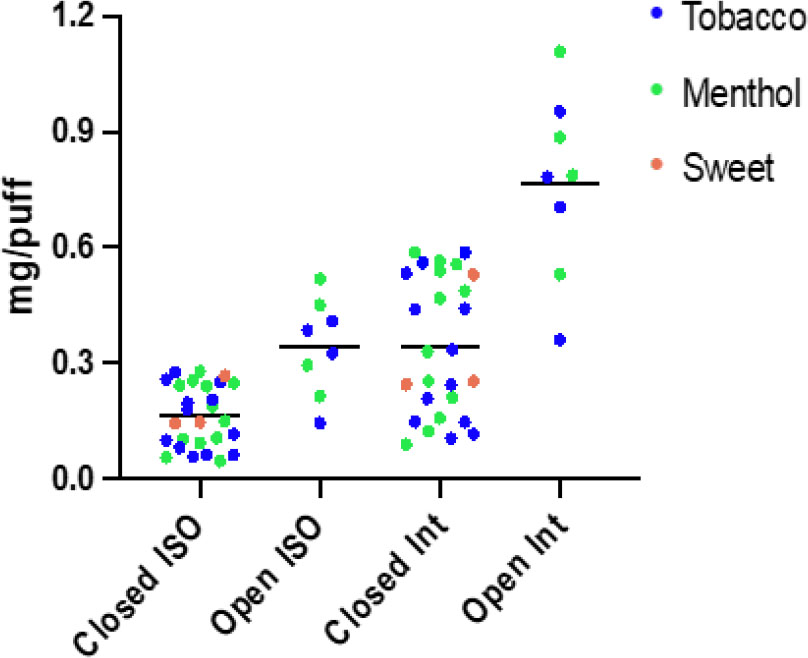
Figure 1.
Nicotine aerosol yields for North American ENDS under ISO 20768 (ISO) and Intense (Int) puffing regimes.
For PG and glycerol, aerosol yields corresponded to e-liquid formulations ranging from approximately 70:30 to 30:70 (PG:Glycerol). Menthol aerosol yields for non-tobacco flavored ENDS ranged from 0.009 to 0.168 mg/puff for ISO 20768 and 0.013 to 0.337 mg/puff for intense puffing regime. Water aerosol yields ranged from 0.14 to 0.80 mg/puff for ISO 20768 and 0.23 to 1.53 mg/puff for intense collections.
3.3. Carbonyls in ENDS aerosol
Carbonyl formation has been a subject of particular interest within ENDS research due to their ability to form from primary aerosol constituents and known adverse impact on human health when inhaled at sufficient concentrations (55). Although the formation of carbonyls is well understood from a mechanistic standpoint, i.e., oxidation of primary ingredients PG and glycerol during heating and aerosolization, generation of carbonyls is dynamic in that device design, power, wicking rate, formulation, and coil temperature impact their aerosol yields (50).
Carbonyl yields per puff for ISO 20768 and intense aerosol collections for market ENDS are presented in Table 4 (page 205). Data normalized per collection and per g DML are presented in supplemental material (Tables S9 and S10). Formaldehyde yields ranged from 0.054 to 4.69 µg/puff in closed system ENDS and 0.066 to 30.4 µg/puff in open system ENDS under the ISO 20768 puffing regime while intense puffing ranged from 0.11 to 82.1 µg/puff in closed system ENDS and 0.75 to 36.3 µg/puff in open system ENDS.
Unlike primary ingredients, carbonyls were highly variable across the 35 ENDS tested. All products produced quantifiable levels of acetaldehyde, acrolein and formaldehyde, irrespective of puffing regime, while other carbonyl compounds were brand dependent. No correlation was observed between carbonyl yields and DML or puff count for the tested products. Specifically, the products with the highest DML yield (Smok Nord 4) and largest number of puffs (JUUL) yielded among the lowest levels of formaldehyde and other carbonyls, providing strong evidence that device characteristics, i.e., heater design and temperature control, drive carbonyl formation. This finding was consistent with published literature (56). For select brands, marked changes in carbonyl yields were observed between ISO 20768 and intense puffing regimes (e.g., myBlu and South Beach). One brand (RELX Classic) was tested with four different e-liquid flavors in which differences in carbonyl yields were observable on a per-g DML basis suggesting that while device design is the primary driver of carbonyl formation, e-liquid composition is also a contributing factor in determining yields of carbonyl compounds potentially due to differences in wicking between formulations. These findings were consistent with published literature (57, 58). Lastly, for one brand (Vuse Alto) the same flavor (Rich Tobacco) was analyzed for three different nicotine strengths (5.0%, 2.4% and 1.8%). For this brand, no correlation between nicotine concentration and carbonyl formation was observed.
3.4. Metals in ENDS aerosol
Unlike traditional cigarettes, ENDS devices are designed to operate below combustion temperatures and the transfer of metals, i.e., volatility, does not occur in the same manner (32). Metals in ENDS aerosol can be attributed to many different sources, and thus, device design plays a critical role in their overall yields.
Selected metal yields per puff for ISO 20768 and intense aerosol collections for market ENDS are presented in Table 5 (page 210). Additional metals and data normalized per collection and per g DML are presented in supplemental material (Tables S11 and S12).
Nickel aerosol yields on a per-puff basis showed nearly all ENDS aerosol contained quantifiable levels (31 out of 35, i.e., ISO 20768 or intense) above LOQ, ranging from BLOD to 61.0 ng/puff in closed system ENDS and 0.62 to 307 ng/puff in open system ENDS. In general, Cr, Cu, Fe, Ni, Pb, and Zn concentrations in aerosol were found to be highly variable ranging from BLOD to >30 ng/puff. Despite similar metal alloys used for heating elements in ENDS (34), not all tested products generated similar amounts of metals in aerosol. In particular, the open system products used identical e-liquid formulations and wide variations in metal yields were observable. Another observation was the use of a single brand (RELX Classic) with multiple flavor formulations yielded different levels of select metals in aerosol (e.g., Cu) as well. The results indicate that aerosol metals yields are a factor of both device design and e-liquid formulation which are consistent with published literature (34, 59). Additional metals were tested (As, Be, Cd, Co, Se, Ag) and are shown in supplemental material where all values were at or BLOQ for all tested products.
3.5. Glycidol in ENDS aerosol
Glycidol was initially reported in e-cigarettes by Sleiman et al. (60) in which formation was attributed to dehydration of glycerol, and later supported by others (61, 62). The glycidol values on a per-puff basis for ISO 20768 and intense aerosol collections for market ENDS are presented in Table 6 (page 215). For additional comparisons, per collection and per g DML data are presented in supplemental material (Tables S13 and S14).
Under the ISO 20768 puffing regime, glycidol aerosol yields ranged from 0.006 to 0.45 µg/puff in closed system ENDS and 0.003 to 58.0 µg/puff in open system ENDS. The total DML and total number of puffs do not correlate with the amount of glycidol generated in ENDS aerosol. In addition, glycerol per puff did not correlate with glycidol concentrations even though glycidol in ENDS aerosol is formed via the degradation of glycerol (62).
3.6. ENDS vs. combustible cigarettes
Although a health risk assessment associated with the HPHCs reported in this work is out of the scope of this publication, the scientific evidence behind the reduction of toxic chemicals associated with ENDs aerosol compared to CC smoke has been previously demonstrated in the literature. Tables 7 and 8 show the percent change between tested HPHCs for the ENDS category aerosol collected using ISO 20768 and intense puffing regimes compared to ISO 3308 and ISO 20778 1R6F CC smoke values obtained by multiple sources as described in the materials and methods, which are consistent with other 1R6F CC smoke values in the published literature (63).
Table 7.
Comparison between ENDS ISO 20768 aerosol collection yields and 1R6F Reference CC ISO 3308 smoke values (per mg of nicotine).
| Constituent | ENDS category (mg/mg nicotine) | 1R6F CC smoke (mg/mg nicotine) | ENDS category (% change) | ||||
|---|---|---|---|---|---|---|---|
| ISO 20768 | ISO 3308 Standard | Non-intense | |||||
| Lowest | Mean | Highest | Mean | Lowest | Mean | Highest | |
| Acetaldehyde | 8.27E-05 | 3.28E-03 | 5.83E-02 | 7.24E-01 | −99.99% | −99.5% | −92.0% |
| Acetyl Propionyl | 7.23E-07 | 3.19E-05 | 3.39E-04 | 1.56E-02 | −99.995% | −99.8% | −97.8% |
| Acrolein | 8.66E-05 | 2.10E-03 | 1.26E-02 | 5.96E-02 | −99.9% | −96.5% | −79.0% |
| n-Butyraldehyde | 7.23E-07 | 2.69E-05 | 6.29E-04 | 3.47E-02 | −99.998% | −99.9% | −98.2% |
| Crotonaldehyde | 1.18E-06 | 2.41E-05 | 1.53E-04 | 1.41E-02 | −99.99% | −99.8% | −98.9% |
| Diacetyl | 7.43E-06 | 8.64E-05 | 1.09E-03 | 1.26E-01 | −99.99% | −99.9% | −99.1% |
| Formaldehyde | 1.53E-04 | 5.00E-03 | 9.36E-02 | 3.74E-02 | −99.6% | −86.6% | 150% |
| Arsenic | 1.22E-07 | 5.35E-07 | 1.67E-06 | 3.35E-06 | −96.4% | −84.0% | −50.2% |
| Cadmium | 1.22E-08 | 2.71E-08 | 7.96E-08 | 5.08E-05 | −99.98% | −99.9% | −99.8% |
| *Chromium | 2.00E-07 | 1.11E-06 | 1.28E-05 | 2.49E-06 | NC | NC | 416% |
| Copper | 3.88E-07 | 1.33E-05 | 1.55E-04 | 1.64E-05 | −97.63% | −18.6% | 848% |
| Lead | 3.07E-08 | 7.07E-07 | 1.69E-05 | 1.63E-05 | −99.81% | −95.7% | 3.82% |
| *Nickel | 2.00E-07 | 1.27E-05 | 1.23E-04 | 4.98E-06 | NC | 155% | 2376% |
| Glycidol | 9.09E-06 | 4.43E-04 | 8.20E-03 | 1.04E-03 | −99.1% | −57.2% | 691% |
* = Below limit of quantitation in 1R6F literature. Limit of quantitation was used for comparison to ENDS, refer to section 3.6.
Table 8.
Comparison between ENDS Intense aerosol collection yields and 1R6F Reference CC ISO 20778 Intense smoke values (per mg of nicotine).
| Constituent | END category (mg/m nicotine) | 1R6F CC smoke (mg/mg nicotine) | ENDs category (% change) | ||||
|---|---|---|---|---|---|---|---|
| Intense (110 mL, 6 s, 30 s) | ISO 20778 Intense | Intense | |||||
| Lowest | Mean | Highest | Mean | Lowest | Mean | Highest | |
| Acetaldehyde | 1.66E-04 | 6.34E-03 | 1.60E-01 | 8.19E-01 | −99.98% | −99.2% | −80.5% |
| Acetyl propionyl | 5.69E-06 | 3.99E-05 | 3.67E-04 | 1.83E-02 | −99.969% | −99.8% | −98.0% |
| Acrolein | 1.21E-04 | 3.41E-03 | 5.02E-02 | 8.12E-02 | −99.9% | −95.8% | −38.2% |
| n-Butyraldehyde | 7.23E-07 | 3.67E-05 | 8.08E-04 | 3.55E-02 | −99.998% | −99.9% | −97.7% |
| Crotonaldehyde | 1.80E-06 | 3.89E-05 | 2.03E-04 | 2.69E-02 | −99.99% | −99.9% | −99.2% |
| Diacetyl | 2.59E-05 | 1.46E-04 | 2.00E-03 | 1.25E-01 | −99.98% | −99.9% | −98.4% |
| Formaldehyde | 2.17E-04 | 1.05E-02 | 3.37E-01 | 5.49E-02 | −99.6% | −80.8% | 514% |
| Arsenic | 1.34E-07 | 4.22E-07 | 1.21E-06 | 3.50E-06 | −96.2% | −87.9% | −65.5% |
| Cadmium | 1.34E-08 | 2.73E-08 | 7.72E-08 | 4.96E-05 | −99.97% | −99.9% | −99.8% |
| *Chromium | 1.34E-07 | 1.07E-06 | 1.20E-05 | 2.49E-06 | NC | NC | 382% |
| Copper | 5.09E-07 | 1.79E-05 | 7.23E-05 | 2.16E-05 | −97.6% | −17.2% | 235% |
| Lead | 3.36E-08 | 1.20E-06 | 2.70E-05 | 1.62E-05 | −99.8% | −92.6% | 66.5% |
| *Nickel | 2.50E-07 | 1.71E-05 | 1.04E-04 | 4.98E-06 | NC | 243% | 1991% |
| Glycidol | 1.22E-05 | 5.02E-04 | 9.26E-03 | 1.11E-03 | −98.9% | −54.7% | 736% |
* = Below limit of quantitation in 1R6F literature. Limit of quantitation was used for comparison to ENDS, refer to section 3.6.
For six out of the seven carbonyl compounds reported in this study, significant reductions in carbonyl compounds were observed in aerosol from ENDS, irrespective of puffing regime, when compared to 1R6F CC smoke. Formaldehyde was the only exception in which the lowest generating tested ENDS product showed a 99% reduction and the highest generating ENDS tested showed a significant increase (>100%) when compared to 1R6F CC smoke values. In addition, ISO 20768 and intense puffing regimes showed observable differences in the mean and highest formaldehyde producing ENDS, illustrating that ENDS HPHC yields are specific to the device and formulation.
A recent review article by Soulet and Sussman (51), evaluated numerous studies published after 2017 for the analysis of metals in ENDS aerosol and found that many lacked information regarding aerosol collection methods and tested devices, preventing impactful outcomes needed for appropriate health risk contextualization. In this study, standardized puffing conditions, aerosol collection, and validated methods allowed for critical quality control measures (i.e., background laboratory aerosol blanks) to be established providing the accuracy and precision needed to quantify ENDS aerosol metals at low levels. ENDS aerosol nickel yields were quantifiable (>LOQ in at least one puffing regime) in 23 of 27 closed system products and all eight open system products. Chromium was quantifiable in eight of 27 closed system products and five of eight open system products (Table 5). ENDS may utilize metals in the device components (e.g., Ni and Cr) while 1R6F CC smoke values for Ni and Cr remain below limits of detection and quantitation (44, 45, 63). In order to perform percent change calculations, LOQ values for Ni (10.0 ng/cig) and Cr (5.0 ng/cig) reported in Hashizume et al. (45) for ISO 20778 intense 1R6F smoke values were used for comparison, consistent with other reported limits in literature (21). Some ENDS yielded low levels of Ni and Cr in aerosol below 1R6F CC smoke LOQ, however, several products had considerably higher aerosol yields than 1R6F CC smoke. Similarly, mean values for both Cu and Pb were reduced in most ENDS aerosol when compared to 1R6F CC smoke, but certain products produced Cu and Pb yields considerably above levels reported in 1R6F CC smoke. These observations were consistent with previously published literature (64).
To date, minimal data exist on CC smoke glycidol yields due to its absence on the FDAs established list of 93 HPHCs (65). With the proposed addition of glycidol to the established HPHC list (66), limited comparisons between product categories exist. The comparison between ENDS aerosol and 1R6F CC smoke in the current study is unique in that the glycidol yields for 1R6F CC smoke were determined in the same test facility utilizing the same analytical method. Similar to formaldehyde, the mean and lowest yielding glycidol ENDS remain significantly reduced when compared to 1R6F CC smoke. However, the highest glycidol yielding ENDS produce nicotine normalized yields exceeding 1R6F CC smoke.
Considered holistically, ENDS aerosol shows dramatic reductions in HPHC yields compared to 1R6F CC smoke. As discussed above, not all market ENDS generate equivalent levels of HPHCs. With respect to certain individual toxic metals and carbonyl compounds, the yields differed by several orders of magnitude between the lowest and highest HPHC yielding market ENDS, some approached or exceeded 1R6F CC smoke yields.
3.7. Limitations
The current work is intended to provide a comprehensive overview of select HPHCs and other chemicals quantitatively determined using both regimens, ISO 20768 and intense puffing, to collect aerosol for market ENDS reflective of North America in 2021 and 2022. The analyses were performed by an ISO accredited laboratory using validated analytical methods designed to provide a head-to-head comparative study. Currently, no standardized intense puffing regime exists. Intense puffing conditions were chosen to study HPHC yields under exaggerated conditions that may not be representative of typical product usage. Without consumer behavior data for each product toxicological health risk assessments were out of scope of the study.
HPHC yields have been shown previously to vary over pod life (44). However, ENDS may suffer from elevated HPHCs when depletion of the pod is approached (67). To collect a representative sample of product aerosol with standardized methodology, while minimizing the collection of dry puffs since consumer behavior suggests that ENDS users do not repeatedly dry-puff due to the off-putting taste (68), aerosol was collected using an 85% EOL approach. The goal of this study aimed at providing comparisons under standardized conditions and was not designed to provide values representative of specific use scenarios such as end of pod life that may result in dry puffing. Despite efforts to minimize dry puffing, high standard deviations for carbonyl yields for select products may indicate individual replicates experienced one or more dry puffs during aerosol collection.
The authors state in the materials and methods that all devices and e-liquid formulations were bought commercially and handled only by the test facility; and the authors do not have information regarding the product age or storage conditions prior to purchasing. The aerosol collections for the open system ENDS presented in this work use one brand of e-liquid (Mr. Salt-E), and any future reference to the study data should be appropriately contextualized. In addition, the open system ENDS aerosol collections were performed using a brand-new refillable pod with fresh e-liquid, i.e., recently removed from the commercial packaging, however, the current work does not provide any data regarding HPHC yields post first fill and first use. Therefore, future work should evaluate the HPHC yields after first fill and first use to provide HPHC yields over the course of the refillable pod life as repetitive use may lead to a change in HPHC aerosol yields.
Lastly, it is worth acknowledging that while conducting the study in 2021 and 2022 several changes occurred in the market and regulatory environment in North America. First, the U.S. ENDS market shifted significantly from 2020 to 2022 towards illegally imported disposable flavored ENDS (69). Future studies may want to include such products while they remain accessible despite regulatory efforts to combat importation and retail of illicit products. In Canada, the Nicotine Concentration in Vaping Products Regulations (NCVPR) established a maximum nicotine concentration of 20 mg/mL (~2.0% wt.) for vaping products manufactured or imported for sale (70), and therefore, the vast number of tested ENDS in this study are now no longer available in that market. In summary, although the selected ENDS in the present study may not be representative of the 2024 consumer market, it does provide a critical snapshot in time to help multiple stakeholders, in industry, regulatory bodies, and academia, track the change in ENDS over time with respect to HPHC yields.
4. CONCLUSION
To date, the following study is one of the most comprehensive analyses of select HPHCs in ENDS aerosol using validated analytical methods in the same test facility for a head-to-head comparison. The most notable outcome of this study was that the ENDS product landscape is highly varied in product characteristics, and that device design and e-liquid formulations are critical to minimize the yields of select carbonyls, metals, and glycidol generated in aerosol. The reported dataset contains multiple e-liquid formulations tested in the same device, and multiple devices (i.e., open systems) with identical e-liquids. Both of which resulted in varied HPHC yields. Importantly, in corroboration with previous studies relating to individual ENDS, the North American ENDS market as a whole represents a significant reduction in total HPHC yields compared to 1R6F CC, when normalized to milligrams per nicotine. However, some ENDS produced yields of certain individual HPHCs that exceeded 1R6F CC while other ENDS yielded reductions greater than 99%. This variation across the ENDS product landscape highlights the need for appropriate regulatory standards to ensure consumers understand the risks associated with use of a particular product or product category. At present the tobacco-flavored formulations of two devices in this study (NJOY ACE & Vuse Solo) have received marketing granted orders (MGOs) from the U.S. FDA (71). The current study provides a critical comparison of these and other products existing in the North American ENDS market based on commercial availability between 2021 and 2022.
Notes
7.
ACKNOWLEDGMENTS
Authors would like to thank Michael Oldham, Thomas Cocciardi, and Jason Mosebach for additional editorial services.
Notes
9. SUPPLEMENTARY MATERIAL
The Supplementary Material for this article can be found at: https://sciendo.com/article/10.2478/cttr-2024-0008.
10. DATA AVAILABILITY
The data supporting the conclusion may be made available upon request and appropriate legal review.