

Table 1.
Number of farms and their average size in V4 countries
| Country | Number of farms (thousands) | Change 2023/2010 | Average size of the farm (ha of UAA) | Change 2023/2010 | ||||
|---|---|---|---|---|---|---|---|---|
| 2010 | 2016 | 2023 | 2010 | 2016 | 2023 | |||
| Czechia | 22.9 | 26.5 | 33.2 | 1.45 | 152.4 | 130.2 | 130.0 | 0.85 |
| Hungary | 571.7 | 430.0 | 196.0 | 0.34 | 8.2 | 10.9 | 26.1 | 3.18 |
| Poland | 1,506.6 | 1,410.7 | 1,232.6 | 0.82 | 9.6 | 10.2 | 11.9 | 1.24 |
| Slovakia | 24.5 | 25.7 | 19.2 | 0.78 | 77.5 | 73.6 | 95.0 | 1.23 |
[i] Source: Own performance based on Czech Statistical Office, 2024; Eurostat, 2026; Statistics Poland; Hungarian Central Statistical Office, 2024; European Commission, 2026
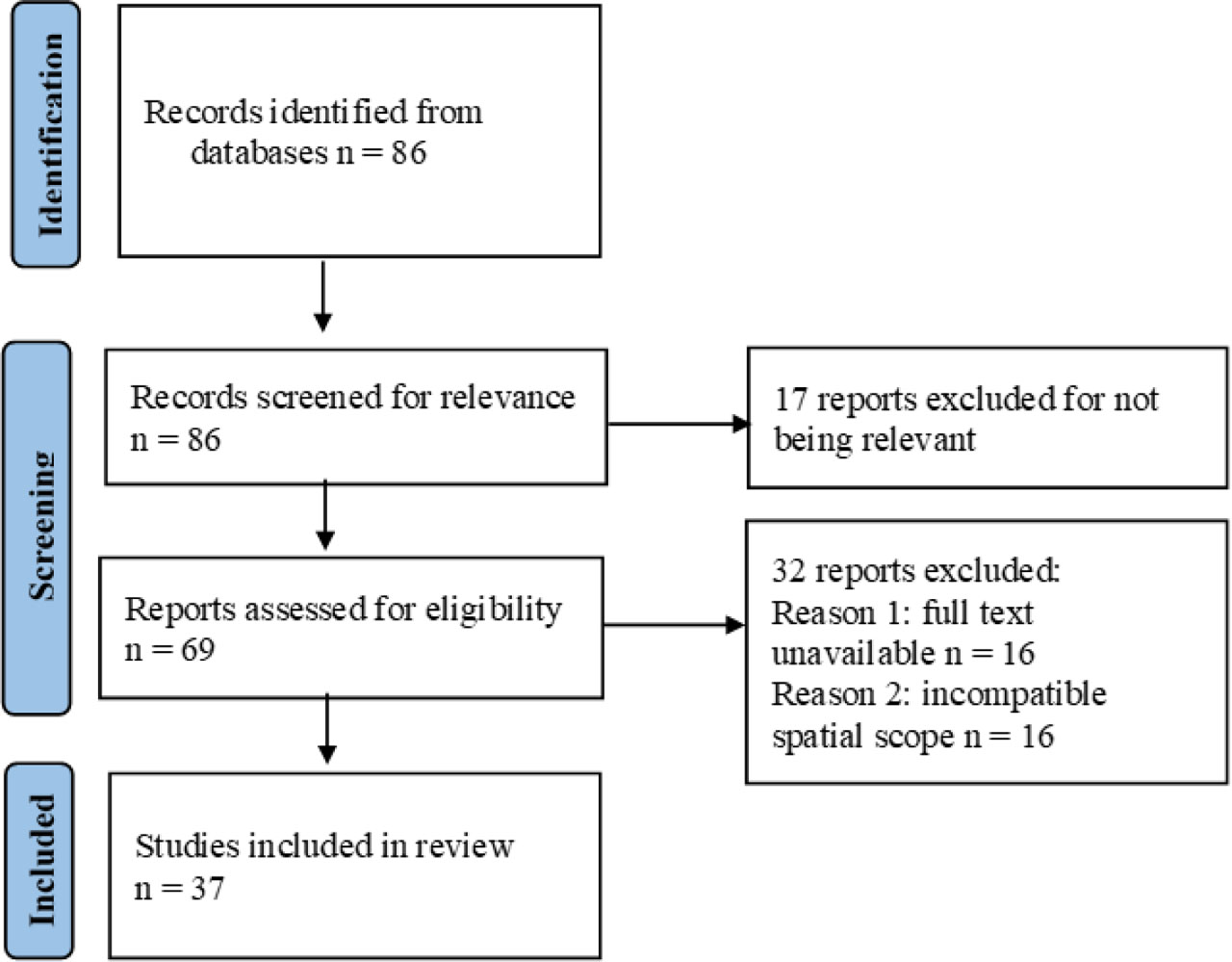
Figure 1.
PRISMA flow diagram for the study. Source: own performance based on PRISMA Executive (2026). PRISMA, Preferred Reporting Items for Systematic Reviews and Meta-Analyses
Table 2.
Scopes of the articles selected under the PRISMA checklist
| Time scope | Spatial scope | Topic scope | |||
|---|---|---|---|---|---|
| Year | No. | Country | No. | Key wordsa | No. |
| 2015 | 1 | Poland | 14 | Short food supply chain(s) | 13 |
| 2016 | 0 | Hungary | 14 | Food supply | 12 |
| 2017 | 3 | The Czech Republic | 9 | Alternative food network | 7 |
| 2018 | 2 | Slovakia | 3 | Sustainability | 5 |
| 2019 | 2 | Italy, UK, Spain (each) | 3 | Food consumption | 5 |
| 2020 | 3 | Journal name | No. | Supply Chain Management | 5 |
| 2021 | 3 | Sustainability | 10 | Rural development | 4 |
| 2022 | 6 | Deturope | 3 | Food production | 4 |
| 2023 | 2 | Studies in Agric. Econom. | 3 | Alternative agriculture | 3 |
| 2024 | 3 | Int. Jour. of Food Science | 2 | Farming system | 3 |
| 2025 | 7 | Agriculture | 2 | Farms | 3 |
| 2026 | 5 | Others | 17 | Urban agriculture | 3 |
Table 3.
Classification of SFSC literature by sales channel, type of analysis and methods (n = 37)
| No. | Author(s), year | Main sales channel analysed | Type of analysisa | Methods used |
|---|---|---|---|---|
| 1 | Borychowski et al. (2026) | SFSCs (general) | Explanatory | Quantitative (survey, statistics) |
| 2 | Nováčková, Pixová and Plank (2026) | CSA | Qualitative explanatory | Interviews, qualitative analysis |
| 3 | Plank and Pixová (2026) | Alternative food networks (AFNs) | Conceptual/political economy | Qualitative, document analysis |
| 4 | Raftowicz and Struś (2026) | CSA | Descriptive explanatory | Qualitative interviews |
| 5 | Kufel-Gajda (2026) | Organic/local food systems | Explanatory | Qualitative policy analysis |
| 6 | László, Czuppon and Michalec (2025) | Local food systems/direct sales | Exploratory | Qualitative interviews |
| 7 | Onyszkiewicz and Sylla (2025) | CSA | Evaluative | Mixed methods |
| 8 | Ritter and Orbán (2025) | Digital SFSCs | Explanatory | Quantitative survey |
| 9 | Varecha, Laginová and Jarábková (2025) | SFSCs food service | Descriptive | Quantitative survey |
| 10 | Pijet-Migoń et al. (2025) | Direct sales/wine tourism | Exploratory | Qualitative interviews |
| 11 | Smędzik-Ambroży et al. (2025) | SFSCs (general) | Comparative | Quantitative efficiency analysis |
| 12 | Gjokaj et al. (2025) | SFSCs (general) | Descriptive explanatory | Mixed methods |
| 13 | Smędzik-Ambroży et al. (2024) | SFSCs (general) | Comparative | Quantitative survey |
| 14 | Daněk and Jehlička (2024) | Self-provisioning | Conceptual empirical | Qualitative |
| 15 | Acella et al. (2024) | Direct sales/local products | Evaluative | Mixed methods |
| 16 | Oleksiuk and Rull Quesada (2023) | Direct sales/SMEs | Exploratory | Qualitative case studies |
| 17 | Drejerska and Sobczak-Malitka (2023) | SFSCs (general) | Descriptive | Literature + empirical synthesis |
| 18 | Csordás, Lengyel and Füzesi (2022) | SFSCs (consumer side) | Systematic review | Literature review |
| 19 | Daněk et al. (2022) | Self-provisioning | Longitudinal qualitative | Interviews |
| 20 | Kovács, Balázsné Lendvai and Beke (2022) | Local food markets | Explanatory | Quantitative survey |
| 21 | Floriš et al. (2022) | SFSCs/small farms | Descriptive | Quantitative survey |
| 22 | Aouinaït et al. (2022) | SFSCs (multi-actor) | Evaluative | Qualitative stakeholder analysis |
| 23 | Török et al. (2022) | SFSCs restaurants | Economic evaluation | Case study |
| 24 | Ruszkai, Pajtók Tari and Patkós (2021) | Local food networks | Institutional analysis | Qualitative |
| 25 | Raftowicz et al. (2021) | CSA (aquaculture) | Exploratory | Case study |
| 26 | Wiśniewska-Paluszak and Paluszak (2021) | Urban/peri-urban farming | Relational analysis | Qualitative |
| 27 | Goszczyński (2019) | AFNs(conceptual) | Conceptual | Theoretical |
| 28 | Rivera et al. (2020) | SFSCs/small farms | Comparative | Mixed methods |
| 29 | Hruška et al. (2020) | AFNs | Historical descriptive | Qualitative |
| 30 | Slámová and Belčáková (2019) | Small farms/local food | Evaluative | Case studies |
| 31 | Kacz, Hegyi and Gombkötő (2019) | CSA | Descriptive | Quantitative survey |
| 32 | Sacchi et al. (2018) | Alternative food systems | Multi-actor review | Literature review |
| 33 | Mezei et al. (2018) | Local food systems | Comparative | Qualitative |
| 34 | de Hoop and Jehlička (2017) | Self-provisioning | Explanatory | Qualitative interviews |
| 35 | Szabó (2017) | SFSCs (consumer side) | Explanatory | Quantitative |
| 36 | Bakos (2017) | Community-supported food systems | Descriptive | Literature review |
| 37 | Sovová (2015) | Self-provisioning | Exploratory | Qualitative |
a The analytical focus of each publication was classified according to its primary research objective. Each study was assigned to a single dominant category reflecting the principal aim of the analysis. Explanatory studies sought to identify causal relationships or determinants; they investigated relatively under-researched phenomena; descriptive studies characterised existing conditions or practices; evaluative studies assessed the effectiveness or performance of specific solutions; comparative studies compared countries, systems or groups; conceptual studies developed theoretical frameworks or conceptual discussions; and institutional analyses focused on institutional, policy or governance aspects of SFSC development
Table 4.
Comparative characteristics of SFSCs in V4 countries based on literature review
| Dimension | Czech Republic | Hungary | Poland | Slovakia |
|---|---|---|---|---|
| Estimated share of farms in SFSCs | Officially very low 1%–2%; informal activity likely higher | Around 20% | Officially low (≈3%), but informal participation substantial | Around 20% |
| Main products sold via SFSCs | Mainly animal products; limited diversification | Fruits, vegetables, dairy, herbs; some functional foods | Fruits, vegetables, dairy, honey | Fruits, vegetables, dairy, sheep and goat products |
| Dominant marketing channels | Direct sales, farmers’ markets, box schemes | Direct sales, farmers’ markets | Direct sales, farmers’ markets, home delivery | Direct sales, order-based delivery |
| Role of CSA | Moderately developed; mainly urban-based | Moderately developed; concentrated around Budapest | Emerging; limited but growing | Very weak/marginal |
| Digital tools and online sales | Limited but growing | Relatively advanced (online platforms, apps, inventory tools) | Emerging slowly | Very limited |
| Consumer motivations | Quality, locality, ethical and environmental values | Freshness, health, uniqueness, animal welfare | Trust in local, family farms; food origin | Freshness, direct relationship with producer |
| Main producer motivations | Higher income/prices, direct customer relationships | Higher income/prices, innovation opportunities | Higher income/prices, regulatory facilitation, trust | Higher income/prices, direct contact, local embeddedness |
| Key barriers identified by farmers | Time constraints, bureaucracy, lack of knowledge, seasonality | Skills deficits, marketing limitations, low scale | Time constraints, seasonality, lack of knowledge, low scale | Time constraints, low scale, skills deficits, access to land |
| Policy and institutional support | Strong, multi-level (CAP, ministries, Local Action Groups) | Strong, long-term national programs | Strong since 2017, focused on deregulation | Moderate, mainly project-based |
| Overall level of SFSC development | Low–moderate | Moderate | Moderate (with high growth potential) | Low |
[i] Note: Estimates are derived from heterogeneous sources (scientific publications, institutional reports and official statistics) and should, therefore, be interpreted as indicative rather than directly comparable.
[ii] Note: This qualitative assessment takes into account the combined evidence regarding the diversity of SFSC channels, the scale of farmer participation, institutional support, market development and other characteristics consistently reported across the reviewed studies. It does not represent a quantitative index.