

Table 1a.
Frequencies for categorical variables
| Variables | Full sample | Of which: | Restricted sample | Of which: | |||
|---|---|---|---|---|---|---|---|
| Pedagogy | STEM | Humanities | Foreign languages | Social Sciences | |||
| Dependent variables | |||||||
| Teachers in concurrent mode | 3.5 | 100 | - | - | - | - | - |
| Teachers in consecutive mode | 6.29 | - | 10.90 | 10.57 | 12.67 | 24.67 | 0.89 |
| Independent variables | |||||||
| Gender | |||||||
| Female | 69.30 | 96.53 | 69.92 | 53.09 | 76.93 | 85.38 | 67.89 |
| Male | 30.70 | 3.47 | 30.08 | 46.91 | 23.07 | 14.62 | 32.11 |
| Type of secondary school | |||||||
| General | 97.99 | 96.82 | 98.75 | 99.33 | 98.67 | 99.32 | 97.99 |
| Vocational | 2.01 | 3.18 | 1.25 | 0.67 | 1.33 | 0.68 | 2.01 |
| Social stipend | |||||||
| receiving | 12.56 | 20.38 | 13.13 | 14.84 | 16.40 | 13.14 | 10.72 |
| not receiving | 87.44 | 79.62 | 86.87 | 85.16 | 83.60 | 86.86 | 89.28 |
| Mode of studying | |||||||
| full time | 75.95 | 72.90 | 84.75 | 98.51 | 88.93 | 87.13 | 72.25 |
| part time | 11.78 | 0.22 | 7.78 | 0.36 | 2.82 | 8.17 | 14.39 |
| evening | 12.27 | 26.88 | 7.47 | 1.13 | 8.25 | 4.70 | 13.36 |
| Highest degree obtained | |||||||
| MA | 52.34 | 44.80 | 48.94 | 50.94 | 48.64 | 46.54 | 49.38 |
| BA | 47.66 | 55.20 | 51.06 | 49.06 | 51.36 | 53.46 | 50.62 |
| Starting on time | |||||||
| starting the programme on time | 95.06 | 97.18 | 95.27 | 94.05 | 95.48 | 94.83 | 96.32 |
| joining later | 4.94 | 2.82 | 4.73 | 5.95 | 4.52 | 5.17 | 3.68 |
| N | 39,779 | 1,384 | 23,790 | 5,834 | 3,298 | 5,999 | 8,659 |
Table 1b.
Descriptive statistics (mean, sd) for continuous variables
| Independent variables | Full sample | Of which: | Restricted sample | Of which | |||
|---|---|---|---|---|---|---|---|
| Pedagogy | STEM | Humanities | Foreign languages | Social Sciences | |||
| Hometown population†, * | 874,298 (805,313) | 793,140 (820,562) | 886,023 (802,214) | 875,805 (797,393) | 901,727 (809,809) | 855,417 (801,783) | 908,130 (802,173) |
| Hometown revenues per capita (PLN) †† | 3,541 (1,826) | 3,393 (2,124) | 3,578 (1,834) | 3590 (1766) | 3589 (1810) | 3508 (1961) | 3613 (1797) |
| Hometown unemployment (%)†† | 7.99 (5.85) | 8.45 (5.94) | 7.892085 (5.84) | 7.90 (5.74) | 7.86 (5.91) | 8.11 (5.96) | 7.74 (5.78) |
| Matura subjects at advanced level | 2.61 (1.05) | 2.08 (1.08) | 2.67 (1.01) | 2.71 (0.87) | 2.53 (0.98) | 2.71 (0.98) | 2.68 (1.11) |
| Matura outcome (Si sec) ††† | 0.727 (0.152) | .609 (.140) | .737 (0.146) | 0.768 (0.136) | .0723 (0.139) | 0.754 (0.139) | 0.712 (0.156) |
| Achievements at UW (Si univ) †††† | 0.557 (0.115) | .525 (0.095) | .559 (0.114) | (0.576) (0.130) | (0.546) (0.120) | 0.564 (0.114) | (0.549) (0.096) |
Table 2.
Exemplary mechanisms of self-selection to teacher training
| Sign of β | Description | |||
|---|---|---|---|---|
| sisec | sisec2 | siuniv | siuniv2 | |
| + | 0 | + | 0 | Double positive selection. Positive and linear self-selection to teacher training with respect to both Matura score and early achievements at UW |
| − | − | + | + | Thriving specialists. Many teachers recruit themselves from among students who scored low on their Matura, but who perform very well within their UW programme. |
| − | 0 | 0 | 0 | Random selection from among low-profile students. The effect of Matura score on self-selection to teaching is linearly negative. Later experience at the university has no impact on students’ decisions |
| + | − | 0 | 0 | Middling skills selection. Teaching career is not attractive for low-performing students, but its attractiveness increases at a falling rate as we move along the achievements distribution. |
| 0/+ | 0 | + | − | Falling back students. Achievements on Matura do not affect students’ choices, but teaching is more likely to be chosen be those struggling academically while at UW |
| + | 0 | − | 0 | Mismatched. Prospective teachers had good scores on their Matura, but nevertheless they struggle at their university programme. |
| − | 0 | − | 0 | Double negative. Negative and linear self-selection to teacher training with respect to both Matura score and early achievements at UW |
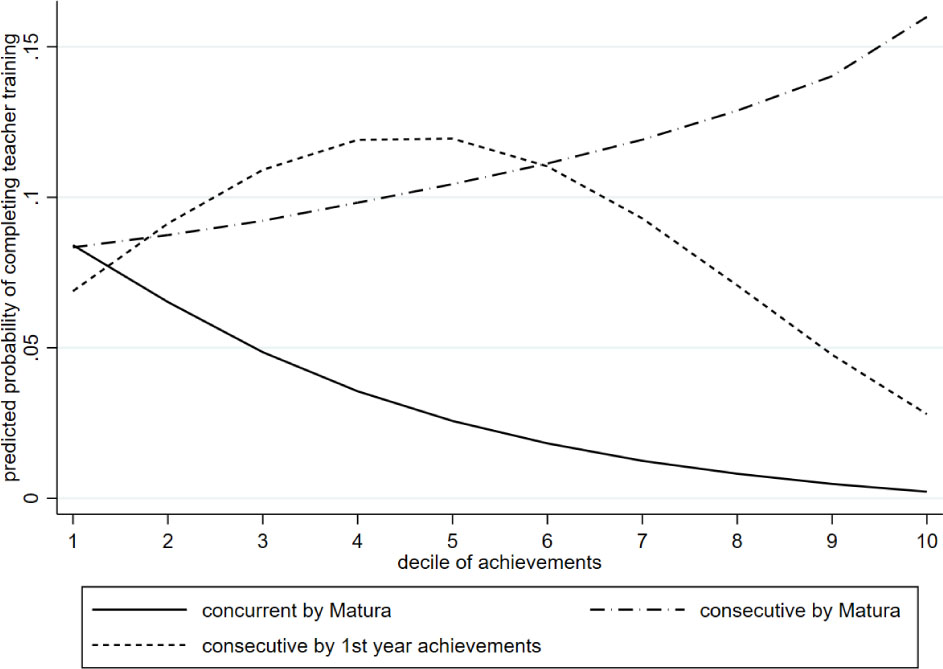
Figure 1.
Predicted probability of completing concurrent and consecutive teacher training, by percentile of the average Matura rank outcome and by percentiles of achievements during the first year at UW
Table 3.
Logit regression outcomes: concurrent versus consecutive mode of teacher training
| (1) | (2) | |
|---|---|---|
| Concurrent | Consecutive | |
| Gender (f) | 2.374*** | 0.462*** |
| (0.148) | (0.0675) | |
| While in secondary school | ||
| General sec. (vs. vocational) | 0.578*** | 0.666 |
| (0.170) | (0.355) | |
| Matura outcome | 12.54*** | −4.234** |
| (1.358) | (1.474) | |
| Matura^2 | −14.24*** | 4.371*** |
| (1.109) | (1.045) | |
| N of subjects at advanced level | −0.303*** | 0.0785** |
| (0.0311) | (0.0282) | |
| Log_hometown population | −0.094*** | 0.0422 |
| (0.0318) | (0.0421) | |
| Unemployment in hometown | −0.0306 | 0.0454 |
| (0.0474) | (0.0424) | |
| Local revenues in hometown | 0.112* | −0.187* |
| (0.0568) | (0.0946) | |
| While at the university | ||
| Starting on time_ | 0.687*** | −0.688*** |
| (0.170) | (0.140) | |
| 1st year achievements | 5.924*** | |
| (1.555) | ||
| 1st year achievements^2 | −6.513*** | |
| (1.378) | ||
| Social stipend | 0.293*** | 0.361*** |
| (0.0752) | (0.0667) | |
| Evening mode | −4.793*** | −1.072*** |
| (0.579) | (0.213) | |
| Part-time mode | −0.267*** | −0.845*** |
| (0.0799) | (0.140) | |
| MA (vs. BA) | −0.226*** | 1.199*** |
| (0.0651) | (0.0647) | |
| Erasmus experience | −0.0638 | |
| (0.0616) | ||
| constant | −6.132*** | −6.380*** |
| (0.786) | (0.972) | |
| Pseudo r2 | 0.195 | 0.311 |
| N | 39779 | 23336 |
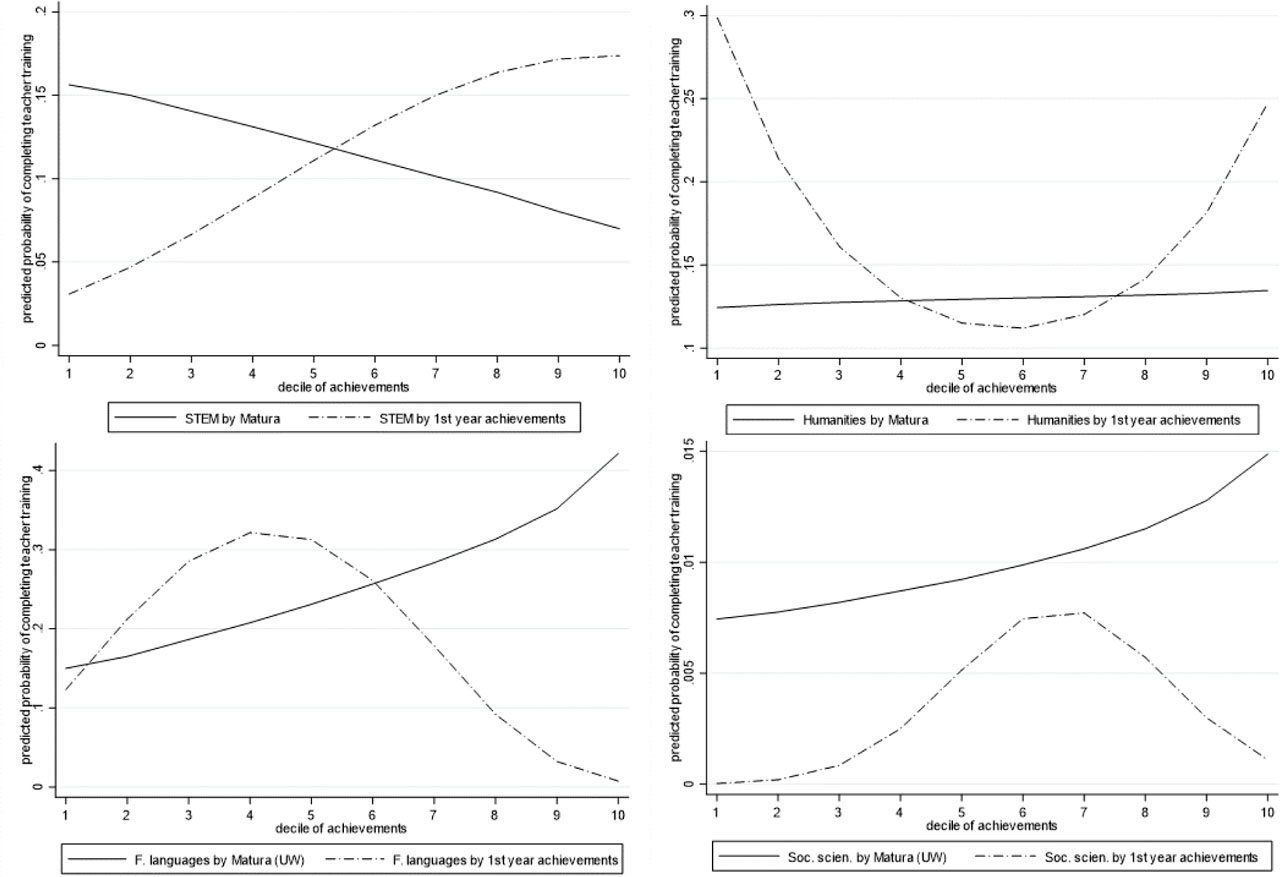
Figure 2.
Predicted probability of completing consecutive teacher training, by field of studies, and by decile of Matura outcome/first-year achievements
Table 4.
Logit regression outcomes by field: consecutive mode of teacher training
| (1) | (2) | (3) | (4) | |
|---|---|---|---|---|
| STEM | Humanities | Foreign languages | Social sciences | |
| Gender (f) | 0.540*** | 0.411* | 0.229* | 0.874* |
| (0.116) | (0.164) | (0.110) | (0.370) | |
| While in secondary school | ||||
| General secondary (vs. vocational) | −0.0238 | 1.279 | 0.950 | 0 |
| (0.582) | (0.759) | (0.648) | (.) | |
| Matura outcome | 6.506 | 0.290 | −8.758*** | −2.727 |
| (3.473) | (3.121) | (2.174) | (8.127) | |
| Matura^2 | −6.053* | −0.0324 | 8.889*** | 3.100 |
| (2.503) | (2.287) | (1.524) | (5.629) | |
| N of subjects at advanced level | −0.216** | −0.161* | 0.242*** | 0.550*** |
| (0.0696) | (0.0645) | (0.0402) | (0.148) | |
| Log hometown population | 0.0182 | −0.127 | 0.119* | −0.0114 |
| (0.0938) | (0.0964) | (0.0602) | (0.225) | |
| Unemployment in hometown | 0.172* | 0.0111 | −0.0288 | 0.0976 |
| (0.0843) | (0.0943) | (0.0653) | (0.245) | |
| Local revenues in hometown | −0.194 | 0.0285 | −0.191 | −0.0481 |
| (0.208) | (0.214) | (0.138) | (0.535) | |
| While at the university | ||||
| Starting on time | −0.167 | −0.700* | −1.042*** | −1.414* |
| (0.307) | (0.308) | (0.215) | (0.700) | |
| 1st year achievements | 5.752 | −6.753* | 11.45*** | 21.00 |
| (3.409) | (2.928) | (2.457) | (12.81) | |
| 1st year achievements^2 | −2.920 | 6.437* | −13.48*** | −17.03 |
| (2.903) | (2.670) | (2.214) | (10.82) | |
| Social stipend | 0.410*** | 0.340* | 0.345** | 0.0373 |
| (0.123) | (0.143) | (0.106) | (0.449) | |
| Evening mode | −0.274 | 0.453 | −1.771*** | 0.679 |
| (1.054) | (0.393) | (0.370) | (0.471) | |
| Part-time mode | −2.310** | −0.904*** | −0.856*** | 1.016 |
| (0.746) | (0.258) | (0.198) | (0.632) | |
| MA (vs. BA) | 1.487*** | 0.827*** | 1.365*** | 0.341 |
| (0.150) | (0.145) | (0.0934) | (0.388) | |
| Erasmus experience | −0.282 | −0.935*** | 0.108 | −0.0865 |
| (0.154) | (0.245) | (0.0803) | (0.296) | |
| constant | −7.683*** | 0.887 | −5.897*** | −9.973 |
| (2.072) | (2.328) | (1.621) | (5.592) | |
| Pseudo R2 | 0.255 | 0.118 | 0.276 | 0.311 |
| N | 4975 | 3158 | 5815 | 7355 |
Table 5.
Predicted probabilities of completing teacher training
| (1) | (2) | (3) | (4) | (5) | (6) | ||
|---|---|---|---|---|---|---|---|
| Variable | Categories | Concurrent mode | Consecutive mode | STEM | Human | Foreign languages | Social sciences |
| Gender | |||||||
| Male | 0.47% | 8.42% | 9.43% | 9.80% | 22.26% | 0.57% | |
| Female | 4.54% | 11.56% | 13.81% | 13.63% | 25.18% | 1.20% | |
| Social stipend | |||||||
| Yes | 4.30% | 13.21% | 15.29% | 15.88% | 28.76% | 1.06% | |
| No | 3.32% | 10.46% | 11.61% | 12.20% | 24.13% | 1.03% | |
| Number of Matura subjects taken at advanced level | |||||||
| 1 | 4.89% | 9.98% | 15.32% | 15.41% | 19.37% | 0.39% | |
| 3 | 2.84% | 11.08% | 11.44% | 12.1% | 25.41% | 1.06% | |
| 5 | 1.61% | 12.27% | 8.33% | 9.23% | 32.27% | 2.46% | |
| Mode of university programme | |||||||
| full-time | 4.49% | 11.32% | 12.57% | 13.50% | 25.83% | 0.97% | |
| part-time (evening) | 0.04% | 5.20% | 10.39% | 18.90% | 8.18% | 1.69% | |
| part-time | 3.54% | 6.20% | 1.93% | 6.37% | 15.64% | 1.16% | |
| Population of hometown | |||||||
| 5,000 | 4.82% | 9.77% | 11.78% | 18.73% | 19.07% | 1.07% | |
| 500,000 | 3.32% | 11.08% | 12.45% | 12.20% | 25.59% | 1.03% | |
| Unemployment rate in hometown | |||||||
| mean − 1 std. dev. | 3.58% | 10.53% | 10.71% | 12.75% | 25.19% | 0.95% | |
| mean + 1 std. dev. | 3.39% | 11.19% | 13.62% | 13.00% | 24.44% | 1.12% | |
| MA/BA | |||||||
| MA | - | 15.20% | 17.20% | 16.82% | 34.38% | 1.12% | |
| BA | - | 6.67% | 5.56% | 8.56% | 16.49% | 0.84% | |
| Erasmus experience | |||||||
| Yes | - | 10.55% | 10.41% | 6.30% | 25.72% | 0.99% | |
| No | - | 11.00% | 12.65% | 13.70% | 24.31% | 1.06% | |