

1. Introduction
The construction industry plays a fundamental role in supporting economic development through infrastructure provision and urban expansion, yet it remains one of the most resource-intensive sectors globally. Recent studies highlight that the sector is responsible for significant environmental pressures, including high energy consumption, carbon emissions, and construction waste generation, which collectively contribute to climate change and environmental degradation (UNEP, 2024). In response, global sustainability agendas increasingly emphasize the need for construction firms to transition to low-carbon, resource-efficient practices aligned with sustainable development goals (IEA, 2022).
Sustainable construction practices have therefore become a strategic priority for industry stakeholders, particularly through mechanisms such asgreen investment, green marketing, and the integration of corporate social responsibility (CSR) (M. Zhang et al., 2022). Green investment enables construction firms to adopt energy-efficient technologies, low-emission materials, and environmentally friendly construction methods that reduce lifecycle environmental impacts (H. Van Tran et al., 2026). Green marketing further supports the adoption of sustainability by enhancing stakeholder awareness and promoting an environmentally responsible corporate identity, thereby improving market competitiveness (Kinnunen et al., 2022). Meanwhile, CSR initiatives strengthen accountability and stakeholder engagement, ensuring that construction activities align with environmental and social expectations (D. K. Tran, 2025).
Recent empirical studies indicate that sustainability-oriented strategies positively influence both environmental and organizational performance in construction firms (Alghamdi, 2025). Green investment has been shown to improve operational efficiency and reduce environmental risks, while CSR enhances corporate legitimacy and stakeholder trust (Q. Zhang et al., 2022). Similarly, green marketing contributes to improved corporate reputation and customer preference for sustainable construction services (Kinnunen et al., 2022). However, most existing research examines these variables separately, limiting understanding of their combined effects within an integrated sustainability-performance framework.
To address this gap, this study develops a comprehensive structural model that examines the relationships among green investment, green marketing, CSR, corporate reputation, and business performance in construction companies. Structural Equation Modelling (SEM) is employed to analyse both direct and indirect relationships among these constructs and to identify the most influential sustainability drivers of organizational performance (Hair et al., 2019). This integrated approach provides a more holistic understanding of how sustainability strategies interact to shape construction firm performance in emerging economies.
This study contributes to the sustainable construction literature in two main ways. First, it provides recent empirical evidence on the role of integrated sustainability practices in improving construction firm performance under contemporary environmental pressures (Alghamdi, 2025). Second, it offers a decision-support framework for construction managers to optimize sustainability investments and enhance long-term competitiveness in a rapidly evolving industry landscape (Shurrab et al., 2019). The findings are expected to support both academic development and practical implementation of sustainable construction management strategies.
2. Methodology
2.1. Research Design
This study employed a quantitative cross-sectional research design to investigate the relationships among sustainability practices and organizational performance in construction companies. The proposed research framework integrates Green Investment, Green Marketing, Corporate Social Responsibility (CSR), Corporate Reputation, and Business Performance to evaluate the contribution of sustainability-oriented strategies to construction performance. Structural Equation Modelling (SEM) was adopted because it enables the simultaneous estimation of multiple relationships among latent variables while accounting for measurement errors.
2.2. Sample and Data Collection
The study was conducted using primary data collected from Indonesian construction companies implementing sustainability-related practices. A total of 459 questionnaires were distributed through purposive sampling to managers and professionals responsible for environmental management, project management, sustainability programs, and organizational strategy. After data screening, 212 valid responses were retained for analysis. Incomplete questionnaires and responses exhibiting substantial missing data or inconsistent response patterns were excluded to ensure data quality.
2.3. Measurement of Variables
Four latent constructs were examined in this study:
Green Investment (GI): organizational investment in environmentally sustainable technologies, equipment, and operational practices.
Green Marketing (GM): organizational initiatives promoting environmentally responsible products, services, and corporate image.
Corporate Social Responsibility (CSR): organizational commitment to environmental, social, and ethical responsibilities.
Corporate Reputation (CR): stakeholders’ overall evaluation of organizational credibility and sustainability commitment.
Business Performance (BP): organizational performance achieved through sustainability-oriented management practices.
All measurement items were adapted from previously validated studies and assessed using a six-point Likert scale ranging from 1 (strongly disagree) to 6 (strongly agree).
2.4. Measurement Model Assessment
Before hypothesis testing, the measurement model was evaluated using Confirmatory Factor Analysis (CFA). Internal consistency was assessed through Cronbach’s alpha and Composite Reliability (CR), while convergent validity was examined using standardized factor loadings and Average Variance Extracted (AVE). Discriminant validity was subsequently evaluated to ensure that each construct represented a distinct concept within the proposed sustainability framework.
2.5. Sustainability Performance Assessment Framework
This study adopted a structured sustainability performance assessment framework consisting of five sequential stages:
Collection of sustainability-related data from construction companies.
Data screening and quality assessment.
Evaluation of the measurement model using confirmatory factor analysis.
Estimation of the structural model using SEM.
Assessment of the relationships among sustainability practices and construction business performance.
The framework provides a systematic approach for evaluating how sustainability initiatives collectively contribute to organizational performance within construction companies.
2.6. SEM
Structural Equation Modelling (SEM) was employed to evaluate the proposed research model because it enables simultaneous estimation of relationships among multiple latent constructs. Model adequacy was assessed using Chi-square probability, CMIN/DF, Goodness-of-Fit Index (GFI), Adjusted Goodness-of-Fit Index (AGFI), Comparative Fit Index (CFI), Tucker–Lewis Index (TLI), Incremental Fit Index (IFI), Root Mean Square Error of Approximation (RMSEA), and Root Mean Square Residual (RMR). The assessment followed commonly used SEM fit criteria.
5.7. Data Interpretation
The structural model was interpreted based on standardized path coefficients, critical ratios, and significance levels. Significant positive relationships among the constructs were used to explain how sustainability-oriented practices contribute to organizational performance in construction companies. The findings were further discussed in the context of sustainable construction management and environmental performance, providing practical implications for construction practitioners and policymakers.
3. Results
3.1. Respondent and Study Context
Table 1 presents the demographic characteristics of the 212 respondents included in the analysis. Male respondents represented most of the sample (68.4%), while female respondents accounted for 31.6%.
Table 1:
Respondent characteristics
| Variable | Category | Frequency [n] | Percentage [%] |
|---|---|---|---|
| Gender | Male | 145 | 68.4 |
| Female | 67 | 31.6 | |
| Age | <25 years | 20 | 9.4 |
| 25–34 years | 70 | 33.0 | |
| 35–44 years | 60 | 28.3 | |
| 45–54 years | 49 | 23.1 | |
| >55 years | 13 | 6.1 | |
| Education level | High school / Vocational school | 25 | 11.8 |
| Associate degree | 37 | 17.5 | |
| Bachelor's degree | 95 | 44.8 | |
| Master's degree | 50 | 23.6 | |
| Doctorate | 5 | 2.4 | |
| Position | Board of directors / Senior management | 43 | 20.3 |
| Manager | 32 | 15.1 | |
| Supervisor / Engineer / Architect | 36 | 17.0 | |
| Technical / Operational staff | 33 | 15.6 | |
| Non-technical staff | 31 | 14.6 | |
| Consultant/Project-based | 37 | 17.5 | |
| Years of service | 1–3 years | 82 | 38.7 |
| 4–7 years | 44 | 20.8 | |
| 8–12 years | 39 | 18.4 | |
| >12 years | 47 | 22.2 |
Regarding age, the largest proportion of respondents was aged 25–34 years (33.0%), followed by those aged 35–44 years (28.3%) and 45–54 years (23.1%). In terms of educational attainment, Bachelor's degree holders constituted the largest group (44.8%), followed by Master's degree holders (23.6%). The respondents represented various organizational positions, with Board of Directors/Senior Management accounting for 20.3%, followed by Supervisor/Engineer/Architect (17.0%) and Consultant/Project-Based personnel (17.5%). Regarding years of service, 38.7% of respondents had 1–3 years of experience in the organization, while 22.2% had more than 12 years of service. The distribution indicates that the sample includes respondents from different organizational levels and professional backgrounds, providing varied perspectives for assessing sustainability practices and performance in the construction context.
3.2. Descriptive Statistics
Table 1:
Descriptive overview of sustainability constructs
| Construct | Number of initial indicators | Observed mean range | General response | Interpretation |
|---|---|---|---|---|
| Corporate Social Responsibility (CSR) | 8 | 4.18–4.40 | Somewhat agree | Positive perception of CSR practices |
| Green Investment (GI) | 5 | 3.85–4.22 | Somewhat agree | Positive perception of environmental investment practices |
| Green Marketing (GM) | 4 | 3.98–4.12 | Somewhat agree | Positive perception of sustainability-oriented marketing practices |
| Business Performance (BP) | 5 | 4.18–4.39 | Somewhat agree | Positive perception of organizational performance |
The descriptive analysis indicates generally positive perceptions of sustainability-related practices and business performance among the respondents. CSR obtained indicator mean values ranging from 4.18 to 4.40, while GI ranged from 3.85 to 4.22. GM showed mean values between 3.98 and 4.12, whereas BP ranged from 4.18 to 4.39. Based on the six-point Likert scale, these results indicate that respondents generally perceived the implementation of sustainability-oriented practices and organizational performance positively. The descriptive findings provide an initial overview of sustainability implementation prior to the measurement model's refinement through Confirmatory Factor Analysis (CFA).
3.3. Measurement Model Assessment
Table 3:
Factor loadings, reliability, and convergent validity
| Construct | Indicator | Standardized loading | Cronbach’s α | Composite Reliability (CR) | Average Variance Extracted (AVE) |
|---|---|---|---|---|---|
| Green Investment (GI) | GI1 | 0.845 | 0.871 | 0.884 | 0.718 |
| GI2 | 0.880 | ||||
| GI3 | 0.823 | ||||
| Green Marketing (GM) | GM1 | 0.774 | 0.832 | 0.866 | 0.618 |
| GM2 | 0.801 | ||||
| GM3 | 0.766 | ||||
| GM4 | 0.795 | ||||
| Corporate Social Responsibility (CSR) | CSR1 | 0.847 | 0.935 | 0.932 | 0.663 |
| CSR2 | 0.815 | ||||
| CSR3 | 0.781 | ||||
| CSR4 | 0.775 | ||||
| CSR6 | 0.817 | ||||
| CSR7 | 0.857 | ||||
| CSR8 | 0.824 | ||||
| Business Performance (BP) | BP1 | 0.873 | 0.908 | 0.912 | 0.721 |
| BP2 | 0.891 | ||||
| BP4 | 0.801 | ||||
| BP5 | 0.830 |
The measurement model demonstrated satisfactory reliability and convergent validity across all four constructs. The standardized factor loadings of the retained indicators ranged from 0.766 to 0.891, indicating that the indicators adequately represented their respective latent constructs. Cronbach’s alpha values ranged from 0.832 to 0.935, while Composite Reliability values ranged from 0.866 to 0.932, showing strong internal consistency. The Average Variance Extracted (AVE) values ranged from 0.618 to 0.721, exceeding the recommended minimum of 0.50. These results confirm that the final measurement model provides adequate reliability and convergent validity for evaluating sustainability-related relationships in the construction context.
3.4. Structural Model and Goodness-of-fit
After the measurement model demonstrated satisfactory reliability and convergent validity, the structural model was evaluated using CB-SEM. The assessment first examined overall model fit and then evaluated the hypothesized relationships among GI, GM, CSR, and BP.
Table 2:
Goodness-of-fit indices of the structural model
| Goodness-of-fit index | Recommended value | Model result | Evaluation |
|---|---|---|---|
| Chi-square (χ2) | As low as possible | 120.071 | Good fit |
| Probability (p-value) | ≥ 0.05 | 0.723 | Good fit |
| CMIN/DF | ≤ 2.00 | 0.924 | Good fit |
| GFI | ≥ 0.90 | 0.943 | Good fit |
| AGFI | ≥ 0.90 | 0.925 | Good fit |
| TLI | ≥ 0.95 | 1.004 | Good fit |
| CFI | ≥ 0.95 | 1.000 | Good fit |
| IFI | ≥ 0.95 | 1.000 | Good fit |
| RMSEA | ≤ 0.08 | 0.002 | Good fit |
| RMR | ≤ 0.08 | 0.025 | Good fit |
The structural model demonstrated satisfactory fit with the empirical data. The probability value was 0.723, exceeding the 0.05 criterion, while CMIN/DF was 0.924. Absolute fit indices were also satisfactory (GFI = 0.943; AGFI = 0.925), and incremental fit indices were strong (TLI = 1.004; CFI = 1.000; IFI = 1.000). RMSEA = 0.002 and RMR = 0.025 were below the stated criteria. Collectively, these results indicate that the proposed four-construct structural model provides an adequate basis for testing the hypothesized relationships.
3.5. Structural Relationships and Hypothesis Testing
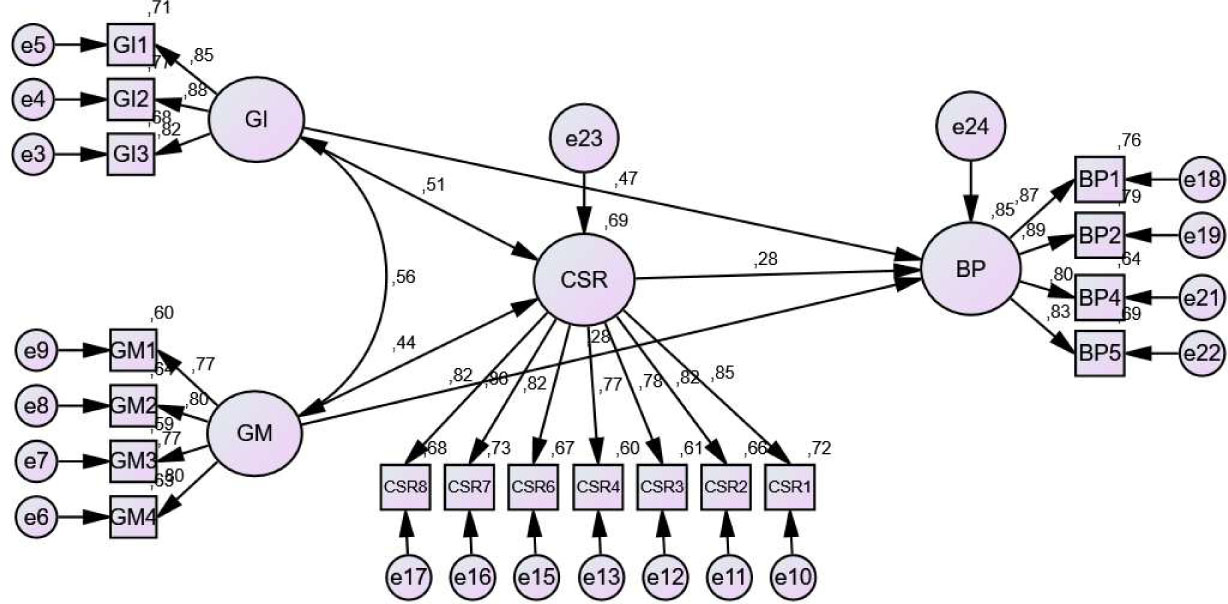
Figure 1:
Final structural model
Figure 1 presents the final structural model estimated using CB-SEM. The model positions GI and GM as sustainability-oriented antecedents, CSR as the organizational mechanism, and BP as the outcome construct. The figure shows direct paths from GI and GM to CSR and BP, together with the CSR-to-BP pathway. It also visualizes the retained measurement indicators and their standardized loadings.
The structural relationships were evaluated using standardized regression coefficients, critical ratios (C.R.), and p-values generated by IBM SPSS Amos. A relationship was considered statistically significant when the C.R. exceeded ±1.96 and p < 0.05. The direct-effect hypothesis test results are presented in Table 3.5.
Table 3:
Structural relationships and hypothesis testing
| Hypothesis | Structural relationship | Standardized β | C.R. | p-value | Decision |
|---|---|---|---|---|---|
| H1 | Green investment → Corporate social responsibility | 0.505 | 10.587 | <0.001 | Supported |
| H2 | Green investment → Business performance | 0.473 | 10.587 | <0.001 | Supported |
| H3 | Green marketing → Corporate social responsibility | 0.437 | 6.423 | <0.001 | Supported |
| H4 | Green marketing → Business performance | 0.281 | 4.330 | <0.001 | Supported |
| H5 | Corporate social responsibility → Business performance | 0.283 | 3.702 | <0.001 | Supported |
The structural model indicates that all five hypothesized direct relationships are positive and statistically significant. Green Investment has a significant positive effect on Corporate Social Responsibility (β = 0.505, C.R. = 10.587, p < 0.001), supporting H1. Green Investment also significantly affects Business Performance (β = 0.473, C.R. = 10.587, p < 0.001), supporting H2. Green Marketing significantly influences Corporate Social Responsibility (β = 0.437, C.R. = 6.423, p < 0.001) and Business Performance (β = 0.281, C.R. = 4.330, p < 0.001), supporting H3 and H4, respectively. Finally, Corporate Social Responsibility has a significant positive effect on Business Performance (β = 0.283, C.R. = 3.702, p < 0.001), supporting H5. Overall, the results indicate that environmental investment, green-oriented marketing, and CSR are positively associated with organizational performance in the construction context.
3.6. Mediation Analysis
The mediating role of CSR was assessed through standardized indirect effects generated by the CB-SEM model. The analysis examined whether GI and GM influence BP indirectly through CSR. The results are presented in Table 6.
Table 6:
Indirect effects of corporate social responsibility
| Hypothesis | Indirect relationship | Standardized indirect effect | p-value | Decision |
|---|---|---|---|---|
| H6 | Green investment → CSR → Business performance | 0.143 | 0.001 | Supported |
| H7 | Green marketing → CSR → Business performance | 0.123 | 0.002 | Supported |
CSR significantly mediates both sustainability-performance relationships. The indirect effect of GI on BP through CSR was significant (βindirect = 0.143, p = 0.001), supporting H6. Similarly, GM had a significant indirect effect on BP through CSR (βindirect = 0.123, p = 0.002), supporting H7. These results indicate that CSR represents an organizational pathway through which environmental investment and green-oriented marketing practices can be translated into business performance.
4. Discussions
4.1. Green Investment and Sustainable Construction Performance
The findings demonstrate that Green Investment has a significant positive effect on both Corporate Social Responsibility (CSR) and Business Performance. The relationship between Green Investment and CSR is particularly strong (β = 0.505, p < 0.001), while its direct effect on Business Performance is also substantial (β = 0.473, p < 0.001). These results indicate that environmental investment should not be regarded solely as an additional cost associated with regulatory compliance. In the construction context, investment in environmentally responsible technologies, resource-efficient equipment, cleaner production processes, and improved environmental management can become an organizational capability that supports both responsible construction practices and operational performance.
This finding is consistent with the broader development of sustainable construction, where environmental and economic objectives increasingly need to be addressed simultaneously rather than treated as competing priorities. Recent research on green construction practices indicates that sustainability-oriented approaches can enhance economic performance by improving environmental and social outcomes. The present findings extend this perspective by showing that Green Investment is directly associated with Business Performance and strengthens CSR. Thus, the contribution of environmental investment in construction is not limited to reducing environmental impacts but also involves creating organizational capacity to manage sustainability-related requirements.
From a civil and environmental engineering perspective, this result is important because construction activities require substantial material, energy, and technological resources. Green Investment can therefore be interpreted as an enabling mechanism to improve resource efficiency and integrate environmental considerations into construction operations. Investments in cleaner technologies, energy-efficient equipment, waste-reduction systems, and environmentally preferable processes may enhance construction firms' ability to meet environmental requirements while maintaining operational effectiveness. The result also supports the view that sustainability in construction needs to be embedded in organizational and project-management decisions rather than implemented as an isolated environmental program.
4.2. Green Marketing as a Supporting Mechanism for Construction Sustainability
Green Marketing has a significant positive effect on CSR (β = 0.437, p < 0.001) and Business Performance (β = 0.281, p < 0.001). Although Green Marketing has a smaller direct coefficient than Green Investment, its significance indicates that sustainability-oriented communication and market positioning remain relevant to construction organizations. This relationship should be interpreted carefully within the CEE context. Green Marketing is not primarily important for promotional activity itself, but for how construction firms communicate and institutionalize their environmental commitments to clients, project stakeholders, regulators, and other external parties.
Construction projects involve complex stakeholder relationships and increasingly require firms to demonstrate environmental and social responsibility. Recent construction research emphasizes the importance of stakeholder expectations and CSR in achieving sustainable project outcomes. For example, research on construction mega-projects found that stakeholder pressure can strengthen CSR and sustainable project performance, with CSR functioning as an important mechanism in this relationship. Therefore, the positive relationship observed in the present study suggests that communicating environmental commitments can reinforce organizational responsibility when such communication is supported by substantive sustainability practices.
The positive effect of Green Marketing on Business Performance further indicates that sustainability-related market positioning may generate organizational benefits. However, this finding should not be interpreted as evidence that communication alone improves construction performance. Rather, the result suggests that environmental orientation becomes more valuable when it is connected to actual organizational practices. For construction companies, credible communication regarding environmentally responsible construction methods, resource efficiency, and sustainability commitments may strengthen relationships with clients and other stakeholders. This interpretation is consistent with evidence that CSR practices in construction can generate benefits related to business opportunities, corporate image, reputation, and supply-chain risk reduction.
4.3. Corporate Social Responsibility as a Mechanism for Construction Performance
The significant positive relationship between CSR and BP (β = 0.283, p < 0.001) indicates that responsible organizational practices are associated with improved business performance. In construction, CSR extends beyond philanthropy and includes safety, environmental management, stakeholder relationships, employee practices, construction quality, and responsible resource use.
Mao et al. (2025), based on a review of 77 construction-sector studies, identify environmental sustainability, corporate practices, employee well-being, customer satisfaction, and corporate reputation among important CSR and performance dimensions. Dang et al. (2024) also report a positive relationship between CSR and financial performance in international engineering contracting enterprises. These studies support the interpretation that CSR can be connected to organizational outcomes while also highlighting that CSR in construction is multidimensional.
The present finding therefore positions CSR as a bridge between sustainability commitments and organizational implementation. For construction management, this means that environmental objectives should be incorporated into operating procedures, safety management, procurement, stakeholder engagement, employee practices, and resource-use decisions. For engineering practice, CSR can provide the governance structure needed to translate technical sustainability measures into consistent project-level routines.
4.4. The Mediating Role of CSR in Sustainable Construction
The mediation results indicate that CSR significantly mediates the relationships of GI and GM with BP: GI → CSR → BP (βindirect = 0.143, p = 0.001) and GM → CSR → BP (βindirect = 0.123, p = 0.002). These findings add a mechanism-based explanation to the direct relationships by showing that part of the association between sustainability-oriented strategies and performance operates through organizational responsibility.
The GI–CSR–BP pathway suggests that environmental investment provides resources and technological capacity, whereas CSR provides an organizational mechanism for integrating those resources into responsible practices. This interpretation is consistent with construction-sector evidence emphasizing the connection between CSR practices and organizational benefits (Zhang et al., 2022; Mao et al., 2025). The implication is not that investment automatically produces performance, but that its organizational value is strengthened when sustainability resources are embedded in governance and operational processes.
The GM–CSR–BP pathway provides a complementary explanation. GM can increase sustainability visibility and stakeholder communication, while CSR can institutionalize the underlying commitments through policies, project practices, monitoring, and stakeholder engagement. In this sense, CSR can help connect external sustainability communication with internal implementation. This is relevant in construction because clients and other stakeholders can increasingly assess whether environmental claims are supported by observable project practices.
4.5. Integrated Implications for Sustainable Construction Management
Taken together, the results support an integrated sustainability pathway in which Green Investment and Green Marketing function as sustainability-oriented drivers, CSR functions as an organizational mechanism, and Business Performance represents the organizational outcome. The model is therefore relevant to construction management because it demonstrates that sustainability should be approached as an interconnected system rather than as a collection of separate initiatives.
The strongest direct relationship in the model is between Green Investment and CSR (β = 0.505), followed by the relationship between Green Investment and Business Performance (β = 0.473). This indicates that investment-related decisions are particularly important in establishing sustainability capability within the construction organization. For construction managers, the implication is that sustainability budgets should prioritize initiatives that deliver measurable environmental and operational improvements, such as resource efficiency, cleaner technologies, waste minimization, and environmentally responsible construction processes.
At the same time, the significant CSR pathway demonstrates that technological or financial investment alone is insufficient. Sustainability investments need to be supported by organizational policies, stakeholder engagement, responsible project practices, and monitoring mechanisms. Recent research on sustainable construction similarly emphasizes the need to integrate environmental, economic, and social dimensions throughout construction activities rather than treating sustainability as a separate project objective.
Accordingly, the contribution of this study to the CEE literature lies in demonstrating an organizational sustainability mechanism within the construction sector: environmentally oriented investment and market orientation are more effectively translated into performance when embedded in CSR practices. This complements recent construction research that identifies CSR as an important component of sustainable construction
4.6. Limitations and Future Research
This study has several limitations. First, the cross-sectional design does not establish temporal or causal ordering beyond the tested statistical relationships. Second, purposive sampling and 212 valid responses limit generalizability beyond the sampled construction context. Third, self-reported organizational perceptions may not fully represent objective project-level environmental performance. Finally, Corporate Reputation was not included in the final model because no corresponding measurement items and structural results were retained in the analysed dataset.
Future research should test the framework across larger and more diverse construction samples and consider longitudinal or multi-source designs. Researchers should also integrate objective engineering indicators, including energy consumption, carbon emissions, material efficiency, construction waste, water use, and resource utilization, and may examine Corporate Reputation as an additional construct when valid measurement data are available.
5. Conclusion
This study examined the relationships among Green Investment, Green Marketing, Corporate Social Responsibility (CSR), and Business Performance in the construction context using Covariance-Based Structural Equation Modelling (CB-SEM). Based on data from 212 respondents, the findings demonstrate that sustainability-oriented practices are positively associated with organizational performance. Green Investment emerged as an important driver, showing significant positive effects on both CSR (β = 0.505, p < 0.001) and Business Performance (β = 0.473, p < 0.001). Green Marketing also had significant effects on CSR (β = 0.437, p < 0.001) and Business Performance (β = 0.281, p < 0.001), while CSR had a significant positive effect on Business Performance (β = 0.283, p < 0.001). These findings indicate that environmental investment, sustainability-oriented market practices, and responsible organizational practices can operate together to support construction-sector performance.
The mediation analysis further demonstrates that CSR serves as an important organizational mechanism by which sustainability initiatives translate into performance outcomes. CSR significantly mediated the relationship between Green Investment and Business Performance (indirect β = 0.143, p = 0.001) and between Green Marketing and Business Performance (indirect β = 0.123, p = 0.002). This finding suggests that the organizational benefits of sustainability initiatives are not generated solely through direct investment or market-oriented activities, but are strengthened when these initiatives are incorporated into broader corporate responsibility practices. In the construction context, sustainability therefore requires integration between environmental investment, organizational responsibility, and stakeholder-oriented practices.
From the perspective of civil and environmental engineering, the findings provide empirical support for an integrated approach to sustainable construction management. Green Investment can provide the resource and technological foundation for sustainability-oriented operations, while CSR can support the organizational implementation of these initiatives. The results imply that construction organizations seeking to improve long-term performance should integrate sustainability considerations into investment planning, construction management, resource utilization, stakeholder engagement, and organizational policies. However, the findings should be interpreted as evidence of relationships between organizational sustainability practices and Business Performance, rather than as a direct measure of physical environmental outcomes.
Overall, the study contributes to the sustainable construction literature by demonstrating an integrated pathway linking Green Investment and Green Marketing → CSR → Business Performance, while also confirming significant direct relationships among these constructs. The proposed framework offers a basis for assessing how sustainability-oriented organizational practices can be incorporated into construction management and may assist construction practitioners and policymakers in developing more systematic approaches to sustainable organizational performance. Future research should extend the model across multiple construction firms and geographic settings and incorporate objective environmental and project-level indicators, such as energy consumption, carbon emissions, material efficiency, construction waste, and resource utilization, to strengthen the engineering dimension of sustainability assessment.
Acknowledgements
This study was funded individually, without third-party funding.
Notes
[1] Author Contributions
Y.Z., U.S., and S.F.W. conceptualized the study, developed the research methodology, implemented the software, and conducted the analysis. Y.Z. carried out the analysis and validation process and prepared the original draft. Y.Z. collected data and contributed to review and editing. All authors critically reviewed and approved the final version of the manuscript and agreed to be accountable for all aspects of the work.