

1. Introduction
Temperature field and temperature stress are important fields in engineering science and physics research. Their variation and distribution are very important for understanding the phenomena of heat conduction, heat radiation and heat convection in matter. In the field of engineering, the temperature stress caused by the uneven temperature distribution inside the object may cause the deformation or cracking of materials and structures, which has an important impact on the performance and service life of materials and structures.
As a common roadbed material, the performance of cement-modified aeolian sand is significantly affected by temperature. Especially in cold areas, due to low temperature and large temperature difference between day and night, the temperature field of the high railway surface changes dramatically, and the roadbed materials are susceptible to the influence of temperature stress, resulting in cracks or swelling. In May 2024, cracks appeared in the section of Anci Expressway in Hunan Province due to temperature changes and settlement, which seriously affected the service life and safety of the high railway foundation. The requirement of high railway foundation is more strict than that of highway. How to reduce the temperature fatigue damage of high railway foundation improved by cement has become a difficult problem that hinders the development of high railway foundation in high cold area of our country.
From the direction of material and mechanical properties, Guo (2020) simulated the temperature field and temperature stress of mass concrete numerically, and proposed that the temperature stress and shrinkage stress generated under fixed constraint boundary conditions had inconsistent cooling rates at different depths. Liu (2023) and Ruan (2023) et al. conducted a systematic experimental study on the phenomenon of strength reduction, subsidence and other diseases of subgrade caused by freeze-thaw action at least once a year during exposure to the natural environment, and analyzed its feasibility and applicability as subgrade filler. In terms of freezing damage and temperature influence, Zhou (2018) mainly conducted an in-depth study on freezing damage mechanism of eolian sand embankment in high-cold areas, and put forward corresponding prevention and control countermeasures. Zhang (2024), Zhao (2023) and others have conducted an in-depth study on the influence of temperature on fracture propagation. Ling (2023) explored the distributed sensing characteristics of soil temperature field and humidity field under the conditions of single-end freezing and double-end melting. Wang (2016) analyzed the influence of factors such as pavement width, wind speed, subgrade height and direction on the inter-annual variation characteristics of each surface temperature of permafrost subgrade. Min (2004) and Yang (2018) discussed the law of the freezing and melting process of the roadbed, and expounded the stability of the roadbed in the permafrost region. In terms of crack and damage research, Song (2023) and Wang (2023) conducted damage evolution through numerical simulation, and Zhu (2025) analyzed the generation, development and causes of cracks in asphalt pavement. Liu (2019) analyzed that the disease of waterproof sealing layer of roadbed between ballastless tracks of high-speed railway is caused by the failure of expansion joints caused by transverse penetration of expansion joints during construction, resulting in overarch and rupture of the closure layer, which affect traffic safety. At present, although there are a lot of theoretical analyses, there is still a lack of in-depth understanding of the temperature fatigue damage of cement modified aeolian sand high railway foundation, and the existing theoretical models may not be able to accurately describe the actual behavior of cement modified aeolian sand in high railway foundation.
By means of theoretical analysis, numerical simulation and experimental research, this study aims to deeply explore the temperature field distribution and temperature stress state of cement-improved Aeolus sand, reveal the complex and variable change law of temperature field of high railway foundation, evaluate the temperature fatigue life of cement improved Aeolus sand roadbed, identify the failure mechanism of temperature stress on high railway foundation structure, and propose corresponding improvement measures. It provides theoretical basis and technical support for effectively prolonging the service life of high railway foundation under temperature stress.
2. Construction of base temperature field theory of high railway
2.1. High railway base temperature field theory
The railway pavement structure is exposed to the natural environment. Due to the change of environmental meteorological parameters such as solar radiation and external temperature, the heat transfer between the external environment and the pavement structure continues. In classical heat transfer, there are three ways of heat transfer: heat conduction, convection, and heat radiation. Before the temperature is not balanced, heat flows inside the object, and at some time t, the temperature of all points of the object is called the temperature field.
The concrete improved eolian sand subgrade is divided into countless small units by calculus. When the new subgrade is subjected to temperature change and temperature stress is generated, each individual unit will be affected by heat flux. Then, the solution to the temperature stress problem of cement modified aeolian sand can be simplified as solving the transient thermal conductivity equation under the boundary conditions set in advance, and the transient temperature field of the improved soil block can be obtained (Hou, 2002; Liu, 2020; Liu, 2018; Li, 2024). The temperature field calculation element block as shown in the figure can be expressed as dx, dy and dz, then the net heat absorbed by the element block in the X-axis direction is the difference of heat absorbed by the two opposite sides of the element block in the X-axis direction, as shown in Figure 1:
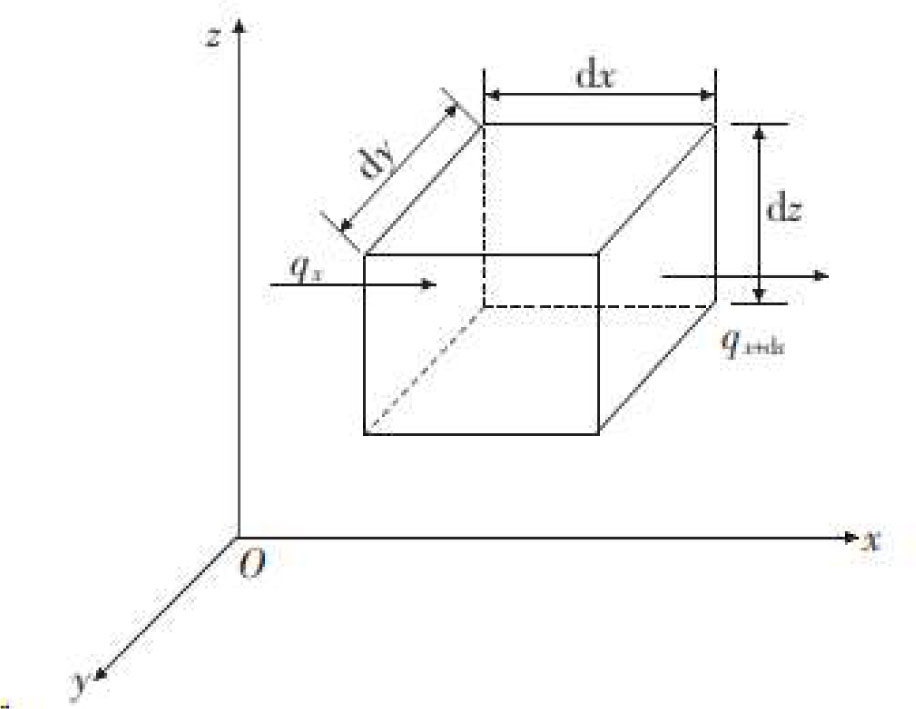
Figure 1:
Heat flow diagram
The amount of heat q per unit area in the heat transfer process changes with the value of (temperature gradient), and the conduction direction is opposite to the direction of .
The same can be obtained Qy, Qz
Then the total heat:
The improved soil releases heat during solidification:
Absorb heat in the process:
theIt can be obtained by two formulas:
Using the three-dimensional finite difference model, the boundary conditions can be simplified as
Adiabatic boundary condition:
The third kind of boundary conditions:
The fourth kind of boundary conditions:
When the boundary conditions are met, numerical simulation of the temperature field of the roadbed will be carried out below in order to further clarify the influence of the boundary conditions on the temperature field of the roadbed.
2.2. Stress field and temperature fatigue theory
The temperature stress of the cement-improved eolus sand roadbed is closely related to its temperature field change. According to the literature (Li, 2021; Jiang, 2013; Xie, 2021; Ye, 2015), the temperature stress calculation formula adopts the following formula:
Where:
σ - Material temperature stress, [MPa],
α - Coefficient of thermal expansion, 1/°C,
ΔT - Material temperature difference, °C,
E - Elastic modulus of material, [MPa].
The temperature fatigue formula adopts the following formula:
Where:
N - The number of times when temperature stress causes pavement failure,
λ - Temperature stress level.
The damage to the road surface generated by the same temperature cycle n (n is 30 days) in each month is:
According to the cumulative damage principle, the temperature stress damage caused in one year is:
When the cumulative damage reaches 1, the pavement fatigue failure occurs, and the temperature fatigue life of the roadbed can be calculated as follows:
2.3. Improved elastoplastic deformation characteristics of soil
The stress-strain curve of improved soil under tension is shown in Chyba! Neznámy argument prepínača.. Because the modified soil is a multiphase composite material (sand, silt, free water, bubbles, etc.), it is not a completely elastic body but an elastoplastic body. When it is stressed, it will not only produce elastic deformation that can be recovered (Sabah & Ali Nasir 2019.), but also plastic deformation that cannot be recovered. Therefore, its stress-strain curve is not a straight line but a curve Chyba! Neznámy argument prepínača..
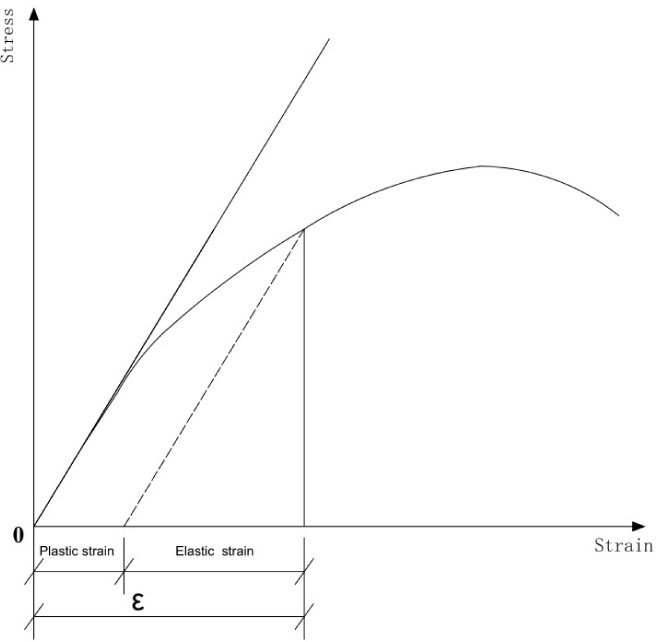
Figure 2:
Stress-strain curve during tension
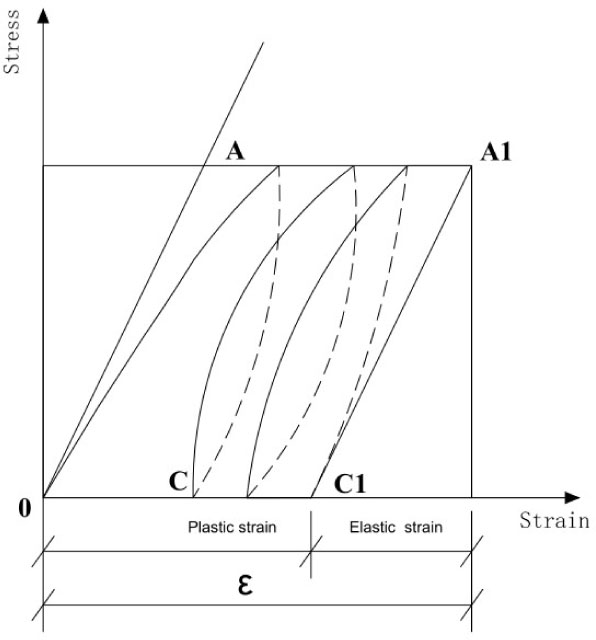
Figure 3:
Stress-strain curve under repeated loads
The stress-strain curve of the improved soil under repeated loads is shown in the figure, which varies with the magnitude of the applied force. Some plastic deformation remains in each unloading, and the increment of plastic deformation gradually decreases with the increase of the number of repetitions. Finally, the curve stabilizes at A1C1, which is parallel to the initial tangent line. However, if the applied force is too large, the plastic deformation will gradually increase with the increase of the number of repetitions, which will eventually lead to fatigue failure of the improved soil.
3. Project overview
The new Baotou to Yinchuan high-speed railway main line Baotou (including) to Huinong South (excluding) section is located in Inner Mongolia and Ningxia Hui Autonomous Region. The line starts from Baotou Station in the east, and runs west along the new double line Baotou and Lanzhou Railway, passing through Baotou City, Bayannur City, Ordos City, Wuhai City and Huinong District of Shizuishan, Inner Mongolia Autonomous Region Figure 4.
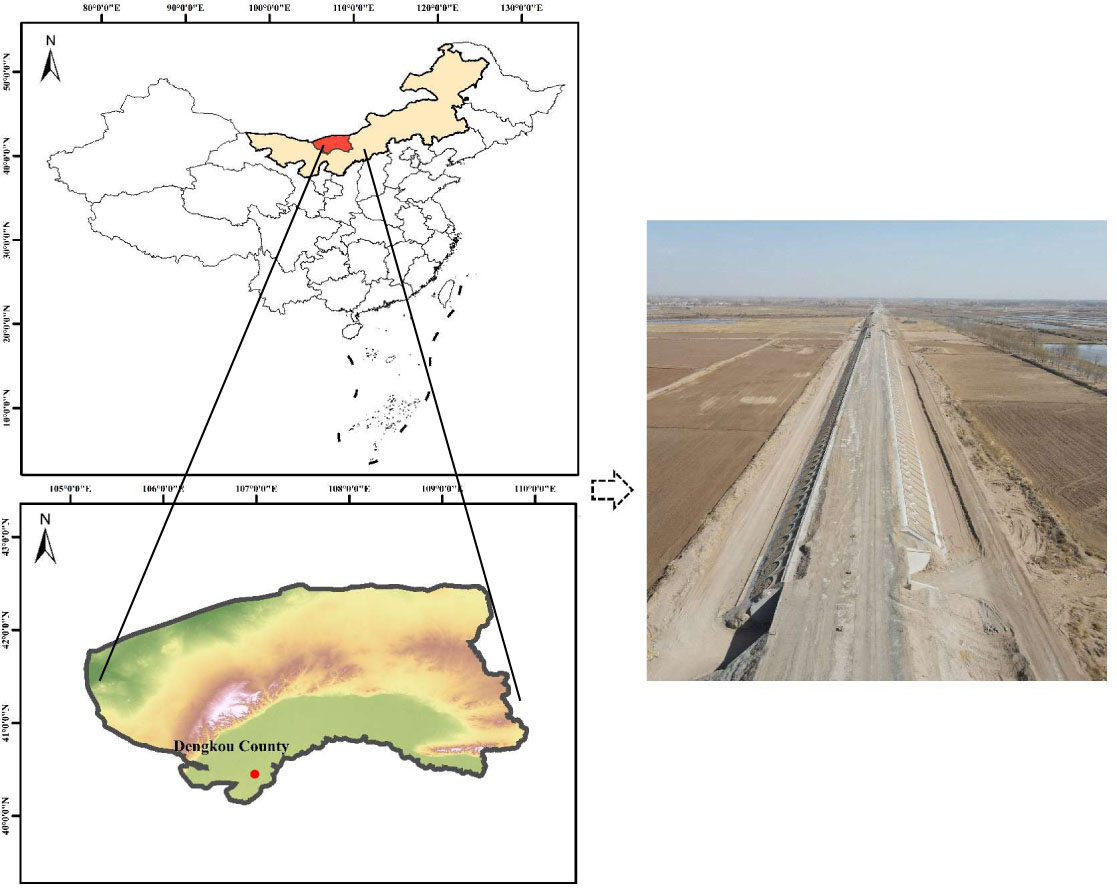
Figure 4:
Geographical position
The project corridor lies within a temperate sub-arid to semi-arid climate zone, characterized by dry conditions, distinct seasonal variations, and significant diurnal temperature ranges. Precipitation is scarce, averaging 140.2–305.4 mm annually, and is highly concentrated in July through September, primarily as showers. Annual evaporation (945.9–2731.8 mm) significantly exceeds rainfall. The annual mean temperature ranges from 7.4°C to 14.9°C, with extremes between −30.5°C and 41°C. The freezing period extends from late October to late April, with maximum soil freezing depths of 144 cm in the Linhe area and 127 cm in the Settle area. Wind speeds average 1.6–3.1 m/s, with instantaneous maximums of 13.1–22.0 m/s. Prevailing winds from the WN, WNW, and NW directions peak during spring (March–May), resulting in severe sandstorms. Adverse weather events primarily include frost, hail, and strong winds..
To mitigate cracking, rain infiltration, and foundation bed softening, a plastic sealing material (preliminarily set at 2% of cement mass, subject to field testing) is incorporated within the upper 0.6 m of the improved soil. Designed for a 250 km/h double-track ballast railway, the embankment foundation bed features a 0.7 m graded gravel surface layer and a 2.3 m bottom layer. The bottom layer consists of non-frost-heaving gravel or sand (1.1 m thick in specific sections, 0.8 m elsewhere) overlying cement-modified soil. Additionally, seepage fill is utilized below the flood protection elevation, with surface saline soil excavated and replaced beneath the treatment cushion. These measures address the complex thermal and structural demands of the subgrade Chyba! Nenašiel sa žiaden zdroj odkazov..
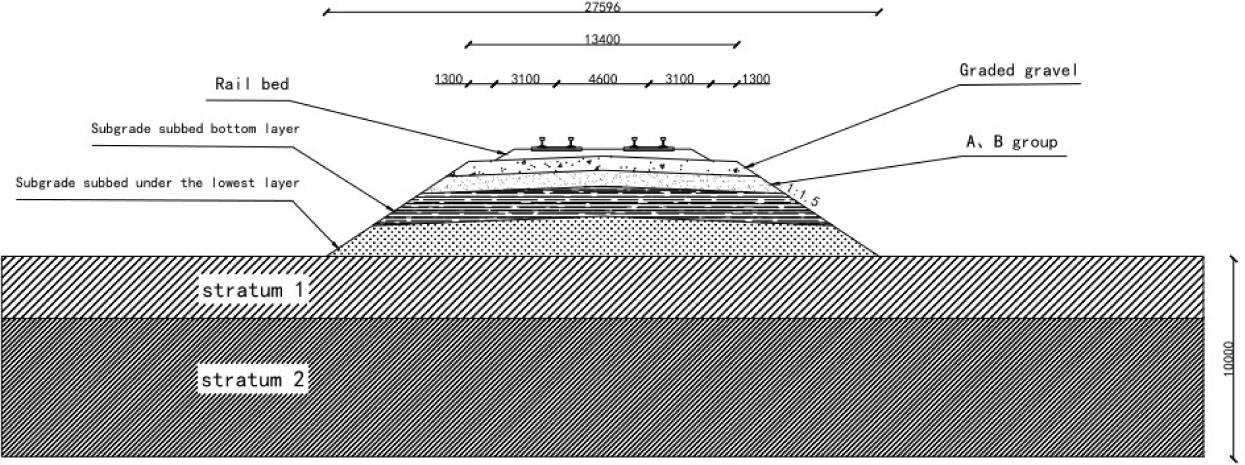
Figure 5:
Schematic diagram of subgrade filling in improved soil
4. Numerical simulation of heat-force coupling of subgrade
4.1. Model building
A hexahedral 8-node SOLDD70 isoparametric solid element suitable for the analysis of temperature field and temperature stress field of improved soil was selected for structural thermal analysis. The temperature stress field is analyzed with the equivalent stress field analysis unit (SOLID45) by using the temperature field unit (SOLID70). The coupling finite element calculation model of temperature field and stress field is a finite element model established by mapping division. The temperature load is analyzed in this calculation (Yan, 2016; Wang, 2017). The parameters affected mainly include the initial temperature of the model, the temperature of the external environment, the heat generation rate of the improved soil, and the heat dissipation coefficient of the model, etc. As transverse cracks on the surface of the subgrade can be observed in actual engineering, they mainly occur in the subgrade subgrade stratum and below the subgrade layer during construction, in order to analyze the influence of temperature stress on transverse cracks of the subgrade more directly, as shown in Chyba! Neznámy argument prepínača.. The simulation adopts the example of the bottom layer of the foundation bed and below for modeling. The finite element model established by the example in this chapter is as follows Chyba! Neznámy argument prepínača..
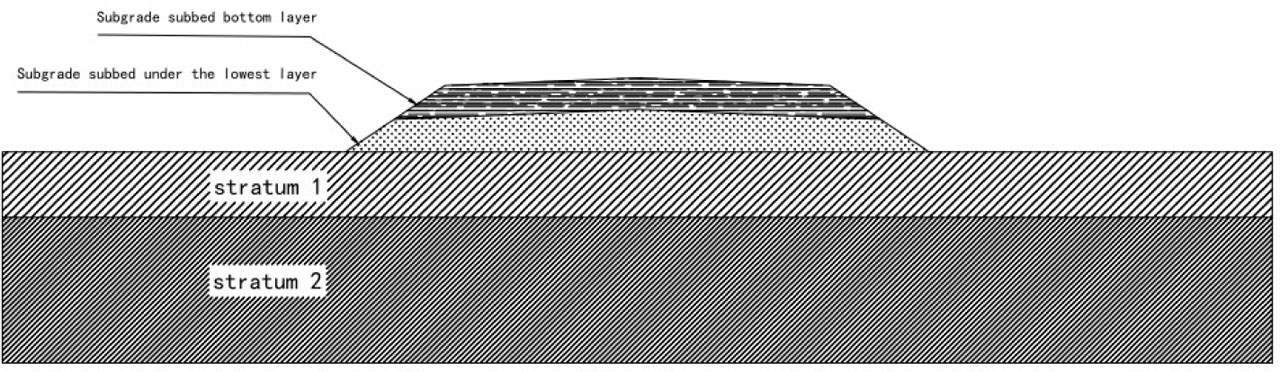
Figure 6:
Schematic diagram of subgrade section
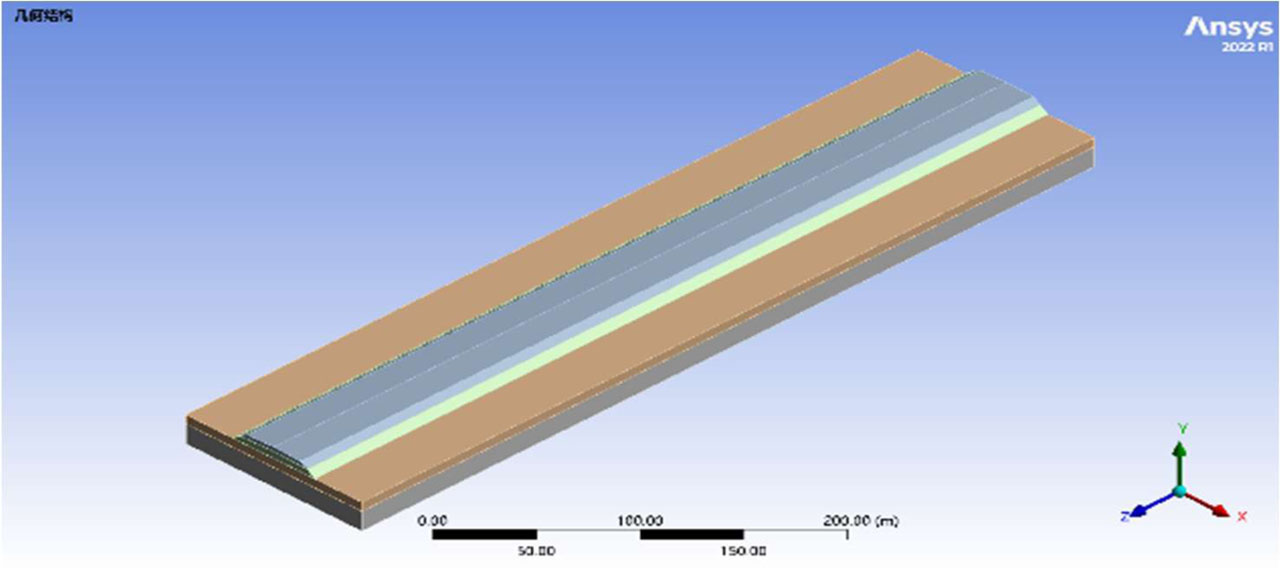
Figure 7:
Example finite element calculation model
As for the analysis and change of temperature field and temperature stress field of improved soil, current studies mostly focus on the external constraints of roadbed structure, and relatively few studies on the influence of external temperature. This simulation analysis focuses on the change of temperature field and temperature stress field of improved soil under the change of temperature Chyba! Neznámy argument prepínača..
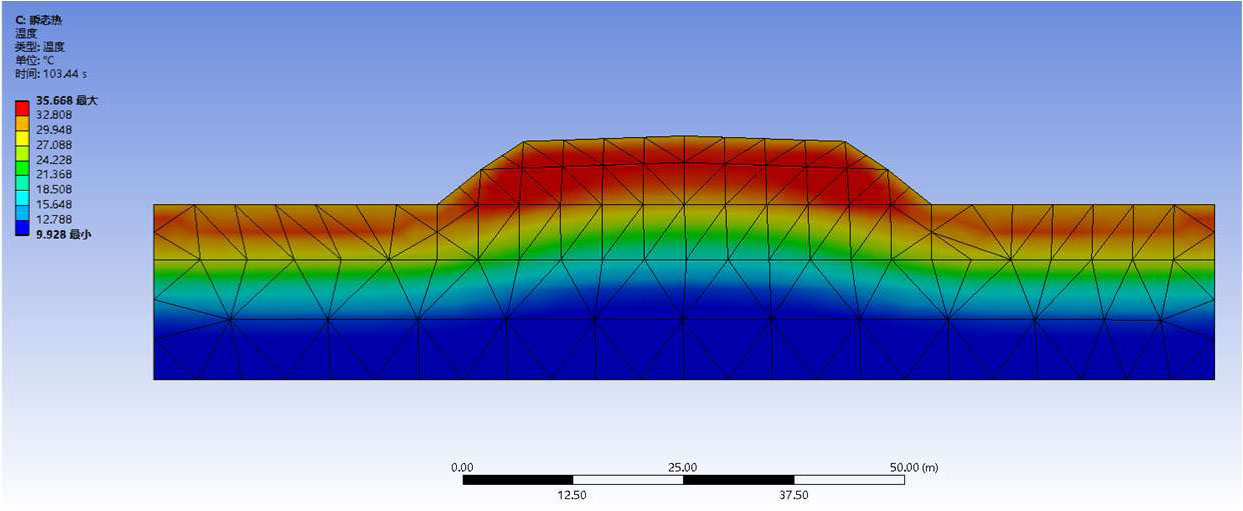
Figure 8:
Cross-section of temperature field
Due to the obvious stress concentration and overall deformation phenomenon found in the simulation process, according to the field construction experience, Solid plans to preset a 10mm wide expansion joint every 50m in order to achieve the effect of dispersed temperature stress Chyba! Neznámy argument prepínača.-Chyba! Neznámy argument prepínača..
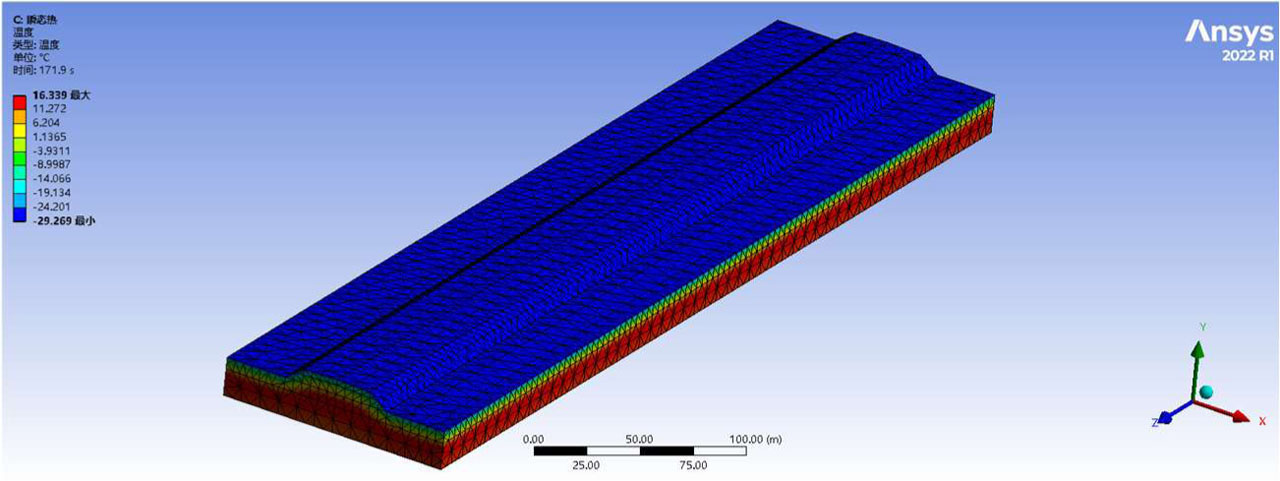
Figure 9:
Temperature field simulation diagram
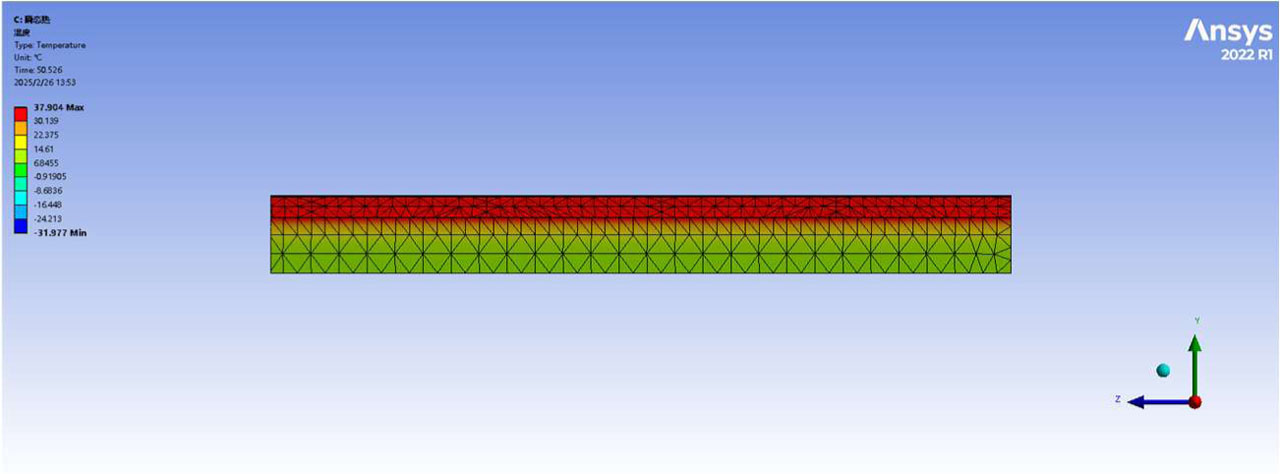
Figure 10:
Profile of temperature field
4.2. Calculation parameter selection
4.2.1. Thermal parameter
According to the experimental report of the construction side, combined with the local geological and meteorological data, the final thermodynamic parameters of the roadbed structure are determined as follows, and the thermal parameters determined by the experiment are as follows Chyba! Neznámy argument prepínača.-Table 2::
Table 1:
Thermal parameters of soil improved by aeolian sand
| Subgrade formation | Thermal conductivity [W/m.°C] | Specific Heat Capacity [J/kg.°C] | Density [kg/m3] | Modulus of elasticity [MPa] | Poisson's ratio | Coefficient of thermal expansion [1/°C] |
|---|---|---|---|---|---|---|
| Foundation bed | 0.9258 | 744.3 | 1.92 | 100 | 0.3 | 1e-05 |
| Subbed | 1 | 744.3 | 1.92 | 40 | 0.35 | 1e-05 |
4.2.2. Meteorological temperature and parameters
Take the temperature change from 2015 to 2024 Chyba! Neznámy argument prepínača.-0.
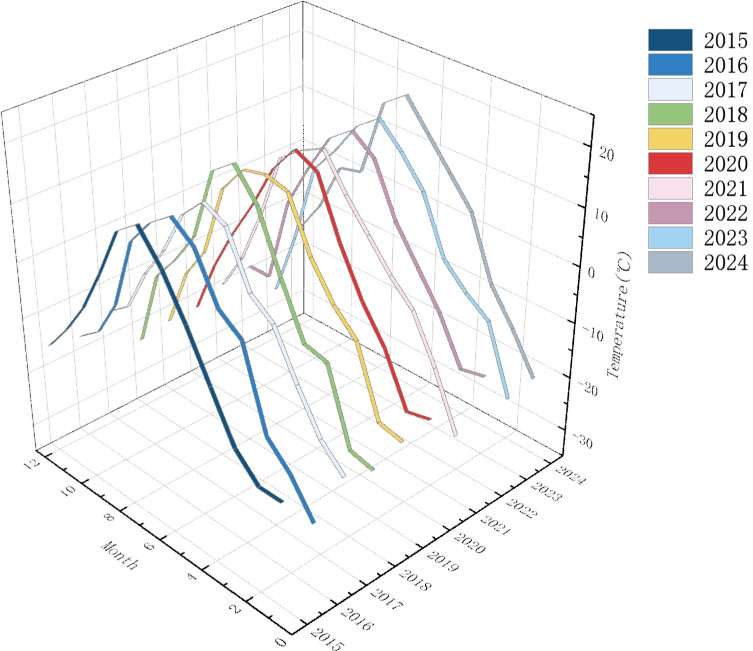
Figure 11:
Minimum monthly temperatures from 2015 to 2024
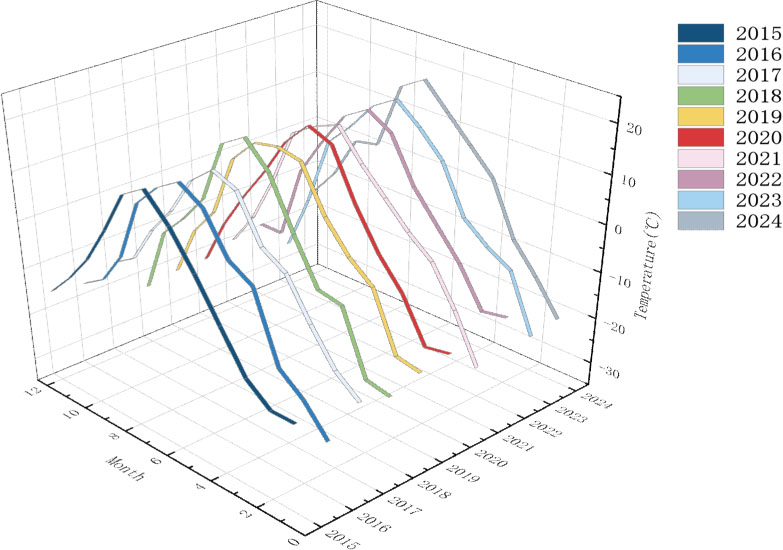
Figure 12:
Maximum monthly temperatures from 2015 to 2024
Considering that the construction area is a cold area and the construction season is from summer to winter, the simulation analysis determined that the surface temperature of the roadbed is 10°C by using local meteorological data, and the daily temperature change function obtained by fitting the temperature function curve is:
T0 is 11°C, and A is the one-day temperature change value, which is obtained by 18°C:
According to Table 3 and the daily temperature change function (16) 0,
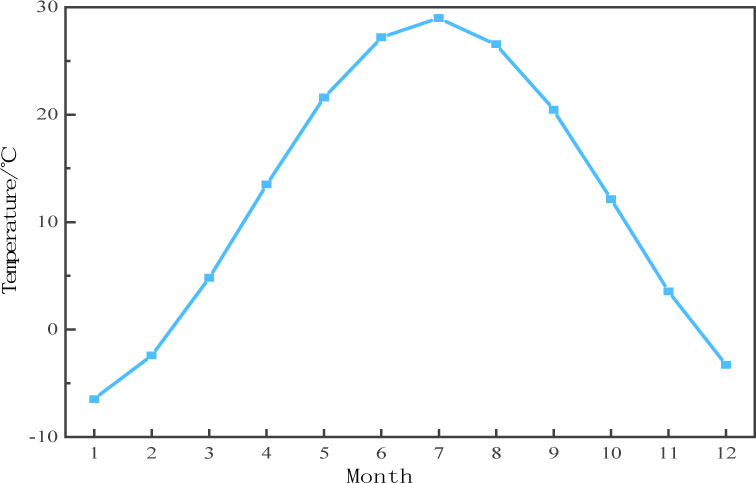
Figure 13:
Function image of monthly temperature change throughout the year
As can be seen from Chyba! Neznámy argument prepínača. ,the local surface temperature reaches the highest from July to August, and the lowest from December to January of the following year. The maximum temperature and the minimum temperature period as the temperature changes over time are consistent in the figure, and it can be seen that the temperature change has a certain functional law.
4.3. Model calculation
4.3.1. Analysis of temperature field change
According to (15), before calculating the temperature stress of the cement improved eolian sand roadbed, it is necessary to obtain the coefficient of thermal expansion, temperature difference of road temperature and elastic modulus of eolian sand mixture, and the latter two are related to the temperature field of the improved soil pavement. (Run, 2024; Deng, 2023) Therefore, the annual climate data of Dengkou County in 2023 will be selected in this paper to simulate the temperature field of railway roadbed.
Taking 2023 as an example, the annual temperature of different buried depths is as follows Chyba! Neznámy argument prepínača.:
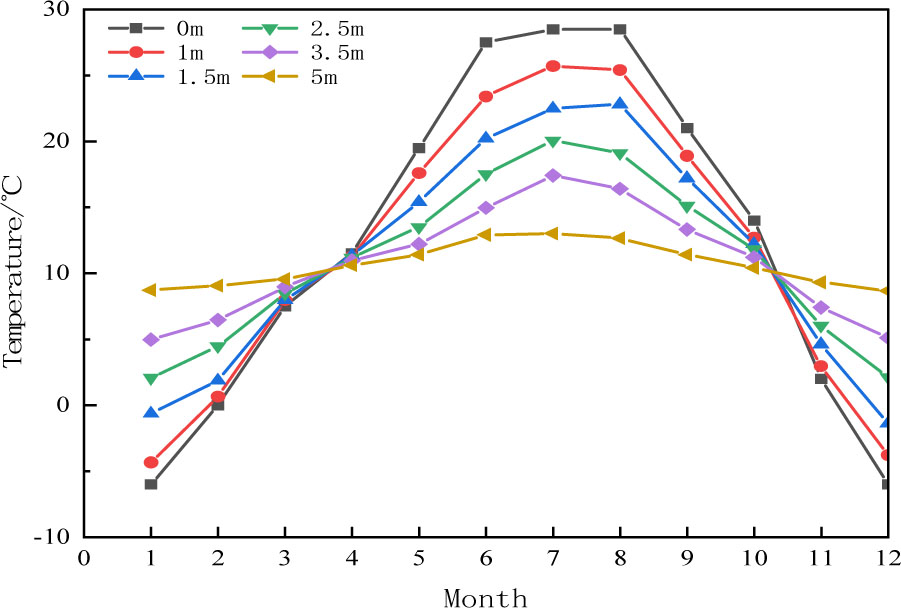
Figure 14:
Temperature of subgrade under different buried depths
Heat is transferred from the place with high temperature to the place with low temperature on the cement-improved aeolian sand pavement. Due to the periodic change of temperature, especially in the area with large temperature difference, the heat inside the pavement may not always be transferred from top to bottom. When the temperature changes from high to low in a day, the temperature of the upper layer may be lower than that of the middle and lower layers. At this time, the direction of heat transfer becomes bottom-up, and the temperature sensitivity of cement-improved aeolian sand is very strong, so its thickness may affect this temperature transfer mode. Therefore, it is necessary to analyze the difference in temperature distribution of the pavement with different buried depths to test whether the influence of different depths on the pavement temperature field is significant.
The monthly road temperature of Dengkou County in 2023 is shown in Table 3. Different temperature differences lead to different temperature stresses on the eolian sand roadbed at different times of the year. The annual temperature stresses are calculated according to the annual temperature changes and formula (15), and the temperature stresses at different buried depths are obtained Chyba! Nenašiel sa žiaden zdroj odkazov.:
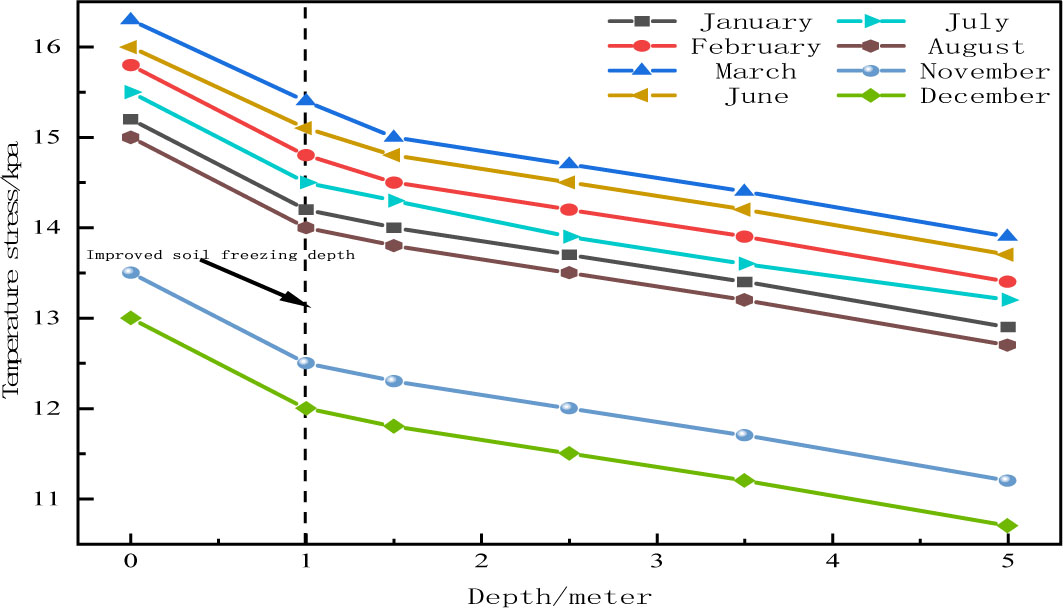
Figure 15:
Temperature stress at different burial depths
As can be seen from Chyba! Neznámy argument prepínača., the temperature stress changes with the diurnal temperature difference. The diurnal temperature difference of March in winter and June in summer is 15.7 degrees Celsius, and the temperature difference of June in summer is 15.6 degrees Celsius. The temperature difference of the above two months reaches the highest value of the whole year, and the temperature stress contained therein also reaches the peak, which is expected to cause the most obvious damage. The temperature of the buried depth hardly changes with the change of the average temperature. Figure 12. However, when the depth or temperature difference increases, the buried depth temperature changes, and has a certain relationship with the depth from the road surface and the temperature difference. It can be seen from the image that the temperature stress has an obvious inflection point when the buried depth is 1 meter. According to the analysis of the local climate environment, Dengkou County is a cold area with a freezing depth of about 1.2 meters. Before the buried depth is 1 meter, the temperature of the roadbed changes significantly with the temperature, and the heat flux and temperature stress are large; after the buried depth is 1 meter, the temperature of the roadbed changes little and the temperature stress gradient changes gradually. The results presented in the image also match the actual temperature difference.
The local temperature fatigue life is calculated using the temperature fatigue formula (16) ~ (19), n is 30 when calculating, and the results are shown in Chyba! Neznámy argument prepínača.:
Table 3:
Temperature stress fatigue parameters of road surface in recent ten years (without joint)
| Year | Mean monthly temperature difference [°C] | Monthly mean temperature stress levelλ [KPa] | Average monthly temperature fatigue times N2 | Fatigue life year |
|---|---|---|---|---|
| 2015 | 25.4 | 0.1632 | 92217.64 | 88.70 |
| 2016 | 27.3 | 0.1740 | 79627.56 | 77.75 |
| 2017 | 25.5 | 0.1719 | 93248.77 | 75.87 |
| 2018 | 26.3 | 0.1684 | 79467.30 | 82.44 |
| 2019 | 25.3 | 0.1641 | 86923.24 | 87.14 |
| 2020 | 26.0 | 0.1627 | 85305.66 | 89.32 |
| 2021 | 26.3 | 0.1705 | 60396.46 | 83.36 |
| 2022 | 25.7 | 0.1680 | 95897.05 | 83.37 |
| 2023 | 27.5 | 0.1715 | 59280.17 | 83.82 |
| 2024 | 25.3 | 0.1646 | 81027.25 | 88.61 |
| Average fatigue life/year | 84.04 |
Although the study site is located in a cold region with significant diurnal temperature variations, the calculated temperature fatigue life of the local cement-improved aeolian sand pavement is only 84.04 years. This falls short of the 100-year design service life for high-speed railway subgrade main engineering as required by the Design Code for High-speed Railway (TB 10621-2014). Consequently, numerical simulation was employed to optimize the subgrade design.
Ansys simulations of the temperature field in January and July reveal a trapezoidal distribution, with isotherms positioned higher at the subgrade center and decreasing toward the slopes. This pattern is most pronounced in January and July, when the centerline temperatures ranged from −12.2°C to 0°C and 22.1°C to 35.1°C, respectively. Compared to April and October, the minimum temperatures in January dropped by 17°C and 19°C, while the maximum temperatures in July rose by 17°C and 14°C, indicating significant seasonal thermal extremes at the subgrade base.
Further analysis of temperature variations at the subgrade centerline (surface, 1 m, 3.5 m, and 5 m depths) demonstrates that thermal fluctuations attenuate with depth. While shallow layers are highly sensitive to ambient air temperature, the influence of external climatic changes diminishes significantly as depth increases, becoming negligible below 5 m.
4.3.2. Analysis of stress field change
As can be seen from the figure, the temperature difference between day and night is large in the local temperature variation, and the temperature stress generated by it is mostly concentrated in the surface of the roadbed. After superimposed on the overall pavement, the weak part of the roadbed will eventually be fractured (Fan, 2021; Liu, 2013), resulting in the destruction of the eolian sand roadbed. Considering the premise of meeting the requirements of engineering construction, the expansion joint is preset at the interval of each pavement section to achieve the purpose of distributing the overall stress and deformation of the subgrade to both sides of each expansion joint.
The total deformation and equivalent elastic deformation of subgrade caused by temperature stress without and after expansion joints are simulated by Ansys are as follows Chyba! Nenašiel sa žiaden zdroj odkazov.-Chyba! Nenašiel sa žiaden zdroj odkazov.:
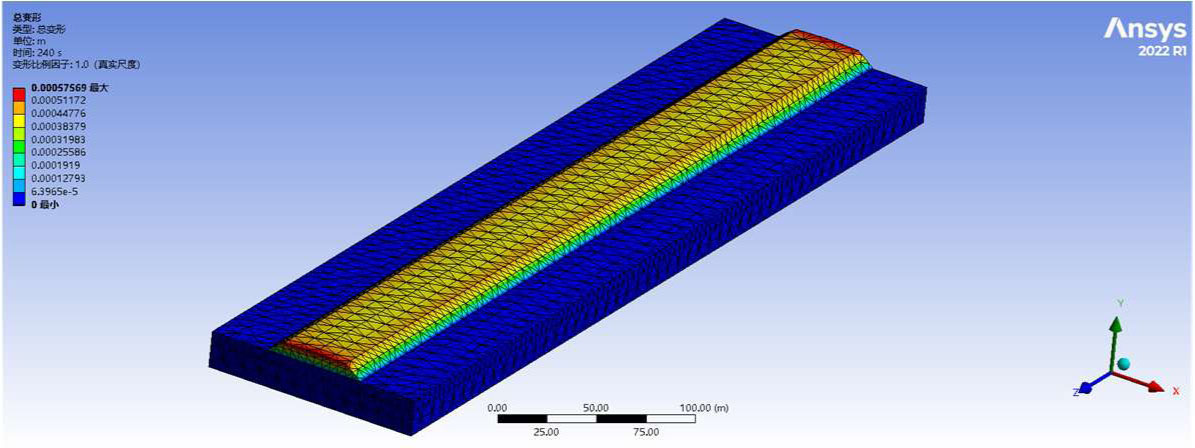
Figure 16:
Total simulated deformation of subgrade (seamless)
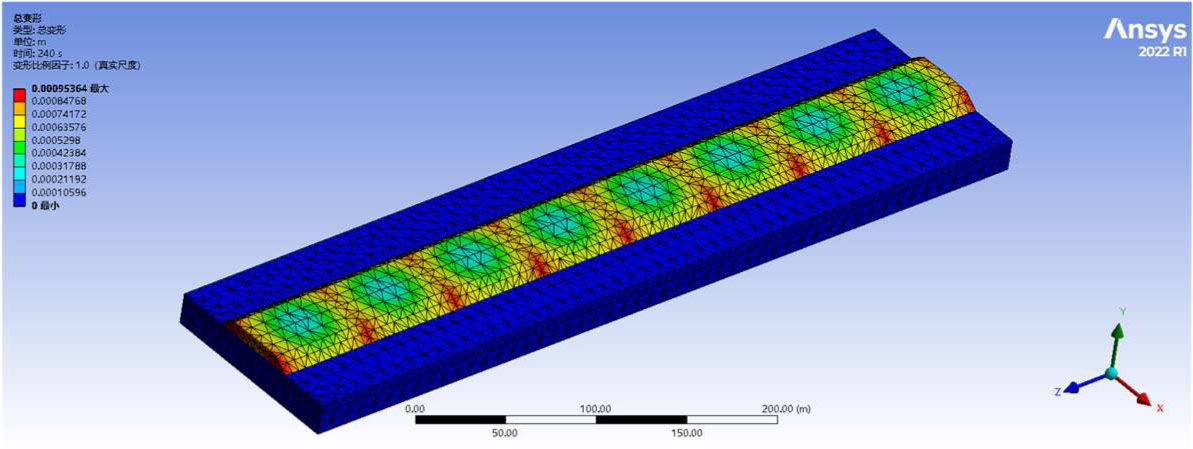
Figure 17:
Total simulated deformation of subgrade (with cracks)
As can be seen from Chyba! Nenašiel sa žiaden zdroj odkazov.-Chyba! Nenašiel sa žiaden zdroj odkazov., before the expansion joint is added, the overall deformation of the subgrade is concentrated on both sides of the model, and the equivalent stress and equivalent deformation are the maximum values at both ends. If the stress is concentrated, damage will occur in the weak part of the subgrade, which will seriously affect the service life of the ewind sand subgrade and endanger the operation safety of the high-speed railway. After the expansion joint is added in the simulation, the maximum temperature stress of the roadbed decreases significantly, the temperature stress is dispersed to both sides of each expansion joint, the peak value of the overall shape variable of the roadbed decreases, and the damage effect to the roadbed is significantly reduced. Therefore, it is concluded that on the basis of meeting the design requirements and site construction conditions, Adding expansion joints at fixed intervals of roadbed can effectively reduce the damage effect of temperature stress on roadbed, thus achieving the effect of extending the temperature fatigue life of wind-deposited sand roadbed and extending the service life of railway.
According to the simulation situation, refer to Chyba! Neznámy argument prepínača. and use the temperature fatigue formula (16) ~ (19) to calculate the temperature fatigue life after increasing the expansion joint. n is set to 30 during calculation, and the results are shown in Chyba! Neznámy argument prepínača.:
Table 4:
Temperature stress fatigue parameters of road surface in recent ten years (joint)
| Year | Mean monthly temperature difference [°C] | Monthly mean temperature stress levelλ [KPa] | Average monthly temperature fatigue times N2 | Fatigue life year |
|---|---|---|---|---|
| 2015 | 25.4 | 0.1423 | 106925.42 | 118.99 |
| 2016 | 27.3 | 0.1513 | 91950.22 | 105.11 |
| 2017 | 25.5 | 0.1486 | 107796.98 | 104.44 |
| 2018 | 26.3 | 0.1464 | 92521.91 | 111.42 |
| 2019 | 25.3 | 0.1425 | 100987.50 | 117.88 |
| 2020 | 26.0 | 0.1420 | 99127.60 | 119.70 |
| 2021 | 26.3 | 0.1481 | 71613.75 | 113.27 |
| 2022 | 25.7 | 0.1459 | 110358.63 | 113.01 |
| 2023 | 27.5 | 0.1493 | 70225.44 | 113.06 |
| 2024 | 25.3 | 0.1428 | 94610.40 | 120.32 |
| Average fatigue life/year | 113.72 |
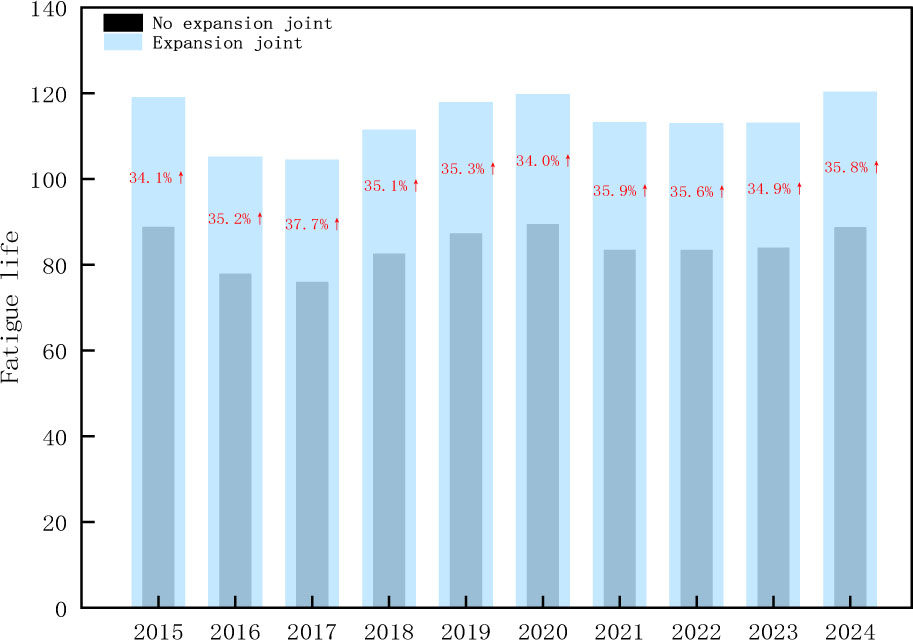
Figure 18:
Increase the extension of fatigue life of expansion joints
As can be seen from the calculation results in Chyba! Neznámy argument prepínača. the fatigue life of the roadbed is extended from 84.04 years to 113.72 years by presetting the expansion joint of the roadbed, and the increase in the life of the roadbed reaches 35.3%, the effect is significant, so it is considered to add the expansion joint in the construction.
Construction parameters of expansion joints, including transverse spacing and width, etc. Usually, the transverse spacing of the expansion joint should not be greater than 6m, and the width should be controlled at about 20mm to fill the expansion joint. According to the width of the expansion joint, select the appropriate filling material to fill the expansion joint. The filling material can be rubber strip, asphalt paste or other material modified soil pouring. If the initial setting time of the improved soil is greater than the time of the construction gap, the improved soil can be directly poured evenly into the expansion joint, and the vibration equipment can be used to vibrate the improved soil 50 ~ 100mm deeply to ensure a good combination between the old and new soil layers.
5. Analysis and discussion
The influence of temperature field and temperature stress on the performance of roadbed is deeply discussed in the research of temperature failure of high railway foundation with wind-deposited sand improved by cement. Through the analysis of relevant theories and numerical simulation experiments, the temperature field distribution, temperature stress state and temperature fatigue life estimation based on temperature fatigue times of cement improved high railway foundation with aeolian sand were obtained (Liu, 2002; Ma, 2017; Zhang, 2017;).
By solving the transient heat conduction equation, the transient temperature field of the improved soil block is simulated successfully. This method provides a powerful tool for understanding the distribution state of the temperature field of the roadbed. Scholar Luo Yao has studied the temperature stress of asphalt pavement, and this study extends it to cement to improve the eolian sand high railway foundation. The temperature stress under different buried depths is calculated by numerical simulation and field data, and its variation with the temperature difference between day and night and the depth from the road surface is analyzed. The results show that the temperature stress changes significantly with the change of diurnal temperature difference, and reaches its peak value in winter and summer. Figure. 18 In addition, the temperature stress gradually decreases with the increase of burial depth, and the change of temperature stress tends to be gentle when the burial depth exceeds a certain level. These findings provide theoretical basis for us to formulate effective improvement measures.
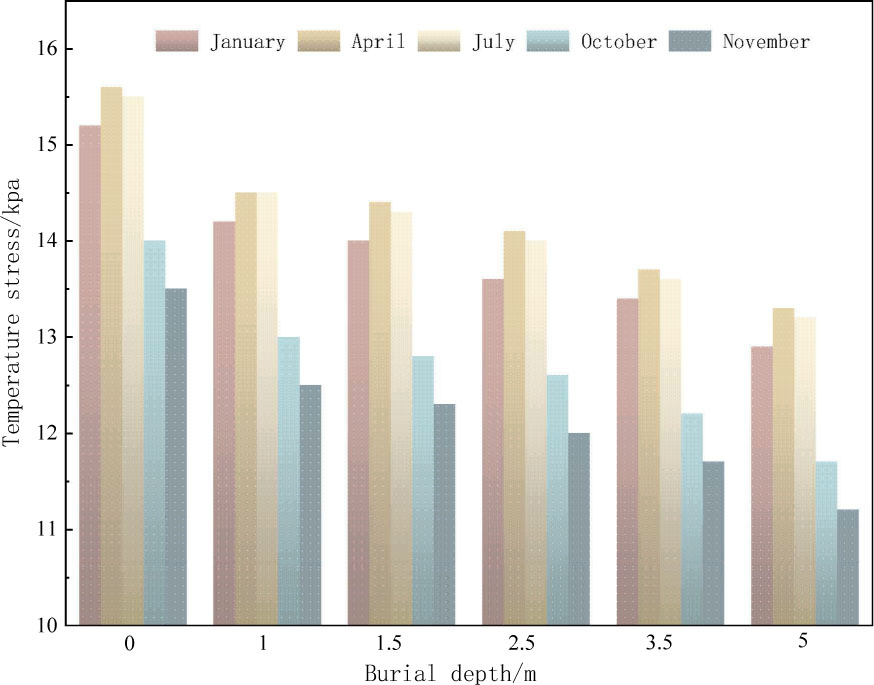
Figure 19:
Temperature stress under different temperature differences
In terms of improvement measures, the research verifies that the method of adding expansion joint in the fixed interval of subgrade is also applicable to the cement improvement of aeolian sand high railway foundation. According to the numerical simulation analysis, it is found that the maximum temperature stress of the roadbed is significantly reduced after the expansion joint is added, and the temperature stress is distributed to both sides of the expansion joint, which effectively reduces the damage effect of temperature stress on the roadbed. The research on temperature fatigue stress by Liu Yongchang effectively confirms this point. In addition, the temperature fatigue life after adding the expansion joint is calculated, and the results show that the fatigue life of the roadbed is significantly improved.
In the study of temperature failure of high railway foundation and asphalt pavement improved by cement, the addition of expansion joints, as an effective control measure, shows similar mechanism. In both the eolian sand roadbed and asphalt pavement, the addition of expansion joints can effectively alleviate the temperature stress caused by temperature change. By increasing the expansion joint, the overall stress and deformation can be distributed to both sides of each expansion joint, thereby reducing the stress concentration in a single location and reducing the risk of damage to the roadbed or pavement. The addition of expansion joints helps to extend the service life of both pavement structures. By dispersing the temperature stress, the crack and swelling caused by temperature fatigue are reduced, and the durability and stability of pavement structure are improved. This improvement measure not only extends the temperature fatigue life of the eolian sand roadbed, but also provides a useful reference for the continuous development and innovation of high-speed railway engineering.
There are significant differences in material characteristics between eolian sand subgrade and asphalt pavement. Eolian sand has the characteristics of loose particles, easy to be blown by the wind, and asphalt is a strong bonding material. Therefore, when adding expansion joints, it is necessary to consider the physical properties of different materials such as thermal expansion coefficient and elastic modulus to develop more reasonable expansion joint design parameters. Because of the different material characteristics, the temperature field distribution of eolian sand subgrade and asphalt pavement is also different. The temperature field of eolian sand subgrade is significantly affected by the ambient temperature, especially in the area with large temperature difference. On the other hand, the temperature field of asphalt pavement is relatively stable and is less affected by the external environment temperature. This difference leads to the difference in the size and distribution of temperature stresses that need to be considered when adding expansion joints. The disease forms of eolian sand subgrade and asphalt pavement are different under the action of temperature stress. Wind sand subgrade is more prone to crack, swelling and other diseases, while asphalt pavement may appear rutting, pushing and other diseases. Therefore, when adding expansion joints, it is necessary to formulate corresponding control measures for specific disease forms.
In the process of numerical simulation, simplified model and parameter Settings are adopted, which may lead to some deviation between the simulation results and the actual situation. The calculation of temperature fatigue life is fuzzy. The research mainly focuses on the influence of temperature field and temperature stress on roadbed performance, but does not consider the comprehensive influence of other factors such as humidity field and load on roadbed performance.
To sum up, the addition of expansion joints in wind-sand subgrade and asphalt pavement has similarities in relieving temperature stress, extending service life and construction requirements, but there are differences in material characteristics, temperature field distribution and disease forms. These differences provide an important reference for us to formulate more reasonable design parameters and control measures for expansion joints in practical engineering. In the future research, we can further explore the design optimization method of expansion joints under different pavement structures, so as to better adapt to the climatic conditions and pavement use requirements in different regions.
6. Conclusion
1) The temperature field of the roadbed is significantly affected by the external environment temperature, especially in the area of large temperature difference, the temperature changes dramatically, resulting in complex heat transfer modes inside the roadbed. With the increase of the depth of the roadbed, the influence of the temperature field on the external environment temperature gradually decreases. The closer the roadbed surface is, the greater the influence of air temperature on the measured temperature is. The spatial position of the isotherm in the center of the roadbed is higher, and the farther away from the middle line of the roadbed, the lower the spatial position of the isotherm.
2) The greater the temperature difference, the greater the temperature stress, and the more obvious the damage to the roadbed. The temperature stress mainly concentrates on the surface of the roadbed, and will eventually break in the weak part of the roadbed after superposition of the whole road surface, which will cause the destruction of the eolian sand roadbed. The temperature stress in the buried depth has an inflection point, which is generally near the freezing depth. After the inflection point, the temperature of the roadbed changes little, and the temperature stress gradient changes gradually.
3) The research site is located in the cold area, the temperature difference between day and night is generally large, and the temperature fatigue life of the local railway cement improved Aeolus sand pavement is 84.04 years, which fails to meet the requirement of 100 years design service life of the main engineering of high-speed railway roadbed. According to the numerical simulation, the improvement measure of adding expansion joint in the fixed interval of subgrade is put forward, which can effectively reduce the damage effect of temperature stress on subgrade and prolong the temperature fatigue life of eolian sand subgrade.
4) After expansion joints are added, the maximum temperature stress of the subgrade decreases significantly, the temperature stress is distributed to both sides of each expansion joint, and the peak value of the subgrade's overall shape variable decreases. The simulation results show that the temperature fatigue life of the roadbed after adding the expansion joint is significantly increased to 113.72 years, which can meet the requirements of the design service life of the main engineering of the high-speed railway roadbed.
In summary, the temperature field and temperature stress of high railway foundation are the key factors affecting the stability and durability of high-speed railway lines. Through the in-depth study of the temperature field of the high railway base, the complex and changeable law of its change is revealed, and it is found that many factors such as climatic conditions, geographical environment, roadbed material characteristics and train running conditions will have a significant impact on it. At the same time, the destruction mechanism of the roadbed structure caused by temperature stress, including deformation, damage and accelerated fatigue wear of materials, is defined. In order to ensure the safe operation of high-speed railway, we must attach great importance to the temperature field and temperature stress of high railway foundation, and take effective engineering measures and technical means to prevent and control. In the future, we will continue to deepen relevant research and explore more accurate and efficient solutions to promote the sustainable development and innovation of high-speed railway engineering.
Acknowledgments
The authors gratefully acknowledge the financial support from the Major project of China Railway Beijing Engineering Group Co., Ltd. (Grant No.2023A-Major project-005)
Notes
[1] Author Contributions
M.L., Y.W., Z.Q. conceived and designed the study. X.P., X.L., W.Y. conducted the experiments and collected the data. Y.G., P.J. contributed to data interpretation and manuscript drafting. All authors critically reviewed and approved the final version of the manuscript and agreed to be accountable for all aspects of the work.