

1. Introduction
In the current context of road expansion and urban development, improving unstable soils has become a critical priority to ensure safe and durable infrastructures. In particular, stabilizing subgrades with locally available materials has emerged as a sustainable alternative to costly industrial additives. This approach not only optimizes available resources but also enhances the technical efficiency of road works in areas with deficient soils. According to Basnet et al (2025), the incorporation of natural additives such as quarry dust and stone residues significantly increases the bearing capacity and compactability of clayey subgrades while effectively reducing their permeability, which is essential for controlling water infiltration and maintaining subgrade stability.
Geotechnical engineers commonly face the challenge of working with inadequate natural soils, especially in urban areas where expansion limits the availability of optimal land (Jafari et al, 2025). Among the various types of problematic soils, clayey soils stand out due to their high plasticity and tendency to expand and contract, which compromises the stability of the subgrade (Burga Vásquez, 2023). In fact, expansive soils present significant challenges in geotechnical engineering, primarily due to volume changes induced by moisture fluctuations (Boudehene et al, 2025). On the other hand, sandy soils, while presenting good drainage, have a granular structure with low cohesion and high porosity, limiting their mechanical performance (Piechowicz et al., 2024). In response to these limitations, geotechnical engineering has resorted to the incorporation of stabilizers such as ash (Ali & Atemimi, 2025), cement (Sorsa, 2022), or asphalt, which improve soil strength, durability, and compaction (Alarcón et al, 2020).
At the regional level, accessible alternatives using locally available materials have been promoted, representing an effective strategy not only technically but also economically and environmentally. The use of waste or unconventional inputs in geotechnical works has shown to reduce construction costs while simultaneously improving project sustainability. According to Benavente Huamán & Navarro Cárdenas (2020), the use of recycled materials in stabilized soils helps minimize negative impacts on public health and the environment, while generating value from underutilized resources. Likewise, Moale (2020) points out that proper compaction during road construction is key to achieving the required density levels; however, deficiencies in the construction process still lead to rework and cost overruns. These difficulties highlight the need to employ more effective stabilization methodologies adapted to the specific behavior of the soil.
Several recent studies emphasize the effectiveness of using clay as a stabilizing material in sandy and silty-sandy soils, due to its ability to improve cohesion, mechanical strength, and reduce permeability. Amiri Tasuji et al. (2024) demonstrated that the addition of clay increased compressive strength and reduced hydraulic conductivity while also improving erosion resistance. Hemmati et al (2025), by combining clay with lime and cement, achieved significant improvements in strength and modulus of elasticity, validating these effects through SEM microscopy. On the other hand, the use of crushed stone, whether as dust, slurry, or residues, has also proven to be a key component in improving clayey and granular soils. Muthu Lakshmi & Sivakumar (2025) showed that using up to 100% stone waste reduced plasticity and swelling while increasing dry density and CBR strength. Similarly, Sammarwar & Kirar (2023) demonstrated that the addition of limestone dust improved density, reduced optimum moisture content, and increased CBR. Peter (2022) found that the combination of lime and stone dust increased unconfined compressive strength and CBR.
The problem is: What is the improvement of sandy soil through the incorporation of clay and crushed stone? Its objective is to evaluate the improvement of sandy soil through the incorporation of clay and crushed stone. The study focuses on a section of a road located in Lima, where the poor conditions of the subgrade require sustainable and technically efficient solutions. This approach aims to provide a clear understanding of the problem, justify the proposed methodology, and highlight the practical importance of the results for the development of urban road infrastructure.
2. Methodology
According to Romero Urréa et al. (2022), applied research aims to address specific and real problems within particular contexts, with a practical focus on solving these issues. This study is applied research, as it seeks to solve a specific technical problem related to improving the behavior of sandy soils by incorporating clay and crushed stone, with the purpose of optimizing their performance as subgrade in road infrastructure.
The approach is quantitative; Ramos-Galarza (2021) mentions that the quantitative approach is characterized by focusing on obtaining and examining information expressed in numbers, aiming to detect patterns, determine relationships between variables, and verify hypotheses using statistical techniques. All this is supported by the collection and analysis of numerical data obtained through laboratory tests, which allows identifying cause-and-effect relationships between variables.
According to Huamán Flores et al. (2022), experimental design involves the intentional manipulation of one or more independent variables to observe their effect on a dependent variable under controlled conditions. An experimental design was adopted, as the proportions of stabilizing materials were deliberately modified to observe their effect on the physical, mechanical, and hydraulic properties of the soil. Independent variable 1 was clay, incorporated and evaluated through Atterberg limits according to ASTM D4318. The crushed stone, incorporated at a constant proportion, was evaluated by particle size analysis (ASTM C136) and density determination (ASTM C29).
The population, according to Willie et al (2024), is the complete set of units sharing a relevant characteristic for the study, allowing generalization of results. It comprised all subgrade soil sections located in the district of Santa María, province of Huaura, Lima, Peru, specifically along Libertad Street and its intersection with Avenida Centenario, within the approximate UTM coordinates (WGS84, Zone 18S): E 239,800 – 239,840 m and N 8,770,060 – 8,770,200 m (Figure 1)
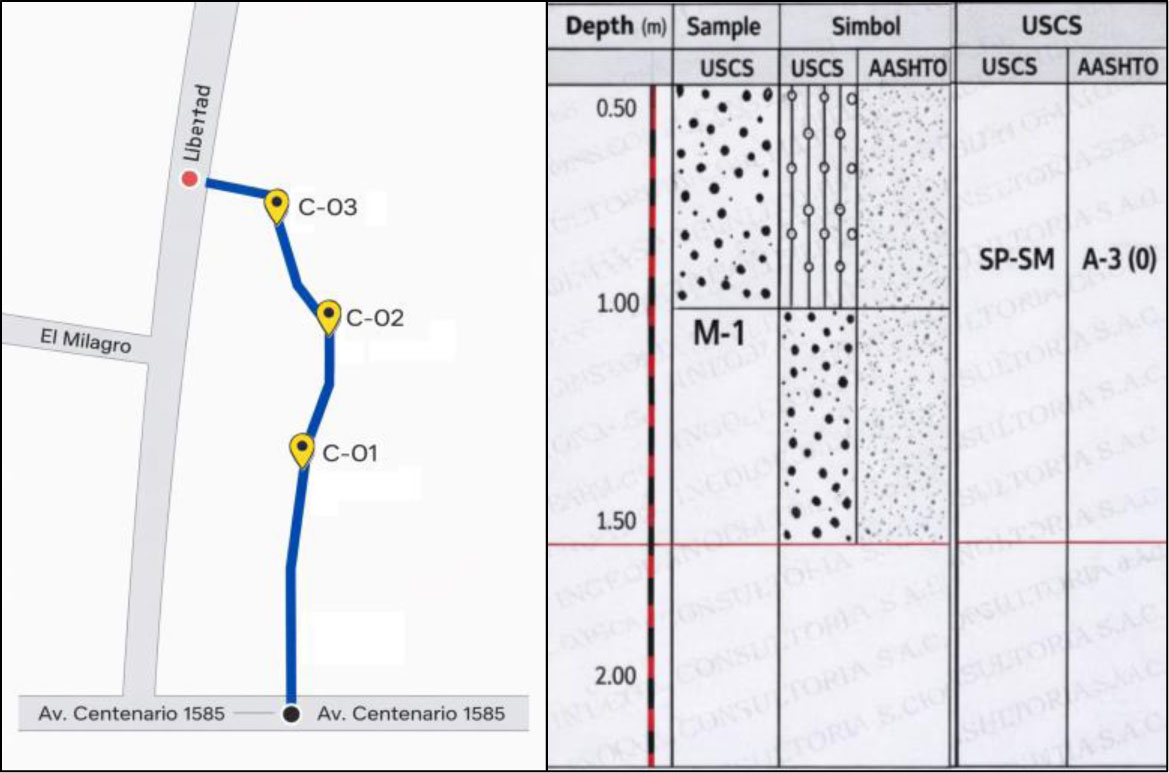
Figure 1:
Location and Soil Characteristics of the Study Area
A poorly graded sandy soil with gravel (SP–SM) was identified, consisting predominantly of sand with minor gravel content and a low percentage of fines. The material is a mixture of sand and silt with the presence of gravel particles, including minimal fragments up to 2 inches in size, representing approximately 0.6% of the total composition. The gravel is subangular to angular, exhibiting non-plastic behavior and a medium-dense consistency, with a light beige coloration and a moisture content of 1.6%. Overall, the soil is characterized as granular, with the following distribution: gravel (0.6%), sand (96.2%), and fines (3.2%), corresponding to normal ground conditions (Figure 1)
The sample, according to Arias-Gómez et al (2016), is a defined, limited, and accessible set of cases forming the reference for selecting samples that meet a series of predetermined criteria. It consisted of samples extracted from three test pits within the area, selected by purposive non-probabilistic sampling, which allowed choosing zones with representative characteristics for the technical stabilization analysis.
The unit of analysis was sandy-textured soil samples, selected under specific criteria ensuring adequate granulometric composition and absence of contaminants. The data collection technique was direct observation of the treated soil properties under controlled conditions through standardized tests.
A structured data collection form was used as an instrument, gathering required parameters according to standards ASTM D1557 – Standard Test Methods for Laboratory Compaction Characteristics of Soil Using Modified Effort (56,000 ftlbf/ft3) (Modified Proctor Test), ASTM D1883 – Standard Test Method for CBR (California Bearing Ratio) of Laboratory-Compacted Soils and ASTM D2434 – Standard Test Method for Permeability of Granular Soils (Constant Head). To guarantee study validity, methodological coherence was established among objectives, experimental design, and applied techniques, ensuring the relevance of obtained results.
Data were processed using SPSS statistical software, allowing organization, analysis, and interpretation of numerical results obtained from Modified Proctor, CBR, and permeability tests.
Regarding ethical aspects, principles of scientific integrity, data veracity, methodological transparency, and information confidentiality were respected. The study complied with guidelines established by the Consejo Nacional de Ciencia, Tecnología e Innovación Tecnológica – CONCYTEC (2021), as well as institutional dispositions on research ethics, ensuring responsible use of information and safeguarding traceability and reliability. According to CONCYTEC (2021), all research in Peru must promote respect for human dignity, scientific integrity, intellectual honesty, and social responsibility. In accordance with national and international standards, the UCV requires researchers to respect participant confidentiality, avoid conflicts of interest, and have documented informed consent, especially for experimental or intervention studies.
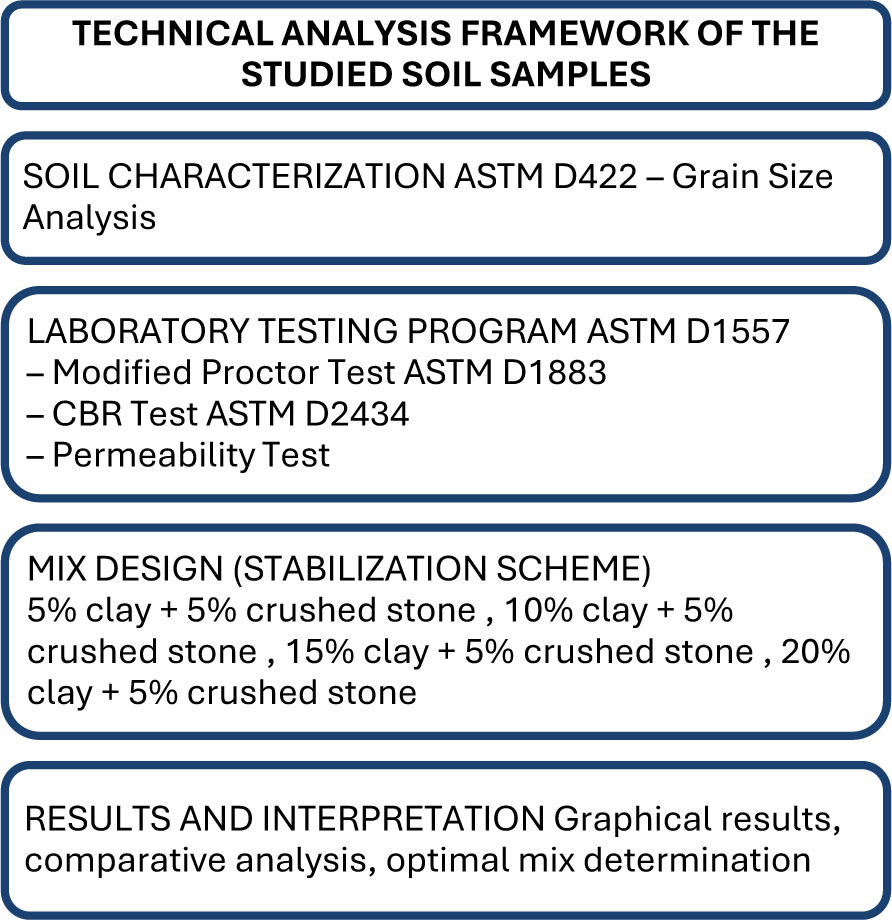
Figure 2:
Standards of applied tests
The Figure 2 show technical sequence developed in the figure allowed for the analysis of the behavior of a sandy soil stabilized with different percentages of clay and crushed stone, in the context of its use as road subgrade. The process began with the collection of representative soil samples, followed by a particle size analysis according to ASTM D422 to determine the classification of the base soil. Subsequently, mixtures were prepared with clay additions in proportions of 5%, 10%, 15%, and 20%, maintaining a constant 5% of previously sieved crushed stone. The mixtures were evaluated through Modified Proctor compaction tests (ASTM D1557), CBR strength tests (ASTM D1883), and constant head permeability tests (ASTM D2434).
3. Results
Table 1:
Particle Size Distribution (ASTM D422)
| ASTM standard sieve [-] | Aperture [mm] | Retained Weight [gr] | Percent Retained [%] | Cumulative Retained [%] | Percent Passing [%] | Description | |
|---|---|---|---|---|---|---|---|
| 1″ | 25.4 | 100 | Natural Moisture | 0.8 | |||
| 3/4″ | 19.05 | 42 | 0.2 | 0.2 | 99.8 | Liquid Limit | 0 |
| 1/2″ | 12.7 | 31 | 0.2 | 0.4 | 99.6 | Plastic Limit | NP |
| 3/8″ | 9.525 | 11 | 0.1 | 0.5 | 99.5 | Plasticity Index | NP |
| 1/4″ | 6.35 | 10 | 0.1 | 0.5 | 99.5 | Soil Classification (SUCS) | SP |
| No.4 | 4.76 | 13 | 0.1 | 0.6 | 99.4 | AASHTO Classification | A-3 (0) |
| No.10 | 2 | 8.02 | 0 | 0.7 | 99.3 | Maximum Size | 1″ |
| No.20 | 0.84 | 8.82 | 0.1 | 0.7 | 99.3 | Nominal Maximum Size | 3/4″ |
| No.40 | 0.42 | 981.74 | 5.7 | 6.4 | 93.6 | Gravel (%) | 0.6 |
| No.60 | 0.25 | 6848.16 | 39.5 | 45.9 | 54.1 | Sand (%) | 96.2 |
| No.100 | 0.15 | 5426.46 | 31.3 | 77.1 | 22.9 | Fines (%) | 3.2 |
| No.200 | 0.074 | 3411.92 | 19.7 | 96.8 | 3.2 | ||
| PASA | 554.89 | 3.2 | 100 | ||||
Table 1 shows that the grain size analysis indicates that the material is a clean, poorly graded sandy soil (SP according to SUCS), composed mainly of sand (≈96.2%), with a very low presence of fines (≈3.2%) and a practically negligible gravel content. The absence of plasticity (LL = 0, PL = NP, PI = NP) confirms that it is a non-cohesive soil, exhibiting typical sand behavior. Furthermore, its classification A-3 (0) according to AASHTO identifies it as a fine sand with good drainage but low bearing capacity when unconfined. The particle size distribution shows a concentration of particles within specific ranges, indicating poor gradation (uniformity), while its low natural moisture content (0.8%) suggests that the material is practically dry. Overall, it is a permeable soil with low cohesion and is susceptible to displacement if not properly compacted
Table 2:
Modified Proctor Test
| Sample [-] | MDD [gr/cm3] | OMC [%] |
|---|---|---|
| Pattern | 1.704 | 14.4 |
| 5% clay + 5 % crushed stone | 1.770 | 13.2 |
| 10% clay + 5 % crushed stone | 1.794 | 13.2 |
| 15% clay + 5 % crushed stone | 1.882 | 10.8 |
| 20% clay + 5 % crushed stone | 1.916 | 11.1 |
Table 2, corresponding to the Modified Proctor Test, reveals a significant trend of improvement in the compaction properties of the stabilized soil through the progressive incorporation of clay and a constant 5% of crushed stone. The maximum dry density (MDD) increased from 1.704 g/cm3 in the control sample to 1.916 g/cm3 with the addition of 20% clay, representing a 12.44% increase.
This increase indicates a greater capacity of the soil to achieve a compact and dense structure, which is essential for its use in subgrade layers. In addition, a notable reduction in the optimum moisture content (OMC) is observed, decreasing from 14.4% in the pattern to a minimum of 10.8% with 15% clay, before stabilizing around 11.1% with 20% clay. This reduction in OMC suggests that the soil requires less moisture to reach its optimum compaction, which is advantageous from a construction standpoint, as it reduces the time and costs associated with moisture control during the construction process.
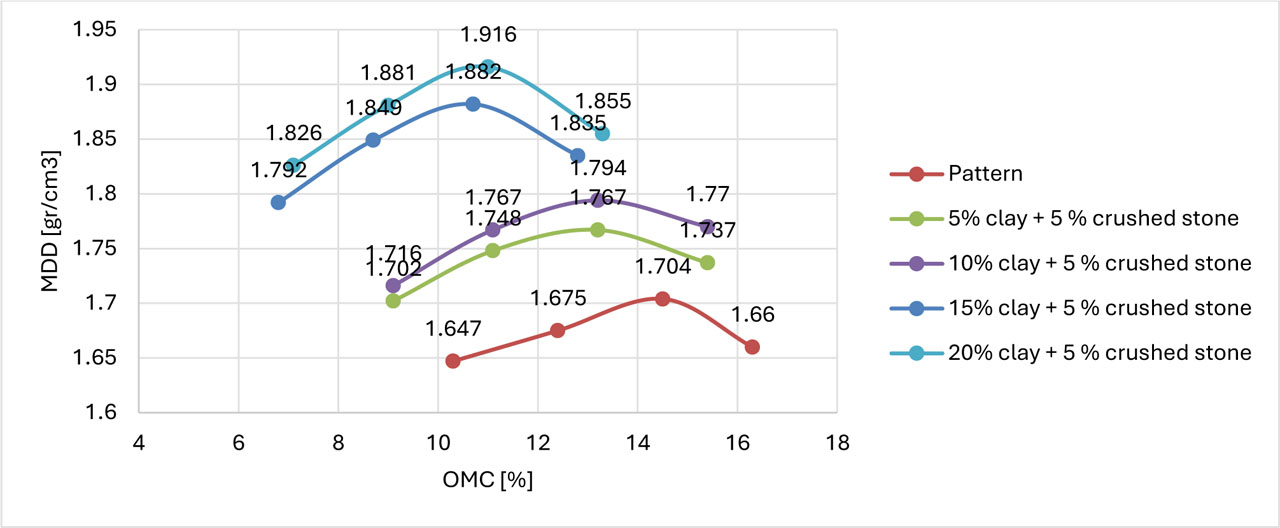
Figure 3:
Modified Proctor Test Results
Figure 3 shows that as the clay content increases, the curves shift upwards, indicating a progressive increase in the maximum dry density (MDD), with improvements of 3.87%, 5.28%, 10.45%, and 12.44% compared to the pattern. The optimum moisture content (OMC), on the other hand, shows a downward trend with reductions of up to 25%, indicating a lower water requirement to achieve maximum compaction.
The inclusion of crushed stone at 5% provides key benefits: it acts as a granular skeleton that improves the soil’s internal structure, reduces deformability, increases volumetric stability, and promotes a denser packing of particles by filling the voids between fine grains. This interaction between coarse particles (crushed stone) and fine particles (clay) optimizes the material’s mechanical behavior, favoring more efficient compaction with lower moisture contents, which is advantageous for subgrade layers in road construction projects.
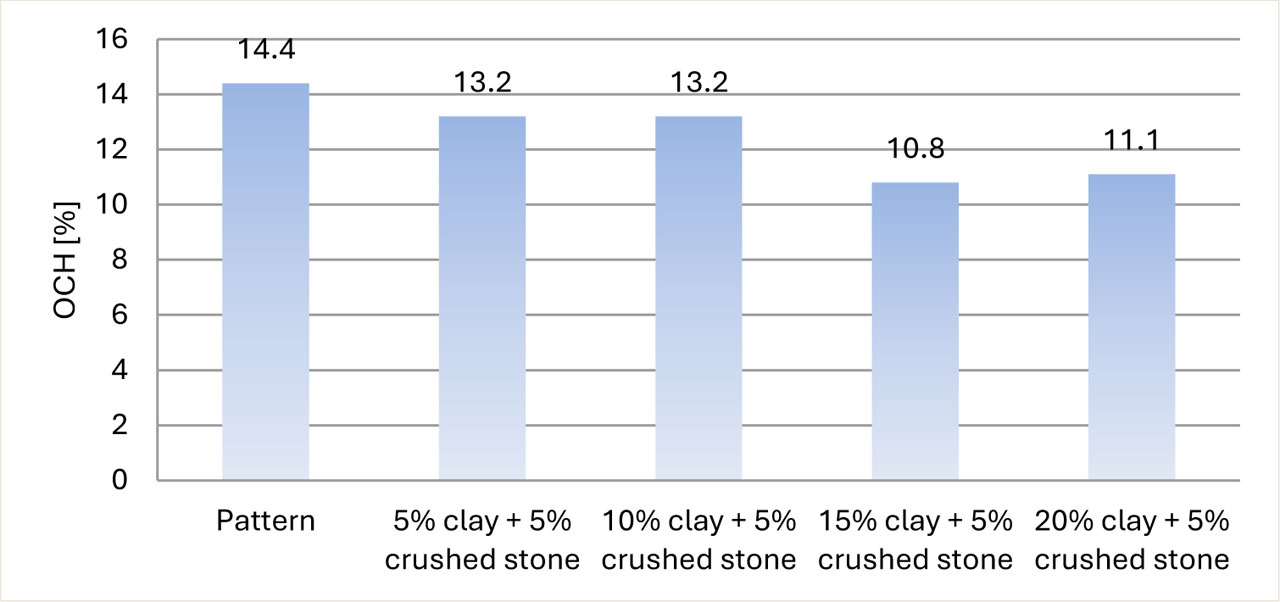
Figure 4:
Variation of the Optimum Moisture Content
Figure 4 shows a progressive decrease in this parameter when clay and crushed stone mixtures are incorporated into the reference soil. The Pattern presents the highest OMC value (14.4%), while the mixtures with 5% and 10% clay plus 5% crushed stone reduce this value to 13.2%. The mixture with 15% clay + 5% crushed stone reaches the lowest value (10.8%), indicating better compaction with less water. This behavior suggests that the controlled addition of fines improves the soil structure, increasing its compaction efficiency.
However, when clay content is increased to 20%, the OMC slightly rises to 11.1%, which can be attributed to a fines saturation that no longer favors compaction but instead increases water demand. The figure 3 shows that there is an optimal dosage of stabilizers, highlighting that the mixture of 15% clay + 5% crushed stone is the most effective. These results highlight that an adequate proportion of fine materials enhances soil densification without excessively increasing the moisture content required for compaction.
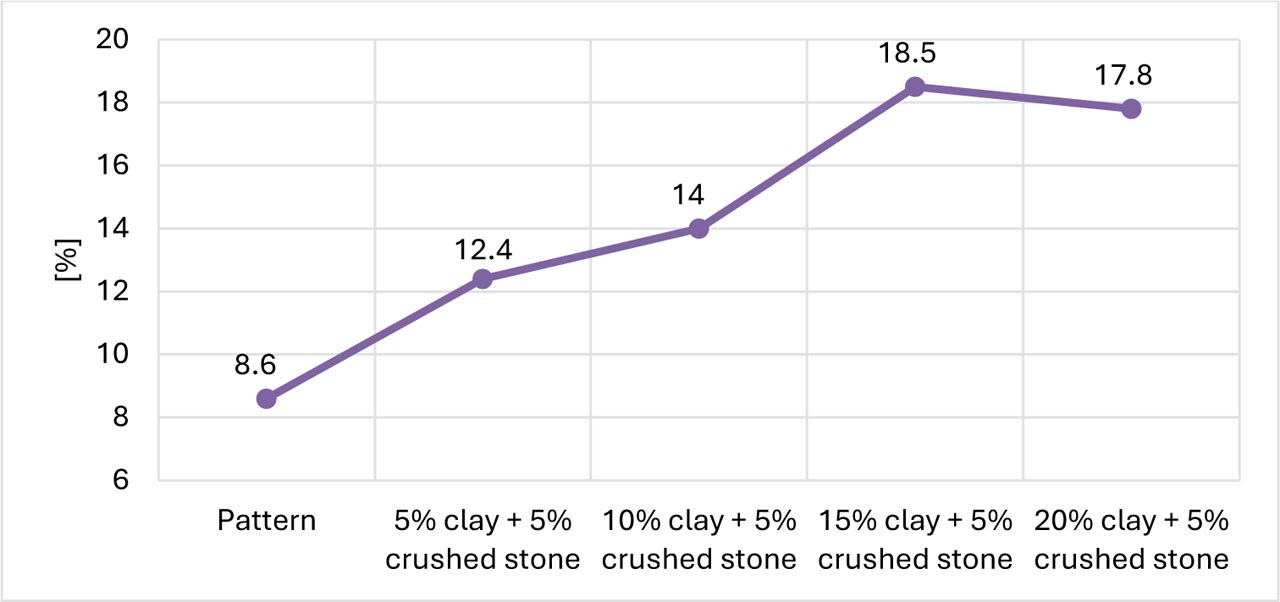
Figure 5:
CBR Test Results
Figure 5 shows the analysis of the California Bearing Ratio (CBR), which evidenced a substantial improvement in the load-bearing capacity of the soil stabilized with different proportions of clay and a constant 5% of crushed stone. The pattern presented a CBR of 8.6%. With the incorporation of 5% and 10% clay, the CBR increased to 12.4% and 14%, respectively, demonstrating a positive effect of progressive dosing on the shear strength of the material.
The highest value was obtained with the mixture of 15% clay and 5% crushed stone, reaching a CBR of 18.5%, which represents an increase of 115.12% compared to the natural soil. However, when clay content was increased to 20%, the CBR dropped to 17.8%, showing a slight decrease in the benefit achieved. This suggests that an excess of fines can cause a loss of internal friction and negatively affect load-bearing capacity, possibly due to saturation or alteration of the granular structure.
The percentage evolution of CBR relative to the control sample shows an upward trend up to an optimum point. The mixtures with 5% and 10% clay generated increases of 44.19% and 62.79%, while the 15% mixture achieved the maximum improvement. In contrast, the increase of only 106.98% observed with 20% clay supports the existence of an efficient dosage threshold. Overall, the results confirm that the combination of 15% clay and 5% crushed stone constitutes the most suitable alternative for improving sandy soils as subgrade or subbase in road structures, meeting the mechanical strength criteria established by technical standards.
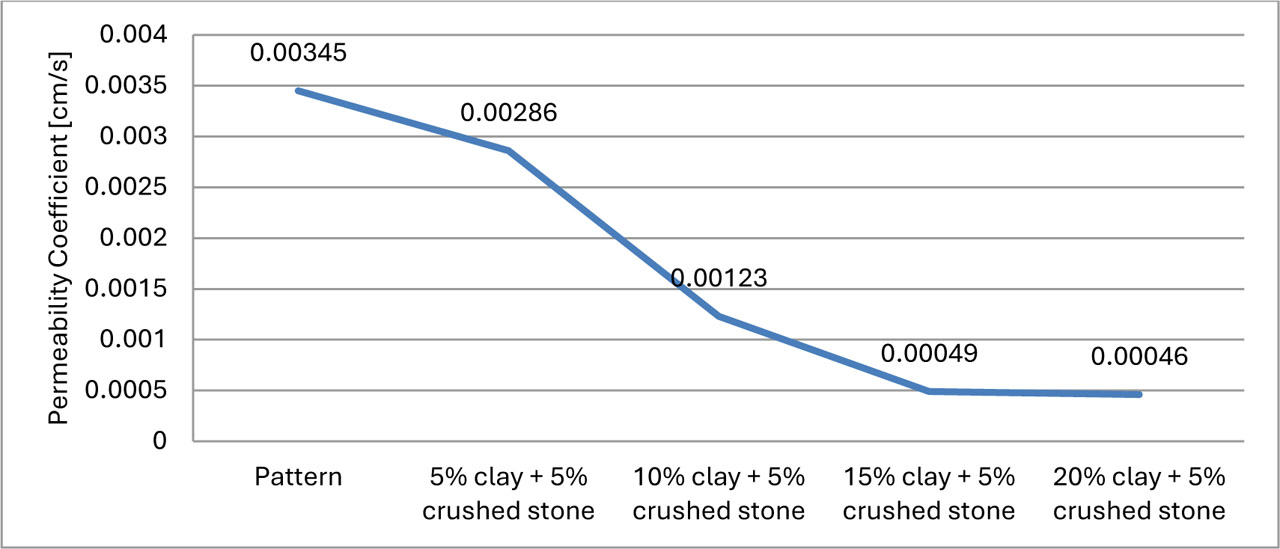
Figure 6:
Permeability Test of Granular Soils – Constant Head
The analysis of the permeability coefficient showed a clear decreasing trend as the clay content increased in the mixtures stabilized with 5% crushed stone. The pattern sample recorded a permeability of 0.00345 cm/s, characteristic of a granular soil with high porosity. The progressive addition of clay significantly reduced this value: with 5% and 10% clay, the coefficient dropped to 0.00286 cm/s and 0.00123 cm/s, representing decreases of 17.10% and 64.35%, respectively. The mixtures with 15% and 20% clay reached values of 0.00049 cm/s and 0.00046 cm/s, corresponding to reductions of 85.80% and 86.81%, evidencing a semipermeable behavior (Figure 6)
This improvement in impermeability is due to the fact that clay, with its fine particles and high plasticity, fills the interstices of the sandy soil, reducing pore connectivity and limiting water flow. The inclusion of crushed stone promotes a dense and stable structure, improving compaction without compromising sealing capacity. These results show that, from a clay content of 15% onwards, the permeability reduction effect tends to stabilize, suggesting an efficiency threshold.
Overall, the combination of clay and crushed stone constitutes an effective technical alternative to reduce the permeability of granular soils, making them suitable for subgrade layers in pavements, especially in areas where infiltration control is required to preserve structural durability.
Table 3:
Modified Proctor ANOVA
| Source [-] | Sum of Squares [-] | DF [-] | Mean Square [-] | F0 [-] | p-value [-] |
|---|---|---|---|---|---|
| Crushed stone | 15.2964 | 1 | 15.2964 | 19.91 | <0.0 |
| Clay | 15.6151 | 4 | 3.903 | 5.08 | <0,001 |
| Interaction AB | 100.0580 | 4 | 25.0145 | 32.57 | <0,001 |
| Error | 69.1170 | 90 | 0. | ||
| Total | 200.0865 | 99 |
The ANOVA analysis in Table 3 shows that both crushed stone and clay have a statistically significant effect on the maximum dry density of the soil, as evidenced by the p-values equal to 0.00, which indicates a very low probability that these results are due to chance. The crushed stone factor presents a calculated F (F0) of 19.91, considerably higher than the critical value, confirming that its presence significantly improves the soil’s compactability. Likewise, clay shows an F0 of 5.08, which also demonstrates a significant effect, although of lesser magnitude compared to crushed stone.
Table 4:
CBR ANOVA
| Source [-] | Sum of Squares [-] | DF [-] | Mean Square [-] | F0 [-] | p-value [-] |
|---|---|---|---|---|---|
| Crushed stone | 936.6330 | 1 | 936.6330 | 16.47 | <0,001 |
| Clay | 962.5600 | 4 | 240.6400 | 4.23 | <0.001 |
| Interaction AB | 7082.3850 | 4 | 1770.5963 | 31.14 | <0.001 |
| Error | 5117.0833 | 90 | 56.8565 | ||
| Total | 14098.6996 | 99 |
Table 4 presents the analysis of variance (ANOVA) for the CBR index, revealing substantial differences in the soil’s bearing capacity in response to the applied treatments. The high mean square associated with crushed stone (936.6330) and its corresponding F statistic (16.47) indicate that its incorporation significantly influences the soil’s mechanical behavior, markedly increasing its shear strength. Meanwhile, clay, with a mean square of 240.64 and F0 of 4.23, also has a favorable effect, though with a less dominant impact than the coarse aggregate. This suggests that while clay improves cohesion and void filling, crushed stone provides a more resilient granular structure against penetration
Table 5:
ANOVA for Permeability
| Source [-] | Sum of Squares [-] | DF [-] | Mean Square [-] | F0 [-] | p-value [-] |
|---|---|---|---|---|---|
| Crushed Stone | 11,618.3670 | 1 | 11,618.3670 | 11.97 | <0.0 |
| Clay | 11,942.7490 | 4 | 2,985.6873 | 3.08 | <0.0 |
| Interaction AB | 117,317.3886 | 4 | 29,329.3472 | 30.22 | <0.0 |
| Error | 87,334.6204 | 90 | 970.3847 | ||
| Total | 228.213,1253 | 99 |
The ANOVA table 5 for the permeability coefficient reveals statistically significant effects of both crushed stone and clay on reducing water flow through the soil, as evidenced by p-values of 0.00. Crushed stone shows an F0 of 11.97, indicating a substantial impact on improving the soil’s hydraulic properties, likely due to its structured filling effect and reduction of macropores.
In the case of clay, the F0 of 3.08 also confirms a significant, albeit more moderate, influence. This can be attributed to clay’s ability to fill the voids between coarse particles, creating a more compact and less permeable matrix. Consequently, both stabilizers effectively contribute to decreasing soil permeability, which is crucial in road subgrades to prevent water infiltration and the deterioration of upper layers.
4. Discussion
4.1. Interpretation of Results
The experimental results showed that the combination of 15 % clay and 5 % crushed stone significantly improves the geotechnical properties of sandy soil. In the Proctor test, a maximum dry density of 1.916 g/cm3 was achieved, higher than that of the natural soil, and an optimum moisture content of 11.1 %, lower than the initial value. This improvement is consistent with the findings of Sammarwar & Kirar (2023), who reported that the addition of limestone powder increases dry density and reduces optimum moisture, resulting in a denser and more construction-efficient soil. Similarly, Peter (2022) showed that adding crushed stone dust to lime-stabilized soils increases compaction to reach an optimum point, a behavior also observed in this study.
Regarding mechanical strength, the unsoaked CBR value increased to 18.5 % in the optimal mix, showing an improvement of 115 % compared to the natural soil. This result places the treated soil within the required range for light to medium traffic subgrades. Comparatively, Muthu Lakshmi & Sivakumar (2025) reported CBR increases of 86.5 % when treating clayey soils with stone waste, validating the effectiveness of granular material as structural reinforcement. On the other hand, Peter (2022) found a 47.6 % CBR increase when combining lime with stone dust, whereas in this study, the improvement was achieved without chemical additives, highlighting the technical and economic feasibility of the clay-stone mixture.
Regarding permeability, the natural soil presented a value of 0.0034 cm/s, which decreased to 0.00049 cm/s in the optimal mix, representing an 85.5 % reduction. This improvement is critical to limit water infiltration and prevent the loss of structural support in subgrade layers. This behavior aligns with the findings of Amiri Tasuji et al. (2024), who reported a 35 % reduction in hydraulic conductivity when stabilizing sandy soils with clay, even under extreme conditions. In this sense, the pore-sealing and cohesion mechanisms generated by clay were also observed in this study, resulting in a dense, lowpermeability matrix.
Moreover, the achieved strength can be explained by the synergy between cohesion (provided by clay) and internal friction (provided by crushed stone). Hemmati et al. (2025) demonstrated that mixing clay with chemical binders and recycled fibers increased unconfined compressive strength up to 10 times compared to natural soil, validating those improvements can scale significantly with appropriate stabilizer combinations. Although no cementing agents were used in this study, a substantial improvement was obtained, positioning this combination as a sustainable option in rural or resource-limited contexts.
Another relevant aspect is the reduction in optimum moisture content, which implies lower water requirements during compaction and, consequently, reduced cost and construction time. This phenomenon was also observed by Muthu Lakshmi & Sivakumar (2025) and Sammarwar & Kirar (2023), who demonstrated that stone dust not only improves compaction but also reduces plasticity and swelling susceptibility in cohesive soils. In this study, its application in sandy soils produces similar behavior, albeit in a less plastic matrix, broadening the potential uses of the material.
4.2. Limitations
This study had few limitations, as most experiments were conducted under controlled conditions that allowed for proper analysis. However, certain environmental factors, such as extreme climate changes, and economic aspects related to the practical application of the materials were not considered, which could affect their long-term performance. Despite this, the limitations did not significantly affect the validity of the results obtained.
5. Conclusion
The optimal dosage for compaction corresponds to 20% clay and 5% crushed stone. The incorporation of crushed stone combined with varying clay contents proved to be an effective strategy for enhancing the geotechnical properties of sandy soil. In terms of compaction, the progressive increase in clay content led to a significant rise in the maximum dry density (MDD), from 1.704 g/cm3 in the natural soil to 1.916 g/cm3 with 20% clay, representing a 12.44% increase. Simultaneously, the optimum moisture content (OMC) decreased from 14.4% to 10.8%, equivalent to a 25% reduction. This behavior reflects improved compaction efficiency, mainly due to enhanced particle packing and reduced void ratio, as fine clay particles fill the intergranular spaces of the sand while the crushed stone contributes to a denser and more stable structure with lower water demand during compaction.
The optimal dosage for bearing capacity is 15% clay and 5% crushed stone. The CBR test results revealed a substantial improvement compared to the natural soil, increasing from 8.6% to 18.5%, which corresponds to a 115.12% increase. This notable enhancement is attributed to the development of a more compact and mechanically stable structure, in which crushed stone forms a rigid load-bearing skeleton, while clay fills the voids and enhances interparticle bonding. As a result, stress distribution becomes more uniform, and both shear strength and internal resistance are significantly improved.
The optimal dosage for hydraulic behavior is 15% clay and 5% crushed stone. From a hydraulic standpoint, the addition of these materials led to a marked reduction in soil permeability, with hydraulic conductivity decreasing from 0.00345 cm/s to 0.00049 cm/s, representing an 85.8% reduction. This improvement is primarily due to the reduction in pore size and continuity caused by the presence of clay, along with the densification effect induced by crushed stone. Consequently, water flow through the soil is restricted, improving infiltration control and reducing the risk of subgrade saturation, which is essential for long-term pavement performance.
Acknowledgements
We express our deepest gratitude to all individuals and institutions that contributed in any way to the completion of this article. Special thanks to our thesis advisor for his valuable guidance, patience, and unwavering dedication, which were essential to the successful development of this work. We also extend our sincere appreciation to Universidad Cesar Vallejo, whose academic support and institutional resources made this research possible.
Notes
[2] Contributed by Author Contributions
J.C.F.M and L.I.F.M. Cconceived and designed the study, defining the main objectives J.M.L.E. establishing the appropriate methodology to achieve the expected results. L.I.F.M. conducted the laboratory experiments D.L.H.V. responsible for the collection, organization C.C.V.N., and initial validation of the data obtained during the project development. S.A.D.L.C., as the advisor, closely supervised the statistical analysis, critically interpreted the results, C.M.M.F. made significant contributions to the writing and revision of the manuscript, ensuring the coherence and scientific quality of the work.