

1. Introduction
Concrete is a fundamental construction material worldwide and is one of the most important and widely used building materials due to its strength, durability, affordability and adaptability. Its composition, consisting mainly of cement, water, and aggregates, can be adapted to meet particular performance requirements, making it essential for a variety of structural applications. Innovations in concrete technology, such as incorporating recycled materials and advanced mix designs, improve its sustainability and performance in modern infrastructure (Burduhos-Nergis, 2023; Nicholas & Brinkman, 2024; Paglia, 2023; Zhang, 2014). In addition to its mechanical strength, concrete's thermal performance is increasingly recognised as a key factor in building energy efficiency, indoor thermal comfort and fire resistance.
Recently, the utilization of iron powder waste (IPW) in concrete production has emerged as a promising solution to mitigate the environmental impacts associated with industrial waste. By repurposing this by-product, the construction industry can enhance sustainability while potentially improving material properties (M. J. Miah et al., 2020; Sharma & Singh, 2023; Sista & Dwarapudi, 2018). The incorporation of iron powder into concrete represents a significant advancement in concrete technology, particularly due to its influence on thermophysical properties. Previous studies have indicated that iron-based additives can enhance thermal conductivity, heat capacity, and thermal diffusivity, which are critical parameters for improving the thermal performance and durability of concrete structures (Dehdezi et al., 2011; Ju et al., 2011; K. Liu et al., 2017).
In addition to the experimental evaluation of thermophysical properties, understanding the broader context of heat transfer, fire performance, and sustainability is important. Previous studies have highlighted that thermal conductivity and heat transfer in concrete are strongly influenced by material composition and environmental conditions (Asadi et al., 2018). The incorporation of alternative or recycled materials, such as iron powder waste, can enhance energy efficiency while contributing to sustainable construction practices (Y. H. Lee et al., 2021; Martini et al., 2022). Fire performance and residual structural behaviour under thermal exposure have been studied using experimental and numerical approaches, such as the analysis of concrete‑encased pultruded GFRP beams exposed to fire and simulated with finite element models (Mahmood et al., 2022). Finite element modeling (FEM) has also been widely used to simulate temperature fields and assess thermal responses in concrete elements under thermal loads, providing predictive tools for material design and optimization (Chen et al., 2024; Klemczak et al., 2024). Standardized fire exposure protocols, such as ASTM E119 and ISO 834, are commonly applied to evaluate the thermal performance of structural materials under high temperatures, emphasizing the relevance of accurate thermophysical parameters (Banerjee, 2021). Integrating these perspectives strengthens the practical applicability of the present thermophysical measurements and highlights their potential use in energy-efficient and fire-resilient concrete design.
The incorporation of iron powder into cementitious materials has recently attracted increasing attention as both a sustainable recycling strategy and an effective method for enhancing concrete performance under elevated temperatures. These additions not only improve mechanical strength but also contribute to durability and thermal resistance, making them valuable components in advanced concrete formulations. Several studies have demonstrated the positive influence of iron-based additives on concrete properties. For instance, (X. Liu et al., 2023) reported that substituting 20% of river sand with iron tailings resulted in measurable increases in compressive and flexural strengths, with compressive strength improving by 3.14 MPa compared to conventional concrete. Similarly, (Kanibou et al., 2024) observed that iron powder waste and iron fibers improved thermophysical properties, including thermal conductivity and heat capacity, indicating enhanced heat-transfer and heat-storage potential. Other studies have shown that partial replacement of sand or cement with iron powder can increase strength and density (Adeyanju & Manohar, 2011; Ghannam et al., 2016; Largeau et al., 2018), as well as reduce spalling and enhance fire resistance (Al-Amin & Hossain, 2024; Gao et al., 2025). Collectively, these findings highlight the potential of iron powder as a sustainable additive capable of improving both mechanical and thermal performance in concrete.
Although several studies examined iron powder or industrial waste in concrete primarily from a mechanical performance perspective (Chao et al., 2024; Harshitha et al., 2025; Sah et al., 2025), few studies have provided a systematic and temperature-dependent evaluation of multiple thermophysical parameters in iron powder-modified concrete. Some researchers have evaluated concrete thermal conductivity with certain additives (Moldovan & Gligor, 2025; Wijesinghe et al., 2025), but these works did not include volumetric heat capacity, diffusivity, and effusivity.
Despite the growing body of literature on the incorporation of iron powder in concrete, most existing studies have focused primarily on mechanical strength, durability or fire resistance. Comprehensive investigations that address the combined evaluation of thermophysical properties and microstructural evolution across a wide replacement range and under controlled temperature conditions remain limited. In particular, the systematic characterisation of thermal conductivity, volumetric heat capacity, thermal diffusivity and thermal effusivity as a function of temperature has not been sufficiently documented. Therefore, a clearer understanding of the structure–property relationship governing heat transfer behaviour in iron powder-modified concrete is still needed.
The main objective of this study is to systematically evaluate the influence of iron powder waste (5–25%) on the temperature-dependent thermophysical properties of concrete and to establish a clear relationship between microstructural evolution and heat-transfer performance. By combining microstructural characterization (SEM–EDX and XRD) with temperature-controlled thermophysical measurements using a CT-meter, this study is among the first to provide a systematic temperature-dependent characterization of thermal conductivity, volumetric heat capacity, diffusivity, and effusivity in iron powder waste-modified concrete, combined with detailed microstructural analysis.
2. Materials and Methods
2.1. Materials
The experimental programme employed a variety of materials, including Ordinary Portland Cement (CPJ 45), coarse and fine aggregates (sand), iron powder waste (IPW) and water.
Natural sand and IPW were used to study concrete properties. The particle size distribution of the sand and IPW was determined by sieving grains with diameters between 0.08 mm and 0.8 mm (Kanibou et al., 2024).
All concrete mixes used CPJ 45 Portland cement, which contains 65% or more of one or more secondary constituents such as fillers, pozzolans or fly ash, in accordance with the NM 10.1.004 regulations.
Table 1 shows the chemical compositions of the two materials. The iron powder is mainly composed of iron and oxygen, with smaller amounts of carbon, aluminium, silicon, and traces of other metals such as magnesium, manganese, zinc, titanium, copper, and nickel. This confirms its metallic nature with some oxide phases. In contrast, sand is dominated by silicon, oxygen, and calcium, together with moderate amounts of carbon, aluminium, and magnesium, while iron appears only in low proportion. Small traces of titanium, potassium, barium, and zirconium are also present, reflecting its mineral origin. Overall, iron powder is metal-rich, whereas sand is mineral-rich, which highlights their contrasting properties when used in construction materials. These results were confirmed by XRD analysis of the different materials.
Figure 1a shows that the sand is mainly composed of quartz, accompanied by calcite and dolomite, which confirms its silicate and carbonate nature. In contrast, the XRD pattern of the iron powder waste presented in Figure 1b exhibits sharp diffraction peaks corresponding to α-Fe, indicating the crystalline metallic structure of the material. The presence of minor oxide traces can also be observed.
Table 2:
Chemical composition of Iron powder waste and sand
| Element [at. %] | Iron Powder | Sand |
|---|---|---|
| Fe | 53.05 | 3.053 |
| O | 37.37 | 47.06 |
| C | 3.971 | 5.283 |
| Al | 1.531 | 1.998 |
| Si | 1.094 | 16.90 |
| Ca | 0.9304 | 22.27 |
| Mg | 0.2742 | 1.517 |
| Mn | 0.2574 | 0.03586 |
| Zn | 0.2468 | 0.01114 |
| Ti | 0.2245 | 0.3030 |
| Na | 0.2187 | 0.3124 |
| S | 0.2111 | 0.1133 |
| K | 0.1575 | 0.6180 |
| Cu | 0.09433 | - |
| Cl | 0.09119 | 0.09269 |
| Cr | 0.08109 | 0.04485 |
| Ni | 0.05807 | 0.01234 |
| Ba | 0.05070 | 0.1779 |
| Pb | 0.02089 | - |
| P | 0.02059 | 0.03559 |
| Nb | 0.01356 | 0.002971 |
| Zr | 0.01152 | 0.06760 |
| Pa | 0.01063 | - |
| Sr | 0.007697 | - |
| Rb | - | 0.01009 |
| Mo | 0.004148 | - |
| Tot | 100 | 100 |
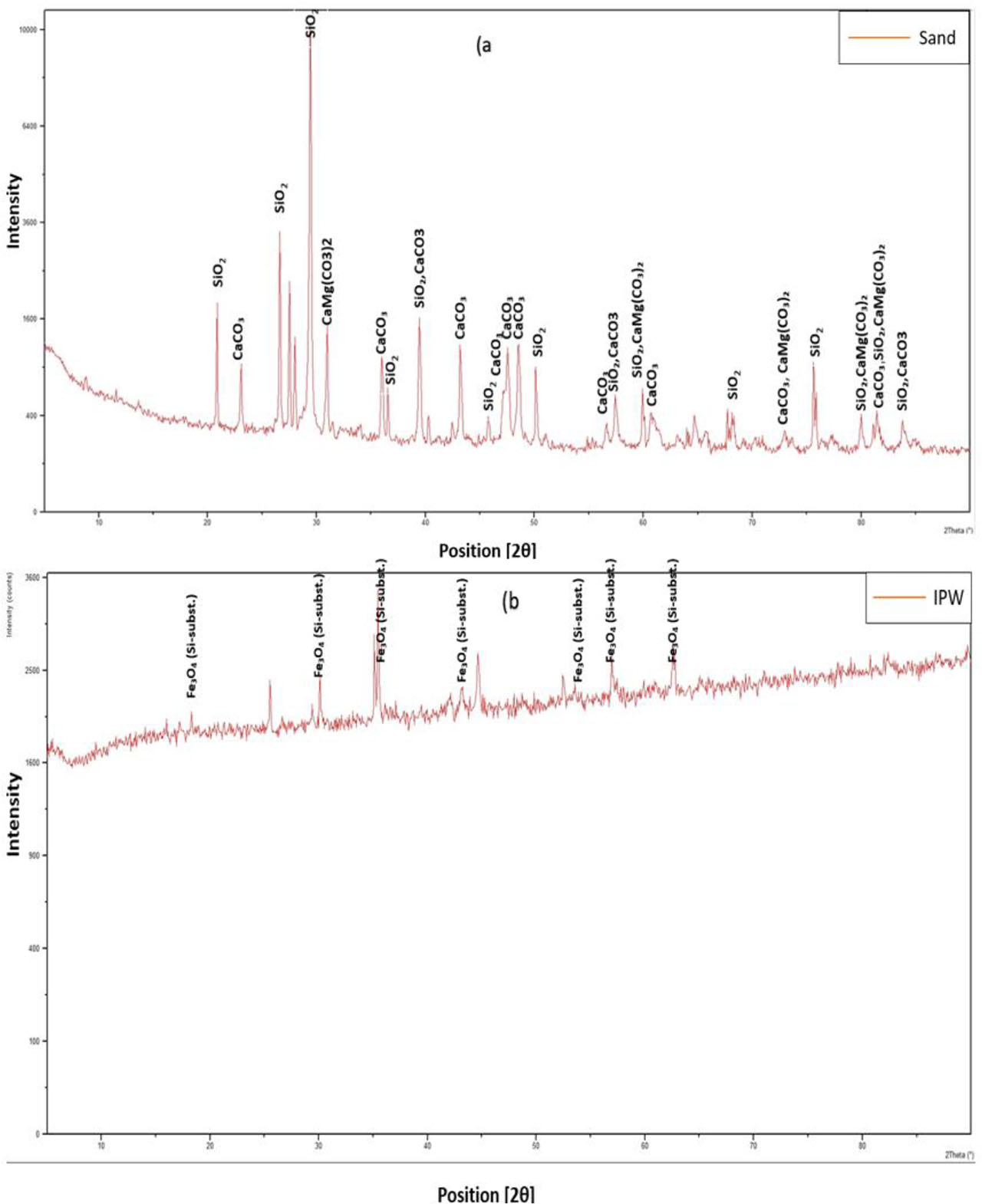
Figure 2:
(a) XRD analysis of the sand; (b) XRD analysis of Iron Powder Waste
2.1. Sample Preparation
The fabrication of concrete samples involved the systematic blending of cement, fine aggregate, and coarse aggregate in a nominal mix ratio of 1:1.5:3, corresponding to M20 grade concrete. The water-to-cement ratio was maintained at 0.52 for all mixtures. Waste iron powder (WIP) was incorporated as a partial replacement for the sand in order to evaluate its impact on the resulting concrete's thermophysical properties. The replacement levels of fine aggregate were set at 5%, 10%, 15%, 20%, and 25% by weight, in addition to a control mix (0% WIP) that was prepared as a baseline. This experimental approach permitted a comprehensive evaluation of the effect of metallic waste additives on concrete behaviour, particularly in terms of thermal response and structural performance.
A series of concrete specimens was produced, designated MIP0 (0%), MIP5 (5%), MIP10 (10%), MIP15 (15%), MIP20 (20%) and MIP25 (25%). The sample preparation process began with thorough dry-mixing of cement, sand, coarse aggregate and the specified amount of waste iron powder to ensure uniform particle distribution. Water was then gradually added to achieve the desired plastic consistency suitable for moulding and compaction. The fresh concrete mixtures were then cast into rectangular moulds with internal dimensions of 75 × 50 × 90 mm3. To ensure homogeneity and eliminate air voids, each mixture was manually compacted within the moulds, thereby enhancing the density and mechanical stability of the prepared samples (see Figure 3).
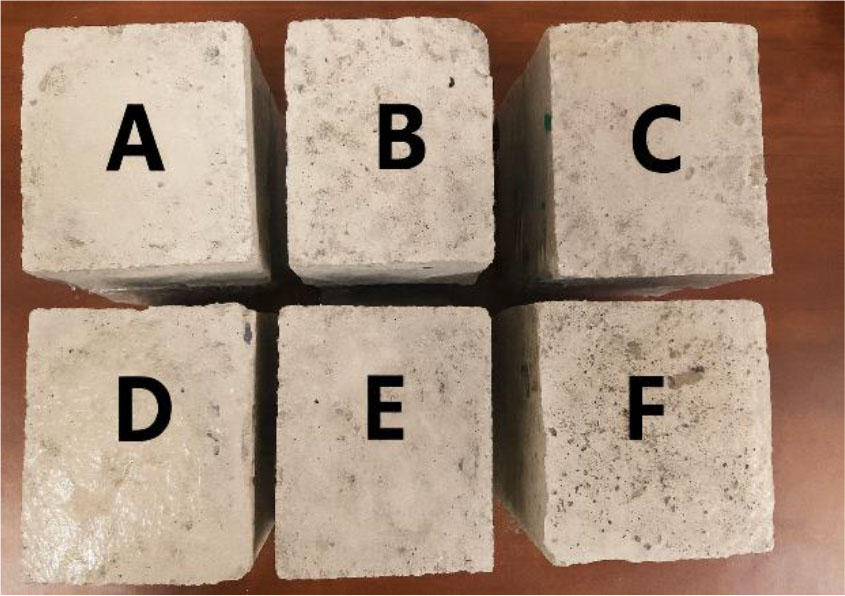
Figure 4:
A) MIP0+ 0% IP; (B) MIP5+ 5% IP; (C) MIP10+ 10% IP; (D) MIP15+ 15% IP; (E) MIP20+ 20%; (F) MIP25+ 25%
2.1. Methods
X-ray diffraction (XRD) analysis is used to identify the crystallised minerals that make up a material. These analyses were carried out at the CNRST in Morocco using a PANalytical X'Pert PRO MPD diffractometer. This sophisticated instrument is designed for X-ray diffraction analysis and features a vertical goniometer with a θ-θ configuration. This setup enables precise angular measurements and sample positioning, which are crucial for accurately collecting diffraction data. The system is equipped with a copper anticathode X-ray tube and a rotating sample holder to enhance its versatility for various sample types. Integrating an X'Celerator detector and a secondary monochromator improves the quality of the obtained data even further.
The morphology of the samples was verified using a scanning electron microscope JEOL IT 100 type MEOL (JEOL, Tokyo, Japan), a high-performance tool designed for detailed imaging at various magnifications. The JEOL IT 100 offers exceptional resolution, capable of imaging fine surface features with precision at magnifications up to 100,000× and resolutions as small as 4 nm. The JEOL IT 100 scanning electron microscope (SEM) is a sophisticated instrument designed for high-resolution imaging and analysis of sample surfaces. It integrates advanced features such as a surface height measurement system and an objective lens control unit, enhancing the precision of electron beam focus and surface profiling. The system includes deflecting means to manipulate the electron beam’s path, allowing for detailed scanning of the specimen. The JEOL IT 100 scanning electron microscope, equipped with an Energy Dispersive X-ray Spectrometer (EDS), is a powerful tool for elemental analysis. EDS operates by detecting characteristic X-rays emitted when a high-energy electron beam interacts with the sample, allowing for detailed elemental composition analysis (Morita, 2018). This technique is widely utilized in various fields, including materials science and nuclear fuel analysis, due to its ability to provide insights into microstructures and elemental distributions (Yee et al., 2008). These analyses were carried out at the CNRST, UATRS (Rabat, Morocco).
The thermal properties of the specimens were measured using a standard CT Meter supplied by the Modern Society of Electronic Studies (Voiron, France) and developed by the Technical and Scientific Centre for Construction (CSTB). This instrument is designed to determine the thermal conductivity (W/m·K) and volumetric heat capacity (kJ/m3·K) of solid materials, in accordance with NF EN 993-15:2005 (Bakari et al., 2022; Boussaq et al., 2025; Ouaazizi et al., 2023). The device operates using a flexible, ring-shaped probe featuring a thickness of 0.2 mm, dimensions of 60 mm × 90 mm and a central radius of 10 mm. Containing a resistive heating wire and a thermocouple embedded in an insulating Kapton support, the probe is connected to the CT Meter via a dedicated plug (Figure 5).
During testing, the probe was positioned between two identical samples. A heating resistance of 2.20 Ω and a power input of 1 W were applied for 400 seconds to produce a controlled heat pulse, while the resulting temperature increase was monitored continuously by the integrated thermocouple. Following the heating phase, a 500 s measurement period was conducted during which the rate of temperature increase was recorded. These data were then used to calculate the thermal conductivity and specific heat capacity of the material, based on the known power input, temperature variation and material characteristics.
All measurements were performed in a hermetic glove box (Figure 6) to ensure a stable and controlled thermal environment. The glove box was adapted from a 400 L commercial freezer and has internal dimensions of 120 cm (length) × 48 cm (width) × 72 cm (height), as well as a transparent, 20 mm-thick Plexiglas lid for visual observation. Two 11 W ventilators ensured homogeneous temperature distribution inside the chamber, which could be fitted with one or two heating elements as required. Temperature regulation was achieved using a contact thermometer connected to a temperature controller, maintaining an accuracy of ±1 °C.
Each test result is the average of three measurements, and the standard uncertainty associated with the CT meter was estimated at 5%. Two independent samples were used for preliminary testing of the CT-meter measurements, and six pairs of specimens were prepared for the main experiments. Each sample was measured three times, and the reported value corresponds to the average of all measurements. All thermal measurements were conducted under the assumption that the concrete samples were macroscopically homogeneous and isotropic. The samples were dried to constant mass and thermal equilibrium was ensured prior to testing. The CT-meter probe was positioned centrally between two identical specimens, ensuring consistent contact pressure for all measurements, to ensure uniform heat flow and repeatability. Tests were performed at controlled temperatures of 20, 30, 40 and 50 °C to simulate the moderate thermal exposure relevant to building applications. The computer interface of the system enabled real-time visualisation and processing of the data, facilitating accurate determination of the thermophysical parameters of the specimens under test.
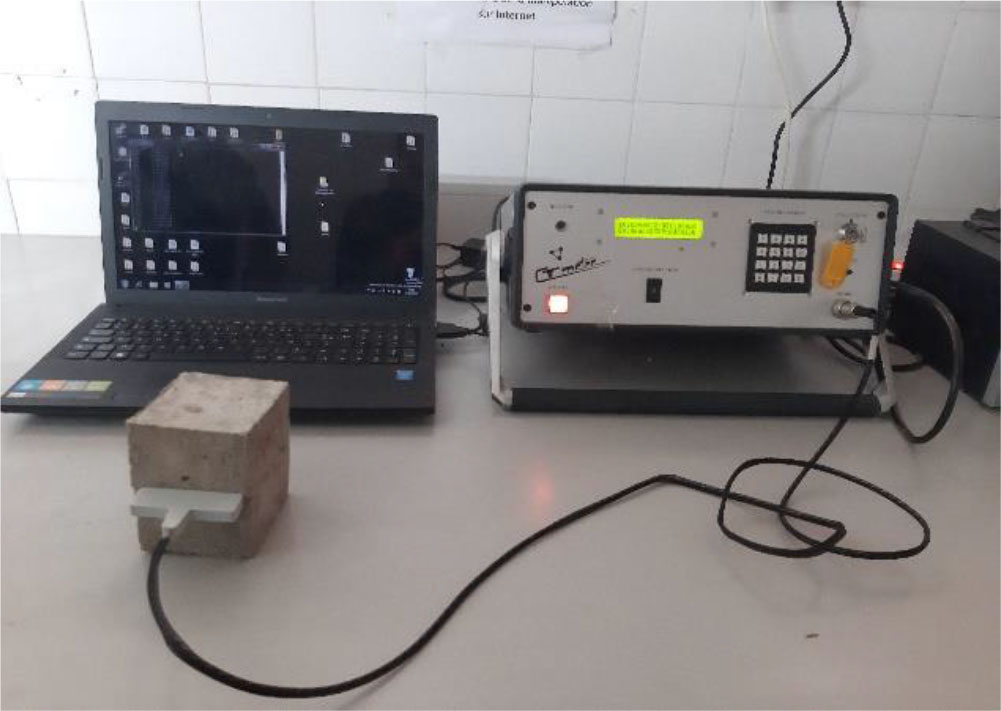
Figure 7:
CT meter
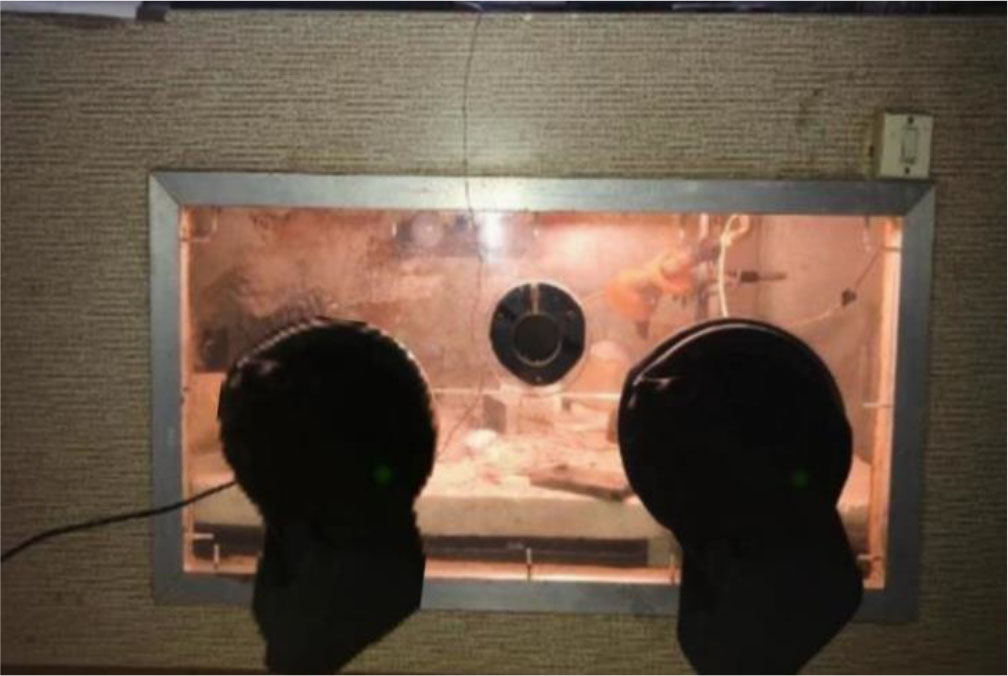
Figure 8:
The glove box
3. Results and Discussions
3.1. Scanning Electron Microscopy (SEM)
Waste iron powder (WIP) and natural sand were first examined using scanning electron microscopy (SEM) to characterize their surface morphology and textural features. The corresponding micrographs are presented in Figure 5. As shown in Figure 5a, the iron powder waste particles exhibit an irregular, flaky morphology with rough and heterogeneous surfaces, often covered by residual layers. This surface texture results from the mechanical and thermal processes involved in metalworking operations that generate this type of waste (Cui et al., 2022; Sepman et al., 2024). Such irregularity and increased surface area are expected to enhance mechanical interlocking and interfacial bonding with the cementitious matrix when iron powder is used as a partial replacement for sand. In contrast, the natural sand particles shown in Figure 5b display angular to sub-angular shapes with relatively smooth and dense surfaces, which are characteristic of siliceous aggregates.
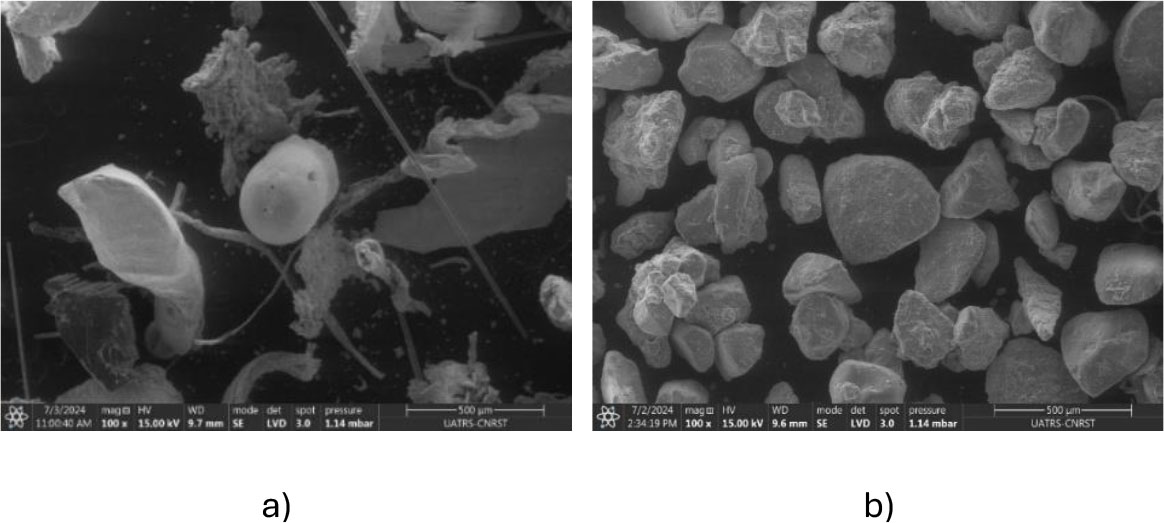
Figure 9:
Scanning electron microscopy of (a) Iron powder waste, and (b) Sand
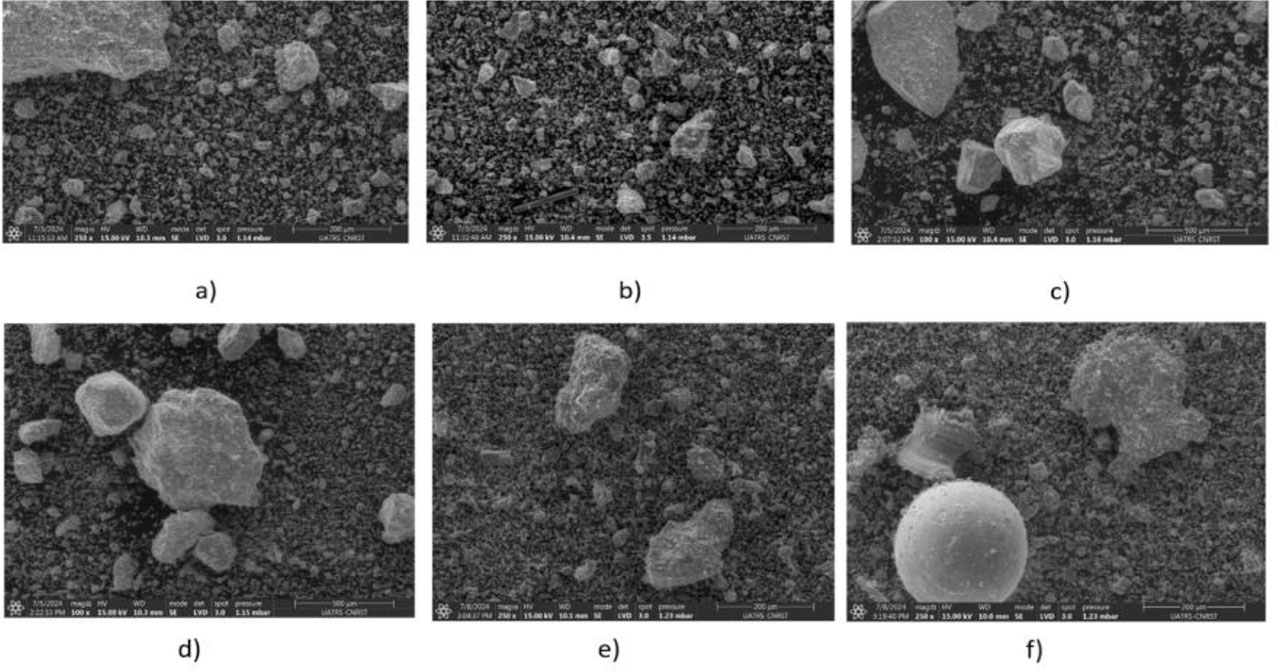
Figure 10:
SEM images of concrete samples: a) MIP0+ 0% IP, b) MIP5+ 5% IP, c) MIP10+ 10% IP, d) MIP15+15% IP, e) MIP20+20% IP, f) MIP25+25% IP
SEM observations were then systematically conducted for all investigated concrete compositions incorporating iron powder at replacement levels ranging from 0% to 25% (0%, 5%, 10%, 15%, 20%, and 25%), enabling a comprehensive assessment of the microstructural evolution as a function of iron powder content. The corresponding micrographs are presented in Figure 11(a–f). The reference concrete without iron powder (0% IP, Figure 12a) exhibits a relatively homogeneous microstructure, with aggregates well embedded in the cementitious matrix and a uniform distribution of hydration products, which is typical of conventional concrete.
At low replacement levels, the incorporation of 5% iron powder (Figure 13b) leads to a noticeably denser and more compact microstructure. Fine iron particles effectively fill microvoids within the matrix, improving particle packing and enhancing cohesion between the cement paste and aggregates. This densification effect remains evident at intermediate replacement levels. At 10–15% iron powder (Figure 14c–d), the microstructure shows increased solid-phase density and a rougher surface texture, indicating intensified particle interactions and improved matrix continuity, although localized heterogeneities begin to emerge compared to the 5% mixture.
At higher substitution levels (20–25% IP, Figure 15e–f), SEM images reveal the formation of larger, irregular agglomerates dispersed within the cementitious matrix. This particle clustering results in increased microstructural heterogeneity and a less uniform distribution of phases. Such agglomeration is attributed to the high surface energy and fine size of iron powder particles, which promote particle–particle interactions at elevated contents, as also reported in previous studies (M. Miah et al., 2022; M. J. Miah et al., 2020).These microstructural features may adversely affect workability and matrix cohesion.
Overall, the SEM analysis confirms that waste iron powder significantly influences the internal structure of concrete depending on the replacement level. Moderate additions in the range of 5–15% promote a denser and more homogeneous microstructure by effectively filling microvoids and improving particle cohesion, whereas excessive iron powder content leads to agglomeration and structural heterogeneity. These microstructural trends provide a clear explanation for the observed thermophysical behavior, as improved compactness enhances heat-transfer pathways at low-to-moderate replacement levels, while excessive clustering limits further performance gains. Unlike many previous studies that present isolated micrographs, this work systematically documents the progressive microstructural evolution across the full replacement range, offering a clear structure–property correlation (Barbir et al., 2025; Tayeh & Al Saffar, 2018).
3.2. Thermo-physical properties
3.2.1. Impact of temperature on the thermal conductivity of concrete with iron powder
Temperature plays a crucial role in determining the thermal behavior of concrete, influencing heat transfer, conductivity, and overall thermal stability. Despite the increasing interest in sustainable concrete technologies, limited research has examined how temperature variations affect the thermal conductivity of concrete containing iron powder as a partial replacement for cement. This study addresses this gap by investigating the effect of temperature on the thermal conductivity of concrete samples incorporating different iron powder substitution levels: 0%, 5%, 10%, 20%, and 25%, hereafter referred to as IP0, IP5, IP10, IP20, and IP25, respectively.
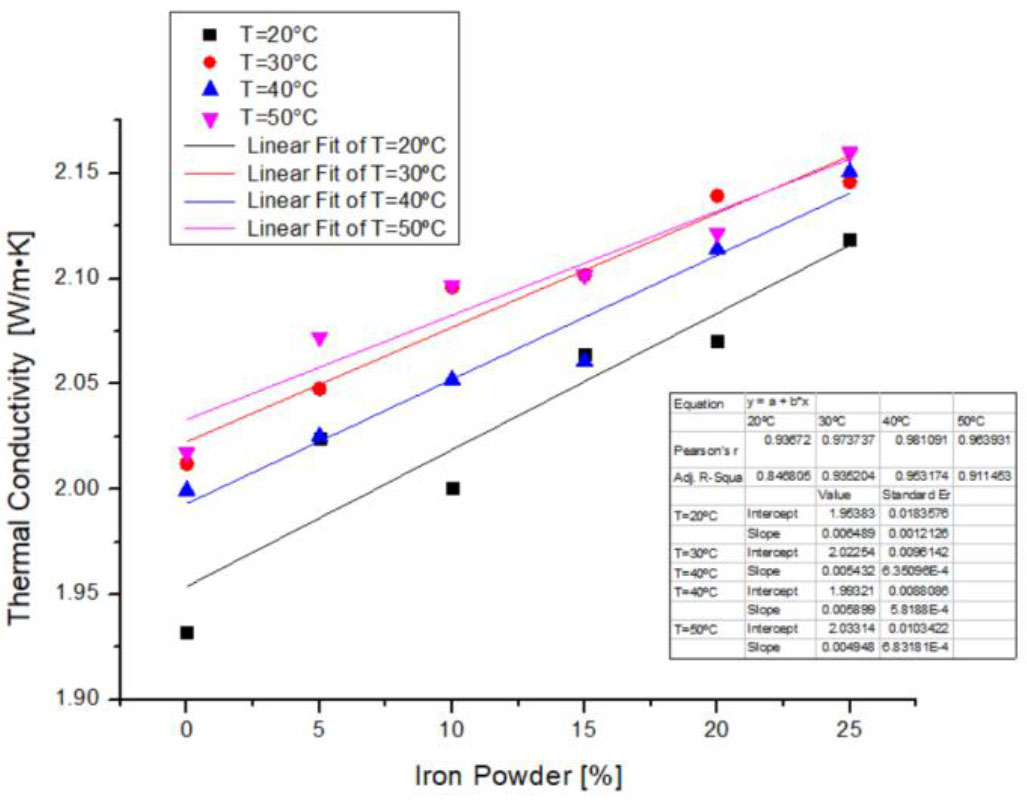
Figure 16:
The Thermal conductivity of composites as a function of temperature and IPW content
To conduct this investigation, concrete specimens were carefully prepared in accordance with the specified proportions of iron powder and tested in a dry state. Thermal conductivity measurements were performed across a temperature range of 20–50 °C to represent realistic environmental conditions relevant to practical construction applications.
As can be seen in Figure 17, the results reveal that thermal conductivity increases slightly with iron powder content across the studied temperature range. For the reference sample (IP0), thermal conductivity increased by approximately 3.47%, 4.14% and 4.40% at 30 °C, 40 °C and 50 °C respectively compared to 20 °C. For IP5, the corresponding increases were 0.05%, 1.17%, and 2.32%. IP10 exhibited increases of 2.6%, 4.8%, and 4.85%, while IP20 showed a slight decrease of 0.19% at 30 °C, followed by increases of 2.13%, 3.33%, and 2.46% at higher temperatures. The IP25 sample showed minor increases of 1.54%, 1.32% and 2% at 30 °C, 40 °C and 50 °C respectively.
Overall, the results suggest that the thermal conductivity of concrete containing iron powder remains relatively consistent within the temperature range of 20 °C to 50 °C. This stability is due to several interacting mechanisms that govern heat transfer within the composite material. The addition of iron powder increases the density and thermal mass of the concrete, contributing to consistent thermal behaviour over moderate temperature variations (Kanibou et al., 2024). Furthermore, concrete's inherent heterogeneous composition, comprising aggregates, mortar, and interfacial transition zones, results in complex thermal transfer paths that are less sensitive to temperature changes, as also reported by (Jin et al., 2017).
The thermal behaviour of concrete, encompassing both the aggregate and the cementitious matrix, generally remains stable within moderate temperature ranges. Studies have shown that thermal properties such as conductivity and specific heat capacity are primarily governed by the nature of the aggregate and the composition of the binder matrix (Kodur & Sultan, 2003; Moret et al., 2015). While the addition of conductive metallic additives such as iron powder can enhance the overall thermal conductivity, this improvement may be limited by the heterogeneous structure of concrete and the interfacial thermal resistances between its constituent phases (H.-S. Lee & Kwon, 2016).
In contrast to previous studies, which often only evaluated thermal performance at room temperature (around 20 °C), this investigation extends the analysis up to 50 °C. This demonstrates that the thermal conductivity of iron-powder-modified concrete changes only marginally with increasing temperature. The plateau-like behaviour observed beyond 40 °C suggests that the thermal transport mechanisms reach a quasi-stable equilibrium, rendering these materials suitable for environments with moderate thermal fluctuations.
These findings highlight the potential of iron powder as a sustainable additive that can slightly enhance thermal conductivity without compromising the thermal stability of concrete under practical temperature conditions. Future research could focus on developing empirical correlations between iron powder content, temperature and thermal conductivity, as well as extending the evaluation to higher temperature ranges through predictive modelling approaches.
3.2.2. Impact of temperature on the specific heat capacity of concrete with iron powder
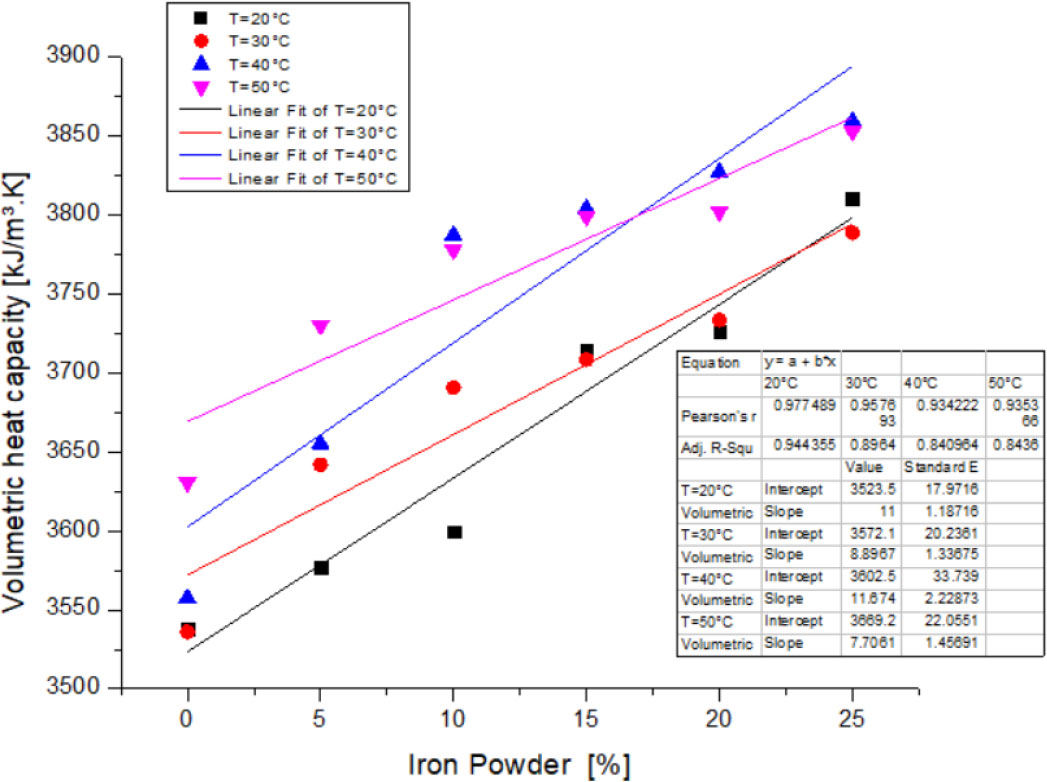
Figure 18:
The volumetric heat capacity of composites as a function of temperature and IPW content
The evolution of the specific heat capacity of concrete containing iron powder (IP) is shown in Figure 19. It was observed that the specific heat capacity of the samples decreased slightly as the temperature rose from 20°C to 30°C with increasing iron powder content. A moderate increase in heat capacity was then noted as the temperature increased further to 40 °C and 50 °C across all mixtures, with maximum values obtained at 10% IP replacement.
At 40 °C, the specific heat capacity values for 0%, 5%, 10%, 15%, 20% and 25% IP replacement were 0.55%, 2.18%, 5.21%, 2.41%, 2.70% and 1.28% respectively. Similarly, at 50 °C, the corresponding values were 2.62%, 4.27%, 4.95%, 0.4%, 2.04% and 1.11%. A slight reduction in heat capacity was observed at 15% IP content, showing a negligible change of 0.4%.
These results indicate that the incorporation of iron powder influences the thermal storage capacity of concrete within the moderate temperature range of 20–50 °C. Overall behaviour reveals small but noticeable variations in specific heat capacity depending on temperature and IP content. This trend can be attributed to the iron powder modifying the concrete microstructure by introducing micropores that enhance heat dissipation and affect thermal performance. Similar observations were reported by (Huang et al., 2021; Prałat et al., 2022). Furthermore, the presence of iron powder contributes to more homogeneous heat distribution within the concrete matrix, reducing localised temperature gradients and improving thermal stability, as highlighted in references (Funda Akbulut et al., 2023; Khedaywi et al., 2025; Lai et al., 2021).
Overall, the evolution of specific heat capacity confirms that iron powder incorporation induces moderate but consistent changes in the thermal storage behaviour of concrete within the 20–50 °C range. Although the variations remain relatively small, the results indicate that IP content influences the balance between heat absorption and distribution within the cementitious matrix. The combined effect of metallic particles and microstructural modifications appears to regulate the material’s thermal response, contributing to stable behaviour under moderate temperature variations.
3.2.3. Impact of temperature on the Thermal Diffusivity of concrete with iron powder
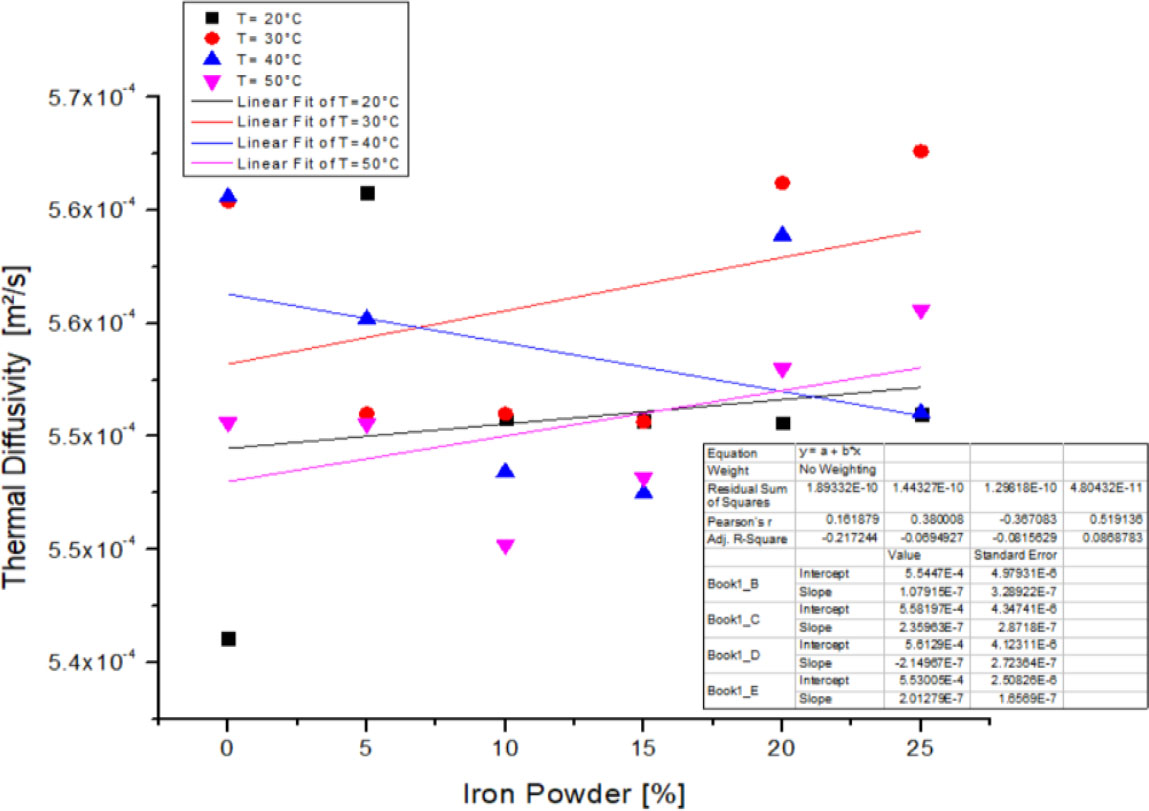
Figure 20:
The thermal diffusivity of composites as a function of temperature and IPW content
According to (Boy et al., 2022), thermal diffusivity (D) is defined as the ratio of thermal conductivity (λ) to volumetric heat capacity (Cp), as expressed in Eq. (1):
Where:λ [w/m. k] – definition of the thermal conductivity.
Cp [KJ/m3 ∙K] – the volumetric specific heat.
As shown in Figure 21, the thermal diffusivity of concrete containing 5–25% iron powder exhibits a slight decrease with increasing temperature. At 20 °C, diffusivity values range between 5.8 × 10⁻⁷ m2/s and 5.5 × 10⁻⁷ m2/s, whereas a more pronounced decline is observed at 50 °C. This behavior indicates that, although the iron powder content exerts a limited effect on thermal diffusivity, temperature remains the dominant factor influencing heat propagation within the material.
The observed reduction in thermal diffusivity with increasing temperature can be attributed to the interplay between thermal conductivity (λ), density (ρ), and specific heat capacity (cp). The incorporation of iron powder enhances λ by forming conductive pathways; however, this improvement is counterbalanced by the rise in cp at elevated temperatures, which increases the material’s ability to store heat and consequently reduces the rate of temperature change. These results emphasize the significant influence of both temperature and iron powder content on the thermal transport behavior of concrete.
The thermal diffusivity of concrete with iron powder showed a slight decrease with increasing temperature, reflecting a slower rate of heat propagation at higher temperatures. This trend is consistent with previous studies on cementitious composites (Hager et al., 2022; M. Miah et al., 2022) and is attributed to changes in heat capacity and microstructure. Such behaviour indicates improved thermal stability and potential benefits for applications requiring moderate thermal inertia
3.2.4. Impact of temperature on the Thermal effusivity of concrete with iron powder
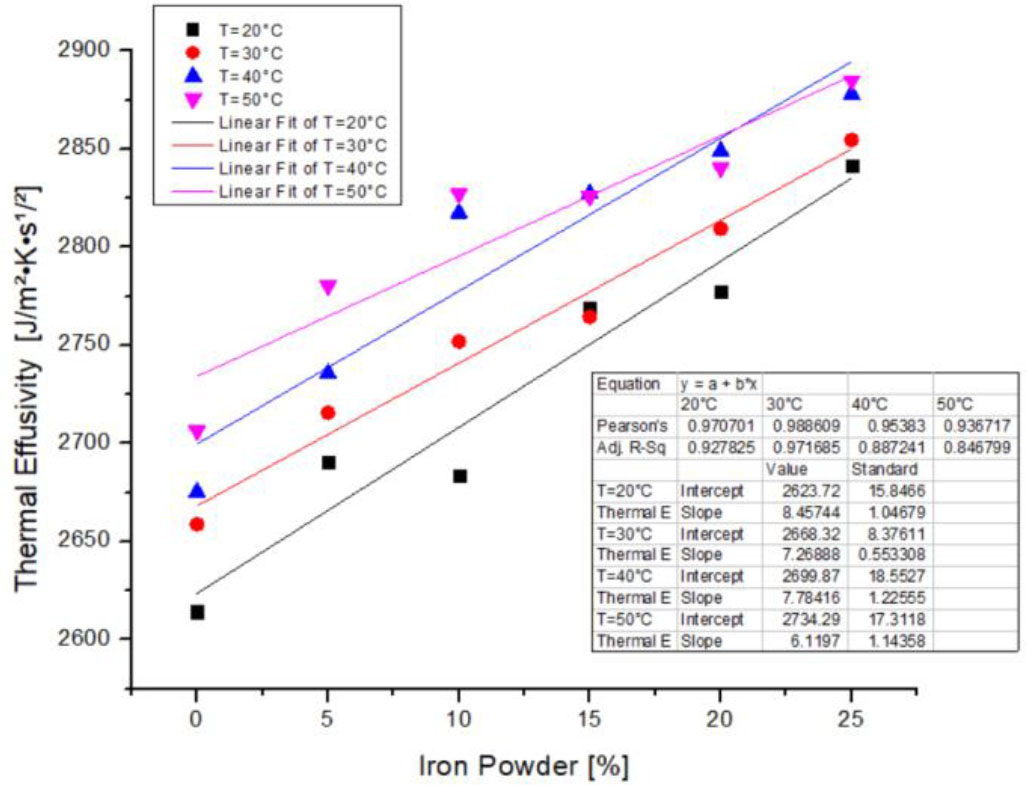
Figure 22:
The thermal effusivity of composites as a function of temperature and IPW content
Thermal effusivity is defined by Eq. (2):
Where:λ [w/m. k] – definition of the thermal conductivity,
Cp [KJ/m3 ∙K] – the volumetric specific heat.
The thermal effusivity values, calculated using Eq. (2), are presented in Figure 23. As illustrated in the figure, thermal effusivity increases with both rising temperature and higher proportions of iron powder substitution. Specifically, for the control concrete (without iron powder), thermal effusivity increases from 2614.5 to 2706.4 J/(m2·K·s1/2) as the temperature rises from 20 to 50 °C. Likewise, for the concrete incorporating 25% iron powder, thermal effusivity increases from 2841.4 to 2884.9 J/(m2·K·s1/2) over the same temperature range.
According to Eq. (2), thermal effusivity is directly governed by both thermal conductivity and volumetric heat capacity, emphasizing their interdependent roles in heat transfer processes (Abdallah et al., 2024; Demezhko et al., 2018; Gustafsson et al., 2023). The observed increase in thermal effusivity with temperature and iron powder content indicates that the material’s ability to absorb and release heat becomes more pronounced under elevated temperatures. This combined effect of temperature and iron powder addition enhances the concrete’s capacity for heat exchange, making it more suitable for thermally sensitive structural applications (Huang et al., 2021; M. Miah et al., 2022).
4. Conclusion
This study investigated the thermophysical behaviour of concrete incorporating iron powder waste as a partial replacement for sand, with the aim of enhancing the energy efficiency of building materials. Microstructural and mineralogical characterisations (SEM, XRD, XRF) were carried out in combination with thermophysical measurements using a CT-meter probe to evaluate the influence of iron powder content and temperature.
The results showed that replacing 25% of the sand with iron powder slightly improved the thermophysical properties of the composite. Specifically, thermal conductivity increased from 2.118 to 2.16 W/m·K, the specific heat capacity increased from 3810.66 to 3853 kJ/m3·K, and the thermal effusivity increased from 2841.39 to 2884.87 J/m2·K·s1/2, while thermal diffusivity remained almost unchanged at 5.6 × 10⁻⁴ m2/s. Overall, the incorporation of 25% iron powder resulted in a net enhancement of thermophysical performance, with thermal conductivity, volumetric heat capacity, and thermal diffusivity increasing by approximately 2%, 1.11%, and 1.53%, respectively, relative to the reference concrete, demonstrating the positive impact of iron powder on heat transfer and storage capacity. SEM–EDX observations confirmed that these improvements were linked to modifications in the internal microstructure. Temperature also significantly affected all thermophysical parameters within the 20–50 °C range, indicating stable and predictable behaviour under moderate thermal exposure.
The findings of this study have important implications for both researchers and practitioners. For researchers, the quantified thermophysical properties of concrete containing iron powder offer a reliable dataset for modelling and simulating heat transfer, thermal storage and energy efficiency in cementitious materials. For practitioners, the observed improvements in thermal conductivity, volumetric heat capacity and thermal diffusivity suggest that replacing some of the sand in concrete with iron powder could improve its thermal performance in real-world applications such as walls, floors and pavements that are subject to temperature variations. These insights can inform the design of more energy-efficient, durable and fire-resistant concrete structures, as well as guiding future experimental studies and numerical simulations aimed at optimising material performance.
Acknowledgements
The authors express their gratitude to the Associate Editor for his assistance and support, and to the Thermodynamics-Energy team at the Energy Research Centre in the Physics Department, Faculty of Science and Mohammed V University, in Rabat.
Notes
[1] Contributed by Author Contributions
F.K. conceived and designed the study, prepared the concrete specimens, conducted the experimental investigations, and performed the chemico-mineralogical analyses (XRD, XRF, and SEM). R.B. and K.O. contributed to data processing and assisted in the explanation and interpretation of the experimental results. S.A. and A.A. contributed to the interpretation of results, manuscript revision, and correction of the final draft. All authors critically reviewed and approved the final version of the manuscript and agree to be accountable for all aspects of the work.