

1. Introduction
Permafrost is frozen ground that remains below 0 °C for at least two consecutive years (Tarnocai, 1989). On the Qinghai–Tibet Plateau, permafrost is typically warm and highly sensitive; warming and engineering disturbance intensify freeze–thaw cycling and can induce pavement thawing, frost heave, differential settlement, and cracking, thereby weakening subgrade bearing capacity and threatening transportation safety (Wu & Zhang, 2008; Wu, Q. et al., 2021). Under the combined influence of global warming and thermal disturbance induced by road construction, the energy and water balance at the ground–air interface has been reshaped (Kong et al., 2019; Chen et al., 2018), and intensified freeze–thaw processes can enhance CO2 production and release in permafrost ecosystems (Wang et al., 2020; Horgby et al., 2019).
To maintain the stability of transportation infrastructure, crushed-rock embankments are widely adopted as an active-cooling countermeasure. Their cooling performance depends on intrinsic properties (particle size, gradation, porosity) and external boundary conditions such as radiation, wind, diurnal temperature variation, and freeze–thaw action (Chen et al., 2018; Yu et al., 2020). In windy and sand-prone corridors, aeolian sediments and weathering products can clog voids and suppress airflow, thereby reducing convective cooling and generating maintenance wastes; recycling the accumulated weathered rock as local aggregate is attractive but may not meet cold-region pavement requirements without targeted improvement.
From a materials-engineering perspective, the practical reuse of reclaimed weathered rock from crushed-rock embankments hinges on addressing its typically elevated porosity, weakened surface integrity, and potential vulnerability to freeze–thaw action, all of which can compromise the early-age strength and durability required by cold-region pavement layers. Therefore, an upgrading approach that can rapidly densify the pore structure, improve interfacial quality, and preferably deliver additional environmental benefits is highly desirable. In this context, CO2-based curing/pretreatment emerges as a promising option because it can couple performance enhancement with carbon mineralization, providing a logical bridge between permafrost-related infrastructure challenges and carbonation technology.
Carbonation (CO2) curing introduces CO2 to react with cementitious phases and hydration products, producing CaCO3 and silica gel; CaCO3 commonly crystallizes as calcite, vaterite, and aragonite (Shao et al., 2006). The effectiveness of CO2 curing is governed by coupled parameters. With respect to duration, early exposure is often reaction-controlled and yields rapid strength gain, whereas prolonged exposure increasingly becomes diffusion-limited because near-surface CaCO3 precipitation reduces pore connectivity (Padmalal et al., 2024; Han et al., 2024; Ning et al., 2025). Pressure and CO2 concentration can accelerate carbonation by increasing CO2 solubility and the driving force for CaCO3 precipitation, but macroscopic performance commonly shows non-linear responses due to competing precipitation and transport limitation, including self-sealing effects (Ding et al., 2023; Kalkreuth et al., 2024; Lee et al., 2025; Wang et al., 2022; Zhuang et al., 2025). Relative humidity and water state are also critical: carbonation is often fastest at intermediate RH, precuring residual water-cement ratio affects CO2-curing efficiency and pore evolution, and long-exposure kinetics can transition from an initial reaction-limited stage to a much slower stage with a plateau behavior (Ashraf & Olek, 2016; Shi et al., 2014; Saeki et al., 2025; Han et al., 2020; Kim et al., 2021).
Within carbon-neutrality and emission-peak goals, CO2 mineralization in concrete-related materials provides meaningful but bounded decarbonization potential that depends on energy supply, CO2 purity and transport, and achievable uptake at scale (Driver et al., 2024; Zajac et al., 2022). CO2 uptake also occurs via end-of-life carbonation of crushed concrete and is strongly controlled by moisture and particle size (Kikuchi & Kuroda, 2011). Demonstrations span laboratory and pilot scales, including fast carbonation using industrial gases and flue-gas-based mineralization routes, and system analyses indicate measurable regional storage potential and multiple utilization pathways (Izoret et al., 2023; Morin et al., 2022; Rosa et al., 2022; Zajac et al., 2021; Suescum-Morales et al., 2023).
At the material and component levels, CO2 curing can deliver substantial early-age performance gains. CO2 curing can match or exceed steam curing for precast elements while improving impermeability, freeze–thaw resistance, and corrosion resistance (Rostami et al., 2012). Staged curing (precuring–carbonation–subsequent moisture curing) can simultaneously improve strength and abrasion resistance while reducing chloride permeability and stabilizing pH, linked to accelerated CaCO3 precipitation and pore refinement (Li et al., 2019). Reported benefits extend to pavement-relevant materials such as pervious concrete, and to binder modifications and alternative CO2 sources or reaction promoters (Ba et al., 2023; Haselbach et al., 2014; Seo et al., 2018; He et al., 2025). Microstructural studies further show that atmospheric CO2 curing can induce CaCO3 precipitation and C-S-H recombination, leading to pore refinement and reduced permeability, while optimization of moisture–pressure–time windows is crucial for balancing performance and uptake (Xian & Shao, 2021; Zhang et al., 2023). Broader carbonation knowledge and research approaches, including kinetic modeling of cement-paste powders and CO2-reactive hardening binders, reinforce that reaction pathways depend on precursor characteristics and curing design (Medvedev & Pustovgar, 2023; Zhu et al., 2023; Kim et al., 2023).
For recycled aggregates and recycled-aggregate concrete (RAC), CO2 pretreatment and ITZ engineering can reduce absorption and porosity by CaCO3 filling and interface reconstruction and improve mechanical/durability performance (Li et al., 2020; Wu et al., 2022; Lu et al., 2023; Bergmans et al., 2024). Aggregate source and carbonation history measurably affect concrete performance, and parent material/particle size govern carbonation-induced property changes (Etxeberria & Castillo, 2023; Qin et al., 2024; Bustamante et al., 2024). Water-state control (e.g., short-duration pre-saturation) stabilizes workability with limited strength penalty, and comparative pretreatment assessments summarize feasible upgrade routes (García-González et al., 2014; Kępniak et al., 2025; Junior et al., 2025; Neupane et al., 2023). Durability under cold-region actions has been addressed for RAC and reinforced systems, including freeze–thaw–enhanced carbonation depth and NaCl-induced freeze–thaw erosion, as well as improved frost resistance under combined curing methods (Liu, H. et al., 2021; Zhu et al., 2022; Liang et al., 2024). Quantitative tools and indicators used in related carbonation/RAC studies include µCT–diffraction integration, pragmatic XRD semi-quantification, and impact-echo–based prediction frameworks (Zhang et al., 2020; Salcedo et al., 2021; Yu et al., 2022), while mix design and process alternatives include fly-ash co-recycling and CO2 incorporation during mixing (Yao et al., 2024; Liu et al., 2025a). Broader investigations in recycled and modified cementitious systems further inform stiffness-mismatch-driven damage evolution, cold-region toughness modifications, and application boundaries (Liu et al., 2025b; Muhmood, 2025; Mousa et al., 2024; Ahmed et al., 2025; Marcalikova et al., 2024; Mao et al., 2025; Kara De Maeijer et al., 2021). Finally, curing environment can govern the durability of alkaline-sensitive reinforcements, and pH-depth measurements indicate that subsequent standard curing can largely restore alkalinity after CO2 curing (Nourredine, 2011; Wei et al., 2023).
However, concrete incorporating weathered limestone reclaimed from cold-region crushed-rock roadbed maintenance remains poorly understood, especially regarding how its high porosity affects early-age carbonation kinetics and subsequent hydration, and thus the evolution of stiffness and strength. Therefore, this study investigates recycled weathered limestone as coarse aggregate and quantifies the efficiency of short-duration early-age CO2 curing followed by standard curing, integrating mass uptake–UPV–compressive behavior with XRD/NMR and carbonation-depth evidence to build a cross-scale mechanism link. The novelty lies in targeting a maintenance-derived weathered aggregate source rarely studied in carbonation curing, and in providing time-dependent performance gains and diminishing-return behavior together with a mechanism-based explanation for cold-region road engineering.
2. Methodology
2.1. Materials
In this study, weathered limestone was collected from a section of the Gongyu Expressway located in Guoluo Tibetan Autonomous Prefecture, Qinghai Province, China. Its geographical location is shown in Figure 1.
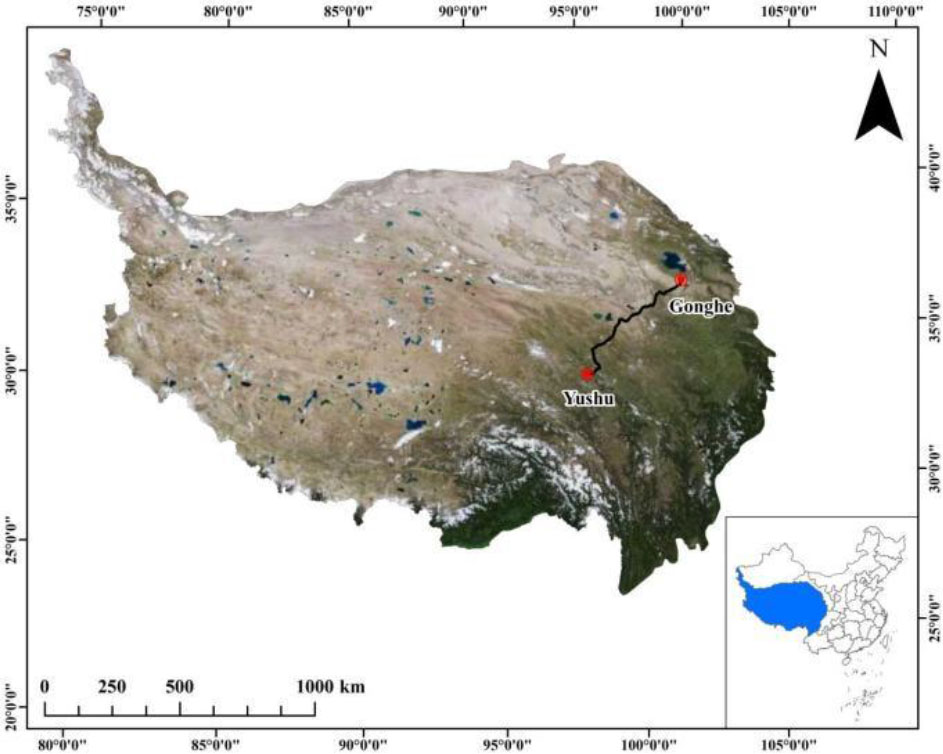
Figure 1:
Gonghe-Yushu Expressway
The rock subgrades of Gonghe-Yushu Expressway is shown in Figure 2. The weathered limestone collected on site was selected from the weathered rock subgrades.
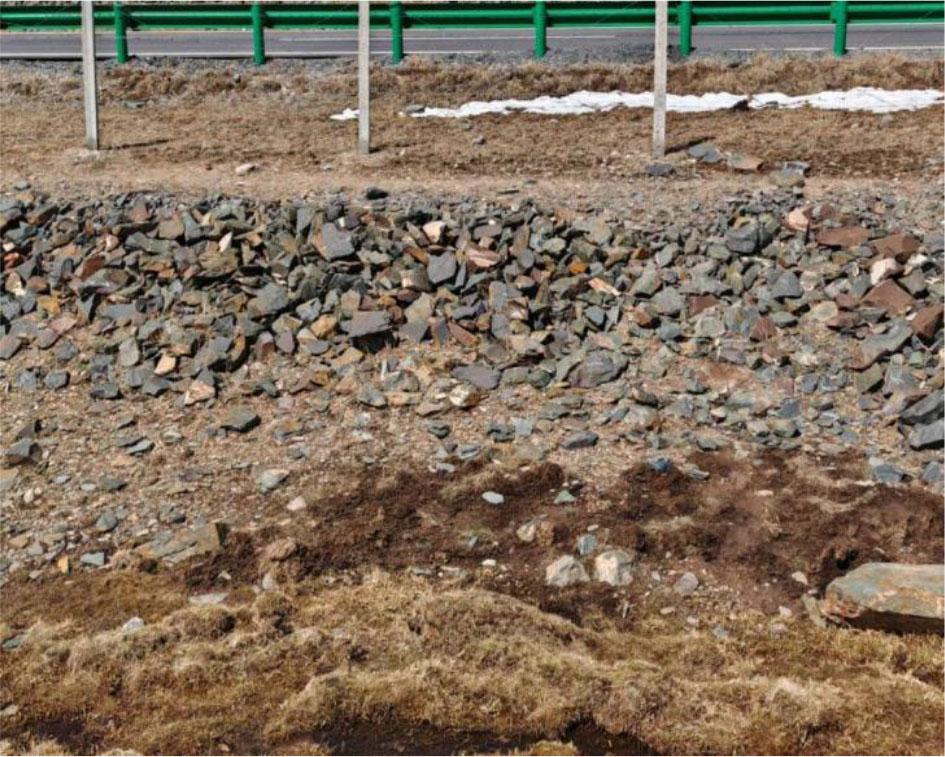
Figure 2:
Rock subgrades
Weathered limestone was crushed and sieved. Coarse aggregate size was 5–15 mm, and natural river sand (0.15–4.75 mm) was used as fine aggregate; the particle-size distribution curves are shown in Figure 3. Ordinary Portland cement (P·O 42.5) and tap water were used. The mix proportions were w/c = 0.38, coarse aggregate/cement = 1.11, and sand/cement = 2.72, with 1.5% polycarboxylate superplasticizer. Cubic specimens (150 mm × 150 mm × 150 mm) were cast for subsequent curing and testing.
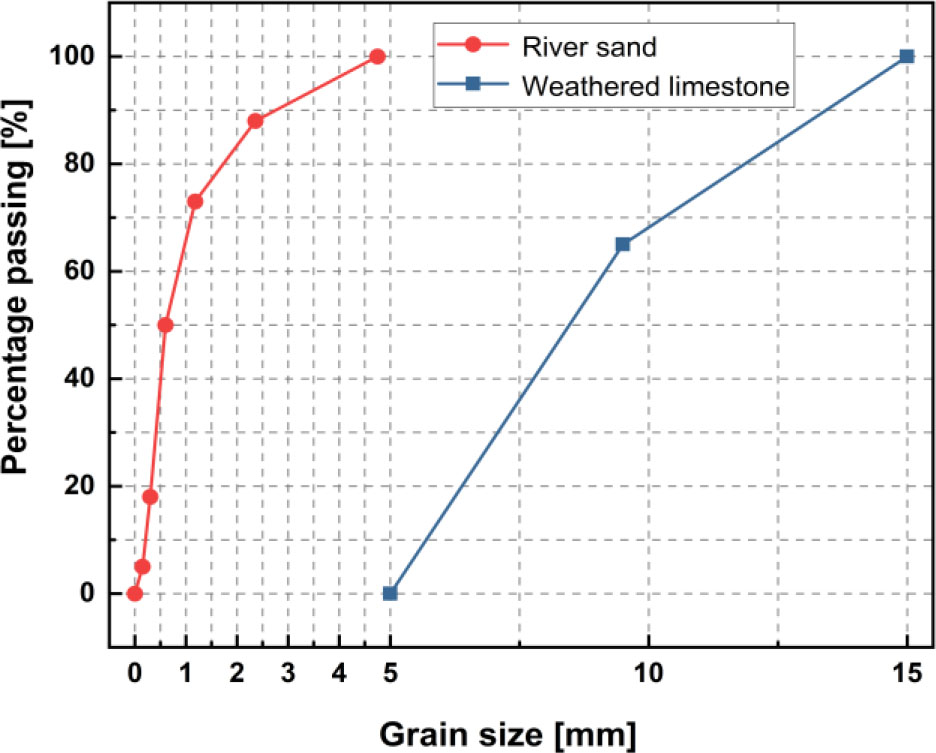
Figure 3:
Particle-size distribution curves of the aggregates
Cylindrical specimens (50 mm in diameter and 100 mm in height) were prepared following ISRM, SL/T264-2020, and JTGE41-2005. The end surfaces were ground to a smoothness < 0.05 mm, and the maximum deviation in diameter and height was controlled within 0.3 mm.
2.2. Experimental scheme
Different curing ages and carbonization durations were designed to analyze the samples. The curing ages were 3 d, 7 d and 28 d respectively, and the carbonization time was 0 h, 2 h, 4 h and 6 h respectively.
2.3. Experimental procedure
The specimens in this study underwent CO2 curing, subsequent standard curing, saturation treatment, and a series of laboratory tests. For clarity, the overall experimental workflow and key stages are summarized in Figure 4, while the test coverage and the number of specimens for each test item are provided in Table 1. Detailed procedures for the individual tests are presented in Sections 2.3.1–2.3.4.
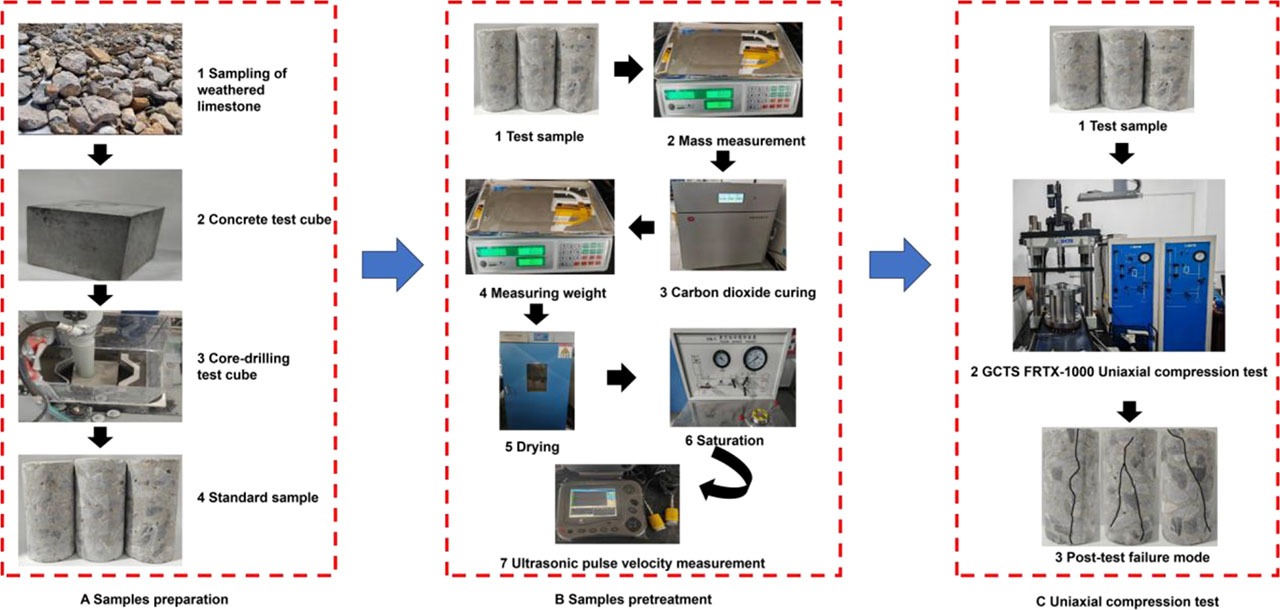
Figure 4:
Test flow chart
Table 1:
Overview of tests
| Tests | Curing age [d] | CO2 curing [h] | Number of specimens [n] |
|---|---|---|---|
| Basic physical parameters | 3 7 28 | 0 2 4 6 | 3 |
| Uniaxial compression test | |||
| XRD test | |||
| NMR test |
2.3.1. Carbon dioxide curing test
Weathered limestone specimens were subjected to carbon dioxide curing using a carbonation chamber (TMS9015) with CO2 purity of 99%. The curing conditions were set as follows: temperature 20 °C, relative humidity 70%, and CO2 concentration 20%. Specimens were cured for 0, 2, 4, and 6 hours, with three parallel specimens for each curing duration. Following CO2 curing, all specimens were placed in a standard curing room maintained at 20 ± 2 °C and ≥95% relative humidity. At curing ages of 3, 7, and 28 days, specimen mass and volume were measured, and ultrasonic pulse velocity (UPV) was recorded using a non-metallic ultrasonic testing analyzer. Specimens exhibiting significant deviations in UPV were excluded from further testing. Physical parameters under natural and dry conditions were subsequently calculated.
Prior to mechanical testing, specimens were fully saturated using a vacuum saturation device under 0.1 MPa vacuum pressure for 12 hours. After saturation, mass and UPV were measured.
The basic physical properties of the specimens were determined through experimental measurements. The dry density, saturated density, saturated water content, and porosity of each specimen were calculated to characterize the physical state and water-holding capacity of the weathered limestone samples. The basic physical parameters are shown in Table 2.
Table 2:
Basic physical parameters
| Test specimen | UPV [m/s] | ρd [g/cm3] | ρsa [g/cm3] | ω [%] | Porosity n [%] |
|---|---|---|---|---|---|
| Recovery of weathered limestone | 4310 | 2.36 | 2.46 | 4.23 | 9.98 |
For absorptive recycled aggregates, controlling the water state is an established approach to mitigate excessive water uptake during mixing and to stabilize fresh workability (García-González et al., 2014). In addition, accelerated carbonation treatments have been widely reported to reduce recycled-aggregate absorption by CaCO3 precipitation in old mortar pores and by ITZ reconstruction, providing a mechanistic basis for the present CO2-curing compensation strategy.
According to GB / T50082-2024 “Test method standard for long-term performance and durability of concrete”. In this experiment, 1 % concentration of phenolphthalein solution was configured. The 100mm * 100mm * 100mm cube sample was split along the axial direction. The phenolphthalein solution was evenly sprayed on the clean section to observe the colour change and measure the carbonization depth.
2.3.2. Uniaxial compression test
The uniaxial compression test was carried out by using the low temperature and high pressure servo control rock triaxial test system (FRTX-1000), and the stress-strain curve was measured. In order to reduce the test error and ensure the accuracy of the test results, three groups of parallel tests were used for the samples with different curing conditions.
2.3.3. X-ray diffraction test
Samples with different CO2 curing durations were ground into fine powder and analyzed by X-ray diffraction (XRD) to identify crystalline phases.
2.3.4. Nuclear magnetic resonance test
After drying and saturation, specimens were tested using a MacroMR12-150H-I low-field NMR instrument (Newmai Technology). T2 relaxation measurements were performed to obtain T2 spectra for pore-structure analysis under different curing conditions.
3. Results
3.1. Mass and UPV changes
The mass and ultrasonic pulse velocity change of concrete under different curing ages and carbonation are important indicators of its microstructure evolution and macroscopic performance. These changes profoundly reflect the hydration process, pore structure change and long-term durability characteristics of the material.
Mass and UPV were monitored at curing ages of 3, 7, and 28 days under CO2 curing durations of 0–6 h to quantify macroscopic responses to carbonation and subsequent hydration.
Figures 5 and 6 summarize the mass and UPV results of weathered limestone specimens at curing ages of 3, 7, and 28 days under CO2 curing durations of 0, 2, 4, and 6 h. The bars represent mean values, and the error bars indicate ±SE (n=3).
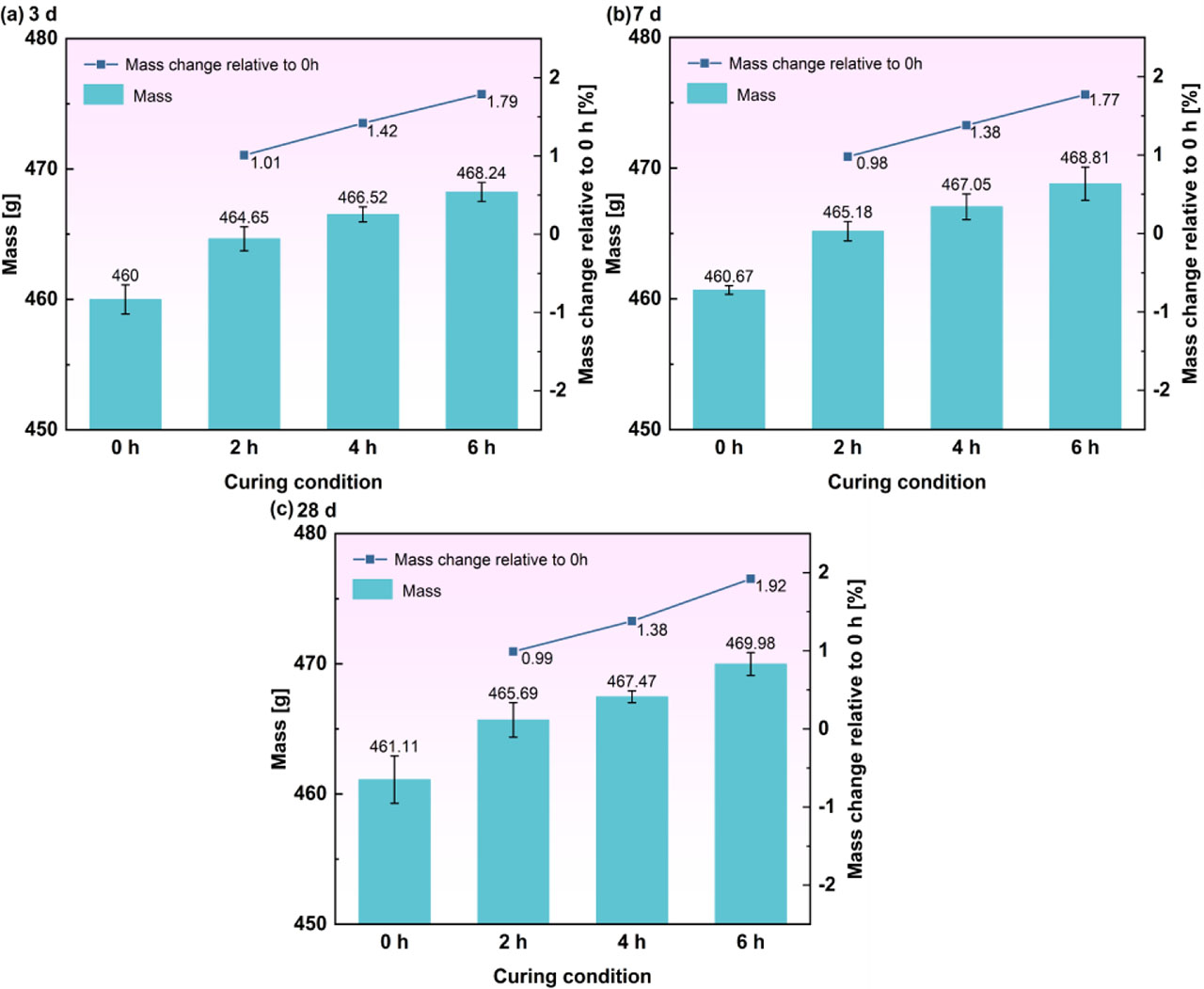
Figure 5:
Variation of mass of weathered limestone specimens
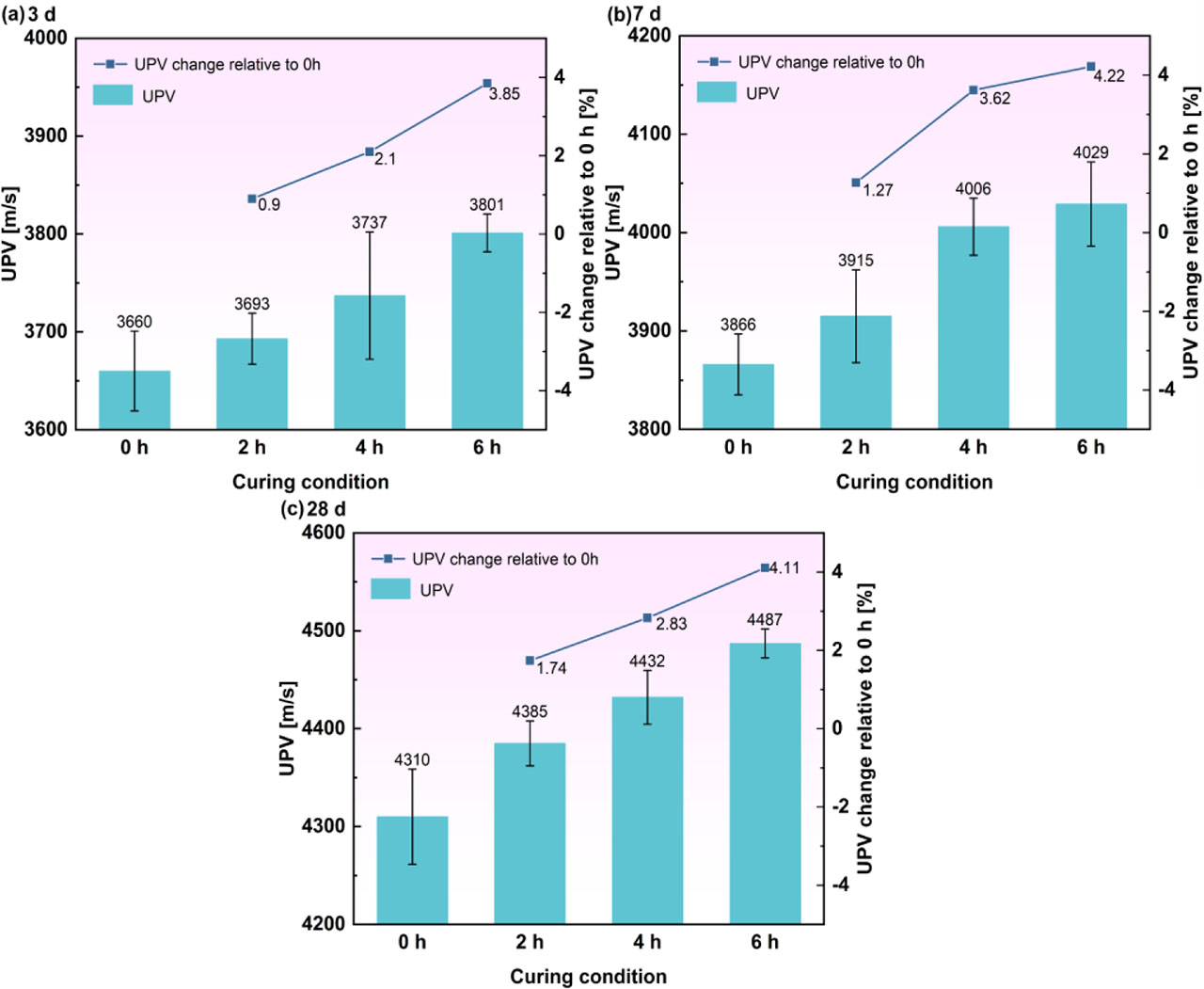
Figure 6:
Variation of UPV of weathered limestone specimens
At a given curing age, the mass increases monotonically with CO2 curing duration. Specifically, relative to the 0 h condition, the mass changes at 2, 4, and 6 h are approximately 1.01%, 1.42%, and 1.79% at 3 d; 0.98%, 1.38%, and 1.77% at 7 d; and 0.99%, 1.38%, and 1.92% at 28 d, respectively. In contrast, at a fixed CO2 curing duration, the mass differences among curing ages are comparatively small, indicating that, within the investigated window, CO2 curing duration exerts a more pronounced influence on mass than curing age. In addition, the mass gain exhibits a distinct ‘fast-first-then-slow’ characteristic: most of the increase is achieved within the first 2 h, followed by smaller incremental gains at longer durations. This kinetic signature is consistent with an initially rapid reaction in accessible pore networks, followed by progressive pore refinement and the development of a carbonate-enriched layer that increases transport resistance, causing the process to become diffusion-limited and the marginal uptake to decrease with time (Padmalal et al., 2024; Ning et al., 2025).
UPV shows a complementary trend. At the same curing age, UPV increases with CO2 curing duration, with relative increases (compared with 0 h) of approximately 0.90%, 2.10%, and 3.85% at 3 d; 1.27%, 3.62%, and 4.22% at 7 d; and 1.74%, 2.83%, and 4.11% at 28 d for CO2 curing durations of 2, 4, and 6 h, respectively. These increases can be attributed to carbonation-induced pore refinement and localized densification via CaCO3 precipitation, which improves wave-path continuity and enhances the apparent dynamic stiffness sensed by ultrasonic propagation. In contrast, at a fixed CO2 curing duration, UPV increases markedly with curing age. For instance, under the 0 h CO2-curing condition, UPV rises from 3660 m/s at a curing age of 3 days to 4310 m/s at 28 days, corresponding to an overall increase of approximately 17.8%. A comparable age-dominant increase is observed under 6 h CO2 curing, where UPV increases from 3801 m/s at 3 days to 4487 m/s at 28 days, which is about 18.0%. These results demonstrate that curing age, reflecting the progression of hydration and associated microstructural densification, governs the UPV response, whereas short-term CO2 curing provides an additional but smaller and consistent enhancement of roughly 4% within 6 h (Xian & Shao, 2021).
The increase in mass during early-age carbonation is primarily attributed to the rapid reaction of CO2 with the specimen surface. Free calcium hydroxide (CH) reacts with CO2 to form CaCO3 and H2O, followed by decalcification of the C-S-H hydration product, where Ca2+ migrates and precipitates as CaCO3. The carbonation front advances rapidly at the early stage (0–2 h) and slows as a CaCO3-rich surface layer, resulting in the characteristic “fast-first-then-slow” growth of mass. The UPV increases slightly due to pore sealing and local densification induced by the formation of continuous carbonate filling zones.
During standard curing, the slow increase in mass from 3 to 28 days is mainly driven by ongoing hydration. Hydration consumes free water and generates additional products, increasing the volume fraction of the gel phase and reducing capillary space. However, this hydration-induced mass gain is relatively minor compared with the mass increase caused by early-age carbonation. In contrast, UPV increases markedly with curing age because continuous hydration refines the pore structure and densifies the interfacial transition zone, enhancing the propagation of ultrasonic waves.
3.2. Stress-strain curve analysis
Figure 7 presents the stress-strain curves and corresponding uniaxial compressive strength of weathered limestone concrete specimens under different curing ages and CO2 curing durations, in combination with Table 3. Among them, (a) (d), (b) (e), (c) (f) are the uniaxial stress-strain curves and error bar diagrams at the curing age of 3 d, 7 d and 28 d.
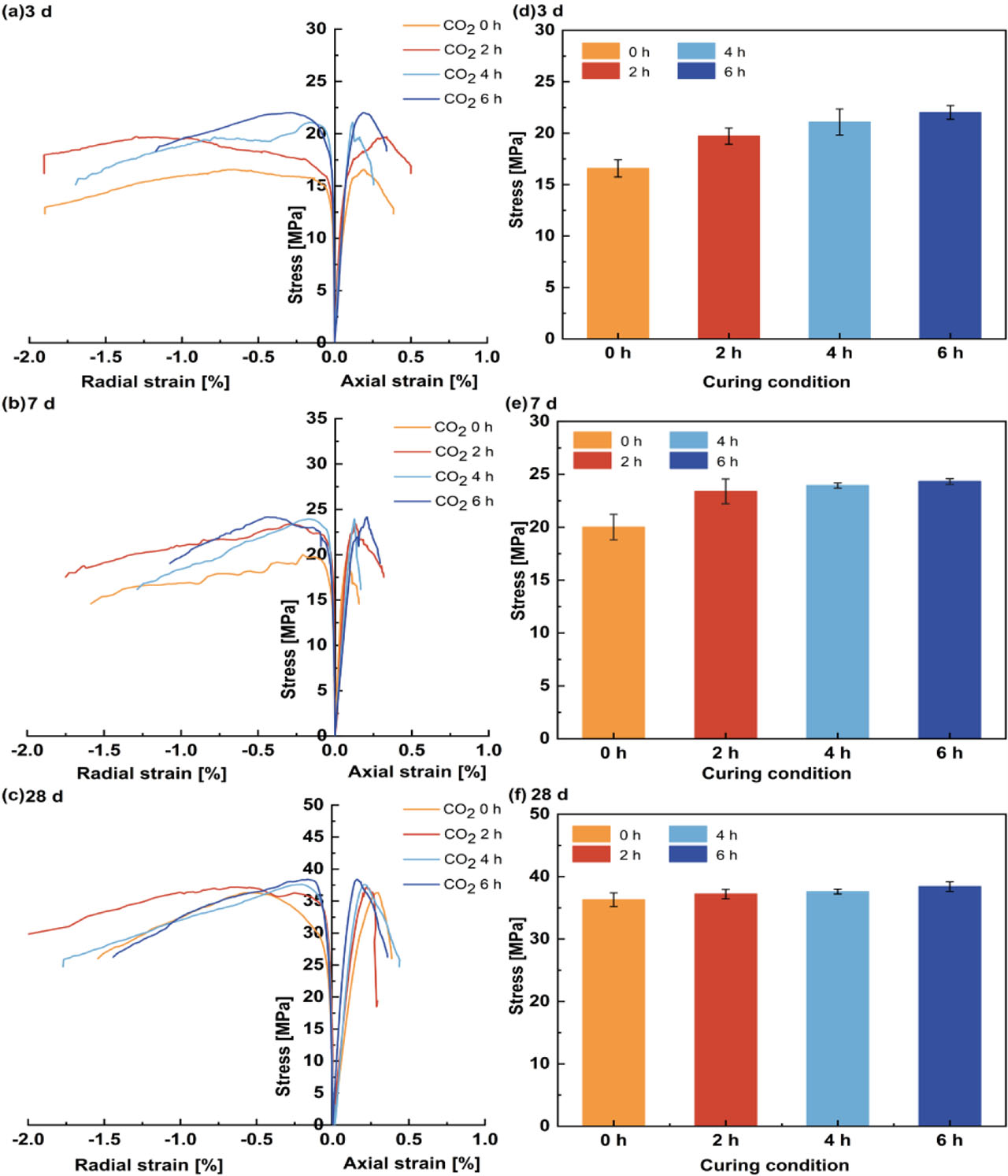
Figure 7:
Stress-strain curves of recycled weathered limestone under uniaxial compression
Table 3:
Uniaxial peak strength
| Test specimen | Curing condition | Peak strength [MPa] |
|---|---|---|
| Recovery of weathered limestone | 3 d, CO2 0 h | 16.58 |
| 3 d, CO2 2 h | 19.72 | |
| 3 d, CO2 4 h | 21.09 | |
| 3 d, CO2 6 h | 22.02 | |
| 7 d, CO2 0 h | 20.02 | |
| 7 d, CO2 2 h | 23.38 | |
| 7 d, CO2 4 h | 23.94 | |
| 7 d, CO2 6 h | 24.15 | |
| 28 d, CO2 0 h | 36.30 | |
| 28 d, CO2 2 h | 37.21 | |
| 28 d, CO2 4 h | 37.42 | |
| 28 d, CO2 6 h | 38.38 |
At an early curing age of 3 days, the uncarbonated specimen exhibits the lowest overall stress-strain response, with a peak stress of 16.58 MPa. The elastic region is short and nearly non-linear, while the post-peak decline is relatively gentle, indicating a loosely hydrated microstructure. With increasing CO2 curing time to 2 h and 4 h, the peak stress rises significantly to 19.72 MPa and 21.09 MPa, respectively, and the slope of the elastic region increases, reflecting enhanced elastic modulus and material stiffness. Extending the CO2 curing to 6 h further increases the peak stress to 22.02 MPa, although the increment slows, demonstrating the typical marginal diminishing effect of carbonation curing. The corresponding bar chart shows that CO2 curing from 0 h to 6 h increases strength by 32.81%, confirming that early-age carbonation plays a decisive role in rapid strength development. This effect is primarily due to the reaction of CO2 with Ca(OH)2 to form CaCO3, which fills pores and densifying the ITZ, thereby enhancing compressive performance.
At 7 days of curing, a similar trend is observed, with overall strength increased compared to 3 days. The uncarbonated specimen reaches 20.02 MPa, while the specimen carbonated for 6 h attains 24.15 MPa. Although the absolute strength gain remains significant, it is less pronounced than at 3 days, reflecting the progression of hydration. The ongoing formation of C-S-H gel and partial filling of capillary pores increases the inherent density of the system, reducing the relative contribution of carbonation. The stress-strain curves show more pronounced linear elastic behavior before peak stress and slightly increased elastic modulus, while the post-peak slope remains steep, indicating enhanced brittleness and limited energy dissipation.
At 28 days, the mechanical behavior is dominated by hydration. The uncarbonated specimen achieves 36.30 MPa, and the 6 h carbonated specimen reaches 38.38 MPa, an increase of only 5.73%. This clearly demonstrates the hydration-dominant effect, where long-term hydration primarily determines the mechanical properties, and additional carbonation has limited impact. The limited effect of prolonged carbonation at this stage is attributed to two factors: (1) the formation of a dense CaCO3 outer layer during early carbonation, which partially restricts water and ion transport, and (2) the gradual filling of capillary pores by hydration products, which reduces the available space for CO2 reactions. Consequently, extending carbonation time beyond early stages does not significantly enhance strength.
Figure 8 presents representative fracture patterns of weathered limestone concrete cylinders tested under uniaxial compression, for which splitting-dominated and shear-dominated failures are commonly reported as typical modes in cylindrical compression. Specimen (a) fails predominantly by axial cracking, with one or more major cracks propagating parallel to the loading direction, which is characteristic of a splitting-type failure. In contrast, specimen (c) displays a distinct inclined fracture band that traverses the cylinder, indicating a shear-dominated failure mode. Specimen (b) exhibits a mixed failure pattern, where longitudinal splitting coexists with inclined cracking, suggesting a transitional response between the splitting- and shear-dominated end members. The three specimens correspond to curing ages of 3, 7, and 28 days, respectively.
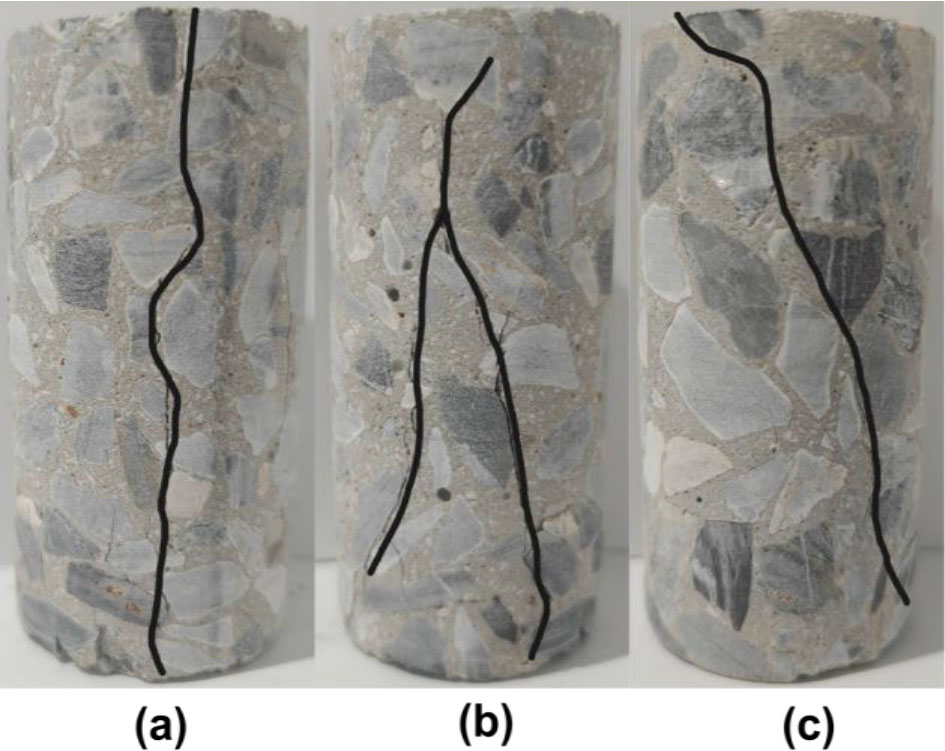
Figure 8:
Typical failure modes of weathered limestone concrete under uniaxial compression
Overall, the strength gain from CO2 curing is prominent at early age but becomes marginal at later age; meanwhile, longer CO2 curing tends to increase pre-peak stiffness and steepen the post-peak drop, indicating increased brittleness likely related to pore refinement and carbonate precipitation in the ITZ (Rostami et al., 2012; Li, Z. et al., 2019).
These observations confirm that early-age carbonation not only accelerates strength development by filling pores and reinforcing the ITZ but also affects the mechanical behavior and failure patterns of the concrete.
3.3. Results of XRD analysis
Under varying curing conditions, the mineral composition changes of concrete samples were examined by XRD. The XRD patterns are presented in Figure 9, with panels (a), (b), and (c) corresponding to curing ages of 3 days, 7 days, and 28 days, respectively. Figure 10 illustrates the mineral composition of weathered limestone under different curing regimes: panels (a) and (b) show the results at a curing age of 3 days with carbonation durations of 0 h and 6 h, respectively; panels (c) and (d) correspond to a curing age of 28 days with carbonation times of 0 h and 6 h, respectively.
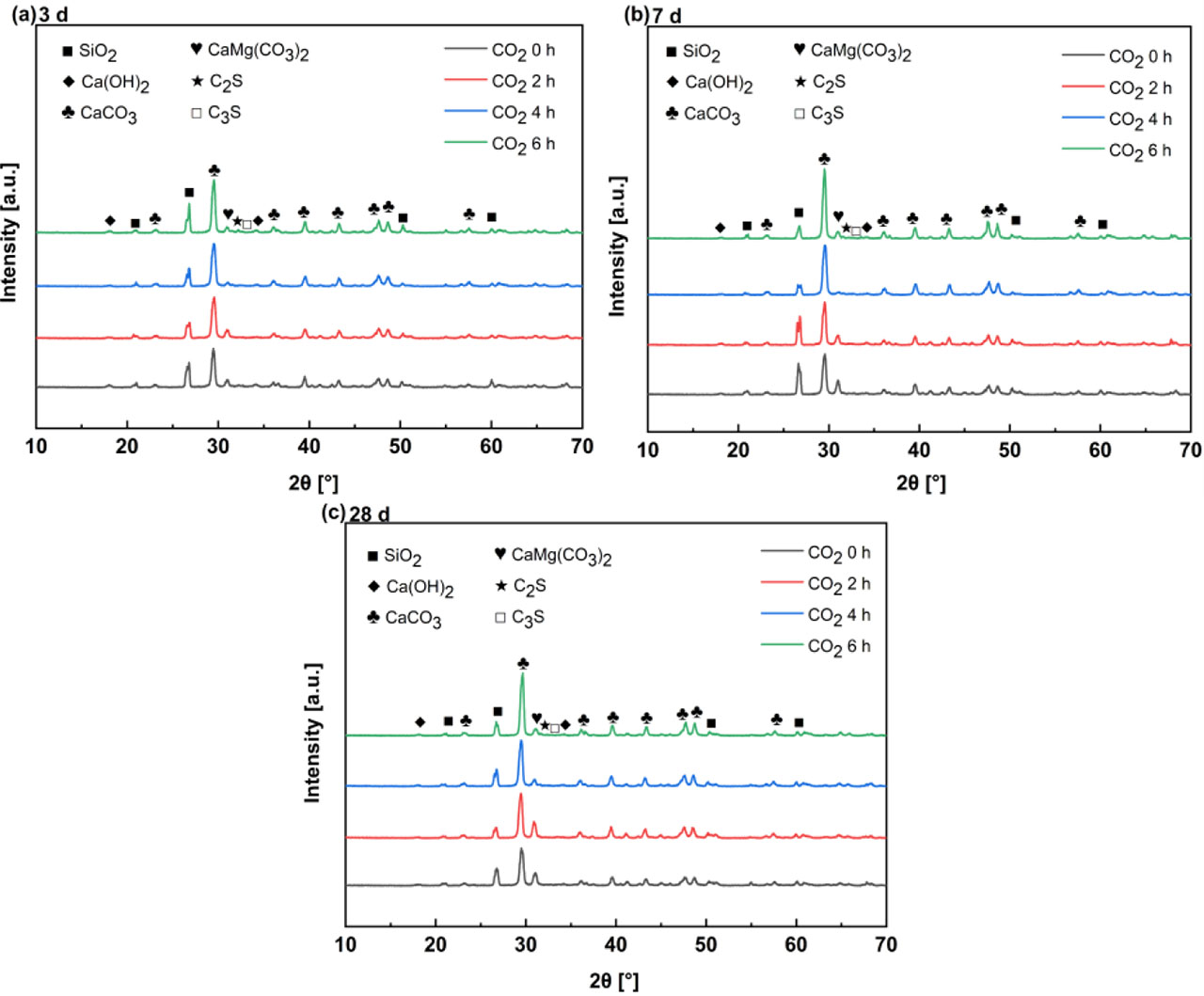
Figure 9:
X-ray diffraction patterns and mineral composition of weathered limestone concrete
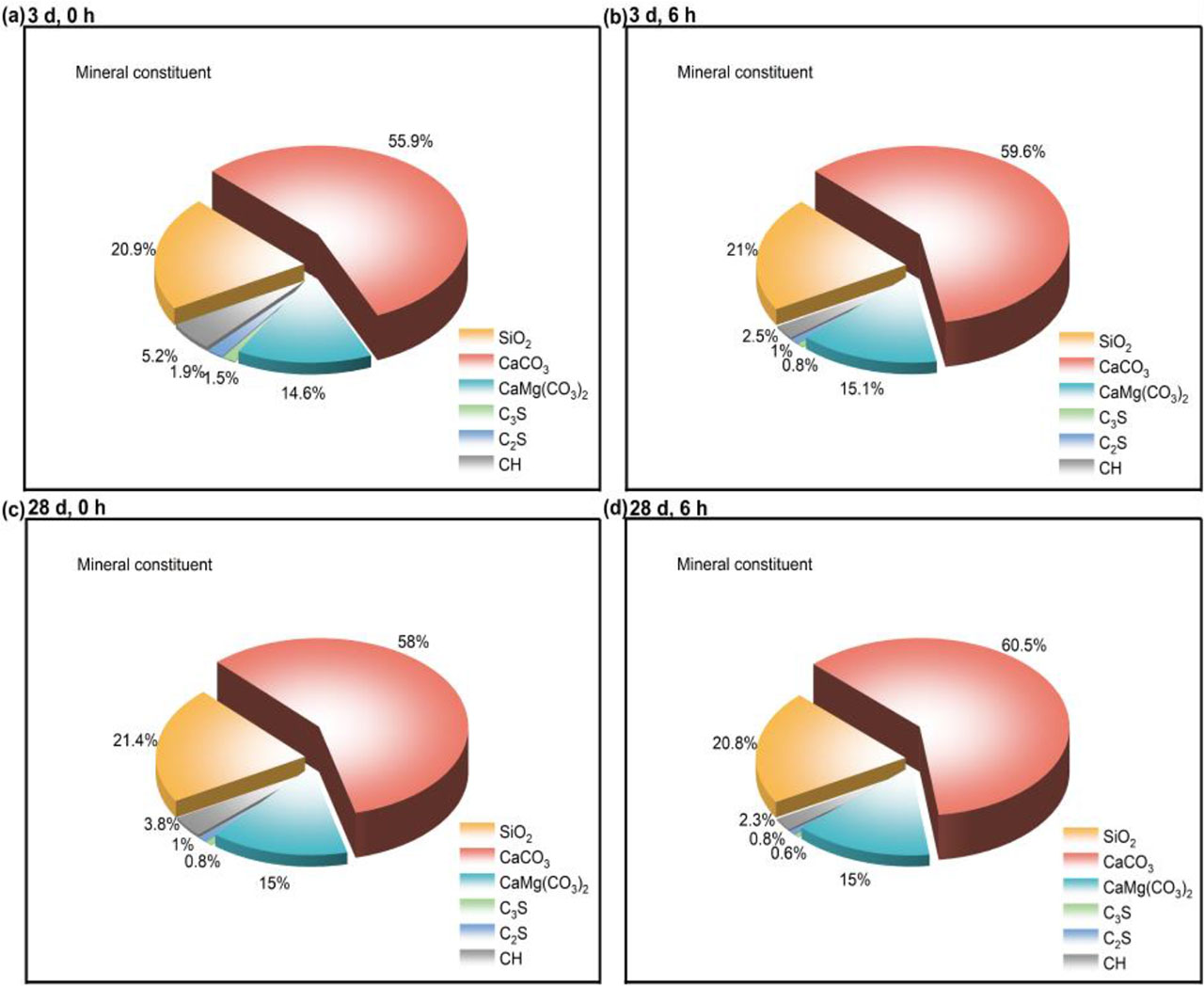
Figure 10:
X-ray diffraction patterns and mineral composition of weathered limestone concrete
Figures 9 and 10 report the crystalline-phase evolution of weathered limestone concrete exposed to CO2 curing for 0–6 h at curing ages of 3, 7, and 28 d. Phase identification is supported by diagnostic reflections under Cu Kα radiation: portlandite Ca (OH)2 is tracked by its characteristic peaks near 2θ of 18.1°, 34.1°, and 47.1°. Calcite CaCO3 is tracked by its major reflection near 29.4° together with secondary reflections such as 39.4° and 43.2°. Dolomite CaMg(CO3)2 shows a characteristic reflection near 31.0°. Quartz SiO2 is evidenced by the strong reflections near 20.8° and 26.6°.
At a curing age of 3 d, the XRD patterns in Figure 9 (a) show a clear attenuation of portlandite reflections at about 18.1° and 34.1° as CO2 curing duration increases, while carbonate-related reflections become more prominent, especially the calcite reflection near 29.4° and its accompanying peaks around 39.4° and 43.2°. The corresponding phase fractions in Figure 10 indicate that CaCO3 increases from 55.9% at 0 h to 59.6% at 6 h, whereas CH decreases from 1.5% to 0.8%. These coupled changes provide direct evidence that Ca (OH)2 is converted to CaCO3 during carbonation, with portlandite being one of the first hydration products to undergo carbonation and form carbonate phases.
At a curing age of 7 d, Figure 9 (b) retains the same direction of change with increasing CO2 curing duration, namely progressive weakening of CH reflections and strengthening of carbonate reflections. However, the contrast between adjacent CO2 curing durations is smaller than at 3 d, as reflected by the more gradual change in peak prominence across the 0–6 h series. This observation indicates that the incremental phase conversion achievable within a short CO2-curing window decreases with age.
At a curing age of 28 d, CH reflections in Figure 9 (c) are weak, and the remaining evolution with CO2 curing is primarily manifested as a further increase in carbonate-related reflections together with a marginal additional reduction of CH. Figure 10 quantifies this net change between 0 h and 6 h at 28 d, where CaCO3 increases from 58.0% to 60.5% and CH decreases from 0.8% to 0.6%. The smaller magnitude of CH depletion at 28 d compared with 3 d indicates that short-term carbonation produces a reduced additional conversion of crystalline CH at later age, while carbonate accumulation continues but at a lower marginal rate within the same CO2-curing duration window.
In summary, the XRD results show a coupled trend of portlandite depletion and carbonate enrichment with increasing CO2 curing duration, as reflected by the systematic weakening of CH reflections and the intensification of carbonate-related reflections (Shao et al., 2006). The magnitude of these changes is more pronounced at early age and becomes progressively less evident at later ages, indicating a reduced incremental crystalline-phase conversion within the same short CO2-curing window as curing age increases.
3.4. NMR test results and analysis
The evolution of pore structure in recycled weathered limestone concrete is influenced by both carbonation and curing age. The NMR T2 spectra and porosity measurements provide a quantitative basis for elucidating the underlying pore structure development mechanisms. According to NMR theory, the relationship between the T2 relaxation time and pore size can be expressed by the following equation:
Where:ρ2 - the transverse surface relaxivity,
rc - the pore radius,
Fs - the geometric factor,
T2 - relaxation time.
Based on this relationship, the T2 relaxation times can be classified into three categories: short relaxation (0.01–10ms), medium relaxation (10–100ms), and long relaxation (100–10,000ms). The relaxation time reflects the degree of water confinement within the pore: shorter relaxation times correspond to more strongly bound water and, consequently, smaller pore sizes.
The T2 spectra of the samples under different curing conditions are shown in Figure 11. Where, (a), (d); (b), (e); (c) and (f) are the T2 spectrum and porosity diagram of the sample at the curing age of 3 d, 7 d and 28 d, respectively.
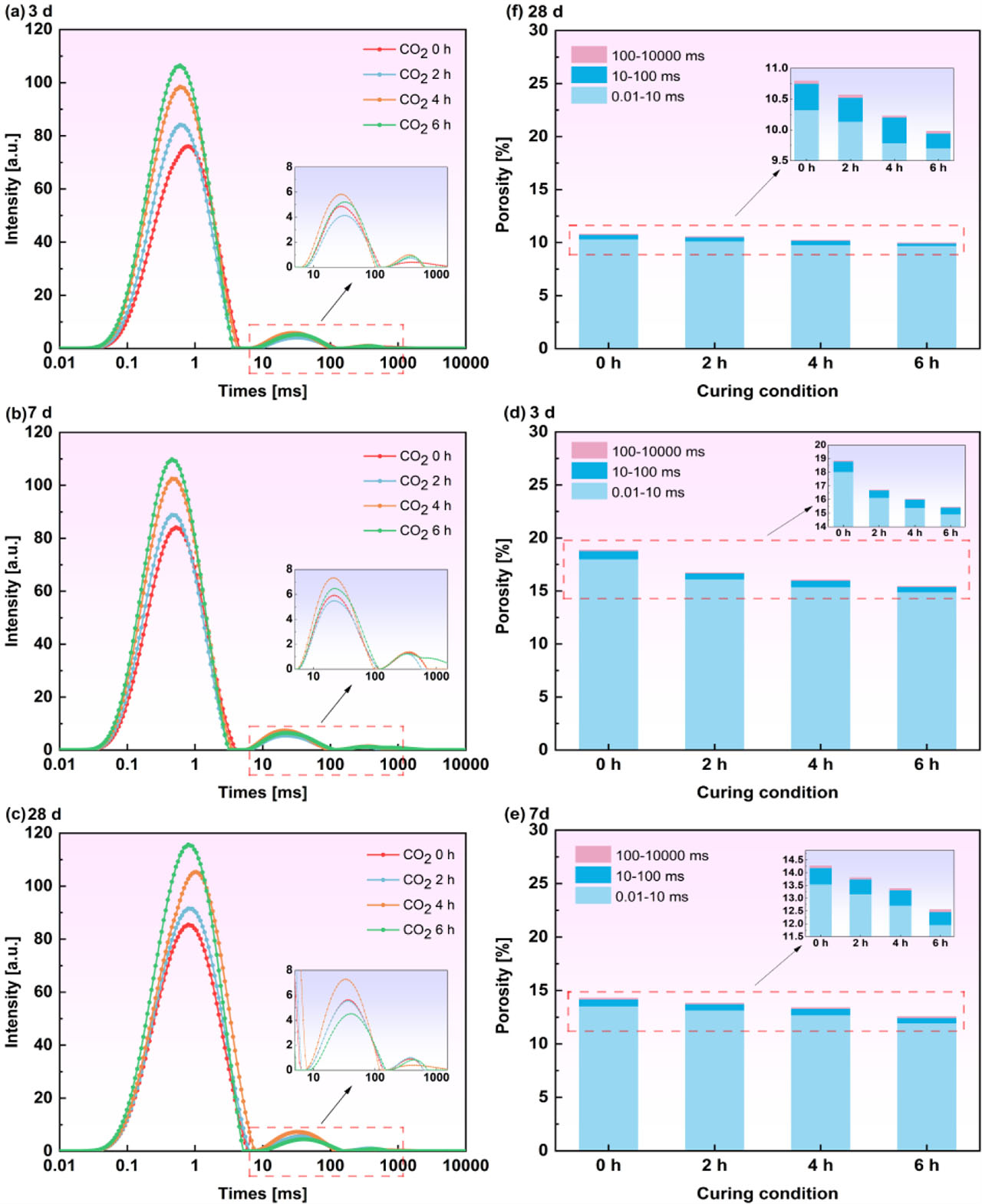
Figure 11:
T2 spectra of recycled weathered limestone under different curing conditions
From the perspective of carbonation duration, increasing CO2 curing time (0–6 h) shifts the T2 spectra toward shorter relaxation times: the short-T2 peak intensity increases while the long-T2 peak area decreases, indicating that larger or connected pores are progressively refined. This is mainly driven by CaCO3 precipitation from the carbonation of Ca(OH)2, which deposits in capillary pores and the ITZ and reduces pore connectivity. The porosity reduction is most evident at 4–6 h, whereas further densification of the surface layer may hinder CO2 ingress and slow the subsequent reduction rate (Li, Z. et al., 2019; Xian & Shao, 2021).
From the perspective of curing age, the porosity of specimens at 3, 7, and 28 days exhibits a continuous decrease, with the main peak of the T2 spectrum shifting toward shorter relaxation times. This long-term trend is primarily attributed to ongoing hydration, during which unhydrated C3S and C2S react to form C-S-H gel and additional Ca(OH)2. These hydration products fill capillary and some macropores, reducing overall porosity. Under CO2 curing, part of the CH is further converted into CaCO3, producing a synergistic effect of crystal deposition and gel filling. With increasing age, this synergy between hydration and carbonation products progressively densifies the pore structure. By 28 days, the T2 spectrum shows that peaks in the long relaxation time region almost disappear, and porosity stabilizes, reflecting the long-term equilibrium of the hydration-carbonation coupling reaction.
In summary, CO2 curing primarily governs the rapid transformation of pore structure at early ages through CaCO3 deposition, while curing age controls the long-term trend of porosity reduction and matrix densification. The combined action of hydration and carbonation products explains both the shift from long to short relaxation times in T2 spectra and the gradual decline in porosity. This microstructural optimization provides a basis for improved durability and mechanical properties, highlighting the complementary roles of CO2 curing and age growth in enhancing concrete pore structure.
4. Carbonation Mechanism Analysis
4.1. Carbonation Depth and Duration
For concrete materials, predicting durability through service-life evaluation is of great engineering significance. Regarding carbonation resistance, according to Fick’s first law of diffusion, the carbonation depth is proportional to the square root of carbonation time, expressed as:
Where:x - the carbonation depth,
k - the carbonation coefficient influenced by multiple factors,
t - the carbonation duration.
Figure 12 shows the phenolphthalein colour boundary used to determine carbonation depth (pink: uncarbonized; colourless: carbonized) for CO2 curing durations of 0, 2, 4, and 6 h.
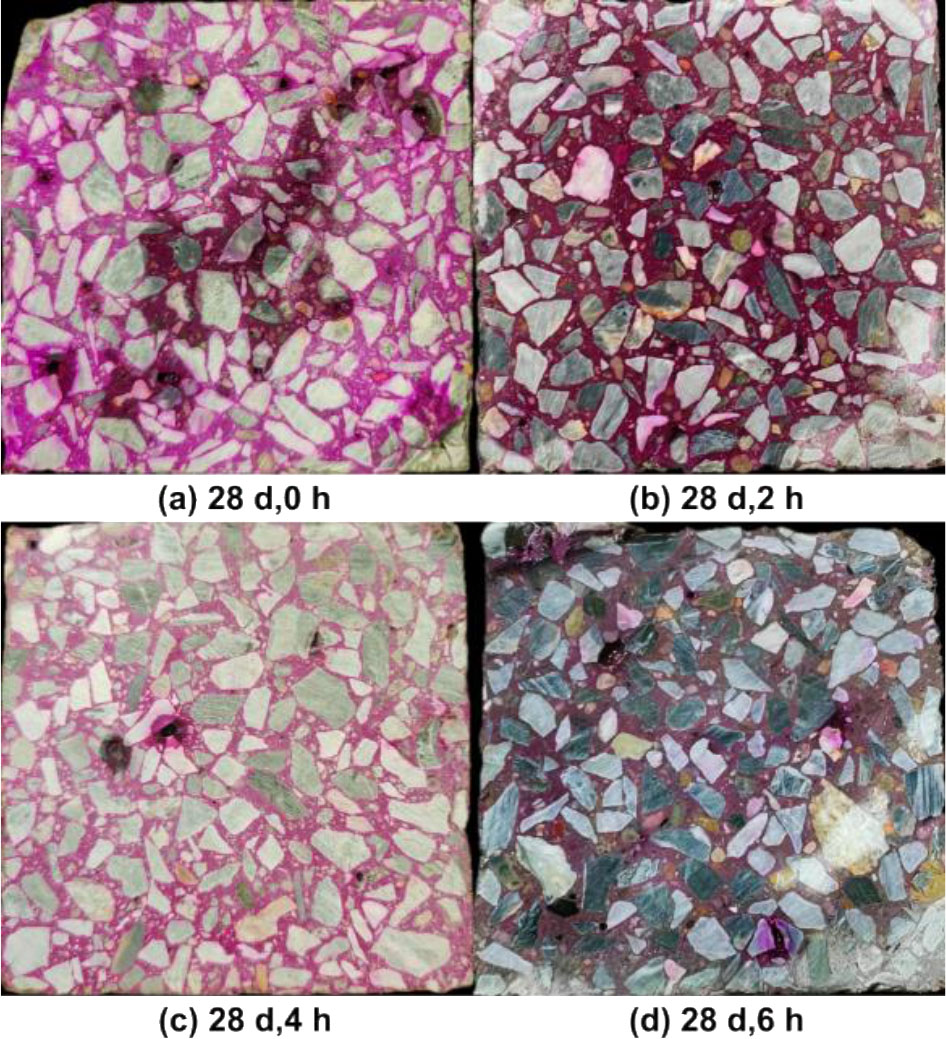
Figure 12:
Colour change of sample
As shown in Figure 13, the carbonation depth curve yields a carbonation coefficient k of 2.60[mm/√d], indicating favorable carbonation resistance of the concrete.
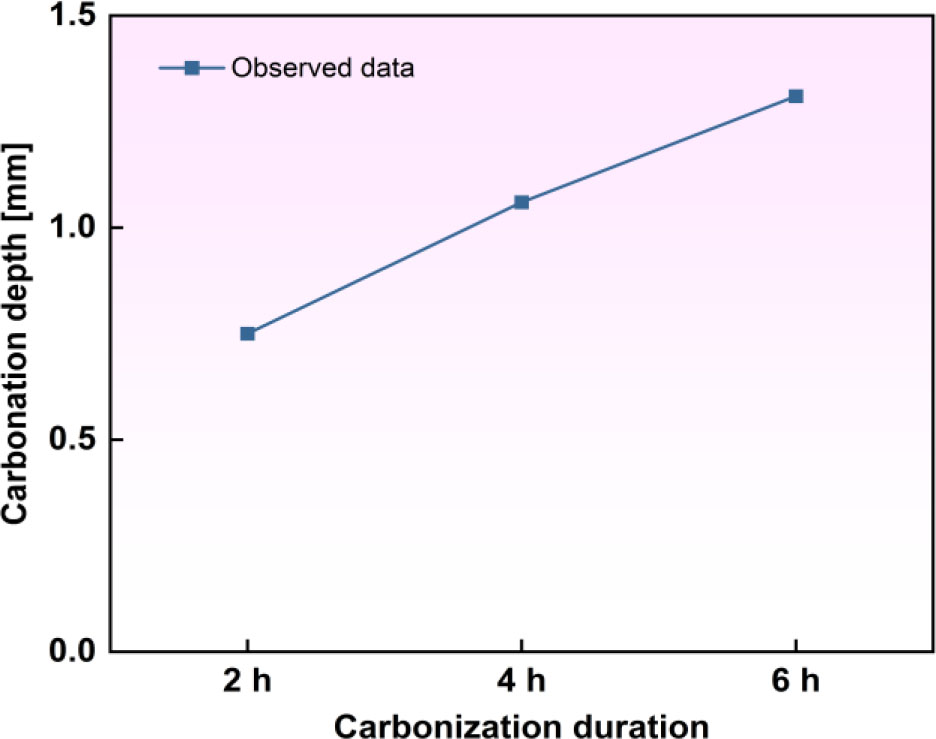
Figure 13:
Carbonation depth of recycled weathered limestone concrete
4.2. Mechanism analysis
In the carbonation experiment, carbon dioxide diffuses from the surface to the inside through the concrete pore system, and dissolves in the pore liquid phase to form carbonic acid, which then undergoes a series of chemical reactions with the cement hydration products. The process follows the gas-liquid-solid three-phase reaction mechanism, in which Ca (OH)2 is the main reactant, and CaCO3 crystal is formed by carbonation reaction and releases water. At the same time, the silicate phase such as C-S-H gel also undergoes decalcification decomposition, resulting in the degradation of its cementitious properties.
As illustrated in Figure 14, the stick models represent the schematic progression of the main carbonation and hydration reactions of recycled weathered limestone concrete with increasing CO2 curing time and curing age. Labels (a), (b), (c), and (d) correspond to reactions (3), (4), (5), and (6), respectively, highlighting the distinct carbonation-hydration processes at different stages.
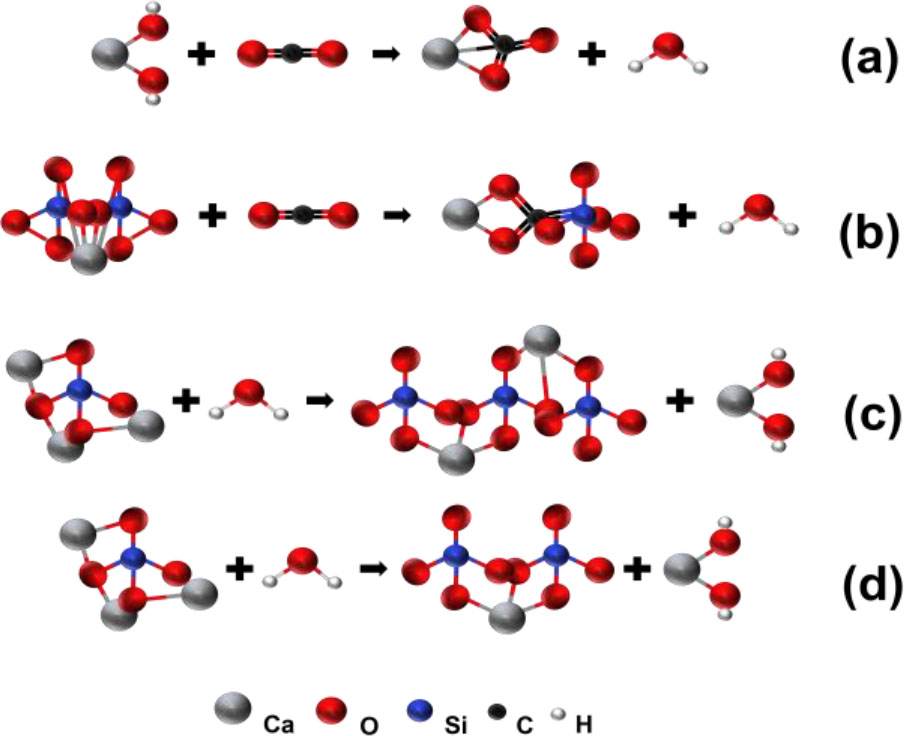
Figure 14:
Schematic illustration of carbonation-hydration reactions
The main hydration reactions of the recycled weathered limestone concrete at different stages are summarized as follows:
By integrating the results from Figures 7, 9, and 11, the evolution of the matrix can be summarized as follows:
At 0 h carbonation, the 3-day specimen exhibits insufficient hydration, low C-S-H connectivity, and limited CH reserve. The T2 spectrum shows a dominant peak at longer relaxation times with an extended tail, while the uniaxial stress-strain curve displays the lowest peak stress and elastic modulus. In contrast, at 7 d, the matrix is denser, the T2 main peak shifts to shorter times, the tail is reduced, and mechanical properties increase. The 28-day specimen shows the most mature structure, with a flatter XRD background, minimal porosity, a left-shifted T2 peak, and the highest mechanical indices.
At 2 h carbonation, all ages enter the “CH-prioritized carbonation” stage. XRD reveals increased CaCO3 peaks and decreased CH peaks, with amplitude growing with age. T2 spectra show systematic left-shifts and increased peak intensities, accompanied by attenuation of the long-time tail, indicating pore refinement and reduced connectivity due to CaCO3 nucleation and filling. Correspondingly, the uniaxial curves exhibit significant increases in peak stress and initial tangent modulus, with the 28-day specimen showing the largest gains, reflecting the combined effect of sufficient CH supply and favorable pore topology for CaCO3 deposition.
At 4 h carbonation, CH carbonation continues and reaches the stage of maximum densification. XRD shows the clearest contrast between CaCO3 and CH, and T2 spectra exhibit prominent short-time peaks with minimal long-time tails at 7 d and 28 d, indicating that CaCO3 deposition has transitioned from point nucleation to sheet-like penetration, significantly reducing macropore connectivity. The uniaxial curves show improved strength and stiffness, with negligible post-peak softening, suggesting optimized load-transfer pathways within the matrix. At this stage, densification and ITZ strengthening dominate mechanical performance, while C-S-H decalcification and microcrack formation remain minimal.
At 6 h carbonation, CH carbonation persists, but age-dependent differentiation emerges. In 7-day and 28-day specimens, surface-layer C-S-H decalcification begins, CaCO3 content further increases but shows convergence, and CH reduction is no longer linear. T2 spectra still shift left, but with reduced rate, and some cases show shoulder peaks or minor long-tail rebound, indicating partial shortening of the effective gel connectivity network. Uniaxial curves exhibit stabilized or slightly decreased peak stress and steeper post-peak softening, reflecting toughness reduction due to surface decalcification and micro-scale volumetric changes.
In summary, early-age hydration defines the baseline availability of reactive Ca2+ and pore structure. early-age carbonation is initially dominated by CH carbonation, with the 2 h reaction being most pronounced. At 4 h, pore refinement and load-bearing chain optimization are achieved, while 6 h carbonation induces more pronounced C-S-H decalcification, leading to increased brittleness post-peak. Overall, early-age carbonation significantly enhances early-age strength, but its effect gradually diminishes with increasing age, demonstrating the characteristic “marginal diminishing effect” (Han et al., 2020).
5. Discussion
This study demonstrates that early-age CO2 curing effectively enhances the early strength and microstructure of concrete made with recycled weathered limestone.
5.1. Interpretation of Results
Across curing ages, mass uptake, UPV, and compressive response show a consistent cross-scale signature under different CO2-curing durations. The measured CO2 uptake is about 1–2% and exhibits a fast-first-then-slow trend with diminishing returns beyond 4 h, which is consistent with accelerated carbonation transitioning from reaction control to diffusion limitation due to near-surface CaCO3 accumulation and self-sealing (Padmalal et al., 2024; Han et al., 2024; Ning et al., 2025). The same transport-limited behavior is also consistent with reported RH sensitivity and later-stage plateauing kinetics (Ashraf & Olek, 2016; Saeki et al., 2025). In parallel, UPV increases by up to 4% with CO2 curing, indicating enhanced phase continuity and higher apparent stiffness, which aligns with porosity-reduction-driven elastic-property gains observed in carbonated cementitious materials (Zhang et al., 2020; Li et al., 2019).
Benchmarking against ordinary concrete. At 28 d, the uncarbonated weathered-limestone concrete in this study reached 36.30 MPa, which is comparable to or higher than the conventionally water-cured normal-strength Portland cement concrete reported by Wang et al. (2022), where the 28 d compressive strength of the water-cured control ranged from 26.73 to 31.58 MPa depending on cylinder size; accordingly, the present 28 d baseline exceeds that ordinary-concrete range by 4.72–9.57 MPa (approximately 14.9–35.8%) (Wang et al., 2022). In Li et al. (2019), the conventionally moisture-cured reference at 28 d is reported at approximately 69.8 MPa, but the corresponding mixture design adopts a low water-to-binder ratio (w/c = 0.35) and a high cement content (450 kg/m3), which places it in a substantially higher strength-grade regime; therefore, it should be interpreted as a high-strength benchmark rather than a direct counterpart to the present cold-region recycled weathered-limestone system (Li et al., 2019).
XRD and pore-related observations corroborate the macroscopic trends described above. The XRD patterns indicate a progressive consumption of portlandite together with an enrichment of carbonate phases, which is consistent with the carbonation reaction forming calcium carbonate (including different polymorphs) during CO2 curing (Shao et al., 2006). The NMR results suggest pore refinement, as evidenced by a shift of the T2 distribution toward shorter relaxation components. This observation is consistent with carbonate precipitation filling and partially bridging pores, while ongoing hydration further consumes capillary pore space, which together helps explain the simultaneous increases in UPV and early compressive strength (Li et al., 2019; Zhang et al., 2020).
5.2. Research Significance and Limitations
From an aggregate-suitability viewpoint, the recycled weathered limestone is porous and absorptive, which may disturb the local effective w/c ratio near the ITZ and reduce early stiffness/strength if unmanaged. Water-state control such as short-duration pre-saturation is an established strategy to stabilize workability with limited strength penalty (García-González et al., 2014). In addition, CO2-based treatments for recycled aggregates have been shown to reduce absorption and improve ITZ integrity via CaCO3 filling and interface reconstruction, providing a mechanistic basis for using short-term CO2 curing as a compensation route for porous aggregates (Li et al., 2020; Wu et al., 2022; Lu et al., 2023; Bergmans et al., 2024).
The engineering motivation is that crushed-rock embankments in permafrost corridors are sensitive to clogging by aeolian deposits and weathering products, which degrades convective cooling and motivates local recycling of maintenance wastes into value-added materials (Chen et al., 2018; Yu et al., 2020; Kong et al., 2019). From a sustainability standpoint, CO2 mineralization can deliver measurable but bounded net benefits that depend on process energy and CO2 logistics (Driver et al., 2024; Zajac et al., 2022), and recycled-concrete mineralization has demonstrated regional-scale storage potential and industrially compatible operation windows (Rosa et al., 2022; Izoret et al., 2023; Suescum-Morales et al., 2023). Therefore, combining recycled weathered limestone utilization with staged CO2 curing offers a plausible pathway for cold-region road materials, while comprehensive aggregate qualification and durability validation remain the key next steps.
6. Conclusion
This study shows that short-duration early-age CO2 curing is an effective route to enhance recycled weathered limestone concrete for cold-region applications. CO2 curing yields rapid densification, as evidenced by about 1–2% mass uptake and up to 4% UPV increase, and it significantly improves early strength, while the later-age gain is modest, indicating diminishing returns with prolonged exposure. The improvements are explained by carbonation–hydration coupling: XRD confirms progressive portlandite consumption with carbonate enrichment, and NMR indicates pore refinement, together implying matrix and ITZ densification. Recycling maintenance-derived weathered limestone from crushed-rock roadbeds, combined with controlled early-age CO2 curing, offers a practical pathway for waste valorization and CO2 mineralization in permafrost road engineering.
Acknowledgements
This work was supported by the National Natural Science Foundation of China (Nos. 42473059, 42161026, 41801046); Transportation Science and Technology Project of Qinghai Province, China (No. 2025–02); Qinghai Province Central Government Guidance Fund for Local Technological Development (2025ZY013); Qinghai Institute of Technology for the support of “Kunlun Talent” Talent Introduction Research Project (2025-QLGKLYCZX-034).
Notes
[1] Contributed by Author Contributions
W.X. contributed to writing the original draft, visualization, and methodology. W.Q. was responsible for writing– review and editing, supervision, project administration, and funding acquisition. F.J. participated in methodology and investigation. L.Y. assisted in visualization and validation. X.Y. contributed to investigation. S.G. supported visualization and methodology. All authors critically reviewed and approved the final version of the manuscript and agreed to be accountable for all aspects of the work.