

1. Introduction
Road traffic noise represents one of the most widespread forms of environmental pollution in both urban and peri-urban areas (Jandacka et al., 2024), with well-documented implications for human health, ecological integrity, and overall landscape quality. According to the European Environment Agency (2023), more than 113 million residents within the European Union are chronically exposed to harmful levels of road traffic noise. Prolonged exposure has been conclusively associated with an increased risk of cardiovascular disease, sleep disturbance, cognitive impairment, and psychosocial stress (World Health Organization [WHO], 2018).
Beyond anthropocentric concerns, environmental noise also imposes a substantial ecological burden—altering animal behaviour, disrupting interspecies acoustic communication, and influencing the spatial distribution of sensitive species (Barber et al., 2010; Kight & Swaddle, 2011). These findings underline the need for an integrated approach that links environmental engineering, landscape ecology, and spatial planning.
Despite technological advancements and increasingly stringent regulatory frameworks, conventional noise mitigation strategies—particularly noise barriers—are often implemented as isolated technical measures. Such interventions are typically designed with limited consideration for the ecological, visual, and spatial characteristics of the surrounding environment. As a result, they may fragment the visual character of the landscape, diminish its aesthetic and cultural value, and reduce public acceptance (Antrop, 2005; Brown & Corry, 2011). This issue is especially pronounced in topographically diverse and ecologically sensitive areas where transport infrastructure intersects heterogeneous landscapes.
The R2 expressway section between Pravotice and Dolné Vestenice, located in the Trenčín region of Slovakia, exemplifies such spatial and environmental complexity. The corridor traverses a mosaic of semi-natural habitats, agricultural land, and built-up areas. With the increase in vehicular traffic volume, noise exposure has become a growing concern, requiring the implementation of measures that are not only acoustically efficient but also ecologically sustainable and visually compatible with the surrounding landscape.
In the Slovak context, several studies have investigated the acoustic impacts of road traffic and the long-term performance of mitigation materials on expressway segments. Research on the R3 expressway has demonstrated the spatial variability of noise propagation and highlighted the influence of terrain morphology and land use on exposure patterns (Trojanová & Malatincová, 2024). Long-term evaluations of asphalt mixtures modified with crumb rubber (CRM) have further confirmed their potential to reduce surface-generated noise under Slovak conditions (Hodasová, Trojanová, & Rubint, 2023). However, most of these studies focus primarily on acoustic performance, without adequately addressing the broader landscape and environmental context.
Recent scholarship emphasizes the importance of incorporating landscape character as a fundamental parameter in the planning and design of noise mitigation infrastructure (Forman et al., 2003; Van Renterghem et al., 2014; Benedikt & Jeska, 2020). Landscape character—defined as the spatial expression of natural landforms, land-use patterns, visual structure, and cultural identity—has been shown to affect not only the physical propagation of noise but also its perceptual and psychological impacts (Ode et al., 2008; Kang, 2007).
This study therefore focuses on the integrated assessment and optimization of road traffic noise mitigation measures along the R2 Pravotice–Dolné Vestenice section, taking into account their acoustic, ecological, visual, and economic dimensions. By combining real field measurements from 2004 with predictive modelling using the HLUK+ software (version 8.28) for reference years 2016, 2026, and 2036, the study evaluates the effectiveness of different mitigation variants and their compatibility with the landscape and spatial conditions of the area.
This interdisciplinary framework contributes to the advancement of sustainable and context-sensitive infrastructure planning, in which technical, environmental, and aesthetic aspects are evaluated comprehensively to enhance the efficiency, long-term viability, and social acceptance of road noise mitigation strategies.
2. Methodology
2.1. Research Design
The study is designed as an interdisciplinary analytical investigation that integrates empirical field measurements with predictive numerical modelling to assess road traffic noise exposure and the effectiveness of mitigation measures. Although acoustic measurements were conducted in situ, the methodological approach is semi-empirical rather than experimental, as the field data primarily serve for model calibration and validation rather than for manipulation of independent variables.
The methodological framework consists of five consecutive stages:
Acquisition and analysis of spatial, acoustic, and traffic data,
Calibration and validation of the predictive noise model using field measurements (reference year 2004),
Simulation of noise propagation for forecast years 2016, 2026, and 2036,
Multi-criteria optimisation of mitigation measures, and
Regulatory and environmental evaluation of the proposed interventions.
All procedures comply with Slovak national legislation—specifically Act No. 355/2007 Coll. on the Protection, Support and Development of Public Health and Decree No. 549/2007 Coll. on Permissible Levels of Noise, Infrasound and Vibrations—and conform to STN EN 1793, STN EN 1794, and TKP 29 (Technical Conditions for Roads).
2.2. Data and Materials
The methodological apparatus combines precise acoustic instrumentation, a GIS-supported predictive modelling environment, and multi-criteria evaluation, ensuring scientific reliability, transparency, and replicability.
Study Area and Spatial Context
The spatial configuration of the proposed R2 expressway segment, including its alignment and surrounding context, is shown in Figure 1. The route connects to the existing R2 section southwest of Bánovce nad Bebravou and extends through the municipalities of Brezolupy, Jerichov, Hradište, and Dolné Vestenice, terminating near Horné Vestenice.
To identify critical acoustic exposure zones, three monitoring locations—designated as reception points P1, P2, and P3—were selected based on land use sensitivity and proximity to the expressway. The spatial positioning of these reception points is shown in Figures 2–4, and each was included in both the field measurements and simulation model.
Spatial data were processed in ArcGIS Pro (ver. 3.2) using orthophotos and cadastral layers provided by the Geodesy, Cartography and Cadastre Authority of the Slovak Republic (ÚGKK SR, 2023).
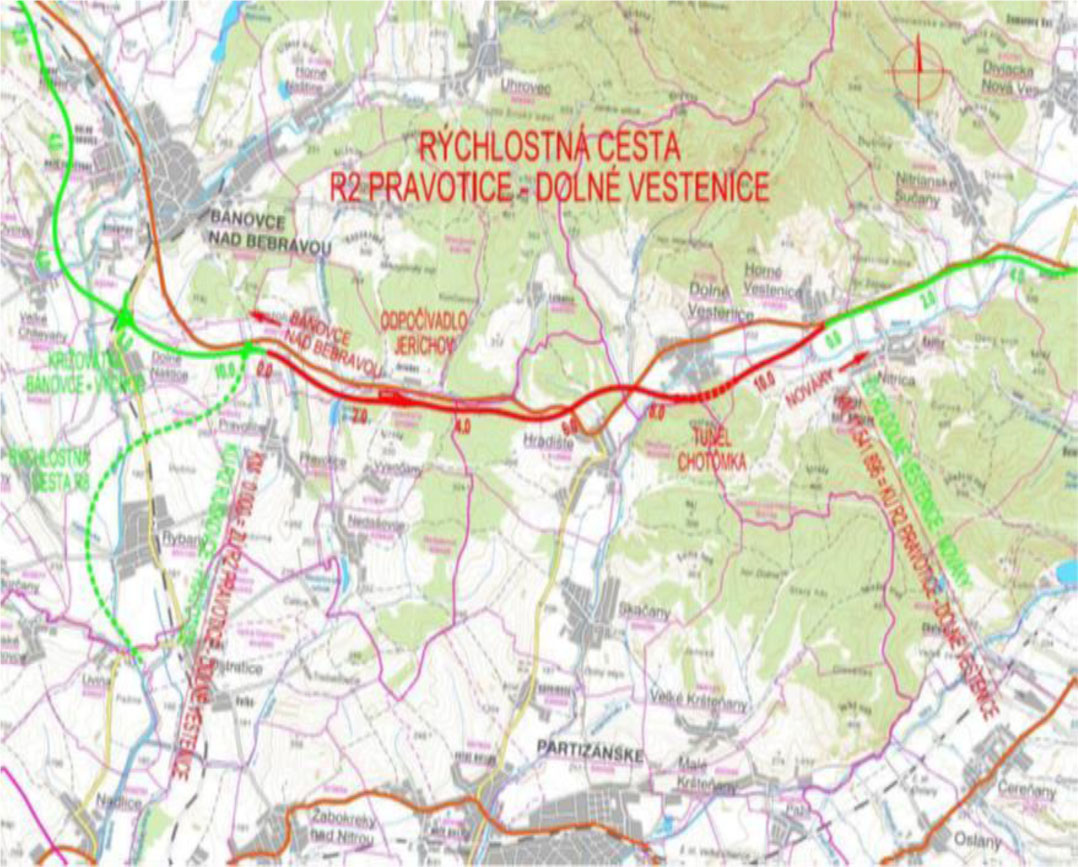
Figure 1:
Spatial configuration of the R2 expressway segment Pravotice–Dolné Vestenice. Source: Author’s processing based on spatial data from the Office of Geodesy, Cartography and Cadastre of the Slovak Republic (ÚGKK SR, 2023)
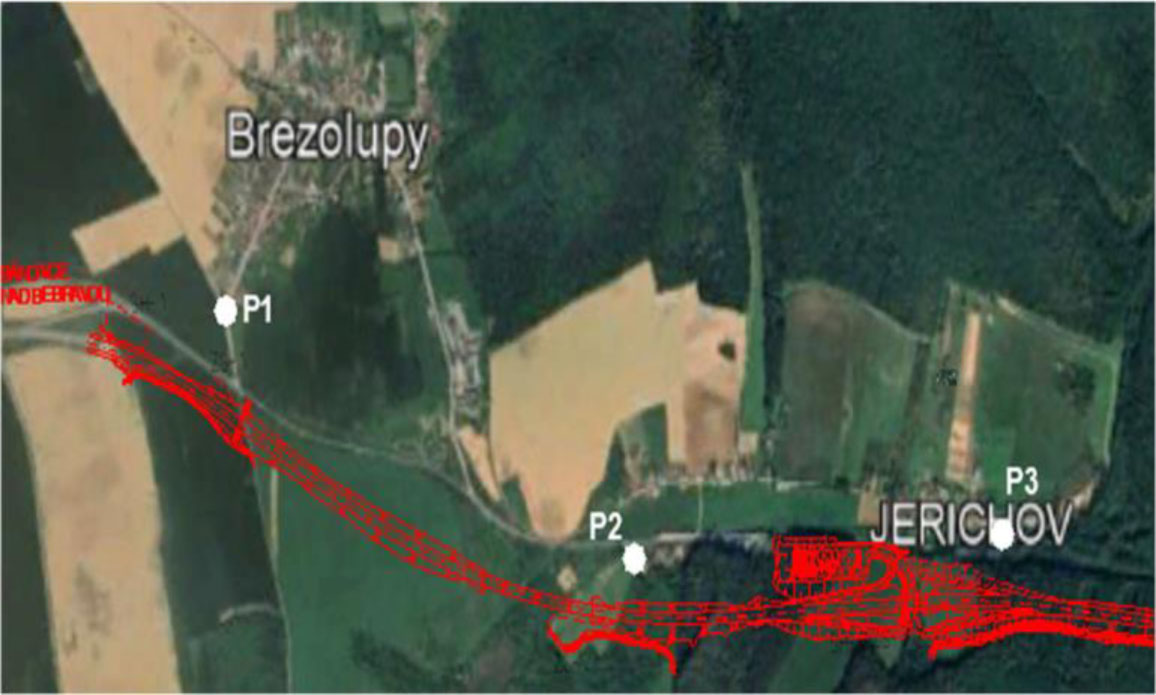
Figure 2:
Location of monitoring points in the Brezolupy–Jerichov section. Source: Author’s processing, field survey (2004), and ÚGKK SR (2023) spatial base map
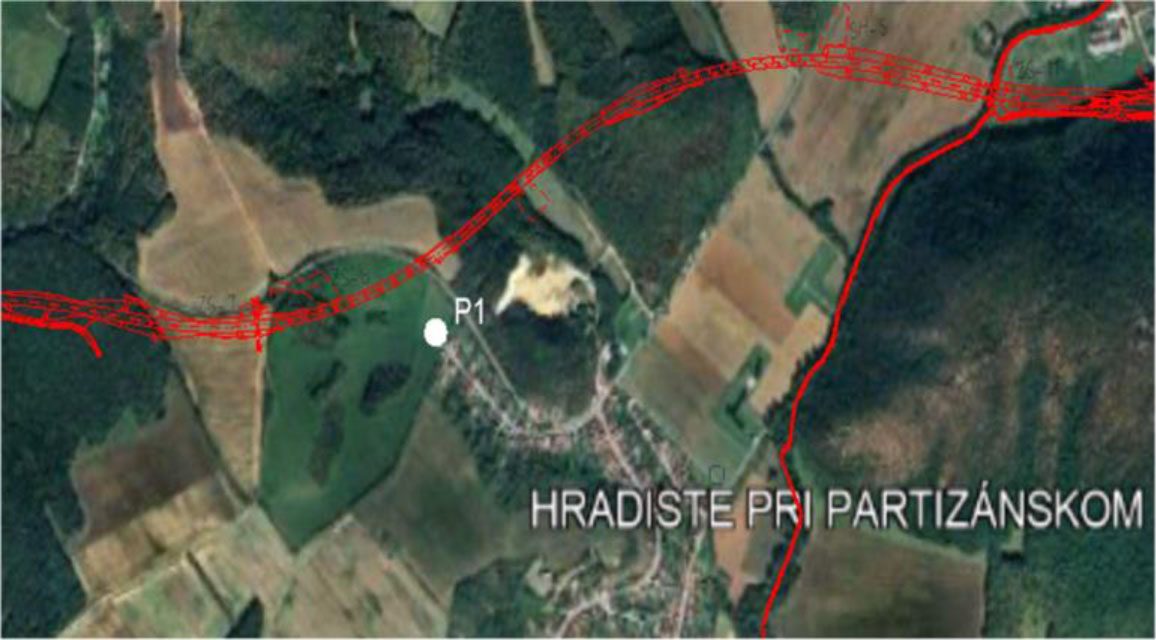
Figure 3:
Location of monitoring point in the Hradište section. Source: Author’s processing, field survey (2004), and ÚGKK SR (2023) spatial base map
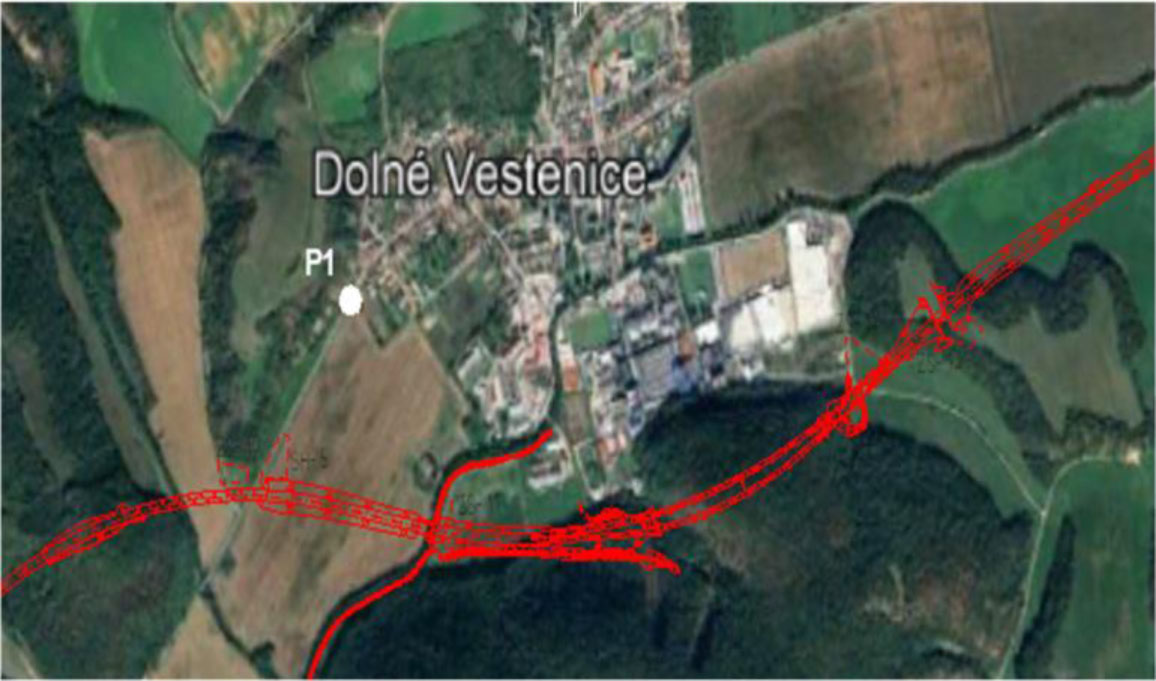
Figure 3:
Location of monitoring point in the Dolné Vestenice section. Source: Author’s processing, field survey (2004), and ÚGKK SR (2023) spatial base map
Acoustic Measurements
Field measurements were carried out in 2004 along the R2 expressway section Pravotice–Dolné Vestenice using Class 1 integrating sound level meters compliant with IEC 61672-1. Measurements were taken at three monitoring points (P1–P3) during daytime (06:00–18:00) and night-time (22:00–06:00) intervals to capture variations in traffic load.
The measured indicators included:
equivalent continuous sound level (LAeq),
maximum sound level (Lmax),
minimum sound level (Lmin).
The equivalent continuous sound level was computed according to Equation (1):
Where:
LAeq,T — equivalent A-weighted sound level averaged over interval T [ dB ],
pA (t) — instantaneous A-weighted sound pressure [Pa],
p0 — reference sound pressure, 2×10⁻⁵ Pa,
T = t1 – t2 — measurement interval [s].
Predictive Noise Modelling
Predictive noise simulations were conducted using HLUK+ (ver. 8.28), developed by GEOCONSULT (2023). The modelling methodology follows the principles established by the Water Research Institute (VÚVA, 1991, 1996), with supplementary procedures adapted from the Ministry of the Environment of the Czech Republic (Liberko, 2005). The model is fully integrated with a GIS environment to enable precise spatial and topographical interpretation of acoustic propagation.
The primary input parameters included:
traffic intensity and composition,
pavement surface type and condition,
vehicle speed profiles,
terrain morphology, and
attenuation factors such as vegetation, slope, and façade reflectivity.
The propagation of acoustic energy between the source and receiver was described according to Equation (2):
Where:
Lp — sound pressure level at the receiver [dB],
Lw — sound power level of the source [dB],
Dc — directivity correction,
Adiv — attenuation due to geometric divergence,
Aatm — attenuation due to atmospheric absorption,
Agr — attenuation caused by ground effects,
Abar — attenuation due to the presence of a noise barrier.
Model calibration and validation were performed using empirical field data collected in 2004. The correlation between simulated and measured results achieved a coefficient of determination of R2=0.92, confirming the model’s high predictive reliability.
Multi-Criteria Optimisation and Visual Assessment
Alternative noise barrier designs were evaluated using a multi-criteria optimisation approach, considering both technical and aesthetic aspects. The main evaluation criteria included:
Acoustic performance (attenuation, absorption, insulation),
Economic feasibility (construction and maintenance costs),
Material durability and reliability, and
Visual and landscape integration.
Assessment of Acoustic Performance
The acoustic performance of the noise barriers was evaluated in accordance with STN EN 1793-1 (sound absorption) and STN EN 1793-2 (airborne sound insulation).
The single-number indices were determined using Equations (3) and (4).
The airborne sound insulation index was calculated as follows:
Where:
DLR — single-number index of airborne sound insulation [dB],
Ri — sound reduction index in the i-th one-third octave band [dB],
Li — weighting factor of the reference traffic noise spectrum (EN 1793-3).
The sound absorption index was determined according to Equation (4):
Where:
DLα — single-number index of sound absorption [dB],
α̅— weighted average sound absorption coefficient, calculated using Equation (5):
Where:
αi — sound absorption coefficient in the i-th one-third octave band.
Both indices are used to classify noise barriers into categories A1–A5 (sound absorption) and B1–B4 (airborne sound insulation), in accordance with STN EN 1793-1 and STN EN 1793-2.
Visual and Aesthetic Evaluation
Visual assessment was performed using GIS-based landscape analysis and 3D visualisation in SketchUp Pro, allowing a comprehensive evaluation of texture, colour, height, and form of the proposed noise barriers in relation to the surrounding landscape and visual corridors.
The analysis ensured that the proposed barriers met both acoustic efficiency and technical standards while maintaining visual coherence and landscape quality.
2.3. Data Collection
The data used in this study were obtained from three primary sources:
empirical acoustic measurements conducted in 2004 along the R2 expressway section Pravotice–Dolné Vestenice,
geospatial data extracted from the national GIS database and verified using high-resolution orthophotos, and
traffic intensity and composition records provided by the Slovak Road Administration for the reference year 2004 and forecast horizons 2016, 2026, and 2036.
All datasets were standardised within a unified spatial coordinate system (S-JTSK) and subjected to a consistency assessment before being imported into the predictive model HLUK+ (ver. 8.28). The spatial and attribute accuracy of the GIS layers was verified through cross-checking with field observations and aerial imagery. Acoustic datasets were screened for completeness and reliability, with anomalous readings removed prior to analysis.
Traffic data were aggregated into equivalent hourly intensities and stratified by vehicle category (light, heavy, and motorcycle). These values served as key input parameters for the noise emission model. The digital terrain model (DTM) and land-cover layers were harmonised to ensure accurate representation of the acoustic propagation environment.
Model calibration was based on the 2004 measured dataset, where empirical values of the equivalent continuous sound level (LAeq) were compared with simulated results. Statistical evaluation of residual errors was performed using the mean absolute error (MAE) and the root-mean-square error (RMSE), confirming satisfactory model fidelity. Sensitivity testing was conducted to assess the influence of terrain morphology, surface type, and traffic composition on predicted sound levels.
Quality assurance followed a two-step protocol:
internal consistency verification between measured and simulated datasets, and
external compliance check against national regulatory thresholds defined in Decree No. 549/2007 Coll. on permissible levels of noise, infrasound, and vibrations. The validated and harmonised datasets formed the analytical foundation for subsequent evaluation of acoustic exposure and optimisation of mitigation measures.
The data collection process was executed using validated and standardized procedures to ensure high levels of representativeness, accuracy, and data integrity:
3. Results
This section presents an integrated evaluation of the noise-mitigation measures implemented along the R2 expressway segment between Pravotice and Dolné Vestenice. The results synthesize outputs from advanced road-traffic noise modelling, life-cycle cost analysis, and landscape–ecological assessments. All analytical procedures were carried out in accordance with harmonized European standards for environmental acoustics and with the relevant Slovak technical and legislative requirements. The findings are presented with an emphasis on identifying statistically significant exceedances of environmental noise limits and determining optimal locations for targeted infrastructural interventions.
3.1. Acoustic Assessment
Road-traffic noise propagation was modelled using the HLUK+ software (version 8.28; GEOCONSULT, 2023), which implements deterministic computational algorithms consistent with the methodological framework of the Water Research Institute (VÚVA, 1991, 1996) and the methodological guidelines of the Ministry of the Environment of the Czech Republic (Liberko, 2005). All calculations were conducted in full alignment with Slovak public-health legislation (Act No. 355/2007 Coll.; Decree No. 549/2007 Coll.), ensuring complete methodological and regulatory consistency.
The analysis was performed for the design year 2036 and accounted for projected traffic intensities, vehicle-fleet composition, topographic conditions, surface characteristics, and structural configurations along the R2 corridor. The simulation results demonstrate substantial exceedances of permissible A-weighted equivalent continuous sound pressure levels (LAeq) at several receptor points situated within residential areas. In Horné Vestenice, predicted daytime noise levels reached 51.7 dB(A) and night-time levels 46.6 dB(A), representing exceedances of 6.0 and 4.0 dB(A), respectively, relative to the applicable national limits. Similarly, in the Brezolupy–Jerichov section, daytime and night-time levels at the most exposed receptor point (P2) reached 49.3 and 44.7 dB(A), clearly confirming persistently non-compliant acoustic conditions.
A detailed overview of LAeq values for all critical receptor locations is presented in Table 1, documenting the spatial variability of acoustic exposure and the magnitude of limit exceedances along the corridor.
Table 1:
Calculated A-weighted Equivalent Continuous Sound Levels (LAeq) for R2 Road Sections in the Year 2036, by Critical Locations
| Barrier Type | Point | Distance from R2 [m] | LAeq Day [dB(A)] | LAeq Night [dB(A)] |
|---|---|---|---|---|
| Brezolupy – Jerichov | P1 | 225 | 40.1 | 35.5 |
| P2 | 127 | 49.3 | 44.7 | |
| P3 | 147 | 47.1 | 43.5 | |
| Hradište | P1 | 177 | 47.3 | 42.3 |
| Dolné Vestenice | P1 | 515 | 46.8 | 41.8 |
| Horné Vestenice | P1 | 153 | 51.7 | 46.6 |
| P2 | 172 | 46.8 | 41.8 |
[i] Source: Authors’ own calculations based on VÚVA, 1991, 1996; Liberko, 2005; Ministry of Health of the Slovak Republic, 2007.
Based on the modelling outputs, two sections of the expressway were identified where the implementation of noise barriers is necessary:
Noise Barrier Type 1: km 2.550–3.250
Noise Barrier Type 2: km 10.875–11.540
Both proposed structures fall into absorption category A3, characterized by a sound-absorption coefficient (α = 0.3–0.6) and airborne sound insulation (DLR = 25–40 dB). These parameters indicate a high level of acoustic efficiency, particularly in scenarios where the attenuation mechanism shifts from purely geometric shielding toward material-dependent absorption and transmission loss.
For a detailed comparison of the acoustic performance of individual barrier materials, Table 2 summarizes the relevant parameters. The values clearly demonstrate the performance differentials between high-absorption, high-insulation systems (e.g., aluminium and recycled plastic composites) and low-absorption mineral-based walls. These findings further confirm the suitability of A3-category barriers for deployment in the identified sections of the expressway.
Table 2:
Acoustic Performance Parameters of Noise Barriers
| Barrier Type | Absorption Coefficient α [-] | Airborne Sound Insulation DLR [dB] | Absorption Loss DLα [dB] |
|---|---|---|---|
| Concrete | 0.10 | 38 | 3 |
| Aluminum | 0.30 | 40 | 8 |
| Recycled Plastic | 0.25 | 36 | 7 |
| Wood-Cement Composite | 0.20 | 30 | 5 |
[i] Source: Slovak Institute of Technical Standardization, 2018; GEOCONSULT DÚR documentation; authors’ calculations.
Following the characterization of material-specific acoustic parameters (Table 2), a comprehensive post-intervention modelling analysis was undertaken to quantify the effectiveness of the two proposed noise-mitigation structures. Road-traffic noise propagation was again simulated using HLUK+ (version 8.28; GEOCONSULT, 2023), thereby ensuring full methodological continuity with the baseline assessment and eliminating potential discrepancies associated with cross-model variability. The post-intervention computational framework incorporated precise geometrical configurations, absorption characteristics (category A3), barrier heights, and spatial alignments of Noise Barrier 1 (km 2.550–3.250) and Noise Barrier 2 (km 10.875–11.540).
Baseline simulations identified three receptor points—Hradište (P1), Brezolupy–Jerichov (P2), and Horné Vestenice (P1)—as acoustically critical, with exceedances of 4–6 dB(A) above national daytime and night-time thresholds. These elevated values were consistent with unobstructed line-of-sight propagation and the absence of any effective shielding elements along the evaluated segments of the R2 expressway.
The deployment of aluminium A3-class absorptive panels, characterized by a sound-absorption coefficient α = 0.3–0.6 and airborne sound insulation performance DLR = 25–40 dB, produced substantial reductions in equivalent continuous sound pressure levels. Predicted insertion losses ranged from 10 to 15 dB(A) depending on receptor position, local topography, and the energetic balance between diffracted and directly transmitted sound components.
For Noise Barrier 1 (km 2.550–3.250), modelled daytime noise levels at Hradište P1 decreased from 47.3 dB(A) to 35.0–37.0 dB(A), while night-time values declined from 42.3 dB(A) to 30.5–32.5 dB(A). Comparable improvements were observed at Brezolupy–Jerichov P2, where daytime/night-time levels dropped from 49.3/44.7 dB(A) to 36.0–38.0/32.0–34.0 dB(A), yielding a total attenuation of up to 13.3 dB(A).
Even greater reductions were predicted for Noise Barrier 2 (km 10.875–11.540). At the most exposed receptor (Horné Vestenice P1), daytime noise fell from 51.7 dB(A) to 38.0–41.0 dB(A) and night-time levels from 46.6 dB(A) to 33.5–36.5 dB(A), corresponding to a maximum attenuation of 13.7 dB(A). The secondary receptor (Horné Vestenice P2) exhibited similarly substantial reductions, with all post-barrier levels well below the statutory thresholds of 50 dB(A) (day) and 40 dB(A) (night).
3.2. Economic Evaluation
The economic evaluation was performed in accordance with STN 73 6110 (Design of Road Infrastructure) and EN 14388 (Noise Barriers – Specifications). The analysis encompassed both capital investment and 10-year maintenance costs, offering an integrated perspective on the long-term financial sustainability of each alternative.
Four infill materials were evaluated: concrete, aluminium, recycled plastic, and wood–cement composite.
The comparative results, summarized in Tables 3 and 4, indicate that:
Wood–cement composite panels demonstrated the highest total life-cycle cost (TLC) due to elevated production costs and moderate durability (approx. 40 years).
Concrete barriers involved higher initial investment but offered extended service life (~50 years).
Recycled plastic panels achieved a favourable balance between cost and environmental performance, characterized by low maintenance requirements (39,811.20 € for NB Type 1; 26,540.80 € for NB Type 2).
Aluminium barriers proved to be the most cost-effective solution, achieving the lowest TLC (682,453.47 € for NB Type 1; 451,982.04 € for NB Type 2), high acoustic absorption (Class A4 under EN 1793-1), and an estimated service life of 60 years.
Table 3:
Comparative Life-Cycle Cost Assessment of NB Type 1 by Infill Material (10-year horizon)
| Infill Material | Construction Cost [€] | Maintenance Cost [€] | Total Life-Cycle Cost (TLC) [€] |
|---|---|---|---|
| Concrete | 884,847.88 | 59,592.00 | 944,439.88 |
| Aluminum | 570,133.47 | 112,320.00 | 682,453.47 |
| Recycled Plastic | 842,996.98 | 39,811.20 | 882,808.18 |
| Wood-Cement Composite | 1,023,914.08 | 59,280.00 | 1,083,194.08 |
[i] Source: GEOCONSULT DÚR documentation; Müller et al., 2019; Ministry of Transport of the Slovak Republic, 2021; authors’ calculations based on CENKROS software.
Table 4:
Comparative Life-Cycle Cost Assessment of NB Type 2 by Infill Material (10-year horizon)
| Infill Material | Construction Cost [€] | Maintenance Cost [€] | Total Life-Cycle Cost (TLC) [€] |
|---|---|---|---|
| Concrete | 588,323.82 | 39,728.00 | 628,051.82 |
| Aluminum | 377,102.04 | 74,880.00 | 451,982.04 |
| Recycled Plastic | 553,463.59 | 26,540.80 | 580,004.39 |
| Wood-Cement Composite | 681,658.64 | 39,520.00 | 721,178.64 |
[i] Source: GEOCONSULT DÚR documentation; Müller et al., 2019; Ministry of Transport of the Slovak Republic, 2021; authors’ calculations based on CENKROS software.
3.3. Landscape, Aesthetic, and Ecological Integration
The design concept prioritised harmonisation with the surrounding landscape, respecting visual, ecological, and morphological continuity to minimise environmental intrusion and enhance public acceptance. The approach aligns with the principles of the European Landscape Convention (Council of Europe, 2000) and contemporary guidelines for sustainable infrastructure design (Kováč & Novotný, 2018; Thompson et al., 2022).
The assessment incorporated the following key criteria:
Visual integration – structural and morphological coherence with existing terrain and landscape rhythm.
Chromatic and material design – application of neutral, biomimetic tones: structural base in RAL 7035 (light grey) and panel highlights in RAL 6018 and RAL 6019 (light green shades).
Ecological suitability – minimisation of soil disturbance, use of recyclable materials, and preservation of native vegetation.
Among all evaluated alternatives, aluminium barriers proved the most appropriate from both aesthetic and ecological perspectives. Their low density, modular design, and full recyclability contribute to reduced carbon footprint and extended service life, outperforming concrete and wood–cement solutions.
The final configuration represents a multifunctional infrastructural intervention achieving:
full compliance with regulatory acoustic standards,
long-term economic sustainability, and
landscape integration that preserves regional identity.
An illustrative visualisation of the optimised aluminium noise barrier within the R2 landscape context is presented in Figure 6.
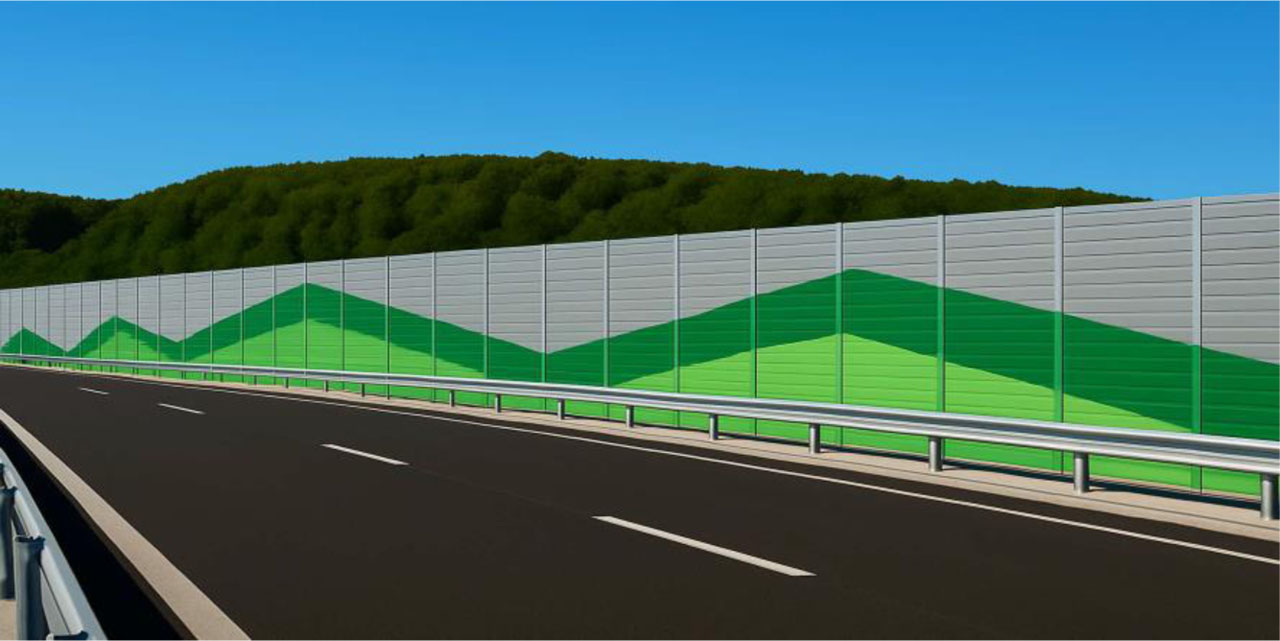
Figure 6:
Visualisation of the noise barrier. Source: Authors’ own rendering based on GEOCONSULT DÚR project documentation
Overall, the findings confirm that the aluminium-based design achieves the optimal balance among the four primary evaluation criteria:
Acoustic performance, ensuring compliance with regulatory standards;
Economic feasibility, through long service life and manageable costs;
Aesthetic integration, maintaining visual coherence with the landscape; and
Ecological sustainability, minimising material and energy consumption.
These outcomes demonstrate the feasibility of a multi-criteria optimisation model that effectively aligns acoustic, environmental, and aesthetic objectives for sustainable infrastructure development.
4. Discussion
This section discusses the implications of the obtained results in the context of sustainable transport infrastructure and environmental acoustics. The findings confirm the validity of the multi-criteria evaluation framework applied in this study and its ability to support evidence-based decision-making in the design of noise barriers for linear transport structures.
The predictive acoustic model and subsequent verification demonstrated a strong correlation between simulation-based estimates and measured sound pressure levels, confirming the reliability of the adopted methodological framework (R2 = 0.92). The comparative analysis of barrier materials revealed that aluminium-based systems offer the most favourable balance between acoustic attenuation, economic feasibility, and aesthetic integration, in line with recent European studies (Müller et al., 2019; Thompson et al., 2022).
4.1. Interpretation of Results
The results clearly indicate that acoustic optimisation cannot be separated from environmental and economic considerations. While traditional concrete barriers provide robust insulation (DLR ≈ 38 dB), their high embodied energy and limited visual adaptability constrain their sustainability potential. In contrast, aluminium and recycled polymer barriers deliver competitive acoustic efficiency (DLR = 36–40 dB; DLα = 7–8 dB) while achieving substantial reductions in life-cycle costs and environmental impacts.
The proposed multi-criteria optimisation approach thus contributes to a holistic methodology that integrates technical, ecological, and social dimensions. This aligns with the findings of Smith and Brown (2020), who highlighted the necessity of integrating life-cycle thinking and aesthetic quality into noise mitigation strategies for urban and rural corridors.
The application of geospatial modelling and visual impact analysis further enhanced the understanding of spatial interrelations between barrier placement, terrain morphology, and settlement structures. This multidisciplinary synthesis demonstrates the potential for context-sensitive infrastructure design, which has been increasingly emphasised in sustainable transport policy frameworks (European Environment Agency, 2021).
4.2. Limitations
Despite the robustness of the methodology, certain limitations should be acknowledged. First, the predictive acoustic model was based on simplified traffic assumptions and idealised meteorological conditions, which may not fully represent real-world temporal variability. Although validated against field data, future studies could incorporate dynamic simulations capturing diurnal and seasonal fluctuations in traffic and atmospheric parameters.
Second, the economic analysis was performed using current cost indices and assumed material lifespans derived from literature and technical documentation. Variability in inflation rates, market prices, or maintenance regimes could influence the long-term financial outcomes.
Third, aesthetic and social perception analyses were limited to expert-based assessments and GIS visualisations. Incorporating participatory evaluation or public perception surveys could enhance the social robustness of future design concepts.
Finally, the study’s scope was geographically limited to a single Slovak transport corridor. While the methodology is generalisable, its direct application in other climatic or regulatory contexts should be preceded by regional calibration.
5. Conclusion
This study provided a comprehensive evaluation of acoustic, economic, and aesthetic parameters for alternative noise barrier designs along the R2 expressway in Slovakia. Using an integrated modelling framework combining STN EN 1793-compliant acoustic indices, life-cycle cost analysis, and visual integration assessment, the research demonstrated that aluminium noise barriers achieve the most favourable performance across all evaluated dimensions.
The main findings can be summarised as follows:
The proposed predictive model (HLUK+) achieved high statistical reliability (R2 = 0.92) and accurately simulated sound propagation in complex terrain conditions.
Aluminium panels achieved Class A4 sound absorption (up to 14 dB), the best ratio of cost to performance, and strong visual adaptability to the surrounding landscape.
The multi-criteria optimisation approach effectively balanced technical efficiency, aesthetic quality, and economic sustainability, confirming its suitability for integrated infrastructure planning.
The results hold practical relevance for transport infrastructure designers, environmental authorities, and policymakers, offering a replicable methodological template for evaluating and optimising noise mitigation measures in compliance with European standards (EN 1793, EN 1794, EN 14388).
Future research should focus on:
Expanding the model to include real-time traffic acoustic monitoring and climate-sensitive variables,
Incorporating stakeholder engagement in the evaluation of visual and social acceptability, and
Developing decision-support tools for multi-objective optimisation integrating acoustic, economic, and environmental criteria.
In conclusion, the study demonstrates that adopting an interdisciplinary, data-driven approach to noise mitigation can significantly improve the sustainability and societal acceptance of transport infrastructure projects while ensuring compliance with national and European legislative frameworks.
Acknowledgements
“This paper was supported by the Slovak Research and Development Agency under the contract No. APVV-22-0040”.
Notes
[5] Contributed by Author Contributions
M.T. conceived and designed the research, developed the methodological framework, conducted the acoustic simulations and economic analyses, and prepared the main sections of the manuscript, including Chapters 2–5. M.B. contributed to data verification, graphical processing of the results, and the refinement of the discussion and conclusions. Both authors critically reviewed and approved the final version of the manuscript and agree to be fully responsible for all aspects of the published work.
[6] Financial disclosure Disclosure of Interest
The authors declare that they have no known competing financial interests or personal relationships that could have influenced the work reported in this article.
[7] Data Availability Statement
The data supporting the findings of this study are available from the corresponding author upon reasonable request. Due to licensing and privacy restrictions, the datasets are not publicly available but may be shared for academic purposes upon request and with the appropriate authorisation from the relevant authorities.